Full public teaching and readers are free without an account. A free learner account is required for saved LMS progress and recorded assessment. Completion and any course-completion certificate depend on the configured LMS conditions. Open the course overview.
Lesson 1
A shared landscape is still a workplace
Separate buggy, pedestrian and maintenance movements using the actual route conditions.
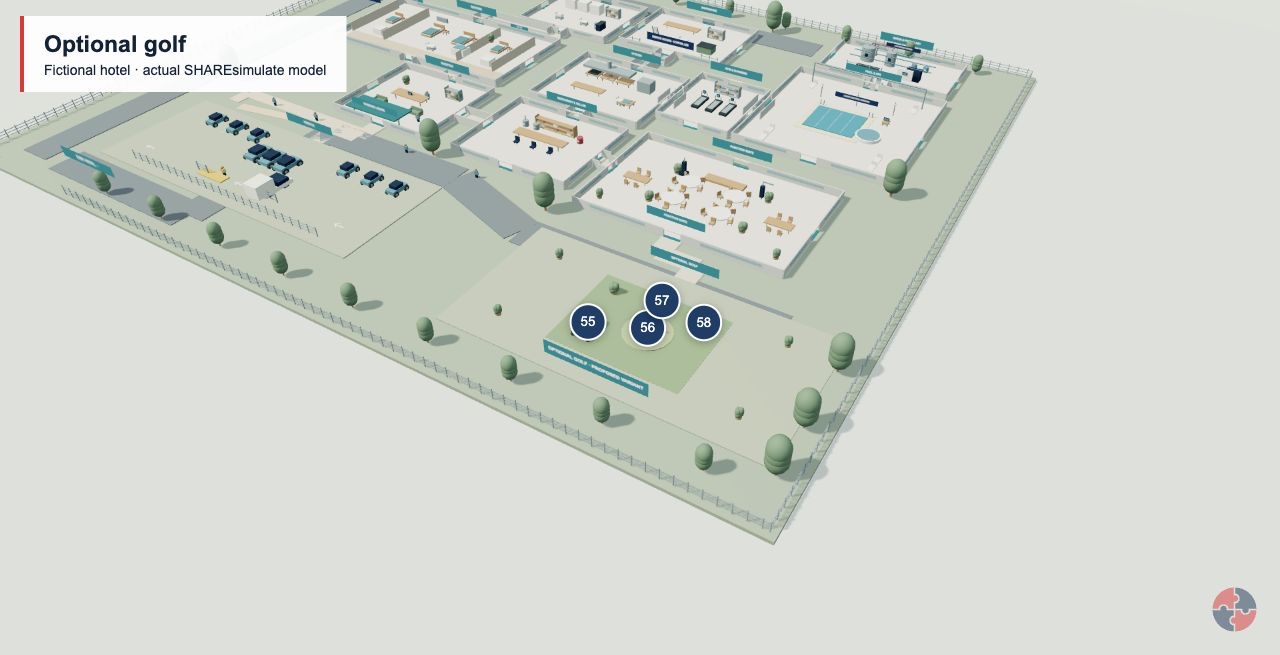
Actual fictional SHAREsimulate hotel model: Optional golf. The stated case supplies the conditions; the image does not prove a defect or control state.
Follow the changing interfaces across a shift
A route may be used by walkers, buggies and maintenance equipment at different times. Players can be concentrating on the game and guests may not recognise a service crossing. Map the complete movement, including blind points, stopping space and the effect of temporary closures.
Coordinate the work with play and public access. Separate conflicting activity through the assessed layout, timing and communication arrangements, and make the holding point clear. A warning board does not establish that an exposed person has seen it or can leave the danger area.
The golf module is optional within the fictional hotel complex. Apply its learning only to relevant grounds activities; do not assume that every hotel has the same equipment, landscape or operating arrangements. The control decision must be based on the actual site.
Work through this separate hotel case
A buggy hire route is diverted through a busy walking path because maintenance has closed the normal track.
Apply the same control test whenever the activity, users, product, staffing or conditions change. Design and maintain buggy routes and crossings, brief authorised users and restrict use where visibility, ground or pedestrian conflict makes the route unsuitable. Check connected areas: Optional golf play, buggy movement and scheduled grounds maintenance.
Evidence to establish: Check path visibility, user behaviour and the buggy operating arrangement. Observe both users negotiating the corrected route in representative conditions. Observe the busiest shared crossing and check actual buggy use, passenger behaviour, sight lines and condition-related restrictions.
How should transport risk be assessed?
Assessment should map people, vehicles, routes, movements, loading, reversing, visibility and work pressure.
A transport assessment should start with a movement map. Where do vehicles enter, reverse, park, load, tip, refuel, charge, turn, couple, uncouple and exit? Where do pedestrians walk, wait, cross, work, queue or visit welfare? Where do temporary works, waste skips, deliveries or contractors change the route?
The assessment should then challenge each interface. Can pedestrians and vehicles be separated? Can reversing be eliminated? Can route direction be simplified? Are visiting drivers briefed? Are banksmen competent and protected? Are schedules realistic enough to prevent rushing?
Risk area
Assessment question
Control focus
Pedestrian routes
Can people walk without entering vehicle routes?
Segregation, barriers and crossings.
Reversing
Can reversing be eliminated or controlled?
One-way routes, turning areas, aids and banksman rules.
Loading/unloading
Who controls the vehicle, load, people and exclusion zone?
Loading plan and communication.
Blind spots
What can the driver not see?
Vehicle selection, aids, exclusion and pedestrian control.
Temporary change
How do works, skips or congestion alter routes?
Change briefing and temporary traffic plan.
Road journeys
Are time, weather, rest and welfare realistic?
Safe journey planning.
How should a busy warehouse yard be controlled?
A strong yard plan separates people and vehicles, controls reversing and manages visiting drivers before they enter the risk area.
A warehouse has vans, articulated lorries, pedestrian staff, agency workers, forklift trucks, visitors and waste collections. Near misses occur when visiting drivers walk across the yard to reception and forklifts reverse near a loading bay. A weak response is to add more warning signs. A stronger response redesigns pedestrian access, creates a driver waiting point, sets a one-way vehicle system, marks loading exclusion zones, controls reversing, briefs visiting drivers, improves lighting, reviews delivery scheduling and checks compliance during peak periods.
The lesson is that transport safety is mainly design and management. Behaviour matters, but only after the site has made the safe route obvious and practical.
Drivers walking through yard. Weak control: Tell them to watch for vehicles; Better control: Create protected pedestrian route and waiting point.
Forklift reversing. Weak control: Rely on reversing alarm; Better control: Redesign route and use exclusion controls.
Loading bay interface. Weak control: Paint lines only; Better control: Physical controls, bay rules and communication.
Fictional loading sequence: prevent early departure
A visiting driver parks as directed and uses the segregated waiting area. The agreed loading controller verifies suitable vehicle/trailer parking brakes and stability, the loading exclusion and the assessed site method that prevents premature departure. Driver and loader confirm the hold is active before work. If that hold, stability or separation is uncertain, loading stops. Only the agreed controller gives positive departure release after people and equipment are clear, the load is safe and all checks are complete. A briefing or painted bay line alone cannot prevent a runaway or drive-away; select the method for the actual vehicles and site.
Applied case
A buggy hire route is diverted through a busy walking path because maintenance has closed the normal track.
Decision and explanation
Separate or redesign the conflict and restrict movement while unresolved.
This controls the relevant exposure rather than relying on appearance or reassurance. Observe the busiest shared crossing and check actual buggy use, passenger behaviour, sight lines and condition-related restrictions. A speed warning does not establish a safe shared route. Assess and control the pedestrian conflict before use. This transfers the problem to pedestrians and may create falls or accessibility barriers. Provide a suitable route arrangement.
Lesson 2
Ground conditions can remove the planned safety margin
Recognise when wet ground or slopes exceed the assessed equipment arrangement.
Actual fictional SHAREsimulate hotel model: Optional golf. The stated case supplies the conditions; the image does not prove a defect or control state.
Use task and equipment limits rather than confidence
Rain, slope, surface damage and load can change traction, stability and stopping. Check the manufacturer’s limits, the assessed operating method and current conditions together. Familiarity with a route does not establish that machinery is suitable for it after heavy rain.
Where conditions exceed the assessed arrangement, stop or relocate the task and seek an authorised alternative. Do not invent a universal safe slope from the model or assume that reduced speed resolves overturning and sliding. Training, maintenance and suitable equipment remain essential.
Grounds treatments add product, drift, runoff and re-entry questions. Only competent authorised people should select and apply products under their applicable instructions and restrictions. Protect nearby people and water, communicate closures and verify the required conditions before reopening. This awareness course does not confer pesticide competence or application authority.
Work through this separate hotel case
Rain has saturated a slope normally cut by a ride-on machine, and the operator reports wheel slip.
Apply the same control test whenever the activity, users, product, staffing or conditions change. Use machine-specific capability and ground assessment, competent operators and condition-based restrictions; change the method when traction or stability is doubtful. Check connected areas: Optional golf play, buggy movement and scheduled grounds maintenance.
Evidence to establish: Check actual ground, slope and machine instructions with a competent operator. A competent reassessment confirms ground and machine suitability before restart. Check the actual slope, wetness, hidden edges and attachments against the equipment instructions and the documented go/no-go decision.
How can a jam, clean or repair be handled safely?
Plan the intervention before opening protection. Stop the machine, identify and isolate every relevant energy source, secure against reconnection, verify the safe condition, and prevent other people starting or entering while work continues. Use a separately engineered and authorised mode if movement is genuinely needed.
An interlock or emergency stop alone can leave electrical power, air pressure, hydraulic pressure, gravity or a coasting part available. The competent isolation plan covers linked conveyors and upstream equipment, stored loads, trapped pressure and each person working in the danger area. Do not reach in to pull material while a motor is merely stopped. HSE Maintenance of work equipment; HSE Guarding in quarries.
Intervention hold points
Stage
Decision or evidence
Before access
Identify machine, task, hazard and authorised workers; agree whether it can be done with guards in place or from outside the danger zone.
Secure
Stop, isolate and lock the applicable sources under the site procedure; each exposed worker retains personal control. Release or restrain stored energy by a competent method.
Verify
Check the intended safe state by the authorised method, including linked equipment and coasting. If the state is uncertain, hold work and escalate.
Perform and change
Use the approved tools and route. If the jam, access or energy state differs from the plan, stop, withdraw and revise the method.
Hand back
Account for people and tools; restore guards, remove locks only through the agreed process, function-check protection and authorise restart with affected operators informed.
Applied case
Rain has saturated a slope normally cut by a ride-on machine, and the operator reports wheel slip.
Decision and explanation
Choose a safer method or defer work when assessed operating conditions are not met.
Ground conditions have changed and wheel slip is warning evidence. Stop and reassess the method and machine suitability. More momentum can reduce control and worsen consequences. Do not exceed the safe operating envelope to finish the task. This controls the relevant exposure rather than relying on appearance or reassurance. Check the actual slope, wetness, hidden edges and attachments against the equipment instructions and the documented go/no-go decision.
Lesson 3
Plan grounds movement around people and changing ground
Combine routes, equipment capability and conditions in the movement decision.
Actual fictional SHAREsimulate hotel model: Optional golf. The stated case supplies the conditions; the image does not prove a defect or control state.
Plan grounds movement around people and changing ground
Hotel grounds mix leisure with work. Guests may cross a maintenance route, a contractor may reverse towards a store and golf or grounds equipment may move across a slope. Follow the actual journeys and identify where people enter the work area. Include visitors unfamiliar with the site and those using an accessible route. A path marked on a plan may be temporarily unavailable or unsuitable in the current conditions.
Avoid conflicting movement through timing and separation where practical. Select equipment and a planned method suitable for the task, terrain and manufacturer’s limits. Rain, soft ground, poor visibility and an altered load can change that decision. Do not invent a universal safe slope or assume that driving slowly makes every surface suitable. Obtain the responsible competent review where conditions differ from the plan.
In the fictional hotel, a grounds vehicle’s alternative route passes across an area that has softened overnight. Keep the affected movement restricted while a suitable option is established. Check that the alternative protects guests without introducing another hazard or blocking emergency access. Communicate the arrangement to reception and the workers who will actually use it.
How should transport risk be assessed?
Assessment should map people, vehicles, routes, movements, loading, reversing, visibility and work pressure.
A transport assessment should start with a movement map. Where do vehicles enter, reverse, park, load, tip, refuel, charge, turn, couple, uncouple and exit? Where do pedestrians walk, wait, cross, work, queue or visit welfare? Where do temporary works, waste skips, deliveries or contractors change the route?
The assessment should then challenge each interface. Can pedestrians and vehicles be separated? Can reversing be eliminated? Can route direction be simplified? Are visiting drivers briefed? Are banksmen competent and protected? Are schedules realistic enough to prevent rushing?
Risk area
Assessment question
Control focus
Pedestrian routes
Can people walk without entering vehicle routes?
Segregation, barriers and crossings.
Reversing
Can reversing be eliminated or controlled?
One-way routes, turning areas, aids and banksman rules.
Loading/unloading
Who controls the vehicle, load, people and exclusion zone?
Loading plan and communication.
Blind spots
What can the driver not see?
Vehicle selection, aids, exclusion and pedestrian control.
Temporary change
How do works, skips or congestion alter routes?
Change briefing and temporary traffic plan.
Road journeys
Are time, weather, rest and welfare realistic?
Safe journey planning.
How should a busy warehouse yard be controlled?
A strong yard plan separates people and vehicles, controls reversing and manages visiting drivers before they enter the risk area.
A warehouse has vans, articulated lorries, pedestrian staff, agency workers, forklift trucks, visitors and waste collections. Near misses occur when visiting drivers walk across the yard to reception and forklifts reverse near a loading bay. A weak response is to add more warning signs. A stronger response redesigns pedestrian access, creates a driver waiting point, sets a one-way vehicle system, marks loading exclusion zones, controls reversing, briefs visiting drivers, improves lighting, reviews delivery scheduling and checks compliance during peak periods.
The lesson is that transport safety is mainly design and management. Behaviour matters, but only after the site has made the safe route obvious and practical.
Drivers walking through yard. Weak control: Tell them to watch for vehicles; Better control: Create protected pedestrian route and waiting point.
Forklift reversing. Weak control: Rely on reversing alarm; Better control: Redesign route and use exclusion controls.
Loading bay interface. Weak control: Paint lines only; Better control: Physical controls, bay rules and communication.
Fictional loading sequence: prevent early departure
A visiting driver parks as directed and uses the segregated waiting area. The agreed loading controller verifies suitable vehicle/trailer parking brakes and stability, the loading exclusion and the assessed site method that prevents premature departure. Driver and loader confirm the hold is active before work. If that hold, stability or separation is uncertain, loading stops. Only the agreed controller gives positive departure release after people and equipment are clear, the load is safe and all checks are complete. A briefing or painted bay line alone cannot prevent a runaway or drive-away; select the method for the actual vehicles and site.
Applied case
A previously suitable maintenance route is waterlogged, and the proposed diversion crosses a guest walking path.
Decision and explanation
A reviewed suitable route and method that control ground conditions and guest conflict.
A reviewed suitable route and method that control ground conditions and guest conflict. In the fictional hotel, a grounds vehicle’s alternative route passes across an area that has softened overnight. Keep the affected movement restricted while a suitable option is established. Check that the alternative protects guests without introducing another hazard or blocking emergency access. Communicate the arrangement to reception and the workers who will actually use it.
Lesson 4
Reduce exposure from equipment, not just the shift label
Recognise noise, vibration, handling and maintenance factors in a grounds task.
Actual fictional SHAREsimulate hotel model: Optional golf. The stated case supplies the conditions; the image does not prove a defect or control state.
Reduce exposure from equipment, not just the shift label
Grounds work can combine noise, vibration, repetitive handling and awkward access. Identify the actual tool or vehicle, the task, equipment condition and the pattern of use. A job title or a previous operator’s experience does not establish today’s exposure. Competent assessment and the employer’s actual arrangements determine what controls, information and monitoring are needed; the course supplies no universal operating time.
Consider avoidance, a different method or suitable lower-exposure equipment before relying on personal protection or reminders. Maintain equipment so deterioration does not increase exposure, and organise the work so the chosen control can be used. A task rotation does not automatically remove exposure if everyone is doing similarly demanding work. Report symptoms, equipment problems and practical difficulties through the agreed route rather than treating them as a normal price of the job.
Verify a change during the real task. Does the replacement equipment suit the terrain and intended use? Has reduced noise introduced another issue such as a different handling demand or less obvious vehicle movement? Review the work system with those who use it. Awareness learning supports reporting and planning questions; it does not establish individual fitness or diagnose a health condition.
How can a jam, clean or repair be handled safely?
Plan the intervention before opening protection. Stop the machine, identify and isolate every relevant energy source, secure against reconnection, verify the safe condition, and prevent other people starting or entering while work continues. Use a separately engineered and authorised mode if movement is genuinely needed.
An interlock or emergency stop alone can leave electrical power, air pressure, hydraulic pressure, gravity or a coasting part available. The competent isolation plan covers linked conveyors and upstream equipment, stored loads, trapped pressure and each person working in the danger area. Do not reach in to pull material while a motor is merely stopped. HSE Maintenance of work equipment; HSE Guarding in quarries.
Intervention hold points
Stage
Decision or evidence
Before access
Identify machine, task, hazard and authorised workers; agree whether it can be done with guards in place or from outside the danger zone.
Secure
Stop, isolate and lock the applicable sources under the site procedure; each exposed worker retains personal control. Release or restrain stored energy by a competent method.
Verify
Check the intended safe state by the authorised method, including linked equipment and coasting. If the state is uncertain, hold work and escalate.
Perform and change
Use the approved tools and route. If the jam, access or energy state differs from the plan, stop, withdraw and revise the method.
Hand back
Account for people and tools; restore guards, remove locks only through the agreed process, function-check protection and authorise restart with affected operators informed.
Applied case
A mower develops unusual vibration, but the plan is to keep using it and split the task between more workers.
Decision and explanation
The equipment defect and a competent review of the actual task and exposure controls.
The equipment defect and a competent review of the actual task and exposure controls. Verify a change during the real task. Does the replacement equipment suit the terrain and intended use? Has reduced noise introduced another issue such as a different handling demand or less obvious vehicle movement? Review the work system with those who use it. Awareness learning supports reporting and planning questions; it does not establish individual fitness or diagnose a health condition.
Lesson 5
Keep public areas separate from controlled work
Coordinate chemical, water-edge and maintenance activities with guest access.
Actual fictional SHAREsimulate hotel model: Optional golf. The stated case supplies the conditions; the image does not prove a defect or control state.
Keep public areas separate from controlled work
A grounds task can create a temporary work area inside a place guests expect to use freely. Chemical application, vegetation clearance, pond maintenance or equipment repair may need controls that differ from normal public access. Define the actual task and affected boundary, who may enter and how the restriction will remain effective. A sign facing away from the approaching guest is not a reliable arrangement.
Use the actual assessment, product information and competent work method. Avoid improvised chemical mixing or application, and do not assume that a clear-looking pond or a shallow appearance removes water-edge risk. Consider how equipment, changing weather and public curiosity affect the boundary. Contractors and hotel staff should agree who maintains it and how a change or emergency is reported.
Before returning the area to guests, verify the relevant conditions required by the actual arrangements. Do not invent a universal re-entry time or release because equipment has left. Communicate the decision to the people controlling access and retain any continuing restriction. In the fictional exercise, the useful record links the task to the evidence and responsible release, rather than merely stating that grounds maintenance is complete.
How can the ISO 45001 hierarchy of controls guide COSHH exposure controls before relying on health surveillance?
Choose prevention and reliable engineering control before procedures or PPE; verify the actual equipment and task.
For isocyanate two-pack spray paint, assess a non-isocyanate coating or off-site process first. If spraying remains, use an enclosed extracted booth with clearance time and suitable air-fed breathing equipment, plus controlled gun cleaning, training and checks. The HSE spray-painter guide specifies these controls; HSENI COSHH sets the NI hierarchy. Stop spraying for failed extraction, unknown clearance time or missing air supply; do not rely on a better mask alone.
On a small screen, scroll this table sideways to read all columns.
How can the ERICPD hierarchy of controls guide COSHH exposure controls before relying on health surveillance?
ERICPD is a planning crossmap. Its prompts do not add a sixth rung or rank Isolate above engineering. Discipline verifies and sustains every control level.
Worked activity: Task application for What should you know about COSHH control measures and health surveillance?
Activity and release context
For isocyanate two-pack spray paint, assess a non-isocyanate coating or off-site process first. If spraying remains, use an enclosed extracted booth with clearance time and suitable air-fed breathing equipment, plus controlled gun cleaning, training and checks. The HSE spray-painter guide specifies these controls; HSENI COSHH sets the NI hierarchy. Stop spraying for failed extraction, unknown clearance time or missing air supply; do not rely on a better mask alone.
Specify non-spray or off-site finished part if feasible.
Designer records option; hold spray if safe no-spray route works.
Substitute / reduce
Select compatible lower-hazard coating after assessment.
Coatings engineer approves; stop on unknown chemistry.
Engineering / isolate and control
Extracted booth with verified clearance and safe air supply.
Booth lead tests; stop on failed extraction or air.
Administrative / discipline
COSHH assessment, cleaning, maintenance and access control.
Supervisor inspects; hold on failed clearance.
PPE / PPE
Task-specific air-fed RPE and skin protection.
Trainer checks; no spray if protection fails.
How can the ISO 45001 hierarchy of controls guide COSHH exposure controls before relying on health surveillance?
The hierarchy of controls in ISO 45001:2018 comes under Clause 8.1.2 (Eliminating hazards and reducing OH&S risks), which is located within Clause 8 ("Operation").
Worked activity: Task application for What should you know about COSHH control measures and health surveillance?
Activity and release context
For isocyanate two-pack spray paint, assess a non-isocyanate coating or off-site process first. If spraying remains, use an enclosed extracted booth with clearance time and suitable air-fed breathing equipment, plus controlled gun cleaning, training and checks. The HSE spray-painter guide specifies these controls; HSENI COSHH sets the NI hierarchy. Stop spraying for failed extraction, unknown clearance time or missing air supply; do not rely on a better mask alone.
Specify non-spray or off-site finished part if feasible.
Designer records option; hold spray if safe no-spray route works.
Substitute / reduce
Select compatible lower-hazard coating after assessment.
Coatings engineer approves; stop on unknown chemistry.
Engineering / isolate and control
Extracted booth with verified clearance and safe air supply.
Booth lead tests; stop on failed extraction or air.
Administrative / discipline
COSHH assessment, cleaning, maintenance and access control.
Supervisor inspects; hold on failed clearance.
PPE / PPE
Task-specific air-fed RPE and skin protection.
Trainer checks; no spray if protection fails.
HSE five-level hierarchy complements ERICPD. For this spray process, the competent designer specifies the booth/extraction for the actual coating, spray load, workpiece geometry, mist generation, air supply and discharge. Competent commissioning verifies installed compatibility and effective exposure control under representative conditions and records performance benchmarks, acceptance, user instructions and maintenance duties before use; see HSE LEV commissioning. MR2 (January2025) supports measured/displayed clearance time, negative-pressure containment, breathing-air quality and equipment checks. Before each job, check extraction, airlines, RPE and damage; monitor booth condition and performance during use, and reassess process changes. Keep maintenance, clearance and examination results and act on defects. Stop failed extraction or unsafe air supply; correct the cause, recheck required performance and clearance, and authorise restart only when control is restored.
Applied case
A contractor finishes a treatment task beside a guest path, but the agreed release evidence has not been handed over.
Decision and explanation
Maintain the necessary restriction until the responsible person verifies the actual release conditions.
Maintain the necessary restriction until the responsible person verifies the actual release conditions. Before returning the area to guests, verify the relevant conditions required by the actual arrangements. Do not invent a universal re-entry time or release because equipment has left. Communicate the decision to the people controlling access and retain any continuing restriction. In the fictional exercise, the useful record links the task to the evidence and responsible release, rather than merely stating that grounds maintenance is complete.
Lesson 6
Make remote work and changing weather part of the plan
Check communication, assistance and the trigger for stopping or returning.
Actual fictional SHAREsimulate hotel model: Optional golf. The stated case supplies the conditions; the image does not prove a defect or control state.
Make remote work and changing weather part of the plan
Some grounds tasks take a worker away from immediate support. Assess the task, location, access and how help would be obtained if conditions change. A mobile phone is useful only where the arrangement makes communication and response achievable. Consider signal, the person receiving a call, the information needed to locate the worker and what happens when a planned contact is missed.
Weather and daylight can change the decision during the job. A safe route may become slippery, wind may affect the chosen equipment or visibility may reduce guest separation. Set a clear trigger for review through the actual method and equipment requirements. Do not turn a programme deadline into permission to continue beyond the planned safe conditions. Workers should know what they may stop and how to obtain an alternative arrangement.
Test readiness before relying on the plan. Confirm the people, communication and access needed for the foreseeable response without performing a real hazardous rescue as a training exercise. Record findings with an owner and verify the change. In the fictional hotel, a completed lone-work form does not supply a missing radio or make an inaccessible location reachable. Keep the task within a workable support arrangement.
How can a jam, clean or repair be handled safely?
Plan the intervention before opening protection. Stop the machine, identify and isolate every relevant energy source, secure against reconnection, verify the safe condition, and prevent other people starting or entering while work continues. Use a separately engineered and authorised mode if movement is genuinely needed.
An interlock or emergency stop alone can leave electrical power, air pressure, hydraulic pressure, gravity or a coasting part available. The competent isolation plan covers linked conveyors and upstream equipment, stored loads, trapped pressure and each person working in the danger area. Do not reach in to pull material while a motor is merely stopped. HSE Maintenance of work equipment; HSE Guarding in quarries.
Intervention hold points
Stage
Decision or evidence
Before access
Identify machine, task, hazard and authorised workers; agree whether it can be done with guards in place or from outside the danger zone.
Secure
Stop, isolate and lock the applicable sources under the site procedure; each exposed worker retains personal control. Release or restrain stored energy by a competent method.
Verify
Check the intended safe state by the authorised method, including linked equipment and coasting. If the state is uncertain, hold work and escalate.
Perform and change
Use the approved tools and route. If the jam, access or energy state differs from the plan, stop, withdraw and revise the method.
Hand back
Account for people and tools; restore guards, remove locks only through the agreed process, function-check protection and authorise restart with affected operators informed.
Applied case
A grounds worker is sent to a remote boundary where the agreed communication method is unavailable.
Decision and explanation
A workable communication and assistance arrangement for the actual location and task.
A workable communication and assistance arrangement for the actual location and task. Test readiness before relying on the plan. Confirm the people, communication and access needed for the foreseeable response without performing a real hazardous rescue as a training exercise. Record findings with an owner and verify the change. In the fictional hotel, a completed lone-work form does not supply a missing radio or make an inaccessible location reachable. Keep the task within a workable support arrangement.
Lesson 7
Golf buggy route crosses walking traffic
Provide suitable separated routes where practicable, with assessed crossings, passenger arrangements and user instructions. Control speed and access for the actual ground conditions and restrict routes when necessary. Preserve a walking option that is continuous and accessible rather than directing pedestrians onto a buggy track.
Actual fictional SHAREsimulate hotel model: Optional golf. The stated case supplies the conditions; the image does not prove a defect or control state.
Understand the activity and how harm develops
Golf buggies share the grounds with walkers, players and grounds workers who may not expect vehicles approaching from behind planting or a blind turn. Slopes and surface conditions change stopping and steering performance. Visitors' familiarity with road vehicles does not establish competence for this route and machine.
Provide suitable separated routes where practicable, with assessed crossings, passenger arrangements and user instructions. Control speed and access for the actual ground conditions and restrict routes when necessary. Preserve a walking option that is continuous and accessible rather than directing pedestrians onto a buggy track.
Golf is an optional module of this fictional leisure exemplar. It introduces public access, moving equipment, changing ground and environmental interfaces. Assess the actual route, activity and conditions each time; an established booking, previous task or generic machine limit does not demonstrate present control.
Recognise the evidence boundary
Question
Case evidence
What is observed?
In the optional golf module, a buggy route meets the walking path at a blind bend.
How can harm occur?
Walkers can be struck or trapped by a moving buggy.
What information is needed?
Check path visibility, user behaviour and the buggy operating arrangement.
Protect, manage and verify
Purpose
Practical application
Immediate protection
Separate or redesign the conflict and restrict movement while unresolved.
Accountable work arrangement
Separate or redesign the conflict and restrict movement while unresolved. Design and maintain buggy routes and crossings, brief authorised users and restrict use where visibility, ground or pedestrian conflict makes the route unsuitable. Provide suitable protected routes, unloading areas and crossing sight lines. Agree the responsible person and safe interim arrangement for buggy route. Reopen or restart only when the relevant verification below has been accepted.
Release verification
Observe both users negotiating the corrected route in representative conditions.
Apply this at work
Apply the same control test whenever the activity, users, product, staffing or conditions change. Design and maintain buggy routes and crossings, brief authorised users and restrict use where visibility, ground or pedestrian conflict makes the route unsuitable. Check connected areas: Optional golf play, buggy movement and scheduled grounds maintenance.
How should transport risk be assessed?
Assessment should map people, vehicles, routes, movements, loading, reversing, visibility and work pressure.
A transport assessment should start with a movement map. Where do vehicles enter, reverse, park, load, tip, refuel, charge, turn, couple, uncouple and exit? Where do pedestrians walk, wait, cross, work, queue or visit welfare? Where do temporary works, waste skips, deliveries or contractors change the route?
The assessment should then challenge each interface. Can pedestrians and vehicles be separated? Can reversing be eliminated? Can route direction be simplified? Are visiting drivers briefed? Are banksmen competent and protected? Are schedules realistic enough to prevent rushing?
Risk area
Assessment question
Control focus
Pedestrian routes
Can people walk without entering vehicle routes?
Segregation, barriers and crossings.
Reversing
Can reversing be eliminated or controlled?
One-way routes, turning areas, aids and banksman rules.
Loading/unloading
Who controls the vehicle, load, people and exclusion zone?
Loading plan and communication.
Blind spots
What can the driver not see?
Vehicle selection, aids, exclusion and pedestrian control.
Temporary change
How do works, skips or congestion alter routes?
Change briefing and temporary traffic plan.
Road journeys
Are time, weather, rest and welfare realistic?
Safe journey planning.
How should a busy warehouse yard be controlled?
A strong yard plan separates people and vehicles, controls reversing and manages visiting drivers before they enter the risk area.
A warehouse has vans, articulated lorries, pedestrian staff, agency workers, forklift trucks, visitors and waste collections. Near misses occur when visiting drivers walk across the yard to reception and forklifts reverse near a loading bay. A weak response is to add more warning signs. A stronger response redesigns pedestrian access, creates a driver waiting point, sets a one-way vehicle system, marks loading exclusion zones, controls reversing, briefs visiting drivers, improves lighting, reviews delivery scheduling and checks compliance during peak periods.
The lesson is that transport safety is mainly design and management. Behaviour matters, but only after the site has made the safe route obvious and practical.
Drivers walking through yard. Weak control: Tell them to watch for vehicles; Better control: Create protected pedestrian route and waiting point.
Forklift reversing. Weak control: Rely on reversing alarm; Better control: Redesign route and use exclusion controls.
Loading bay interface. Weak control: Paint lines only; Better control: Physical controls, bay rules and communication.
Fictional loading sequence: prevent early departure
A visiting driver parks as directed and uses the segregated waiting area. The agreed loading controller verifies suitable vehicle/trailer parking brakes and stability, the loading exclusion and the assessed site method that prevents premature departure. Driver and loader confirm the hold is active before work. If that hold, stability or separation is uncertain, loading stops. Only the agreed controller gives positive departure release after people and equipment are clear, the load is safe and all checks are complete. A briefing or painted bay line alone cannot prevent a runaway or drive-away; select the method for the actual vehicles and site.
Applied case
A buggy hire route is diverted through a busy walking path because maintenance has closed the normal track.
Decision and explanation
Separate or redesign the conflict and restrict movement while unresolved.
This controls the relevant exposure rather than relying on appearance or reassurance. Observe the busiest shared crossing and check actual buggy use, passenger behaviour, sight lines and condition-related restrictions. A speed warning does not establish a safe shared route. Assess and control the pedestrian conflict before use. This transfers the problem to pedestrians and may create falls or accessibility barriers. Provide a suitable route arrangement.
Lesson 8
Grounds maintenance conflicts with play
Separate maintenance from play through scheduling and effective boundaries, using the machine's instructions and site assessment to establish exclusion. Check for debris and protect nearby routes. Stop safely if someone enters the area; do not rely on the public recognising the machine's operating envelope.
Actual fictional SHAREsimulate hotel model: Optional golf. The stated case supplies the conditions; the image does not prove a defect or control state.
Understand the activity and how harm develops
A mower, trimmer or other grounds machine can injure a passer-by through direct contact, thrown objects or uncontrolled movement. Noise and protective equipment may reduce the operator's awareness of people approaching. A busy playing area changes the operating conditions even if the same machine was used safely earlier.
Separate maintenance from play through scheduling and effective boundaries, using the machine's instructions and site assessment to establish exclusion. Check for debris and protect nearby routes. Stop safely if someone enters the area; do not rely on the public recognising the machine's operating envelope.
Golf is an optional module of this fictional leisure exemplar. It introduces public access, moving equipment, changing ground and environmental interfaces. Assess the actual route, activity and conditions each time; an established booking, previous task or generic machine limit does not demonstrate present control.
Recognise the evidence boundary
Question
Case evidence
What is observed?
Grounds work is segregated on one fairway, but play is due to resume nearby.
How can harm occur?
People may be struck by machinery, projectiles or golf balls.
What information is needed?
Compare the work boundary, equipment hazards and communication with play control.
Protect, manage and verify
Purpose
Practical application
Immediate protection
Schedule or separate maintenance and play with effective access control.
Accountable work arrangement
Schedule or separate maintenance and play with effective access control. Schedule work away from public use, establish suitable exclusion and observation, and stop the operation when separation cannot be maintained. Provide suitable guards, interlocks and equipment designed for the task. Agree the responsible person and safe interim arrangement for greens work. Reopen or restart only when the relevant verification below has been accepted.
Release verification
Confirm both teams understand the release and the work zone is clear.
Apply this at work
Apply the same control test whenever the activity, users, product, staffing or conditions change. Schedule work away from public use, establish suitable exclusion and observation, and stop the operation when separation cannot be maintained. Check connected areas: Optional golf play, buggy movement and scheduled grounds maintenance.
How can a jam, clean or repair be handled safely?
Plan the intervention before opening protection. Stop the machine, identify and isolate every relevant energy source, secure against reconnection, verify the safe condition, and prevent other people starting or entering while work continues. Use a separately engineered and authorised mode if movement is genuinely needed.
An interlock or emergency stop alone can leave electrical power, air pressure, hydraulic pressure, gravity or a coasting part available. The competent isolation plan covers linked conveyors and upstream equipment, stored loads, trapped pressure and each person working in the danger area. Do not reach in to pull material while a motor is merely stopped. HSE Maintenance of work equipment; HSE Guarding in quarries.
Intervention hold points
Stage
Decision or evidence
Before access
Identify machine, task, hazard and authorised workers; agree whether it can be done with guards in place or from outside the danger zone.
Secure
Stop, isolate and lock the applicable sources under the site procedure; each exposed worker retains personal control. Release or restrain stored energy by a competent method.
Verify
Check the intended safe state by the authorised method, including linked equipment and coasting. If the state is uncertain, hold work and escalate.
Perform and change
Use the approved tools and route. If the jam, access or energy state differs from the plan, stop, withdraw and revise the method.
Hand back
Account for people and tools; restore guards, remove locks only through the agreed process, function-check protection and authorise restart with affected operators informed.
Applied case
Players start crossing behind an operating mower to reach the next tee.
Decision and explanation
Schedule or separate maintenance and play with effective access control.
This controls the relevant exposure rather than relying on appearance or reassurance. Observe the boundary and stop response under realistic use, including blind approaches, play continuing nearby and debris conditions. Shouting is unreliable around noisy machinery and leaves people within the exposure zone. Stop and separate the activities. The operator's PPE does not protect the public from the machine or thrown material. Restore effective separation.
Lesson 9
Wet slope exceeds machinery capability
Assess the actual ground against the manufacturer's limits and choose a method that remains suitable in current conditions. Avoid the task or use alternative equipment where needed. Rollover protection and restraints, where provided and required for the machine, complement a suitable operating method rather than permitting use beyond it.
Actual fictional SHAREsimulate hotel model: Optional golf. The stated case supplies the conditions; the image does not prove a defect or control state.
Understand the activity and how harm develops
A wet slope can reduce traction and stability, creating an overturn or uncontrolled-slide risk. The safe envelope depends on the machine, attachments, load, ground and operating method. A published maximum for one condition is not a guarantee for every slope, and the absence of a previous incident proves little.
Assess the actual ground against the manufacturer's limits and choose a method that remains suitable in current conditions. Avoid the task or use alternative equipment where needed. Rollover protection and restraints, where provided and required for the machine, complement a suitable operating method rather than permitting use beyond it.
Golf is an optional module of this fictional leisure exemplar. It introduces public access, moving equipment, changing ground and environmental interfaces. Assess the actual route, activity and conditions each time; an established booking, previous task or generic machine limit does not demonstrate present control.
Recognise the evidence boundary
Question
Case evidence
What is observed?
Rain has softened a slope that the grounds machine previously traversed.
How can harm occur?
Loss of traction or stability can overturn the machine or strike a person.
What information is needed?
Check actual ground, slope and machine instructions with a competent operator.
Protect, manage and verify
Purpose
Practical application
Immediate protection
Choose a safer method or defer work when assessed operating conditions are not met.
Accountable work arrangement
Choose a safer method or defer work when assessed operating conditions are not met. Use machine-specific capability and ground assessment, competent operators and condition-based restrictions; change the method when traction or stability is doubtful. Provide suitable guards, interlocks and equipment designed for the task. Agree the responsible person and safe interim arrangement for slope machine. Reopen or restart only when the relevant verification below has been accepted.
Release verification
A competent reassessment confirms ground and machine suitability before restart.
Apply this at work
Apply the same control test whenever the activity, users, product, staffing or conditions change. Use machine-specific capability and ground assessment, competent operators and condition-based restrictions; change the method when traction or stability is doubtful. Check connected areas: Optional golf play, buggy movement and scheduled grounds maintenance.
How can a jam, clean or repair be handled safely?
Plan the intervention before opening protection. Stop the machine, identify and isolate every relevant energy source, secure against reconnection, verify the safe condition, and prevent other people starting or entering while work continues. Use a separately engineered and authorised mode if movement is genuinely needed.
An interlock or emergency stop alone can leave electrical power, air pressure, hydraulic pressure, gravity or a coasting part available. The competent isolation plan covers linked conveyors and upstream equipment, stored loads, trapped pressure and each person working in the danger area. Do not reach in to pull material while a motor is merely stopped. HSE Maintenance of work equipment; HSE Guarding in quarries.
Intervention hold points
Stage
Decision or evidence
Before access
Identify machine, task, hazard and authorised workers; agree whether it can be done with guards in place or from outside the danger zone.
Secure
Stop, isolate and lock the applicable sources under the site procedure; each exposed worker retains personal control. Release or restrain stored energy by a competent method.
Verify
Check the intended safe state by the authorised method, including linked equipment and coasting. If the state is uncertain, hold work and escalate.
Perform and change
Use the approved tools and route. If the jam, access or energy state differs from the plan, stop, withdraw and revise the method.
Hand back
Account for people and tools; restore guards, remove locks only through the agreed process, function-check protection and authorise restart with affected operators informed.
Applied case
Rain has saturated a slope normally cut by a ride-on machine, and the operator reports wheel slip.
Decision and explanation
Choose a safer method or defer work when assessed operating conditions are not met.
This controls the relevant exposure rather than relying on appearance or reassurance. Check the actual slope, wetness, hidden edges and attachments against the equipment instructions and the documented go/no-go decision. Ground conditions have changed and wheel slip is warning evidence. Stop and reassess the method and machine suitability. More momentum can reduce control and worsen consequences. Do not exceed the safe operating envelope to finish the task.
Lesson 10
Grounds treatment exposes people or water
Consider non-chemical alternatives and use only an authorised suitable product under the assessed competent method. Plan weather, exclusion, storage, mixing, application and waste together. Re-entry and water-protection conditions are product- and site-specific; do not invent a universal waiting period or buffer distance from the illustration.
Actual fictional SHAREsimulate hotel model: Optional golf. The stated case supplies the conditions; the image does not prove a defect or control state.
Understand the activity and how harm develops
Grounds-treatment products may expose staff, players or nearby water through spray drift, spills, runoff and contaminated equipment. The product's authorisation and label conditions determine whether and how it may be used. Good intentions or a familiar trade name do not establish suitability beside a drain or watercourse.
Consider non-chemical alternatives and use only an authorised suitable product under the assessed competent method. Plan weather, exclusion, storage, mixing, application and waste together. Re-entry and water-protection conditions are product- and site-specific; do not invent a universal waiting period or buffer distance from the illustration.
Golf is an optional module of this fictional leisure exemplar. It introduces public access, moving equipment, changing ground and environmental interfaces. Assess the actual route, activity and conditions each time; an established booking, previous task or generic machine limit does not demonstrate present control.
Recognise the evidence boundary
Question
Case evidence
What is observed?
A proposed grounds treatment borders a water feature and an occupied path.
How can harm occur?
Spray drift, contact or runoff can expose people or contaminate water.
What information is needed?
Check the authorised product, label, weather, application plan and public access.
Protect, manage and verify
Purpose
Practical application
Immediate protection
Use competent authorised application with assessed exclusion and water-protection arrangements.
Accountable work arrangement
Use competent authorised application with assessed exclusion and water-protection arrangements. Use competent authorised application, product-specific controls, suitable weather and boundaries, and protection for drains, water and people throughout the task. Provide compatible storage, containment and designed dispensing or dosing. Agree the responsible person and safe interim arrangement for treatment boundary. Reopen or restart only when the relevant verification below has been accepted.
Release verification
Verify conditions, application records and required re-entry arrangements before access.
Apply this at work
Apply the same control test whenever the activity, users, product, staffing or conditions change. Use competent authorised application, product-specific controls, suitable weather and boundaries, and protection for drains, water and people throughout the task. Check connected areas: Optional golf play, buggy movement and scheduled grounds maintenance.
How can the ISO 45001 hierarchy of controls guide COSHH exposure controls before relying on health surveillance?
Choose prevention and reliable engineering control before procedures or PPE; verify the actual equipment and task.
For isocyanate two-pack spray paint, assess a non-isocyanate coating or off-site process first. If spraying remains, use an enclosed extracted booth with clearance time and suitable air-fed breathing equipment, plus controlled gun cleaning, training and checks. The HSE spray-painter guide specifies these controls; HSENI COSHH sets the NI hierarchy. Stop spraying for failed extraction, unknown clearance time or missing air supply; do not rely on a better mask alone.
On a small screen, scroll this table sideways to read all columns.
How can the ERICPD hierarchy of controls guide COSHH exposure controls before relying on health surveillance?
ERICPD is a planning crossmap. Its prompts do not add a sixth rung or rank Isolate above engineering. Discipline verifies and sustains every control level.
Worked activity: Task application for What should you know about COSHH control measures and health surveillance?
Activity and release context
For isocyanate two-pack spray paint, assess a non-isocyanate coating or off-site process first. If spraying remains, use an enclosed extracted booth with clearance time and suitable air-fed breathing equipment, plus controlled gun cleaning, training and checks. The HSE spray-painter guide specifies these controls; HSENI COSHH sets the NI hierarchy. Stop spraying for failed extraction, unknown clearance time or missing air supply; do not rely on a better mask alone.
Specify non-spray or off-site finished part if feasible.
Designer records option; hold spray if safe no-spray route works.
Substitute / reduce
Select compatible lower-hazard coating after assessment.
Coatings engineer approves; stop on unknown chemistry.
Engineering / isolate and control
Extracted booth with verified clearance and safe air supply.
Booth lead tests; stop on failed extraction or air.
Administrative / discipline
COSHH assessment, cleaning, maintenance and access control.
Supervisor inspects; hold on failed clearance.
PPE / PPE
Task-specific air-fed RPE and skin protection.
Trainer checks; no spray if protection fails.
How can the ISO 45001 hierarchy of controls guide COSHH exposure controls before relying on health surveillance?
The hierarchy of controls in ISO 45001:2018 comes under Clause 8.1.2 (Eliminating hazards and reducing OH&S risks), which is located within Clause 8 ("Operation").
Worked activity: Task application for What should you know about COSHH control measures and health surveillance?
Activity and release context
For isocyanate two-pack spray paint, assess a non-isocyanate coating or off-site process first. If spraying remains, use an enclosed extracted booth with clearance time and suitable air-fed breathing equipment, plus controlled gun cleaning, training and checks. The HSE spray-painter guide specifies these controls; HSENI COSHH sets the NI hierarchy. Stop spraying for failed extraction, unknown clearance time or missing air supply; do not rely on a better mask alone.
Specify non-spray or off-site finished part if feasible.
Designer records option; hold spray if safe no-spray route works.
Substitute / reduce
Select compatible lower-hazard coating after assessment.
Coatings engineer approves; stop on unknown chemistry.
Engineering / isolate and control
Extracted booth with verified clearance and safe air supply.
Booth lead tests; stop on failed extraction or air.
Administrative / discipline
COSHH assessment, cleaning, maintenance and access control.
Supervisor inspects; hold on failed clearance.
PPE / PPE
Task-specific air-fed RPE and skin protection.
Trainer checks; no spray if protection fails.
HSE five-level hierarchy complements ERICPD. For this spray process, the competent designer specifies the booth/extraction for the actual coating, spray load, workpiece geometry, mist generation, air supply and discharge. Competent commissioning verifies installed compatibility and effective exposure control under representative conditions and records performance benchmarks, acceptance, user instructions and maintenance duties before use; see HSE LEV commissioning. MR2 (January2025) supports measured/displayed clearance time, negative-pressure containment, breathing-air quality and equipment checks. Before each job, check extraction, airlines, RPE and damage; monitor booth condition and performance during use, and reassess process changes. Keep maintenance, clearance and examination results and act on defects. Stop failed extraction or unsafe air supply; correct the cause, recheck required performance and clearance, and authorise restart only when control is restored.
Applied case
A planned treatment is beside a drain and the wind now carries spray towards a walking route.
Decision and explanation
Use competent authorised application with assessed exclusion and water-protection arrangements.
This controls the relevant exposure rather than relying on appearance or reassurance. Match the actual product, label conditions, operator competence and application record to the weather, exclusion and water-protection arrangements. Previous use does not establish suitability for this location, weather or exposure route. Reassess against the product and site conditions. This leaves uncontrolled public exposure and does not address drift or water contamination. Stop until the required conditions are achieved.
Lesson 11
A busy hotel shift: justify each release
Control treatment exposure and protect water through authorised planning, restrictions and verification.
Actual fictional SHAREsimulate hotel model: Optional golf. The stated case supplies the conditions; the image does not prove a defect or control state.
Resolve the connected hotel case
After rain, a grounds team plans mowing beside an active buggy crossing and a treatment near drainage. The normal route is slippery, play is continuing and no one has confirmed the product’s access restrictions. Coordinate a protected alternative plan and the evidence required before work or public access resumes.
Separate the affected activities before deciding what may proceed. For each, state the observed condition, people who could be harmed, mechanism of harm and the control actually available. Do not assume that resolving one concern releases a different task. Identify uncertainty explicitly and preserve the relevant restriction while the responsible competent person resolves it.
Compare the reasoning below with the facts in the combined case. These are teaching examples with their own stated conditions; they do not add unstated defects or measurements to the case. Use the same evidence questions to decide which controls matter and what must be verified.
In the fictional hotel, a grounds vehicle’s alternative route passes across an area that has softened overnight. Keep the affected movement restricted while a suitable option is established. Check that the alternative protects guests without introducing another hazard or blocking emergency access. Communicate the arrangement to reception and the workers who will actually use it.
Verify a change during the real task. Does the replacement equipment suit the terrain and intended use? Has reduced noise introduced another issue such as a different handling demand or less obvious vehicle movement? Review the work system with those who use it. Awareness learning supports reporting and planning questions; it does not establish individual fitness or diagnose a health condition.
Before returning the area to guests, verify the relevant conditions required by the actual arrangements. Do not invent a universal re-entry time or release because equipment has left. Communicate the decision to the people controlling access and retain any continuing restriction. In the fictional exercise, the useful record links the task to the evidence and responsible release, rather than merely stating that grounds maintenance is complete.
Test readiness before relying on the plan. Confirm the people, communication and access needed for the foreseeable response without performing a real hazardous rescue as a training exercise. Record findings with an owner and verify the change. In the fictional hotel, a completed lone-work form does not supply a missing radio or make an inaccessible location reachable. Keep the task within a workable support arrangement.
Build a release and handover decision for each issue. Name the responsible role, immediate protection, information still needed and objective condition for release. Explain what remains held to the people controlling the next use. A signed form, completed course or commercial deadline cannot manufacture the missing evidence. Where the relevant control has been verified, record precisely what that decision covers and what change would trigger another review.
Control and verification for the assigned activities
Golf buggy route crosses walking traffic: Separate or redesign the conflict and restrict movement while unresolved. Verification: Observe both users negotiating the corrected route in representative conditions.
Grounds maintenance conflicts with play: Schedule or separate maintenance and play with effective access control. Verification: Confirm both teams understand the release and the work zone is clear.
Wet slope exceeds machinery capability: Choose a safer method or defer work when assessed operating conditions are not met. Verification: A competent reassessment confirms ground and machine suitability before restart.
Grounds treatment exposes people or water: Use competent authorised application with assessed exclusion and water-protection arrangements. Verification: Verify conditions, application records and required re-entry arrangements before access.
How should transport risk be assessed?
Assessment should map people, vehicles, routes, movements, loading, reversing, visibility and work pressure.
A transport assessment should start with a movement map. Where do vehicles enter, reverse, park, load, tip, refuel, charge, turn, couple, uncouple and exit? Where do pedestrians walk, wait, cross, work, queue or visit welfare? Where do temporary works, waste skips, deliveries or contractors change the route?
The assessment should then challenge each interface. Can pedestrians and vehicles be separated? Can reversing be eliminated? Can route direction be simplified? Are visiting drivers briefed? Are banksmen competent and protected? Are schedules realistic enough to prevent rushing?
Risk area
Assessment question
Control focus
Pedestrian routes
Can people walk without entering vehicle routes?
Segregation, barriers and crossings.
Reversing
Can reversing be eliminated or controlled?
One-way routes, turning areas, aids and banksman rules.
Loading/unloading
Who controls the vehicle, load, people and exclusion zone?
Loading plan and communication.
Blind spots
What can the driver not see?
Vehicle selection, aids, exclusion and pedestrian control.
Temporary change
How do works, skips or congestion alter routes?
Change briefing and temporary traffic plan.
Road journeys
Are time, weather, rest and welfare realistic?
Safe journey planning.
How should a busy warehouse yard be controlled?
A strong yard plan separates people and vehicles, controls reversing and manages visiting drivers before they enter the risk area.
A warehouse has vans, articulated lorries, pedestrian staff, agency workers, forklift trucks, visitors and waste collections. Near misses occur when visiting drivers walk across the yard to reception and forklifts reverse near a loading bay. A weak response is to add more warning signs. A stronger response redesigns pedestrian access, creates a driver waiting point, sets a one-way vehicle system, marks loading exclusion zones, controls reversing, briefs visiting drivers, improves lighting, reviews delivery scheduling and checks compliance during peak periods.
The lesson is that transport safety is mainly design and management. Behaviour matters, but only after the site has made the safe route obvious and practical.
Drivers walking through yard. Weak control: Tell them to watch for vehicles; Better control: Create protected pedestrian route and waiting point.
Forklift reversing. Weak control: Rely on reversing alarm; Better control: Redesign route and use exclusion controls.
Loading bay interface. Weak control: Paint lines only; Better control: Physical controls, bay rules and communication.
Fictional loading sequence: prevent early departure
A visiting driver parks as directed and uses the segregated waiting area. The agreed loading controller verifies suitable vehicle/trailer parking brakes and stability, the loading exclusion and the assessed site method that prevents premature departure. Driver and loader confirm the hold is active before work. If that hold, stability or separation is uncertain, loading stops. Only the agreed controller gives positive departure release after people and equipment are clear, the load is safe and all checks are complete. A briefing or painted bay line alone cannot prevent a runaway or drive-away; select the method for the actual vehicles and site.
How can the ISO 45001 hierarchy of controls guide COSHH exposure controls before relying on health surveillance?
Choose prevention and reliable engineering control before procedures or PPE; verify the actual equipment and task.
For isocyanate two-pack spray paint, assess a non-isocyanate coating or off-site process first. If spraying remains, use an enclosed extracted booth with clearance time and suitable air-fed breathing equipment, plus controlled gun cleaning, training and checks. The HSE spray-painter guide specifies these controls; HSENI COSHH sets the NI hierarchy. Stop spraying for failed extraction, unknown clearance time or missing air supply; do not rely on a better mask alone.
On a small screen, scroll this table sideways to read all columns.
How can the ERICPD hierarchy of controls guide COSHH exposure controls before relying on health surveillance?
ERICPD is a planning crossmap. Its prompts do not add a sixth rung or rank Isolate above engineering. Discipline verifies and sustains every control level.
Worked activity: Task application for What should you know about COSHH control measures and health surveillance?
Activity and release context
For isocyanate two-pack spray paint, assess a non-isocyanate coating or off-site process first. If spraying remains, use an enclosed extracted booth with clearance time and suitable air-fed breathing equipment, plus controlled gun cleaning, training and checks. The HSE spray-painter guide specifies these controls; HSENI COSHH sets the NI hierarchy. Stop spraying for failed extraction, unknown clearance time or missing air supply; do not rely on a better mask alone.
Specify non-spray or off-site finished part if feasible.
Designer records option; hold spray if safe no-spray route works.
Substitute / reduce
Select compatible lower-hazard coating after assessment.
Coatings engineer approves; stop on unknown chemistry.
Engineering / isolate and control
Extracted booth with verified clearance and safe air supply.
Booth lead tests; stop on failed extraction or air.
Administrative / discipline
COSHH assessment, cleaning, maintenance and access control.
Supervisor inspects; hold on failed clearance.
PPE / PPE
Task-specific air-fed RPE and skin protection.
Trainer checks; no spray if protection fails.
How can the ISO 45001 hierarchy of controls guide COSHH exposure controls before relying on health surveillance?
The hierarchy of controls in ISO 45001:2018 comes under Clause 8.1.2 (Eliminating hazards and reducing OH&S risks), which is located within Clause 8 ("Operation").
Worked activity: Task application for What should you know about COSHH control measures and health surveillance?
Activity and release context
For isocyanate two-pack spray paint, assess a non-isocyanate coating or off-site process first. If spraying remains, use an enclosed extracted booth with clearance time and suitable air-fed breathing equipment, plus controlled gun cleaning, training and checks. The HSE spray-painter guide specifies these controls; HSENI COSHH sets the NI hierarchy. Stop spraying for failed extraction, unknown clearance time or missing air supply; do not rely on a better mask alone.
Specify non-spray or off-site finished part if feasible.
Designer records option; hold spray if safe no-spray route works.
Substitute / reduce
Select compatible lower-hazard coating after assessment.
Coatings engineer approves; stop on unknown chemistry.
Engineering / isolate and control
Extracted booth with verified clearance and safe air supply.
Booth lead tests; stop on failed extraction or air.
Administrative / discipline
COSHH assessment, cleaning, maintenance and access control.
Supervisor inspects; hold on failed clearance.
PPE / PPE
Task-specific air-fed RPE and skin protection.
Trainer checks; no spray if protection fails.
HSE five-level hierarchy complements ERICPD. For this spray process, the competent designer specifies the booth/extraction for the actual coating, spray load, workpiece geometry, mist generation, air supply and discharge. Competent commissioning verifies installed compatibility and effective exposure control under representative conditions and records performance benchmarks, acceptance, user instructions and maintenance duties before use; see HSE LEV commissioning. MR2 (January2025) supports measured/displayed clearance time, negative-pressure containment, breathing-air quality and equipment checks. Before each job, check extraction, airlines, RPE and damage; monitor booth condition and performance during use, and reassess process changes. Keep maintenance, clearance and examination results and act on defects. Stop failed extraction or unsafe air supply; correct the cause, recheck required performance and clearance, and authorise restart only when control is restored.
Applied case
After rain, a grounds team plans mowing beside an active buggy crossing and a treatment near drainage. The normal route is slippery, play is continuing and no one has confirmed the product’s access restrictions. Coordinate a protected alternative plan and the evidence required before work or public access resumes.
Decision and explanation
Separate the affected tasks, maintain necessary restrictions and verify each release with its responsible competent owner.
One resolved issue does not release another. Match actual controls and evidence to each task and preserve the restriction and release conditions through handover.
Lesson 12
Take a verified action into the workplace
Connect one actual task to an owner, evidence and a clear release or escalation decision.
Actual fictional SHAREsimulate hotel model: Optional golf. The stated case supplies the conditions; the image does not prove a defect or control state.
Turn awareness into a practical question
Independent hotel, pool and leisure awareness using the fictional Riverside model. GB workplace guidance; apply corresponding NI and nation-specific arrangements. England-specific fire guidance is labelled. Learning does not establish practical competence, clinical advice, specialist work or operational authority.
Choose one relevant operation from the course. Describe the people at risk, the mechanism of harm and the exact condition that needs controlling. Separate an observation from a conclusion. A display, signature, badge or clean appearance answers only a limited question.
Use the included practice resources to prepare a fictional task brief, risk review or verification question. Decide which competent role owns the decision and which evidence must be available before the affected activity is released. Keep guest protection and staff protection as distinct decisions where both apply.
At work, use your actual approved arrangements. Report uncertainty and preserve the relevant hold, restriction or safe state while it is resolved. Confirm that the action addressed the original harm route and check whether another shift, product, cleaning task or maintenance change could reintroduce it.
Course completion records awareness learning. It does not establish practical competence, authorise pool operation, intrusive maintenance, chemical dosing or emergency entry.
How should transport risk be assessed?
Assessment should map people, vehicles, routes, movements, loading, reversing, visibility and work pressure.
A transport assessment should start with a movement map. Where do vehicles enter, reverse, park, load, tip, refuel, charge, turn, couple, uncouple and exit? Where do pedestrians walk, wait, cross, work, queue or visit welfare? Where do temporary works, waste skips, deliveries or contractors change the route?
The assessment should then challenge each interface. Can pedestrians and vehicles be separated? Can reversing be eliminated? Can route direction be simplified? Are visiting drivers briefed? Are banksmen competent and protected? Are schedules realistic enough to prevent rushing?
Risk area
Assessment question
Control focus
Pedestrian routes
Can people walk without entering vehicle routes?
Segregation, barriers and crossings.
Reversing
Can reversing be eliminated or controlled?
One-way routes, turning areas, aids and banksman rules.
Loading/unloading
Who controls the vehicle, load, people and exclusion zone?
Loading plan and communication.
Blind spots
What can the driver not see?
Vehicle selection, aids, exclusion and pedestrian control.
Temporary change
How do works, skips or congestion alter routes?
Change briefing and temporary traffic plan.
Road journeys
Are time, weather, rest and welfare realistic?
Safe journey planning.
How should a busy warehouse yard be controlled?
A strong yard plan separates people and vehicles, controls reversing and manages visiting drivers before they enter the risk area.
A warehouse has vans, articulated lorries, pedestrian staff, agency workers, forklift trucks, visitors and waste collections. Near misses occur when visiting drivers walk across the yard to reception and forklifts reverse near a loading bay. A weak response is to add more warning signs. A stronger response redesigns pedestrian access, creates a driver waiting point, sets a one-way vehicle system, marks loading exclusion zones, controls reversing, briefs visiting drivers, improves lighting, reviews delivery scheduling and checks compliance during peak periods.
The lesson is that transport safety is mainly design and management. Behaviour matters, but only after the site has made the safe route obvious and practical.
Drivers walking through yard. Weak control: Tell them to watch for vehicles; Better control: Create protected pedestrian route and waiting point.
Forklift reversing. Weak control: Rely on reversing alarm; Better control: Redesign route and use exclusion controls.
Loading bay interface. Weak control: Paint lines only; Better control: Physical controls, bay rules and communication.
Fictional loading sequence: prevent early departure
A visiting driver parks as directed and uses the segregated waiting area. The agreed loading controller verifies suitable vehicle/trailer parking brakes and stability, the loading exclusion and the assessed site method that prevents premature departure. Driver and loader confirm the hold is active before work. If that hold, stability or separation is uncertain, loading stops. Only the agreed controller gives positive departure release after people and equipment are clear, the load is safe and all checks are complete. A briefing or painted bay line alone cannot prevent a runaway or drive-away; select the method for the actual vehicles and site.
How can the ISO 45001 hierarchy of controls guide COSHH exposure controls before relying on health surveillance?
Choose prevention and reliable engineering control before procedures or PPE; verify the actual equipment and task.
For isocyanate two-pack spray paint, assess a non-isocyanate coating or off-site process first. If spraying remains, use an enclosed extracted booth with clearance time and suitable air-fed breathing equipment, plus controlled gun cleaning, training and checks. The HSE spray-painter guide specifies these controls; HSENI COSHH sets the NI hierarchy. Stop spraying for failed extraction, unknown clearance time or missing air supply; do not rely on a better mask alone.
On a small screen, scroll this table sideways to read all columns.
How can the ERICPD hierarchy of controls guide COSHH exposure controls before relying on health surveillance?
ERICPD is a planning crossmap. Its prompts do not add a sixth rung or rank Isolate above engineering. Discipline verifies and sustains every control level.
Worked activity: Task application for What should you know about COSHH control measures and health surveillance?
Activity and release context
For isocyanate two-pack spray paint, assess a non-isocyanate coating or off-site process first. If spraying remains, use an enclosed extracted booth with clearance time and suitable air-fed breathing equipment, plus controlled gun cleaning, training and checks. The HSE spray-painter guide specifies these controls; HSENI COSHH sets the NI hierarchy. Stop spraying for failed extraction, unknown clearance time or missing air supply; do not rely on a better mask alone.
Specify non-spray or off-site finished part if feasible.
Designer records option; hold spray if safe no-spray route works.
Substitute / reduce
Select compatible lower-hazard coating after assessment.
Coatings engineer approves; stop on unknown chemistry.
Engineering / isolate and control
Extracted booth with verified clearance and safe air supply.
Booth lead tests; stop on failed extraction or air.
Administrative / discipline
COSHH assessment, cleaning, maintenance and access control.
Supervisor inspects; hold on failed clearance.
PPE / PPE
Task-specific air-fed RPE and skin protection.
Trainer checks; no spray if protection fails.
How can the ISO 45001 hierarchy of controls guide COSHH exposure controls before relying on health surveillance?
The hierarchy of controls in ISO 45001:2018 comes under Clause 8.1.2 (Eliminating hazards and reducing OH&S risks), which is located within Clause 8 ("Operation").
Worked activity: Task application for What should you know about COSHH control measures and health surveillance?
Activity and release context
For isocyanate two-pack spray paint, assess a non-isocyanate coating or off-site process first. If spraying remains, use an enclosed extracted booth with clearance time and suitable air-fed breathing equipment, plus controlled gun cleaning, training and checks. The HSE spray-painter guide specifies these controls; HSENI COSHH sets the NI hierarchy. Stop spraying for failed extraction, unknown clearance time or missing air supply; do not rely on a better mask alone.
Specify non-spray or off-site finished part if feasible.
Designer records option; hold spray if safe no-spray route works.
Substitute / reduce
Select compatible lower-hazard coating after assessment.
Coatings engineer approves; stop on unknown chemistry.
Engineering / isolate and control
Extracted booth with verified clearance and safe air supply.
Booth lead tests; stop on failed extraction or air.
Administrative / discipline
COSHH assessment, cleaning, maintenance and access control.
Supervisor inspects; hold on failed clearance.
PPE / PPE
Task-specific air-fed RPE and skin protection.
Trainer checks; no spray if protection fails.
HSE five-level hierarchy complements ERICPD. For this spray process, the competent designer specifies the booth/extraction for the actual coating, spray load, workpiece geometry, mist generation, air supply and discharge. Competent commissioning verifies installed compatibility and effective exposure control under representative conditions and records performance benchmarks, acceptance, user instructions and maintenance duties before use; see HSE LEV commissioning. MR2 (January2025) supports measured/displayed clearance time, negative-pressure containment, breathing-air quality and equipment checks. Before each job, check extraction, airlines, RPE and damage; monitor booth condition and performance during use, and reassess process changes. Keep maintenance, clearance and examination results and act on defects. Stop failed extraction or unsafe air supply; correct the cause, recheck required performance and clearance, and authorise restart only when control is restored.
Applied case
The shift action log says “training completed, issue closed”. It records no condition check, restriction status or task owner.
Decision and explanation
The accountable person verifies the task-specific control and records the justified decision.
Learning supports the decision; evidence that the relevant control works is needed before the responsible person closes the action.