Full public teaching and readers are free without an account. A free learner account is required for saved LMS progress and recorded assessment. Completion and any course-completion certificate depend on the configured LMS conditions. Open the course overview.
Lesson 1
Think in complete guest journeys
Trace a protected, accessible guest journey through arrivals and reception.
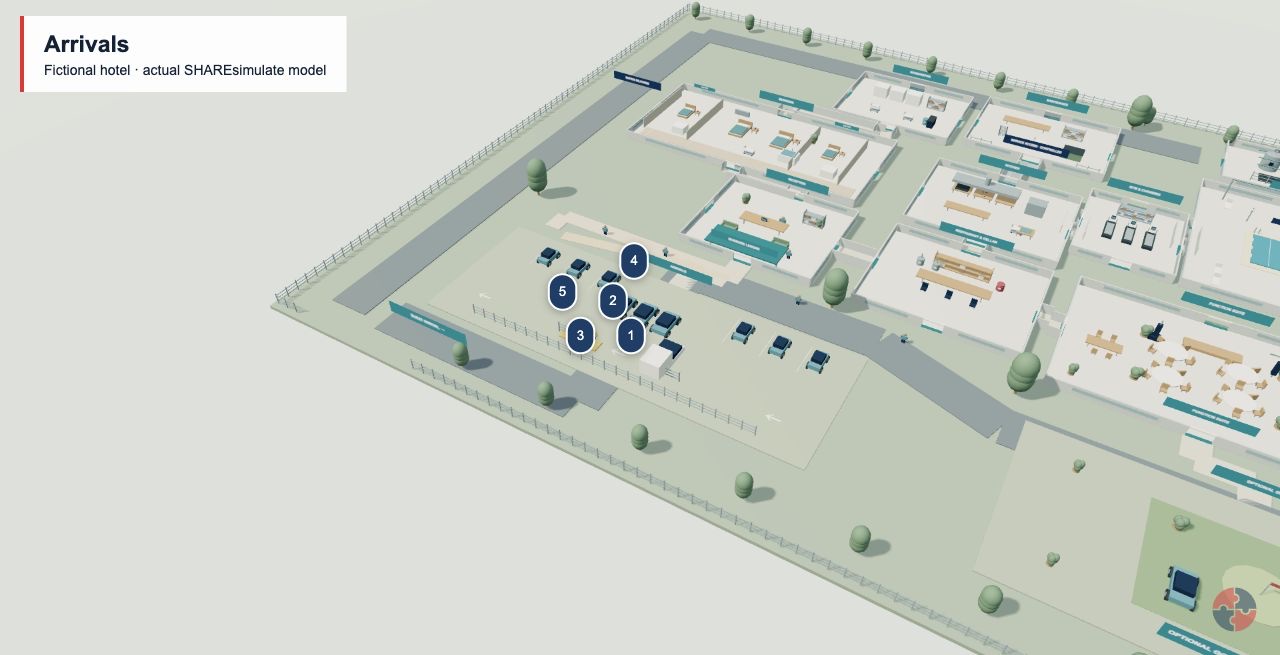
Actual fictional SHAREsimulate hotel model: Arrivals. The stated case supplies the conditions; the image does not prove a defect or control state.
A safe welcome depends on the whole route
A guest arrives with luggage while a taxi stops, a coach unloads and a delivery driver asks to reverse. Each person sees a different task. Reception holds the overview: where people will walk, where vehicles may move and what changes when the normal route is unavailable. Begin with the journey from arrival to the actual reception desk, including passengers, children and people who need accessible access.
Walk the route in both directions and consider what the user can see. A barrier with an uncontrolled gate, a ramp ending in the roadway or a display hiding a crossing can defeat an otherwise reasonable arrangement. Confirm the temporary route and its holding points before directing a guest into it. A sign or an instruction to be careful supports a physical arrangement; it does not create separation.
Plan for variation. Wet coats and wheeled cases bring water inside; darkness changes visibility; an unexpected delivery creates pressure to improvise. Compare the normal plan with a representative busy period and record the owner of each interface. If the proposed shortcut removes protection, hold the affected movement and provide a safe alternative within your role.
Work through this separate hotel case
A van arrives early while a family unloads beside the gate. The driver asks reception to wave everyone through together.
Apply the same control test whenever the activity, users, product, staffing or conditions change. Prefer a layout avoiding reversing; otherwise agree a holding point, protected pedestrian route and competent control of the manoeuvre. Check connected areas: Guest arrivals, departures and separately coordinated service deliveries.
Evidence to establish: Compare the live arrival route, delivery movement and driver briefing. Observe arrivals and a controlled delivery using the agreed separation. Watch the gate during a representative luggage arrival and delivery; confirm who can stop movement and what happens if communication fails.
How should transport risk be assessed?
Assessment should map people, vehicles, routes, movements, loading, reversing, visibility and work pressure.
A transport assessment should start with a movement map. Where do vehicles enter, reverse, park, load, tip, refuel, charge, turn, couple, uncouple and exit? Where do pedestrians walk, wait, cross, work, queue or visit welfare? Where do temporary works, waste skips, deliveries or contractors change the route?
The assessment should then challenge each interface. Can pedestrians and vehicles be separated? Can reversing be eliminated? Can route direction be simplified? Are visiting drivers briefed? Are banksmen competent and protected? Are schedules realistic enough to prevent rushing?
Risk area
Assessment question
Control focus
Pedestrian routes
Can people walk without entering vehicle routes?
Segregation, barriers and crossings.
Reversing
Can reversing be eliminated or controlled?
One-way routes, turning areas, aids and banksman rules.
Loading/unloading
Who controls the vehicle, load, people and exclusion zone?
Loading plan and communication.
Blind spots
What can the driver not see?
Vehicle selection, aids, exclusion and pedestrian control.
Temporary change
How do works, skips or congestion alter routes?
Change briefing and temporary traffic plan.
Road journeys
Are time, weather, rest and welfare realistic?
Safe journey planning.
How should a busy warehouse yard be controlled?
A strong yard plan separates people and vehicles, controls reversing and manages visiting drivers before they enter the risk area.
A warehouse has vans, articulated lorries, pedestrian staff, agency workers, forklift trucks, visitors and waste collections. Near misses occur when visiting drivers walk across the yard to reception and forklifts reverse near a loading bay. A weak response is to add more warning signs. A stronger response redesigns pedestrian access, creates a driver waiting point, sets a one-way vehicle system, marks loading exclusion zones, controls reversing, briefs visiting drivers, improves lighting, reviews delivery scheduling and checks compliance during peak periods.
The lesson is that transport safety is mainly design and management. Behaviour matters, but only after the site has made the safe route obvious and practical.
Drivers walking through yard. Weak control: Tell them to watch for vehicles; Better control: Create protected pedestrian route and waiting point.
Forklift reversing. Weak control: Rely on reversing alarm; Better control: Redesign route and use exclusion controls.
Loading bay interface. Weak control: Paint lines only; Better control: Physical controls, bay rules and communication.
Fictional loading sequence: prevent early departure
A visiting driver parks as directed and uses the segregated waiting area. The agreed loading controller verifies suitable vehicle/trailer parking brakes and stability, the loading exclusion and the assessed site method that prevents premature departure. Driver and loader confirm the hold is active before work. If that hold, stability or separation is uncertain, loading stops. Only the agreed controller gives positive departure release after people and equipment are clear, the load is safe and all checks are complete. A briefing or painted bay line alone cannot prevent a runaway or drive-away; select the method for the actual vehicles and site.
Applied case
A van arrives early while a family unloads beside the gate. The driver asks reception to wave everyone through together.
Decision and explanation
Hold conflicting movement and provide a protected guest route before allowing the delivery.
This controls the relevant exposure rather than relying on appearance or reassurance. Watch the gate during a representative luggage arrival and delivery; confirm who can stop movement and what happens if communication fails. Speed reduction leaves pedestrians inside the reversing envelope. Restore separation before authorising the conflicting movements. A position behind a reversing vehicle is not a protected waiting area; use an agreed refuge outside its movement envelope.
Lesson 2
Use information as a working control
Resolve vehicle conflicts, wet entrances and gaps in lone-worker support.
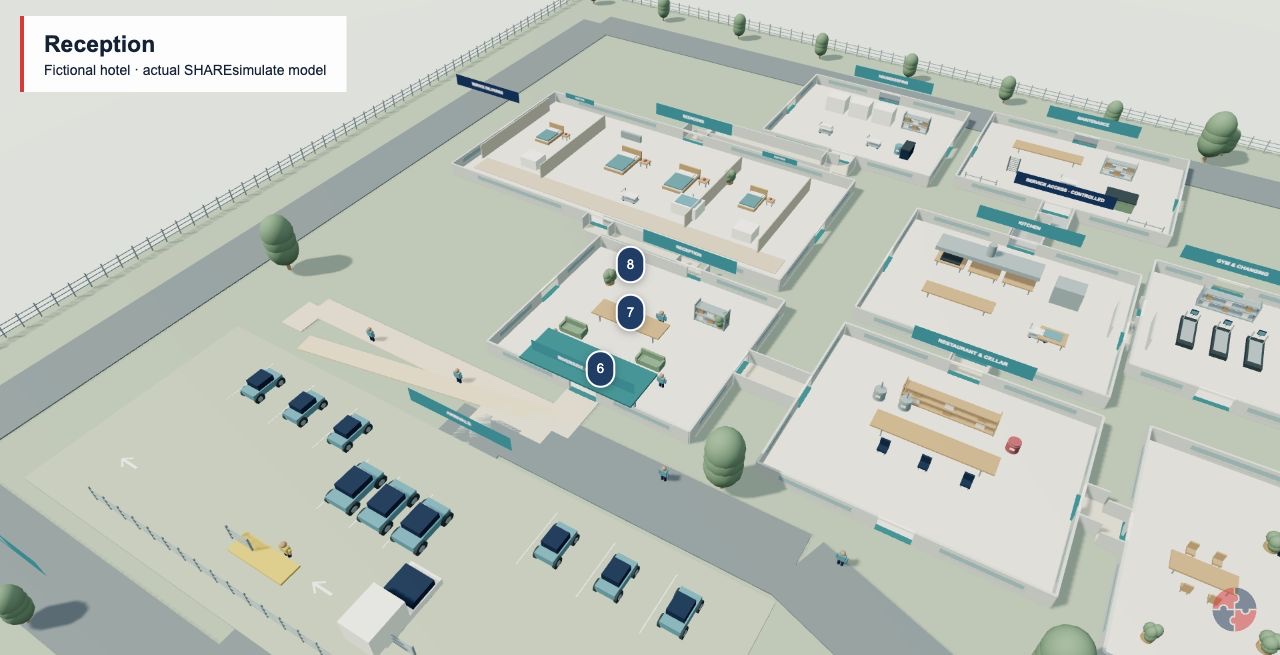
Actual fictional SHAREsimulate hotel model: Reception. The stated case supplies the conditions; the image does not prove a defect or control state.
Make a restriction survive the next shift
A maintenance request and an operating restriction do different jobs. The request tells somebody to fix a defect; the restriction tells current staff what must remain unavailable until the fix has been checked. A message saying contractor contacted can leave the evening team believing the area has reopened. State the precise location, affected activity, current protection, owner and release evidence.
Test the handover with a question: if the contractor has not arrived, what can the next team permit? The answer should identify the actual hold, not depend on finding the person who noticed the problem. Check that temporary staff and other departments receive the restriction when their tasks could expose guests or workers.
Lone-working support also needs a functioning response. A button, telephone or radio is useful only if somebody receives the call and can act under the agreed arrangement. Test communication and escalation without manufacturing a real emergency. Report a failed test and agree safe interim staffing or access arrangements before relying on the system.
Work through this separate hotel case
A manager asks reception to sell a closed room because the previous shift left no obvious warning on the desk.
Apply the same control test whenever the activity, users, product, staffing or conditions change. Keep room status and physical access consistent; require competent release evidence and an identified authoriser before removing a restriction. Check connected areas: Check-in, public circulation, guest assistance and shift handover.
Evidence to establish: Compare the live room system, restriction record and receiving worker's understanding. Ask the next shift to explain and demonstrate how release remains prevented. Ask the receiving shift to identify blocked rooms, demonstrate prevention of key issue and state who can authorise reopening.
How should handover quality be checked?
Quality should be sampled through observation, record review and incoming-person understanding.
A signed handover sheet does not prove understanding. Assurance should watch the handover, ask incoming people what they understood and compare the message with live plant or task status. See HSE shift handover for the relevant source and scope.
Where remote or digital handover is used, the standard should still require two-way communication and cross-checking of safety-critical information.
A manager asks reception to sell a closed room because the previous shift left no obvious warning on the desk.
Decision and explanation
Keep restrictions visible in booking and handover systems with clear ownership.
Appearance cannot establish that the outstanding safety condition has been resolved. Retain the block and obtain the release evidence. This controls the relevant exposure rather than relying on appearance or reassurance. Ask the receiving shift to identify blocked rooms, demonstrate prevention of key issue and state who can authorise reopening. This separates the operational booking decision from the control owner. Keep a traceable accepted restriction until formal release.
Lesson 3
Design the arrival around real guest journeys
Connect accessible guest routes, vehicle movements and a controlled crossing.
Actual fictional SHAREsimulate hotel model: Arrivals. The stated case supplies the conditions; the image does not prove a defect or control state.
Design the arrival around real guest journeys
An arrival assessment starts where the person actually leaves the vehicle, not at the reception desk. A family may stand behind a car while finding luggage; a wheelchair user may need a different unloading position; a coach group may follow its guide across the service entrance. Draw those journeys through to reception and include the return journey. A route that ends at a locked door or a step is not a complete control.
Reduce conflicting movements through layout and scheduling before relying on people to notice each other. Necessary crossings need a clear, workable arrangement, including who controls the movement, where people wait and what happens if that arrangement is unavailable. A marshal cannot see through a vehicle or create space that the layout does not provide. Drivers and guests must receive instructions they can understand before entering the conflict.
In the fictional hotel, a linen delivery arrives during coach unloading. Reception should establish which movement can wait and how the protected guest route remains available. Check the physical route and the actual driver communication. A delivery slot in a diary is evidence of a plan; it does not demonstrate that the present arrival is controlled.
How should transport risk be assessed?
Assessment should map people, vehicles, routes, movements, loading, reversing, visibility and work pressure.
A transport assessment should start with a movement map. Where do vehicles enter, reverse, park, load, tip, refuel, charge, turn, couple, uncouple and exit? Where do pedestrians walk, wait, cross, work, queue or visit welfare? Where do temporary works, waste skips, deliveries or contractors change the route?
The assessment should then challenge each interface. Can pedestrians and vehicles be separated? Can reversing be eliminated? Can route direction be simplified? Are visiting drivers briefed? Are banksmen competent and protected? Are schedules realistic enough to prevent rushing?
Risk area
Assessment question
Control focus
Pedestrian routes
Can people walk without entering vehicle routes?
Segregation, barriers and crossings.
Reversing
Can reversing be eliminated or controlled?
One-way routes, turning areas, aids and banksman rules.
Loading/unloading
Who controls the vehicle, load, people and exclusion zone?
Loading plan and communication.
Blind spots
What can the driver not see?
Vehicle selection, aids, exclusion and pedestrian control.
Temporary change
How do works, skips or congestion alter routes?
Change briefing and temporary traffic plan.
Road journeys
Are time, weather, rest and welfare realistic?
Safe journey planning.
How should a busy warehouse yard be controlled?
A strong yard plan separates people and vehicles, controls reversing and manages visiting drivers before they enter the risk area.
A warehouse has vans, articulated lorries, pedestrian staff, agency workers, forklift trucks, visitors and waste collections. Near misses occur when visiting drivers walk across the yard to reception and forklifts reverse near a loading bay. A weak response is to add more warning signs. A stronger response redesigns pedestrian access, creates a driver waiting point, sets a one-way vehicle system, marks loading exclusion zones, controls reversing, briefs visiting drivers, improves lighting, reviews delivery scheduling and checks compliance during peak periods.
The lesson is that transport safety is mainly design and management. Behaviour matters, but only after the site has made the safe route obvious and practical.
Drivers walking through yard. Weak control: Tell them to watch for vehicles; Better control: Create protected pedestrian route and waiting point.
Forklift reversing. Weak control: Rely on reversing alarm; Better control: Redesign route and use exclusion controls.
Loading bay interface. Weak control: Paint lines only; Better control: Physical controls, bay rules and communication.
Fictional loading sequence: prevent early departure
A visiting driver parks as directed and uses the segregated waiting area. The agreed loading controller verifies suitable vehicle/trailer parking brakes and stability, the loading exclusion and the assessed site method that prevents premature departure. Driver and loader confirm the hold is active before work. If that hold, stability or separation is uncertain, loading stops. Only the agreed controller gives positive departure release after people and equipment are clear, the load is safe and all checks are complete. A briefing or painted bay line alone cannot prevent a runaway or drive-away; select the method for the actual vehicles and site.
Applied case
The accessible unloading point is clear, but the path from it to reception passes through the linen van’s reversing area.
Decision and explanation
A usable protected journey from unloading to reception, with conflicting movement controlled.
A usable protected journey from unloading to reception, with conflicting movement controlled. In the fictional hotel, a linen delivery arrives during coach unloading. Reception should establish which movement can wait and how the protected guest route remains available. Check the physical route and the actual driver communication. A delivery slot in a diary is evidence of a plan; it does not demonstrate that the present arrival is controlled.
Lesson 4
Make a handover preserve the restriction
Separate a logged concern from an acknowledged operating restriction.
Actual fictional SHAREsimulate hotel model: Reception. The stated case supplies the conditions; the image does not prove a defect or control state.
Make a handover preserve the restriction
Hotel work crosses shifts and departments. Reception may receive the first complaint, maintenance may investigate it and the duty manager may decide which service remains restricted. Information is lost when the handover records only “maintenance informed”. The next person needs to know the affected place or activity, the observed condition, the current restriction, who owns the response and what evidence permits release.
Use precise statements. “Reception entrance is slippery after rain; the affected doorway is restricted and the accessible alternative is staffed” gives a different picture from “wet floor dealt with”. Distinguish an observation, an unverified explanation and a completed control. The recipient should confirm what they have received, particularly where an unresolved restriction affects an arrival or an emergency route. A read receipt is not the same as a shared understanding.
A useful handover also explains what could change the decision. Another delivery, increasing rain, a larger group or the loss of the person controlling a crossing can invalidate the arrangement. At the start of the shift, verify the relevant physical condition instead of treating yesterday’s signature as a release. Keep a restriction in place until the responsible person can justify changing it.
How should handover quality be checked?
Quality should be sampled through observation, record review and incoming-person understanding.
A signed handover sheet does not prove understanding. Assurance should watch the handover, ask incoming people what they understood and compare the message with live plant or task status. See HSE shift handover for the relevant source and scope.
Where remote or digital handover is used, the standard should still require two-way communication and cross-checking of safety-critical information.
The evening log says “entrance checked”, but no one can explain whether the alternative guest route is still required.
Decision and explanation
The exact restriction, affected guests, owner, current evidence and release condition, acknowledged by the recipient.
The exact restriction, affected guests, owner, current evidence and release condition, acknowledged by the recipient. A useful handover also explains what could change the decision. Another delivery, increasing rain, a larger group or the loss of the person controlling a crossing can invalidate the arrangement. At the start of the shift, verify the relevant physical condition instead of treating yesterday’s signature as a release. Keep a restriction in place until the responsible person can justify changing it.
Lesson 5
Handle pressure without losing the safety decision
Choose a safe escalation when a guest, driver or colleague presses for an exception.
Actual fictional SHAREsimulate hotel model: Reception. The stated case supplies the conditions; the image does not prove a defect or control state.
Handle pressure without losing the safety decision
Reception is a service role, but good service includes making safe alternatives possible. Pressure can come from an upset guest, a waiting coach, a driver concerned about time or a colleague who wants a queue cleared. Recognise the point where service pressure is replacing a control decision. A promise to be careful does not replace separation, a usable route or the staff capability needed to manage the situation.
Explain the immediate restriction and the available alternative in plain language. Keep communication respectful and avoid arguing about blame at the conflict point. If behaviour becomes threatening, follow the agreed security and assistance arrangements and maintain a route to safety. Do not put a receptionist into a vehicle’s path to settle a disagreement. Staff should know how to obtain help and what they may pause within their role.
Afterwards, record the circumstances and review the system. If the same pressure returns at every delivery, the solution may be the booking process, layout or escalation arrangements rather than another reminder to staff. Verify that the alternative works for guests needing assistance and that the next shift can use it. A resolved argument does not by itself show that the transport risk has been controlled.
When should a worker withdraw or call emergency services?
Withdraw to an agreed safe place whenever the worker feels unsafe, controls fail or violence may occur; call 999 when a crime is in progress or someone is in immediate danger, and use online reporting or 101 for non-emergencies.
Do not block or confront the aggressor, pursue them, resist a robbery, recover cash or property, enforce a ban or collect footage while danger continues. Life comes before property and evidence. Withdraw immediately when unsafe; no worker needs permission or a failed de-escalation attempt before leaving. Use a duress alarm only if it can be activated safely. If leaving is impossible, follow the local shelter or lockdown plan and provide location and threat information to emergency services when safe. NI uses NI police 999 for emergencies and 101 or online routes for non-emergencies. Local emergency plans must define responders, safe areas and accessibility. See GOV.UK Contact the police.
Any specialist security or physical-intervention duty must be separately authorised under applicable law, a task-specific risk assessment, defined duties, demonstrated competence and a specific approved procedure. This page does not authorise restraint, confrontation, pursuit, property recovery or physical intervention.
Trigger
Immediate action
Attack, credible imminent threat, weapon or immediate danger
A driver tells a lone receptionist to stand behind the vehicle and guide it through waiting guests.
Decision and explanation
Keep the conflicting movement held and obtain the agreed competent support or an alternative arrangement.
Keep the conflicting movement held and obtain the agreed competent support or an alternative arrangement. Afterwards, record the circumstances and review the system. If the same pressure returns at every delivery, the solution may be the booking process, layout or escalation arrangements rather than another reminder to staff. Verify that the alternative works for guests needing assistance and that the next shift can use it. A resolved argument does not by itself show that the transport risk has been controlled.
Lesson 6
Verify the control where the service happens
Use an observation and an appropriate record to test the arrival system.
Actual fictional SHAREsimulate hotel model: Arrivals. The stated case supplies the conditions; the image does not prove a defect or control state.
Verify the control where the service happens
A procedure describes intended arrangements. Verification asks whether they are available and effective during the actual service. For an arrival, inspect the route, crossing, waiting position and visibility, and speak with the people carrying out the arrangement. Check whether instructions reach a new driver and whether guests can recognise the route without already knowing the site. Include darkness, rain and the busiest credible overlap.
Records help when they answer the relevant question. A delivery schedule shows planned timing; a defect report may explain an unavailable barrier; a training record can support competence arrangements. None alone proves that today’s gate is closed, the crossing is controlled or the accessible door is unlocked. Resolve conflicting information rather than choosing the record that permits the service to continue.
Turn findings into a useful action. Name the affected task, the responsible role, the interim protection and the evidence required for closure. In the fictional hotel, moving a sign may be a sensible action, but closure also needs a check that the full journey works during an arrival. Review again when traffic, guest needs or the physical layout changes. Keep the exercise separate from a real operational authorisation.
How should transport risk be assessed?
Assessment should map people, vehicles, routes, movements, loading, reversing, visibility and work pressure.
A transport assessment should start with a movement map. Where do vehicles enter, reverse, park, load, tip, refuel, charge, turn, couple, uncouple and exit? Where do pedestrians walk, wait, cross, work, queue or visit welfare? Where do temporary works, waste skips, deliveries or contractors change the route?
The assessment should then challenge each interface. Can pedestrians and vehicles be separated? Can reversing be eliminated? Can route direction be simplified? Are visiting drivers briefed? Are banksmen competent and protected? Are schedules realistic enough to prevent rushing?
Risk area
Assessment question
Control focus
Pedestrian routes
Can people walk without entering vehicle routes?
Segregation, barriers and crossings.
Reversing
Can reversing be eliminated or controlled?
One-way routes, turning areas, aids and banksman rules.
Loading/unloading
Who controls the vehicle, load, people and exclusion zone?
Loading plan and communication.
Blind spots
What can the driver not see?
Vehicle selection, aids, exclusion and pedestrian control.
Temporary change
How do works, skips or congestion alter routes?
Change briefing and temporary traffic plan.
Road journeys
Are time, weather, rest and welfare realistic?
Safe journey planning.
How should a busy warehouse yard be controlled?
A strong yard plan separates people and vehicles, controls reversing and manages visiting drivers before they enter the risk area.
A warehouse has vans, articulated lorries, pedestrian staff, agency workers, forklift trucks, visitors and waste collections. Near misses occur when visiting drivers walk across the yard to reception and forklifts reverse near a loading bay. A weak response is to add more warning signs. A stronger response redesigns pedestrian access, creates a driver waiting point, sets a one-way vehicle system, marks loading exclusion zones, controls reversing, briefs visiting drivers, improves lighting, reviews delivery scheduling and checks compliance during peak periods.
The lesson is that transport safety is mainly design and management. Behaviour matters, but only after the site has made the safe route obvious and practical.
Drivers walking through yard. Weak control: Tell them to watch for vehicles; Better control: Create protected pedestrian route and waiting point.
Forklift reversing. Weak control: Rely on reversing alarm; Better control: Redesign route and use exclusion controls.
Loading bay interface. Weak control: Paint lines only; Better control: Physical controls, bay rules and communication.
Fictional loading sequence: prevent early departure
A visiting driver parks as directed and uses the segregated waiting area. The agreed loading controller verifies suitable vehicle/trailer parking brakes and stability, the loading exclusion and the assessed site method that prevents premature departure. Driver and loader confirm the hold is active before work. If that hold, stability or separation is uncertain, loading stops. Only the agreed controller gives positive departure release after people and equipment are clear, the load is safe and all checks are complete. A briefing or painted bay line alone cannot prevent a runaway or drive-away; select the method for the actual vehicles and site.
Applied case
A completed arrival checklist is available, but the temporary gate is tied open and the alternative route is locked.
Decision and explanation
The actual unavailable controls and the need for a workable interim arrangement.
The actual unavailable controls and the need for a workable interim arrangement. Turn findings into a useful action. Name the affected task, the responsible role, the interim protection and the evidence required for closure. In the fictional hotel, moving a sign may be a sensible action, but closure also needs a check that the full journey works during an arrival. Review again when traffic, guest needs or the physical layout changes. Keep the exercise separate from a real operational authorisation.
Lesson 7
Guest route crosses delivery reversing
Trace the complete journey from a parked car to reception. A barrier is useful only when openings, temporary diversions and delivery movements preserve its protection. Reception must be able to hold a delivery without asking guests to negotiate the manoeuvring space.
Actual fictional SHAREsimulate hotel model: Arrivals. The stated case supplies the conditions; the image does not prove a defect or control state.
Understand the activity and how harm develops
A hotel guest may be concentrating on luggage, children or finding reception while a delivery driver concentrates on a narrow reversing manoeuvre. The critical interface is the gate through the pedestrian barrier. A painted crossing does not stop a vehicle, and a reversing alarm does not establish that everyone has heard it.
Trace the complete journey from a parked car to reception. A barrier is useful only when openings, temporary diversions and delivery movements preserve its protection. Reception must be able to hold a delivery without asking guests to negotiate the manoeuvring space.
Arrivals change with coaches, taxis, luggage and service deliveries. Consider children, unfamiliar visitors and guests with mobility or sensory needs. A quiet inspection does not test a busy event arrival; check the interface under the conditions that actually challenge it.
Recognise the evidence boundary
Question
Case evidence
What is observed?
A barrier separates the guest path from the delivery bay; check the temporary gate arrangement.
How can harm occur?
A guest entering the reversing envelope could be struck or crushed.
What information is needed?
Compare the live arrival route, delivery movement and driver briefing.
Protect, manage and verify
Purpose
Practical application
Immediate protection
Hold conflicting movement and provide a protected guest route before allowing the delivery.
Accountable work arrangement
Hold conflicting movement and provide a protected guest route before allowing the delivery. Prefer a layout avoiding reversing; otherwise agree a holding point, protected pedestrian route and competent control of the manoeuvre. Provide suitable protected routes, unloading areas and crossing sight lines. Agree the responsible person and safe interim arrangement for vehicle crossing. Reopen or restart only when the relevant verification below has been accepted.
Release verification
Observe arrivals and a controlled delivery using the agreed separation.
Apply this at work
Apply the same control test whenever the activity, users, product, staffing or conditions change. Prefer a layout avoiding reversing; otherwise agree a holding point, protected pedestrian route and competent control of the manoeuvre. Check connected areas: Guest arrivals, departures and separately coordinated service deliveries.
How should transport risk be assessed?
Assessment should map people, vehicles, routes, movements, loading, reversing, visibility and work pressure.
A transport assessment should start with a movement map. Where do vehicles enter, reverse, park, load, tip, refuel, charge, turn, couple, uncouple and exit? Where do pedestrians walk, wait, cross, work, queue or visit welfare? Where do temporary works, waste skips, deliveries or contractors change the route?
The assessment should then challenge each interface. Can pedestrians and vehicles be separated? Can reversing be eliminated? Can route direction be simplified? Are visiting drivers briefed? Are banksmen competent and protected? Are schedules realistic enough to prevent rushing?
Risk area
Assessment question
Control focus
Pedestrian routes
Can people walk without entering vehicle routes?
Segregation, barriers and crossings.
Reversing
Can reversing be eliminated or controlled?
One-way routes, turning areas, aids and banksman rules.
Loading/unloading
Who controls the vehicle, load, people and exclusion zone?
Loading plan and communication.
Blind spots
What can the driver not see?
Vehicle selection, aids, exclusion and pedestrian control.
Temporary change
How do works, skips or congestion alter routes?
Change briefing and temporary traffic plan.
Road journeys
Are time, weather, rest and welfare realistic?
Safe journey planning.
How should a busy warehouse yard be controlled?
A strong yard plan separates people and vehicles, controls reversing and manages visiting drivers before they enter the risk area.
A warehouse has vans, articulated lorries, pedestrian staff, agency workers, forklift trucks, visitors and waste collections. Near misses occur when visiting drivers walk across the yard to reception and forklifts reverse near a loading bay. A weak response is to add more warning signs. A stronger response redesigns pedestrian access, creates a driver waiting point, sets a one-way vehicle system, marks loading exclusion zones, controls reversing, briefs visiting drivers, improves lighting, reviews delivery scheduling and checks compliance during peak periods.
The lesson is that transport safety is mainly design and management. Behaviour matters, but only after the site has made the safe route obvious and practical.
Drivers walking through yard. Weak control: Tell them to watch for vehicles; Better control: Create protected pedestrian route and waiting point.
Forklift reversing. Weak control: Rely on reversing alarm; Better control: Redesign route and use exclusion controls.
Loading bay interface. Weak control: Paint lines only; Better control: Physical controls, bay rules and communication.
Fictional loading sequence: prevent early departure
A visiting driver parks as directed and uses the segregated waiting area. The agreed loading controller verifies suitable vehicle/trailer parking brakes and stability, the loading exclusion and the assessed site method that prevents premature departure. Driver and loader confirm the hold is active before work. If that hold, stability or separation is uncertain, loading stops. Only the agreed controller gives positive departure release after people and equipment are clear, the load is safe and all checks are complete. A briefing or painted bay line alone cannot prevent a runaway or drive-away; select the method for the actual vehicles and site.
Applied case
A van arrives early while a family unloads beside the gate. The driver asks reception to wave everyone through together.
Decision and explanation
Hold conflicting movement and provide a protected guest route before allowing the delivery.
This controls the relevant exposure rather than relying on appearance or reassurance. Watch the gate during a representative luggage arrival and delivery; confirm who can stop movement and what happens if communication fails. Speed reduction leaves pedestrians inside the reversing envelope. Restore separation before authorising the conflicting movements. A position behind a reversing vehicle is not a protected waiting area; use an agreed refuge outside its movement envelope.
Lesson 8
Crossing sightline blocked
Temporary wedding signs, parked coaches and seasonal displays can change visibility after a satisfactory inspection. Keep the sight triangle under control as part of event setup and deliveries, with an alternative crossing or held traffic while an obstruction is removed.
Actual fictional SHAREsimulate hotel model: Arrivals. The stated case supplies the conditions; the image does not prove a defect or control state.
Understand the activity and how harm develops
The promotional sign creates a blind approach at the crossing. Drivers and pedestrians can each believe the route is clear while the other remains concealed. A high camera view hides this limitation: sight lines must be checked at a driver's seated eye level and from the position of a child or seated wheelchair user.
Temporary wedding signs, parked coaches and seasonal displays can change visibility after a satisfactory inspection. Keep the sight triangle under control as part of event setup and deliveries, with an alternative crossing or held traffic while an obstruction is removed.
Arrivals change with coaches, taxis, luggage and service deliveries. Consider children, unfamiliar visitors and guests with mobility or sensory needs. A quiet inspection does not test a busy event arrival; check the interface under the conditions that actually challenge it.
Recognise the evidence boundary
Question
Case evidence
What is observed?
A tall promotional sign obstructs the view at a pedestrian crossing.
How can harm occur?
A driver and guest could meet without sufficient warning to avoid impact.
What information is needed?
Check both approach sight lines from actual driving and pedestrian positions.
Protect, manage and verify
Purpose
Practical application
Immediate protection
Remove the obstruction and reassess the crossing location and vehicle movement.
Accountable work arrangement
Remove the obstruction and reassess the crossing location and vehicle movement. Locate signs and waiting vehicles outside the assessed sight lines; protect the crossing while the layout is corrected. Provide suitable protected routes, unloading areas and crossing sight lines. Agree the responsible person and safe interim arrangement for sightline. Reopen or restart only when the relevant verification below has been accepted.
Release verification
Walk both approaches and observe the corrected crossing in use.
Apply this at work
Apply the same control test whenever the activity, users, product, staffing or conditions change. Locate signs and waiting vehicles outside the assessed sight lines; protect the crossing while the layout is corrected. Check connected areas: Guest arrivals, departures and separately coordinated service deliveries.
How should transport risk be assessed?
Assessment should map people, vehicles, routes, movements, loading, reversing, visibility and work pressure.
A transport assessment should start with a movement map. Where do vehicles enter, reverse, park, load, tip, refuel, charge, turn, couple, uncouple and exit? Where do pedestrians walk, wait, cross, work, queue or visit welfare? Where do temporary works, waste skips, deliveries or contractors change the route?
The assessment should then challenge each interface. Can pedestrians and vehicles be separated? Can reversing be eliminated? Can route direction be simplified? Are visiting drivers briefed? Are banksmen competent and protected? Are schedules realistic enough to prevent rushing?
Risk area
Assessment question
Control focus
Pedestrian routes
Can people walk without entering vehicle routes?
Segregation, barriers and crossings.
Reversing
Can reversing be eliminated or controlled?
One-way routes, turning areas, aids and banksman rules.
Loading/unloading
Who controls the vehicle, load, people and exclusion zone?
Loading plan and communication.
Blind spots
What can the driver not see?
Vehicle selection, aids, exclusion and pedestrian control.
Temporary change
How do works, skips or congestion alter routes?
Change briefing and temporary traffic plan.
Road journeys
Are time, weather, rest and welfare realistic?
Safe journey planning.
How should a busy warehouse yard be controlled?
A strong yard plan separates people and vehicles, controls reversing and manages visiting drivers before they enter the risk area.
A warehouse has vans, articulated lorries, pedestrian staff, agency workers, forklift trucks, visitors and waste collections. Near misses occur when visiting drivers walk across the yard to reception and forklifts reverse near a loading bay. A weak response is to add more warning signs. A stronger response redesigns pedestrian access, creates a driver waiting point, sets a one-way vehicle system, marks loading exclusion zones, controls reversing, briefs visiting drivers, improves lighting, reviews delivery scheduling and checks compliance during peak periods.
The lesson is that transport safety is mainly design and management. Behaviour matters, but only after the site has made the safe route obvious and practical.
Drivers walking through yard. Weak control: Tell them to watch for vehicles; Better control: Create protected pedestrian route and waiting point.
Forklift reversing. Weak control: Rely on reversing alarm; Better control: Redesign route and use exclusion controls.
Loading bay interface. Weak control: Paint lines only; Better control: Physical controls, bay rules and communication.
Fictional loading sequence: prevent early departure
A visiting driver parks as directed and uses the segregated waiting area. The agreed loading controller verifies suitable vehicle/trailer parking brakes and stability, the loading exclusion and the assessed site method that prevents premature departure. Driver and loader confirm the hold is active before work. If that hold, stability or separation is uncertain, loading stops. Only the agreed controller gives positive departure release after people and equipment are clear, the load is safe and all checks are complete. A briefing or painted bay line alone cannot prevent a runaway or drive-away; select the method for the actual vehicles and site.
Applied case
An events team puts a tall welcome board beside the crossing shortly before a coach arrives.
Decision and explanation
Remove the obstruction and reassess the crossing location and vehicle movement.
This controls the relevant exposure rather than relying on appearance or reassurance. Check visibility in both directions from realistic road-user positions, including darkness and glare where relevant. This requires a person to enter or approach a live vehicle envelope to obtain visibility; correct the obstruction and crossing arrangement. Another sign does not restore the obscured view. The driver still cannot see someone entering the crossing.
Lesson 9
Accessible route forces roadway use
Walk the full route with users' needs in mind: gradients, transitions, doors, surfaces, lighting and temporary barriers all matter. An improvised ramp must be suitable and secure; it must not send people across an active delivery route or obstruct an exit.
Actual fictional SHAREsimulate hotel model: Arrivals. The stated case supplies the conditions; the image does not prove a defect or control state.
Understand the activity and how harm develops
A nominally accessible parking space is ineffective when its route ends at a kerb or blocked doorway. A wheelchair user, someone with a walking aid or a guest pushing luggage may divert into the service road. The defect connects accessibility and collision risk rather than being only a matter of signage.
Walk the full route with users' needs in mind: gradients, transitions, doors, surfaces, lighting and temporary barriers all matter. An improvised ramp must be suitable and secure; it must not send people across an active delivery route or obstruct an exit.
Arrivals change with coaches, taxis, luggage and service deliveries. Consider children, unfamiliar visitors and guests with mobility or sensory needs. A quiet inspection does not test a busy event arrival; check the interface under the conditions that actually challenge it.
Recognise the evidence boundary
Question
Case evidence
What is observed?
A wheelchair user's route ends at a kerb beside the service lane.
How can harm occur?
The user could be forced among vehicles or fall at the discontinuity.
What information is needed?
Trace an accessible journey from parking through the entrance during deliveries.
Protect, manage and verify
Purpose
Practical application
Immediate protection
Provide a continuous suitable accessible route protected from vehicle movements.
Accountable work arrangement
Provide a continuous suitable accessible route protected from vehicle movements. Provide a continuous usable protected route, including suitable transitions, and arrange an accessible alternative during repairs. Provide suitable protected routes, unloading areas and crossing sight lines. Agree the responsible person and safe interim arrangement for accessible route. Reopen or restart only when the relevant verification below has been accepted.
Release verification
A user-informed route check confirms access without entering the traffic envelope.
Apply this at work
Apply the same control test whenever the activity, users, product, staffing or conditions change. Provide a continuous usable protected route, including suitable transitions, and arrange an accessible alternative during repairs. Check connected areas: Guest arrivals, departures and separately coordinated service deliveries.
How should transport risk be assessed?
Assessment should map people, vehicles, routes, movements, loading, reversing, visibility and work pressure.
A transport assessment should start with a movement map. Where do vehicles enter, reverse, park, load, tip, refuel, charge, turn, couple, uncouple and exit? Where do pedestrians walk, wait, cross, work, queue or visit welfare? Where do temporary works, waste skips, deliveries or contractors change the route?
The assessment should then challenge each interface. Can pedestrians and vehicles be separated? Can reversing be eliminated? Can route direction be simplified? Are visiting drivers briefed? Are banksmen competent and protected? Are schedules realistic enough to prevent rushing?
Risk area
Assessment question
Control focus
Pedestrian routes
Can people walk without entering vehicle routes?
Segregation, barriers and crossings.
Reversing
Can reversing be eliminated or controlled?
One-way routes, turning areas, aids and banksman rules.
Loading/unloading
Who controls the vehicle, load, people and exclusion zone?
Loading plan and communication.
Blind spots
What can the driver not see?
Vehicle selection, aids, exclusion and pedestrian control.
Temporary change
How do works, skips or congestion alter routes?
Change briefing and temporary traffic plan.
Road journeys
Are time, weather, rest and welfare realistic?
Safe journey planning.
How should a busy warehouse yard be controlled?
A strong yard plan separates people and vehicles, controls reversing and manages visiting drivers before they enter the risk area.
A warehouse has vans, articulated lorries, pedestrian staff, agency workers, forklift trucks, visitors and waste collections. Near misses occur when visiting drivers walk across the yard to reception and forklifts reverse near a loading bay. A weak response is to add more warning signs. A stronger response redesigns pedestrian access, creates a driver waiting point, sets a one-way vehicle system, marks loading exclusion zones, controls reversing, briefs visiting drivers, improves lighting, reviews delivery scheduling and checks compliance during peak periods.
The lesson is that transport safety is mainly design and management. Behaviour matters, but only after the site has made the safe route obvious and practical.
Drivers walking through yard. Weak control: Tell them to watch for vehicles; Better control: Create protected pedestrian route and waiting point.
Forklift reversing. Weak control: Rely on reversing alarm; Better control: Redesign route and use exclusion controls.
Loading bay interface. Weak control: Paint lines only; Better control: Physical controls, bay rules and communication.
Fictional loading sequence: prevent early departure
A visiting driver parks as directed and uses the segregated waiting area. The agreed loading controller verifies suitable vehicle/trailer parking brakes and stability, the loading exclusion and the assessed site method that prevents premature departure. Driver and loader confirm the hold is active before work. If that hold, stability or separation is uncertain, loading stops. Only the agreed controller gives positive departure release after people and equipment are clear, the load is safe and all checks are complete. A briefing or painted bay line alone cannot prevent a runaway or drive-away; select the method for the actual vehicles and site.
Applied case
A guest using a wheelchair reaches the end of the pavement while a service vehicle waits to leave.
Decision and explanation
Provide a continuous suitable accessible route protected from vehicle movements.
This controls the relevant exposure rather than relying on appearance or reassurance. Seek user feedback and demonstrate a complete journey during the delivery period without entering the roadway. A short distance still exposes the guest to moving vehicles and may remove any safe place to wait. Paint improves visibility but does not make an unusable transition passable. Provide a suitable continuous route.
Lesson 10
Taxi and coach doors open into traffic
Assess the actual coach door, luggage lockers, vehicle sweep and accessible unloading. A protected set-down area should lead directly to the guest path. Schedule or hold other traffic where necessary rather than relying on guests to understand a service-yard arrangement.
Actual fictional SHAREsimulate hotel model: Arrivals. The stated case supplies the conditions; the image does not prove a defect or control state.
Understand the activity and how harm develops
Passengers leave a coach as a group, often carrying bags and looking towards the entrance. If the passenger door opens into traffic, an occupied vehicle lane becomes the first step of the guest journey. Mirrors and driver care cannot reliably protect everyone stepping down, particularly children or people needing assistance.
Assess the actual coach door, luggage lockers, vehicle sweep and accessible unloading. A protected set-down area should lead directly to the guest path. Schedule or hold other traffic where necessary rather than relying on guests to understand a service-yard arrangement.
Arrivals change with coaches, taxis, luggage and service deliveries. Consider children, unfamiliar visitors and guests with mobility or sensory needs. A quiet inspection does not test a busy event arrival; check the interface under the conditions that actually challenge it.
Recognise the evidence boundary
Question
Case evidence
What is observed?
The proposed coach stop places passenger doors beside moving traffic.
How can harm occur?
Passengers with luggage could step directly into a vehicle path.
What information is needed?
Compare door locations, pedestrian flows and the stopping arrangement.
Protect, manage and verify
Purpose
Practical application
Immediate protection
Relocate or control the stop so boarding and unloading occur in a protected area.
Accountable work arrangement
Relocate or control the stop so boarding and unloading occur in a protected area. Use an assessed set-down position with protected door and luggage access, clear driver instructions and enough space for assistance. Provide suitable protected routes, unloading areas and crossing sight lines. Agree the responsible person and safe interim arrangement for taxi door. Reopen or restart only when the relevant verification below has been accepted.
Release verification
Observe a representative arrival and confirm passengers reach the entrance safely.
Apply this at work
Apply the same control test whenever the activity, users, product, staffing or conditions change. Use an assessed set-down position with protected door and luggage access, clear driver instructions and enough space for assistance. Check connected areas: Guest arrivals, departures and separately coordinated service deliveries.
How should transport risk be assessed?
Assessment should map people, vehicles, routes, movements, loading, reversing, visibility and work pressure.
A transport assessment should start with a movement map. Where do vehicles enter, reverse, park, load, tip, refuel, charge, turn, couple, uncouple and exit? Where do pedestrians walk, wait, cross, work, queue or visit welfare? Where do temporary works, waste skips, deliveries or contractors change the route?
The assessment should then challenge each interface. Can pedestrians and vehicles be separated? Can reversing be eliminated? Can route direction be simplified? Are visiting drivers briefed? Are banksmen competent and protected? Are schedules realistic enough to prevent rushing?
Risk area
Assessment question
Control focus
Pedestrian routes
Can people walk without entering vehicle routes?
Segregation, barriers and crossings.
Reversing
Can reversing be eliminated or controlled?
One-way routes, turning areas, aids and banksman rules.
Loading/unloading
Who controls the vehicle, load, people and exclusion zone?
Loading plan and communication.
Blind spots
What can the driver not see?
Vehicle selection, aids, exclusion and pedestrian control.
Temporary change
How do works, skips or congestion alter routes?
Change briefing and temporary traffic plan.
Road journeys
Are time, weather, rest and welfare realistic?
Safe journey planning.
How should a busy warehouse yard be controlled?
A strong yard plan separates people and vehicles, controls reversing and manages visiting drivers before they enter the risk area.
A warehouse has vans, articulated lorries, pedestrian staff, agency workers, forklift trucks, visitors and waste collections. Near misses occur when visiting drivers walk across the yard to reception and forklifts reverse near a loading bay. A weak response is to add more warning signs. A stronger response redesigns pedestrian access, creates a driver waiting point, sets a one-way vehicle system, marks loading exclusion zones, controls reversing, briefs visiting drivers, improves lighting, reviews delivery scheduling and checks compliance during peak periods.
The lesson is that transport safety is mainly design and management. Behaviour matters, but only after the site has made the safe route obvious and practical.
Drivers walking through yard. Weak control: Tell them to watch for vehicles; Better control: Create protected pedestrian route and waiting point.
Forklift reversing. Weak control: Rely on reversing alarm; Better control: Redesign route and use exclusion controls.
Loading bay interface. Weak control: Paint lines only; Better control: Physical controls, bay rules and communication.
Fictional loading sequence: prevent early departure
A visiting driver parks as directed and uses the segregated waiting area. The agreed loading controller verifies suitable vehicle/trailer parking brakes and stability, the loading exclusion and the assessed site method that prevents premature departure. Driver and loader confirm the hold is active before work. If that hold, stability or separation is uncertain, loading stops. Only the agreed controller gives positive departure release after people and equipment are clear, the load is safe and all checks are complete. A briefing or painted bay line alone cannot prevent a runaway or drive-away; select the method for the actual vehicles and site.
Applied case
A coach parks facing the wrong way so its passenger door opens beside moving taxis.
Decision and explanation
Relocate or control the stop so boarding and unloading occur in a protected area.
This controls the relevant exposure rather than relying on appearance or reassurance. Observe a realistic coach arrival, including luggage collection and the last passenger leaving, before accepting the arrangement. The driver's attention does not create physical protection for passengers stepping into the taxi route. Hurrying increases instability and still leaves passengers in traffic. Reposition or hold conflicting movements before unloading.
Lesson 11
Dark or icy external route
Winter arrangements should follow actual forecast and surface conditions, with ownership between shifts. Inspect the route used by people rather than recording that grit was spread somewhere on site. If a safe route cannot be maintained, restrict the affected section and provide a lit accessible alternative.
Actual fictional SHAREsimulate hotel model: Arrivals. The stated case supplies the conditions; the image does not prove a defect or control state.
Understand the activity and how harm develops
Ice can remain on a shaded path even when the car park appears clear. Water from downpipes, meltwater and repeated freezing may defeat a single treatment. Darkness hides surface changes, while a guest's unfamiliarity with the route makes a local shortcut or step especially difficult to anticipate.
Winter arrangements should follow actual forecast and surface conditions, with ownership between shifts. Inspect the route used by people rather than recording that grit was spread somewhere on site. If a safe route cannot be maintained, restrict the affected section and provide a lit accessible alternative.
Arrivals change with coaches, taxis, luggage and service deliveries. Consider children, unfamiliar visitors and guests with mobility or sensory needs. A quiet inspection does not test a busy event arrival; check the interface under the conditions that actually challenge it.
Recognise the evidence boundary
Question
Case evidence
What is observed?
Exterior lights are working, but a shaded path remains icy after treatment.
How can harm occur?
Guests or staff could slip and fall on the untreated approach.
What information is needed?
Check the actual surface, weather response and accessible alternative route.
Protect, manage and verify
Purpose
Practical application
Immediate protection
Restrict the unsafe section and treat or clear it using the assessed winter plan.
Accountable work arrangement
Restrict the unsafe section and treat or clear it using the assessed winter plan. Repair drainage and lighting defects; plan inspection, treatment, reinspection and temporary closure for exposed or shaded sections. Provide suitable surfaces, drainage, matting and maintained lighting for actual use. Agree the responsible person and safe interim arrangement for outside route. Reopen or restart only when the relevant verification below has been accepted.
Release verification
Inspect the surface after treatment and monitor changing conditions.
Apply this at work
Apply the same control test whenever the activity, users, product, staffing or conditions change. Repair drainage and lighting defects; plan inspection, treatment, reinspection and temporary closure for exposed or shaded sections. Check connected areas: Guest arrivals, departures and separately coordinated service deliveries.
How can the ISO 45001 hierarchy of controls remove slip and trip hazards from workplace routes?
Control classification: Classify the mechanism separately from its upkeep: physical floor repair, drainage, barriers, protected routes, compartmentation, fire doors and suitable disposal facilities are physical measures where specified. Cleaning schedules, inspections, policies, funding, supervision and verification are administrative arrangements maintaining them. A verbal instruction is not a physical barrier. Read this correction with the source table. Retained overview and stage artwork requires the matching classification update.
Remove or reduce the hazard before relying on procedures or personal protection.
For slips and trips, assess the actual task and first look for a way to remove the hazard. Where that is not possible, consider a safer substitute, engineered separation and then clear work procedures. PPE protects against remaining exposure; it does not make an uncontrolled task safe. HSE hierarchy of controls
The selected measures need a named owner, a usable stop point and a check that they still work when the task or conditions change. In Northern Ireland, verify the separate legal route and site instructions.
For the wet entrance, eliminate recurring water entry at source where practicable. Reduce contamination with suitable matting, drainage and a cleaning method that leaves the route safe; physically prevent access while unsafe and provide an alternative. Repair floor and route defects, then select footwear for residual risk and sustain checks. ERICPD (Eliminate, Reduce, Isolate, Control, PPE, Discipline) is a teaching prompt; Discipline means competent cleaning, supervision and defect closure. HSE slip and trip factors; HSE barriers and cleaning.
How can the ERICPD hierarchy of controls remove slip and trip hazards from workplace routes?
ERICPD is a planning crossmap. Its prompts do not add a sixth rung or rank Isolate above engineering. Discipline verifies and sustains every control level.
Worked activity: Wet leisure-centre entrance
Activity and exposure
Wet entrance at a public leisure centre during heavy rain.
Before work
Wet leaves and rainwater carried through an entrance onto a smooth floor; no mat change or drainage response.
During the activity
Close or physically separate the wet route, give a safe alternative, remove contamination and inspect matting and drainage.
Hold or stop
Do not reopen while the floor remains wet or the alternate route creates another hazard.
Hand-back and release
Repair the recurrent water source, choose suitable matting/flooring, brief cleaners and reopen after a dry-floor check.
Evidence to retain
Record weather trigger, barrier time, floor condition, repair owner, worker feedback and repeat incidents.
How can the ISO 45001 hierarchy of controls remove slip and trip hazards from workplace routes?
The hierarchy of controls in ISO 45001:2018 comes under Clause 8.1.2 (Eliminating hazards and reducing OH&S risks), which is located within Clause 8 ("Operation").
ESEAP mapping crosswalk: these are retained ERICPD source rows, mapped to the five ESEAP levels. Read the control-classification correction for mixed physical and administrative measures; six source rows do not mean six ESEAP levels.
Five-level control stage(s)
Topic-specific example
Source and full task context
Elimination
Remove recurring water entry at source where practicable.
The morning log says gritting is complete, but a shaded path still has visible ice where guests walk.
Decision and explanation
Restrict the unsafe section and treat or clear it using the assessed winter plan.
This controls the relevant exposure rather than relying on appearance or reassurance. Compare the treatment record with the actual path after weather changes; confirm the alternative route remains lit and usable. An unassessed diversion may introduce falls and accessibility barriers. Provide a suitable controlled alternative. The observed condition overrides an assumption that the treatment worked; a sign does not remove the slippery surface.
Lesson 12
Rainwater at the lobby entrance
The control system combines entrance design, effective matting, prompt removal of water and a safe cleaning method. Work on one controlled section at a time, keeping people away until the surface is suitable. Review repeated water spread with facilities staff rather than indefinitely adding warning cones.
Actual fictional SHAREsimulate hotel model: Reception. The stated case supplies the conditions; the image does not prove a defect or control state.
Understand the activity and how harm develops
Rain can bypass an entrance mat, leaving a wet film on an otherwise suitable lobby floor. People turn, pull cases and change pace at reception, so a small wet patch can cause a fall. A mat that is saturated, curled or too short can itself create additional problems.
The control system combines entrance design, effective matting, prompt removal of water and a safe cleaning method. Work on one controlled section at a time, keeping people away until the surface is suitable. Review repeated water spread with facilities staff rather than indefinitely adding warning cones.
Reception connects bookings, guest assistance, room status and emergency communications. A change at the desk can alter exposure in a distant room. Keep restrictions and responsibilities visible across shifts, and make it possible for staff to report uncertainty without pressure to release a room or complete a sale.
Recognise the evidence boundary
Question
Case evidence
What is observed?
A maintained entrance mat is dry, while rainwater has bypassed its edge.
How can harm occur?
Wet contamination can reduce floor grip and cause a fall.
What information is needed?
Trace the rainwater path and inspect mat capacity, placement and cleaning response.
Protect, manage and verify
Purpose
Practical application
Immediate protection
Prevent water spread, restrict access during removal and correct the entrance control.
Accountable work arrangement
Prevent water spread, restrict access during removal and correct the entrance control. Control the water source and mat capacity, segregate wet cleaning, and use a method that leaves the floor safe before reopening. Provide suitable surfaces, drainage, matting and maintained lighting for actual use. Agree the responsible person and safe interim arrangement for entrance. Reopen or restart only when the relevant verification below has been accepted.
Release verification
Check grip conditions and water spread during continued arrivals and rain.
Apply this at work
Apply the same control test whenever the activity, users, product, staffing or conditions change. Control the water source and mat capacity, segregate wet cleaning, and use a method that leaves the floor safe before reopening. Check connected areas: Check-in, public circulation, guest assistance and shift handover.
How can the ISO 45001 hierarchy of controls remove slip and trip hazards from workplace routes?
Control classification: Classify the mechanism separately from its upkeep: physical floor repair, drainage, barriers, protected routes, compartmentation, fire doors and suitable disposal facilities are physical measures where specified. Cleaning schedules, inspections, policies, funding, supervision and verification are administrative arrangements maintaining them. A verbal instruction is not a physical barrier. Read this correction with the source table. Retained overview and stage artwork requires the matching classification update.
Remove or reduce the hazard before relying on procedures or personal protection.
For slips and trips, assess the actual task and first look for a way to remove the hazard. Where that is not possible, consider a safer substitute, engineered separation and then clear work procedures. PPE protects against remaining exposure; it does not make an uncontrolled task safe. HSE hierarchy of controls
The selected measures need a named owner, a usable stop point and a check that they still work when the task or conditions change. In Northern Ireland, verify the separate legal route and site instructions.
For the wet entrance, eliminate recurring water entry at source where practicable. Reduce contamination with suitable matting, drainage and a cleaning method that leaves the route safe; physically prevent access while unsafe and provide an alternative. Repair floor and route defects, then select footwear for residual risk and sustain checks. ERICPD (Eliminate, Reduce, Isolate, Control, PPE, Discipline) is a teaching prompt; Discipline means competent cleaning, supervision and defect closure. HSE slip and trip factors; HSE barriers and cleaning.
How can the ERICPD hierarchy of controls remove slip and trip hazards from workplace routes?
ERICPD is a planning crossmap. Its prompts do not add a sixth rung or rank Isolate above engineering. Discipline verifies and sustains every control level.
Worked activity: Wet leisure-centre entrance
Activity and exposure
Wet entrance at a public leisure centre during heavy rain.
Before work
Wet leaves and rainwater carried through an entrance onto a smooth floor; no mat change or drainage response.
During the activity
Close or physically separate the wet route, give a safe alternative, remove contamination and inspect matting and drainage.
Hold or stop
Do not reopen while the floor remains wet or the alternate route creates another hazard.
Hand-back and release
Repair the recurrent water source, choose suitable matting/flooring, brief cleaners and reopen after a dry-floor check.
Evidence to retain
Record weather trigger, barrier time, floor condition, repair owner, worker feedback and repeat incidents.
How can the ISO 45001 hierarchy of controls remove slip and trip hazards from workplace routes?
The hierarchy of controls in ISO 45001:2018 comes under Clause 8.1.2 (Eliminating hazards and reducing OH&S risks), which is located within Clause 8 ("Operation").
ESEAP mapping crosswalk: these are retained ERICPD source rows, mapped to the five ESEAP levels. Read the control-classification correction for mixed physical and administrative measures; six source rows do not mean six ESEAP levels.
Five-level control stage(s)
Topic-specific example
Source and full task context
Elimination
Remove recurring water entry at source where practicable.
A lobby cleaner has placed a cone beside water extending around the edge of the entrance mat.
Decision and explanation
Prevent water spread, restrict access during removal and correct the entrance control.
This controls the relevant exposure rather than relying on appearance or reassurance. Inspect the mat edge and walking route during continued rain and arrivals; check that the response has prevented further spread. A cone warns but leaves the exposure present. Remove the water safely and address why it bypassed the mat. A towel can move, saturate or curl into a trip hazard. Use suitable entrance controls and a managed cleaning response.
Lesson 13
Reception worker cannot summon help
Ask who receives the call, how they acknowledge it and what happens if that person is occupied. Plan lone periods, safe withdrawal and escalation to emergency services. A worker should not have to remain in danger to protect cash or resolve a guest complaint.
Actual fictional SHAREsimulate hotel model: Reception. The stated case supplies the conditions; the image does not prove a defect or control state.
Understand the activity and how harm develops
An assistance button is a component of an emergency arrangement, not proof that help is available. Reception staff may face aggression, illness or a medical emergency during quiet shifts. A silent or unmonitored call can leave the worker isolated while the situation develops beyond their ability to manage it.
Ask who receives the call, how they acknowledge it and what happens if that person is occupied. Plan lone periods, safe withdrawal and escalation to emergency services. A worker should not have to remain in danger to protect cash or resolve a guest complaint.
Reception connects bookings, guest assistance, room status and emergency communications. A change at the desk can alter exposure in a distant room. Keep restrictions and responsibilities visible across shifts, and make it possible for staff to report uncertainty without pressure to release a room or complete a sale.
Recognise the evidence boundary
Question
Case evidence
What is observed?
The reception worker's assistance button has no recent functional result.
How can harm occur?
Delayed support could increase injury during aggression or sudden illness.
What information is needed?
Ask how help is summoned and test the response without creating a false emergency.
Protect, manage and verify
Purpose
Practical application
Immediate protection
Provide a reliable communication and response arrangement suited to lone periods.
Accountable work arrangement
Provide a reliable communication and response arrangement suited to lone periods. Provide tested communication, a safe withdrawal route, suitable staffing and a clear response to aggression or a failed assistance call. Provide reliable alarm, communication, access and other equipment appropriate to the emergency. Agree the responsible person and safe interim arrangement for reception desk. Reopen or restart only when the relevant verification below has been accepted.
Release verification
A planned call demonstrates reception can summon the assigned available responder.
Apply this at work
Apply the same control test whenever the activity, users, product, staffing or conditions change. Provide tested communication, a safe withdrawal route, suitable staffing and a clear response to aggression or a failed assistance call. Check connected areas: Check-in, public circulation, guest assistance and shift handover.
When should a worker withdraw or call emergency services?
Withdraw to an agreed safe place whenever the worker feels unsafe, controls fail or violence may occur; call 999 when a crime is in progress or someone is in immediate danger, and use online reporting or 101 for non-emergencies.
Do not block or confront the aggressor, pursue them, resist a robbery, recover cash or property, enforce a ban or collect footage while danger continues. Life comes before property and evidence. Withdraw immediately when unsafe; no worker needs permission or a failed de-escalation attempt before leaving. Use a duress alarm only if it can be activated safely. If leaving is impossible, follow the local shelter or lockdown plan and provide location and threat information to emergency services when safe. NI uses NI police 999 for emergencies and 101 or online routes for non-emergencies. Local emergency plans must define responders, safe areas and accessibility. See GOV.UK Contact the police.
Any specialist security or physical-intervention duty must be separately authorised under applicable law, a task-specific risk assessment, defined duties, demonstrated competence and a specific approved procedure. This page does not authorise restraint, confrontation, pursuit, property recovery or physical intervention.
Trigger
Immediate action
Attack, credible imminent threat, weapon or immediate danger
The night receptionist cannot confirm that anyone responds to the assistance button during a difficult guest interaction.
Decision and explanation
Provide a reliable communication and response arrangement suited to lone periods.
This controls the relevant exposure rather than relying on appearance or reassurance. Run a planned assistance test with the actual shift team, checking acknowledgement and arrival without creating a false emergency. A light demonstrates only a local response. It does not establish that an available person receives and acts on the call. Delay may expose the worker to escalating aggression. The arrangement must support early assistance and safe withdrawal.
Lesson 14
Shift handover loses a critical restriction
Make the restriction specific: affected rooms, reason, interim arrangements, owner and authority for release. Record acceptance by the receiving shift and maintain the booking block. Missing evidence requires investigation; it is not automatic proof that every physical control has failed.
Actual fictional SHAREsimulate hotel model: Reception. The stated case supplies the conditions; the image does not prove a defect or control state.
Understand the activity and how harm develops
A physical closure can be undermined by a booking system or shift handover that treats rooms as available. The incoming receptionist may unknowingly issue a key to a wing awaiting water-system clearance or contractor hand-back. The cause is loss of a safety restriction across an organisational boundary.
Make the restriction specific: affected rooms, reason, interim arrangements, owner and authority for release. Record acceptance by the receiving shift and maintain the booking block. Missing evidence requires investigation; it is not automatic proof that every physical control has failed.
Reception connects bookings, guest assistance, room status and emergency communications. A change at the desk can alter exposure in a distant room. Keep restrictions and responsibilities visible across shifts, and make it possible for staff to report uncertainty without pressure to release a room or complete a sale.
Recognise the evidence boundary
Question
Case evidence
What is observed?
The current handover lists a closed wing and names the person accepting that restriction.
How can harm occur?
An omitted restriction could send guests into an unsafe room or work area.
What information is needed?
Compare the live room system, restriction record and receiving worker's understanding.
Protect, manage and verify
Purpose
Practical application
Immediate protection
Keep restrictions visible in booking and handover systems with clear ownership.
Accountable work arrangement
Keep restrictions visible in booking and handover systems with clear ownership. Keep room status and physical access consistent; require competent release evidence and an identified authoriser before removing a restriction. Choose suitable task design, equipment and product or material controls for the actual exposure. Agree the responsible person and safe interim arrangement for handover screen. Reopen or restart only when the relevant verification below has been accepted.
Release verification
Ask the next shift to explain and demonstrate how release remains prevented.
Apply this at work
Apply the same control test whenever the activity, users, product, staffing or conditions change. Keep room status and physical access consistent; require competent release evidence and an identified authoriser before removing a restriction. Check connected areas: Check-in, public circulation, guest assistance and shift handover.
How should handover quality be checked?
Quality should be sampled through observation, record review and incoming-person understanding.
A signed handover sheet does not prove understanding. Assurance should watch the handover, ask incoming people what they understood and compare the message with live plant or task status. See HSE shift handover for the relevant source and scope.
Where remote or digital handover is used, the standard should still require two-way communication and cross-checking of safety-critical information.
A manager asks reception to sell a closed room because the previous shift left no obvious warning on the desk.
Decision and explanation
Keep restrictions visible in booking and handover systems with clear ownership.
This controls the relevant exposure rather than relying on appearance or reassurance. Ask the receiving shift to identify blocked rooms, demonstrate prevention of key issue and state who can authorise reopening. This separates the operational booking decision from the control owner. Keep a traceable accepted restriction until formal release. Appearance cannot establish that the outstanding safety condition has been resolved. Retain the block and obtain the release evidence.
Lesson 15
A busy hotel shift: justify each release
Give a handover that preserves restrictions until named verification is complete.
Actual fictional SHAREsimulate hotel model: Reception. The stated case supplies the conditions; the image does not prove a defect or control state.
Resolve the connected hotel case
An early delivery coincides with coach arrivals. Rain is bypassing the lobby mat, the night receptionist reports an unanswered assistance test and a handover note says barrier repair booked. Decide which movements or tasks remain on hold, how guests will be directed and what the next duty manager must verify.
Separate the affected activities before deciding what may proceed. For each, state the observed condition, people who could be harmed, mechanism of harm and the control actually available. Do not assume that resolving one concern releases a different task. Identify uncertainty explicitly and preserve the relevant restriction while the responsible competent person resolves it.
Compare the reasoning below with the facts in the combined case. These are teaching examples with their own stated conditions; they do not add unstated defects or measurements to the case. Use the same evidence questions to decide which controls matter and what must be verified.
In the fictional hotel, a linen delivery arrives during coach unloading. Reception should establish which movement can wait and how the protected guest route remains available. Check the physical route and the actual driver communication. A delivery slot in a diary is evidence of a plan; it does not demonstrate that the present arrival is controlled.
A useful handover also explains what could change the decision. Another delivery, increasing rain, a larger group or the loss of the person controlling a crossing can invalidate the arrangement. At the start of the shift, verify the relevant physical condition instead of treating yesterday’s signature as a release. Keep a restriction in place until the responsible person can justify changing it.
Afterwards, record the circumstances and review the system. If the same pressure returns at every delivery, the solution may be the booking process, layout or escalation arrangements rather than another reminder to staff. Verify that the alternative works for guests needing assistance and that the next shift can use it. A resolved argument does not by itself show that the transport risk has been controlled.
Turn findings into a useful action. Name the affected task, the responsible role, the interim protection and the evidence required for closure. In the fictional hotel, moving a sign may be a sensible action, but closure also needs a check that the full journey works during an arrival. Review again when traffic, guest needs or the physical layout changes. Keep the exercise separate from a real operational authorisation.
Build a release and handover decision for each issue. Name the responsible role, immediate protection, information still needed and objective condition for release. Explain what remains held to the people controlling the next use. A signed form, completed course or commercial deadline cannot manufacture the missing evidence. Where the relevant control has been verified, record precisely what that decision covers and what change would trigger another review.
Control and verification for the assigned activities
Guest route crosses delivery reversing: Hold conflicting movement and provide a protected guest route before allowing the delivery. Verification: Observe arrivals and a controlled delivery using the agreed separation.
Crossing sightline blocked: Remove the obstruction and reassess the crossing location and vehicle movement. Verification: Walk both approaches and observe the corrected crossing in use.
Accessible route forces roadway use: Provide a continuous suitable accessible route protected from vehicle movements. Verification: A user-informed route check confirms access without entering the traffic envelope.
Taxi and coach doors open into traffic: Relocate or control the stop so boarding and unloading occur in a protected area. Verification: Observe a representative arrival and confirm passengers reach the entrance safely.
Dark or icy external route: Restrict the unsafe section and treat or clear it using the assessed winter plan. Verification: Inspect the surface after treatment and monitor changing conditions.
Rainwater at the lobby entrance: Prevent water spread, restrict access during removal and correct the entrance control. Verification: Check grip conditions and water spread during continued arrivals and rain.
Reception worker cannot summon help: Provide a reliable communication and response arrangement suited to lone periods. Verification: A planned call demonstrates reception can summon the assigned available responder.
Shift handover loses a critical restriction: Keep restrictions visible in booking and handover systems with clear ownership. Verification: Ask the next shift to explain and demonstrate how release remains prevented.
How should transport risk be assessed?
Assessment should map people, vehicles, routes, movements, loading, reversing, visibility and work pressure.
A transport assessment should start with a movement map. Where do vehicles enter, reverse, park, load, tip, refuel, charge, turn, couple, uncouple and exit? Where do pedestrians walk, wait, cross, work, queue or visit welfare? Where do temporary works, waste skips, deliveries or contractors change the route?
The assessment should then challenge each interface. Can pedestrians and vehicles be separated? Can reversing be eliminated? Can route direction be simplified? Are visiting drivers briefed? Are banksmen competent and protected? Are schedules realistic enough to prevent rushing?
Risk area
Assessment question
Control focus
Pedestrian routes
Can people walk without entering vehicle routes?
Segregation, barriers and crossings.
Reversing
Can reversing be eliminated or controlled?
One-way routes, turning areas, aids and banksman rules.
Loading/unloading
Who controls the vehicle, load, people and exclusion zone?
Loading plan and communication.
Blind spots
What can the driver not see?
Vehicle selection, aids, exclusion and pedestrian control.
Temporary change
How do works, skips or congestion alter routes?
Change briefing and temporary traffic plan.
Road journeys
Are time, weather, rest and welfare realistic?
Safe journey planning.
How should a busy warehouse yard be controlled?
A strong yard plan separates people and vehicles, controls reversing and manages visiting drivers before they enter the risk area.
A warehouse has vans, articulated lorries, pedestrian staff, agency workers, forklift trucks, visitors and waste collections. Near misses occur when visiting drivers walk across the yard to reception and forklifts reverse near a loading bay. A weak response is to add more warning signs. A stronger response redesigns pedestrian access, creates a driver waiting point, sets a one-way vehicle system, marks loading exclusion zones, controls reversing, briefs visiting drivers, improves lighting, reviews delivery scheduling and checks compliance during peak periods.
The lesson is that transport safety is mainly design and management. Behaviour matters, but only after the site has made the safe route obvious and practical.
Drivers walking through yard. Weak control: Tell them to watch for vehicles; Better control: Create protected pedestrian route and waiting point.
Forklift reversing. Weak control: Rely on reversing alarm; Better control: Redesign route and use exclusion controls.
Loading bay interface. Weak control: Paint lines only; Better control: Physical controls, bay rules and communication.
Fictional loading sequence: prevent early departure
A visiting driver parks as directed and uses the segregated waiting area. The agreed loading controller verifies suitable vehicle/trailer parking brakes and stability, the loading exclusion and the assessed site method that prevents premature departure. Driver and loader confirm the hold is active before work. If that hold, stability or separation is uncertain, loading stops. Only the agreed controller gives positive departure release after people and equipment are clear, the load is safe and all checks are complete. A briefing or painted bay line alone cannot prevent a runaway or drive-away; select the method for the actual vehicles and site.
How should handover quality be checked?
Quality should be sampled through observation, record review and incoming-person understanding.
A signed handover sheet does not prove understanding. Assurance should watch the handover, ask incoming people what they understood and compare the message with live plant or task status. See HSE shift handover for the relevant source and scope.
Where remote or digital handover is used, the standard should still require two-way communication and cross-checking of safety-critical information.
An early delivery coincides with coach arrivals. Rain is bypassing the lobby mat, the night receptionist reports an unanswered assistance test and a handover note says barrier repair booked. Decide which movements or tasks remain on hold, how guests will be directed and what the next duty manager must verify.
Decision and explanation
Separate the affected tasks, maintain necessary restrictions and verify each release with its responsible competent owner.
One resolved issue does not release another. Match actual controls and evidence to each task and preserve the restriction and release conditions through handover.
Lesson 16
Take a verified action into the workplace
Connect one actual task to an owner, evidence and a clear release or escalation decision.
Actual fictional SHAREsimulate hotel model: Reception. The stated case supplies the conditions; the image does not prove a defect or control state.
Turn awareness into a practical question
Independent hotel, pool and leisure awareness using the fictional Riverside model. GB workplace guidance; apply corresponding NI and nation-specific arrangements. England-specific fire guidance is labelled. Learning does not establish practical competence, clinical advice, specialist work or operational authority.
Choose one relevant operation from the course. Describe the people at risk, the mechanism of harm and the exact condition that needs controlling. Separate an observation from a conclusion. A display, signature, badge or clean appearance answers only a limited question.
Use the included practice resources to prepare a fictional task brief, risk review or verification question. Decide which competent role owns the decision and which evidence must be available before the affected activity is released. Keep guest protection and staff protection as distinct decisions where both apply.
At work, use your actual approved arrangements. Report uncertainty and preserve the relevant hold, restriction or safe state while it is resolved. Confirm that the action addressed the original harm route and check whether another shift, product, cleaning task or maintenance change could reintroduce it.
Course completion records awareness learning. It does not establish practical competence, authorise pool operation, intrusive maintenance, chemical dosing or emergency entry.
How should transport risk be assessed?
Assessment should map people, vehicles, routes, movements, loading, reversing, visibility and work pressure.
A transport assessment should start with a movement map. Where do vehicles enter, reverse, park, load, tip, refuel, charge, turn, couple, uncouple and exit? Where do pedestrians walk, wait, cross, work, queue or visit welfare? Where do temporary works, waste skips, deliveries or contractors change the route?
The assessment should then challenge each interface. Can pedestrians and vehicles be separated? Can reversing be eliminated? Can route direction be simplified? Are visiting drivers briefed? Are banksmen competent and protected? Are schedules realistic enough to prevent rushing?
Risk area
Assessment question
Control focus
Pedestrian routes
Can people walk without entering vehicle routes?
Segregation, barriers and crossings.
Reversing
Can reversing be eliminated or controlled?
One-way routes, turning areas, aids and banksman rules.
Loading/unloading
Who controls the vehicle, load, people and exclusion zone?
Loading plan and communication.
Blind spots
What can the driver not see?
Vehicle selection, aids, exclusion and pedestrian control.
Temporary change
How do works, skips or congestion alter routes?
Change briefing and temporary traffic plan.
Road journeys
Are time, weather, rest and welfare realistic?
Safe journey planning.
How should a busy warehouse yard be controlled?
A strong yard plan separates people and vehicles, controls reversing and manages visiting drivers before they enter the risk area.
A warehouse has vans, articulated lorries, pedestrian staff, agency workers, forklift trucks, visitors and waste collections. Near misses occur when visiting drivers walk across the yard to reception and forklifts reverse near a loading bay. A weak response is to add more warning signs. A stronger response redesigns pedestrian access, creates a driver waiting point, sets a one-way vehicle system, marks loading exclusion zones, controls reversing, briefs visiting drivers, improves lighting, reviews delivery scheduling and checks compliance during peak periods.
The lesson is that transport safety is mainly design and management. Behaviour matters, but only after the site has made the safe route obvious and practical.
Drivers walking through yard. Weak control: Tell them to watch for vehicles; Better control: Create protected pedestrian route and waiting point.
Forklift reversing. Weak control: Rely on reversing alarm; Better control: Redesign route and use exclusion controls.
Loading bay interface. Weak control: Paint lines only; Better control: Physical controls, bay rules and communication.
Fictional loading sequence: prevent early departure
A visiting driver parks as directed and uses the segregated waiting area. The agreed loading controller verifies suitable vehicle/trailer parking brakes and stability, the loading exclusion and the assessed site method that prevents premature departure. Driver and loader confirm the hold is active before work. If that hold, stability or separation is uncertain, loading stops. Only the agreed controller gives positive departure release after people and equipment are clear, the load is safe and all checks are complete. A briefing or painted bay line alone cannot prevent a runaway or drive-away; select the method for the actual vehicles and site.
How should handover quality be checked?
Quality should be sampled through observation, record review and incoming-person understanding.
A signed handover sheet does not prove understanding. Assurance should watch the handover, ask incoming people what they understood and compare the message with live plant or task status. See HSE shift handover for the relevant source and scope.
Where remote or digital handover is used, the standard should still require two-way communication and cross-checking of safety-critical information.