Full public teaching and readers are free without an account. A free learner account is required for saved LMS progress and recorded assessment. Completion and any course-completion certificate depend on the configured LMS conditions. Open the course overview.
Lesson 1
Information travels with the meal
Resolve ingredient changes and cross-contact uncertainty before making a food claim.
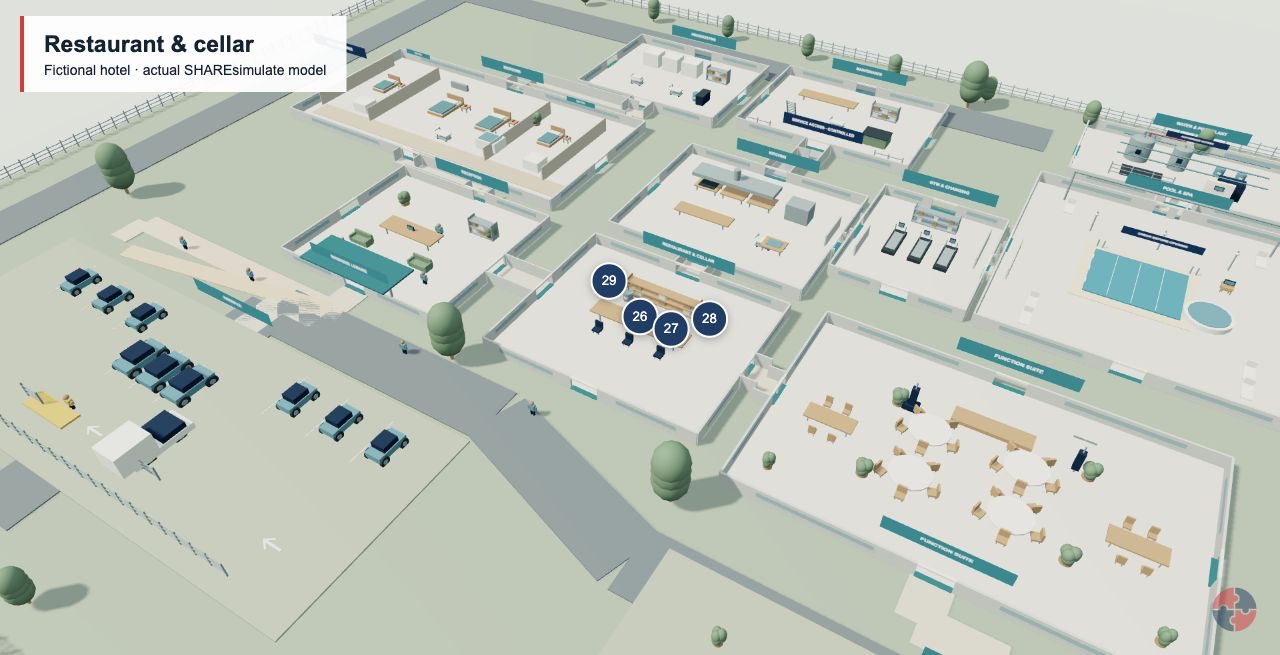
Actual fictional SHAREsimulate hotel model: Restaurant & cellar. The stated case supplies the conditions; the image does not prove a defect or control state.
Verify the ingredient change before giving assurance
An allergen answer describes the food actually served, including substituted ingredients, recipe changes and cross-contact controls. It cannot rely on a familiar product name or last week’s menu folder. Stop the uncertain claim and obtain current ingredient information through the food business’s process before the meal is offered on that basis.
Kitchen and front-of-house communication is a closed loop. The request must reach the people preparing the meal, the intended arrangement must be checked and the correct dish must reach the correct guest. Communicate uncertainty clearly; do not turn a supplier assumption or a guess into reassurance.
Where controls cannot support a claimed allergen-free dish, staff must not make that claim. The learner’s task is to recognise the information gap and use the responsible decision route. This awareness course does not replace the business’s validated allergen procedures or clinical advice.
Work through this separate hotel case
A replacement sauce arrives for a wedding meal, but the printed allergen matrix still refers to the original product.
Apply the same control test whenever the activity, users, product, staffing or conditions change. Control substitutions, recipes, cross-contact and staff communication; verify the allergen information reflects the ingredients actually being served. Check connected areas: Meal service, bar replenishment, glass collection and restricted cellar access.
Evidence to establish: Compare the exact ingredient specification, recipe and customer information. Check the first prepared dish and staff communication before release. Trace the substituted batch into recipes and service information, and ask the server how a guest's allergy enquiry is answered reliably.
How should allergen risk be managed?
Keep ingredient, recipe, substitution and cross-contact information current so customers receive accurate allergen information. Apply the correct nation and food-format labelling route; stop service when the ingredient or allergen status cannot be confirmed.
Allergens deserve their own control route because ordinary cleanliness is not enough. A small amount of allergen can be serious for a sensitised person. Controls need to cover recipes, substitutions, supplier changes, menu wording, staff handover, cleaning and serving practices.
The safest culture is one where staff do not guess. If allergen information is uncertain, the answer should be checked before food is served.
Allergen control points
Control point
What good looks like
Failure scenario
Control pointSupplier and ingredient control
What good looks likeApproved suppliers and checked ingredient changes.
Failure scenarioA substitute product contains an undeclared allergen.
Control pointRecipe and menu control
What good looks likeCurrent recipes and allergen matrix match what is actually cooked.
Failure scenarioKitchen changes a sauce but the menu is not updated.
Control pointCross-contact control
What good looks likeSeparate utensils, storage, cleaning and preparation for allergen-sensitive meals.
Failure scenarioShared tongs transfer allergen to a supposedly safe meal.
Control pointCommunication
What good looks likeStaff know how to answer and when to check.
Failure scenarioFront-of-house staff reassure a customer without verifying.
Control pointIncident response
What good looks likeAllergic reaction triggers first aid, investigation and review.
Failure scenarioNear miss is treated as customer preference rather than safety failure.
A replacement sauce arrives for a wedding meal, but the printed allergen matrix still refers to the original product.
Decision and explanation
Hold uncertain service and update verified information with cross-contact controls.
A shared description does not establish identical ingredients or cross-contact information. Verify the actual replacement before service. This controls the relevant exposure rather than relying on appearance or reassurance. Trace the substituted batch into recipes and service information, and ask the server how a guest's allergy enquiry is answered reliably. A taste test can cause serious harm and is not an allergen control. Never test a person's allergy through exposure.
Lesson 2
Back-of-house risks affect the whole service
Control broken glass and maintain a safe service/waste route.
Actual fictional SHAREsimulate hotel model: Restaurant & cellar. The stated case supplies the conditions; the image does not prove a defect or control state.
Recognise hidden atmospheres and awkward loads
Cellar gases can create hazardous conditions without a reliable sensory warning. A suspected leak, alarm or collapsed person is a reason to keep people out and activate the emergency arrangements, not an invitation for an untrained entry. Do not use smell, breath holding or an open door as proof of a safe atmosphere.
Keep gas-system checks, ventilation, alarm arrangements and specialist response under competent ownership. Know the boundaries of your role before an incident occurs. A safe response should account for other people who may try to help and for adjacent occupied areas under the local emergency plan.
Keg movement and broken-glass handling need suitable equipment and routes. Avoid trapped fingers, uncontrolled rolling and blind handling of waste. Isolate a breakage area, protect exposed food and use the approved collection and disposal method. Closing a bar task includes checking the area, equipment and affected products before release.
Work through this separate hotel case
A cellar gas alarm sounds while a worker is downstairs and a colleague wants to go in to help.
Apply the same control test whenever the activity, users, product, staffing or conditions change. Secure cylinders, maintain connections, select gas-specific detection where required and provide an externally actionable alarm and no-entry response. Check connected areas: Meal service, bar replenishment, glass collection and restricted cellar access.
Evidence to establish: Obtain alarm information and competent atmospheric assessment without entering. Only competent clearance and verified fault correction permit re-entry. Review detector suitability, test and maintenance evidence, ventilation performance and the actual response to a cellar alarm.
How should rescue capability be governed?
Rescue capability should be treated as a controlled emergency function with defined people, equipment, maintenance, drills and review.
Rescue arrangements need the same discipline as entry controls. The organisation should know which types of entry require non-entry retrieval, internal rescue, breathing apparatus, specialist contractors, external emergency-service liaison or a combination. The plan should match the geometry of the space and the likely condition of the casualty.
Drills should test credible scenarios, not comfortable ones. A good drill asks whether communications work, whether equipment reaches the casualty, whether the casualty can be extracted through the access point, whether rescuers are protected and whether the response time is realistic.
Rescue capability governance
Capability
Management requirement
Evidence
Rescue plan library
Plans matched to space classes and tasks.
Task-specific rescue sheets.
People
Competent rescue personnel available during entry.
Training, authorisation and rota.
Equipment
Suitable and maintained retrieval, BA/RPE, communication and first-response kit.
Inspection and maintenance records.
Drills
Scenario-based practice and debrief.
Drill report and action close-out.
External liaison
Emergency services know site access and hazards where relevant.
Emergency plan and liaison notes.
Review
Weaknesses escalated and resourced.
Management review and improvement plan.
Applied case
A cellar gas alarm sounds while a worker is downstairs and a colleague wants to go in to help.
Decision and explanation
Withdraw, restrict access and use the designated emergency response without improvised rescue.
This controls the relevant exposure rather than relying on appearance or reassurance. Review detector suitability, test and maintenance evidence, ventilation performance and the actual response to a cellar alarm. A dangerous atmosphere can rapidly incapacitate a rescuer. Raise the alarm, prevent entry and call the planned specialist emergency response. Carbon dioxide has no reliable smell warning and creates hazards not established by an oxygen-only check. Use competent gas-specific assessment.
Lesson 3
Keep allergen information connected to the served dish
Check the actual ingredient, preparation and communication chain before giving an assurance.
Actual fictional SHAREsimulate hotel model: Restaurant & cellar. The stated case supplies the conditions; the image does not prove a defect or control state.
Keep allergen information connected to the served dish
An allergen enquiry is a decision about the food actually being served. Follow the ingredient from supply information through storage, recipe and preparation to the guest’s plate. A menu or matrix can support that decision only if it remains current and the preparation arrangements match it. Substitutions, garnishes, shared equipment and last-minute changes can break the link even where the main recipe is unchanged.
Front-of-house and kitchen staff need a reliable way to pass the enquiry and confirm the answer. Do not fill an information gap with a guess, a visual inspection or a statement that the ingredient is present only in a small amount. Check the actual information and the relevant cross-contact controls. Where the requested assurance cannot be supported, explain the limitation honestly and follow the approved escalation and alternative-service arrangements.
In the fictional restaurant, a sauce has changed and the supplier specification has not reached service staff. Restrict the unsupported claim while the responsible person resolves it. The evidence is not merely that someone asked the kitchen, but what was checked and how the answer relates to this dish and its preparation. A course record does not authorise staff to make a food-safety claim without that evidence.
How should allergen risk be managed?
Keep ingredient, recipe, substitution and cross-contact information current so customers receive accurate allergen information. Apply the correct nation and food-format labelling route; stop service when the ingredient or allergen status cannot be confirmed.
Allergens deserve their own control route because ordinary cleanliness is not enough. A small amount of allergen can be serious for a sensitised person. Controls need to cover recipes, substitutions, supplier changes, menu wording, staff handover, cleaning and serving practices.
The safest culture is one where staff do not guess. If allergen information is uncertain, the answer should be checked before food is served.
Allergen control points
Control point
What good looks like
Failure scenario
Control pointSupplier and ingredient control
What good looks likeApproved suppliers and checked ingredient changes.
Failure scenarioA substitute product contains an undeclared allergen.
Control pointRecipe and menu control
What good looks likeCurrent recipes and allergen matrix match what is actually cooked.
Failure scenarioKitchen changes a sauce but the menu is not updated.
Control pointCross-contact control
What good looks likeSeparate utensils, storage, cleaning and preparation for allergen-sensitive meals.
Failure scenarioShared tongs transfer allergen to a supposedly safe meal.
Control pointCommunication
What good looks likeStaff know how to answer and when to check.
Failure scenarioFront-of-house staff reassure a customer without verifying.
Control pointIncident response
What good looks likeAllergic reaction triggers first aid, investigation and review.
Failure scenarioNear miss is treated as customer preference rather than safety failure.
A server is told that a new sauce is “probably the same” and is asked to reassure a guest with an allergy.
Decision and explanation
Reliable information about the actual sauce and preparation controls before giving an assurance.
Reliable information about the actual sauce and preparation controls before giving an assurance. In the fictional restaurant, a sauce has changed and the supplier specification has not reached service staff. Restrict the unsupported claim while the responsible person resolves it. The evidence is not merely that someone asked the kitchen, but what was checked and how the answer relates to this dish and its preparation. A course record does not authorise staff to make a food-safety claim without that evidence.
Lesson 4
Organise service without exporting the risk
Review how trays, spill response, glassware and layout affect other people.
Actual fictional SHAREsimulate hotel model: Restaurant & cellar. The stated case supplies the conditions; the image does not prove a defect or control state.
Organise service without exporting the risk
Service changes the environment while guests are using it. A tray, spill, broken glass or rearranged table can alter the walking route immediately. Consider the worker carrying the load and the people who may encounter it: guests with luggage, children, people using mobility aids and colleagues moving in the opposite direction. A task is not controlled if it simply moves the hazard into another person’s path.
Reduce unnecessary carrying and awkward reaches through layout, suitable equipment and the work sequence. Keep load size and visibility compatible with the actual route. Where a spill or breakage occurs, protect the affected area and use the approved response before it is returned to use. A warning sign can communicate a restriction but does not remove contamination, fragments or an unstable surface.
Check the final condition and the service interface. Was the route actually cleaned and made suitable? Did the alternative route obstruct another exit? Has the person reopening the area received the relevant information? In the fictional hotel, closing a cleaning task on a tablet should follow verification of the physical result. Review repeated incidents for layout, equipment or workload issues instead of attributing every event to a careless guest.
What should happen after a sharps injury or suspected exposure?
Speed matters. Workers should not wait until the end of the shift or decide privately that the exposure was probably low risk.
Stop the task and follow the site exposure procedure immediately. For a puncture, gently encourage bleeding, wash with soap and water, and do not scrub or suck the wound. Wash a splash to the eyes or mouth with plenty of water. Report the event promptly and obtain urgent assessment by an appropriate clinician, who decides whether any testing, vaccination or post-exposure treatment is needed; the supervisor must not make that clinical judgement. Do not keep or recap the sharp for testing. HSE workplace blood-borne-virus exposure guidance gives this initial response and follow-up boundary.
Step
Action
Reason
Stop the task
Move to a safe place and prevent further exposure.
Continuing work can spread contamination and delay assessment.
First aid
Encourage gentle bleeding where appropriate, wash with soap and water, cover the wound and irrigate splashes to eyes or mouth.
Early cleansing reduces local contamination and prepares for clinical advice.
Report immediately
Tell the supervisor or agreed contact without delay.
Post-exposure assessment may be time-sensitive.
Seek clinical advice
Use the agreed urgent clinical exposure route or an emergency department; do not delay assessment while waiting for routine appointments.
Qualified clinicians decide testing, vaccination, PEP or follow-up.
Preserve facts
Record what happened, what the sharp was, where it came from and whether source details are known.
Clinical and investigation decisions need accurate facts.
The purpose is preventing recurrence, not blaming the injured person.
Support the worker
Protect confidentiality and offer psychological support where needed.
Sharps injuries can cause significant anxiety while waiting for clinical advice or test results.
Applied case
A drink is spilled beside a table used by guests who need assistance, and a server places a sign while continuing service.
Decision and explanation
Protect people, remove the hazard through the approved method and verify a usable route before release.
Protect people, remove the hazard through the approved method and verify a usable route before release. Check the final condition and the service interface. Was the route actually cleaned and made suitable? Did the alternative route obstruct another exit? Has the person reopening the area received the relevant information? In the fictional hotel, closing a cleaning task on a tablet should follow verification of the physical result. Review repeated incidents for layout, equipment or workload issues instead of attributing every event to a careless guest.
Lesson 5
Treat cellar atmosphere concerns as an emergency boundary
Choose reporting and exclusion without attempting an improvised entry or rescue.
Actual fictional SHAREsimulate hotel model: Restaurant & cellar. The stated case supplies the conditions; the image does not prove a defect or control state.
Treat cellar atmosphere concerns as an emergency boundary
Cellars may contain equipment and substances that create an atmospheric hazard. A gas release can affect a person before they can judge the condition, and smell is not a reliable clearance method. Start with prevention: suitable equipment, maintenance, ventilation, detection and access arrangements determined by the actual assessment. Know what an alarm or suspected release requires within your role.
If someone may be affected, raise the planned emergency response and prevent further exposure. Do not enter to investigate, reset equipment or recover a colleague without the required competent emergency arrangements. Holding your breath, opening a door or relying on a portable fan is not a substitute for a safe system and verified atmosphere. Keep other staff and contractors away from the affected boundary while help is organised.
After an incident, the absence of an audible alarm is not by itself evidence for reopening. The responsible competent people need to establish the cause, relevant equipment and atmospheric condition, effective controls and authorised handback. Communicate any continuing restriction to the next shift. This learning rehearses recognition, reporting and safe boundaries; it does not train gas-system repair, atmospheric testing or rescue entry.
How should rescue capability be governed?
Rescue capability should be treated as a controlled emergency function with defined people, equipment, maintenance, drills and review.
Rescue arrangements need the same discipline as entry controls. The organisation should know which types of entry require non-entry retrieval, internal rescue, breathing apparatus, specialist contractors, external emergency-service liaison or a combination. The plan should match the geometry of the space and the likely condition of the casualty.
Drills should test credible scenarios, not comfortable ones. A good drill asks whether communications work, whether equipment reaches the casualty, whether the casualty can be extracted through the access point, whether rescuers are protected and whether the response time is realistic.
Rescue capability governance
Capability
Management requirement
Evidence
Rescue plan library
Plans matched to space classes and tasks.
Task-specific rescue sheets.
People
Competent rescue personnel available during entry.
Training, authorisation and rota.
Equipment
Suitable and maintained retrieval, BA/RPE, communication and first-response kit.
Inspection and maintenance records.
Drills
Scenario-based practice and debrief.
Drill report and action close-out.
External liaison
Emergency services know site access and hazards where relevant.
Emergency plan and liaison notes.
Review
Weaknesses escalated and resourced.
Management review and improvement plan.
Applied case
A cellar alarm activates while a colleague is below. A server suggests going down quickly to help.
Decision and explanation
Raise the emergency response and prevent further entry while planned competent rescue is mobilised.
Raise the emergency response and prevent further entry while planned competent rescue is mobilised. After an incident, the absence of an audible alarm is not by itself evidence for reopening. The responsible competent people need to establish the cause, relevant equipment and atmospheric condition, effective controls and authorised handback. Communicate any continuing restriction to the next shift. This learning rehearses recognition, reporting and safe boundaries; it does not train gas-system repair, atmospheric testing or rescue entry.
Lesson 6
Check the last handover before the guest receives it
Verify identity and restrictions at the point where service becomes a guest decision.
Actual fictional SHAREsimulate hotel model: Restaurant & cellar. The stated case supplies the conditions; the image does not prove a defect or control state.
Check the last handover before the guest receives it
A service system can be undermined at the final handover. The correct dish may go to the wrong place, a restricted item may be relabelled to clear a queue, or a replacement server may not know that an enquiry remains unresolved. Design the handover so the receiving person understands what is ready, what must remain held and which guest or order the information concerns. Protect privacy while passing the information needed for safe service.
Do not treat speed as the only measure of successful coordination. A short pause to resolve an uncertain order can prevent a serious error. Use a clear escalation route when the dish, ingredients, label or preparation evidence does not match the intended service. Keep the relevant item controlled instead of placing it where another worker could serve it by mistake.
At the end of the shift, review the cause as well as the immediate correction. Was the source information current? Did the pass, booking or ordering process preserve the enquiry? Could another team recreate the same error? A useful action has a responsible role and a verification step that tests the changed arrangement during real service. The fictional exercise records learning rather than a real guest’s dietary information.
What can a manual-handling weight or tool score actually tell us?
The law has no fixed safe lifting weight. Observe the full task and the person doing it; a filter or coloured tool score is a screening aid, not permission to continue a harmful lift.
Manual handling includes lifting, lowering, carrying, pushing, pulling and supporting a load. If the task cannot be avoided, consider frequency, reach, vertical travel, twisting, grip, load stability, route, pace and the individual. The same carton can present different risk at floor level and waist height. HSE manual handling at work and HSE L23 Manual handling guidance on regulations.
V-MAC is for work meeting HSE’s full eligibility conditions, including regular single-person handling with substantially variable loads/frequency over a substantial part of the shift. Variable box weights alone do not make the two-person archive example eligible. Assess relevant lift/carry and trolley push/pull elements separately with MAC/RAPP as appropriate; do not combine scores into a pass mark. HSE: V-MAC criteria and toolkit limitations.
Applied case
A held plate is placed beside ready meals without any clear status, and a new server starts clearing the pass.
Decision and explanation
A clearly controlled status and a confirmed, specific release decision before the item enters service.
A clearly controlled status and a confirmed, specific release decision before the item enters service. At the end of the shift, review the cause as well as the immediate correction. Was the source information current? Did the pass, booking or ordering process preserve the enquiry? Could another team recreate the same error? A useful action has a responsible role and a verification step that tests the changed arrangement during real service. The fictional exercise records learning rather than a real guest’s dietary information.
Lesson 7
Ingredient substitution invalidates allergen information
Check the actual product label and specification whenever an ingredient changes. Update controlled recipe and allergen information before service, including affected prepacked formats where relevant. If the business cannot provide reliable information for a requested meal, it must not guess or give unsupported reassurance.
Actual fictional SHAREsimulate hotel model: Restaurant & cellar. The stated case supplies the conditions; the image does not prove a defect or control state.
Understand the activity and how harm develops
A supplier substitution can introduce an allergen that is absent from the current recipe record or menu information. The failure travels through purchasing, preparation and guest communication. For a person with an allergy, reassurance based on an outdated matrix can lead to a severe reaction even though the dish looks unchanged.
Check the actual product label and specification whenever an ingredient changes. Update controlled recipe and allergen information before service, including affected prepacked formats where relevant. If the business cannot provide reliable information for a requested meal, it must not guess or give unsupported reassurance.
Restaurant service connects purchasing, kitchen preparation, customer communication and the cellar. Staff need a reliable way to obtain the actual information and stop a task when a condition is unresolved. Customer demand and an apparently normal product or room do not establish that a critical control is effective.
Recognise the evidence boundary
Question
Case evidence
What is observed?
A substitute sauce arrives but the menu allergen record shows the previous recipe.
How can harm occur?
A guest could unknowingly consume an allergen and suffer a serious reaction.
What information is needed?
Compare the exact ingredient specification, recipe and customer information.
Protect, manage and verify
Purpose
Practical application
Immediate protection
Hold uncertain service and update verified information with cross-contact controls.
Accountable work arrangement
Hold uncertain service and update verified information with cross-contact controls. Control substitutions, recipes, cross-contact and staff communication; verify the allergen information reflects the ingredients actually being served. Design separation, storage and temperature-control arrangements for the actual food flow. Agree the responsible person and safe interim arrangement for ingredient record. Reopen or restart only when the relevant verification below has been accepted.
Release verification
Check the first prepared dish and staff communication before release.
Apply this at work
Apply the same control test whenever the activity, users, product, staffing or conditions change. Control substitutions, recipes, cross-contact and staff communication; verify the allergen information reflects the ingredients actually being served. Check connected areas: Meal service, bar replenishment, glass collection and restricted cellar access.
How should allergen risk be managed?
Keep ingredient, recipe, substitution and cross-contact information current so customers receive accurate allergen information. Apply the correct nation and food-format labelling route; stop service when the ingredient or allergen status cannot be confirmed.
Allergens deserve their own control route because ordinary cleanliness is not enough. A small amount of allergen can be serious for a sensitised person. Controls need to cover recipes, substitutions, supplier changes, menu wording, staff handover, cleaning and serving practices.
The safest culture is one where staff do not guess. If allergen information is uncertain, the answer should be checked before food is served.
Allergen control points
Control point
What good looks like
Failure scenario
Control pointSupplier and ingredient control
What good looks likeApproved suppliers and checked ingredient changes.
Failure scenarioA substitute product contains an undeclared allergen.
Control pointRecipe and menu control
What good looks likeCurrent recipes and allergen matrix match what is actually cooked.
Failure scenarioKitchen changes a sauce but the menu is not updated.
Control pointCross-contact control
What good looks likeSeparate utensils, storage, cleaning and preparation for allergen-sensitive meals.
Failure scenarioShared tongs transfer allergen to a supposedly safe meal.
Control pointCommunication
What good looks likeStaff know how to answer and when to check.
Failure scenarioFront-of-house staff reassure a customer without verifying.
Control pointIncident response
What good looks likeAllergic reaction triggers first aid, investigation and review.
Failure scenarioNear miss is treated as customer preference rather than safety failure.
A replacement sauce arrives for a wedding meal, but the printed allergen matrix still refers to the original product.
Decision and explanation
Hold uncertain service and update verified information with cross-contact controls.
A shared description does not establish identical ingredients or cross-contact information. Verify the actual replacement before service. This controls the relevant exposure rather than relying on appearance or reassurance. Trace the substituted batch into recipes and service information, and ask the server how a guest's allergy enquiry is answered reliably. A taste test can cause serious harm and is not an allergen control. Never test a person's allergy through exposure.
Lesson 8
Broken glass contaminates service and waste
Stop service in the affected area and follow the assessed breakage procedure, including disposal of potentially contaminated food or ice. Use suitable tools and a rigid appropriate waste container. Inspect and authorise return to service rather than relying on the absence of visible large pieces.
Actual fictional SHAREsimulate hotel model: Restaurant & cellar. The stated case supplies the conditions; the image does not prove a defect or control state.
Understand the activity and how harm develops
Broken glass can cut staff and contaminate food, ice or service equipment. Fragments may travel further than the obvious breakage and remain in cloths or waste. Reaching into an ice well or pushing glass into a thin bag creates an additional injury route.
Stop service in the affected area and follow the assessed breakage procedure, including disposal of potentially contaminated food or ice. Use suitable tools and a rigid appropriate waste container. Inspect and authorise return to service rather than relying on the absence of visible large pieces.
Restaurant service connects purchasing, kitchen preparation, customer communication and the cellar. Staff need a reliable way to obtain the actual information and stop a task when a condition is unresolved. Customer demand and an apparently normal product or room do not establish that a critical control is effective.
Recognise the evidence boundary
Question
Case evidence
What is observed?
Broken glass is isolated in a labelled rigid container away from service.
How can harm occur?
Loose fragments could cut staff or contaminate nearby food and drink.
What information is needed?
Check the affected area, container and safe collection procedure.
Protect, manage and verify
Purpose
Practical application
Immediate protection
Preserve segregation and remove fragments using suitable tools, never bare hands.
Accountable work arrangement
Preserve segregation and remove fragments using suitable tools, never bare hands. Restrict the affected service area, use a defined contamination boundary and suitable collection tools, and manage the waste without hand sorting. Choose suitable task design, equipment and product or material controls for the actual exposure. Agree the responsible person and safe interim arrangement for glass service. Reopen or restart only when the relevant verification below has been accepted.
Release verification
Inspect the service area and verify safe disposal and any food disposition.
Apply this at work
Apply the same control test whenever the activity, users, product, staffing or conditions change. Restrict the affected service area, use a defined contamination boundary and suitable collection tools, and manage the waste without hand sorting. Check connected areas: Meal service, bar replenishment, glass collection and restricted cellar access.
What should happen after a sharps injury or suspected exposure?
Speed matters. Workers should not wait until the end of the shift or decide privately that the exposure was probably low risk.
Stop the task and follow the site exposure procedure immediately. For a puncture, gently encourage bleeding, wash with soap and water, and do not scrub or suck the wound. Wash a splash to the eyes or mouth with plenty of water. Report the event promptly and obtain urgent assessment by an appropriate clinician, who decides whether any testing, vaccination or post-exposure treatment is needed; the supervisor must not make that clinical judgement. Do not keep or recap the sharp for testing. HSE workplace blood-borne-virus exposure guidance gives this initial response and follow-up boundary.
Step
Action
Reason
Stop the task
Move to a safe place and prevent further exposure.
Continuing work can spread contamination and delay assessment.
First aid
Encourage gentle bleeding where appropriate, wash with soap and water, cover the wound and irrigate splashes to eyes or mouth.
Early cleansing reduces local contamination and prepares for clinical advice.
Report immediately
Tell the supervisor or agreed contact without delay.
Post-exposure assessment may be time-sensitive.
Seek clinical advice
Use the agreed urgent clinical exposure route or an emergency department; do not delay assessment while waiting for routine appointments.
Qualified clinicians decide testing, vaccination, PEP or follow-up.
Preserve facts
Record what happened, what the sharp was, where it came from and whether source details are known.
Clinical and investigation decisions need accurate facts.
The purpose is preventing recurrence, not blaming the injured person.
Support the worker
Protect confidentiality and offer psychological support where needed.
Sharps injuries can cause significant anxiety while waiting for clinical advice or test results.
Applied case
A glass breaks beside an open ice well while drinks are being prepared for a function.
Decision and explanation
Preserve segregation and remove fragments using suitable tools, never bare hands.
This transfers the cutting hazard to cleaners and waste handlers. Use appropriate rigid containment and do not compress sharp waste. This controls the relevant exposure rather than relying on appearance or reassurance. Check all potentially affected food, ice, equipment and waste routes and record the competent release decision after cleaning. Small fragments may be hidden in the ice. Apply the breakage procedure and remove potentially contaminated material.
Lesson 9
Cellar gas leak creates a hidden atmosphere hazard
Prevent leaks through suitable installation and maintenance, provide assessed ventilation and detection and plan a safe response. Assess whether the space meets the confined-space definition through its conditions and specified risks. Never enter to investigate an alarm or rescue someone without the competent emergency arrangement.
Actual fictional SHAREsimulate hotel model: Restaurant & cellar. The stated case supplies the conditions; the image does not prove a defect or control state.
Understand the activity and how harm develops
Beverage gas escaping in a cellar can create a dangerous atmosphere that cannot be judged by sight or smell. Carbon dioxide can have harmful physiological effects as well as displacing oxygen. An oxygen-only instrument may therefore be insufficient for the actual gas hazard, and a small room can become dangerous before a person recognises symptoms.
Prevent leaks through suitable installation and maintenance, provide assessed ventilation and detection and plan a safe response. Assess whether the space meets the confined-space definition through its conditions and specified risks. Never enter to investigate an alarm or rescue someone without the competent emergency arrangement.
Restaurant service connects purchasing, kitchen preparation, customer communication and the cellar. Staff need a reliable way to obtain the actual information and stop a task when a condition is unresolved. Customer demand and an apparently normal product or room do not establish that a critical control is effective.
Recognise the evidence boundary
Question
Case evidence
What is observed?
A cellar gas alarm activates; the doorway gives no proof of safe air.
How can harm occur?
A leaking gas can create a dangerous atmosphere and incapacitate an entrant.
What information is needed?
Obtain alarm information and competent atmospheric assessment without entering.
Protect, manage and verify
Purpose
Practical application
Immediate protection
Withdraw, restrict access and use the designated emergency response without improvised rescue.
Accountable work arrangement
Withdraw, restrict access and use the designated emergency response without improvised rescue. Secure cylinders, maintain connections, select gas-specific detection where required and provide an externally actionable alarm and no-entry response. Prevent leaks and provide suitable assessed ventilation and gas-specific detection. Agree the responsible person and safe interim arrangement for cellar gas. Reopen or restart only when the relevant verification below has been accepted.
Release verification
Only competent clearance and verified fault correction permit re-entry.
Apply this at work
Apply the same control test whenever the activity, users, product, staffing or conditions change. Secure cylinders, maintain connections, select gas-specific detection where required and provide an externally actionable alarm and no-entry response. Check connected areas: Meal service, bar replenishment, glass collection and restricted cellar access.
How should rescue capability be governed?
Rescue capability should be treated as a controlled emergency function with defined people, equipment, maintenance, drills and review.
Rescue arrangements need the same discipline as entry controls. The organisation should know which types of entry require non-entry retrieval, internal rescue, breathing apparatus, specialist contractors, external emergency-service liaison or a combination. The plan should match the geometry of the space and the likely condition of the casualty.
Drills should test credible scenarios, not comfortable ones. A good drill asks whether communications work, whether equipment reaches the casualty, whether the casualty can be extracted through the access point, whether rescuers are protected and whether the response time is realistic.
Rescue capability governance
Capability
Management requirement
Evidence
Rescue plan library
Plans matched to space classes and tasks.
Task-specific rescue sheets.
People
Competent rescue personnel available during entry.
Training, authorisation and rota.
Equipment
Suitable and maintained retrieval, BA/RPE, communication and first-response kit.
Inspection and maintenance records.
Drills
Scenario-based practice and debrief.
Drill report and action close-out.
External liaison
Emergency services know site access and hazards where relevant.
Emergency plan and liaison notes.
Review
Weaknesses escalated and resourced.
Management review and improvement plan.
Applied case
A cellar gas alarm sounds while a worker is downstairs and a colleague wants to go in to help.
Decision and explanation
Withdraw, restrict access and use the designated emergency response without improvised rescue.
Carbon dioxide has no reliable smell warning and creates hazards not established by an oxygen-only check. Use competent gas-specific assessment. This controls the relevant exposure rather than relying on appearance or reassurance. Review detector suitability, test and maintenance evidence, ventilation performance and the actual response to a cellar alarm. A dangerous atmosphere can rapidly incapacitate a rescuer. Raise the alarm, prevent entry and call the planned specialist emergency response.
Lesson 10
Keg movement exposes hands and feet
Avoid manual movement where a suitable handling system can do the work. Choose equipment for the actual load and route, maintain it and plan storage to prevent uncontrolled movement. Team lifting is not automatically a safe solution; assess coordination, space and the physical demand before selecting a method.
Actual fictional SHAREsimulate hotel model: Restaurant & cellar. The stated case supplies the conditions; the image does not prove a defect or control state.
Understand the activity and how harm develops
Kegs combine substantial weight with a shape that can roll or trap hands and feet. Cellar steps, narrow doors and wet floors increase the demand and reduce control. Trying to catch a falling keg or steady it with a foot exposes the worker to a crushing injury.
Avoid manual movement where a suitable handling system can do the work. Choose equipment for the actual load and route, maintain it and plan storage to prevent uncontrolled movement. Team lifting is not automatically a safe solution; assess coordination, space and the physical demand before selecting a method.
Restaurant service connects purchasing, kitchen preparation, customer communication and the cellar. Staff need a reliable way to obtain the actual information and stop a task when a condition is unresolved. Customer demand and an apparently normal product or room do not establish that a critical control is effective.
Recognise the evidence boundary
Question
Case evidence
What is observed?
A keg must be moved across a threshold without the usual handling aid.
How can harm occur?
A rolling or dropped keg can crush feet or trap hands and cause strain.
What information is needed?
Check keg weight, route, handling aid and the worker's method.
Protect, manage and verify
Purpose
Practical application
Immediate protection
Use suitable handling equipment and a controlled route or defer the move.
Accountable work arrangement
Use suitable handling equipment and a controlled route or defer the move. Provide suitable keg-handling equipment and secure storage, control the route and keep people clear of rolling or dropped-load paths. Redesign loads, heights and routes and provide suitable maintained handling aids. Agree the responsible person and safe interim arrangement for kegs. Reopen or restart only when the relevant verification below has been accepted.
Release verification
Observe a stable assisted movement without hands or feet in trapping positions.
Apply this at work
Apply the same control test whenever the activity, users, product, staffing or conditions change. Provide suitable keg-handling equipment and secure storage, control the route and keep people clear of rolling or dropped-load paths. Check connected areas: Meal service, bar replenishment, glass collection and restricted cellar access.
What can a manual-handling weight or tool score actually tell us?
The law has no fixed safe lifting weight. Observe the full task and the person doing it; a filter or coloured tool score is a screening aid, not permission to continue a harmful lift.
Manual handling includes lifting, lowering, carrying, pushing, pulling and supporting a load. If the task cannot be avoided, consider frequency, reach, vertical travel, twisting, grip, load stability, route, pace and the individual. The same carton can present different risk at floor level and waist height. HSE manual handling at work and HSE L23 Manual handling guidance on regulations.
V-MAC is for work meeting HSE’s full eligibility conditions, including regular single-person handling with substantially variable loads/frequency over a substantial part of the shift. Variable box weights alone do not make the two-person archive example eligible. Assess relevant lift/carry and trolley push/pull elements separately with MAC/RAPP as appropriate; do not combine scores into a pass mark. HSE: V-MAC criteria and toolkit limitations.
Applied case
A keg has to pass a narrow cellar threshold and someone proposes rolling it across another worker's boot.
Decision and explanation
Use suitable handling equipment and a controlled route or defer the move.
The foot becomes part of the trapping point. Use suitable handling equipment and a route designed for the load. This controls the relevant exposure rather than relying on appearance or reassurance. Observe a representative delivery and changeover with the selected equipment, checking thresholds, hand clearance, load restraint and stable storage. More people do not remove a restricted route or crushing points. Assess and change the method before the move.
Use the appropriate manual handling assessment
This additional teaching takes about 2–5 minutes, in addition to the course estimate. Optional reading and workplace assessment take additional time.
Start by asking whether the hazardous handling can be removed or redesigned. Where handling remains, observe the whole operation with the people who do it and choose an assessment that fits the work.
These aids support the activity assessment. Repetitive upper-limb work may need ART; variable or complex tasks may need other HSE tools or a fuller competent assessment. Mechanical lifting, stored energy, equipment safety and health decisions retain their separate controls. A low factor score, a downloaded report or completion of this course does not approve the work.
TILEO: Task, Individual, Load, Environment and Other factors. MAC: Manual Handling Assessment Charts for appropriate lifting, carrying and team handling. RAPP: Risk Assessment of Pushing and Pulling for appropriate manual pushing and pulling.
Read the portable guide to understand selection, limitations, the mixed-task example and company-branded Word/PDF records. Your existing course checks and completion requirements remain separate.
Recognise cellar gas and keg-handling hazards without improvising rescue or handling.
Actual fictional SHAREsimulate hotel model: Restaurant & cellar. The stated case supplies the conditions; the image does not prove a defect or control state.
Resolve the connected hotel case
A substituted sauce arrives during dinner service. An old allergen sheet is still on the counter, a glass breaks beside the garnish station and a cellar alarm sounds while a worker prepares to move a keg. Decide the separate food, public-access and cellar restrictions and how each will be verified.
Separate the affected activities before deciding what may proceed. For each, state the observed condition, people who could be harmed, mechanism of harm and the control actually available. Do not assume that resolving one concern releases a different task. Identify uncertainty explicitly and preserve the relevant restriction while the responsible competent person resolves it.
Compare the reasoning below with the facts in the combined case. These are teaching examples with their own stated conditions; they do not add unstated defects or measurements to the case. Use the same evidence questions to decide which controls matter and what must be verified.
In the fictional restaurant, a sauce has changed and the supplier specification has not reached service staff. Restrict the unsupported claim while the responsible person resolves it. The evidence is not merely that someone asked the kitchen, but what was checked and how the answer relates to this dish and its preparation. A course record does not authorise staff to make a food-safety claim without that evidence.
Check the final condition and the service interface. Was the route actually cleaned and made suitable? Did the alternative route obstruct another exit? Has the person reopening the area received the relevant information? In the fictional hotel, closing a cleaning task on a tablet should follow verification of the physical result. Review repeated incidents for layout, equipment or workload issues instead of attributing every event to a careless guest.
After an incident, the absence of an audible alarm is not by itself evidence for reopening. The responsible competent people need to establish the cause, relevant equipment and atmospheric condition, effective controls and authorised handback. Communicate any continuing restriction to the next shift. This learning rehearses recognition, reporting and safe boundaries; it does not train gas-system repair, atmospheric testing or rescue entry.
At the end of the shift, review the cause as well as the immediate correction. Was the source information current? Did the pass, booking or ordering process preserve the enquiry? Could another team recreate the same error? A useful action has a responsible role and a verification step that tests the changed arrangement during real service. The fictional exercise records learning rather than a real guest’s dietary information.
Build a release and handover decision for each issue. Name the responsible role, immediate protection, information still needed and objective condition for release. Explain what remains held to the people controlling the next use. A signed form, completed course or commercial deadline cannot manufacture the missing evidence. Where the relevant control has been verified, record precisely what that decision covers and what change would trigger another review.
Control and verification for the assigned activities
Ingredient substitution invalidates allergen information: Hold uncertain service and update verified information with cross-contact controls. Verification: Check the first prepared dish and staff communication before release.
Broken glass contaminates service and waste: Preserve segregation and remove fragments using suitable tools, never bare hands. Verification: Inspect the service area and verify safe disposal and any food disposition.
Cellar gas leak creates a hidden atmosphere hazard: Withdraw, restrict access and use the designated emergency response without improvised rescue. Verification: Only competent clearance and verified fault correction permit re-entry.
Keg movement exposes hands and feet: Use suitable handling equipment and a controlled route or defer the move. Verification: Observe a stable assisted movement without hands or feet in trapping positions.
How should allergen risk be managed?
Keep ingredient, recipe, substitution and cross-contact information current so customers receive accurate allergen information. Apply the correct nation and food-format labelling route; stop service when the ingredient or allergen status cannot be confirmed.
Allergens deserve their own control route because ordinary cleanliness is not enough. A small amount of allergen can be serious for a sensitised person. Controls need to cover recipes, substitutions, supplier changes, menu wording, staff handover, cleaning and serving practices.
The safest culture is one where staff do not guess. If allergen information is uncertain, the answer should be checked before food is served.
Allergen control points
Control point
What good looks like
Failure scenario
Control pointSupplier and ingredient control
What good looks likeApproved suppliers and checked ingredient changes.
Failure scenarioA substitute product contains an undeclared allergen.
Control pointRecipe and menu control
What good looks likeCurrent recipes and allergen matrix match what is actually cooked.
Failure scenarioKitchen changes a sauce but the menu is not updated.
Control pointCross-contact control
What good looks likeSeparate utensils, storage, cleaning and preparation for allergen-sensitive meals.
Failure scenarioShared tongs transfer allergen to a supposedly safe meal.
Control pointCommunication
What good looks likeStaff know how to answer and when to check.
Failure scenarioFront-of-house staff reassure a customer without verifying.
Control pointIncident response
What good looks likeAllergic reaction triggers first aid, investigation and review.
Failure scenarioNear miss is treated as customer preference rather than safety failure.
What can a manual-handling weight or tool score actually tell us?
The law has no fixed safe lifting weight. Observe the full task and the person doing it; a filter or coloured tool score is a screening aid, not permission to continue a harmful lift.
Manual handling includes lifting, lowering, carrying, pushing, pulling and supporting a load. If the task cannot be avoided, consider frequency, reach, vertical travel, twisting, grip, load stability, route, pace and the individual. The same carton can present different risk at floor level and waist height. HSE manual handling at work and HSE L23 Manual handling guidance on regulations.
V-MAC is for work meeting HSE’s full eligibility conditions, including regular single-person handling with substantially variable loads/frequency over a substantial part of the shift. Variable box weights alone do not make the two-person archive example eligible. Assess relevant lift/carry and trolley push/pull elements separately with MAC/RAPP as appropriate; do not combine scores into a pass mark. HSE: V-MAC criteria and toolkit limitations.
Applied case
A substituted sauce arrives during dinner service. An old allergen sheet is still on the counter, a glass breaks beside the garnish station and a cellar alarm sounds while a worker prepares to move a keg. Decide the separate food, public-access and cellar restrictions and how each will be verified.
Decision and explanation
Separate the affected tasks, maintain necessary restrictions and verify each release with its responsible competent owner.
One resolved issue does not release another. Match actual controls and evidence to each task and preserve the restriction and release conditions through handover.
Lesson 12
Take a verified action into the workplace
Connect one actual task to an owner, evidence and a clear release or escalation decision.
Actual fictional SHAREsimulate hotel model: Restaurant & cellar. The stated case supplies the conditions; the image does not prove a defect or control state.
Turn awareness into a practical question
Independent hotel, pool and leisure awareness using the fictional Riverside model. GB workplace guidance; apply corresponding NI and nation-specific arrangements. England-specific fire guidance is labelled. Learning does not establish practical competence, clinical advice, specialist work or operational authority.
Choose one relevant operation from the course. Describe the people at risk, the mechanism of harm and the exact condition that needs controlling. Separate an observation from a conclusion. A display, signature, badge or clean appearance answers only a limited question.
Use the included practice resources to prepare a fictional task brief, risk review or verification question. Decide which competent role owns the decision and which evidence must be available before the affected activity is released. Keep guest protection and staff protection as distinct decisions where both apply.
At work, use your actual approved arrangements. Report uncertainty and preserve the relevant hold, restriction or safe state while it is resolved. Confirm that the action addressed the original harm route and check whether another shift, product, cleaning task or maintenance change could reintroduce it.
Course completion records awareness learning. It does not establish practical competence, authorise pool operation, intrusive maintenance, chemical dosing or emergency entry.
How should allergen risk be managed?
Keep ingredient, recipe, substitution and cross-contact information current so customers receive accurate allergen information. Apply the correct nation and food-format labelling route; stop service when the ingredient or allergen status cannot be confirmed.
Allergens deserve their own control route because ordinary cleanliness is not enough. A small amount of allergen can be serious for a sensitised person. Controls need to cover recipes, substitutions, supplier changes, menu wording, staff handover, cleaning and serving practices.
The safest culture is one where staff do not guess. If allergen information is uncertain, the answer should be checked before food is served.
Allergen control points
Control point
What good looks like
Failure scenario
Control pointSupplier and ingredient control
What good looks likeApproved suppliers and checked ingredient changes.
Failure scenarioA substitute product contains an undeclared allergen.
Control pointRecipe and menu control
What good looks likeCurrent recipes and allergen matrix match what is actually cooked.
Failure scenarioKitchen changes a sauce but the menu is not updated.
Control pointCross-contact control
What good looks likeSeparate utensils, storage, cleaning and preparation for allergen-sensitive meals.
Failure scenarioShared tongs transfer allergen to a supposedly safe meal.
Control pointCommunication
What good looks likeStaff know how to answer and when to check.
Failure scenarioFront-of-house staff reassure a customer without verifying.
Control pointIncident response
What good looks likeAllergic reaction triggers first aid, investigation and review.
Failure scenarioNear miss is treated as customer preference rather than safety failure.
What can a manual-handling weight or tool score actually tell us?
The law has no fixed safe lifting weight. Observe the full task and the person doing it; a filter or coloured tool score is a screening aid, not permission to continue a harmful lift.
Manual handling includes lifting, lowering, carrying, pushing, pulling and supporting a load. If the task cannot be avoided, consider frequency, reach, vertical travel, twisting, grip, load stability, route, pace and the individual. The same carton can present different risk at floor level and waist height. HSE manual handling at work and HSE L23 Manual handling guidance on regulations.
V-MAC is for work meeting HSE’s full eligibility conditions, including regular single-person handling with substantially variable loads/frequency over a substantial part of the shift. Variable box weights alone do not make the two-person archive example eligible. Assess relevant lift/carry and trolley push/pull elements separately with MAC/RAPP as appropriate; do not combine scores into a pass mark. HSE: V-MAC criteria and toolkit limitations.
Applied case
The shift action log says “training completed, issue closed”. It records no condition check, restriction status or task owner.
Decision and explanation
The accountable person verifies the task-specific control and records the justified decision.
Learning supports the decision; evidence that the relevant control works is needed before the responsible person closes the action.