Full public teaching and readers are free without an account. A free learner account is required for saved LMS progress and recorded assessment. Completion and any course-completion certificate depend on the configured LMS conditions. Full course outline and access routes.
Lesson 1
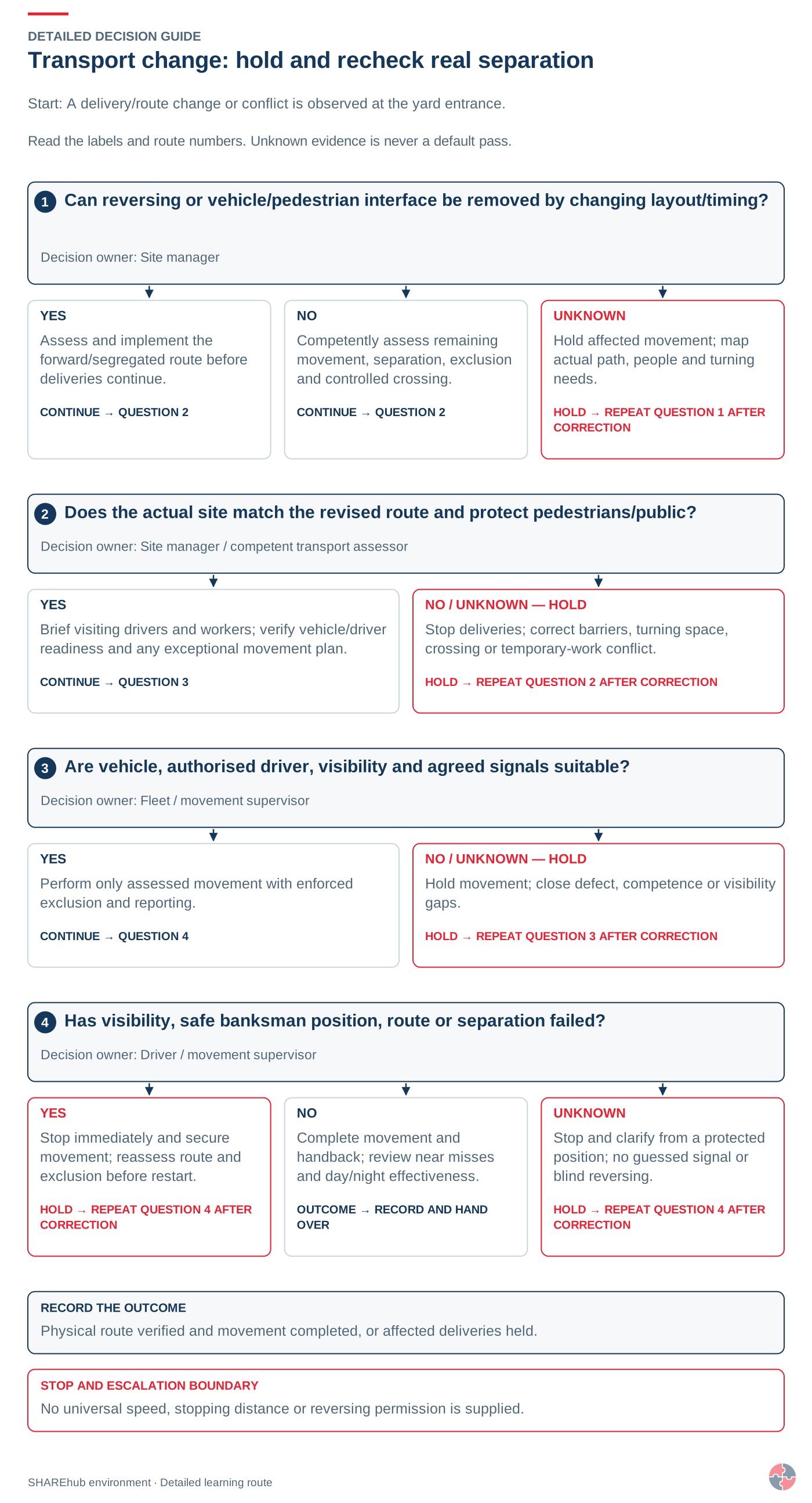
Read the whole tanker route
Identify where people, vehicles and loading equipment can occupy the same space.
The parked tanker is only one part of the movement
The model’s loading lane shows the tanker in a clear position, but a real journey includes approach, waiting, turning, stopping and departure. A trailer follows a swept path that differs from the cab. A person visible before a turn can disappear into a blind area. Evaluate the route from the driver’s and pedestrian’s viewpoints, including reception doors, visitor parking, shortcuts and the public-road boundary.
The strongest improvement removes unnecessary conflict. Separate pedestrian access, protected footways and a layout that reduces reversing can achieve more than adding instructions beside an existing collision point. Where routes cross, establish how one movement is held while the other proceeds, with suitable visibility and understandable controls. A painted line, high-visibility jacket, beacon or reversing sounder can support the plan but cannot physically preserve separation.
Timing is a control interface as well as a scheduling decision. Two simultaneous arrivals can fill the agreed waiting space and displace the queue towards a pedestrian route or public road. Delivery booking should match available space, staffing and release times. A late vehicle does not gain priority over people. Use the agreed holding position and contact route when the intended arrangement cannot be maintained.
Inspect emergency access and exits along the complete movement. A conveniently parked trailer or pallet can obstruct a route needed in a release. Test representative arrangements safely with the relevant people, rather than discovering a conflict during an incident. In the gate mission, identify the point where you would stop movement and which observation would show that the crossing is protected before entry resumes.
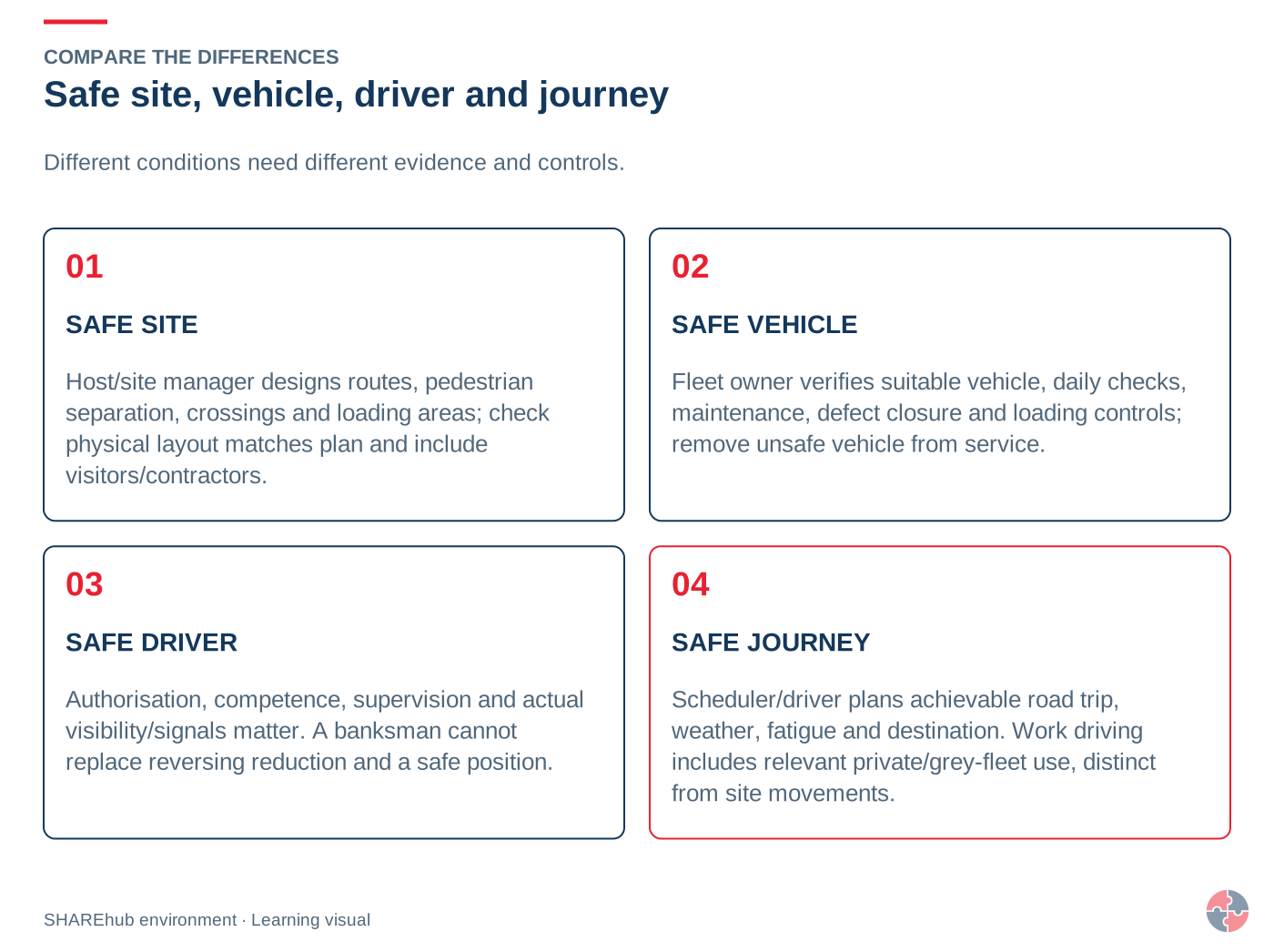
How does the safe site, safe vehicle, safe driver and safe journey model work?
The model separates transport risk into parts that can be checked, owned and improved.
Workplace transport and road driving overlap, but they need different controls. A yard needs route design, segregation, reversing control and loading rules. A road journey needs planning, fatigue control, vehicle roadworthiness, phone rules, weather decisions and realistic schedules.
The model is useful because it stops organisations blaming the driver for risks created by layout, deadlines, vehicle defects, poor delivery control or unmanaged grey fleet.
Element
What to control
Practical demonstration
Safe site
Segregation, routes, reversing, lighting, surface, speed and loading areas.
A protected pedestrian route from gate to reception and no routine reversing through walkways.
Safe vehicle
Suitability, maintenance, daily checks, reversing aids, visibility and load security.
Defective reversing camera triggers repair or revised method before work continues.
Safe driver/operator
Competence, authorisation, fitness, fatigue, phones, behaviour and supervision.
Driver can delay a journey when fatigued without penalty.
Safe journey
Route, weather, time pressure, welfare stops, lone work and emergency arrangements.
Schedule allows breaks and avoids calls while driving.
Safe interface
Visiting drivers, contractors, pedestrians, cyclists, agency staff and temporary routes.
Visitors are briefed and kept in a safe waiting area before loading.
When are banksmen useful and where do they fail?
Banksmen can support controlled movements, but they do not replace segregation, layout and vehicle controls.
A banksman is sometimes needed for reversing, lifting, manoeuvring or complex vehicle movements. But using a banksman as the main control for poor design is weak. The banksman can be struck, ignored, hidden in a blind spot or drawn into the line of fire.
If a movement happens repeatedly, redesign the route or loading area where practicable rather than relying on manual signalling every time.
One-off complex delivery. Banksman role: Control movement and communication; Better design question: Can timing and area be isolated?.
Routine reversing. Banksman role: May support but should not be default; Better design question: Can one-way route remove reversing?.
Poor visibility. Banksman role: Guide only from safe position; Better design question: Can cameras, mirrors or route design improve visibility?.
Public interface. Banksman role: Coordinate with barriers and exclusion; Better design question: Can public be physically separated?.
No safe standing point. Banksman role: Do not use banksman as sacrificial control; Better design question: Redesign movement or stop.
How does work-related road driving fit into workplace transport?
Road risk needs safe journey, safe driver and safe vehicle controls alongside site transport controls.
Many organisations manage site vehicles carefully but overlook road journeys. A field engineer driving between jobs, a manager visiting sites or a worker using a private car for business still creates work-related road risk.
The organisation should control journey need, timing, fatigue, distraction, vehicle condition, driver competence, insurance, emergency arrangements and pressure from appointments or delivery targets.
Journey need. Good practice: Avoid unnecessary journeys; Weak practice: Drive because it is habit.
Timing. Good practice: Allow rest and realistic schedules; Weak practice: Back-to-back jobs encourage speeding.
Driver fitness. Good practice: Fatigue and medication concerns can be reported; Weak practice: Drivers fear reporting issues.
Distraction. Good practice: No calls or messages while driving; Weak practice: Work calls expected on the road.
Vehicle. Good practice: Maintenance, tyres and defects are controlled; Weak practice: Private vehicles unchecked.
Emergency. Good practice: Breakdown and lone-worker routes are known; Weak practice: Driver improvises.
A private-car trip between work sites is work travel and needs the grey-fleet checks. Ordinary travel between home and the usual workplace is generally commuting; a home-origin journey to somewhere other than the normal workplace may be work travel. Establish the actual purpose and pattern using the applicable GB or NI route, including relevant motorcycles and cycles. Do not classify every journey from home alike.
Fictional road decision: delay changes the plan
A technician’s site-to-site appointment is delayed. The fleet/line manager checks the actual vehicle, authorisation, business-use insurance, defects and driver fatigue, then reschedules or provides another safe arrangement instead of asking the driver to recover time. Hold the journey if the vehicle or driver is not fit for it. Record the revised appointment, work cover and receiving contact; a valid MOT alone does not release the trip.
Applied case
Two tankers arrive together while a visitor crosses towards reception. The second driver wants to move closer to keep the public road clear.
Decision and explanation
Keep movement at a safe hold and restore the agreed protected crossing and waiting arrangement.
A controlled hold protects the crossing while the queue is managed. Improvised squeezing or warnings do not establish safe separation.
Look closer
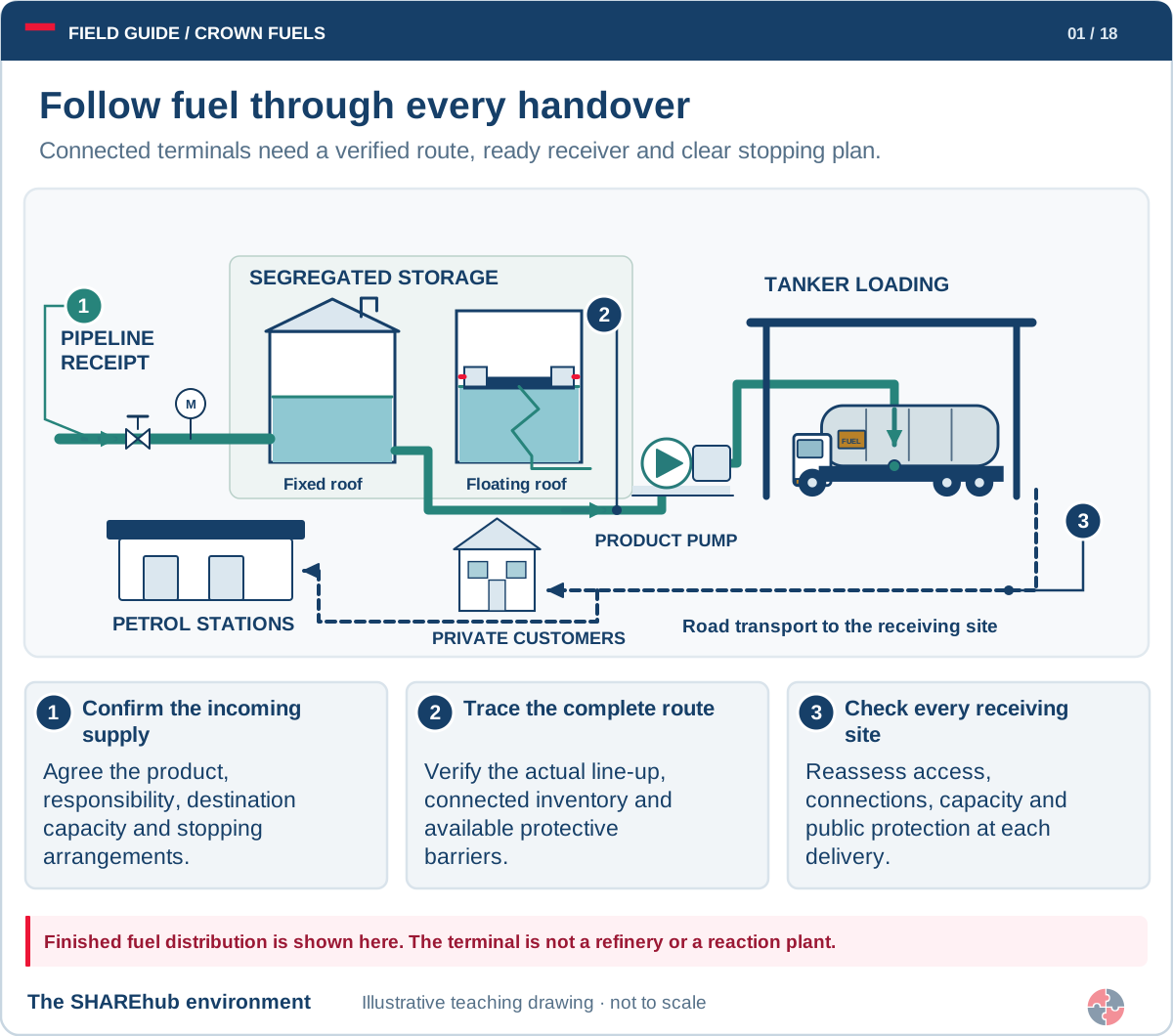
Explore the numbered equipment and control points. Existing SHAREhub teaching schematic; illustrative and not to scale.Incoming supply
Start at pipeline receipt. Confirm product, responsibility, destination capacity and the agreed stopping arrangements before accepting the transfer.
Storage and route
Follow the solid product route through the selected tank and pump. Check the actual line-up and available protection; the second tank illustrates the wider compound.
Receiving customer
Follow the dashed road-delivery route. Reassess access, connections, available capacity and protection of the public for each receiving site.
01 · Read the situation
Two tankers arrive together while a visitor crosses towards reception. The second driver wants to move closer to keep the public road clear.
02 · Explain the principle
The model’s loading lane shows the tanker in a clear position, but a real journey includes approach, waiting, turning, stopping and departure. A trailer follows a swept path that differs from the cab. A person visible before a turn can disappear into a blind area. Evaluate the route from the driver’s and pedestrian’s viewpoints, including reception doors, visitor parking, shortcuts and the public-road boundary.
03 · Carry it into work
A controlled hold protects the crossing while the queue is managed. Improvised squeezing or warnings do not establish safe separation.
Lesson 2
Establish a ready receiver and a correct transfer
Explain why product, compartment, capacity and connection evidence must agree before loading.
Correct paperwork must correspond to the actual equipment
A tanker is a receiving system, not simply a vehicle with spare space. The product, selected compartment, permitted quantity and applicable loading limits must match the planned operation. Familiarity can encourage an operator to use yesterday’s selection or infer identity from a familiar fitting. Positive identification and current information are essential because a plausible connection can still lead to a wrong grade or overfill.
Consider how errors combine. A correct product order does not prove the correct compartment was selected. A displayed capacity does not establish that the receiving space is available for this load. An automatic safeguard does not remove the need for the prescribed checks or prove its own availability. The competent site procedure defines readiness evidence, responsibilities and hold points for the actual tanker and loading arrangement.
Before fuel moves, both parties need a shared understanding of the transfer and how to stop it. Check the task against current equipment identity and any alarms, defects, restrictions or unusual conditions. A discrepancy requires a controlled hold and resolution through the responsible people. Do not experiment with a small quantity to discover where it goes, or override an unready indication to recover the schedule.
Use a teach-back at the fictional gantry: explain the chosen product, receiving compartment, quantity, required protection and stop response in your own words. The exercise should expose mismatched assumptions before a connection is treated as ready. A signed form is useful evidence only when its checks describe the present operation. The model cannot establish real tank capacity or authorise a connection sequence.
What barriers should be healthy before transfer starts?
A transfer starts only when the product, route, connection, receiver and stop system are independently confirmed.
HSE HSG176 gives specific guidance for flammable liquid tank transfer, including earthing, overfill protection and preventing movement while connected. HSE loading guidance applies to vehicle stability, exclusion and safe load movement. Select the barriers for the product and facility; marine, gas and general pallet handling may require different controls.
At a road-tanker bay, one person verifies the delivery note against tank identity and capacity, another confirms line-up as the method requires, and the operator tests the emergency stop path. Any leak, unexpected level trend, lost earth connection or driver movement attempt stops transfer and triggers the site response.
The order is correct, but the loading selection points to a different compartment from the driver’s current record.
Decision and explanation
Hold loading and reconcile the actual product, compartment, capacity and protection evidence.
A wrong receiver can create contamination or loss of containment. Resolve the mismatch before transfer rather than using flow as a test.
Look closer
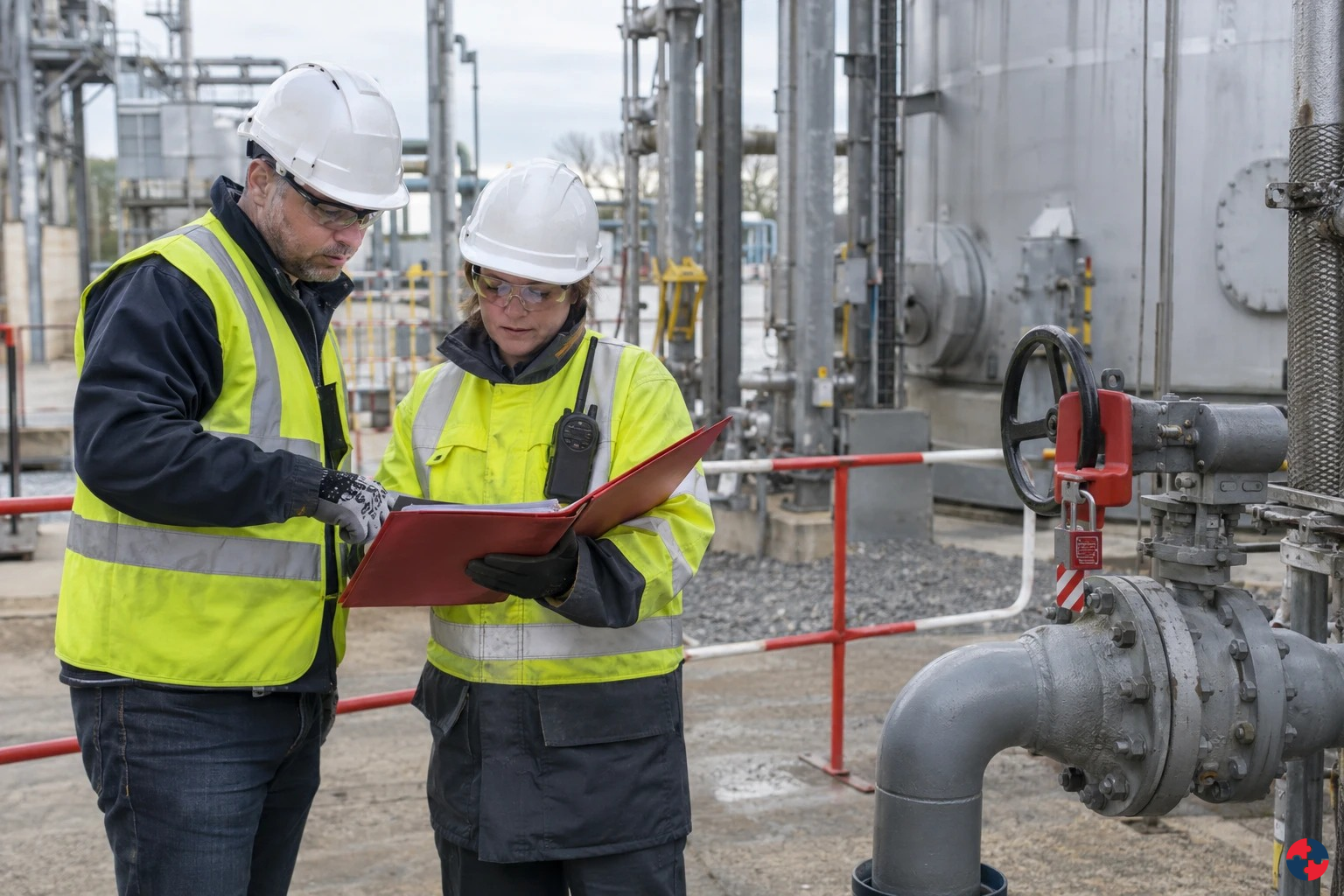
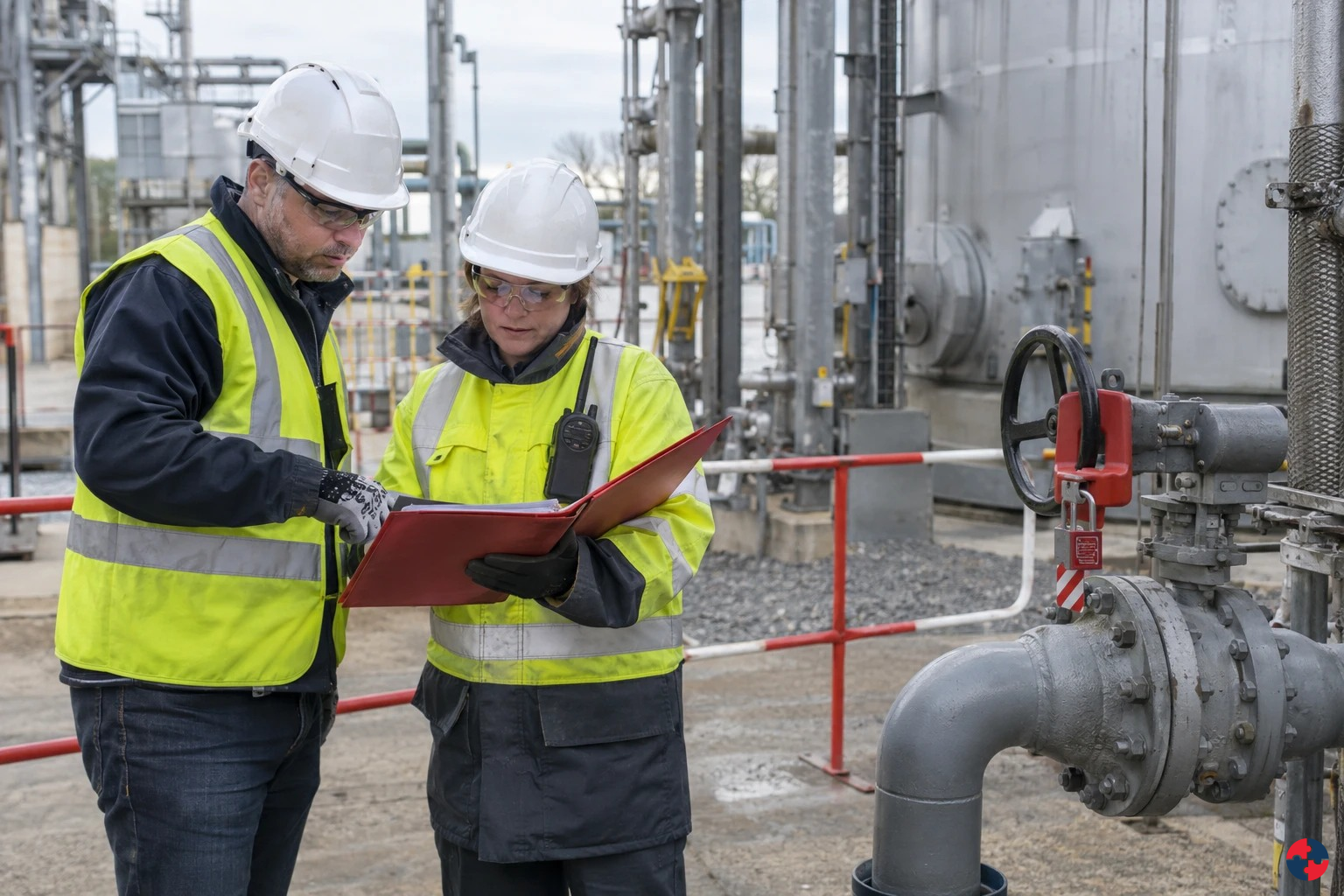
Photorealistic illustrative UK workplace scene. Review checks: Vehicle: Unplanned movement can trap or strike people at the loading area. Load: An unstable or unsecured load can shift, fall or overturn equipment. Transfer: A failed connection or incompatible product can create a separate substance exposure.01 · Read the situation
The order is correct, but the loading selection points to a different compartment from the driver’s current record.
02 · Explain the principle
A tanker is a receiving system, not simply a vehicle with spare space. The product, selected compartment, permitted quantity and applicable loading limits must match the planned operation. Familiarity can encourage an operator to use yesterday’s selection or infer identity from a familiar fitting. Positive identification and current information are essential because a plausible connection can still lead to a wrong grade or overfill.
03 · Carry it into work
A wrong receiver can create contamination or loss of containment. Resolve the mismatch before transfer rather than using flow as a test.
Lesson 3
Keep ignition, vapour and access controls distinct
Describe why different safeguards cannot be substituted for one another during tanker loading.
Several visible connections perform different jobs
A gantry may have product connections, a vapour path, bonding arrangements, interlocks and access equipment. Their proximity can make them appear to be one general package of safety. Each has a particular purpose and failure mode. For example, a physical hose contact is not evidence that the required electrostatic control is effective, and a fitted vapour connection does not by itself establish the correct product route.
Ask what the loading operation releases or generates under its actual conditions. Fuel vapour, splashes, leaks and movement can create hazards beyond the selected connection. Use the assessed hazardous-area and ignition-control arrangements for equipment and activities. Do not assume a device is suitable because its battery is small or because people have used it there before. Suitability and the required controls must be established through the site’s competent arrangements.
Human access adds another pathway to harm. A driver who climbs the tanker to solve an information gap may encounter a fall, vapour or a hazardous work position. First ask whether the task can be completed without going on top, using the approved system. Any remaining access requires a planned method, suitable equipment and relevant protection and rescue arrangements. The model’s clear view is not evidence that a physical access task is authorised.
Keep abnormal-response controls usable. An emergency-stop station hidden by temporary storage may exist on the drawing but fail its purpose when needed. The safe response to missing protection is to hold the affected operation and resolve it, not to borrow a different safeguard as a substitute. During practice, explain the function of each control separately before judging whether the whole loading arrangement is ready.
What is the difference between bonding and earthing?
Bonding equalises potential between conductive items; earthing dissipates charge to earth.
Learners often use bonding and earthing as if they are the same. They are related but different. Bonding prevents a spark between two conductive items by keeping them at the same potential. Earthing connects conductive items to earth so charge can dissipate.
Both must be real, not decorative. A clamp on paint, rust, plastic or an isolated component may not provide continuity. Verification, inspection and maintenance are therefore part of the control.
Verification must follow the competent design: identify each conductive part, the contact points and complete path, suitable test equipment, acceptance criteria and records. A green lamp or fitted clip proves only what that system actually monitors; it does not establish safe insulating liners, liquid charge, atmosphere or all isolated fittings. HSE HSG140 flammable-liquid handling.
Specialist standards gateway
The IEC consolidated listing is a route to the specialist electrostatic guidance, including conductive paths and insulating materials. Obtain the applicable full specification and competent interpretation for the installation; a catalogue page does not validate a design or supply a universal acceptance resistance. IEC TS 60079-32-1:2013+AMD1:2017 consolidated listing
Applied case
The product arm is connected. The bonding indication is unresolved, a vapour connection is absent and a pallet partly hides the stop station.
Decision and explanation
The transfer remains on hold until each required control and its availability are established.
The controls address different hazards. One connected component cannot demonstrate the availability of bonding, vapour management or an accessible stop.
Look closer
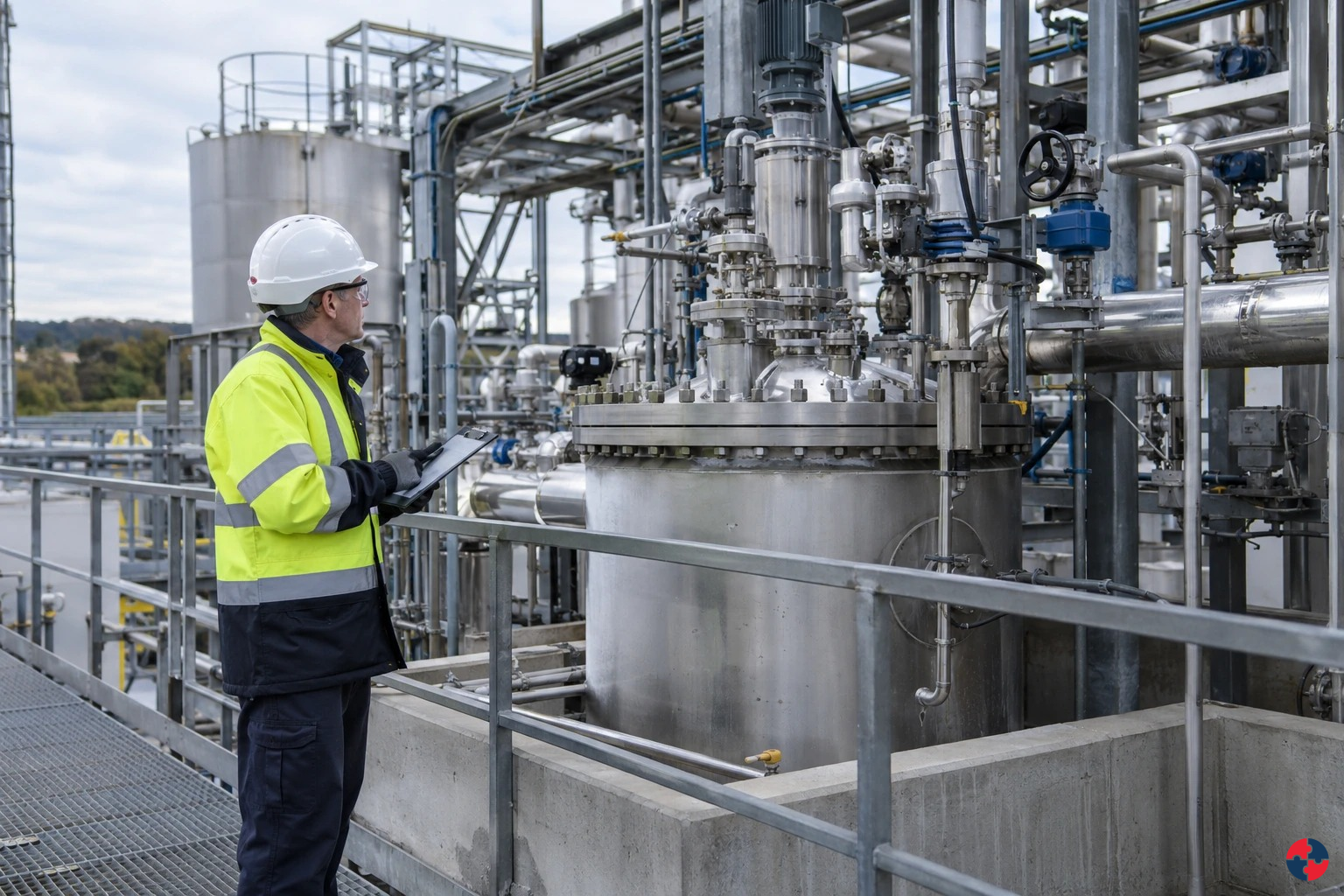
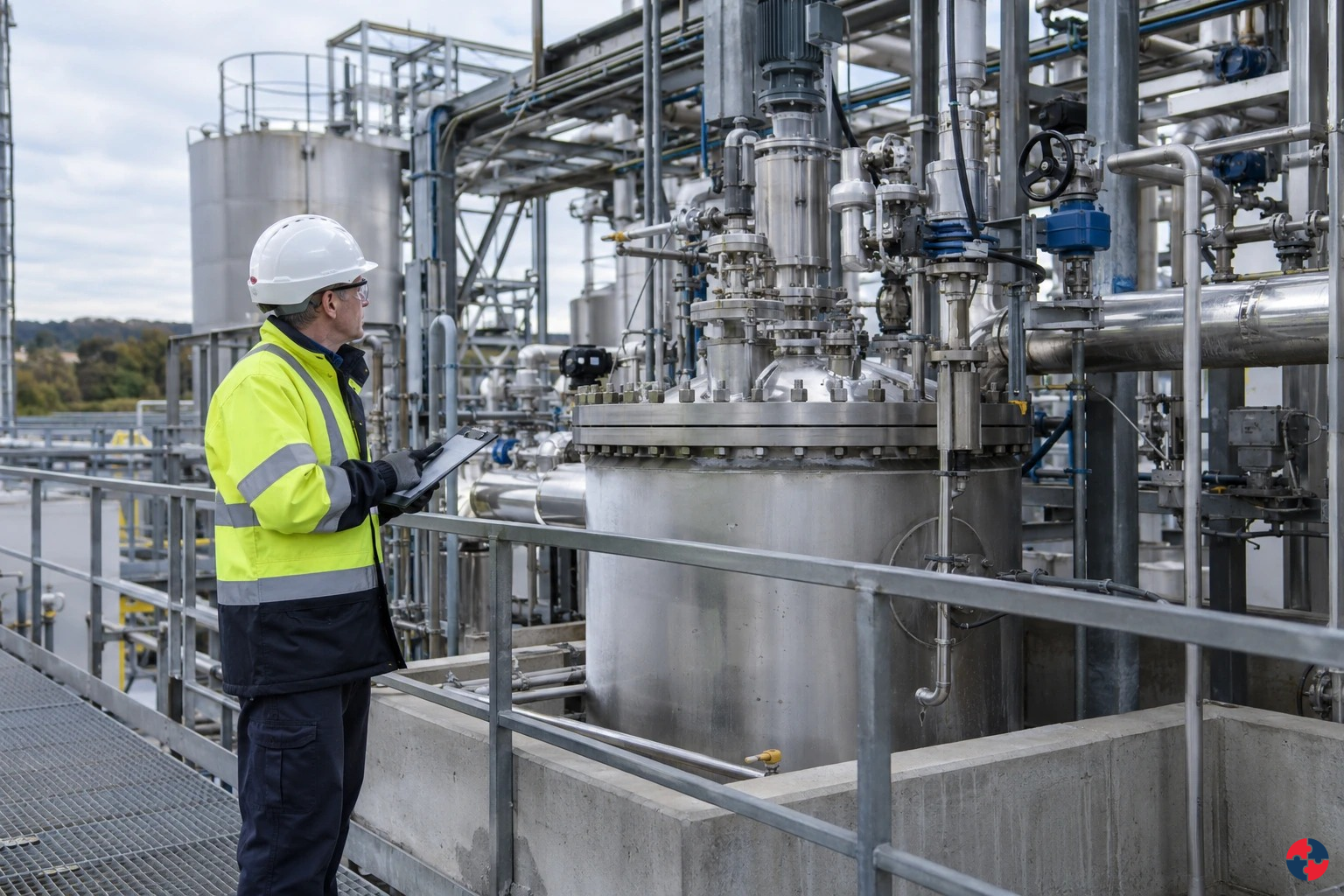
Photorealistic illustrative UK workplace scene. Review checks: Eliminate: Assess avoiding the solvent transfer. Reduce: Assess a genuinely safer compatible material. Isolate: Contain transfer and design suitable conductive paths and equipment. Control: Limit releases and splashing, with verified checks and stop rules. PPE: Task PPE cannot make an unsuitable transfer system safe.01 · Read the situation
The product arm is connected. The bonding indication is unresolved, a vapour connection is absent and a pallet partly hides the stop station.
02 · Explain the principle
A gantry may have product connections, a vapour path, bonding arrangements, interlocks and access equipment. Their proximity can make them appear to be one general package of safety. Each has a particular purpose and failure mode. For example, a physical hose contact is not evidence that the required electrostatic control is effective, and a fitted vapour connection does not by itself establish the correct product route.
03 · Carry it into work
The controls address different hazards. One connected component cannot demonstrate the availability of bonding, vapour management or an accessible stop.
Lesson 4
Treat departure as a controlled transition
Identify the evidence needed to move from connected loading to a safe vehicle and road journey.
Completion of pumping does not mean ready to drive
Stopping product flow and releasing a tanker are different decisions. The vehicle may still have an attached arm or hose, an outstanding alarm, an unresolved quantity discrepancy or equipment in a position that prevents safe movement. A drive-away can damage connections and create a release. Departure therefore needs the defined completion and vehicle-release checks for the actual installation, with clear responsibility and communication.
The route onto the road introduces another interface. Load identity and required documentation need to agree, and the vehicle and driver must be fit for the intended journey. The allocation of dangerous-goods duties depends on the real roles and operation. Terminal dispatch should not assume that an issue stops being relevant at the gate, while a driver should not be pressured to take an uncertain load or unsafe schedule.
Fatigue and time pressure can turn a normal release into an unsafe compromise. Offering coffee does not resolve an unfit driver, and shortening planned breaks is not a recovery measure for delayed loading. Use the responsible transport parties to review fitness, timing, route and safe waiting. Arrangements should allow the person to report a problem and stop without an incentive to hide it.
In the final gantry practice, trace the transition from transfer stopped, through the approved disconnection and equipment-restoration process, to vehicle release and journey readiness. Do not invent a universal connection or disconnection order: the competent site procedure governs it. Your learning task is to recognise missing evidence, maintain the safe hold and escalate through the correct people before any movement is authorised.
Who controls transport risk during live work?
Transport safety depends on clear ownership from gate control through to senior investment decisions.
A driver can make good decisions only if the site, vehicle, schedule and communication support those decisions. A supervisor can stop a movement, but managers must remove recurring design and scheduling weaknesses. The fleet lead and the employer’s health and safety adviser should test whether vehicle standards, grey fleet controls and site layouts match the actual risk.
This role split is important for fatal-risk topics because the immediate event may look like driver error while the underlying causes sit in route design, vehicle specification, fatigue, loading pressure or poor contractor control.
Role
What to check
Evidence
Driver/operator
Vehicle condition, route, visibility, fatigue, phone use and load security.
Daily check, defect report and journey decision.
Supervisor
Segregation, reversing, loading, visiting drivers and temporary change.
Yard walkdown and stop-work record.
Manager
Traffic plan, staffing, scheduling, maintenance and contractor controls.
Transport risk assessment and action tracker.
Fleet lead / employer’s health and safety adviser
Vehicle suitability, grey fleet, competence, incident trends and assurance.
Fleet records, licences, insurance and audit findings.
Senior leader
High-potential events, investment needs and repeat weak signals.
Dashboard review and resource decisions.
When should transport or driving activity stop?
Stop when people and vehicles cannot be safely separated, vehicle condition is unsafe, visibility is inadequate or driving conditions make the journey unsafe.
Transport risk changes quickly. A blocked route, failed reversing aid, visiting driver without briefing, poor lighting, damaged surface, unstable load or pedestrian route obstruction can turn a routine operation into a serious risk.
Supervisors should be clear that production pressure does not override traffic controls. If the safe route is blocked, the work should pause until a safe route is restored.
A loading arm remains connected. Dispatch is late and the driver reports severe tiredness and a mismatch in the product documents.
Decision and explanation
Hold departure and resolve connections, load information and driver/journey fitness through the authorised process.
The vehicle is not ready to depart and the road journey has unresolved risks. A delay cannot justify drive-away, inaccurate documents or unfit driving.
Look closer
Related SHAREhub topic guide. Apply its prompts to the specific case below.01 · Read the situation
A loading arm remains connected. Dispatch is late and the driver reports severe tiredness and a mismatch in the product documents.
02 · Explain the principle
Stopping product flow and releasing a tanker are different decisions. The vehicle may still have an attached arm or hose, an outstanding alarm, an unresolved quantity discrepancy or equipment in a position that prevents safe movement. A drive-away can damage connections and create a release. Departure therefore needs the defined completion and vehicle-release checks for the actual installation, with clear responsibility and communication.
03 · Carry it into work
The vehicle is not ready to depart and the road journey has unresolved risks. A delay cannot justify drive-away, inaccurate documents or unfit driving.
Lesson 5
Protect people at the tanker entrance
Manage space and timing before authorising movement; visibility aids cannot replace a safe relationship between people and vehicles.
Understand this fuel-industry task
At this entrance, the arriving tanker, a visitor and the gate controller have different views of the same crossing. The cab can hide a person close to its front or side, while the trailer follows a different swept path during a turn. The painted walkway is useful information, but it does not physically prevent a vehicle entering it. Study where the pedestrian actually wants to go, including the office door and public pavement, rather than assuming everyone follows a long marked detour.
The strongest improvement removes the conflict: a separate pedestrian gate and protected route, a suitable vehicle waiting position and a layout that avoids unnecessary reversing. Where a crossing remains, both parties need visibility and a clear method for stopping one movement while the other proceeds. Delivery appointments and security checks must fit within that layout. A queue displaced onto the public road creates another interface requiring coordination; it should not be solved by waving the tanker across people.
Trace the initiating event and loss of control
Step
Case pathway
initiatingEvent
A tanker turns towards the gate while a visitor follows the marked path to reception.
lossOfControl
The vehicle and pedestrian enter the same space without effective separation or a confirmed safe crossing.
consequences
A person can be struck, run over or trapped against the fence; sudden avoidance may expose other road users.
Choose effective safeguards
Control priority
Practical application
Eliminate
Remove unnecessary transfer steps and hazardous inventory where practicable.
Substitute
Prefer a simpler transfer route with fewer potential leakage interfaces.
Engineer
Provide suitable containment, independent protection, isolation and vehicle separation.
Manage
Authorise the transfer, coordinate both ends and verify readiness and barrier status.
Protect
Select task-specific clothing and eye/skin protection for the remaining exposure.
Prioritise separate entrances and a continuous protected footway, including the connection from visitor parking; assess the entire vehicle swept path rather than its parked footprint.
Keep an agreed holding position clear of crossings and the public-road interface. Book arrivals to the space and staffing actually available at the gate.
Provide clear sight lines, suitable lighting and crossing controls understood by visiting drivers. Use an authorised trained signaller only where the assessed arrangement requires one.
Include unfamiliar visitors, disabled pedestrians and unusual vehicles in route reviews. High-visibility clothing, horns and beacons support the arrangement but do not confer priority.
Verify effectiveness before release
Observe a safe representative arrival from the cab and pedestrian approach; identify blind spots, turning encroachment and any tempting shortcut.
Check that parked vehicles, signs and the gate position do not obstruct visibility or the protected footway during the busiest arrival period.
Ask a new driver and visitor independently where to wait and how to cross; compare their answers with the actual controlled route.
Transfer the decision to the workplace
Apply the same swept-path and pedestrian-route test at loading bays, forecourts and customer premises, especially when a familiar driver encounters an unfamiliar visitor.
How should transport risk be assessed?
Assessment should map people, vehicles, routes, movements, loading, reversing, visibility and work pressure.
A transport assessment should start with a movement map. Where do vehicles enter, reverse, park, load, tip, refuel, charge, turn, couple, uncouple and exit? Where do pedestrians walk, wait, cross, work, queue or visit welfare? Where do temporary works, waste skips, deliveries or contractors change the route?
The assessment should then challenge each interface. Can pedestrians and vehicles be separated? Can reversing be eliminated? Can route direction be simplified? Are visiting drivers briefed? Are banksmen competent and protected? Are schedules realistic enough to prevent rushing?
Risk area
Assessment question
Control focus
Pedestrian routes
Can people walk without entering vehicle routes?
Segregation, barriers and crossings.
Reversing
Can reversing be eliminated or controlled?
One-way routes, turning areas, aids and banksman rules.
Loading/unloading
Who controls the vehicle, load, people and exclusion zone?
Loading plan and communication.
Blind spots
What can the driver not see?
Vehicle selection, aids, exclusion and pedestrian control.
Temporary change
How do works, skips or congestion alter routes?
Change briefing and temporary traffic plan.
Road journeys
Are time, weather, rest and welfare realistic?
Safe journey planning.
How should a busy warehouse yard be controlled?
A strong yard plan separates people and vehicles, controls reversing and manages visiting drivers before they enter the risk area.
A warehouse has vans, articulated lorries, pedestrian staff, agency workers, forklift trucks, visitors and waste collections. Near misses occur when visiting drivers walk across the yard to reception and forklifts reverse near a loading bay. A weak response is to add more warning signs. A stronger response redesigns pedestrian access, creates a driver waiting point, sets a one-way vehicle system, marks loading exclusion zones, controls reversing, briefs visiting drivers, improves lighting, reviews delivery scheduling and checks compliance during peak periods.
The lesson is that transport safety is mainly design and management. Behaviour matters, but only after the site has made the safe route obvious and practical.
Drivers walking through yard. Weak control: Tell them to watch for vehicles; Better control: Create protected pedestrian route and waiting point.
Forklift reversing. Weak control: Rely on reversing alarm; Better control: Redesign route and use exclusion controls.
Loading bay interface. Weak control: Paint lines only; Better control: Physical controls, bay rules and communication.
Fictional loading sequence: prevent early departure
A visiting driver parks as directed and uses the segregated waiting area. The agreed loading controller verifies suitable vehicle/trailer parking brakes and stability, the loading exclusion and the assessed site method that prevents premature departure. Driver and loader confirm the hold is active before work. If that hold, stability or separation is uncertain, loading stops. Only the agreed controller gives positive departure release after people and equipment are clear, the load is safe and all checks are complete. A briefing or painted bay line alone cannot prevent a runaway or drive-away; select the method for the actual vehicles and site.
Applied case
Two booked tankers arrive together. A visitor is already halfway to reception and the second driver says stopping will delay the next delivery.
Decision and explanation
Hold the vehicle in the agreed safe position and complete the protected crossing before controlled entry.
A horn warns only those who hear and interpret it. It does not establish a clear route or protect someone in a blind spot. This deals with the immediate conflict while preserving the planned traffic arrangement. The queue still needs controlled management. That can create a trapping position inside the vehicle swept path and improvises a new pedestrian route under pressure.
Look closer
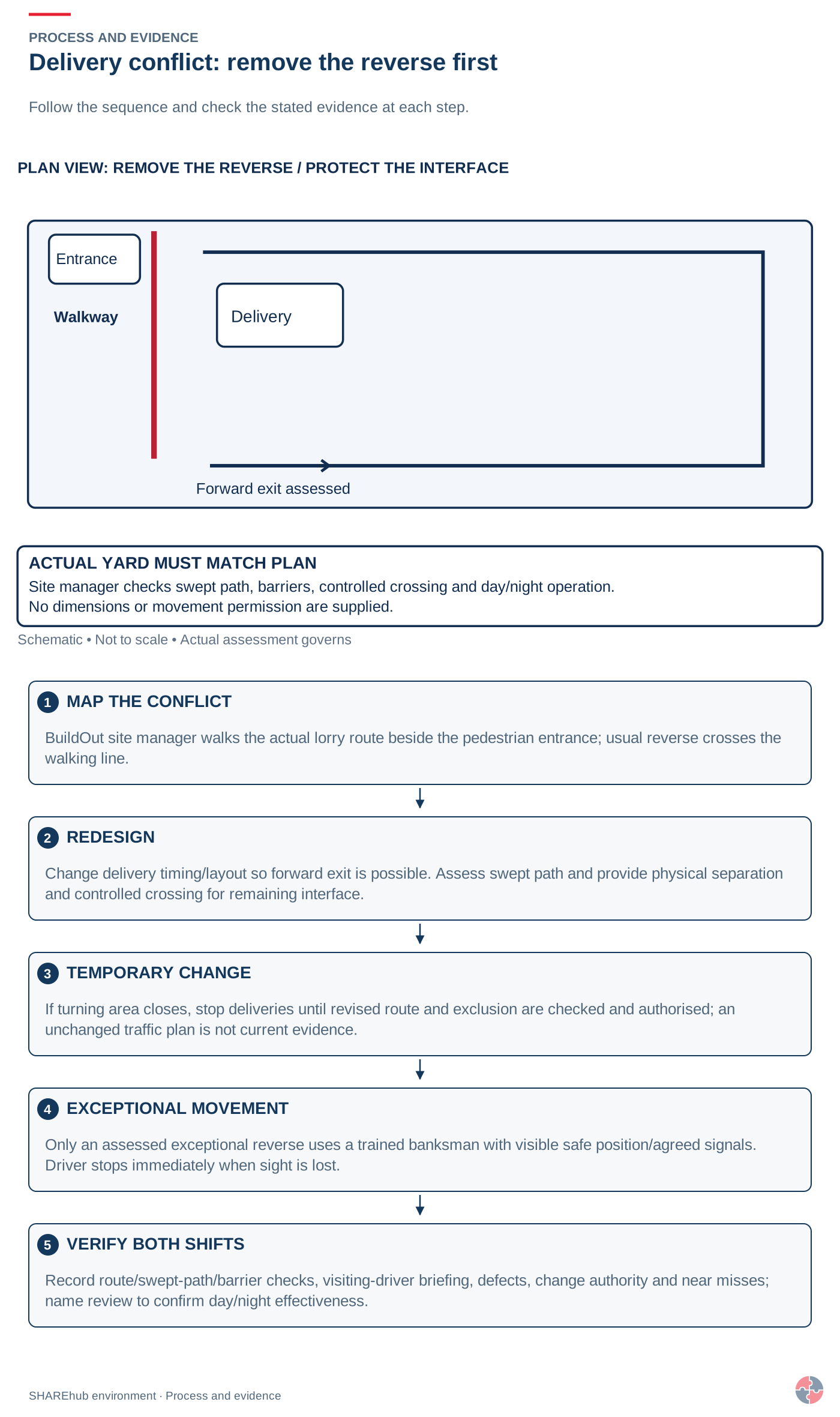
Teaching graphic from the linked SHAREhub source section.01 · What to notice
A tanker is waiting at the entry gate; the proposed arrival path crosses the marked walking route while a visitor approaches.
02 · Trace the harm
A turning tanker can strike or trap someone who is hidden beside the cab; a gate delay can also push pedestrians onto the public road.
03 · Test the safeguard
Observe an arrival from both driver and pedestrian viewpoints; confirm the route, stopping position, assistance and gate instructions work together.
Lesson 6
Make dispatch a safe handover to the road journey
The transfer of fuel to a tanker is also a transfer of information and control responsibilities into a different risk environment.
Understand this fuel-industry task
The departure gate is the last terminal opportunity to resolve a known discrepancy before the tanker reaches public roads. In this exercise, the compartment record and product documents disagree and the driver reports fatigue. A sealed outlet or completed loading ticket cannot establish the identity of the load or the driver's fitness to continue. Wrong information can mislead the next receiver and emergency services, while time pressure can convert a manageable terminal delay into a road collision or unsafe unloading decision.
Dangerous-goods transport involves defined roles across the supply chain, including consignor, loader, carrier and driver. The duties and any exemptions depend on the actual substances, quantities and operation; the model does not determine a real load's legal classification. Competent dangerous-goods advice belongs within the organisation's arrangements where required. Plan realistic journeys and a process for a driver to declare a problem without being pushed to compensate through speeding, missed rest or an improvised change to documentation.
Trace the initiating event and loss of control
Step
Case pathway
initiatingEvent
Dispatch pressure leads to release of a tanker with unresolved load identity and reported driver fatigue.
lossOfControl
The road journey or receiving operation proceeds without reliable information or a driver fit for the planned task.
consequences
Collision, wrong unloading and delayed or inappropriate emergency response can affect road users, customers and the environment.
Choose effective safeguards
Control priority
Practical application
Eliminate
Remove unnecessary transfer steps and hazardous inventory where practicable.
Substitute
Prefer a simpler transfer route with fewer potential leakage interfaces.
Engineer
Provide suitable containment, independent protection, isolation and vehicle separation.
Manage
Authorise the transfer, coordinate both ends and verify readiness and barrier status.
Protect
Select task-specific clothing and eye/skin protection for the remaining exposure.
Hold departure in a suitable safe location when material information or fitness is unresolved; involve the relevant transport and terminal controllers rather than shifting the problem outside the gate.
Reconcile product and compartment identity against reliable loading evidence, then complete the applicable transport information and checks through the authorised process.
Coordinate the responsibilities of consignor, loader, carrier and driver, obtaining competent dangerous-goods advice for the actual operation and applicable requirements.
Build realistic delivery schedules, breaks and escalation routes into journey planning; arrange suitable relief or replanning when fatigue affects safe performance.
Verify effectiveness before release
Trace a sample compartment from the loading record to the product information and destination; identify how discrepancies prevent release rather than being corrected later.
Ask the driver and dispatcher how a fatigue concern changes the journey plan, and check that reporting does not trigger pressure to make up time.
Review actual departure checks for disconnection, secure closures and appropriate vehicle and documentation status, with responsibilities clearly allocated to competent people.
Transfer the decision to the workplace
At a forecourt or private customer's tank, repeat the identity, capacity, safe-access and responsible-person checks rather than assuming terminal dispatch made every receiving condition safe.
How should dangerous goods transport interfaces be managed?
Dangerous goods transport should be managed from classification through to loading, carriage, unloading and emergency handover.
Transport risk is not limited to the driver or vehicle. It includes the consignor who classifies and packages the goods, the packer or filler, the loader, the carrier, the unloader and the site receiving the substance. Interfaces are critical because information and control pass between organisations. A vehicle may arrive at a site with correct paperwork, but the site can still create risk through poor routing, poor segregation, wrong tank selection, weak unloading control or inadequate emergency arrangements.
A final receiving-site unloader is not automatically required to appoint a DGSA for that act alone; HSE distinguishes final consignees from intermediate unloaders under the GB route. The site still assesses its transfer, tank and emergency interfaces. See HSE - ADR, CDG Regs and Dangerous Goods Safety Advisers.
ADR and the GB CDG Regulations are detailed. In practical terms, organisations should know whether the goods are in scope, whether exemptions apply, whether a Dangerous Goods Safety Adviser is needed, and what classification, packaging, marking, labelling, documentation, vehicle equipment, driver training and emergency information are required.
For a workplace page, the useful control question is simple: can the organisation prove that every dangerous goods movement has been classified, prepared, loaded, transported, received and unloaded by competent people using suitable equipment and current information?
Dangerous goods transport control points - Dangerous goods transport control points
Control point
What should be checked
Evidence
Classification
UN number, proper shipping name, class, packing group, tunnel code and environmental hazard where relevant.
SDS section 14, dangerous goods note and technical advice.
Packaging or tank
Approved packaging, IBC, tank or transportable pressure equipment suitable for the substance and journey.
Inspection certificate, approval marking, maintenance and test record.
Documentation
Transport document, instructions in writing where required and emergency information.
Driver pack, consignment records and document checks.
Segregation and load security
Incompatible goods separated and packages secured against movement or damage.
Loading plan, visual checks and carrier procedures.
Vehicle and equipment
Placards, orange plates, fire extinguishers, spill equipment and vehicle condition as applicable.
Vehicle checklist, maintenance record and roadside inspection history.
Loading and unloading
Site rules, route, speed, PPE/RPE, earthing, overfill protection, emergency stop and supervision.
Permit or transfer checklist, observation records and incident reports.
DGSA input
Advice on compliance, annual reports, incident investigation and improvement where required.
DGSA appointment, reports and action close-out.
Applied case
A driver says they are too tired for the next leg. Dispatch also finds that one compartment is described differently on two documents, but the customer is waiting.
Decision and explanation
Keep departure on hold, reconcile the load and arrange a safe driver and journey solution with responsible transport parties.
That leaves the driver and any responder with unresolved load information while the fatigue concern remains active. A stimulant is not a fatigue-management arrangement. Further schedule pressure can worsen both driving and decision-making risk. Both known issues must be resolved through the applicable release process. The customer's deadline does not establish road readiness.
Look closer
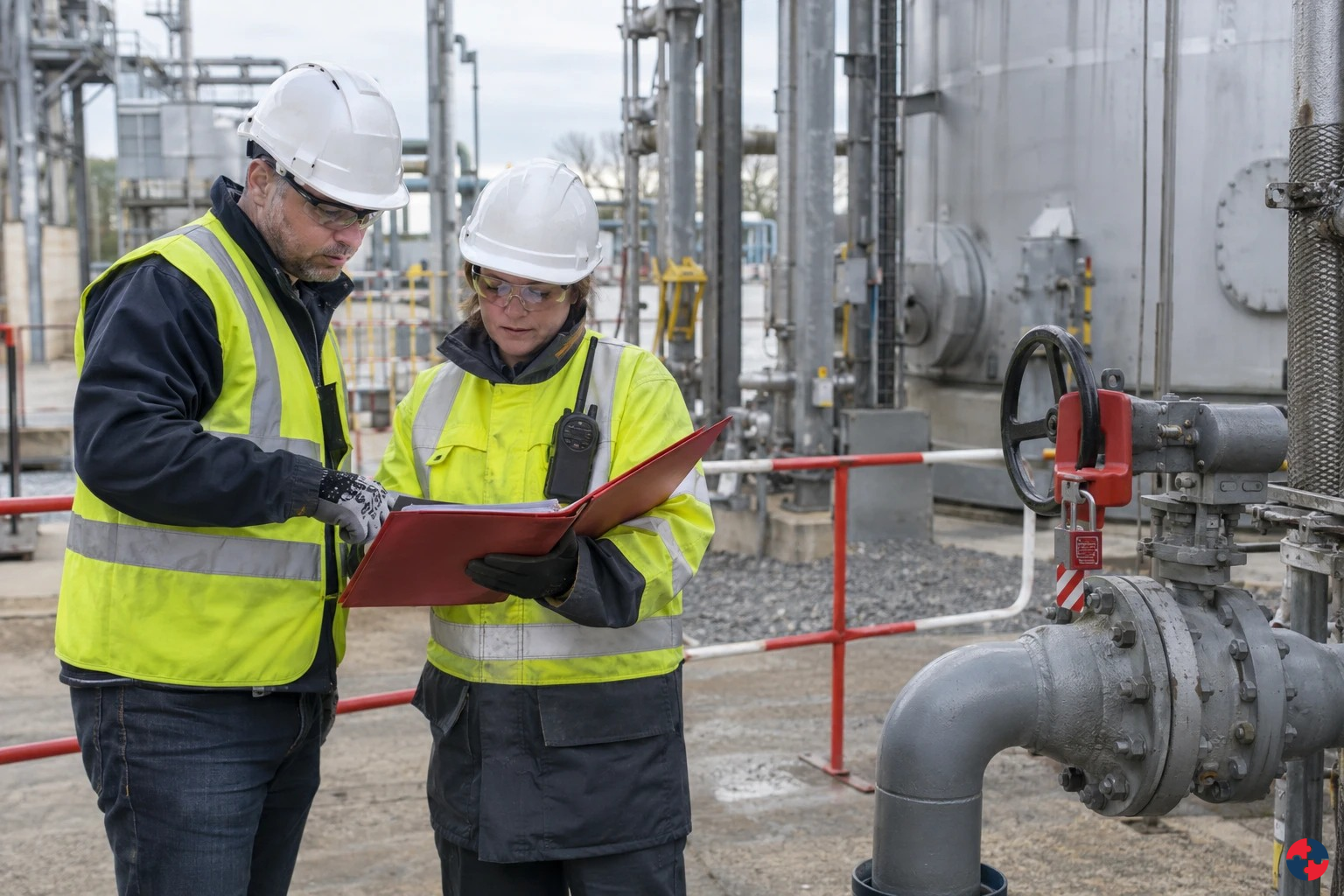
Photorealistic illustrative UK workplace scene. Review checks: Elimination: Assess whether redesign can remove an unnecessary intermediate transfer without creating a new receiving or logistics risk. Substitution: Assess a genuinely lower-hazard grade or process for compatibility and new risks. A smaller inventory alone is not substitution. Engineering: Use the assessed segregated bay, compatible closed system, containment and required sensing, overfill, bonding/isolation and shutdown functions. Administrative: Control receiving identity/capacity checks, delivery authorisation, attendance, driver-site handover and the records that verify the physical barriers. PPE: Select suitable residual chemical/eye/face or flame protection for the assessed task, with compatibility, fit and replacement checks.01 · What to notice
The loaded tanker is due to leave, but the driver reports fatigue and a discrepancy between the product documentation and compartment record.
02 · Trace the harm
Wrong documentation or an unfit driver can increase road and emergency risks beyond the terminal; terminal release does not transfer away everyone else’s duties.
03 · Test the safeguard
Confirm the load and documents agree, connections are secured, checks are complete and the driver and journey are fit to proceed through the agreed release process.
Lesson 7
Tanker bonding: a verified path, not incidental metal contact
Bonding evidence must match its defined electrostatic duty. A green light must represent a working control, not a bypass.
Understand this fuel-industry task
Fuel movement can generate electrostatic charge, with the outcome influenced by the liquid, equipment and transfer conditions. Conductive objects at different potentials can discharge, and a suitable discharge in a flammable atmosphere can ignite it. Bonding is intended to control potential differences between specified conductive parts; earthing provides an intended connection to earth. Their relationship in this loading system must be defined by competent design. Neither should be confused with an unrelated lightning-protection connection or electrical shock-protection arrangement.
The dedicated clamp and permissive in this lane have a specified purpose. A metal arm touching the tanker does not prove the required connection, continuity or monitoring function. Paint, contamination, damaged leads and an unsuitable attachment point can all undermine an apparently neat connection. Follow the approved sequence and verify the protection before flow; do not bypass a permissive to avoid delay. Bonding is one prevention measure within a wider transfer assessment, including the product, charge generation, flow conditions, atmosphere and equipment. It does not prevent overfill, wrong grade, vapour escape or drive-away.
Trace the initiating event and loss of control
Step
Case pathway
initiatingEvent
Fuel transfer generates charge while the required conductive connection is absent, unsuitable or degraded.
lossOfControl
A potential difference persists and an ignition-capable discharge occurs in a suitable flammable atmosphere.
consequences
Flash fire or a larger fire/explosion can injure the driver and operators and involve the loaded vehicle or adjacent lanes.
Choose effective safeguards
Control priority
Practical application
Eliminate
Avoid unnecessary loading and personnel in the vehicle movement area.
Substitute
Prefer arrangements that reduce climbing and manual handling.
Engineer
Provide suitable connections, restraint, static control and assessed protective interlocks.
Manage
Verify product/compartment, driver competence, equipment checks and transfer authority.
Protect
Use suitable clothing, footwear and eye/skin protection for residual transfer exposure.
Prevent unnecessary flammable release and use the approved product-transfer conditions alongside electrostatic controls; a bond is not a substitute for containment.
Connect the specified maintained bonding or earthing arrangement to the correct point in the required sequence and confirm any associated permissive through the approved method.
Inspect leads, clamps, contact surfaces, hoses and continuity arrangements for the actual duty; quarantine defects rather than improvising a connection.
Control interlock bypasses and equipment changes through competent authorisation and impairment management, with operating restrictions and verified restoration.
Verify effectiveness before release
Check the physical connection and its identified contact point against the loading instruction; a clamp on paint or an arbitrary bracket is not evidence of the intended path.
Review suitable continuity and monitor-function evidence, including the safe response to loss of the required connection during a controlled test.
Observe the full approved connection and disconnection sequence with a competent user, checking that restored permissives have not been confused with vehicle-departure authorisation.
Transfer the decision to the workplace
Compare the floating-roof lightning case: electrical connections require evidence of their intended function, and different protection duties cannot be substituted by appearance.
What is the difference between bonding and earthing?
Bonding equalises potential between conductive items; earthing dissipates charge to earth.
Learners often use bonding and earthing as if they are the same. They are related but different. Bonding prevents a spark between two conductive items by keeping them at the same potential. Earthing connects conductive items to earth so charge can dissipate.
Both must be real, not decorative. A clamp on paint, rust, plastic or an isolated component may not provide continuity. Verification, inspection and maintenance are therefore part of the control.
Verification must follow the competent design: identify each conductive part, the contact points and complete path, suitable test equipment, acceptance criteria and records. A green lamp or fitted clip proves only what that system actually monitors; it does not establish safe insulating liners, liquid charge, atmosphere or all isolated fittings. HSE HSG140 flammable-liquid handling.
Specialist standards gateway
The IEC consolidated listing is a route to the specialist electrostatic guidance, including conductive paths and insulating materials. Obtain the applicable full specification and competent interpretation for the installation; a catalogue page does not validate a design or supply a universal acceptance resistance. IEC TS 60079-32-1:2013+AMD1:2017 consolidated listing
Applied case
The bonding monitor will not give a loading permissive. The hose is metal, and a colleague suggests overriding the monitor because the two vehicles look electrically connected.
Decision and explanation
Hold loading and establish the specified connection and verified permissive through the approved fault process.
Incidental contact does not demonstrate the designed path or the monitor’s function. The loss of permissive is a fault to resolve, not proof that protection is unnecessary. This preserves the assessed ignition control and allows competent diagnosis without assuming that any visible metal connection is equivalent. Trial-and-error attachment can mask the wrong connection point or a defect. Use the specified safe method and resolve the cause of the abnormal indication.
Look closer
Photorealistic illustrative UK workplace scene. Review checks: Setting: Workshop solvent transfer into a receiving vessel on an insulating pallet; plastic funnel, splash filling and vapour are credible. Act: Classify the substance and atmosphere, check vessel and hose conductivity, transfer method and validated bond/earth scheme. Hold / review: Do not transfer if atmosphere, container suitability, continuity or flow control cannot be verified.01 · What to notice
The gantry shows a dedicated bonding connection; the proposed loading task assumes the metal hose already provides all required electrostatic protection.
02 · Trace the harm
Charge accumulation and discharge can ignite a suitable flammable atmosphere. Bonding, earthing, electrical shock protection and lightning protection have related but different purposes.
03 · Test the safeguard
Check the intended connection, monitor function and maintenance evidence through the approved safe verification method; a clipped lead or metal contact alone is not proof.
Lesson 8
Compartment capacity: verify the receiver behind the order
Verify capacity at the actual receiving boundary, then assure the separate protection against control failure.
Understand this fuel-industry task
A tanker’s total capacity is divided between individual compartments. Each selected compartment has its own identity, existing contents, intended product and usable receiving capacity for the proposed load. A correct total order can still overflow one compartment or put the wrong grade into another. At this bottom-loading rack, the controller and driver must reconcile the physical connection with the agreed compartment plan before opening the transfer path.
The receiving-capacity check and overfill protection are different barriers. Planning determines that the intended quantity belongs in the selected receiver; the protective function addresses a deviation if control fails. Neither excuses uncertainty about the other. Confirm the required protection is compatible with the vehicle and lane and that its complete permissive and stopping function are demonstrated by the approved arrangements. A vehicle-level display, nominal plate capacity or recent successful loading is insufficient evidence on its own. The safe response to an unresolved discrepancy is a hold, with clear ownership for reconciliation rather than loading until someone observes a spill.
Trace the initiating event and loss of control
Step
Case pathway
initiatingEvent
An incorrect compartment, residual quantity or product allocation is used to authorise loading.
lossOfControl
Liquid exceeds the receiver’s available capacity or enters the wrong compartment and the required prevention or stop barrier is ineffective.
consequences
Fuel can spill around the vehicle, expose people, form a flammable atmosphere and spread through loading-area drains.
Choose effective safeguards
Control priority
Practical application
Eliminate
Avoid unnecessary loading and personnel in the vehicle movement area.
Substitute
Prefer arrangements that reduce climbing and manual handling.
Engineer
Provide suitable connections, restraint, static control and assessed protective interlocks.
Manage
Verify product/compartment, driver competence, equipment checks and transfer authority.
Protect
Use suitable clothing, footwear and eye/skin protection for residual transfer exposure.
Agree the vehicle and compartment plan, verifying product identity, actual available capacity and intended connection before transfer begins.
Use suitable compatible overfill prevention and the required loading permissives; manage defects and any proposed bypass as safety-critical impairments.
Provide clear equipment and connection identifiers, controlled instructions and a positive check suited to the risk rather than relying on memory or colour alone.
Monitor the transfer and abnormal trends, keeping the stop, exclusion and spill-response arrangements usable throughout loading.
Verify effectiveness before release
Match the real compartment and coupling to the authorised order, checking how residual product and usable capacity have been established.
Review the approved function test evidence for the required overfill chain, from sensing through logic to stopping the relevant flow; calibration alone does not prove it.
Observe how a mismatch, failed permissive or unexpected loading total causes a hold and communicated resolution before loading can resume.
Transfer the decision to the workplace
Apply this receiver-level check to incoming tank receipts and private-customer deliveries; total storage capacity, available capacity and the connected destination are distinct facts.
What barriers should be healthy before transfer starts?
A transfer starts only when the product, route, connection, receiver and stop system are independently confirmed.
HSE HSG176 gives specific guidance for flammable liquid tank transfer, including earthing, overfill protection and preventing movement while connected. HSE loading guidance applies to vehicle stability, exclusion and safe load movement. Select the barriers for the product and facility; marine, gas and general pallet handling may require different controls.
At a road-tanker bay, one person verifies the delivery note against tank identity and capacity, another confirms line-up as the method requires, and the operator tests the emergency stop path. Any leak, unexpected level trend, lost earth connection or driver movement attempt stops transfer and triggers the site response.
The vehicle has enough total nominal capacity for the order, but the driver and loading sheet disagree about which compartment contains a residual quantity.
Decision and explanation
Resolve the individual compartment plan, available capacity, product and protection before starting.
The receiver is the selected compartment, not the vehicle total. Positive reconciliation prevents both overfill and wrong-product transfer. A smaller total does not establish where the spare capacity is or whether the selected connection goes to the correct product compartment. The protective device is not a substitute for correct receiver planning. Its compatibility and full stopping function must also be available.
Look closer
Photorealistic illustrative UK workplace scene. Review checks: Vehicle: Unplanned movement can trap or strike people at the loading area. Load: An unstable or unsecured load can shift, fall or overturn equipment. Transfer: A failed connection or incompatible product can create a separate substance exposure.01 · What to notice
The loading exercise has a product order but unresolved compartment allocation, remaining product and overfill-device status.
02 · Trace the harm
Wrong compartment or insufficient capacity can produce overfill, cross-contamination and a flammable release beneath or around the vehicle.
03 · Test the safeguard
Cross-check the actual compartment and connection against the agreed order and capacity evidence, and verify the complete required permissive and stop function.
Lesson 9
Vapour return: the transfer has a second flow path
Follow the displaced material as carefully as the delivered material. Correct liquid flow alone does not prove safe transfer.
Understand this fuel-industry task
As liquid enters a tanker compartment, the space it occupies displaces gas or vapour. The separate vapour-return connection directs that displaced stream through the specified recovery system. It is therefore part of the transfer process, not an optional emissions accessory. An absent, wrongly connected, restricted or incompatible path can let vapour escape or produce unsuitable pressure conditions, depending on the combined vehicle and plant arrangement.
This scene has the liquid arm connected but the required return path unresolved. Hold loading while the competent task checks establish the whole route: compartment connection, return arm, header, recovery plant and dependent safeguards. A coupling that fits does not prove that the route is open, correctly configured or available for this duty. Recovery equipment can also receive abnormal liquid, so a normal vapour-flow indication does not establish protection against every upset. Connection sequence, start permissives, monitoring, safe stop and controlled disconnection need to work as one system with agreed driver and terminal responsibilities.
Trace the initiating event and loss of control
Step
Case pathway
initiatingEvent
Loading is proposed while the specified vapour-return route is missing or unavailable.
lossOfControl
Displaced vapour has no verified controlled route, or a restriction challenges the vehicle and connected plant.
consequences
A flammable release, adverse pressure condition or remote VRU problem can expose people and create fire or explosion risk.
Choose effective safeguards
Control priority
Practical application
Eliminate
Avoid unnecessary loading and personnel in the vehicle movement area.
Substitute
Prefer arrangements that reduce climbing and manual handling.
Engineer
Provide suitable connections, restraint, static control and assessed protective interlocks.
Manage
Verify product/compartment, driver competence, equipment checks and transfer authority.
Protect
Use suitable clothing, footwear and eye/skin protection for residual transfer exposure.
Confirm whether this product and loading arrangement requires vapour return and establish the specified complete route before permitting liquid flow.
Use compatible maintained arms, couplings and headers with clear identity and an approved connection and disconnection sequence.
Verify the required recovery availability, pressure-related protection and start or stop permissives; prohibit informal substitutions or bypasses.
Include abnormal liquid carryover, failed recovery, blocked routes and simultaneous loading demand in the transfer assessment and response instructions.
Verify effectiveness before release
Trace the physical vapour path from the selected vehicle connection to the relevant recovery equipment using current drawings and safe field identification.
Check the availability and complete function-test evidence for the protection required by this combined interface, including the response to loss of the vapour path.
Observe a safe task walkthrough with driver and operator, asking who holds loading and who authorises recovery after an abnormal vapour condition.
Transfer the decision to the workplace
Use this two-path thinking for tank filling and venting, or utility relief: identify what enters, what leaves and what protects against an abnormal restriction or inflow.
What barriers should be healthy before transfer starts?
A transfer starts only when the product, route, connection, receiver and stop system are independently confirmed.
HSE HSG176 gives specific guidance for flammable liquid tank transfer, including earthing, overfill protection and preventing movement while connected. HSE loading guidance applies to vehicle stability, exclusion and safe load movement. Select the barriers for the product and facility; marine, gas and general pallet handling may require different controls.
At a road-tanker bay, one person verifies the delivery note against tank identity and capacity, another confirms line-up as the method requires, and the operator tests the emergency stop path. Any leak, unexpected level trend, lost earth connection or driver movement attempt stops transfer and triggers the site response.
A tanker is ready at the liquid arm, but the specified vapour arm cannot be connected using the approved arrangement. Dispatch says the load will take only a short time.
Decision and explanation
Hold liquid loading and resolve the specified compatible vapour route and its dependent protection.
An improvised release route introduces exposure and ignition risk and bypasses the designed vapour and pressure arrangements. Those checks address different functions. They do not demonstrate a suitable vapour-return route or recovery availability. The liquid and displaced-vapour paths are one transfer system. A delay does not justify removing one of its required functions.
Look closer
Photorealistic illustrative UK workplace scene. Review checks: Eliminate: Avoid unnecessary transfer or redesign to a closed fixed connection. Reduce: Use a less hazardous compatible product or smaller batch where possible. Isolate: Closed hose, correct coupling, earthing/overfill and emergency stop. Control: Product/route cross-check, driver coordination, exclusion and supervised line-up. PPE: Product-compatible gloves, eye and other residual splash protection.01 · What to notice
The bottom-loading lane has a separate vapour-return arm. The task proposal connects the liquid arm but leaves the required vapour path unconfirmed.
02 · Trace the harm
Displaced vapour can escape or an unsuitable pressure condition can develop; a transfer cannot be judged only by its liquid connection.
03 · Test the safeguard
Trace the vapour route through the actual connections and recovery plant, confirming suitability, permissives and required tests through the approved method.
Lesson 10
Departure control: flow complete is not vehicle released
Make vehicle release a verified state with a named decision maker, not an assumption inferred from a meter or ticket.
Understand this fuel-industry task
The loaded tanker is still part of the fixed process while liquid, vapour or other connections remain attached. Vehicle movement can tear an arm, hose or coupling, releasing product and damaging equipment. A completed meter total or stopped pump changes the flow state; it does not establish that every connection is isolated, safely disconnected and stowed or that people are clear of the vehicle.
The departure decision should be a distinct controlled handover between loading and transport. Use the suitable immobilisation, restraint, interlock and communication arrangements selected for this vehicle and lane, with explicit authority to release movement. The safe end sequence also manages residual contents and pressure before disconnection. An emergency breakaway device, where provided and justified, is mitigation for a failure; it is not permission to move while connected. Human factors matter: a green dispatch ticket or lane light must not ambiguously signal departure before the physical release checks are complete.
Trace the initiating event and loss of control
Step
Case pathway
initiatingEvent
A driver interprets loading completion or a dispatch signal as permission to depart.
lossOfControl
The tanker moves with a liquid or vapour connection, bonding lead or person still in the movement envelope.
consequences
Connections can rupture, fuel can spill and ignite, or a person can be struck, dragged or trapped.
Choose effective safeguards
Control priority
Practical application
Eliminate
Avoid unnecessary loading and personnel in the vehicle movement area.
Substitute
Prefer arrangements that reduce climbing and manual handling.
Engineer
Provide suitable connections, restraint, static control and assessed protective interlocks.
Manage
Verify product/compartment, driver competence, equipment checks and transfer authority.
Protect
Use suitable clothing, footwear and eye/skin protection for residual transfer exposure.
Prevent unintended movement with suitable maintained arrangements throughout transfer, defining who controls the vehicle and movement release.
Use the approved isolation, residual-pressure or contents management and disconnection sequence before preparing the vehicle for departure.
Require a positive check that every connection is clear and stowed, access equipment is safe and people are outside the vehicle path.
Design dispatch signals and handover communication so “transfer finished” and “permission to move” cannot be confused; review near misses and defeated restraints.
Verify effectiveness before release
Observe the complete arrival-to-departure task safely, checking the control remains effective after fuel flow stops and while disconnection is occurring.
Test the specified departure prevention and related indication through an approved controlled method, without attempting a live drive-away.
Ask driver and loader separately who can authorise movement and what evidence they require; resolve any conflicting answers before accepting the procedure.
Transfer the decision to the workplace
At the gate and customer site, preserve the same clear ownership for movement, exclusion and handover; a vehicle can cross both workplace-transport and process-safety boundaries.
Where do transfer operations commonly fail?
Common failures are rarely one-person mistakes; they usually reflect unclear design, weak procedure, poor supervision or degraded barriers.
Wrong connection, overfill and delayed response often happen because the system makes error too easy: similar couplings, unclear line labels, poor lighting, noisy alarms, pressure to unload quickly, driver/operator role confusion, unclear ownership of emergency stop, or procedures that do not match the equipment in the field.
Human factors controls should make the safe action obvious and the unsafe action difficult. That means unique or keyed couplings where practicable, clear labels, physical barriers, independent checks for critical steps, usable transfer logs, realistic staffing, clear alarm response logic and handover standards for interrupted transfers.
Two lines or couplings look alike and the wrong route is selected.
Unique fittings, colour coding, physical segregation and independent check.
Time pressure
Driver or operator rushes line-up, earthing or level checks.
Realistic unloading windows, supervisor challenge and stop-work authority.
Alarm without action
Detector or level alarm sounds but response is delayed or unclear.
Alarm response instruction, training, drills and escalation rules.
Poor handover
Transfer paused and restarted by another person without understanding status.
Handover log, lock/hold point and restart verification.
Procedure drift
People use shortcuts because the written process is too slow or impractical.
Field-verify procedure and redesign the control, not just retrain people.
Applied case
The meter has reached the ordered quantity and dispatch sends a green release message. The vapour arm remains connected while the operator completes the end checks.
Decision and explanation
Remain immobilised until the authorised physical disconnection and movement-release checks are complete.
Completion of the load is one milestone. A separate handover establishes that the vehicle can safely leave the fixed process. Any movement while connected can impose loads the arm is not intended to take and can trap the operator or rupture containment. A protective breakaway may limit a failure in its specified duty. It is not a substitute for preventing movement and correctly releasing the vehicle.
Look closer
Photorealistic illustrative UK workplace scene. Review checks: Find: Pedestrians and vehicles would share the proposed unloading area. Hold: Keep the load secured while host and driver agree a protected arrangement. Release: Use the planned unloading method and restore access after hand-back.01 · What to notice
The case describes a driver preparing to move while a loading connection and release check remain outstanding.
02 · Trace the harm
A moving tanker can tear a hose, arm or pipework, causing release, impact and ignition, even when product flow has stopped.
03 · Test the safeguard
Observe the full transfer-to-departure handover: the vehicle cannot be released with connections or other critical conditions outstanding.
Lesson 11
Tanker-top checks: avoid the climb before selecting protection
The safest tanker-top task is often the one redesigned to avoid access. Where access remains, assess the complete system.
Understand this fuel-industry task
Bottom loading keeps routine connections at ground level, reducing the need to climb onto a tanker. A request to inspect a hatch on top introduces a different task and route. Wheels, side fittings or a narrow ladder may provide footholds, but do not establish safe access or a protected working position. Falls can occur at the transition to the top as well as while doing the check, and product openings add atmosphere and ignition concerns.
This driver proposes an unplanned climb because the check appears brief. First establish what information is actually needed and whether it can be obtained from ground level, records or a suitably designed remote method. If access is necessary, plan equipment compatible with the vehicle, guarded transitions, gaps, surfaces and a safe return. Collective fall prevention takes priority where practicable. A harness without the correct system, suitable anchors, clearance and rescue can leave the worker exposed or suspended after a fall. Integrate the access task with loading status, vehicle immobilisation, emergency routes and other lane operations.
Trace the initiating event and loss of control
Step
Case pathway
initiatingEvent
An unexpected hatch query is treated as a quick extension of routine ground-level loading.
lossOfControl
The driver climbs through unprotected transitions or works on the tanker without a suitable access and fall-prevention system.
consequences
A fall, collision with vehicle fittings, product exposure or difficult rescue can cause severe or fatal injury.
Choose effective safeguards
Control priority
Practical application
Eliminate
Avoid unnecessary loading and personnel in the vehicle movement area.
Substitute
Prefer arrangements that reduce climbing and manual handling.
Engineer
Provide suitable connections, restraint, static control and assessed protective interlocks.
Manage
Verify product/compartment, driver competence, equipment checks and transfer authority.
Protect
Use suitable clothing, footwear and eye/skin protection for residual transfer exposure.
Eliminate unnecessary tanker-top access by designing routine checks and connections for a safe ground-level method where practicable.
For necessary access, plan a suitable maintained platform or other system with compatible protected transitions, sound surfaces and secure vehicle positioning.
Control the loading, atmosphere and ignition conditions for the additional task; a working-at-height plan does not itself authorise opening product containment.
Provide task competence, communication and a workable rescue for any residual fall-protection arrangement, keeping the escape and emergency-access route clear.
Verify effectiveness before release
Walk through the full task from the driver’s viewpoint, checking the approach, transition, working position and return for this actual vehicle.
Inspect the access equipment and protection for compatibility and condition; a generic inspection tag does not establish an acceptable gap or anchor arrangement.
Demonstrate the planned emergency recovery safely and confirm who stops the task if the vehicle, product operation or weather conditions change.
Transfer the decision to the workplace
Apply this to floating-roof inspection and high-level valve work: a permanent ladder or personal harness answers only a small part of the access decision.
What must be settled before work starts?
Set the exact task and location, choose the safest practicable method, assign competent people, verify access and controls, protect others and make a workable rescue plan.
A task method should identify equipment and loading, access and egress, overhead services, fragile areas, weather limits, objects, emergency contact, rescue equipment and who can release or stop work. For construction, coordinate sequencing under applicable Construction (Design and Management) Regulations (CDM) duties.
Location and route. Evidence before release: Survey, drawings and walkdown; Hold if: Opening or fragility is unknown.
Equipment and people. Evidence before release: Selection rationale, competence and inspection; Hold if: Platform, anchor or operator status is uncertain.
Interfaces. Evidence before release: Exclusion zone and other-trade coordination; Hold if: People can enter the drop zone.
Emergency. Evidence before release: Site-specific rescue method, people, equipment and practice; Hold if: Only plan is to call emergency services.
Which access method fits the task?
Choose for reach, work position, load, ground, duration, movement and rescue, not for what happens to be nearby.
A ladder may suit a low-risk light task when the risk assessment shows higher-protection equipment is not justified. A guarded platform usually serves extended, forceful or two-handed work better. Specialist scaffold, mast-climbing, suspended or rope systems need competent design and operation.
A driver wants to look at a top hatch and offers to use their own harness. No suitable access system or recovery plan has been agreed for this vehicle.
Decision and explanation
Find a safe alternative first; if access is essential, authorise a suitable complete access, protection and rescue arrangement.
Short duration does not prevent a fall, and the unplanned access may introduce product or ignition hazards as well as height exposure. This follows the control hierarchy and evaluates the whole journey, rather than treating the presence of a harness as a complete system. An improvised foothold and helper do not establish compatible fall prevention, a safe transition or emergency recovery.
Look closer
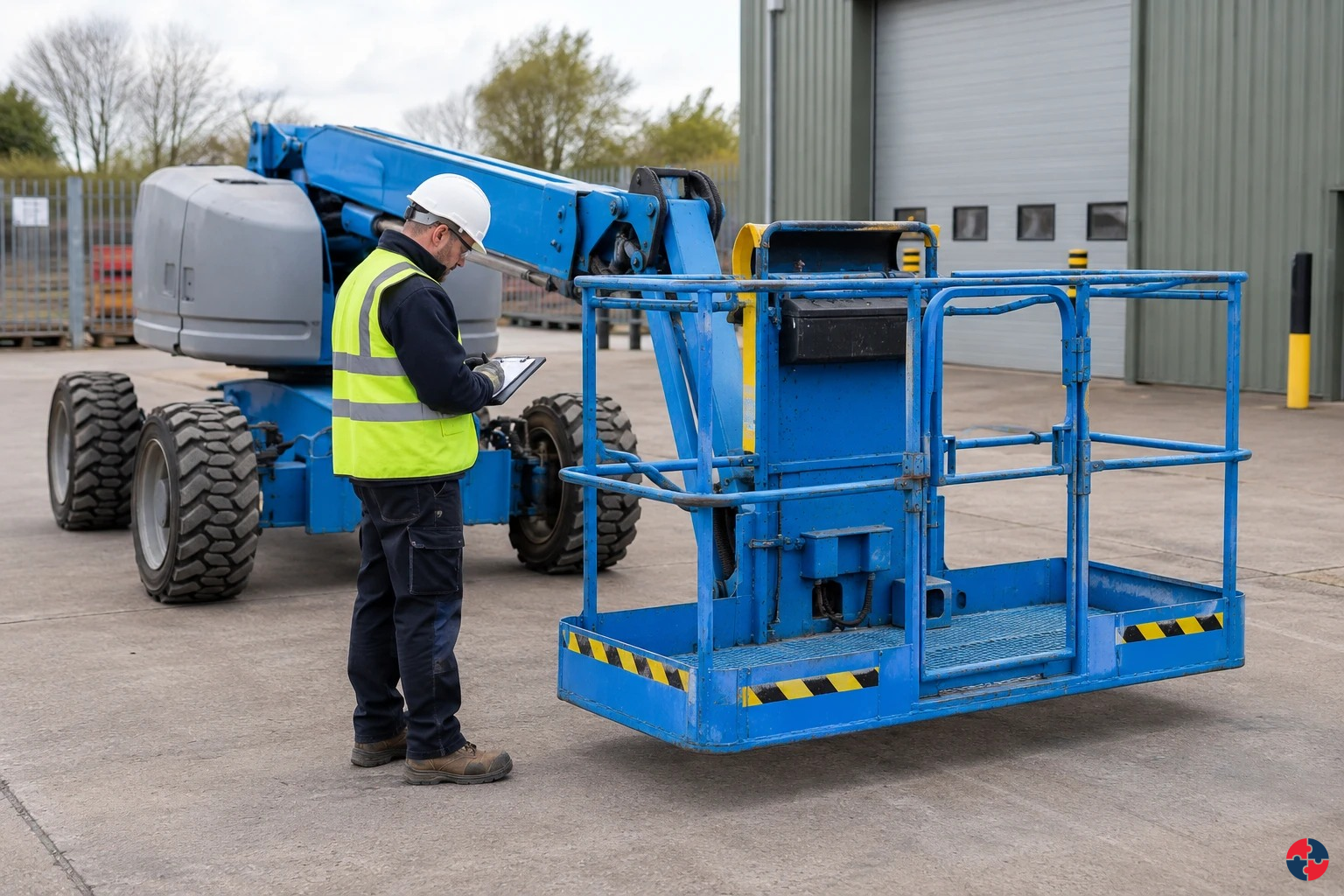
Photorealistic illustrative UK workplace scene. Review checks: Fragile rooflight or sheet: The surface gives way and a person falls through into the space below. Edge, opening or ladder: A slip or overreach leads to a fall onto a hard or obstructed landing. Dropped tool or material: A person below is struck even though the worker above remains protected.01 · What to notice
The bottom-loading gantry keeps routine connections low. A driver proposes climbing the vehicle’s top to check a hatch outside the planned task, without an approved protected access arrangement.
02 · Trace the harm
A fall from the vehicle can be fatal; work over product adds exposure and ignition concerns and may obstruct the emergency route.
03 · Test the safeguard
Walk the actual task with the user, checking the whole route, guarding, gap, surface, vehicle compatibility and an effective emergency recovery arrangement.
Lesson 12
Emergency stop: accessible, effective and matched to the scenario
Availability means a person can reach and use the control and the system achieves the required protective result.
Understand this fuel-industry task
The ESD station is intended to let a person initiate a defined emergency action without approaching the dangerous release. Its usefulness depends on where people are, the safe route to it, visibility, recognition and the action achieved by the connected system. A button behind a pallet may exist on the drawing but be unavailable when needed. A station placed where a spill can surround it may also be difficult to approach even with an unobstructed normal walkway.
The proposed temporary storage needs to be rejected or relocated before it obstructs this safety function. Then check the complete cause-and-effect: which lane stops, which valves or pumps act, what fuel can remain connected and how the shutdown is confirmed. Stopping a pump may not isolate all inventory or make the area safe to enter. ESD use, alarm, withdrawal and responder communication must therefore be part of one understood emergency method. Functional tests need controlled conditions and competent planning; a lamp test or a displayed command is not evidence that final equipment reaches the required state.
Trace the initiating event and loss of control
Step
Case pathway
initiatingEvent
Temporary storage hides the ESD sign and blocks the safe approach during loading.
lossOfControl
A person cannot initiate the required stop promptly, or assumes a button press has isolated more than it actually controls.
consequences
A growing release can expose people and increase the fuel available for fire, vapour-cloud formation or environmental spread.
Choose effective safeguards
Control priority
Practical application
Eliminate
Avoid unnecessary loading and personnel in the vehicle movement area.
Substitute
Prefer arrangements that reduce climbing and manual handling.
Engineer
Provide suitable connections, restraint, static control and assessed protective interlocks.
Manage
Verify product/compartment, driver competence, equipment checks and transfer authority.
Protect
Use suitable clothing, footwear and eye/skin protection for residual transfer exposure.
Keep ESD stations and their safe approaches visible, identifiable and unobstructed; include temporary layouts in the change and housekeeping checks.
Define the required emergency action and accessible initiating locations from the real release scenarios and occupied positions.
Maintain and test the complete initiating-device, logic and final-action chain against the approved cause-and-effect and safe-state requirements.
Train operators and drivers to combine ESD with alarm, safe withdrawal and communication, recognising that shutdown does not automatically authorise re-entry or restart.
Verify effectiveness before release
Check visibility and a safe approach from realistic driver and operator positions, considering a credible spill path rather than only a clear dry lane.
Review an approved controlled test showing the correct affected equipment and final protective result, including any dependencies and failure indication.
Exercise the response and handover safely: staff know what the stop does, how to confirm it and who controls re-entry and restoration.
Transfer the decision to the workplace
Use this practical availability test at fire-main valves, alarm call points and emergency gates; drawings and labels are useful only when the real route and function remain usable.
How should fire and gas cause-and-effect logic be controlled?
Fire and gas systems should connect detection to alarms, shutdowns and emergency actions through controlled cause-and-effect logic.
For a credible gas release during tanker transfer, trace the detector signal through logic and the control-room message to the isolation-valve command, then verify the valve actually closes and the process reaches its defined safe state. A hand-back record should show the tested initiation, each interface, the final element response, removed overrides and the operations lead accepting the restored function. A normal panel display alone proves none of those outcomes.
How should fire and gas cause-and-effect logic be controlled?
Control point
Expert detail
Evidence
Control pointDetector coverage
Expert detailCoverage should match credible releases, wind, congestion, ventilation and equipment layout.
EvidenceDetector mapping and design review.
Control pointAlarm handling
Expert detailOperators should know alarm priority, meaning, confirmation and escalation action.
EvidenceAlarm response procedures and drills.
Control pointShutdown logic
Expert detailTrip, isolation and emergency shutdown actions should match the hazard scenario.
EvidenceCause-and-effect matrix and proof-test record.
Control pointProof testing
Expert detailDetectors, alarms, logic solvers and final elements should be tested at defined intervals.
EvidenceProof-test plan and overdue-action dashboard.
Control pointImpairment management
Expert detailBypassed or failed detectors should trigger temporary controls and authorisation.
EvidenceImpairment log and reinstatement evidence.
Control pointProcess safety interface
Expert detailDetection should link to barrier registers, emergency plans and major accident scenarios.
A pallet would hide this lane’s ESD. The planner proposes painting an arrow above the pallet and retaining the same storage position.
Decision and explanation
Keep the station and safe approach clear, and confirm its complete stop function and response arrangements.
Knowledge does not remove a physical obstruction or provide access for an unfamiliar driver under emergency stress. This adds an avoidable dependency on a repeated housekeeping action and can leave the station blocked when an unexpected release occurs. Accessibility and effective action are both necessary. Relocation of storage should preserve the safety function throughout the duty.
Look closer
Photorealistic illustrative UK workplace scene. Review checks: Elimination: Defer the detector work to a planned shutdown where practicable. Substitution: No separate approved substitution is specified; assess a genuinely safer material or process before relying on lower controls. Engineering controls: Use named, time-limited impairment or bypass authority: identify disabled functions, remaining protection, restrictions, control-room coordination and abort actions. Administrative controls: Use named, time-limited impairment or bypass authority: identify disabled functions, remaining protection, restrictions, control-room coordination and abort actions. PPE: Select compatible task PPE for residual fire, chemical, eye and hand hazards.01 · What to notice
The lane has an accessible emergency station. A proposed pallet position would hide its sign and obstruct the safe approach.
02 · Trace the harm
Delayed detection or access can allow a release to grow; an emergency control that exists on a drawing may be unusable during the event.
03 · Test the safeguard
Test access from realistic occupied positions and verify the complete stop function under controlled conditions, including the correct lane and connected plant response.
Lesson 13
Loaded tanker journeys: manage the driver, vehicle and real route
Delivery promises must fit a safe real journey, not force the driver to compensate for a flawed schedule.
Understand this fuel-industry task
Follow the tanker from the terminal gate onto the public-road segment rather than treating dispatch as the end of risk control. The vehicle carries hazardous inventory through a changing environment: junctions, restricted access, congestion, weather, other road users and the destination approach. A route that suits a car may be unsuitable for a loaded tanker. Unrealistic arrival promises can encourage rushing, unsafe stopping or continuation when the driver is fatigued. The office schedule is therefore part of the risk picture, even though the immediate driving task occurs away from the depot.
Journey planning connects driver capability and fitness, vehicle condition and suitability, route constraints and realistic time. The applicable dangerous-goods requirements add product, load, vehicle, documentation, competence and emergency-information duties according to the actual carriage. An induction certificate does not resolve every transport requirement, and a navigation app cannot establish route suitability. Plan communication that does not distract the driver, safe waiting and revised arrangements when the destination cannot receive. Give drivers usable authority to report fatigue, delay or unsafe access without pressure to improvise. Review near misses and changed conditions with dispatch and customers so the next journey benefits from what happened on the road.
Trace the initiating event and loss of control
Step
Case pathway
initiatingEvent
A loaded tanker is dispatched on an unsuitable route and unrealistic timetable without resolving current driver or vehicle concerns.
lossOfControl
The driver encounters restrictions, fatigue or unsafe manoeuvring pressure while hazardous cargo remains in transit.
consequences
A collision or overturn can injure road users and cause a dangerous release, fire, environmental harm or difficult emergency access.
Choose effective safeguards
Control priority
Practical application
Eliminate
Remove unnecessary transfer steps and hazardous inventory where practicable.
Substitute
Prefer a simpler transfer route with fewer potential leakage interfaces.
Engineer
Provide suitable containment, independent protection, isolation and vehicle separation.
Manage
Authorise the transfer, coordinate both ends and verify readiness and barrier status.
Protect
Select task-specific clothing and eye/skin protection for the remaining exposure.
Assess the journey using current route suitability, restrictions, delivery access, weather and realistic loading, driving, rest and waiting time.
Confirm appropriate driver competence and fitness and a suitable maintained vehicle and load before dispatch under the applicable transport requirements.
Provide required dangerous-goods information and emergency arrangements for the actual carriage, with clear dispatch and customer interfaces.
Let the driver stop or revise an unsafe plan through safe communication, and review recurring delays or near misses rather than transferring pressure to the cab.
Verify effectiveness before release
Compare the planned route with the actual loaded vehicle, restrictions and receiving-site approach; include a safe alternative or refusal decision.
Ask dispatch how a fatigued driver or road closure changes the schedule, and check that the answer is workable in normal commercial conditions.
Review relevant vehicle, driver and carriage evidence and trace journey problems into changes in booking, routing or customer arrangements.
Transfer the decision to the workplace
Apply the same driver–vehicle–journey review to contractors and private-customer runs, where unfamiliar narrow access can add risk after the main road journey.
How does the safe site, safe vehicle, safe driver and safe journey model work?
The model separates transport risk into parts that can be checked, owned and improved.
Workplace transport and road driving overlap, but they need different controls. A yard needs route design, segregation, reversing control and loading rules. A road journey needs planning, fatigue control, vehicle roadworthiness, phone rules, weather decisions and realistic schedules.
The model is useful because it stops organisations blaming the driver for risks created by layout, deadlines, vehicle defects, poor delivery control or unmanaged grey fleet.
Element
What to control
Practical demonstration
Safe site
Segregation, routes, reversing, lighting, surface, speed and loading areas.
A protected pedestrian route from gate to reception and no routine reversing through walkways.
Safe vehicle
Suitability, maintenance, daily checks, reversing aids, visibility and load security.
Defective reversing camera triggers repair or revised method before work continues.
Safe driver/operator
Competence, authorisation, fitness, fatigue, phones, behaviour and supervision.
Driver can delay a journey when fatigued without penalty.
Safe journey
Route, weather, time pressure, welfare stops, lone work and emergency arrangements.
Schedule allows breaks and avoids calls while driving.
Safe interface
Visiting drivers, contractors, pedestrians, cyclists, agency staff and temporary routes.
Visitors are briefed and kept in a safe waiting area before loading.
When are banksmen useful and where do they fail?
Banksmen can support controlled movements, but they do not replace segregation, layout and vehicle controls.
A banksman is sometimes needed for reversing, lifting, manoeuvring or complex vehicle movements. But using a banksman as the main control for poor design is weak. The banksman can be struck, ignored, hidden in a blind spot or drawn into the line of fire.
If a movement happens repeatedly, redesign the route or loading area where practicable rather than relying on manual signalling every time.
One-off complex delivery. Banksman role: Control movement and communication; Better design question: Can timing and area be isolated?.
Routine reversing. Banksman role: May support but should not be default; Better design question: Can one-way route remove reversing?.
Poor visibility. Banksman role: Guide only from safe position; Better design question: Can cameras, mirrors or route design improve visibility?.
Public interface. Banksman role: Coordinate with barriers and exclusion; Better design question: Can public be physically separated?.
No safe standing point. Banksman role: Do not use banksman as sacrificial control; Better design question: Redesign movement or stop.
How does work-related road driving fit into workplace transport?
Road risk needs safe journey, safe driver and safe vehicle controls alongside site transport controls.
Many organisations manage site vehicles carefully but overlook road journeys. A field engineer driving between jobs, a manager visiting sites or a worker using a private car for business still creates work-related road risk.
The organisation should control journey need, timing, fatigue, distraction, vehicle condition, driver competence, insurance, emergency arrangements and pressure from appointments or delivery targets.
Journey need. Good practice: Avoid unnecessary journeys; Weak practice: Drive because it is habit.
Timing. Good practice: Allow rest and realistic schedules; Weak practice: Back-to-back jobs encourage speeding.
Driver fitness. Good practice: Fatigue and medication concerns can be reported; Weak practice: Drivers fear reporting issues.
Distraction. Good practice: No calls or messages while driving; Weak practice: Work calls expected on the road.
Vehicle. Good practice: Maintenance, tyres and defects are controlled; Weak practice: Private vehicles unchecked.
Emergency. Good practice: Breakdown and lone-worker routes are known; Weak practice: Driver improvises.
A private-car trip between work sites is work travel and needs the grey-fleet checks. Ordinary travel between home and the usual workplace is generally commuting; a home-origin journey to somewhere other than the normal workplace may be work travel. Establish the actual purpose and pattern using the applicable GB or NI route, including relevant motorcycles and cycles. Do not classify every journey from home alike.
Fictional road decision: delay changes the plan
A technician’s site-to-site appointment is delayed. The fleet/line manager checks the actual vehicle, authorisation, business-use insurance, defects and driver fatigue, then reschedules or provides another safe arrangement instead of asking the driver to recover time. Hold the journey if the vehicle or driver is not fit for it. Record the revised appointment, work cover and receiving contact; a valid MOT alone does not release the trip.
Applied case
A delayed tanker driver reports fatigue and a diversion unsuitable for the loaded vehicle. The customer insists its original delivery slot must be met.
Decision and explanation
Arrange a safe pause and a revised competent journey and delivery plan that resolves fitness, route and timing.
That transfers unresolved route and fatigue risk to the driver and other road users; customer urgency does not make the journey safe. Correct. Dispatch must support a defensible plan using current conditions, rather than expecting the driver to absorb the conflict. Frequent distracting calls add risk and do not resolve route suitability or fatigue. Agree safe communication and a workable revised plan.
Look closer
Teaching graphic from the linked SHAREhub source section.01 · What to notice
The distribution exercise sends a loaded tanker from the terminal on an unrealistic schedule through restricted or unsuitable routes, with no current driver-fitness review.
02 · Trace the harm
A safe terminal transfer does not remove road-collision, rollover, release or public risks; pressure to recover time can undermine safe driving.
03 · Test the safeguard
Check the actual route constraints, vehicle and load condition, driver fitness and documents, and a schedule that allows safe delays and planned breaks.
Lesson 14
From gate queue to safe dispatch
Integrate traffic, receiving-system readiness, loading safeguards and controlled departure.
Bring the evidence together
A safe loading operation starts before the tanker reaches the gantry and continues through release onto the road. Follow the fictional vehicle through pedestrian conflicts, receiving-compartment checks, ignition controls, connections, access and departure decisions. This course develops awareness and coordinated decisions rather than a replacement loading procedure or dangerous-goods qualification.
Consider the whole sequence of interfaces and degraded conditions. A local repair or completed permit cannot by itself show that every required barrier is available. Separate immediate protection, the competent technical resolution, the operating decision and independent verification.
Use the worked cases and the linked primary guidance to identify the missing information. State who owns the decision and what would keep the operation restricted. The fictional scene illustrates choices; it cannot establish actual process limits, emergency capability or permission to operate.
What evidence should be available for transfer operations?
Evidence should prove the transfer system is safe today, not just that a procedure exists.
Assurance follows one actual transfer: product and tank identity, vehicle immobilisation, hose test, barrier functional check, start authorisation, level trend, stop event and hand-back. Sample records and observe the bay; a signed form alone does not prove the connection was right.
Evidence
What it should show
Failure to challenge
Transfer procedure
Correct sequence for line-up, transfer, monitoring, abnormal response and handback.
Procedure differs from field equipment.
Barrier register
Critical safeguards, owners, tests, impairments and performance standards.
No owner for overfill or ESD protection.
Hose/coupling register
Compatibility, inspection, testing, service life and defect control.
Hoses stored badly or used beyond inspection date.
dangerous-substances fire/explosion assessment
Explosive atmosphere formation, ignition control and emergency mitigation.
Area classification not matched to actual transfer conditions.
Training and authorisation
Operators, drivers, supervisors and contractors know critical steps.
Generic induction with no transfer-specific assessment.
Incident and weak-signal review
Leaks, drips, alarms, near misses and aborted transfers are trended.
Small leaks normalised as housekeeping problems.
Applied case
A tanker arrives during a busy crossing period. Its compartment record disagrees with the loading selection, the vapour arrangement is incomplete and dispatch wants a quick turnaround. After the issues are reported, the driver discloses fatigue. Build a staged hold-and-release plan that names evidence and responsibilities at arrival, transfer and departure, without writing an improvised loading procedure.
Decision and explanation
Separate readiness decisions for arrival, transfer and departure, each supported by the relevant current evidence.
The risk changes across the vehicle journey. A release at one stage cannot establish readiness for the next.
Look closer
Photorealistic illustrative UK workplace scene. Review checks: Vehicle: Unplanned movement can trap or strike people at the loading area. Load: An unstable or unsecured load can shift, fall or overturn equipment. Transfer: A failed connection or incompatible product can create a separate substance exposure.01 · Read the situation
A tanker arrives during a busy crossing period. Its compartment record disagrees with the loading selection, the vapour arrangement is incomplete and dispatch wants a quick turnaround. After the issues are reported, the driver discloses fatigue. Build a staged hold-and-release plan that names evidence and responsibilities at arrival, transfer and departure, without writing an improvised loading procedure.
02 · Explain the principle
A safe loading operation starts before the tanker reaches the gantry and continues through release onto the road. Follow the fictional vehicle through pedestrian conflicts, receiving-compartment checks, ignition controls, connections, access and departure decisions. This course develops awareness and coordinated decisions rather than a replacement loading procedure or dangerous-goods qualification.
03 · Carry it into work
The risk changes across the vehicle journey. A release at one stage cannot establish readiness for the next.
Lesson 15
Turn the learning into a verified workplace action
Choose a bounded action, owner, task-specific evidence and escalation trigger within your role.
Make the course useful at work
Terminal tanker-loading and dispatch operations; site-specific delivery and dangerous-goods responsibilities depend on actual products and roles.
Choose one relevant task from this course. Describe the material, equipment, people and interfaces, then explain the credible harm pathway before choosing the control. Follow the actual site process for obtaining missing technical evidence and deciding whether work may proceed.
Use the linked resource with a specific question. A briefing should test understanding; a checklist should identify missing facts; an audit should compare claims with observations. Keep this exercise fictional and separate from live operating records.
Record the planned action, responsible role, verification evidence and a trigger for escalation or reassessment. Completion of this course is a learning record, not an operating instruction, engineering design, specialist licence or authority to enter, isolate or fight a fire.
How should transport and driving risks be assured?
Assurance should test real vehicle movements, route conditions, driver decisions and management of change.
First-line checks include vehicle condition, route walkdowns and driver briefings. Manager assurance samples peak periods, temporary route changes, visitor control and delivery interface. Senior leaders should review high-potential near misses, reversing events, collisions, defects and fatigue signals.
A useful assurance exercise is to follow a delivery from gate to departure and record every pedestrian/vehicle interface.
Frontline. What to check: Routes, vehicles, loads, visibility and people; What good looks like: Unsafe movement stops immediately.
Supervisor. What to check: Briefings, reversing, loading and visitor controls; What good looks like: Rules are followed in busy periods.
Manager. What to check: Traffic plan, maintenance, competence and trends; What good looks like: Actions address recurring weak signals.
Fleet/technical. What to check: Vehicle condition, specification and roadworthiness; What good looks like: Vehicles fit task and environment.
Leadership. What to check: High-potential events and investment needs; What good looks like: Layout and resources improve over time.
Your handover action says improve fuel safety but names no operation, control owner, evidence or stopping condition.
Decision and explanation
Name the actual task, competent control owner, evidence required and the hold/escalation trigger.
An effective plan connects a real task and control with a responsible role, objective evidence and a clear decision boundary. A course badge or signature does not establish the plant condition.
Look closer
Related SHAREhub topic guide. Apply its prompts to the specific case below.01 · Read the situation
Your handover action says improve fuel safety but names no operation, control owner, evidence or stopping condition.
02 · Explain the principle
Terminal tanker-loading and dispatch operations; site-specific delivery and dangerous-goods responsibilities depend on actual products and roles.
03 · Carry it into work
An effective plan connects a real task and control with a responsible role, objective evidence and a clear decision boundary. A course badge or signature does not establish the plant condition.