Full public teaching and readers are free without an account. A free learner account is required for saved LMS progress and recorded assessment. Completion and any course-completion certificate depend on the configured LMS conditions. Full course outline and access routes.
Lesson 1
See the accident pathway behind the green dashboard
Explain why process-safety assurance needs evidence of the barriers controlling a credible major event.
From routine transfer to major consequence
A terminal receives and moves a hazardous inventory, so a failure can extend beyond the person doing the job. Picture a receiving tank that continues to fill after a misleading level indication. Escaping liquid may create a spreading release, vapour and an ignition opportunity. The important learning question is what interrupts that developing sequence before people, neighbouring operations or the environment are exposed.
Personal injury information still matters. Slips, strains and small cuts need prevention and learning. However, counting those outcomes answers a different question from whether the receiving tank’s protective function will act when demanded. An injury-free month provides no direct demonstration of its condition. A useful review keeps worker-health performance and process-barrier evidence visible together, with appropriate measures for each.
Build a simple barrier story around one specific scenario. Identify the initiating deviation, the loss of control, the potential consequences and the protective functions expected to prevent or limit them. Then ask what each function must do, who owns it and which current observation or test supports confidence. This prevents a general statement such as 'we have alarms' from concealing missing response arrangements or unresolved defects.
At Crown Fuels, compare the office dashboard with the separate impairment and overdue-action information. A supervisor should be able to trace an adverse indicator to the affected equipment and operating decision. A report becomes useful when it leads to a justified restriction, competent action and verification. In this course, take a green display as an invitation to ask for relevant evidence, rather than as a universal release to operate.
Why can low injury rates hide high process safety risk?
Major accident risk is rare, complex and barrier-dependent, so ordinary injury metrics may not reveal degraded controls.
Personal injury rates often count events that occur frequently enough to create visible trends. Major accident events may not occur for years, even when barriers are degraded. That time lag creates false confidence. The organisation may believe it is safe because no one has been hurt, while leaks, bypasses, overdue proof tests and poor MOC are accumulating.
The useful model is two lenses on the same workplace. The personal safety lens asks whether people are protected from task injuries. The process safety lens asks whether hazardous inventory remains contained and major accident barriers are healthy.
Workplace example
Personal safety lens
Process safety lens
Fuel transfer
Slips, manual handling, vehicle interface and PPE.
Overfill, vapour release, ignition, containment and emergency shutdown.
Reactor start-up
Access, heat exposure and manual tasks.
Runaway reaction, alarms, trips, relief and operating envelope.
Maintenance on pipework
Cuts, lifting, tools and work at height.
Isolation, residual pressure, hazardous contents and line breaking.
Warehouse aerosols
Manual handling and vehicle movement.
Flammable inventory, ventilation, ignition sources and fire spread.
Boiler house
Burns, slips and access.
Pressure system integrity, relief, combustion and gas detection.
Confined-space cleaning
Access, rescue and PPE.
Toxic/asphyxiant atmosphere, isolation and loss of containment.
The two columns select questions; they are not exclusive hazard categories. Access, rescue, isolation and atmosphere control can protect the same people in the same confined-space event. Small releases, demands and failed functions belong in process-safety learning even without a site-wide major accident or catastrophic harm.
Applied case
The monthly dashboard is green, but the receiving tank has an unresolved protection-test action. A receipt is booked for this afternoon.
Decision and explanation
Current task-specific protection evidence and the authorised impairment decision.
The protection evidence and impairment decision concern this operation and safeguard. Injury history and previous successful receipts do not demonstrate present availability.
Look closer
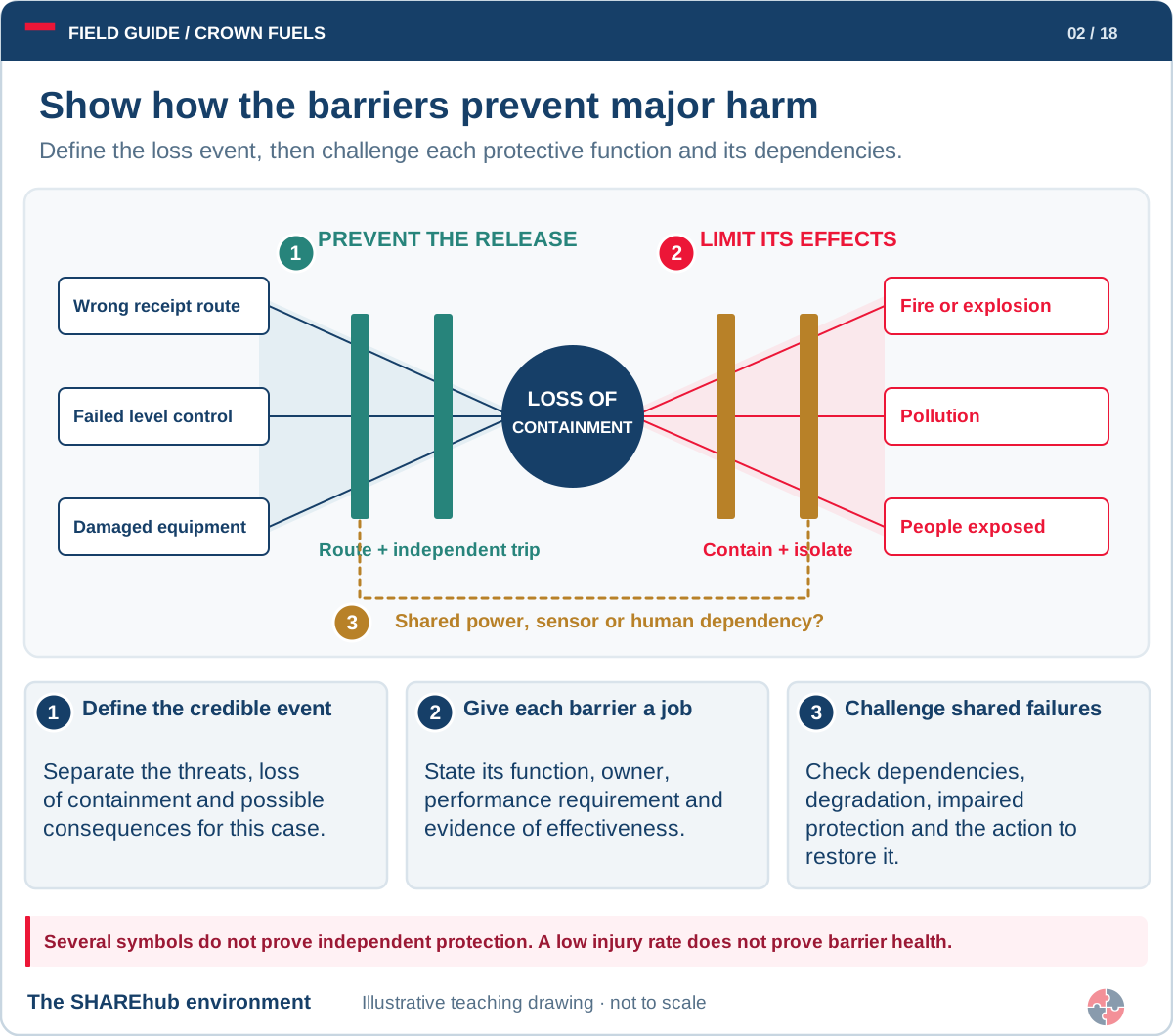
Explore the numbered equipment and control points. Existing SHAREhub teaching schematic; illustrative and not to scale.Prevent the release
Find the route check and independent trip on the left. Ask which initiating event each barrier interrupts, who owns it and what current evidence supports it.
Limit the consequences
Follow the right side from loss of containment to fire, pollution and people exposed. Containment and isolation have specific jobs; their presence on a diagram does not prove availability.
Challenge shared failure
The dashed connection asks whether protection shares power, sensors or human dependencies. Several symbols can still depend on one vulnerable part of the system.
01 · Read the situation
The monthly dashboard is green, but the receiving tank has an unresolved protection-test action. A receipt is booked for this afternoon.
02 · Explain the principle
A terminal receives and moves a hazardous inventory, so a failure can extend beyond the person doing the job. Picture a receiving tank that continues to fill after a misleading level indication. Escaping liquid may create a spreading release, vapour and an ignition opportunity. The important learning question is what interrupts that developing sequence before people, neighbouring operations or the environment are exposed.
03 · Carry it into work
The protection evidence and impairment decision concern this operation and safeguard. Injury history and previous successful receipts do not demonstrate present availability.
Lesson 2
Make leadership visible at the hold point
Describe management actions that support a safe hold and ensure unresolved risks reach the right authority.
Authority must work when production is delayed
Leadership becomes visible when a safe decision has a cost. If a failed safeguard threatens a booked delivery, managers influence whether an operator can hold the task without punishment and obtain competent help promptly. A written stop-work statement is weak if the same manager then pressures the team to continue unchanged. Workers learn from the decisions leaders reward, resource and defend.
For each safety-critical activity, people need understandable authority: who may initiate a hold, who controls the affected operation, who assesses the technical problem and who authorises any justified restoration. These roles can involve different people. Seniority alone does not resolve an engineering uncertainty. The leader’s contribution includes obtaining suitable expertise, maintaining clear restrictions and preventing commercial urgency from becoming an undocumented substitute for protection.
Worker participation supplies information that a dashboard may miss. A night driver may know that a connection is difficult in poor lighting or that the current route invites a shortcut. Listen to the task description, examine the conditions with the people doing the work and explain what happens to the concern. A suggestion box without feedback can teach workers that reporting brings effort without improvement.
Use the model’s office and gate to test the whole communication chain. Can a visiting driver find the responsible person? Can a supervisor explain the restriction at shift change? Does a manager know which resource is needed to resolve it? Record the actual concern, interim controls and ownership in the proper site system. A fictional exercise should rehearse those decisions without creating a live company instruction or authorising anyone to operate.
How does leadership change a barrier decision?
A worked example shows leadership under production pressure, where visible commitment means choosing barrier health over convenience.
Crownway Fuels Ltd has an overdue proof test on an independent high-high level trip for a fuel storage tank. The site is under delivery pressure and a shutdown window has already moved twice. The dashboard still shows low personal injury numbers, so a weak leadership response would be to defer the test again and accept verbal reassurance that operators will monitor levels closely.
A strong process safety leader asks what scenario the trip protects, what other barriers are available, whether manual monitoring is independent and reliable, who is authorised to accept temporary risk, what customers or production plans need adjusting, and when the proof test will be completed. The decision is visible because it changes priorities, not because the leader gave a talk.
Ask what major accident barrier is degraded and escalate.
Production pressure
Treat delivery schedule as fixed.
Review production plan against barrier impairment.
Temporary controls
Rely on operator vigilance.
Define independent temporary controls and risk acceptance.
Risk ownership
Let local team carry informal risk.
Named senior owner approves or stops operation.
Action close-out
Accept email saying test will be done.
Verify proof test result and update dashboard.
Learning
Treat as one overdue task.
Review backlog, planning and resource causes.
Operational example: decisions and evidence
Task material and setting: A terminal’s independent overfill trip has an overdue proof test during a high-volume delivery period.
People and prerequisites: Shift lead owns transfer; instrument specialist tests the trip; process-safety lead judges barrier impairment; executive sponsor controls resources and release authority.
Before: Confirm the overfill scenario, trip performance standard, last valid test, compensating measures and contractual schedule pressure.
During: Pause the affected transfer while the competent team verifies the trip and safe alternative; communicate the reason to crews and customers without blame.
Hold or stop: No transfer under the normal envelope while independent protection remains unproved or a temporary measure lacks competent approval.
Completion and hand back: Restore and proof-test the barrier, close the impairment, update the delivery plan and examine why the test became overdue.
Evidence: Barrier standard, impairment decision, funding/reprioritisation record, test result, operational handback and board review of recurrence.
Three different decisions: the executive sponsor approves resources and escalation; the competent technical authority accepts test/repair or a tested engineered equivalent; operations controls handback and restart. No sponsor may overrule unresolved performance-standard failure or a statutory restriction by signing risk acceptance. Illustrative record: independent overfill trip, affected tank-transfer scenario, hazardous transfer held, repair/proof-test reference required, next-shift/expiry review and immediate stop on changed conditions. Crownway is a fictional teaching case, not a documented HSE incident.
Applied case
A supervisor holds an uncertain receipt. The manager asks for a quick verbal waiver because the customer is important.
Decision and explanation
Support the hold, obtain competent assessment and resource a verified resolution.
Leadership supports a justified delay and resolves the conditions. A waiver cannot make unavailable protection function.
Look closer
Photorealistic illustrative UK workplace scene. Review checks: Source / exposure: Leadership fails when major accident risk is invisible, bad news is filtered or production pressure quietly outranks barriers. Possible consequence: It appears when actions stay overdue, operators stop reporting nuisance alarms, shutdowns are delayed, maintenance is deferred, MOC quality drops, contractor concerns are ignored or leaders ask only about injury rates. Control failure: Strong leadership uses those signals as prompts to look deeper, not as irritations to manage away.01 · Read the situation
A supervisor holds an uncertain receipt. The manager asks for a quick verbal waiver because the customer is important.
02 · Explain the principle
Leadership becomes visible when a safe decision has a cost. If a failed safeguard threatens a booked delivery, managers influence whether an operator can hold the task without punishment and obtain competent help promptly. A written stop-work statement is weak if the same manager then pressures the team to continue unchanged. Workers learn from the decisions leaders reward, resource and defend.
03 · Carry it into work
Leadership supports a justified delay and resolves the conditions. A waiver cannot make unavailable protection function.
Lesson 3
Demonstrate competence across the operator–contractor boundary
Separate training attendance from demonstrated task capability and coordinate responsibilities before work.
One site, several employers, connected decisions
An induction helps a newcomer recognise the site and its rules. It does not by itself show that a person can perform a safety-critical connection, recognise a wrong route or stop correctly when information disagrees. Competence combines relevant knowledge, practical capability and understanding of limits. The evidence must fit the task, equipment and conditions, including abnormal situations that a confident routine performance may never reveal.
Define what the role actually requires before selecting the assessment. A driver may need to identify the correct connection, explain the emergency stop and identify when unloading must not begin. A specialist inspection contractor may need different technical expertise and permit interfaces. An appropriate safe demonstration, questioning and supervised practice can expose gaps more effectively than attendance records alone. Assessment and supervision must themselves be suitable for the risk.
An experienced contractor and a capable operator can still make incompatible assumptions. One may believe the other controls isolation, atmosphere checks or handback. Before release, agree the job boundary, responsibilities, information, supervision and stop arrangements. Ask each party to describe the same task independently; disagreement is evidence to resolve. Neither an insurance certificate nor the contractor’s professional reputation transfers away the operator’s coordination responsibilities.
Maintain capability after initial authorisation. Equipment changes, long absence, unfamiliar duties and lessons from error may justify further support or reassessment. Give people a credible way to say they need assistance without being treated as uncooperative. During the Crown Fuels gate missions, practise choosing supervised support or a hold where competence is uncertain. This is awareness training; the course result cannot replace a site’s task assessment or confer operator authority.
How should competence be demonstrated?
Test knowledge, observed task performance and judgement in credible abnormal conditions against the actual barrier standard.
HSE says training alone is insufficient. For a tank-transfer operator, assess line-up and independent verification, response to a stuck level indicator, interpretation of a high-high alarm, stop/isolating action, communication and hand-back. Use simulation or scenario questioning for rare events, then observed supervised practice on permitted plant states. The assessor must know the task and failure criteria; a course certificate or years of service cannot replace current evidence. If the person cannot explain an abnormal response, restrict authorisation, coach and reassess before unsupervised duty.
On a small screen, scroll this table sideways to read all columns.
Assess a transfer operator
Competence element
Assessment evidence
Failure response
Normal line-up
Observed valve and tank check against current procedure.
Hold authorisation for wrong line-up.
Abnormal indication
Scenario: level instrument disagreement or alarm inhibition.
Stop transfer, verify state and call competent support.
Emergency action
Drill/simulator for shutdown and handover.
Retrain and retest if action/communication misses standard.
Currency
Record last practice, change and restriction.
Supervision/reassessment after long absence or material change.
Agree the assessor’s task-specific acceptance criteria before the assessment: cues, decision, safe action, timing where the scenario requires it, escalation and hand-back evidence. Use a simulator or a controlled permitted plant state for abnormal scenarios; do not create a live hazardous upset to test a trainee. Record observed results and restrictions, check that the shift has current authorised cover, and stop or reassign the critical task if that cover is missing. After a failed assessment, change or prolonged absence, the role owner sets supervision/coaching and reassesses before restoring unsupervised authority. HSE competence guidance supports task standards and assessment beyond course attendance.
Applied case
A tank inspector has impressive qualifications, but the contractor and terminal supervisor name different people as the isolation authority.
Decision and explanation
Resolve the common task boundary, responsibilities and control evidence with both parties.
Technical qualifications are valuable, but the unresolved interface remains a pathway to harm. Both parties must share an accurate work-control arrangement.
Look closer
Photorealistic illustrative UK workplace scene. Review checks: Elimination: Avoid a nonessential transfer or overfill-prone routing. Substitution: Use a lower-rate or smaller batch transfer where compatible with operation. Engineering: Specify an independent high-high level trip, closure time and containment capacity against the overfill scenario; document alarm set point and safe transfer rate. Administrative: Assess operator response, authorisation, independent line-up and handover. PPE: PPE only for residual exposure in planned intervention, never an overfill barrier.01 · Read the situation
A tank inspector has impressive qualifications, but the contractor and terminal supervisor name different people as the isolation authority.
02 · Explain the principle
An induction helps a newcomer recognise the site and its rules. It does not by itself show that a person can perform a safety-critical connection, recognise a wrong route or stop correctly when information disagrees. Competence combines relevant knowledge, practical capability and understanding of limits. The evidence must fit the task, equipment and conditions, including abnormal situations that a confident routine performance may never reveal.
03 · Carry it into work
Technical qualifications are valuable, but the unresolved interface remains a pathway to harm. Both parties must share an accurate work-control arrangement.
Lesson 4
Keep temporary change, fatigue and learning connected
Explain how organisational changes and human factors can weaken barriers and require verified follow-through.
Change does not end when the workaround starts
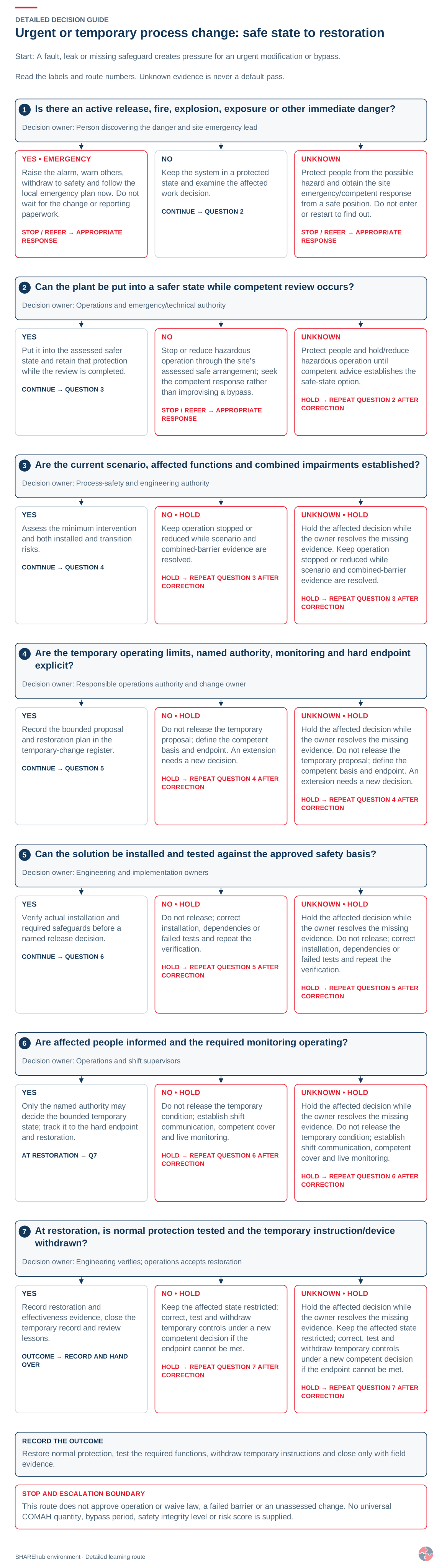
A temporary bypass changes the protection available to an operation, even if no permanent equipment is purchased. Other changes can be less visible: a staffing reduction, a different contractor, revised shift pattern or altered procedure. Consider what the original safe arrangement depended on and whether those assumptions still hold. Calling a change temporary does not make its effect temporary unless ownership, duration and restoration are controlled.
A sound change process establishes the proposed scope, affected hazards and interfaces, competent assessment, approval limits and updated information. It identifies who needs to understand the change and what restrictions apply. Temporary arrangements need a clear expiry and a route for reassessment or reinstatement. Closing the paperwork after expiry while leaving the changed condition in the field creates a dangerous difference between the recorded and actual plant.
Human factors belong in this assessment. Fatigue, glare, poor welfare, workload and confusing displays can affect a critical check. Telling an exhausted operator to concentrate does not redesign the work. Examine staffing, breaks, task timing, lighting, usable information and the ability to obtain help. Involve the people affected; small practical barriers can explain why a theoretically clear procedure fails under real operating pressure.
Incident learning uses the same discipline. After a near overfill, a briefing may communicate the story but does not prove its causes have been addressed. Trace each action into an implemented change, check it works and share the relevant learning across shifts and similar equipment. Before closing an action, ask what would now interrupt the event if the same conditions recurred. That question connects learning to verified prevention instead of a completed attendance list.
How are temporary changes prevented from becoming permanent by drift?
Give each temporary change a competent basis, owner, operating limit, expiry or trigger, monitoring and a plan for permanent correction or removal.
Record maximum authorised duration and earlier withdrawal triggers, shift handover, cumulative impairments and the person who must stop the arrangement. An event-bounded duration needs a competent documented justification and a clear withdrawal condition. Expiry or failed conditions require withdrawal/hold; any extension needs fresh assessment and approval.
Applied case
A temporary bypass has expired. The operator roster has also changed, and the incoming shift cannot describe the current restriction.
Decision and explanation
Hold affected operation and resolve the change, communication and restoration evidence through the authorised process.
The actual altered protection and understanding must be reconciled. Changing labels or dates cannot demonstrate a safe operating state.
Look closer
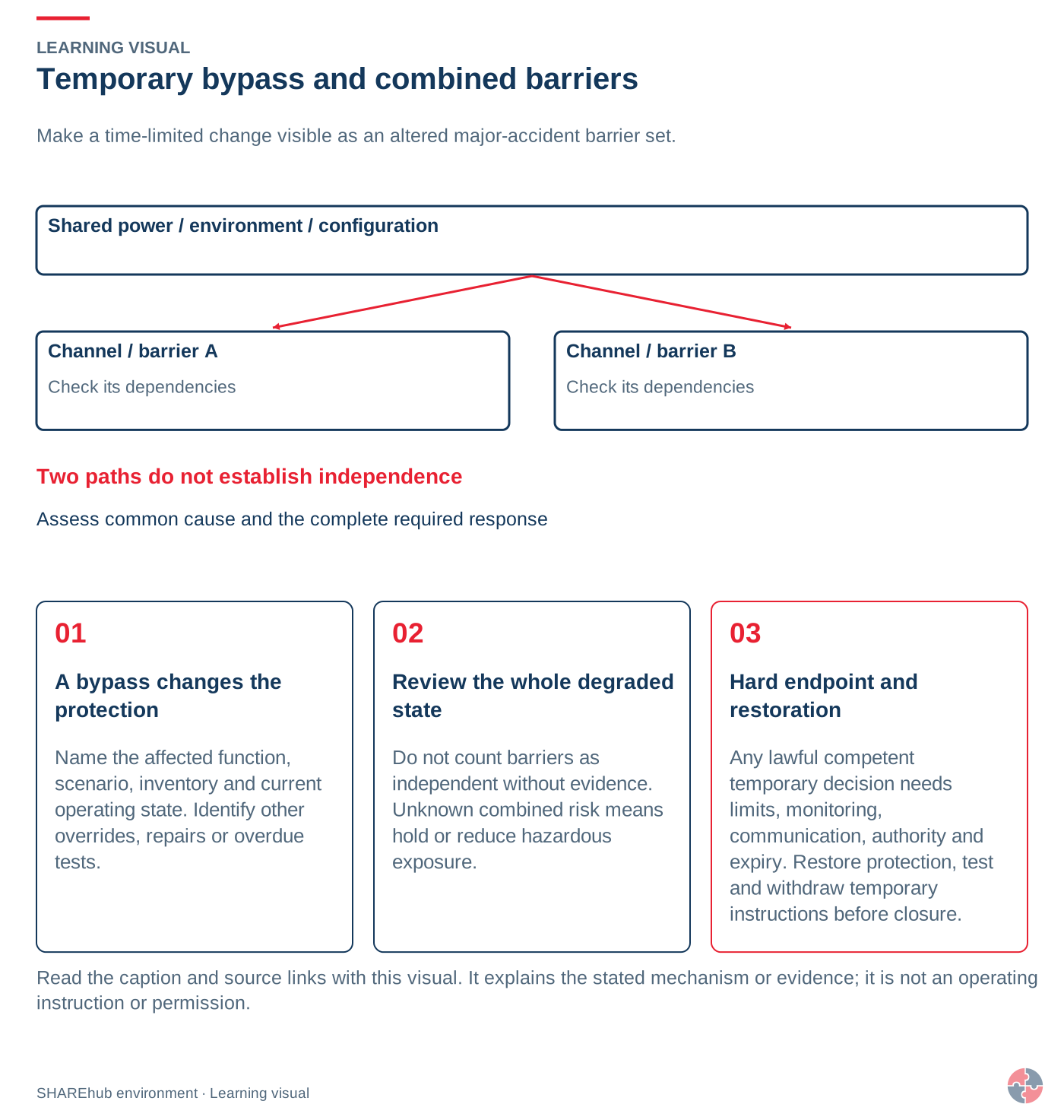
Teaching graphic from the linked SHAREhub source section.01 · Read the situation
A temporary bypass has expired. The operator roster has also changed, and the incoming shift cannot describe the current restriction.
02 · Explain the principle
A temporary bypass changes the protection available to an operation, even if no permanent equipment is purchased. Other changes can be less visible: a staffing reduction, a different contractor, revised shift pattern or altered procedure. Consider what the original safe arrangement depended on and whether those assumptions still hold. Calling a change temporary does not make its effect temporary unless ownership, duration and restoration are controlled.
03 · Carry it into work
The actual altered protection and understanding must be reconciled. Changing labels or dates cannot demonstrate a safe operating state.
Lesson 5
Keep the closed perimeter effective and escape usable
A perimeter is a functioning arrangement, not merely a fence drawn on the site plan.
Understand this fuel-industry task
The fence and controlled gate mark the boundary between ordinary public access and a terminal containing flammable inventories, tanker movements and restricted equipment. Leaving the gate open after hours changes who can enter, how they are detected and whether someone receives the information needed to stay safe. A person does not need to intend damage to cause a serious problem: a lost visitor, curious child or driver following the wrong entrance can enter a vehicle route or approach operating plant.
Security therefore connects with process safety and public protection, while remaining compatible with safe escape and emergency entry. Review how authorised staff, contractors and responders gain access when normal reception is closed or power fails. Avoid a solution that locks people inside or leaves an emergency gate impossible to open. The fictional layout illustrates the interface; its perimeter does not establish a particular legal classification or prove that any real terminal is within COMAH scope.
Trace the initiating event and loss of control
Step
Case pathway
initiatingEvent
An operational convenience removes normal after-hours gate control without an assessed replacement.
lossOfControl
People or vehicles can reach hazardous areas without authorisation, induction, escort or effective detection.
consequences
The public may encounter live equipment or moving tankers; interference can impair barriers or delay emergency actions.
Choose effective safeguards
Control priority
Practical application
Eliminate
Remove unnecessary hazardous material, energy and transfer operations.
Substitute
Choose a less hazardous product or simpler process where practicable.
Engineer
Prefer effective engineered preventive and mitigative barriers.
Manage
Use suitable hazard studies, verify assumptions and act on weak-signal indicators.
Protect
Keep PPE as an additional exposure control within its actual capabilities.
Retain access control until an approved alternative addresses the same hazards, including visitors, out-of-hours work and abnormal loss of power or communications.
Use physical boundary protection, suitable detection and a managed response proportionate to the site; signs explain restrictions but do not enforce them alone.
Coordinate keys, credentials, escorts and contractor departures with people-accounting arrangements, while preserving reliable escape and responder access under the emergency plan.
Treat changes to gates, staffing or patrols as changes affecting the major-hazard interface. Define who reviews the proposal and who can authorise implementation.
Verify effectiveness before release
Walk the boundary to identify gaps, damaged fencing, climbable storage and routes that bypass normal reception without entering a hazardous area.
Use an authorised exercise to demonstrate staff entry, visitor rejection, emergency release and responder access; include an appropriate power-loss case.
Compare the access record with people actually present and ask the responsible shift who responds to an out-of-hours access alarm.
Transfer the decision to the workplace
Review the safety consequences when organisations remove reception cover, change key systems or temporarily open a boundary during construction and deliveries.
How should off-site and environmental consequences shape leadership decisions?
A release may affect neighbours and the environment as well as people on site. Leaders need a credible footprint, receptors, communication route and emergency interfaces.
A maintenance team asks to wedge the gate open overnight so replacement parts can arrive. The security office will be unstaffed.
Decision and explanation
Retain normal control or agree an assessed staffed or controlled delivery arrangement before changing access.
The sign communicates a restriction but does not replace controlled entry, detection or a response to someone who ignores or misses it. Preventing access must not trap occupants or make planned emergency entry impossible. Security and emergency arrangements need to work together. The replacement must address who can enter, how they are checked and how escape and emergency response remain available.
Look closer
Photorealistic illustrative UK workplace scene. Review checks: Source / exposure: A major accident follows a credible path from an initiating fault to loss of containment, escalation and harm when preventive or mitigating barriers fail or are unavailable. Possible consequence: For a fuel tank, inflow can continue after a level instrument fails; an independent high-level shutdown may also be impaired. Control failure: Overflow can create vapour, which may find ignition and affect workers or neighbours.01 · What to notice
The model has a fenced perimeter. A delivery team proposes leaving the gate open after hours without replacement access control.
02 · Trace the harm
Unauthorised entry can expose the public to tanks, moving vehicles and ignition restrictions, and interfere with safety-critical equipment.
03 · Test the safeguard
Walk the boundary and test authorised entry and emergency release. Check that a real visitor cannot bypass the induction and safe route.
Lesson 6
Demonstrate competence for this terminal and task
Authorise the capability required at this plant, including recovery from disagreement and failure, rather than treating a certificate as universal competence.
Understand this fuel-industry task
The agency driver at the gate may hold the correct driving qualifications and have years of fuel-delivery experience. Those are relevant starting points, but they do not show that the person can safely operate this terminal's connection, loading permission or emergency-stop arrangements. Similar-looking gantries can behave differently. Competence combines relevant knowledge, practical skill and the judgement to recognise when conditions fall outside personal authority; an attendance record establishes only that a learning activity was completed.
Begin with the tasks that protect the process, then define the performance required for each role. The driver should understand grade and compartment checks, the connection sequence, stop conditions, escape and communication without having to guess. Assessment should include a safe abnormal scenario, such as an incompatible indication or failed permissive, rather than only the successful routine. Training, supervision and authorisation must reflect the actual gap. A busy colleague nearby is not automatically an effective supervisor for a safety-critical transfer.
Trace the initiating event and loss of control
Step
Case pathway
initiatingEvent
An unfamiliar driver is assigned independent loading on the strength of induction attendance alone.
lossOfControl
A critical check or abnormal-stop action is missed because site-specific capability has not been established.
consequences
Wrong connection, overfill, product release or vehicle movement can injure workers and expose people beyond the loading lane.
Choose effective safeguards
Control priority
Practical application
Eliminate
Remove unnecessary safety-critical manual tasks and avoid excessive workload.
Substitute
Use clearer interfaces and simpler tasks where suitable.
Engineer
Design usable displays, protected workstations and accessible clean welfare facilities.
Manage
Plan staffing, rest, handovers, competence and a culture that acts on concerns.
Protect
Provide appropriate personal protection and hygiene for remaining task exposure.
Identify safety-critical driver tasks and authorisation boundaries; align terminal and carrier responsibilities so neither assumes the other has assessed the same practical skills.
Use site-specific instruction and supervised practice with suitable equipment. Provide information in a form and language the individual can understand and use under pressure.
Assess representative routine and abnormal performance through a safe demonstration or simulation, including when to stop, withdraw and seek authorised help.
Provide competent cover when assessment is incomplete; refresh assessment after relevant plant changes, long absence or evidence of difficulty, rather than relying solely on expiry dates.
Verify effectiveness before release
Ask the driver to identify the actual product route, connection, stop control and escape route in a safe walk-through without prompting every step.
Check that the assessor is competent for this loading system and that recorded authorisation names the actual task and equipment covered.
Examine how an unsuccessful demonstration changes assignment and supervision; confirm the system can delay loading when competent cover is unavailable.
Transfer the decision to the workplace
Use this distinction for control-room operators, permit issuers, instrument technicians and emergency roles: assess the person against the safety function their work protects.
How should competence be demonstrated?
Test knowledge, observed task performance and judgement in credible abnormal conditions against the actual barrier standard.
HSE says training alone is insufficient. For a tank-transfer operator, assess line-up and independent verification, response to a stuck level indicator, interpretation of a high-high alarm, stop/isolating action, communication and hand-back. Use simulation or scenario questioning for rare events, then observed supervised practice on permitted plant states. The assessor must know the task and failure criteria; a course certificate or years of service cannot replace current evidence. If the person cannot explain an abnormal response, restrict authorisation, coach and reassess before unsupervised duty.
On a small screen, scroll this table sideways to read all columns.
Assess a transfer operator
Competence element
Assessment evidence
Failure response
Normal line-up
Observed valve and tank check against current procedure.
Hold authorisation for wrong line-up.
Abnormal indication
Scenario: level instrument disagreement or alarm inhibition.
Stop transfer, verify state and call competent support.
Emergency action
Drill/simulator for shutdown and handover.
Retrain and retest if action/communication misses standard.
Currency
Record last practice, change and restriction.
Supervision/reassessment after long absence or material change.
Agree the assessor’s task-specific acceptance criteria before the assessment: cues, decision, safe action, timing where the scenario requires it, escalation and hand-back evidence. Use a simulator or a controlled permitted plant state for abnormal scenarios; do not create a live hazardous upset to test a trainee. Record observed results and restrictions, check that the shift has current authorised cover, and stop or reassign the critical task if that cover is missing. After a failed assessment, change or prolonged absence, the role owner sets supervision/coaching and reassesses before restoring unsupervised authority. HSE competence guidance supports task standards and assessment beyond course attendance.
Applied case
The driver's induction quiz is complete. During the walk-through they cannot explain what to do when the loading permission fails and suggest bypassing it.
Decision and explanation
Hold unsupervised loading and obtain site-specific assessment, instruction and suitable competent cover.
The demonstrated gap concerns a protective function. It needs practical resolution and a clear limit on assignment, not another attendance signature. Past experience cannot establish performance on an unfamiliar system, especially after the person has described an unsafe response. Supervision requires defined responsibility, capability and capacity to intervene. Incidental observation does not resolve the assessment gap.
Look closer
Photorealistic illustrative UK workplace scene. Review checks: Elimination: Avoid a nonessential transfer or overfill-prone routing. Substitution: Use a lower-rate or smaller batch transfer where compatible with operation. Engineering: Specify an independent high-high level trip, closure time and containment capacity against the overfill scenario; document alarm set point and safe transfer rate. Administrative: Assess operator response, authorisation, independent line-up and handover. PPE: PPE only for residual exposure in planned intervention, never an overfill barrier.01 · What to notice
A new agency driver has completed an online induction but has not demonstrated this terminal’s connection, abnormal-stop or emergency arrangements.
02 · Trace the harm
A knowledgeable driver may still misunderstand unfamiliar controls, causing wrong connection, loss of containment or unsafe movement.
03 · Test the safeguard
Use an appropriate safe simulation: the driver identifies the grade, connections, stop control, safe escape and person to contact when conditions disagree.
Lesson 7
Agree the operator–contractor interface before work
Contracting out a service requires cooperation and clear control of the interfaces that can defeat safety barriers.
Understand this fuel-industry task
The inspection contractor has arrived with specialist equipment, but the terminal has not agreed the exact job boundary or who controls isolation. Expertise in inspection does not give a contractor complete knowledge of every connected line, live receipt or temporary bypass at this terminal. Equally, the terminal must retain enough understanding to specify the work and evaluate the service. Selection checks, insurance and qualifications matter, but none physically isolates the tank or prevents another team changing its status.
Plan the interface around the hazardous task: what plant is included, what remains live, who authorises work, who verifies the boundary and what happens if conditions change. Information must travel in both directions; the contractor can introduce equipment, ignition sources or work methods that affect others. A permit communicates and coordinates agreed precautions within a safe system. It is not a substitute for the risk assessment, practical isolation or supervision that makes those precautions true at the workplace.
Trace the initiating event and loss of control
Step
Case pathway
initiatingEvent
A contractor starts inspection before the terminal and work team agree scope, isolation ownership and simultaneous activities.
lossOfControl
Each party relies on a different plant boundary or assumes the other has made the worksite safe.
consequences
Live fuel, stored energy or moving vehicles can reach people, and an introduced ignition source can escalate a release.
Choose effective safeguards
Control priority
Practical application
Eliminate
Avoid intrusive work on hazardous systems where possible.
Substitute
Use safer inspection and maintenance methods.
Engineer
Provide suitable isolation, contained drains and verified protective arrangements.
Manage
Coordinate permits, contractor competence, gas testing, rescue and handback as applicable.
Protect
Select suitable task PPE and rescue protection; never improvise a confined-space rescue.
Define the scope and exclusions with competent operator and contractor representatives, using current plant information and a joint worksite review before work release.
Agree responsibility for isolation planning, application, verification and handback; reconcile permits and simultaneous operations with the people controlling receipt and transfer.
Confirm the contractor's task capability and proposed equipment suitability, while retaining terminal supervision and enough technical competence to challenge unsafe assumptions.
Set communication, stop-work and emergency arrangements for all shifts, including how a scope change or discovered defect suspends the existing work authority.
Verify effectiveness before release
Ask the terminal representative and contractor supervisor separately which equipment is isolated, what remains live and who may change that status.
Compare the authorised work scope with the actual equipment, access route, isolation evidence and other jobs affecting the same area.
Review a previous handback: verify outstanding defects, temporary items, inspections and operating restrictions reached the authorised person accepting the plant.
Transfer the decision to the workplace
Apply this same joint-boundary approach to instrument calibration, fire-system maintenance, excavation near buried pipes and specialist cleaning during a live terminal shift.
How should contractor rules and HSSE bridging documents be used?
Contractor rules and bridging documents should explain exactly how the contractor's arrangements align with the host site's HSSE standards and process safety controls.
A contractor rules pack is useful for repeat site expectations: access, induction, PPE, permits, isolations, hot work, confined spaces, lifting, vehicles, welfare, waste, reporting, stop-work authority, emergency arrangements and prohibited behaviours. A bridging document is more specific. It compares the contractor's own management arrangements with the host operator's requirements and decides which rule applies where there is a gap, difference or overlap.
The bridging document is especially valuable where a contractor brings its own procedures, supervision model, equipment standards, training rules, emergency arrangements or subcontractors. Without bridging, two organisations can each assume the other controls a risk. The document should make ownership visible: who issues permits, who verifies isolations, who provides rescue, who performs gas testing, who approves changes, who accepts handback and who reports incidents.
For process safety, the bridging document should also connect to the site major accident hazard register. If contractor work affects a safety-critical barrier, the bridge should define the performance standard, required evidence, authority for impairment, hold points, escalation route and acceptance criteria before restart.
Contractor rules and bridging document contents
Element
What the document should define
Practical output
Scope and hierarchy of rules
Which host, contractor and legal requirements apply if standards differ.
Clear decision rule for supervisors and permit issuers.
Roles and authorities
Contract owner, area authority, contractor supervisor, permit issuer, technical authority and emergency contacts.
No ambiguity over who approves or stops work.
Control of work
PTW, isolations, gas testing, line-breaking, hot work, confined spaces and SIMOPS.
Shared work-control expectations before mobilisation.
Safety-critical barriers
Barriers affected by the work and evidence needed to prove they remain healthy.
Barrier performance standard and assurance evidence.
Competence and onboarding
Named role requirements, induction, task briefing, language and refresher needs.
Worker access linked to verified competence.
Emergency and rescue
Alarms, muster, rescue provision, firefighting interface, spill response and medical arrangements.
Practical emergency plan understood by both parties.
Incident and learning rules
Reporting thresholds, investigation ownership, evidence preservation and action close-out.
Consistent learning and accountability.
Change and deviation control
Who approves changes to scope, method, people, equipment, timing or plant status.
No informal drift from the approved work package.
Applied case
The contractor says their standard method covers tank inspection. The terminal operator thinks the contractor will identify the isolation, while the contractor expects it already completed.
Decision and explanation
Hold work and jointly agree and verify scope, isolation, responsibilities and interface precautions.
Competent people can still act on conflicting assumptions. A signature without a shared physical boundary does not control the live system. This establishes the actual safe work conditions and who controls them. Specialist expertise and operator knowledge must meet at the job boundary. Proximity and valve position do not establish a complete boundary. Connected feeds, passing valves and stored contents need competent planning.
Look closer
Photorealistic illustrative UK workplace scene. Review checks: Scope-based pre-qualification: Approves contractors by defined work category and risk level rather than blanket company approval. Pre-assignment audit: Audits readiness before higher-risk work such as tank entry, hot work, line-breaking or safety-critical maintenance. HSSE bridging document: Aligns contractor rules with the process operator permit, DSEAR, isolation, emergency, reporting and subcontractor requirements.01 · What to notice
A tank-inspection contractor arrives with suitable-looking equipment, but the job boundary, isolation authority and supervision are not agreed.
02 · Trace the harm
Conflicting assumptions between operator and contractor can expose people to live product, stored energy or simultaneous vehicle movements.
03 · Test the safeguard
Ask both parties separately to explain the same isolation boundary, stop rule, emergency actions and handback requirements; resolve any difference.
Lesson 8
Measure major-accident barriers, not just injury outcomes
A useful process-safety indicator connects a known scenario to a control, a performance test and a timely accountable decision.
Understand this fuel-industry task
The office dashboard reports injury-free days while the separate barrier log contains an overdue overfill test and repeated transfer alarms. These are different kinds of evidence. Personal-safety measures tell the organisation something important about injuries, but a quiet injury record does not demonstrate that a tank will stop receiving when the primary level system fails. Major accidents can be rare while the conditions that allow one gradually accumulate. An average green score can hide the single failed function that matters to the next receipt.
Start process-safety measurement with a credible scenario and the controls relied on to prevent or limit it. For overfill, useful evidence includes whether required tests met the specified coverage and whether impairments were controlled; demands, failed tests and actual loss of containment reveal weaknesses after they occur. Define the meaning, owner and response for each measure. Completing a work order is not equivalent to passing the functional test, and producing a report does not resolve a degraded barrier.
Trace the initiating event and loss of control
Step
Case pathway
initiatingEvent
An unrecognised or unresolved protective-function impairment remains hidden by a reassuring aggregated dashboard.
lossOfControl
Receipt continues while the barrier needed for the defined overfill scenario is unavailable or unproven.
consequences
A routine level-control failure can progress to fuel release, a hazardous vapour cloud, fire and off-site consequences.
Choose effective safeguards
Control priority
Practical application
Eliminate
Remove unnecessary hazardous material, energy and transfer operations.
Substitute
Choose a less hazardous product or simpler process where practicable.
Engineer
Prefer effective engineered preventive and mitigative barriers.
Manage
Use suitable hazard studies, verify assumptions and act on weak-signal indicators.
Protect
Keep PPE as an additional exposure control within its actual capabilities.
Identify the major-accident scenarios and critical control systems first, then select a small meaningful combination of preventive and failure indicators for each.
Define data quality, scope, accountable owner and escalation criteria so a critical exception remains visible even when most equipment or work orders are healthy.
Link impairment and overdue-test information to operating decisions through the authorised assessment process; dashboards should trigger a response, not grant permission to operate.
Review whether management action restores the required barrier performance, including resources, recurring defects and verification of closure rather than only improved reporting percentages.
Verify effectiveness before release
Follow the overdue test from the dashboard to its actual tank, performance requirement, test coverage, result and current operating restriction.
Sample a task recorded as complete and confirm its evidence demonstrates the required safety function, including failures, exclusions and outstanding defects.
Ask managers what action a failed critical test triggers today, then compare the answer with the latest exception and the decision recorded for affected operation.
Transfer the decision to the workplace
Use the same approach for firewater availability, isolation quality, emergency drills and competence: ask what safety outcome the measure actually demonstrates.
How should indicators be designed from major accident scenarios?
Start with the scenario, identify the barrier, then choose measures that show whether the barrier is healthy.
A common weakness is starting with available data instead of starting with risk. The better route is: major accident scenario -> barrier function -> performance standard -> evidence source -> leading indicator -> lagging indicator -> trigger level -> management action.
This method prevents dashboards from becoming collections of easy numbers. The organisation may have excellent completion of generic inspections while missing the fact that critical alarms are overridden or that proof tests are overdue.
Design step
Question
Example
Scenario
What high-consequence event are we trying to prevent?
Tank overfill leading to vapour cloud explosion.
Barrier
Which control interrupts the event?
Independent high-high level trip.
Performance standard
What must the barrier do?
Detect high level and stop transfer on demand.
Evidence source
Where does data come from?
Proof-test record and bypass register.
Leading indicator
What shows health before failure?
Proof tests due, completed and failed.
Lagging indicator
What shows barrier demand/failure?
Overfill near miss or trip failure.
Trigger/action
What requires escalation?
Any failed test or overdue red action.
Applied case
The monthly report is 98% green. One of the unfinished items is the only credited independent high-level trip test for a tank due to receive fuel.
Decision and explanation
Assess and escalate the particular barrier status and apply the justified operating restriction through the authorised process.
An average does not establish the availability of the specific protection required for this receipt. The location and safety function of the exception matter. This links the indicator to the real major-accident scenario and a practical decision. The percentage remains useful only alongside the critical exception. Separate reporting categories can improve clarity, but hiding the barrier information removes a warning instead of correcting the risk.
Look closer
Photorealistic illustrative UK workplace scene. Review checks: Source / exposure: Indicators fail when they measure easy activity, hide weak signals, lack triggers or are not linked to decisions. Possible consequence: A dashboard can look mature while saying very little. Control failure: Counting audits, training or inspections does not prove safety-critical barriers are healthy.01 · What to notice
The office display celebrates injury-free days; the scenario’s separate barrier log shows overdue overfill tests and repeated transfer alarms.
02 · Trace the harm
Personal injury performance and major-accident prevention address different evidence. A low injury rate can coexist with loss-of-containment risk.
03 · Test the safeguard
Trace a dashboard exception to the real tank function, test history, restriction and verified corrective action; do not substitute injury statistics for that evidence.
Lesson 9
Turn leadership commitment into defensible operating decisions
Leaders influence barrier reliability through the decisions they reward, the resources they provide and the response they give to unwelcome evidence.
Understand this fuel-industry task
At this learning stop, a terminal manager faces a delayed receipt and a protective function that has failed its required test. A signed instruction to continue does not repair the equipment, restore independence or create more response time. Leadership influences whether the operator feels able to hold the transfer and whether repeated defects receive resources. The practical evidence of commitment is therefore visible in difficult decisions: accepting a delay, obtaining competent advice and following justified restrictions when production pressure is strongest.
A major-accident prevention approach needs clear accountability without assuming one manager personally performs every technical assessment. Barrier owners, operating authority and technical specialists should know their roles and the escalation route when protection is degraded. Consider simpler or less hazardous arrangements where practicable, then maintain the engineered and organisational controls selected for the actual scenarios. A corporate policy becomes credible when purchasing, staffing, maintenance and delivery commitments support it. This model teaches that discipline without assigning a COMAH tier to the fictional terminal.
Trace the initiating event and loss of control
Step
Case pathway
initiatingEvent
Commercial pressure leads a manager to dismiss a failed protection test and challenge an operator's hold.
lossOfControl
The operation proceeds outside the justified arrangement, and future warnings may be suppressed to avoid the same conflict.
consequences
A foreseeable initiating fault can reach a major release; weakening reporting also allows other impaired barriers to persist.
Choose effective safeguards
Control priority
Practical application
Eliminate
Cancel unnecessary changes or remove the underlying hazard.
Substitute
Compare safer alternatives before selecting the design.
Engineer
Design suitable independent safeguards for the changed operating envelope.
Manage
Use competent review, pre-startup verification, worker involvement and action closure.
Protect
Update residual-risk protection and competence; PPE cannot repair a weak barrier.
Support the immediate hold and refer the failed function to the competent impairment process, maintaining the safe state and restrictions established for the actual plant.
Assign accountable barrier owners with access to technical expertise, realistic budgets and authority to resolve defects; make escalation and stop authority explicit across shifts.
Review how commercial targets, staffing and maintenance prioritisation affect major-accident control, including the consequences of repeated temporary workarounds and deferrals.
Use visible field discussions and follow-up to test whether workers can challenge assumptions and whether reported defects result in engineering action and reliable reinstatement.
Verify effectiveness before release
Review a recent production-versus-protection decision: identify the facts available, technical assessment, restrictions, authorisation and evidence that the failed function was restored.
Ask operators and contractors privately how a hold is received, and compare their account with leadership's declared reporting and stop-work arrangements.
Trace a repeated barrier defect through funding, repair, testing and close-out; verify that resources addressed its underlying cause rather than only its overdue status.
Transfer the decision to the workplace
Apply this test when approving staffing cuts, maintenance deferrals, temporary plant or ambitious delivery targets: identify which safety assumptions the decision changes.
How does leadership change a barrier decision?
A worked example shows leadership under production pressure, where visible commitment means choosing barrier health over convenience.
Crownway Fuels Ltd has an overdue proof test on an independent high-high level trip for a fuel storage tank. The site is under delivery pressure and a shutdown window has already moved twice. The dashboard still shows low personal injury numbers, so a weak leadership response would be to defer the test again and accept verbal reassurance that operators will monitor levels closely.
A strong process safety leader asks what scenario the trip protects, what other barriers are available, whether manual monitoring is independent and reliable, who is authorised to accept temporary risk, what customers or production plans need adjusting, and when the proof test will be completed. The decision is visible because it changes priorities, not because the leader gave a talk.
Ask what major accident barrier is degraded and escalate.
Production pressure
Treat delivery schedule as fixed.
Review production plan against barrier impairment.
Temporary controls
Rely on operator vigilance.
Define independent temporary controls and risk acceptance.
Risk ownership
Let local team carry informal risk.
Named senior owner approves or stops operation.
Action close-out
Accept email saying test will be done.
Verify proof test result and update dashboard.
Learning
Treat as one overdue task.
Review backlog, planning and resource causes.
Operational example: decisions and evidence
Task material and setting: A terminal’s independent overfill trip has an overdue proof test during a high-volume delivery period.
People and prerequisites: Shift lead owns transfer; instrument specialist tests the trip; process-safety lead judges barrier impairment; executive sponsor controls resources and release authority.
Before: Confirm the overfill scenario, trip performance standard, last valid test, compensating measures and contractual schedule pressure.
During: Pause the affected transfer while the competent team verifies the trip and safe alternative; communicate the reason to crews and customers without blame.
Hold or stop: No transfer under the normal envelope while independent protection remains unproved or a temporary measure lacks competent approval.
Completion and hand back: Restore and proof-test the barrier, close the impairment, update the delivery plan and examine why the test became overdue.
Evidence: Barrier standard, impairment decision, funding/reprioritisation record, test result, operational handback and board review of recurrence.
Three different decisions: the executive sponsor approves resources and escalation; the competent technical authority accepts test/repair or a tested engineered equivalent; operations controls handback and restart. No sponsor may overrule unresolved performance-standard failure or a statutory restriction by signing risk acceptance. Illustrative record: independent overfill trip, affected tank-transfer scenario, hazardous transfer held, repair/proof-test reference required, next-shift/expiry review and immediate stop on changed conditions. Crownway is a fictional teaching case, not a documented HSE incident.
Applied case
A supplier warns that delaying the batch will cost money. The operator has held receipt after a failed overfill protection test, and the manager is asked to override the hold.
Decision and explanation
Support the hold, obtain competent impairment advice and resource a justified safe resolution.
A waiver does not demonstrate equivalent protection or restore the failed safety function. Extra attention must not be invented as an unassessed replacement. That transfers the uncertainty and removes information the next decision maker needs. Accountability includes honest handover of impairments. This preserves the operating boundary while the actual risk and recovery requirements are assessed by the right people.
Look closer
Photorealistic illustrative UK workplace scene. Review checks: Change the work: Eliminate, Reduce including substitution, Isolate, Control, personal protective equipment (PPE) and Discipline (ERICPD) is a prompt for decisions. Strengthen prevention: HSE’s five-level hierarchy prioritises elimination, substitution, engineering controls, administrative controls and PPE. Verify the barriers: They are related frameworks, not identical laws; apply them to the actual task and check the resulting control. Sustain the controls: Eliminate major-accident exposure where a design or business decision can remove a hazardous inventory or operation. Review the decision: Leaders should test a proposal against the actual scenario, not treat behavioural reminders as an engineering alternative.01 · What to notice
An exercise asks the terminal manager to choose between delaying a receipt and operating with protection that has failed its required test.
02 · Trace the harm
Unresolved degradation can turn an ordinary transfer fault into a major accident; pressure from leaders can also suppress future reporting.
03 · Test the safeguard
Review what leaders actually did when a delivery was delayed, whether resources resolved the fault and whether workers could raise the concern without retaliation.
Lesson 10
Close the causes of a near miss, then check the learning works
Complete the improvement, verify its performance and retain its rationale; a briefing alone rarely closes an engineering and communication failure.
Understand this fuel-industry task
The near-overfill was stopped, but that fortunate outcome does not show that the original system was adequate. The case file still contains a recurring sensor fault and unclear handover. Recording 'team briefed' may document communication, yet it leaves both weaknesses capable of affecting the next receipt. Separate what happened from why it was possible: immediate actions, equipment behaviour, information available, workload, supervision and organisational decisions all help reconstruct the event without jumping straight to blame.
Learning becomes useful when recommendations change the conditions that produced the event. A suitable investigation preserves relevant trends, test evidence and accounts, then develops proportionate actions with owners and acceptance criteria. Compare relevant external lessons, including fuel-tank overfill learning from Buncefield, without assuming every site or event is identical. Transfer the resulting knowledge into design information, procedures, competence and maintenance so it survives staff changes. Finally check effectiveness in real work or a safe exercise, rather than declaring success when an email is sent.
Trace the initiating event and loss of control
Step
Case pathway
initiatingEvent
A near-overfill investigation closes after a briefing while a recurring instrument defect and handover gap remain unresolved.
lossOfControl
The same failed defences are present at the next receipt, despite an action register marked complete.
consequences
Another initiating event may produce actual overfill, exposure, fire or environmental harm rather than a successful recovery.
Choose effective safeguards
Control priority
Practical application
Eliminate
Cancel unnecessary changes or remove the underlying hazard.
Substitute
Compare safer alternatives before selecting the design.
Engineer
Design suitable independent safeguards for the changed operating envelope.
Manage
Use competent review, pre-startup verification, worker involvement and action closure.
Protect
Update residual-risk protection and competence; PPE cannot repair a weak barrier.
Address any current impairment first and preserve relevant operating trends, alarm sequence, test results and accounts without exposing people to an unsafe scene.
Investigate immediate, underlying and organisational causes proportionate to the event's credible potential, including why information or earlier faults did not prompt effective action.
Select actions that alter the equipment, task or management arrangement responsible; assign an owner, completion evidence and a separate effectiveness check for important recommendations.
Share relevant learning across shifts and similar assets, update controlled knowledge and assessment, and retain the reasons behind design decisions for future teams.
Verify effectiveness before release
Trace the recurring sensor issue to a technically accepted repair or assessed restriction and suitable test evidence, not merely another completed briefing.
Use a safe handover exercise with another shift to confirm the revised information supports the correct capacity, route and stop decisions.
Revisit recurrence trends and a sample of similar tanks after closure; check whether people can explain the change and whether the same failure path remains credible.
Transfer the decision to the workplace
Use near misses, failed proof tests and external incident reports as opportunities to examine comparable barriers before waiting for a major event at your own plant.
How should incidents and near misses be classified?
Events should be classified by potential consequence, barrier failure, recurrence and learning value, not only injury outcome.
A low-injury event may still be a major warning. A dropped spanner that misses someone, a flammable vapour detector alarm, a damaged lifting accessory found before use or a wrong valve alignment corrected at the last second may all be high learning value events. The classification system should help managers see what could have happened if one more barrier had failed.Investigating accidents and incidents, HSG245RIDDOR reporting
For process safety, classification should connect to the hazardous inventory and scenario: loss of containment, fire, explosion, toxic release, overpressure, runaway reaction, confined atmosphere or environmental release. For general health and safety, it should connect to fatal and serious harm potential, chronic health risk, vulnerability, recurrence and legal reporting.
For the actual task hazard, HSE places elimination first, then substitution, engineering controls, administrative controls and suitable PPE for residual risk. Record why a higher control is not practicable and how the chosen measure is checked in use. HSE hierarchy of controls
Eliminate shared reversing by redesigning delivery; use one-way routes and segregated pedestrian paths. Barrier and gate the conflict point before relying on banksmen or hi-vis.
Transport owner walks the route with drivers and pedestrians; commissions segregation, checks barriers and route before shift, audits near misses.
Repeated near misses on a smooth floor left wet after cleaning
Eliminate the wet-cleaning/pedestrian overlap by rescheduling or using a dry method where suitable. Dry the floor and physically exclude people until safe; signs, footwear and reminders are residual controls, not a substitute for a dry route.
Facilities owner checks the cleaning method and floor condition, records repeat events, tests the barrier and dry-floor release with cleaners and pedestrians, and samples other shifts.
The action owner presents a signed attendance sheet after the near-overfill. The instrument defect remains open and a night-shift operator cannot identify the changed stopping responsibility.
Decision and explanation
Demonstrated resolution of the defect and a usable, understood handover arrangement, with follow-up for recurrence.
Communication is one part of learning. Effective closure must address the known causes and demonstrate that the revised control works across shifts. More information may help understanding, but it does not repair the fault or show that responsibility transfers reliably during live operations. The absence of harm describes the outcome, not the remaining potential. A near miss can expose failed barriers requiring urgent attention.
Look closer
Photorealistic illustrative UK workplace scene. Review checks: Capture: Workers and contractors report near misses, weak signals and unsafe conditions. Classify: Potential severity and barrier impact determine investigation level. Investigate: Root cause and human factors are reviewed.01 · What to notice
The learning review describes a stopped near-overfill. Its action record says “briefed team”, although a recurring sensor fault and unclear handover remain unresolved.
02 · Trace the harm
An outcome that avoided injury can still reveal failed defences. Blaming the last person leaves equipment, workload and communication causes in place.
03 · Test the safeguard
Match every important recommendation to an owner and completion evidence, then test whether another shift can perform the revised task and detect recurrence.
Lesson 11
Control the whole life of a temporary change
Temporary changes require the same understanding of hazards and interfaces as permanent ones, plus deliberate control of time and restoration.
Understand this fuel-industry task
The bypass on the office sketch is described as temporary, but there is no defined expiry, risk review or reinstatement owner. Temporary equipment or logic can alter flow paths, defeat protection, create trapped volumes or confuse the next shift just as permanent modifications can. Its short intended duration does not establish low risk. The first task is to discover the actual installed and operating state: a proposal still on paper and a live undocumented bypass require different immediate actions, both through competent change and impairment arrangements.
Management of change follows the consequences of a proposal beyond the component being altered. Review process conditions, connected plant, protective functions, utilities, procedures, maintenance, workload and emergency response. Consider whether eliminating the need or choosing a simpler arrangement avoids the new hazard. Before use, verify design intent, field installation, documents, competence and outstanding actions through the appropriate readiness review. Temporary status needs controlled review and either proved restoration or formal reassessment; repeatedly changing a date is not evidence that the original assumptions still hold.
Trace the initiating event and loss of control
Step
Case pathway
initiatingEvent
A bypass is introduced or retained without a current review of its duration, plant interfaces and effect on credited protection.
lossOfControl
The real configuration departs from the approved basis of safety while staff continue using assumptions and instructions for the old arrangement.
consequences
Unintended transfer, lost protection or unsafe maintenance can cause loss of containment and delayed emergency response.
Choose effective safeguards
Control priority
Practical application
Eliminate
Cancel unnecessary changes or remove the underlying hazard.
Substitute
Compare safer alternatives before selecting the design.
Engineer
Design suitable independent safeguards for the changed operating envelope.
Manage
Use competent review, pre-startup verification, worker involvement and action closure.
Protect
Update residual-risk protection and competence; PPE cannot repair a weak barrier.
Hold an unreviewed proposal; if the bypass already exists, establish its status and manage affected operation through the competent impairment and change process.
Define scope, purpose, dependencies, accountable approvers and affected documents; include software, staffing and procedures where they alter the safety assumptions.
Assess hazards and protection before implementation, then complete required inspections, tests, operator preparation and pre-start readiness checks against the approved design intent.
Set expiry, review and restoration responsibilities, communicate the status across shifts, and close the change only after the real plant and controlled information are reconciled.
Verify effectiveness before release
Compare the authorised drawing, logic or procedure with the installed bypass and field tags; identify every operational instruction affected by the actual configuration.
Check which safety functions depend on shared equipment or utilities introduced by the change and how the competent review addressed these dependencies.
Examine the closure evidence: physical reinstatement or approved permanent design, appropriate testing, document updates and confirmation that temporary restrictions were formally resolved.
Transfer the decision to the workplace
Apply the method to substitute instruments, revised valve timing, rented generators, staffing changes and altered emergency routes, not only new pipework.
How are temporary changes prevented from becoming permanent by drift?
Give each temporary change a competent basis, owner, operating limit, expiry or trigger, monitoring and a plan for permanent correction or removal.
Record maximum authorised duration and earlier withdrawal triggers, shift handover, cumulative impairments and the person who must stop the arrangement. An event-bounded duration needs a competent documented justification and a clear withdrawal condition. Expiry or failed conditions require withdrawal/hold; any extension needs fresh assessment and approval.
Applied case
A bypass approved for one week is still present a month later. A planner suggests extending the expiry because it has operated without a reported incident.
Decision and explanation
Establish the actual status, apply the authorised impairment restrictions and obtain a competent change review with a defined recovery decision.
A short incident-free period does not validate the hazard review or establish continued protection. The actual arrangement and assumptions need reassessment. This restores accountable control of both current operation and the decision to reinstate, modify or remove the temporary arrangement. Removing information hides the configuration difference and can make operating or maintenance decisions more dangerous.
Look closer
Teaching graphic from the linked SHAREhub source section.01 · What to notice
The change exercise shows a proposed temporary bypass on the manifold sketch; its expiry, risk review and return-to-normal responsibilities are missing.
02 · Trace the harm
Temporary plant, software, procedure or staffing changes can create new routes, remove independence or invalidate the original safety assumptions.
03 · Test the safeguard
Compare the actual configuration with approved documents, review outstanding actions and prove reinstatement before closing the change; “like for like” needs evidence.
Lesson 12
Turn frontline warnings into action on the barrier
Worker voice adds safety value when it changes understanding and action, with a visible route from the report to the condition at the plant.
Understand this fuel-industry task
The driver's complaint about an awkward bonding connector and repeated alarm resets describes work as it is actually performed. The office meeting records only loading time, so the warning never reaches someone able to assess the protective function. Workers often notice early deterioration, confusing instructions and workarounds before a dashboard does. Asking for views is useful, but consultation is incomplete if nobody examines the problem or explains the resulting decision to the people doing the task.
A constructive reporting culture separates the need to understand an event from an automatic assumption that the last person caused it. Examine equipment fit, access, time pressure, instruction quality, staffing and earlier defect response. Include visiting drivers, contractors and night shifts, whose experience can be missed by daytime meetings. Managers still retain responsibility to decide and resource the response. Praise or a suggestion-box count is not a replacement for assessing an impaired barrier, correcting the underlying problem and verifying that the actual work has improved.
Trace the initiating event and loss of control
Step
Case pathway
initiatingEvent
Repeated practical difficulty with a safety-related connection is reported but filtered out of management discussion.
lossOfControl
The unreliable connection or reset workaround remains normal practice, without a competent assessment of the protection being lost.
consequences
A transfer can proceed without effective bonding or with an unresolved process fault, allowing ignition or escalation of a release.
Choose effective safeguards
Control priority
Practical application
Eliminate
Remove unnecessary safety-critical manual tasks and avoid excessive workload.
Substitute
Use clearer interfaces and simpler tasks where suitable.
Engineer
Design usable displays, protected workstations and accessible clean welfare facilities.
Manage
Plan staffing, rest, handovers, competence and a culture that acts on concerns.
Protect
Provide appropriate personal protection and hygiene for remaining task exposure.
Provide accessible ways to report defects and task difficulty across shifts, employers and languages, with a clear route for urgent barrier concerns to reach operating authority.
Assess the immediate plant condition before continuing affected work; involve competent technical people where the report concerns bonding, permissives, alarms or other protective functions.
Observe and redesign the difficult task with users, favouring reliable equipment and usable arrangements over instructions simply to be more careful or reset more often.
Feed back decisions, actions and verification to the reporting group; treat deliberate misconduct fairly while avoiding blame or incentives that suppress honest reporting.
Verify effectiveness before release
Ask the original reporter what happened after the concern and inspect the actual connector or task change; compare that evidence with the closed action entry.
Sample night-shift and contractor reports for response time and escalation of safety-critical issues, rather than counting only meeting attendance.
Observe a safe representative loading preparation and abnormal indication response to verify that workers no longer need the reported workaround to complete the task.
Transfer the decision to the workplace
Seek comparable weak signals from cleaners, security staff, dispatchers and maintenance teams; each sees interfaces that the control room may not observe.
Who must be involved, and when?
Involve the people whose work, knowledge or safety is affected while there is still a genuine opportunity to change the decision. Reach all relevant shifts and interfaces; consulting the most available people is not the same as consulting the affected workforce.
Map the work before choosing the meeting. A change to tank transfer may involve a control-room operator, field operator, driver, instrument technician, maintenance planner and emergency team. Each sees a different part of the risk. Ask who performs the task during nights, holidays, start-up and breakdowns, not just who holds the normal daytime role. Use the legally applicable consultation route alongside these technical contributions.
Make participation possible
Plan release from operational duties, cover for attendance, accessible information and enough preparation time. Rotate sessions or use representative feedback so an off-shift team is not consistently excluded. Consider language, literacy, disability, digital access and confidence speaking in front of managers. Verify understanding through discussion of a realistic task; a translated handout or a signed attendance sheet is not proof that a person can use the information.
Ask specific questions: where does the document differ from actual plant conditions? Which step is difficult when another task is taking place? What happens if a display, radio or utility is unavailable? What information is missing at shift change? These questions make it easier to contribute than asking whether everyone is happy with the procedure. Record a minority concern about a safety-critical assumption even if most participants have not experienced it.
Set consultation around the lifecycle
Seek operating and maintenance input during design, before access and equipment choices become difficult to change. Revisit the discussion during commissioning, before hazardous introduction, following modifications and after abnormal events. Maintenance shutdowns and temporary staffing arrangements deserve attention because the normal pattern of work and protection may be disturbed. A final briefing communicates an approved arrangement; it should not be the first time affected workers see it.
There is no universal consultation period that suits every decision. Allow time proportionate to complexity and workforce coverage, and retain the opportunity for informed responses before the final decision. An immediate danger still requires the site's prompt protective response: do not delay urgent action for a committee meeting. Consult on the ongoing arrangements and resulting changes once the immediate situation is controlled.
The day meeting thanks the driver for raising the connector problem, but asks everyone to reset the same alarm to maintain loading speed while parts are ordered.
Decision and explanation
Assess the affected protection, apply required restrictions, investigate the difficult task with users and verify a working correction.
That can reinforce the workaround and discourage reporting the barrier problem. Speed does not demonstrate a healthy connection or justified reset. Listening begins consultation; it does not establish that the equipment is fit or that continued operation is within the approved arrangement. The report becomes a decision about the real barrier, followed by technical and practical evidence that the response works.
Look closer
Teaching graphic from the linked SHAREhub source section.01 · What to notice
A driver reports an awkward bonding connector and repeated alarm resets; the day meeting records only average loading times.
02 · Trace the harm
Ignoring work-as-done removes early warning of unreliable barriers and encourages unofficial workarounds; consultation loses value without feedback and action.
03 · Test the safeguard
Ask the reporting worker and next shift what changed. Check the actual connector, alarm response and action closure rather than the meeting attendance alone.
Lesson 13
Design the control-office task for human capability
Reliable human performance comes from manageable work and usable information, supported by competence and recovery arrangements.
Understand this fuel-industry task
The operator in the control office is checking similar tank identifiers after extended shifts, missed breaks and a welfare fault. Summer brightness or low winter sun can obscure the display, while high workload competes with alarms, calls and permit coordination. These are foreseeable conditions shaping performance, not evidence that an experienced operator should simply try harder. Fatigue can affect attention, memory and decision making; awkward DSE arrangements and work-related stress can also harm health independently of the process risk.
Assess the task, individual needs and organisational conditions together. Clear identifiers, readable displays, manageable workload and competent relief reduce dependence on memory and endurance. Discuss workstation fit and glare with the user, including screen position, suitable shading and the need to remain aware of the plant. Reliable toilets, washing, drinking water and rest facilities support the work, but they must be usable during the shift. Confidential support can help someone affected by poor mental health; it complements rather than replaces action on harmful working conditions.
Trace the initiating event and loss of control
Step
Case pathway
initiatingEvent
Fatigue, glare and excessive workload make an operator's critical tank-selection and alarm task harder than the design assumes.
lossOfControl
An incorrect identifier is accepted or an important deviation is not understood and acted on within the available time.
consequences
Wrong routing or delayed shutdown can escalate a transfer fault, while prolonged poor work conditions also damage the operator's health.
Choose effective safeguards
Control priority
Practical application
Eliminate
Remove unnecessary safety-critical manual tasks and avoid excessive workload.
Substitute
Use clearer interfaces and simpler tasks where suitable.
Engineer
Design usable displays, protected workstations and accessible clean welfare facilities.
Manage
Plan staffing, rest, handovers, competence and a culture that acts on concerns.
Protect
Provide appropriate personal protection and hygiene for remaining task exposure.
Arrange competent task cover or relief when safe performance is compromised, and maintain the agreed safe operating state while resolving any uncertain critical decision.
Assess staffing, shift patterns, overtime, breaks and concurrent demands against routine and abnormal workload; provide realistic resilience when a colleague is absent.
Complete user-focused DSE and lighting review, control seasonal glare and make identifiers distinguishable; validate changes with the people who must read and act on the information.
Restore usable welfare, address work-related stress causes and provide confidential support routes, without using wellbeing advice as a substitute for correcting the work design.
Verify effectiveness before release
Observe an ordinary shift and a safe abnormal scenario: check readability, competing calls and alarms, access to assistance and completion of critical actions.
Compare actual overtime, breaks and relief with the staffing assessment; ask operators whether workload makes the agreed arrangements impractical at busy times.
Check glare at relevant times of day, workstation adjustment and working welfare facilities with the user; verify that reported health concerns receive appropriate confidential handling.
Transfer the decision to the workplace
Apply the same workload, fatigue and visibility review to tanker drivers, permit coordinators and emergency controllers, especially during abnormal operations and extended maintenance periods.
How do workload and fatigue affect process operations?
Workload and fatigue can turn a normally manageable task into an error-prone task.
Overload occurs when there are too many tasks, alarms, permits, decisions or interruptions for the time and resources available. Underload can also be dangerous where monitoring is prolonged and uneventful. Fatigue can reduce attention, memory, decision quality and willingness to challenge unsafe conditions. HSE workload
Sites should assess workload during peaks, not just quiet periods. A control room may look adequate in normal operation but become unmanageable during start-up, trip recovery or multiple alarms. A supervisor may be competent but still unable to actively supervise if they are issuing permits, managing contractors, answering calls and covering absent staff at the same time.
Example
How risk increases
Control
Alarm flood during compressor trip
Critical alarm is missed or response is delayed.
Alarm rationalisation, priority rules and emergency response drills. HSE workload
Permit rush at shift start
Issuer copies conditions or misses SIMOPS conflict.
Permit staggering, permit coordinator and field verification. HSE workload
Extended turnaround shifts
Fatigue affects isolation checks and handback quality.
Fatigue risk assessment, shift limits and supervisor review. HSE workload
Single supervisor covering several jobs
High-risk work is not actively monitored.
Risk-based supervision plan and workload review. HSE workload
Quiet night monitoring
Low stimulation reduces situation awareness.
Task rotation, alarm design and fatigue controls. HSE workload
Applied case
An operator cannot distinguish two similar tank names through low winter sun and reports working through several breaks. A receipt decision is due now.
Decision and explanation
Arrange competent cover and preserve a safe plant state, then address glare, breaks and workload with the user.
This deals with the immediate safety-critical task and the conditions causing difficulty. Longer-term task and staffing improvements still require follow-through. One display adjustment may not resolve glare, fatigue or competing demands, and does not establish capability for the immediate decision. Support information can be useful, but it cannot compensate for an unsafe workload or an unreadable interface during critical work.
Look closer
Photorealistic illustrative UK workplace scene. Review checks: Immediate action: Were valves labelled, segregated, accessible and independently verified? Procedure: Was the critical lineup step visible, current and usable during real transfer work? Alarm system: Was it trusted, prioritised and linked to a clear operator action?01 · What to notice
The control-office exercise describes extended shifts, screen glare, missed breaks and a welfare fault; an operator struggles to distinguish similar tank identifiers.
02 · Trace the harm
Poor task design and fatigue can increase mistakes and delay alarm response, while stress and unsuitable DSE arrangements also harm health.
03 · Test the safeguard
Observe an ordinary shift and a safe abnormal-situation exercise: screens are readable, welfare works, breaks and relief are practical and workers can obtain help.
Lesson 14
The delayed receipt leadership review
Integrate barrier health, competence, worker information and change control into a justified management decision.
Bring the evidence together
A fuel terminal can look orderly while a protective system is unavailable. This course follows the management choices behind the visible equipment: who can stop a task, who resolves uncertainty, how competence is demonstrated and how an organisation learns. Use the fictional Crown Fuels office and gate cases to practise decisions; local responsibilities and competent technical authority remain essential.
Consider the whole sequence of interfaces and degraded conditions. A local repair or completed permit cannot by itself show that every required barrier is available. Separate immediate protection, the competent technical resolution, the operating decision and independent verification.
Use the worked cases and the linked primary guidance to identify the missing information. State who owns the decision and what would keep the operation restricted. The fictional scene illustrates choices; it cannot establish actual process limits, emergency capability or permission to operate.
What should a temporary transfer bypass decision look like?
A temporary bypass is a design change, not a maintenance shortcut. Crownway must hold transfer, prove the changed containment and barriers, set an expiry, and release only under named authority.
Crownway temporary-transfer bypass
Task, material and setting: Crownway Fuels Ltd, a fictional fuel terminal, proposes a temporary transfer-line bypass while a leaking section is replaced. The line carries flammable liquid near other operations.
People and prerequisites: Operations, engineering, maintenance, contractor and emergency leads need the line inventory, pressure, original design, connected tanks, isolation and fire scenario.
Before: Hold the affected transfer. Screen the temporary design; competent engineers review mechanical loads, materials, pressure, isolation, overfill and emergency effects; record options and permit boundaries.
During: Install only the authorised design with verified isolation, quality checks, contractor coordination and visible temporary status; stop for any deviation.
Hold or stop: Do not introduce fuel if integrity, support, protection, test results, operating limits or emergency arrangements are uncertain, or if another credited barrier is impaired.
Completion and hand back: Carry out specified checks and protected tests, update drawings and temporary register, train operators, obtain named pre-start release, then remove the bypass by its deadline.
Evidence: Retain screen, hazard study, technical approvals, as-built check, pressure/leak and function tests, procedure, competence, temporary expiry and final removal record.
A receipt is due. The dashboard is green, a driver has induction attendance but no task demonstration, a temporary bypass has expired and a night-shift report describes poor visibility at the connection. Build a short decision record: immediate hold or release, affected safeguards, responsible authorities, interim protection, competence support and evidence needed before any restart. Explain how the manager will tell the next shift and verify learning.
Decision and explanation
Hold the affected task, resolve the actual barriers and capability with competent owners, and verify release conditions.
The evidence points to connected uncertainties. A justified release must address their actual effects, not average the number of favourable records.
Look closer
Teaching graphic from the linked SHAREhub source section.01 · Read the situation
A receipt is due. The dashboard is green, a driver has induction attendance but no task demonstration, a temporary bypass has expired and a night-shift report describes poor visibility at the connection. Build a short decision record: immediate hold or release, affected safeguards, responsible authorities, interim protection, competence support and evidence needed before any restart. Explain how the manager will tell the next shift and verify learning.
02 · Explain the principle
A fuel terminal can look orderly while a protective system is unavailable. This course follows the management choices behind the visible equipment: who can stop a task, who resolves uncertainty, how competence is demonstrated and how an organisation learns. Use the fictional Crown Fuels office and gate cases to practise decisions; local responsibilities and competent technical authority remain essential.
03 · Carry it into work
The evidence points to connected uncertainties. A justified release must address their actual effects, not average the number of favourable records.
Lesson 15
Turn the learning into a verified workplace action
Choose a bounded action, owner, task-specific evidence and escalation trigger within your role.
Make the course useful at work
Fuel-terminal leaders, supervisors, operators and contractor coordinators; transfer principles to downstream delivery while checking actual premises duties.
Choose one relevant task from this course. Describe the material, equipment, people and interfaces, then explain the credible harm pathway before choosing the control. Follow the actual site process for obtaining missing technical evidence and deciding whether work may proceed.
Use the linked resource with a specific question. A briefing should test understanding; a checklist should identify missing facts; an audit should compare claims with observations. Keep this exercise fictional and separate from live operating records.
Record the planned action, responsible role, verification evidence and a trigger for escalation or reassessment. Completion of this course is a learning record, not an operating instruction, engineering design, specialist licence or authority to enter, isolate or fight a fire.
What evidence shows leadership commitment is real?
Evidence should show leaders are making decisions, allocating resources and verifying improvement against major accident risks.
Leadership evidence is not the number of posters or speeches. It is the trail of decisions that show process safety risk was understood and acted on. Minutes should show meaningful questions, resource decisions, escalation of red issues, challenge of overdue actions and learning from weak signals.
Field evidence should match board language. If leaders say bypass control is critical, the bypass register, operator interviews and field checks should prove that message has reached work as done.
Top scenarios, degraded barriers and resource decisions are discussed.
Minutes focus only on injury statistics.
Leadership field notes
Questions and actions target barriers and weak signals.
Generic safety tour comments.
Action tracker
High-risk actions have owners, dates and verified close-out.
Repeated extensions without challenge.
Resource decisions
Budget and staffing decisions protect safety-critical work.
Critical maintenance deferred without governance.
Worker feedback
People report bad news without fear.
Weak signals hidden or filtered.
Assurance reports
Independent findings reach leaders unedited.
Findings softened before review.
Risk acceptances
Temporary operations have clear authority and time limits.
Informal acceptance by local teams.
Applied case
Your handover action says improve fuel safety but names no operation, control owner, evidence or stopping condition.
Decision and explanation
Name the actual task, competent control owner, evidence required and the hold/escalation trigger.
An effective plan connects a real task and control with a responsible role, objective evidence and a clear decision boundary. A course badge or signature does not establish the plant condition.
Look closer
Photorealistic illustrative UK workplace scene. Review checks: Change the work: Eliminate, Reduce including substitution, Isolate, Control, personal protective equipment (PPE) and Discipline (ERICPD) is a prompt for decisions. Strengthen prevention: HSE’s five-level hierarchy prioritises elimination, substitution, engineering controls, administrative controls and PPE. Verify the barriers: They are related frameworks, not identical laws; apply them to the actual task and check the resulting control. Sustain the controls: Eliminate major-accident exposure where a design or business decision can remove a hazardous inventory or operation. Review the decision: Leaders should test a proposal against the actual scenario, not treat behavioural reminders as an engineering alternative.01 · Read the situation
Your handover action says improve fuel safety but names no operation, control owner, evidence or stopping condition.
02 · Explain the principle
Fuel-terminal leaders, supervisors, operators and contractor coordinators; transfer principles to downstream delivery while checking actual premises duties.
03 · Carry it into work
An effective plan connects a real task and control with a responsible role, objective evidence and a clear decision boundary. A course badge or signature does not establish the plant condition.