Full public teaching and readers are free without an account. A free learner account is required for saved LMS progress and recorded assessment. Completion and any course-completion certificate depend on the configured LMS conditions. Full course outline and access routes.
Lesson 1
Draw the transfer boundary before choosing an action
Identify the connected source, receiving system and responsibilities in a pipeline transfer.
A boundary line does not stop the inventory
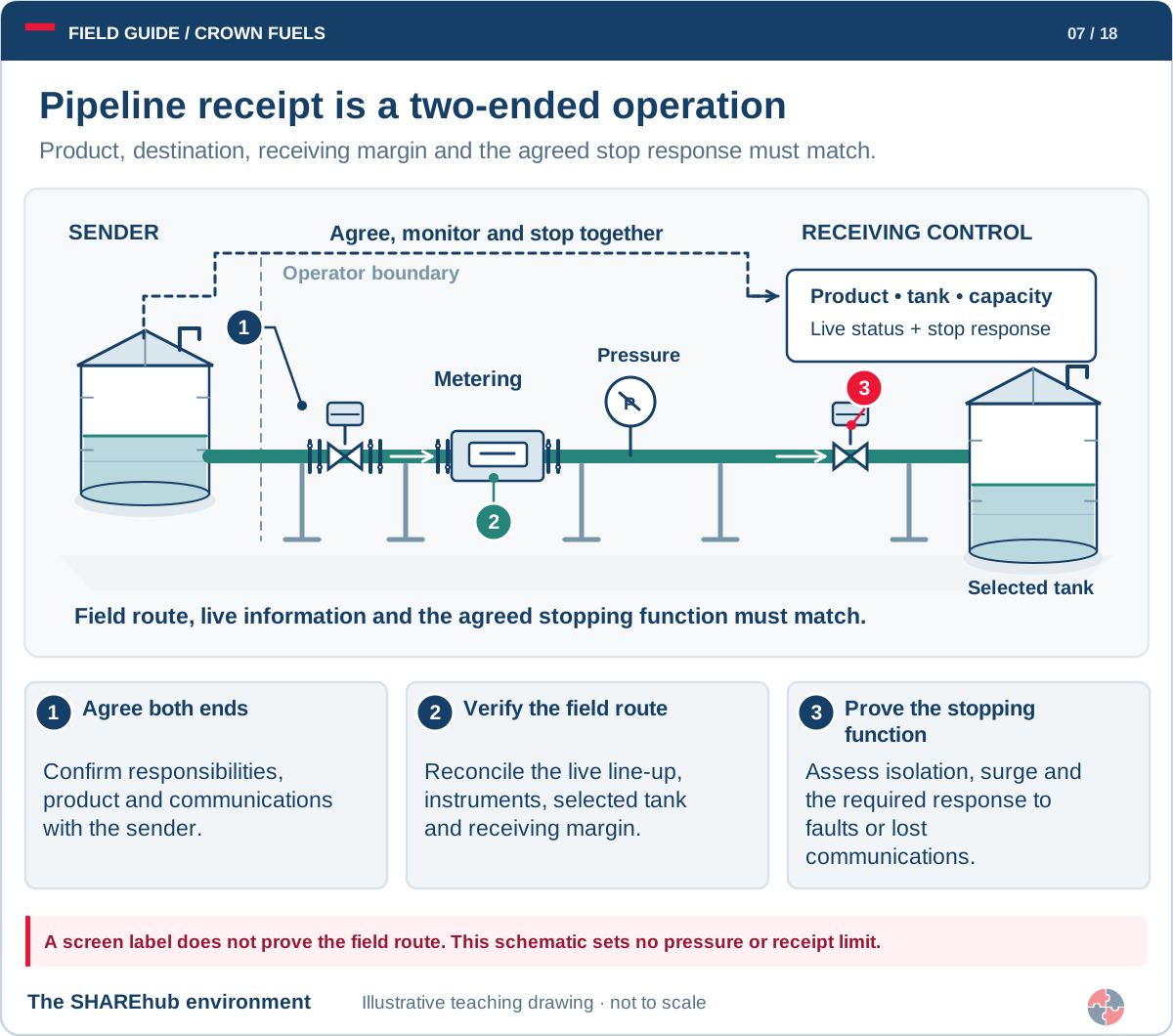
A pipeline receipt has at least two ends and may connect substantial inventory between them. An operator looking at the receiving meter sees only part of the system. The sender may control supply pressure or flow, while the receiver controls routing and available capacity. The work arrangement must identify the actual boundary and who can act, rather than assume that a fence or equipment label divides every responsibility neatly.
Start by tracing the intended journey: source, product, receiving route, tank and downstream connections. Include valves, branches, instruments, isolation points and dependent services that affect the task. Use reliable current information and appropriate field verification by authorised people. A diagram helps explain the system but may be out of date; the visible model is illustrative and cannot establish a real valve state or capacity.
Agree how both ends confirm readiness, communicate changing conditions and stop the supply through the assessed procedure. Communication loss is itself a condition requiring the defined response. A receiver cannot safely rely on an untested belief that the sender will notice a rising level, and the sender cannot assume the receiver’s silence means continuing capacity. The necessary controls depend on the actual transfer and protection design.
In Crown Fuels, follow the route from pipeline receipt to the manifold and selected tank. Explain where your knowledge ends and which person supplies the missing evidence. This is a useful discipline in any connected operation: identify dependencies before proposing an action. It prevents a locally tidy decision from creating an uncontrolled condition at the other end of the system.
How does process knowledge support major accident prevention?
The knowledge spine links hazardous inventory to scenarios, barriers, procedures, competence and assurance evidence.
A useful knowledge model is: hazardous inventory -> material properties -> process chemistry -> design basis -> operating envelope -> credible deviations -> safety-critical barriers -> procedures -> assurance evidence. If any link is missing or out of date, the organisation may make confident but wrong decisions.
This is why P&IDs, SDSs, relief calculations and operating limits must be controlled through MOC and field verification. A document can be current in the database but wrong in the plant if a temporary line, blind, valve change or instrument bypass has not been captured.
Knowledge link
Question to answer
Example evidence
Hazardous inventory
What hazardous material and energy exist?
Inventory list, SDS, tank register and process description.
Process chemistry
What reactions, incompatibilities or decomposition routes matter?
Reaction hazard review and chemistry basis.
Design basis
What was the plant designed to do safely?
Design file, datasheets and basis of safety.
Operating envelope
What limits must not be exceeded?
Safe operating limits and alarm/trip set points.
Credible deviations
What causes loss of control?
hazard and operability study (HAZOP), what-if, layer of protection analysis (LOPA) and scenario register.
Barriers
What prevents, detects, controls or mitigates the event?
Bowtie, cause and effect, proof tests and procedures.
Assurance
How do we know the information still matches reality?
Field verification, audits and MOC close-out.
Applied case
A sender is ready, but the receiving team cannot identify who controls the boundary shutdown or confirm the destination tank.
Decision and explanation
Hold receipt until the route, receiver and two-ended control arrangements are established.
Two-ended readiness is part of controlling the actual transfer. Supplier experience does not establish destination capacity or shutdown responsibility.
Look closer
Explore the numbered equipment and control points. Existing SHAREhub teaching schematic; illustrative and not to scale.Sender and operator boundary
Receipt needs agreement at both ends. Confirm who controls the operation, the product, communications and the response when conditions change.
Field route and metering
Reconcile live information with the field route, selected tank and receiving margin. A display label does not establish the actual connection.
Stopping function
Assess the required stopping response, including faults or lost communications. The schematic supplies no pressure or receipt limit.
01 · Read the situation
A sender is ready, but the receiving team cannot identify who controls the boundary shutdown or confirm the destination tank.
02 · Explain the principle
A pipeline receipt has at least two ends and may connect substantial inventory between them. An operator looking at the receiving meter sees only part of the system. The sender may control supply pressure or flow, while the receiver controls routing and available capacity. The work arrangement must identify the actual boundary and who can act, rather than assume that a fence or equipment label divides every responsibility neatly.
03 · Carry it into work
Two-ended readiness is part of controlling the actual transfer. Supplier experience does not establish destination capacity or shutdown responsibility.
Lesson 2
Resolve the route before trusting the label
Distinguish correct route identification from plausible tags, mimics and past practice.
Three consistent labels can repeat one wrong assumption
A route can look convincing because the paperwork, display and operator memory all repeat the same intended destination. They may still disagree with the equipment in the field. Similar valve tags, a new branch or a locked valve can produce a wrong-grade transfer or dead end. Positive route verification asks whether the actual connected path matches the authorised transfer and its receiving conditions.
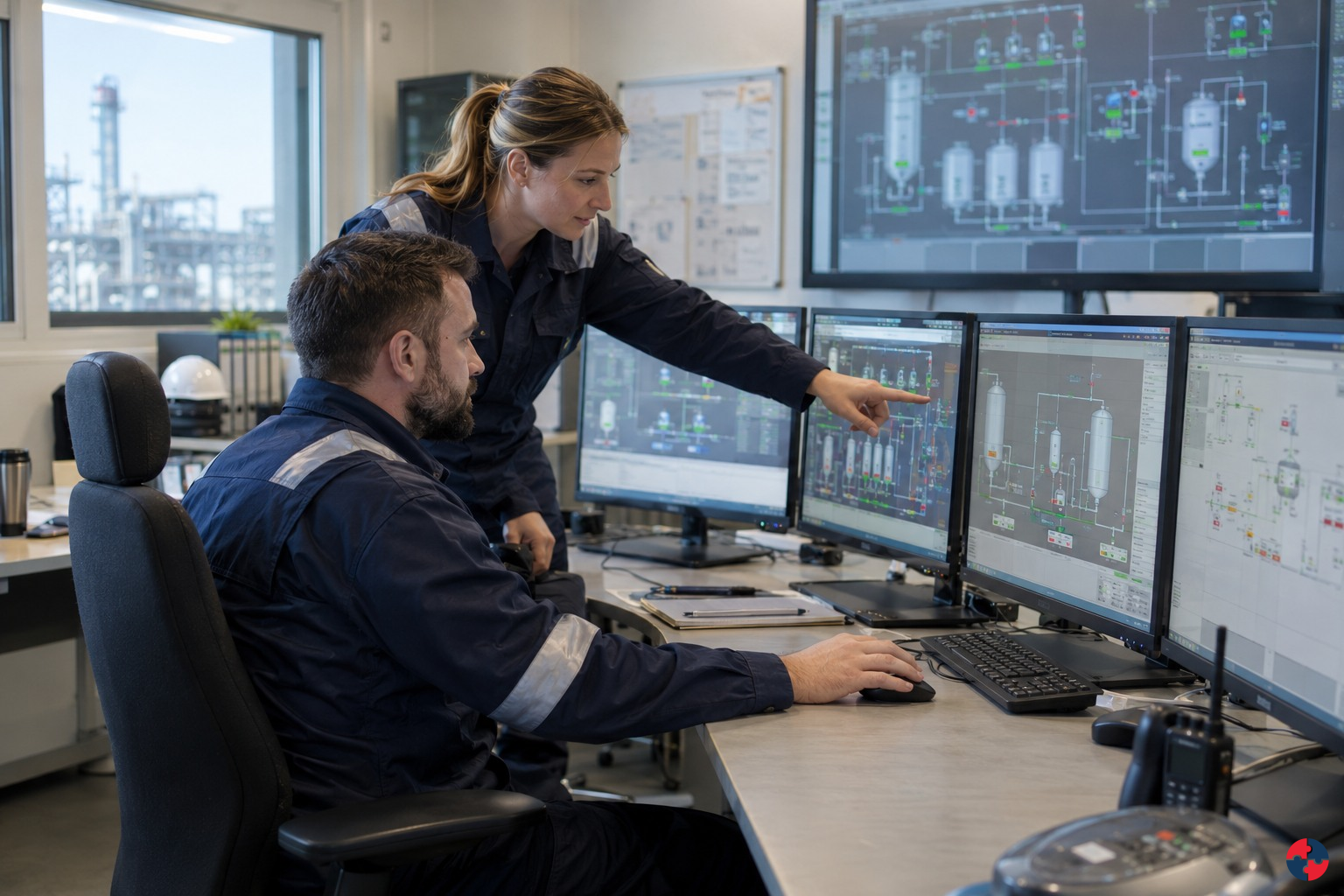
Use current process information and the site’s approved checks to reconcile product identity, source, destination, available receiving capacity and restrictions. Consider open permits, isolations, temporary changes and simultaneous operations. A display that shows a route does not prove that maintenance has restored the same equipment. When sources disagree, preserve the safe state and ask the responsible operations and work-control people to establish what is actually true.
A generic risk score cannot describe every consequence of a new transfer branch. A structured scenario review asks how the route could deviate: wrong destination, unexpected flow, unavailable receiving space or communication failure. Different methods can help competent teams examine such questions; the appropriate depth and technique depend on the change and its potential consequences. This course asks you to recognise the missing analysis, not conduct or approve an engineering study alone.
During the manifold practice, describe the full route in ordinary language and identify the evidence needed at each uncertainty. Avoid solving ambiguous tags by making a trial transfer or moving unfamiliar valves. The useful operator response is a clear discrepancy report: what was planned, what conflicts, which operation is held and who is resolving it. That information makes the hold actionable instead of merely delaying the job.
What should happen when the delivery note and receiver identity disagree?
A discrepancy in product, receiver or available capacity is a hold point before flow. A familiar bay, compatible-looking coupling or verbal assurance cannot settle a conflicting identity. Establish the intended material, destination and route with the people authorised to verify them. Related guidance: Storage of flammable liquids in tanks (HSG176, 2nd edition, 2015).
In an illustrative flammable-liquid delivery, the driver’s paperwork names Tank A while the current site schedule says Tank B. A connection nearby carries an old label. The operator holds connection/start and the supervisor secures the affected bay. They reconcile the delivery, tank identity, pipe route and operating state with competent site information; no small test quantity is transferred to discover the destination. Related guidance: Storage of flammable liquids in tanks (HSG176, 2nd edition, 2015).
The competent operating team verifies capacity using reliable current stock/level information and the planned delivered quantity, with the system’s required allowance. It checks that the intended overfill and shutdown barriers are available, suitable and supported by the specified functional evidence. This page supplies no universal percentage fill limit or permission to bypass an unreliable gauge or protection device. Related guidance: Storage of flammable liquids in tanks (HSG176, 2nd edition, 2015).
Before restart, the site and driver confirm the resolved receiver/product, compatible hose/coupling, applicable bonding/earthing and ignition controls, prevention of vehicle movement, monitoring and the emergency stop route. The technical details must follow the actual system and assessed procedure. HSG176 concerns flammable-liquid tank storage; it is not a universal procedure for every chemical, gas or marine/rail transfer. Related guidance: Storage of flammable liquids in tanks (HSG176, 2nd edition, 2015).
If the discrepancy cannot be resolved, keep the delivery held and communicate the safe waiting or rescheduling decision. Hand-back records the actual transfer state, disconnected/secured interfaces within the site method, remaining restrictions and corrected identification. The manager investigates why obsolete information reached the bay and verifies that the next shift and haulier receive the corrected instruction. Related guidance: Storage of flammable liquids in tanks (HSG176, 2nd edition, 2015).
A new manifold branch has matching screen labels, but the field tag and an active isolation record indicate a different boundary.
Decision and explanation
The conflict must be resolved against current actual route and work-control evidence before transfer.
No isolated source can be selected for convenience. The disagreement itself is a hold point requiring current verified reconciliation.
Look closer
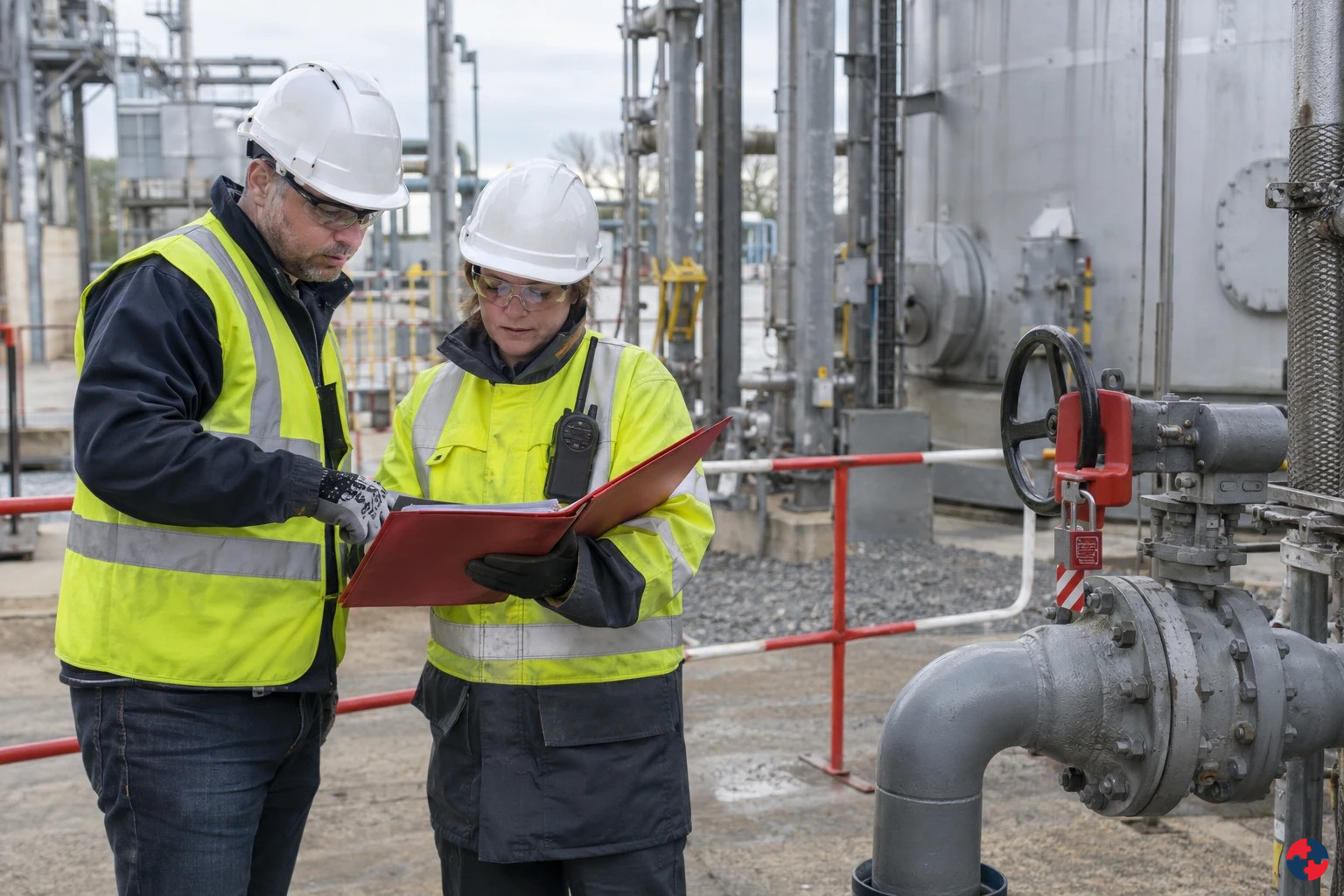
Photorealistic illustrative UK workplace scene. Review checks: Vehicle: Unplanned movement can trap or strike people at the loading area. Load: An unstable or unsecured load can shift, fall or overturn equipment. Transfer: A failed connection or incompatible product can create a separate substance exposure.01 · Read the situation
A new manifold branch has matching screen labels, but the field tag and an active isolation record indicate a different boundary.
02 · Explain the principle
A route can look convincing because the paperwork, display and operator memory all repeat the same intended destination. They may still disagree with the equipment in the field. Similar valve tags, a new branch or a locked valve can produce a wrong-grade transfer or dead end. Positive route verification asks whether the actual connected path matches the authorised transfer and its receiving conditions.
03 · Carry it into work
No isolated source can be selected for convenience. The disagreement itself is a hold point requiring current verified reconciliation.
Lesson 3
Understand pressure, trapped liquid and sampling exposure
Recognise why ordinary transfer changes can create energy or exposure hazards requiring assessed methods.
Small actions can affect the whole connected system
A liquid system carries energy as well as product. Changing flow rapidly can create pressure effects that matter beyond the valve being operated. A proposal to shut a large incoming flow as quickly as possible therefore needs the assessed shutdown response, communication and protection design. The correct action is not a universal valve speed learned from a diagram; competent limits and procedures govern the real system.
A section of liquid isolated between closed boundaries can still change pressure as its conditions change. The liquid does not become harmless because it is no longer moving. Recognise the question: where can pressure go, and what protection was designed for the actual trapped section? Do not crack a fitting or move an unfamiliar valve to test it. Report the condition and preserve the authorised restrictions while competent people resolve it.
Sampling also creates a process boundary. An open live connection can expose someone to liquid, spray or vapour, while the urge to confirm product quality may encourage improvisation. Use the designed sampling system and approved method, suitable exposure controls and appropriate authority. If those conditions cannot be established, hold the sample task rather than obtaining a quick answer by smell, touch or a convenient container.
Connect these principles to the model’s receipt-surge, manifold-thermal and sampling cases. Describe the potential harm and the evidence needed before any action. A useful answer identifies the uncertainty and requests the right competence; it does not provide technical instructions for venting, depressurisation or live sampling. Awareness should make people less willing to improvise, while helping them give a precise and useful escalation.
Which overpressure scenarios must be considered?
Relief protection is only credible when the design scenarios have been identified and kept current.
A relief device sized for one scenario may be inadequate for another. Common cases include blocked outlet, control valve failure, external fire, tube rupture, utility failure, runaway reaction, thermal expansion, gas breakthrough, liquid overfill, reverse flow, abnormal start-up and failure of cooling or agitation. Process safety reviews should ask which cases apply, which case governs capacity and whether plant changes have altered the answer.
This is where management of change becomes critical. A new feedstock, increased throughput, changed solvent, modified control valve, higher storage temperature, new tie-in or changed flare load can invalidate an old relief calculation. Relief basis documents should therefore be living process safety information, not archive material.
Scenario
How pressure rises
What to verify
Blocked outlet
Flow continues into closed or restricted system.
Relief capacity, isolation practices and operating procedure.
External fire
Heat input vaporises contents and raises pressure.
Fire case sizing, emergency response and depressurisation need.
Thermal expansion
Blocked-in liquid expands as temperature rises.
Thermal relief on trapped liquid sections.
Runaway reaction
Heat/gas generation exceeds cooling/control.
Reaction relief basis, vent sizing and quench/emergency systems.
Tube rupture
High-pressure side enters lower-pressure equipment.
Relief capacity and isolation/interlock response.
Utility failure
Cooling, instrument air or power failure creates abnormal state.
Fail-safe positions and emergency operating procedures.
Overfill
Liquid enters vapour relief path or vent system.
Level trips, alarms, independent protection and disposal route.
Include normal venting and underpressure/vacuum scenarios for relevant low-pressure storage. An overpressure-only review is incomplete, and explosion relief has different response assumptions. Keep competent design/manufacturer review; historic standard editions quoted in older guidance are not automatically current.
Applied case
A supervisor proposes a very rapid valve closure and an improvised sample from a live connection to resolve an unexplained receipt discrepancy.
Decision and explanation
Use only the assessed shutdown and sampling arrangements, holding the uncertain tasks for competent resolution.
The proposal adds uncontrolled energy and exposure tasks. The site's assessed arrangements and competent authorities must determine safe actions.
Look closer
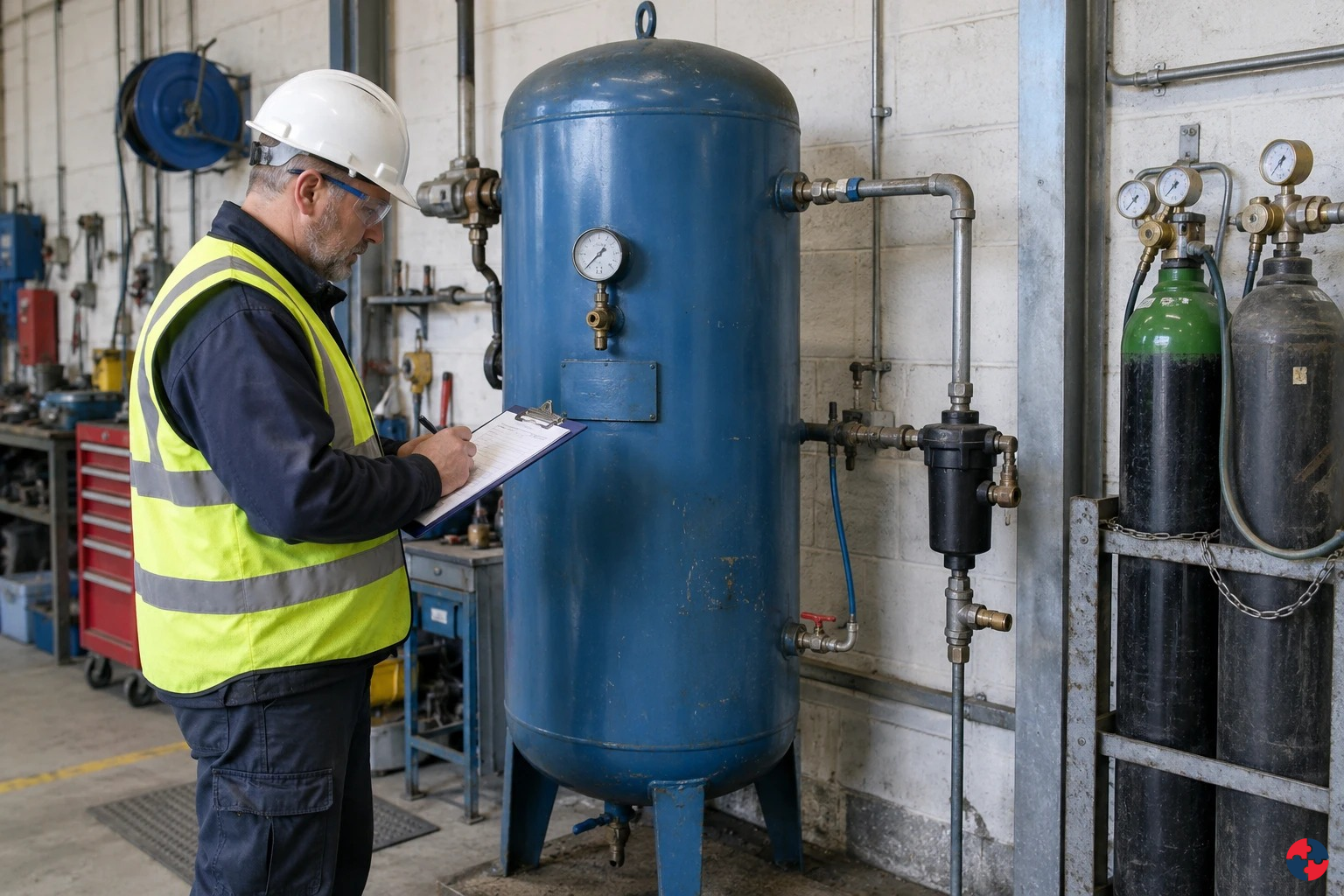
Photorealistic illustrative UK workplace scene. Review checks: Eliminate: Eliminate: the process designer removes a blocked-in liquid segment where possible by redesigning the transfer path and minimising dead legs. Reduce: Substitute and reduce: reduce hazardous inventory or choose lower-pressure operating conditions where the process permits. Isolate: Isolate and engineer: a competent engineer sizes the relief device, inlet and outlet for the governing scenario and routes discharge to a verified safe system. Control: Control, PPE and Discipline: use operating limits, change control, an impairment register and emergency instructions to keep engineered protection available.01 · Read the situation
A supervisor proposes a very rapid valve closure and an improvised sample from a live connection to resolve an unexplained receipt discrepancy.
02 · Explain the principle
A liquid system carries energy as well as product. Changing flow rapidly can create pressure effects that matter beyond the valve being operated. A proposal to shut a large incoming flow as quickly as possible therefore needs the assessed shutdown response, communication and protection design. The correct action is not a universal valve speed learned from a diagram; competent limits and procedures govern the real system.
03 · Carry it into work
The proposal adds uncontrolled energy and exposure tasks. The site's assessed arrangements and competent authorities must determine safe actions.
Lesson 4
Treat inventory balance and handover as active controls
Use discrepancies and cross-checks to keep shared understanding current during a transfer.
Receiving information is different from understanding the plant
Inventory and meter information help a team understand whether a transfer behaves as expected. A mismatch may have several explanations, from measurement or accounting differences to a wrong route or release. It should prompt the defined discrepancy response, not a convenient assumption. The task is to establish the actual cause through safe investigation, while controlling any affected operation under the site’s limits.
Handover is especially important when the transfer continues across shifts. The incoming operator needs more than a quantity total. The shared picture includes current source and destination, flow status, capacity margin, restrictions, alarms, impaired protection, open work and actions awaiting confirmation. Explain what can change next and which conditions require a hold or escalation. An unclear note can hide a critical dependency behind a familiar abbreviation.
Use two-way communication and cross-checking. The outgoing person describes the condition and the incoming person confirms understanding against relevant current information. Written records support that exchange and provide continuity, but reading a log silently does not necessarily resolve an inconsistency. Where a permit, locked valve and mimic disagree, identify the conflict explicitly rather than choosing whichever source makes continuation easiest.
Practise a short handover around the Crown Fuels in-progress receipt. State what is known, what is uncertain, what remains held and who owns the next action. Do not allow the departure of one shift to erase a restriction. A good handover equips the next operator to make the same safe decision with the same evidence, while recognising that changed conditions may require a new assessment.
What minimum content should a high-risk handover include?
Minimum content should cover current state, abnormal conditions, risk controls, decisions and next actions.
The content should be based on the information needs of the incoming person, not the habits of the outgoing person. Handover should be brief enough to use but complete enough to prevent wrong assumptions. See HSE shift handover for the relevant source and scope.
The more hazardous the work, the more explicit the handover should be about what is not normal.
Content area
What to include
Why it matters
Plant or task state
Running, stopped, isolated, depressurised, open, energised, occupied or restricted.
The incoming shift sees a normal flow display, but the log records an unresolved inventory mismatch and an open work restriction.
Decision and explanation
Cross-check the current transfer, discrepancy and restrictions with the outgoing team and relevant records before accepting responsibility.
A shared, verified operating picture preserves the restriction and supports safe decisions. A normal display does not close an unresolved mismatch.
Look closer
Photorealistic illustrative UK workplace scene. Review checks: Outgoing preparation: Review permit board, isolations, abnormal conditions and open actions. (HSE) Verbal handover: Explains what is isolated, what is open, what is impaired and what must not happen. (HSE) Written log: Structured log with plant, permit, barrier and decision status. (HSE)01 · Read the situation
The incoming shift sees a normal flow display, but the log records an unresolved inventory mismatch and an open work restriction.
02 · Explain the principle
Inventory and meter information help a team understand whether a transfer behaves as expected. A mismatch may have several explanations, from measurement or accounting differences to a wrong route or release. It should prompt the defined discrepancy response, not a convenient assumption. The task is to establish the actual cause through safe investigation, while controlling any affected operation under the site’s limits.
03 · Carry it into work
A shared, verified operating picture preserves the restriction and supports safe decisions. A normal display does not close an unresolved mismatch.
Lesson 5
Prove the complete destination before pipeline receipt
A transfer is ready when its complete physical route, receiving capacity and stop arrangements agree with reliable current information.
Understand this fuel-industry task
The incoming pipeline crosses the boundary at the metering skid, but the meter does not know whether the intended receiving tank is the one actually connected. A batch description, a familiar route name and a rising level display each answer only part of the problem. Before receipt, reconcile the product, authorised destination, real valve line-up, available receiving margin and protection status. A wrong tank can create product contamination, incompatible service or overfill even when every individual pipe and pump appears to be operating normally.
Treat pipeline receipt as one coordinated operation spanning supplier and terminal. The people at each end need the same understanding of start permission, expected quantity, limits, communication and the action required when the destination becomes unavailable. Define who has control at each stage and what confirms that flow has stopped. A simpler dedicated route can reduce opportunities for line-up error; where shared manifolds remain, the verification needs to reflect their complexity. Protective functions are additional defences, not a reason to begin with an uncertain destination.
Trace the initiating event and loss of control
Step
Case pathway
initiatingEvent
A batch is accepted before the physical route and safe receiving margin are reconciled.
lossOfControl
Fuel reaches an unintended or unsuitable destination, or continues into a tank without established capacity and protection.
consequences
Contamination, overfill and a flammable release can affect the tank farm, connected loading operations and off-site receptors.
Choose effective safeguards
Control priority
Practical application
Eliminate
Avoid unnecessary cross-connections and redundant pipe sections.
Substitute
Use a simpler dedicated route where reasonably practicable.
Engineer
Design supports, protection, suitable instruments and assessed isolation functions.
Manage
Confirm responsibility, line-up, receipt limits and communications with the sender.
Protect
Use the exposure controls and task PPE specified for sampling or connection work.
Withhold receipt permission until current product identity, nominated tank, approved capacity margin and required protective functions are confirmed through the agreed procedure.
Trace the full source-to-destination route against current drawings and reliable field identification, checking relevant valves and branches rather than only the nearest meter.
Coordinate supplier and terminal controllers, including start and stop responsibilities, expected batch changes, communication failure and destination-unavailable response within the approved design.
Consider reducing cross-connections and transfer complexity during design review; support remaining human checks with suitable identification and engineered safeguards validated for the scenario.
Verify effectiveness before release
Walk the nominated route safely with authorised personnel and compare field identity, current drawings and control indications; resolve any contradiction before release.
Reconcile independent approved inventory information, usable margin and incoming quantity, including operating assumptions that affect the remaining response opportunity.
Use an agreed safe exercise to confirm that both ends recognise the same destination and stop condition, and that the receiving protection's test evidence is current.
Transfer the decision to the workplace
Apply the same destination test to road-tanker unloading, inter-tank transfer and customer delivery; the familiar connection at the source cannot prove the receiver is ready.
What barriers should be healthy before transfer starts?
A transfer starts only when the product, route, connection, receiver and stop system are independently confirmed.
HSE HSG176 gives specific guidance for flammable liquid tank transfer, including earthing, overfill protection and preventing movement while connected. HSE loading guidance applies to vehicle stability, exclusion and safe load movement. Select the barriers for the product and facility; marine, gas and general pallet handling may require different controls.
At a road-tanker bay, one person verifies the delivery note against tank identity and capacity, another confirms line-up as the method requires, and the operator tests the emergency stop path. Any leak, unexpected level trend, lost earth connection or driver movement attempt stops transfer and triggers the site response.
The supplier has confirmed the batch name. The terminal screen names the expected tank, but one manifold tag is unreadable and tank capacity has not been cross-checked.
Decision and explanation
Hold authorisation and reconcile the actual route, destination margin, protection and two-ended communication.
That uses actual transfer to discover the route and can put product into an unsuitable or nearly full destination before the error is recognised. A previous successful route does not prove today's field configuration, current tank margin or protection availability. These checks establish the conditions for a controlled receipt. A product name alone does not prove the complete transfer path.
Look closer
Photorealistic illustrative UK workplace scene. Review checks: Vehicle: Unplanned movement can trap or strike people at the loading area. Load: An unstable or unsecured load can shift, fall or overturn equipment. Transfer: A failed connection or incompatible product can create a separate substance exposure.01 · What to notice
At the metering skid, a proposed receipt identifies a product batch but the nominated tank, actual line-up and available capacity have not been reconciled.
02 · Trace the harm
Fuel may enter the wrong grade or an unsuitable or nearly full tank, creating contamination, overfill and a flammable release.
03 · Test the safeguard
Trace the nominated route in the field against current drawings and control indication; cross-check tank capacity and the tested receiving protection before release.
Lesson 6
Review shutdown as a dynamic pipeline event
Faster action is not automatically safer action; shutdown performance must be judged against all hazards of the connected process.
Understand this fuel-industry task
The proposed faster-closing valve looks like a straightforward improvement: stop incoming fuel sooner. However, the liquid upstream is moving, and changing its velocity quickly creates a transient pressure response throughout the connected pipeline. Valve action, pump trips, restart and reverse-flow conditions can all matter. A change that improves one local stopping time can therefore increase the likelihood of pipe, joint or equipment failure elsewhere. The relevant question is whether the whole coordinated sequence keeps the actual system within its justified limits.
Competent transient assessment considers the pipeline geometry, material and equipment ratings, operating conditions, pumps, control actions and surge-protection arrangements. It must also account for supplier–terminal interactions and loss of power or signal where relevant. The model cannot provide a safe closure time or pressure limit for real equipment. Retain the approved sequence while a proposed change is reviewed, rather than trialling unassessed settings on live product. Validation and controlled commissioning evidence should demonstrate that the implemented response meets the design intent without creating a new release mechanism.
Trace the initiating event and loss of control
Step
Case pathway
initiatingEvent
A local actuator or control setting is changed to close the receipt valve faster without a whole-pipeline assessment.
lossOfControl
The resulting pressure transient exceeds the capability or assessed operating envelope of connected equipment.
consequences
Loss of containment can occur remotely from the valve, producing a hazardous fuel release and defeating the intended shutdown benefit.
Choose effective safeguards
Control priority
Practical application
Eliminate
Avoid unnecessary cross-connections and redundant pipe sections.
Substitute
Use a simpler dedicated route where reasonably practicable.
Engineer
Design supports, protection, suitable instruments and assessed isolation functions.
Manage
Confirm responsibility, line-up, receipt limits and communications with the sender.
Protect
Use the exposure controls and task PPE specified for sampling or connection work.
Hold unreviewed timing or sequence changes and preserve the approved coordinated shutdown arrangement; emergency actions must follow the actual site's authorised procedure.
Use competent system-specific transient assessment covering credible valve, pump and communication events, equipment capability and supplier interfaces before selecting protective measures.
Assess appropriate design changes, pressure protection and coordinated controls through management of change, considering how each safeguard behaves during abnormal utility or signal conditions.
Validate settings and sequence against the approved analysis through a planned safe commissioning method, and update controlled procedures, drawings and competence before operational release.
Verify effectiveness before release
Locate the current transient assessment and verify that it represents the actual pipeline, pumps, valves, operating modes and proposed control change.
Compare approved and installed actuator settings, sequence logic and interface responsibilities, with traceable technical review of any difference.
Review commissioning or test evidence for the complete sequence and its assumptions; check that a successful local stroke test was not mistaken for pipeline validation.
Transfer the decision to the workplace
Use this systems test for emergency isolation, pump ramps, valve replacement and changes in pipeline product or flow, especially when an apparently local modification affects remote equipment.
What should happen when the envelope is challenged?
Excursions should trigger stabilisation, escalation, recording and learning, not informal tolerance.
An excursion is useful safety information. Even if no harm occurs, it may show that the process, procedure, alarm, instrument, training or staffing assumption is weak. See HSE operating procedures for the relevant source and scope.
Repeated small excursions are especially important. They often reveal normalisation before a serious loss of control.
Excursion stage
Expected response
Evidence
Approaching limit
Recognise trend and take planned corrective action.
Hold or safely stop an operation with an impaired credited safety function unless the designated competent authority demonstrates effective protection for that specific operating state. Record the permitted limits, concurrent impairments, owner, expiry and review triggers. A signature and time limit alone do not make a bypass safe.HSE control systems
Applied case
A supplier requests a faster terminal valve actuator after a delay in stopping a batch. No one has reviewed the long incoming line or upstream pump response.
Decision and explanation
Hold the modification and assess the complete transient and shutdown interaction through competent change control.
The improvement must reduce overall risk, including remote pressure effects and upstream dependencies, before the changed timing is implemented. An actuator specification does not establish the pipeline response. Live trial of an unassessed sequence can create the very release being prevented. Pressure and control interactions cross the physical boundary. Responsibilities must be coordinated across the actual connected system.
Look closer
Photorealistic illustrative UK workplace scene. Review checks: Elimination: Use a validated non-reactive route or suitable supplied intermediate where it removes the hazardous reaction step. Substitution: Evaluate less energetic chemistry or formulation using reaction testing; do not assume dilution or a smaller batch is inherently safe. Engineering controls: Use closed charging and segregate people from credible release and relief paths. Engineering controls: Prove cooling, agitation, feed permissives and required protective functions against the reaction-hazard study. Administrative controls: Verify reagent identity and charge order; define addition holds and control-room actions for cooling loss or abnormal temperature.01 · What to notice
The receipt exercise proposes changing valve closure behaviour to stop flow faster, without review of the long pipeline and upstream controls.
02 · Trace the harm
A rapid flow change can create a pressure transient and loss of containment; making one response faster can create another failure mechanism.
03 · Test the safeguard
Check approved transient analysis, validated control settings and suitable commissioning evidence for the complete upstream and terminal sequence.
Lesson 7
Use unexplained inventory differences as an abnormal signal
A discrepancy is a question to investigate against the real process, not a number to remove from the report.
Understand this fuel-industry task
The receipt meter and tank inventory trend do not reconcile in this exercise after normal uncertainty and operating conditions have been considered. The difference might result from instrument error, an accounting issue, wrong routing or loss of containment. The significance is that the explanation has not yet been established. Changing the spreadsheet to make the totals agree removes evidence without resolving the physical condition. It can also delay recognition of a release occurring somewhere outside the operator's immediate view.
Reconciliation requires comparable information: consistent units and timing, appropriate product and temperature assumptions, known transfers and the actual operating configuration. No universal percentage in this model defines a safe discrepancy. The site's assessed limits, measurement capability and abnormal-operation procedure determine the response. Use independent evidence to challenge the convenient explanation, while keeping people away from a suspected hazardous release. Monitoring helps reveal a developing problem, but it is not automatically a credited protective layer or a substitute for containment, isolation and overfill protection.
Trace the initiating event and loss of control
Step
Case pathway
initiatingEvent
A material receipt discrepancy develops and is dismissed or hidden by adjusting records without investigating its cause.
lossOfControl
The terminal loses reliable knowledge of where incoming product is going and whether containment remains intact.
consequences
A continuing leak, wrong destination or missed capacity limit can lead to exposure, fire, contamination and environmental harm.
Choose effective safeguards
Control priority
Practical application
Eliminate
Avoid unnecessary cross-connections and redundant pipe sections.
Substitute
Use a simpler dedicated route where reasonably practicable.
Engineer
Design supports, protection, suitable instruments and assessed isolation functions.
Manage
Confirm responsibility, line-up, receipt limits and communications with the sender.
Protect
Use the exposure controls and task PPE specified for sampling or connection work.
Apply the authorised abnormal-receipt response and place affected transfer in its agreed safe state when the specified discrepancy or uncertainty requires it.
Maintain appropriate measurement assurance, time alignment, units and correction methods so operators can distinguish expected uncertainty from an abnormal inventory signal.
Investigate with independent readings, current routing and safe field evidence, considering both process and instrument causes rather than selecting a bookkeeping explanation first.
Define responsibility, response and escalation for unexplained imbalance, and retain the evidence until a competent cause and suitable recovery decision are established.
Verify effectiveness before release
Reconcile the same time interval using approved corrected meter and tank data, known transfers and relevant measurement uncertainty; document the remaining unexplained difference.
Compare actual field route and valve status with the nominated destination, using safe methods and excluding people from any suspected release area.
Check that the established cause explains the trend and that corrective action, instrument checks or containment repairs support the authorised return to normal operation.
Transfer the decision to the workplace
Use the same evidence discipline for unexplained tanker compartment totals, unexpected sump levels, fuel use and repeated calibration drift across connected systems.
How should process knowledge be assured?
Assurance should test whether information is accurate, used and updated when work or plant changes.
The assurance question is not 'do we have documents?' It is 'can people use the right information to make a safe decision today?' That means sampling real work: isolation planning, permit issue, start-up, abnormal operation, maintenance, emergency drills, contractor work and MOC.
Good assurance combines document sampling, field verification and interviews. Operators, engineers and maintenance staff should be able to explain the information they rely on and what they do if it looks wrong.
Assurance check
Practical test
Output
P&ID walkdown
Does the drawing match plant valves, vents, drains and instruments?
Redline log and update action.
Safe-limit interview
Can operators explain alarm/trip meaning and response?
Competence or procedure action.
MOC sample
Were documents, training and procedures updated before close-out?
MOC quality finding.
Permit sample
Did isolation use current drawings and field verification?
Permit assurance record.
Emergency drill
Could responders find isolation and inventory information quickly?
Drill learning action.
Data-quality dashboard
Are overdue information updates visible?
Management review escalation.
Illustrative discrepancy record: tag V-204, approved drawing revision C, field temporary connection differs from that revision; affected transfer held. Technical owner checks destination, compatibility and protection, approves a controlled temporary redline/instruction with limits and expiry, and verifies the field arrangement before operational release. Record the test/walkdown reference and reconcile the final as-built before close-out. An authorised temporary redline is not inherently unsafe; an uncontrolled copy is not authority.
Applied case
A shift's spreadsheet can be made to balance by changing one received-volume entry, but neither the field route nor the meter fault hypothesis has been checked.
Decision and explanation
Apply the abnormal procedure, preserve evidence and reconcile independent measurements, routing and safe physical checks.
Likelihood alone does not establish this cause, and overwriting can conceal evidence of a wrong route or continuing release. Approaching a possible release can expose the person to vapour or spray. The abnormal procedure and safe plant state must govern investigation. This tests competing causes and controls the process while uncertainty remains, rather than forcing the records to match.
Look closer
Photorealistic illustrative UK workplace scene. Review checks: Setting: the process operator plans to store a lower-flash-point solvent blend in an existing tank with a temporary transfer connection and a vent near a walkway. Act: Compare the blend properties, compatibility, hazardous-area basis, tank limits, transfer connection, P&ID and vent destination with the installed plant. Hold / review: Do not introduce the blend if the drawing misses the connection, the hazardous-area basis is stale, or the vent route and protection are unverified.01 · What to notice
The exercise trend shows an unexplained difference between received volume and tank inventory, after the normal measurement uncertainty and operating conditions are considered.
02 · Trace the harm
The discrepancy can signal a wrong route, leak, instrument fault or accounting error. Choosing the convenient explanation can conceal a continuing release.
03 · Test the safeguard
Reconcile corrected readings, actual routing, tank trends and safe field checks; document the established cause and demonstrate that the discrepancy is resolved.
Lesson 8
Contain the product during quality sampling
Control the source and method of release before selecting protection for the person taking the sample.
Understand this fuel-industry task
The sampling point at the receipt station represents a small task connected to a large live inventory. Loosening an unsuitable flange or connection can expose the person to pressurised liquid and vapour rather than delivering a controlled sample. The volume wanted in the bottle does not limit what a live source can release. Assess fuel health effects as well as ignition: product composition, skin contact, inhalation and contaminated clothing can matter even when no fire occurs.
Begin by asking whether the information can be obtained without the hazardous intervention, or through a suitable engineered sampling arrangement. Approved closed or otherwise assessed sampling equipment should control pressure, release, collection and residual product for the actual substance and task. A safety data sheet informs the assessment but does not replace observation of how the sample is taken. Gloves and eye protection address residual exposure; they do not turn an improvised opening into a safe method. Waste, bottle closure and subsequent handling remain part of the task.
Trace the initiating event and loss of control
Step
Case pathway
initiatingEvent
A worker opens an unsuitable live connection to obtain a quick quality sample outside the approved sampling arrangement.
lossOfControl
Fuel containment and pressure control are lost at a point close to the worker and possible ignition sources.
consequences
Liquid spray or vapour can injure or expose the sampler, contaminate clothing and surroundings, and create a fire or explosive atmosphere.
Choose effective safeguards
Control priority
Practical application
Eliminate
Avoid unnecessary cross-connections and redundant pipe sections.
Substitute
Use a simpler dedicated route where reasonably practicable.
Engineer
Design supports, protection, suitable instruments and assessed isolation functions.
Manage
Confirm responsibility, line-up, receipt limits and communications with the sender.
Protect
Use the exposure controls and task PPE specified for sampling or connection work.
Hold improvised sampling and use the approved assessed arrangement operated by competent people; avoid intrusive sampling where suitable non-intrusive information can meet the need.
Select equipment and collection methods for the actual product, pressure and connection, with engineered containment and a safe route for residual or displaced material.
Assess inhalation, skin and eye exposure alongside DSEAR fire and explosion risks; specify ventilation, ignition control and suitable task protection for remaining risk.
Include sample labelling, compatible containers, secure transport, spill response and waste handling in the safe method, and control changes to sampling points and product service.
Verify effectiveness before release
Walk through the approved sampling method safely with the user: identify the real source, pressure control, containment, collection and final secure condition.
Compare task and product information with equipment suitability and the exposure assessment; check that PPE selection addresses the substance and method actually used.
Inspect sample and waste arrangements, including bottle closure, residual product and reported leaks; confirm a blocked or defective point leads to a hold, not improvisation.
Transfer the decision to the workplace
Apply the same reasoning to drain opening, instrument impulse lines, quality checks at gantries and sample disposal: a small task can remain connected to major inventory.
How do physical forms and exposure routes change the risk?
Physical form and route of exposure change how a substance escapes, travels, contacts people and causes harm.
A liquid may splash skin, evaporate into vapour, form a mist during spraying, contaminate surfaces or enter drains. A powder may become airborne during tipping, settle on surfaces, form an explosible dust cloud, be ingested through poor hygiene or contaminate clothing. A gas may travel quickly, displace oxygen, form a flammable cloud or create a toxic atmosphere in a low area.
COSHH good practice requires consideration of relevant exposure routes including inhalation, skin and ingestion. For dangerous substances, DSEAR adds the safety question: could the substance create fire, explosion, energetic reaction or corrosion-related structural failure?
Can disperse, collect in low/high areas depending on density, displace oxygen or form explosive mixtures.
Detection, ventilation, isolation, emergency response and confined-space controls.
Vapour
Can travel from liquid sources and ignite away from the release point.
Containment, temperature control, ventilation and ignition control.
Mist or aerosol
Can increase inhalation exposure and flammable surface area.
Enclosure, LEV, spray control, respiratory protection and ignition control.
Dust or powder
Can be inhaled, contaminate surfaces or form explosible clouds.
Dust suppression, extraction, housekeeping, segregation and explosion controls.
Skin and eye contact
Can cause burns, sensitisation, absorption or eye injury.
Substitution, closed handling, gloves, face protection, eyewash and hygiene.
Ingestion
Can occur through contaminated hands, food, cigarettes or surfaces.
Welfare, hygiene, cleaning and no eating/drinking in contaminated areas.
Applied case
The normal sampling point is unavailable. A colleague suggests loosening a nearby live connection and catching a small amount in an open bottle while wearing gloves.
Decision and explanation
Hold the method and obtain the approved safe sampling or alternative quality-check arrangement.
The task must control the live source and its pressure. An unavailable sampling point is a defect requiring an authorised solution. PPE does not contain pressurised fuel or control vapour and ignition. Speed can make a sudden release harder to manage. Bottle size does not limit the connected inventory or pressure available at the unsuitable opening.
Look closer
Photorealistic illustrative UK workplace scene. Review checks: Release: A leak, spill or dust release brings dangerous material into the work area. Event: Ignition, reaction or loss of pressure control can produce fire, explosion or another harmful event. People: Workers and neighbours may be exposed along the actual release or escalation path.01 · What to notice
At the metering area, a proposed quality check would crack an unsuitable connection while product remains live and pressurised, rather than use an approved sampling arrangement.
02 · Trace the harm
Liquid spray and vapour may cause exposure, ignition or loss of containment. Fuel toxicity and skin effects need assessment as well as flammability.
03 · Test the safeguard
Demonstrate the actual sample method safely, confirm equipment suitability and check exposure and waste arrangements against the assessed task.
Lesson 9
Transfer a shared understanding of the live receipt
Handover succeeds when the incoming person can act safely on the real situation, not when a document has merely been transmitted.
Understand this fuel-industry task
The pipeline is still receiving when shifts change. The batch stop time has changed and one protective item is impaired, but the incoming operator receives only the dispatch spreadsheet. That sheet may describe commercial intention without explaining the live route, actual tank margin, outstanding restriction or the person controlling upstream flow. Responsibility cannot safely transfer on the assumption that a digital record contains everything the next operator needs. The incoming person must have a usable picture of the current process and the next critical decision.
Prepare handover from reliable current status, then use two-way communication supported by written information and time for questions and cross-checks. An active receipt, temporary configuration or maintenance boundary deserves particular attention because its consequences continue across the shift boundary. Confirm what changed, what remains uncertain, who can stop the transfer and when escalation is required. Where direct face-to-face exchange is impracticable, the agreed alternative still has to achieve reliable understanding. Uncertainty should trigger the authorised safe-state response, not a guess that keeps the batch moving.
Trace the initiating event and loss of control
Step
Case pathway
initiatingEvent
An outgoing shift leaves before communicating a changed live receipt, equipment impairment and revised stopping responsibility.
lossOfControl
The incoming operator continues the process with an incomplete or incorrect understanding of route, margin and required response.
consequences
Fuel can be sent to the wrong destination or continue beyond the justified receiving limit, with delayed response to an abnormal event.
Choose effective safeguards
Control priority
Practical application
Eliminate
Avoid unnecessary cross-connections and redundant pipe sections.
Substitute
Use a simpler dedicated route where reasonably practicable.
Engineer
Design supports, protection, suitable instruments and assessed isolation functions.
Manage
Confirm responsibility, line-up, receipt limits and communications with the sender.
Protect
Use the exposure controls and task PPE specified for sampling or connection work.
Identify active receipts and other high-risk handovers in advance, and allocate sufficient overlap and competent cover for preparation, discussion and verification.
Use a structured record and two-way exchange covering actual route, tank status, limits, alarms, permits, impairments, supplier contact and the next important decision.
Have the incoming operator cross-check critical information and explicitly accept responsibility under the agreed process; keep uncertainty visible and resolve it before affected continuation.
Design logs and displays with their users, include changes during the handover period and review handover quality after plant changes, near misses and staffing pressures.
Verify effectiveness before release
Ask the incoming operator to explain the active receipt and its next stop decision, then compare the answer with current plant and supplier information.
Sample handover records for a changed stop time, impairment and permit interface; verify that questions and unresolved matters reached the responsible controller.
Observe a representative shift exchange or safe exercise, checking time available, interruptions, two-way understanding and clarity over the exact transfer of responsibility.
Transfer the decision to the workplace
Use the same preparation, dialogue and cross-check at permit handback, maintenance shift change, remote-control transfer and emergency-controller relief.
What minimum content should a high-risk handover include?
Minimum content should cover current state, abnormal conditions, risk controls, decisions and next actions.
The content should be based on the information needs of the incoming person, not the habits of the outgoing person. Handover should be brief enough to use but complete enough to prevent wrong assumptions. See HSE shift handover for the relevant source and scope.
The more hazardous the work, the more explicit the handover should be about what is not normal.
Content area
What to include
Why it matters
Plant or task state
Running, stopped, isolated, depressurised, open, energised, occupied or restricted.
The outgoing operator is ready to leave. The spreadsheet lists today's batch, but the incoming operator has not been told that a stop time changed or that a protective item is impaired.
Decision and explanation
Reconcile current status through a structured two-way handover and cross-check, using the agreed safe state for any uncertain continuation.
A current timestamp does not establish that the missing operational facts are present or understood by the person taking responsibility. This addresses both the information gap and actual responsibility for the live operation. The receiving operator must understand the task-relevant status. Stable operation does not remove changed limits or impaired protection. Handover must address the next decision, not only the previous trend.
Look closer
Photorealistic illustrative UK workplace scene. Review checks: Elimination: Complete and safely close an unnecessary intervention before the shift boundary where feasible, without rushing testing or hand-back. Engineering controls: Use a suitable standby duty or planned outage arrangement that avoids pressure to return the impaired pump to service before work is complete. Engineering controls: Maintain verified process and energy isolations, control keys and access and prevent reconnection while the maintenance boundary remains open. Engineering controls: Keep required physical separation, blanking, restraint, containment and any remaining protective functions in the defined safe configuration. Administrative controls: Incoming and outgoing operators reconcile the pump identity, permits, isolation register, open work, bypasses and restart owner using a structured two-way handover.01 · What to notice
The shift scenario has an active receipt, a changed stop time and an equipment impairment, but the incoming operator receives only a dispatch spreadsheet.
02 · Trace the harm
Incomplete handover can leave no shared understanding of tank margin, routing, alarms or who must stop the supplier.
03 · Test the safeguard
Have the incoming operator explain and cross-check the actual route, tank status, supplier contact, next decision and outstanding restrictions before accepting responsibility.
Lesson 10
Resolve product identity through the full manifold route
The correct connection is established by reliable identity and a complete route check; familiarity and colour cannot resolve an evidence conflict.
Understand this fuel-industry task
The manifold groups parallel lines within easy reach, but the work order and faded field tag disagree. Choosing a valve by memory, colour or physical proximity can put the correct product into the wrong destination. In this finished-fuel terminal, that may change product specification and flammability assumptions or feed a tank with inadequate margin. Do not automatically describe every wrong-grade mixture as a violent chemical reaction: identify the actual properties and credible consequences for the substances and receiving equipment involved.
A robust line-up starts with reliable product and equipment identity, current drawings and a source-to-destination check. A second person is useful only if the verification independently challenges the route, rather than repeating the first person's reading of the same unreliable label. Design can reduce error opportunities through simpler dedicated paths, distinguishable connections and durable identifiers. Procedures, training and control indication then support that arrangement. Any unresolved contradiction between field condition and records is a reason to hold the transfer and correct the information through controlled processes.
Trace the initiating event and loss of control
Step
Case pathway
initiatingEvent
An operator chooses a manifold valve despite conflicting or unreadable equipment identification.
lossOfControl
Product is directed to an unintended line, tank or grade without a verified compatible destination and receiving margin.
consequences
Contamination, overfill or changed flammable-service conditions can create on-site release and downstream customer hazards.
Choose effective safeguards
Control priority
Practical application
Eliminate
Remove unused connections and avoid opening live process systems.
Substitute
Choose a less intrusive maintenance or sampling method where suitable.
Engineer
Provide an assessed isolation boundary, contained drains and means to prove its condition.
Manage
Walk down equipment identity, record isolation, coordinate users and control reinstatement.
Protect
Use PPE selected for the substances and residual exposure; it cannot make a live line safe.
Hold the disputed line-up and reconcile product, equipment and destination identity against controlled information and reliable field evidence before transfer permission.
Reduce avoidable cross-connections and similar interfaces where practicable; provide durable identifiers that remain readable in actual lighting and weather, with colour as supporting information.
Use a controlled verification process appropriate to the major-accident risk, tracing relevant valves and branches rather than relying on the remembered position of a familiar handle.
Review changed product service and proposed connections through management of change, including compatibility, tank capability, operating limits and information needed by downstream receivers.
Verify effectiveness before release
Trace the proposed source-to-destination path with authorised personnel and reconcile every disputed tag, drawing and control indication at the relevant field location.
Check whether a second verification uses independent route evidence or merely accepts the same incorrect document or label that initiated the uncertainty.
Inspect identification from the actual working position and review how replacement tags, removed branches and temporary configurations update the controlled plant information.
Transfer the decision to the workplace
Apply this route-verification discipline to hose connections, tanker compartments, chemical dosing and maintenance isolation wherever similar adjacent interfaces invite a selection error.
How does process knowledge support major accident prevention?
The knowledge spine links hazardous inventory to scenarios, barriers, procedures, competence and assurance evidence.
A useful knowledge model is: hazardous inventory -> material properties -> process chemistry -> design basis -> operating envelope -> credible deviations -> safety-critical barriers -> procedures -> assurance evidence. If any link is missing or out of date, the organisation may make confident but wrong decisions.
This is why P&IDs, SDSs, relief calculations and operating limits must be controlled through MOC and field verification. A document can be current in the database but wrong in the plant if a temporary line, blind, valve change or instrument bypass has not been captured.
Knowledge link
Question to answer
Example evidence
Hazardous inventory
What hazardous material and energy exist?
Inventory list, SDS, tank register and process description.
Process chemistry
What reactions, incompatibilities or decomposition routes matter?
Reaction hazard review and chemistry basis.
Design basis
What was the plant designed to do safely?
Design file, datasheets and basis of safety.
Operating envelope
What limits must not be exceeded?
Safe operating limits and alarm/trip set points.
Credible deviations
What causes loss of control?
hazard and operability study (HAZOP), what-if, layer of protection analysis (LOPA) and scenario register.
Barriers
What prevents, detects, controls or mitigates the event?
Bowtie, cause and effect, proof tests and procedures.
Assurance
How do we know the information still matches reality?
Field verification, audits and MOC close-out.
Applied case
The work order specifies a diesel route, while a damaged valve tag appears to name another product. A colleague offers to confirm the colour of the same faded label.
Decision and explanation
Hold transfer and independently trace and reconcile the product route with reliable identification and current controlled information.
Proximity and memory cannot resolve contradictory identity evidence. The physical route and receiving conditions remain uncertain. This addresses the actual uncertainty. Repeating a check of the same damaged label does not create independent confidence. Both people can share the same misleading source. Independence concerns the way the route is challenged, not simply the number of signatures.
Look closer
Photorealistic illustrative UK workplace scene. Review checks: Setting: the process operator plans to store a lower-flash-point solvent blend in an existing tank with a temporary transfer connection and a vent near a walkway. Act: Compare the blend properties, compatibility, hazardous-area basis, tank limits, transfer connection, P&ID and vent destination with the installed plant. Hold / review: Do not introduce the blend if the drawing misses the connection, the hazardous-area basis is stale, or the vent route and protection are unverified.01 · What to notice
The manifold has parallel product lines. In the task evidence, a work order and a faded field tag disagree about the route to the selected tank.
02 · Trace the harm
A wrong line-up can contaminate product or send fuel into a tank with unsuitable properties or capacity, with consequences downstream as well as on site.
03 · Test the safeguard
Trace source-to-destination in the field with authorised personnel and reconcile every relevant valve, drawing and control indication; colour alone is insufficient.
Lesson 11
Protect liquid trapped between closed valves
Stopping flow removes one energy source; it does not remove temperature-driven pressure in trapped liquid.
Understand this fuel-industry task
The manifold sketch proposes closing two valves around a section that remains full of fuel. Even with the transfer pump stopped, solar heating or another temperature rise can expand the trapped liquid. With little available compressible volume, pressure can increase enough to damage the pipe, joint or connected equipment. The absence of a running pump therefore does not establish absence of pressure generation. This mechanism differs from rapid valve-closure surge, which concerns a change in moving-fluid conditions.
Identify trapped-liquid cases in operating, maintenance and temporary configurations, including valve positions that isolate an existing protective route. A competent design review determines whether thermal relief or another suitable arrangement is needed and where any discharge can safely go. A relief valve does not make the system safe if its outlet creates exposure or feeds an unsuitable destination. Do not improvise by cracking a live valve or removing a fitting; preserve the approved plant state and obtain the planned isolation and pressure-protection arrangement for the actual task.
Trace the initiating event and loss of control
Step
Case pathway
initiatingEvent
A liquid-full manifold section is blocked in without a reviewed way of accommodating temperature-driven expansion.
lossOfControl
Pressure rises in the confined volume beyond the capability of the pipework or connected component.
consequences
A joint or equipment item can fail and release pressurised fuel; an unsuitable relief discharge can expose workers or create an ignition hazard.
Choose effective safeguards
Control priority
Practical application
Eliminate
Remove unused connections and avoid opening live process systems.
Substitute
Choose a less intrusive maintenance or sampling method where suitable.
Engineer
Provide an assessed isolation boundary, contained drains and means to prove its condition.
Manage
Walk down equipment identity, record isolation, coordinate users and control reinstatement.
Protect
Use PPE selected for the substances and residual exposure; it cannot make a live line safe.
Identify potential trapped-liquid sections before approving valve configurations, including inactive branches, bypasses and isolation boundaries exposed to temperature changes.
Obtain competent review of suitable thermal-pressure protection or another approved arrangement for the actual service; do not derive settings from the model.
Route any required protective discharge to an assessed safe destination, considering backpressure, product compatibility, receiving capacity and whether the route remains available.
Control isolation, inspection and reinstatement of protective devices through permits and change arrangements so a maintenance action does not silently remove the expansion protection.
Verify effectiveness before release
Compare the physical valve and relief arrangement with current approved drawings; identify whether any valve can isolate the trapped volume from its protection.
Review the design basis and suitable inspection or test evidence for the device and destination, including relevant changes in service, exposure or configuration.
Ask operators and maintainers how they recognise and manage a liquid-full blocked-in section, then compare their account with the authorised operating and isolation method.
Transfer the decision to the workplace
Look for the same mechanism in loading hoses, isolated sample lines, double-valve arrangements and instrument connections exposed to heating after shutdown.
Which overpressure scenarios must be considered?
Relief protection is only credible when the design scenarios have been identified and kept current.
A relief device sized for one scenario may be inadequate for another. Common cases include blocked outlet, control valve failure, external fire, tube rupture, utility failure, runaway reaction, thermal expansion, gas breakthrough, liquid overfill, reverse flow, abnormal start-up and failure of cooling or agitation. Process safety reviews should ask which cases apply, which case governs capacity and whether plant changes have altered the answer.
This is where management of change becomes critical. A new feedstock, increased throughput, changed solvent, modified control valve, higher storage temperature, new tie-in or changed flare load can invalidate an old relief calculation. Relief basis documents should therefore be living process safety information, not archive material.
Scenario
How pressure rises
What to verify
Blocked outlet
Flow continues into closed or restricted system.
Relief capacity, isolation practices and operating procedure.
External fire
Heat input vaporises contents and raises pressure.
Fire case sizing, emergency response and depressurisation need.
Thermal expansion
Blocked-in liquid expands as temperature rises.
Thermal relief on trapped liquid sections.
Runaway reaction
Heat/gas generation exceeds cooling/control.
Reaction relief basis, vent sizing and quench/emergency systems.
Tube rupture
High-pressure side enters lower-pressure equipment.
Relief capacity and isolation/interlock response.
Utility failure
Cooling, instrument air or power failure creates abnormal state.
Fail-safe positions and emergency operating procedures.
Overfill
Liquid enters vapour relief path or vent system.
Level trips, alarms, independent protection and disposal route.
Include normal venting and underpressure/vacuum scenarios for relevant low-pressure storage. An overpressure-only review is incomplete, and explosion relief has different response assumptions. Keep competent design/manufacturer review; historic standard editions quoted in older guidance are not automatically current.
Applied case
A planner closes both ends of a fuel-filled branch for a sunny weekend. They say no pressure hazard remains because the transfer pump is off.
Decision and explanation
Check the trapped-volume case and approved expansion protection, including the safe discharge route and actual valve positions.
Heating a confined liquid can raise pressure without mechanical pumping. The proposed closed volume requires its own assessment. An improvised opening can undermine the isolation or send product to an unsuitable destination. Both protection and isolation must be planned. This addresses the independent pressure-generation mechanism and ensures the protection has somewhere suitable to act.
Look closer
Photorealistic illustrative UK workplace scene. Review checks: Source / exposure: Failures often arise from assumptions, changes, impairments and poor evidence rather than from missing hardware alone. Possible consequence: Common failures include relief valves isolated after maintenance, test dates overdue, incorrect set pressure, blocked vents, corrosion, fouling, undersized relief from old calculations, flare system changes not reviewed, rupture discs installed backwards, relief discharge near ignition sources, bypassed trips and operators unaware of emergency blowdown limits. Control failure: Auditors should challenge neat registers that do not match field condition.01 · What to notice
A proposed valve line-up would trap liquid between two closed valves; the change sketch does not address solar heating or the thermal-relief destination.
02 · Trace the harm
Liquid expansion in a confined section can create damaging pressure even with the transfer pump stopped; a relief discharge can itself introduce a hazard.
03 · Test the safeguard
Compare the real valve arrangement and relief route with the approved design, inspection records and safe reinstatement checks.
Lesson 12
Make the permit, isolation and operating display agree
Shared plant status must describe the real physical and work-control condition, with restoration controlled across both operations and maintenance.
Understand this fuel-industry task
A locked manifold branch is under maintenance, yet the control mimic still presents it as available for transfer. The lock protects part of a work arrangement, while the display supports operating decisions; neither should be interpreted without the current permit and isolation status. An operator may try to send product into a blocked route, or a maintainer may assume the branch cannot be demanded. The conflict is a shared plant-status problem and must be resolved by the authorised parties, not by removing the physical restriction to match the screen.
Use one understood process for recording and communicating unavailable equipment across operations and maintenance. This may involve linked registers and displays rather than one literal document, but the information must be consistent and current. Handover should cover open work, scope, isolation boundaries, temporary changes and restoration conditions. A note can draw attention to the discrepancy while it is managed; it does not by itself reconcile the safe system. Reinstatement needs explicit handback, checks and operating authority so automatic or remote demands cannot surprise people still at work.
Trace the initiating event and loss of control
Step
Case pathway
initiatingEvent
An operating shift relies on an available-looking mimic while a branch remains isolated under an open maintenance permit.
lossOfControl
Operating demand and worksite assumptions conflict, or an isolation is changed without the permit holder's controlled handback.
consequences
Pressurisation of an unintended route, release at an open system or unexpected equipment operation can injure maintainers and escalate the process.
Choose effective safeguards
Control priority
Practical application
Eliminate
Remove unused connections and avoid opening live process systems.
Substitute
Choose a less intrusive maintenance or sampling method where suitable.
Engineer
Provide an assessed isolation boundary, contained drains and means to prove its condition.
Manage
Walk down equipment identity, record isolation, coordinate users and control reinstatement.
Protect
Use PPE selected for the substances and residual exposure; it cannot make a live line safe.
Keep the affected route unavailable and reconcile current permit, isolation register, physical plant and operating information with the authorised operations and maintenance representatives.
Provide reliable status controls for unavailable equipment and demand prevention where required by the assessed work system; do not treat a screen colour as physical proof.
Use two-way shift and function handovers covering open permits, isolation scope, temporary arrangements and the authority required to alter or restore the branch.
Plan handback and reinstatement checks that account for people, tools, equipment condition and temporary items before the authorised controller returns the route to service.
Verify effectiveness before release
At the worksite, compare the permit scope and isolation evidence with actual equipment and the displayed operating status using the approved safe verification method.
Ask the incoming operator and permit holder independently what remains unavailable, which system records the restriction and who may authorise restoration.
Sample a completed handback to confirm actual inspection, testing, release of work controls and operating readiness occurred before the display and route became available.
Transfer the decision to the workplace
Apply this consistency check to disabled fire systems, bypassed trips, electrical isolations and contractor work spanning shifts or control-room boundaries.
How should handover quality be checked?
Quality should be sampled through observation, record review and incoming-person understanding.
A signed handover sheet does not prove understanding. Assurance should watch the handover, ask incoming people what they understood and compare the message with live plant or task status. See HSE shift handover for the relevant source and scope.
Where remote or digital handover is used, the standard should still require two-way communication and cross-checking of safety-critical information.
The operator cannot obtain flow through a branch. The mimic is green, but the field valve is locked and the maintenance permit is still open.
Decision and explanation
Maintain unavailability and reconcile the permit, isolation and display with the authorised teams before any restoration.
The discrepancy concerns both people at work and process routing. It must be resolved through the controlled status and handback arrangements. A display is not permission to defeat a work isolation. Doing so can expose someone relying on the established physical boundary. That can create overpressure or flow into an unintended path and does nothing to resolve the open maintenance boundary.
Look closer
Photorealistic illustrative UK workplace scene. Review checks: Elimination: Complete and safely close an unnecessary intervention before the shift boundary where feasible, without rushing testing or hand-back. Engineering controls: Use a suitable standby duty or planned outage arrangement that avoids pressure to return the impaired pump to service before work is complete. Engineering controls: Maintain verified process and energy isolations, control keys and access and prevent reconnection while the maintenance boundary remains open. Engineering controls: Keep required physical separation, blanking, restraint, containment and any remaining protective functions in the defined safe configuration. Administrative controls: Incoming and outgoing operators reconcile the pump identity, permits, isolation register, open work, bypasses and restart owner using a structured two-way handover.01 · What to notice
The handover case includes a mechanically isolated branch under maintenance, while the displayed route still appears available for transfer.
02 · Trace the harm
Operators may demand flow into an isolated section or maintenance staff may lose their assumed boundary, leading to overpressure or hazardous exposure.
03 · Test the safeguard
Test that the next operator and permit holder describe the same boundary and unavailable equipment, and that restoration requires explicit handback.
Lesson 13
Match the process-risk study to the design decision
A sound risk conclusion depends on complete scenarios and real protection evidence, not the familiarity of a checklist or a convenient score.
Understand this fuel-industry task
The proposed manifold branch has a low score on a general workplace checklist, but the review has not examined what happens when flow reverses, the wrong tank is selected or a utility fails. Slips and PPE are legitimate concerns; they do not describe the process deviations capable of moving a large fuel inventory outside containment. Start with the design intent, actual substances, operating modes and boundaries. A risk score summarises judgements only after suitable scenarios and controls have been understood; it cannot discover hazards that were never considered.
Choose a competent study method to answer the decision. Broad HAZID or what-if work can identify interfaces; HAZOP systematically challenges deviations at defined nodes; bowtie can communicate causes, barriers and consequences. Further layer or quantitative analysis may be justified for specific questions, but assumptions and protection independence must be examined. No diagram or spreadsheet assigns a valid SIL by itself. Compare inherently safer choices before adding complexity, then implement, test and close actions before release. A study report is not a functioning safeguard until its required changes exist in the real plant.
Trace the initiating event and loss of control
Step
Case pathway
initiatingEvent
A new transfer branch is approved using a generic checklist without analysing credible process deviations and dependencies.
lossOfControl
An unrecognised scenario lacks effective prevention or mitigation, or shared safeguards are credited more than once.
consequences
Wrong transfer, overpressure or loss of containment can develop into fire, explosion or environmental harm despite an apparently acceptable score.
Choose effective safeguards
Control priority
Practical application
Eliminate
Remove unnecessary hazardous material, energy and transfer operations.
Substitute
Choose a less hazardous product or simpler process where practicable.
Engineer
Prefer effective engineered preventive and mitigative barriers.
Manage
Use suitable hazard studies, verify assumptions and act on weak-signal indicators.
Protect
Keep PPE as an additional exposure control within its actual capabilities.
Hold design or operational release until suitable multidisciplinary hazard review covers the actual branch, connected equipment, substances and operating modes.
Select methods proportionate to the question and complexity, with competent facilitation, current drawings, operator input and explicit recording of assumptions and uncertainties.
Consider eliminating unnecessary branches, reducing inventory and simplifying routing before relying on additional alarms, procedures or other layers of protection.
Assign study actions to owners, verify implementation and appropriate testing, and review independence, residual risk and readiness through the relevant competent approval process.
Verify effectiveness before release
Follow one deviation, such as reverse flow, from cause through loss of control to consequence; check the study includes actual operating and maintenance configurations.
Challenge each credited safeguard against its required function, dependencies and evidence, especially where control, alarm and trip share sensing, logic or utilities.
Trace important actions to installed changes, test results and updated instructions; confirm that deferred items cannot be hidden behind the completed study cover sheet.
Transfer the decision to the workplace
Apply this study-selection principle to product changes, added loading lanes, software modifications, temporary bypasses and changes in operating or emergency response assumptions.
How does a worked HAZOP node example help learning?
A worked node shows how guidewords become real deviation, safeguard and action decisions.
SHARE method illustration: The cited HSE material supports the broad method and its selection; the prompts and worked entries below are SHARE teaching examples, not a formal study or a claim about an unseen standard. HSE Corus investigation: HAZOP method
Consider a solvent transfer line from a bulk tank to a reactor. The design intent is to transfer the correct solvent at a controlled rate into a reactor under a nitrogen blanket. The HAZOP team applies guidewords such as no flow, more flow, reverse flow, other than and as well as.
A strong learner should be able to see how each line of the HAZOP record supports a decision. If a safeguard is claimed, the team should know whether it is independent, tested, alarmed, maintained and usable under pressure.
Deviation
Credible cause
Consequence
Safeguard/action
No flow
Pump trip, closed valve, blocked strainer or wrong line-up.
Batch delay, operator intervention, possible restart error or manual bypass.
Alarm and procedure may be enough for operability; investigate if manual workaround creates safety risk. SHARE example—verify for the actual process.
More flow
Control valve fails open or pump speed set wrong.
Overfill, reaction rate change, pressure rise or high vapour generation.
Verify high-level trip, flow control, operator response and whether LOPA is required. SHARE example—verify for the actual process.
Reverse flow
Pressure imbalance or failed non-return valve.
Contamination of storage tank, incompatible mixture or loss of containment.
Check non-return valve inspection, isolation philosophy and sampling controls. SHARE example—verify for the actual process.
Other than solvent
Wrong tanker, wrong connection or labelling error.
Incompatible reaction, off-spec product, heat release or toxic vapour.
Independent material verification and locked connection system. SHARE example—verify for the actual process.
As well as water
Water ingress from cleaning or condensation.
Reaction upset, pressure generation or corrosion.
Drying standard, sample test and operating hold point. SHARE example—verify for the actual process.
Less nitrogen
Purge valve closed, low supply pressure or blocked filter.
Flammable atmosphere in reactor headspace.
Purge monitoring, low-flow alarm and defined no-start condition. SHARE example—verify for the actual process.
Node/design intent
Deviation
Credible cause
Consequence
Existing safeguard
Action, owner and close-out evidence
Solvent transfer line: transfer correct solvent from bulk tank to reactor R-201 at controlled flow under nitrogen blanket.
More flow to reactor.
Control valve fails open after maintenance or pump speed is set above the approved recipe value.
Reactor overfill, increased vapour generation, pressure rise and possible flammable release through vent or manway.
Process engineer owns verification that high-high trip is independent of the control transmitter. Close-out evidence: cause-and-effect review, proof-test record, P&ID mark-up and technical authority approval before start-up. SHARE example—verify for the actual process.
Same node and design intent.
Other than correct solvent.
Tanker connected to wrong unloading point, incorrect line-up after cleaning or poor labelling of temporary hose.
Incompatible material charged, heat release, toxic vapour or off-spec batch requiring emergency response.
Delivery paperwork, operator line-up check and labelled connection points.
Operations manager owns independent material verification and locked connection standard. Close-out evidence: revised unloading procedure, physical connection control, operator assessment and first transfer field verification. SHARE example—verify for the actual process.
Same node and design intent.
Less nitrogen purge.
Low nitrogen supply pressure, blocked filter, purge valve left closed or temporary bypass after maintenance.
Flammable atmosphere in reactor headspace during charging, with ignition risk during agitation, sampling or static discharge.
Nitrogen pressure indicator, low-flow alarm and start-up procedure.
Control systems engineer owns no-start interlock or hard hold point where purge flow is below limit. Close-out evidence: alarm/interlock test, updated operating limit, simulator or tabletop drill and supervisor sign-off. SHARE example—verify for the actual process.
Same node and design intent.
Reverse flow from reactor to bulk tank.
Failed non-return valve combined with pressure imbalance during shutdown or blocked transfer route.
Contamination of bulk tank, uncontrolled reaction potential and exposure during later unloading or sampling.
Non-return valve, isolation procedure and batch records.
Maintenance manager owns inspection regime for non-return valve and handback verification after intrusive work. Close-out evidence: inspection record, maintenance task added to CMMS, permit handback checklist and later audit sample. SHARE example—verify for the actual process.
The new branch review gives 'low risk' because the pipe is the same size as an existing line. Reverse flow and wrong destination have not been discussed.
Decision and explanation
Require a suitable competent process-hazard study and verified actions before design or operating release.
Dimensions alone do not establish process conditions, connected inventory, failure paths or protective functions. Those additions do not address missing process deviations or validate containment and protection for the connected system. The review must examine credible deviations and demonstrate implemented safeguards, with the method chosen to fit the decision.
Look closer
Teaching graphic from the linked SHAREhub source section.01 · What to notice
The proposed branch review uses a general “slips and PPE” checklist but has not examined no flow, reverse flow, wrong destination, excess pressure or utility loss.
02 · Trace the harm
A simple score can miss credible process deviations and dependencies, leaving protection unrelated to the actual accident scenarios.
03 · Test the safeguard
Trace identified causes and consequences to implemented, owned safeguards and closed actions; check assumptions, independence and residual risk using competent review.
Lesson 14
An uncertain receipt at shift change
Combine route, receiving capacity, energy and handover evidence into a coordinated hold decision.
Bring the evidence together
Pipeline and manifold decisions connect equipment and people who may be far apart. This course builds a clear mental picture of the system boundary, product route, receiving conditions, pressure and inventory behaviour, sampling exposure and shift information. Crown Fuels provides the fictional cases; actual operating limits, valve actions and shutdown behaviour require competent site procedures.
Consider the whole sequence of interfaces and degraded conditions. A local repair or completed permit cannot by itself show that every required barrier is available. Separate immediate protection, the competent technical resolution, the operating decision and independent verification.
Use the worked cases and the linked primary guidance to identify the missing information. State who owns the decision and what would keep the operation restricted. The fictional scene illustrates choices; it cannot establish actual process limits, emergency capability or permission to operate.
What barriers should be healthy before transfer starts?
A transfer starts only when the product, route, connection, receiver and stop system are independently confirmed.
HSE HSG176 gives specific guidance for flammable liquid tank transfer, including earthing, overfill protection and preventing movement while connected. HSE loading guidance applies to vehicle stability, exclusion and safe load movement. Select the barriers for the product and facility; marine, gas and general pallet handling may require different controls.
At a road-tanker bay, one person verifies the delivery note against tank identity and capacity, another confirms line-up as the method requires, and the operator tests the emergency stop path. Any leak, unexpected level trend, lost earth connection or driver movement attempt stops transfer and triggers the site response.
A pipeline receipt continues towards shift change. Meter and tank information no longer reconcile, a new manifold branch has a generic risk score and a locked valve conflicts with the mimic. Someone proposes a rapid closure and open sampling to save time. Build a two-ended communication and evidence plan: safe state, actual boundaries, competent technical input, relevant restrictions and a cross-checked handover.
Decision and explanation
Hold affected operations through the approved arrangements and reconcile route, inventory, energy response and handover with the responsible teams.
The mismatch crosses information and equipment boundaries. A coordinated, evidence-based response avoids creating new pressure or exposure hazards.
Look closer
Photorealistic illustrative UK workplace scene. Review checks: Vehicle: Unplanned movement can trap or strike people at the loading area. Load: An unstable or unsecured load can shift, fall or overturn equipment. Transfer: A failed connection or incompatible product can create a separate substance exposure.01 · Read the situation
A pipeline receipt continues towards shift change. Meter and tank information no longer reconcile, a new manifold branch has a generic risk score and a locked valve conflicts with the mimic. Someone proposes a rapid closure and open sampling to save time. Build a two-ended communication and evidence plan: safe state, actual boundaries, competent technical input, relevant restrictions and a cross-checked handover.
02 · Explain the principle
Pipeline and manifold decisions connect equipment and people who may be far apart. This course builds a clear mental picture of the system boundary, product route, receiving conditions, pressure and inventory behaviour, sampling exposure and shift information. Crown Fuels provides the fictional cases; actual operating limits, valve actions and shutdown behaviour require competent site procedures.
03 · Carry it into work
The mismatch crosses information and equipment boundaries. A coordinated, evidence-based response avoids creating new pressure or exposure hazards.
Lesson 15
Turn the learning into a verified workplace action
Choose a bounded action, owner, task-specific evidence and escalation trigger within your role.
Make the course useful at work
Bulk fuel-terminal receipt and manifold operations, not retail forecourt operating instructions or engineering design.
Choose one relevant task from this course. Describe the material, equipment, people and interfaces, then explain the credible harm pathway before choosing the control. Follow the actual site process for obtaining missing technical evidence and deciding whether work may proceed.
Use the linked resource with a specific question. A briefing should test understanding; a checklist should identify missing facts; an audit should compare claims with observations. Keep this exercise fictional and separate from live operating records.
Record the planned action, responsible role, verification evidence and a trigger for escalation or reassessment. Completion of this course is a learning record, not an operating instruction, engineering design, specialist licence or authority to enter, isolate or fight a fire.
How should handover quality be checked?
Quality should be sampled through observation, record review and incoming-person understanding.
A signed handover sheet does not prove understanding. Assurance should watch the handover, ask incoming people what they understood and compare the message with live plant or task status. See HSE shift handover for the relevant source and scope.
Where remote or digital handover is used, the standard should still require two-way communication and cross-checking of safety-critical information.
Your handover action says improve fuel safety but names no operation, control owner, evidence or stopping condition.
Decision and explanation
Name the actual task, competent control owner, evidence required and the hold/escalation trigger.
An effective plan connects a real task and control with a responsible role, objective evidence and a clear decision boundary. A course badge or signature does not establish the plant condition.
Look closer
Photorealistic illustrative UK workplace scene. Review checks: Elimination: Complete and safely close an unnecessary intervention before the shift boundary where feasible, without rushing testing or hand-back. Engineering controls: Use a suitable standby duty or planned outage arrangement that avoids pressure to return the impaired pump to service before work is complete. Engineering controls: Maintain verified process and energy isolations, control keys and access and prevent reconnection while the maintenance boundary remains open. Engineering controls: Keep required physical separation, blanking, restraint, containment and any remaining protective functions in the defined safe configuration. Administrative controls: Incoming and outgoing operators reconcile the pump identity, permits, isolation register, open work, bypasses and restart owner using a structured two-way handover.01 · Read the situation
Your handover action says improve fuel safety but names no operation, control owner, evidence or stopping condition.
02 · Explain the principle
Bulk fuel-terminal receipt and manifold operations, not retail forecourt operating instructions or engineering design.
03 · Carry it into work
An effective plan connects a real task and control with a responsible role, objective evidence and a clear decision boundary. A course badge or signature does not establish the plant condition.