Full public teaching and readers are free without an account. A free learner account is required for saved LMS progress and recorded assessment. Completion and any course-completion certificate depend on the configured LMS conditions. Open the course overview.
Lesson 1
Grain dust follows the work, not the job title
Trace releases and people through the whole handling day.
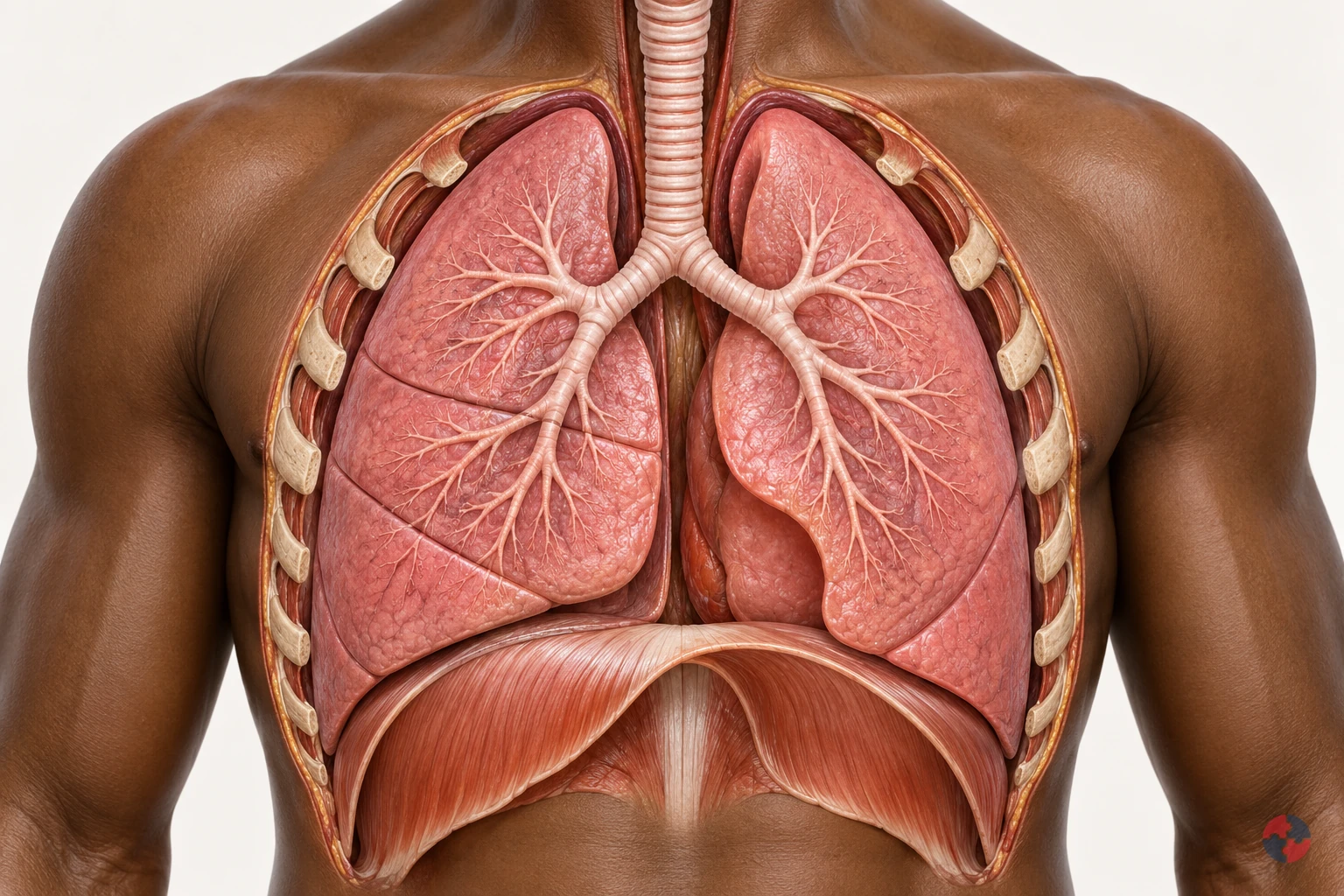
Locate the lungs, branching airways and diaphragm below them. The cutaway reveals structures normally hidden by the chest wall.
Trace the source-to-breathing-zone route in this lesson. Which change would prevent the contaminant reaching the person?
educational illustration · healthy anatomy; enlarged details and teaching colours.
Teaching graphic from the linked SHAREhub source section.
Grain dust follows the work, not the job title
Grain transfer, drying and cleaning can release material into the air where people breathe. Exposure may affect the intake worker, a driver waiting nearby or somebody cleaning after transfer. Dust can irritate and damage health; grain dust can also cause occupational asthma. A clear-looking store after the delivery cannot establish how much a worker breathed during the release.
Map the task, source, air path and people. Ask what happens when the drop changes, doors are open or a filter needs attention. Consider cleaning and maintenance as well as normal transfer. The fictional intake has capture equipment but a damaged connection; a fan sound does not prove dust is being controlled at the source. The model illustrates component relationships rather than measuring airflow or exposure.
Reduce release and separate people through suitable process design, enclosure, capture and work organisation. A competent assessment should determine the necessary control package and verification. Respiratory protection, where required, needs proper selection and management; an unspecified mask cannot compensate for a failed primary control. Do not use compressed air to clean clothing or blow grain dust around the store. Select an assessed cleaning method suitable for both health and combustible-dust concerns.
Hold the affected task when a necessary control is missing or performance is uncertain. Report the source, stage and people exposed, and arrange competent checks under representative conditions before release. Workers should report breathing or other relevant symptoms and receive appropriate qualified advice; the supervisor must not diagnose asthma from a course answer. Suitable risk-based health surveillance supports prevention but does not replace effective control. For the exercise, state what the observed dust establishes and what requires assessment or measurement rather than inventing an exposure concentration.
How can the ISO 45001 hierarchy of controls guide controls after a hazardous-substance health-risk assessment?
ERICPD helps move the assessment from paperwork to stronger, practical control of exposure.
For hazardous substances, the hierarchy is critical. Removing the substance or process is stronger than controlling dust after it is created. Using pellets instead of powder, pre-mixed materials instead of dry mixing, water suppression, closed transfer and enclosure can all reduce exposure before people need RPE.
Administrative controls still matter, but they should support stronger controls. Written procedures, permits, restricted access and supervision are weak if the process still releases uncontrolled dust, vapour or fume. PPE and RPE can be essential, but they are vulnerable to poor fit, discomfort, wrong filter selection, poor maintenance and human behaviour.
Good control should be designed, used, maintained and checked. LEV requires correct design, hood positioning, statutory thorough examination and worker understanding. RPE needs selection, face fit, storage, cleaning and replacement. Gloves need compatibility checks because some chemicals pass through common glove materials.
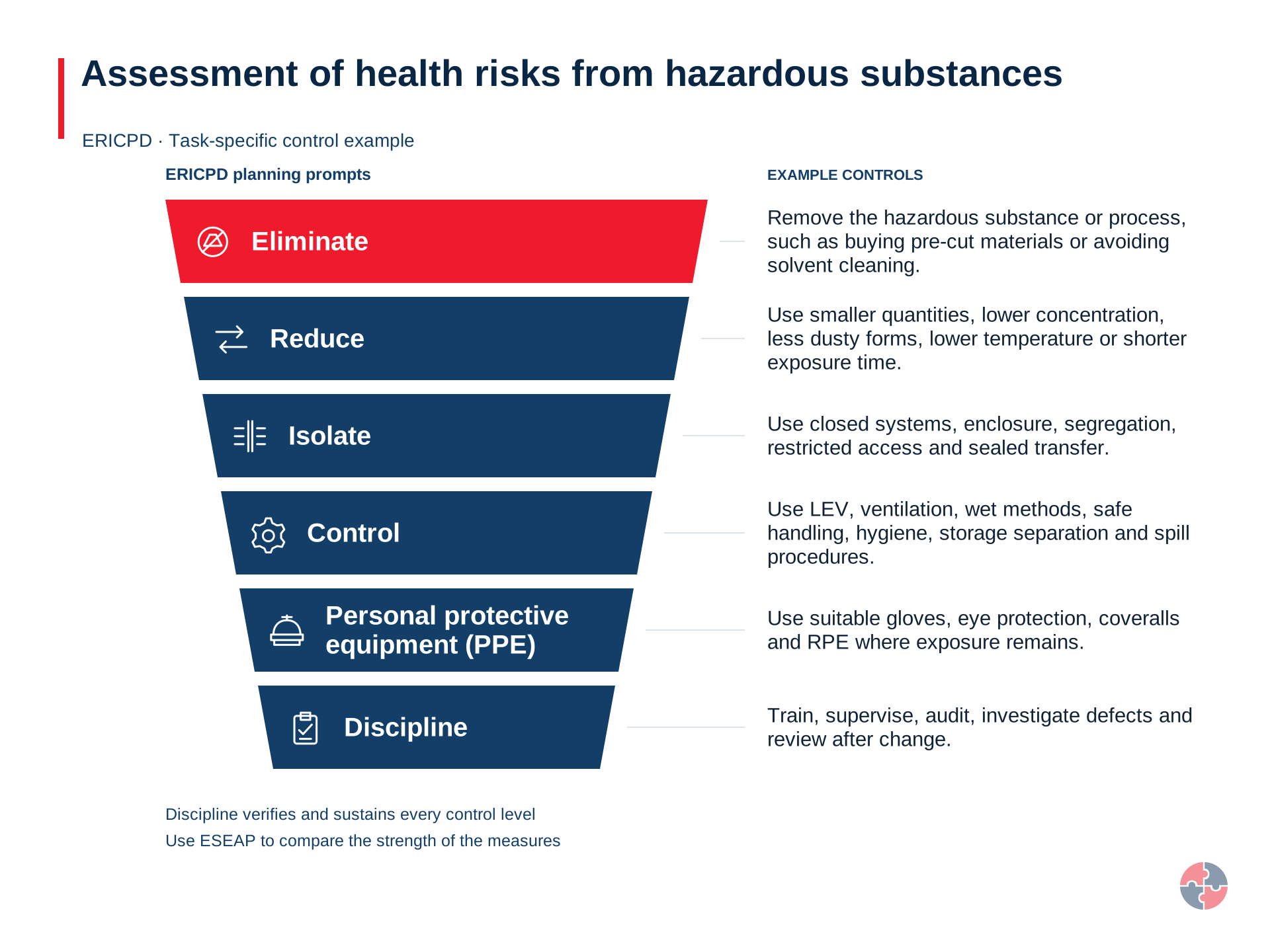
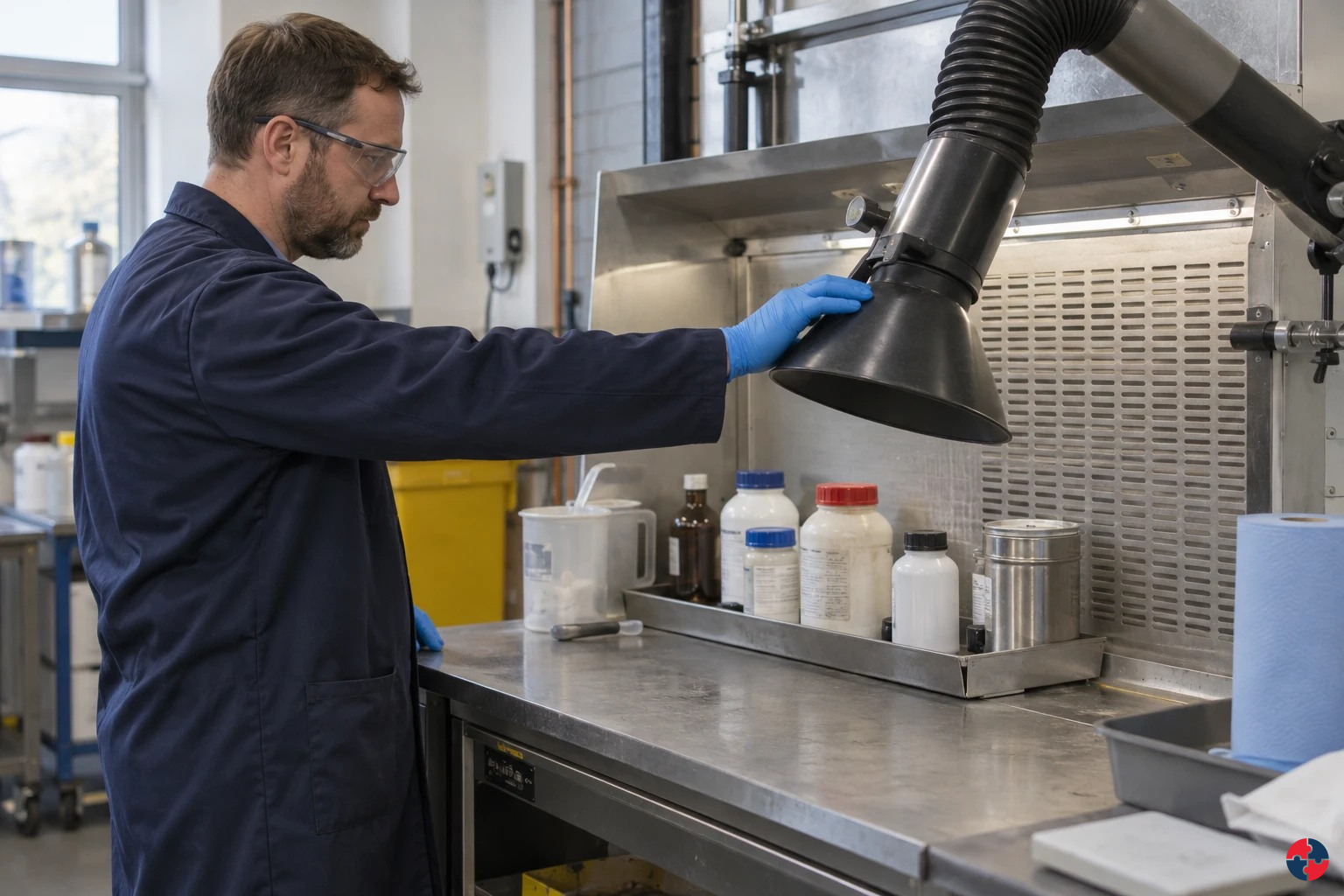
For a solvent cleaning task, first ask whether the process can avoid the chemical or the cleaning step. A less hazardous product may substitute only after checking its actual formulation, use and waste route. Closed dispensing and local exhaust ventilation then provide engineering control for the residual airborne exposure; gloves and RPE are selected for remaining skin or inhalation routes, not as permission to leave a container open. ERICPD Eliminate/Reduce/Isolate/Control/PPE aligns with elimination, substitution, engineering, administrative control and PPE, while Discipline is the continuing check of whether each layer works.
The assessor records the product identity and safety data, task duration, quantity, bystanders, existing controls and any applicable workplace exposure limit. A competent person chooses a sampling strategy for the substance and exposure period; a compliant eight-hour average does not prove that a short peak, skin exposure or sensitisation risk is controlled. The supervisor checks container closure, extraction function, storage and spill response before release and repeats the check after a process change. If the material is unknown, extraction fails, symptoms arise or a spill escapes the controlled area, stop the task, protect others and reassess before restart. Health-surveillance decisions follow the actual legal trigger and exposure evidence.
How can the ERICPD hierarchy of controls guide controls after a hazardous-substance health-risk assessment?
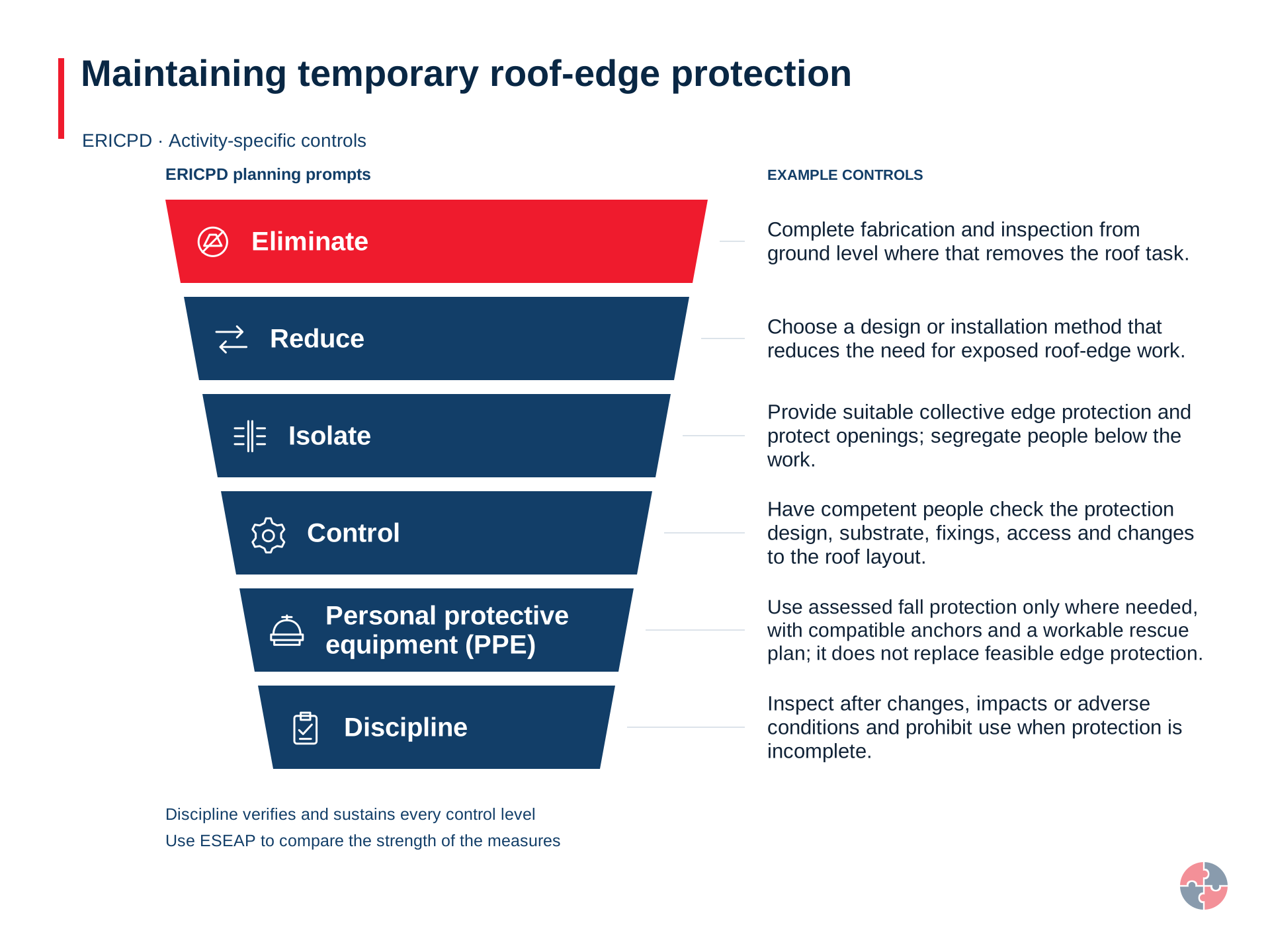
ERICPD is a planning crossmap. Its prompts do not add a sixth rung or rank Isolate above engineering. Discipline verifies and sustains every control level.
Worked activity: Cleaner changed from spray to controlled wipe
Activity and exposure
Crownway Fuels Ltd uses a water-based cleaner on control-room desks; the outcome is to avoid unnecessary mist and skin contact.
Before work
Check whether cleaning is needed, choose a lower-hazard product and pre-dosed wipe or controlled cloth, brief hygiene and spill steps, and keep food and drink away.
During the activity
Use the small quantity and method assessed; avoid spraying into the breathing zone and remove contaminated cloths to the agreed waste route.
Hold or stop
Wrong product, decanted unlabelled bottle, eye/skin symptoms or unexpected strong vapour: stop, isolate the item and obtain competent advice.
Hand-back and release
Clean the area, remove waste, wash hands, close any incident or product mismatch and restock only the approved product.
Evidence to retain
Product ID, SDS version, task assessment, briefing and closed defect.
ERICPD controls for hazardous substances - ERICPD controls for hazardous substances
ERICPD level
Practical application
Evidence to check
Eliminate
Remove the hazardous substance or process, such as buying pre-cut materials or avoiding solvent cleaning.
Design/procurement review and substitution decision record.
Reduce
Use smaller quantities, lower concentration, less dusty forms, lower temperature or shorter exposure time.
Inventory limits, purchasing standards and task design.
Isolate
Use closed systems, enclosure, segregation, restricted access and sealed transfer.
Equipment design, access control and inspection records.
Control
Use LEV, ventilation, wet methods, safe handling, hygiene, storage separation and spill procedures.
LEV test, maintenance, monitoring and inspection findings.
PPE
Use suitable gloves, eye protection, coveralls and RPE where exposure remains.
Compatibility checks, face-fit records, issue and maintenance records.
Discipline
Train, supervise, audit, investigate defects and review after change.
Training matrix, supervisor checks, worker feedback and action close-out.
How can the ISO 45001 hierarchy of controls guide controls after a hazardous-substance health-risk assessment?
The hierarchy of controls in ISO 45001:2018 comes under Clause 8.1.2 (Eliminating hazards and reducing OH&S risks), which is located within Clause 8 ("Operation").
Worked activity: Cleaner changed from spray to controlled wipe
Activity and exposure
Crownway Fuels Ltd uses a water-based cleaner on control-room desks; the outcome is to avoid unnecessary mist and skin contact.
Before work
Check whether cleaning is needed, choose a lower-hazard product and pre-dosed wipe or controlled cloth, brief hygiene and spill steps, and keep food and drink away.
During the activity
Use the small quantity and method assessed; avoid spraying into the breathing zone and remove contaminated cloths to the agreed waste route.
Hold or stop
Wrong product, decanted unlabelled bottle, eye/skin symptoms or unexpected strong vapour: stop, isolate the item and obtain competent advice.
Hand-back and release
Clean the area, remove waste, wash hands, close any incident or product mismatch and restock only the approved product.
Evidence to retain
Product ID, SDS version, task assessment, briefing and closed defect.
Visible dust escapes at a split intake connection while the extraction fan can still be heard.
Decision and explanation
Hold the affected transfer and obtain competent correction and performance verification.
The connection can defeat capture; fan operation is not evidence of effective exposure control.
Lesson 2
A grain surface is not a safe platform
Recognise flowing material and hidden voids without entering.
Related SHAREhub topic guide. Apply its prompts to the specific case below.
A grain surface is not a safe platform
Grain can behave as a flowing material when discharge equipment operates. A person can be pulled down and engulfed, while a crust or bridge can conceal a void that collapses under them. Standing on a surface that appears solid is therefore not a method of checking it. The danger is not removed because the grain is shallow in one visible place.
In the fictional store, discharge has slowed and the operator suspects bridging. Keep people outside the grain and use a suitable externally planned method. Do not walk on the surface to break a bridge, poke from an unsafe position or send someone inside while another person watches. A rope and companion do not establish an adequate entry or rescue arrangement. This lesson provides recognition and escalation, not a grain-entry technique.
The responsible competent person must assess the actual silo, flow, machinery and atmosphere. Avoid entry wherever possible. Any genuinely necessary specialist access needs the applicable isolation, safe-system and rescue planning; stopping a switch alone does not settle all these conditions. Grain can move under gravity or from changes elsewhere, so the plan must account for connected equipment and material movement as well as the obvious auger.
If unexpected discharge or a suspected void is found, keep the activity restricted and prevent others from approaching the dangerous surface. Report the loss of flow and available observations from a safe position. Restart requires the required authorised assessment and handback, not a worker's willingness to take a quick look. For the fictional exercise, draw the possible void and flow path on the cutaway and state which external evidence is required. The drawing explains a mechanism; it cannot establish a real silo's contents, loading or atmosphere.
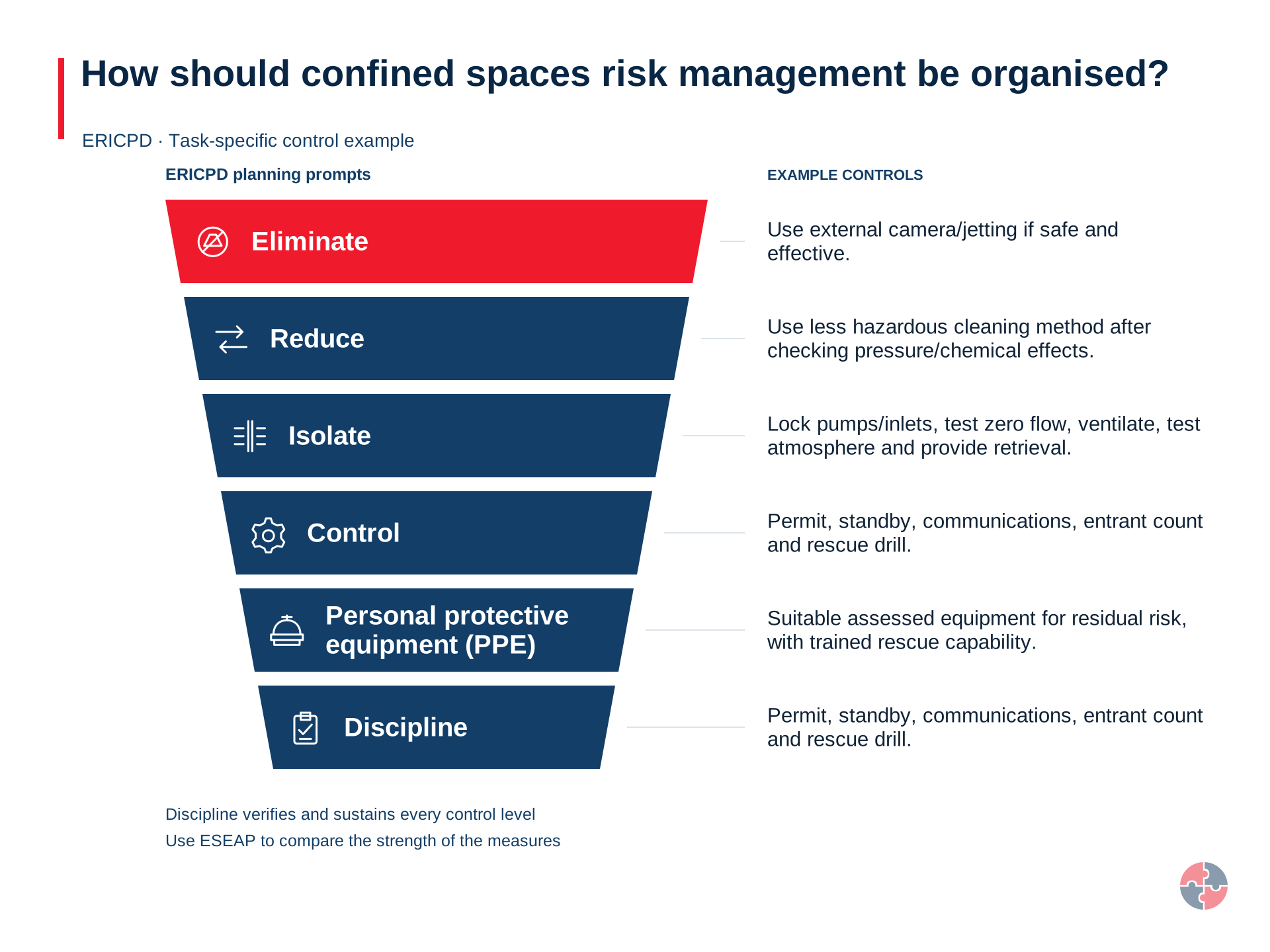
How can the organisation avoid entry?
Make no-entry a design and work-planning decision, with a recorded reason before any permit is considered.
For drain inspection, use a remote camera and external cleaning point if a competent assessment confirms that method is safe. For tanks, provide fixed gauges, sampling points or clean-in-place systems where practicable. Check that pressure, chemical use or jetting does not create a new uncontrolled exposure. The manager signs the selected method; if entry remains necessary, the confined-space lead records why alternatives cannot safely achieve the task. This is the elimination level of the five-level hierarchy and ERICPD, ahead of isolation, engineering, procedures and PPE.
Applied case
The outlet slows and a worker proposes walking on the grain to break a suspected crust.
Decision and explanation
Keep people off the grain and obtain a competent external/no-entry solution.
A surface can conceal a void or flow; do not use a person to test it.
Lesson 3
The auger needs guarding and a separate intervention plan
Keep normal operation distinct from clearing a blockage.
Photorealistic illustrative UK workplace scene. Review checks: Setting: Maintenance must remove a pump spool in a fuel terminal. Act: Establish and prove initial isolation; then safely depressurise, drain and purge the section. Hold / review: Stop if pressure returns, the line identity is uncertain, isolation leaks, the drain path is blocked or the adjacent team changes the system.
The auger needs guarding and a separate intervention plan
An auger can draw a hand, foot or clothing into its rotating flight. Grain or a shallow intake does not make dangerous movement inaccessible. A removed or damaged guard can expose somebody walking nearby as well as the person feeding the plant. The fictional intake has a missing section of protection, so normal transfer must not continue on the promise that people will keep their distance.
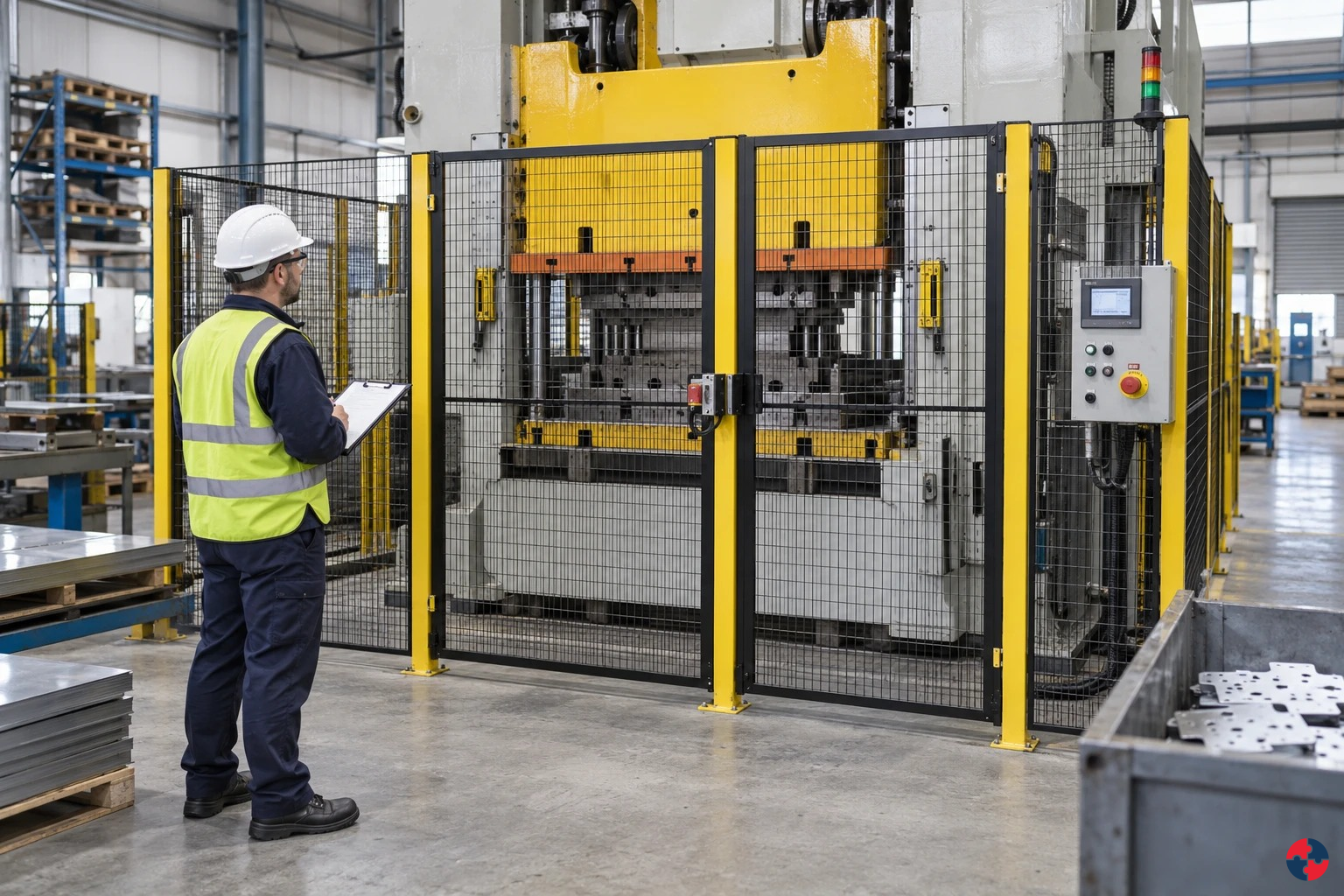
Suitable guarding prevents access during operation and needs maintenance and competent verification. An emergency stop is a response device, not a replacement for guarding. Nor should a guard be defeated because it makes clearing accumulated material easier. If the design creates repeated blockages, review the process and maintenance rather than normalising access to the moving part.
Clearing or repair is a different task. Use Safe Stop and the actual competent isolation procedure, accounting for every relevant source and any stored or gravitational movement. Control restart, allow components to come to rest and verify the safe state by the authorised method. This lesson does not teach a lockout sequence for every fixed plant. Removing a tractor key may not isolate a separately powered store auger or connected automatic equipment.
Report the exact missing protection or recurring blockage and restrict use. The responsible person should arrange repair and a controlled handback that restores guards, confirms people are clear and verifies the relevant stopping and operating functions. Testing must not expose someone to the auger. If more inspection is needed after a test, reapply the required safe intervention arrangements. For the exercise, compare “motor stopped” with evidence of controlled energy and restart. A quiet machine and a completed maintenance form alone do not prove that a worker can safely enter its danger area.
Which energy sources must be identified?
A competent isolation plan looks beyond the obvious power switch.
Energy can be electrical, mechanical, hydraulic, pneumatic, chemical, thermal, gravitational, pressure, radiation or stored in springs, capacitors, accumulators, batteries, elevated loads and process inventory. Multi-energy systems are common in modern plant: a conveyor may have electrical drives, stored mechanical energy, pneumatic actuators, gravity hazards and automated controls. See HSG253 - The safe isolation of plant and equipment.
The isolation plan should be based on physical walkdown, drawings, operating knowledge, previous changes, site experience and challenge from the workers doing the task.
Energy source
How it can harm
Control example
Electrical
Shock, electrocution, arc flash or unexpected start.
Isolate, lock, prove dead and control back-feed.
Mechanical movement
Crushing, shearing, entanglement or amputation.
Block, pin, disengage and verify no movement.
Pressure
Injection, blast, projectile, release or burns.
Depressurise, drain, vent and verify.
Hydraulic/pneumatic
Unexpected actuator movement or stored pressure.
Isolate supply, bleed accumulators and secure parts.
Thermal
Burns from steam, hot product or cold cryogenic release.
Cool, drain, vent and wear suitable PPE.
Chemical/process inventory
Toxic, corrosive, flammable or asphyxiant release.
Clean, purge, gas test and use positive isolation where needed.
Gravity
Falling loads or drifting equipment.
Chock, prop, block or lower to safe position.
Applied case
An intake auger is stopped at the pushbutton and a worker reaches through the missing guard.
Decision and explanation
Verified task-specific isolation and safe intervention arrangements, as well as restored guarding for operation.
A control stop is not verified isolation; guarding and intervention controls have different purposes.
Lesson 4
Dust on beams is part of the explosion question
Connect deposits, disturbance and ignition without inventing test data.
Photorealistic illustrative UK workplace scene. Review checks: Hazard identification: Names wood dust, fine powders and collected dust as potential combustible dust hazards. Design and procurement: Specifies suitable extraction, collection and vacuum systems before purchase. Operational control: Controls sanding, cutting, waste collection, cleaning and hot work.
Dust on beams is part of the explosion question
Combustible dust can burn rapidly when dispersed and ignited under relevant conditions. Deposits can become an airborne cloud during disturbance and contribute to escalation. The exact behaviour depends on material and conditions; a learner must not assume that every visible layer has the same explosibility. Equally, the fact that grain is a familiar agricultural product does not remove the need for suitable fire and explosion assessment.
In the fictional dryer house, dust has collected on elevated surfaces and a repair involving sparks is proposed nearby. The competent DSEAR assessment should consider releases, deposits, cleaning, equipment, ignition and protective arrangements for the actual process. This course does not provide dust-test values, hazardous zoning or explosion-protection design. A photograph cannot establish whether a particular dust or installation meets those requirements.
Prevent accumulation and unnecessary release through suitable enclosure, extraction, maintenance and an assessed cleaning system. Avoid methods that disperse dust or introduce an incompatible ignition source. A general domestic vacuum is not automatically suitable for combustible dust. Plant cleaning, collection and disposal require equipment and methods selected for the assessed hazards. Coordinate repair or hot work with the process restrictions rather than adding a fire watch to an unchanged uncontrolled task.
If deposits, loss of capture or conflicting ignition work reveal a gap, hold the affected activity and obtain the competent decision. Verify both the physical correction and the continuing means of preventing recurrence. Do not climb to dusty beams or enter plant to obtain an exercise sample. Record the actual location, work stage and proposed ignition source, with any uncertainty about material properties explicit. A tidy floor can coexist with hidden high-level deposits, so assurance must consider the relevant system without exposing the inspector.
Why are dust clouds and dust layers both important?
Dust clouds are immediate explosive atmospheres, while dust layers are fuel waiting to be dispersed.
A dust cloud may form during tipping, pouring, pneumatic conveying, bag emptying, milling, sanding, drying, filling, cleaning, leaks or abnormal equipment failure. It may be visible as a dense cloud, but it can also be localised inside equipment where workers cannot see it.
A dust layer is not safe just because it is settled. Layers can be disturbed by air movement, vibration, a small fire, a pressure pulse or a primary explosion. The larger the area covered by settled dust, the more fuel may be available for a secondary explosion. Hidden spaces such as suspended ceilings, cable trays, roof steelwork and collector rooms deserve particular attention.
A useful field test is to ask whether the site has a reliable way of seeing and cleaning dust above head height. If not, the risk assessment may be missing the fuel that matters most during escalation.
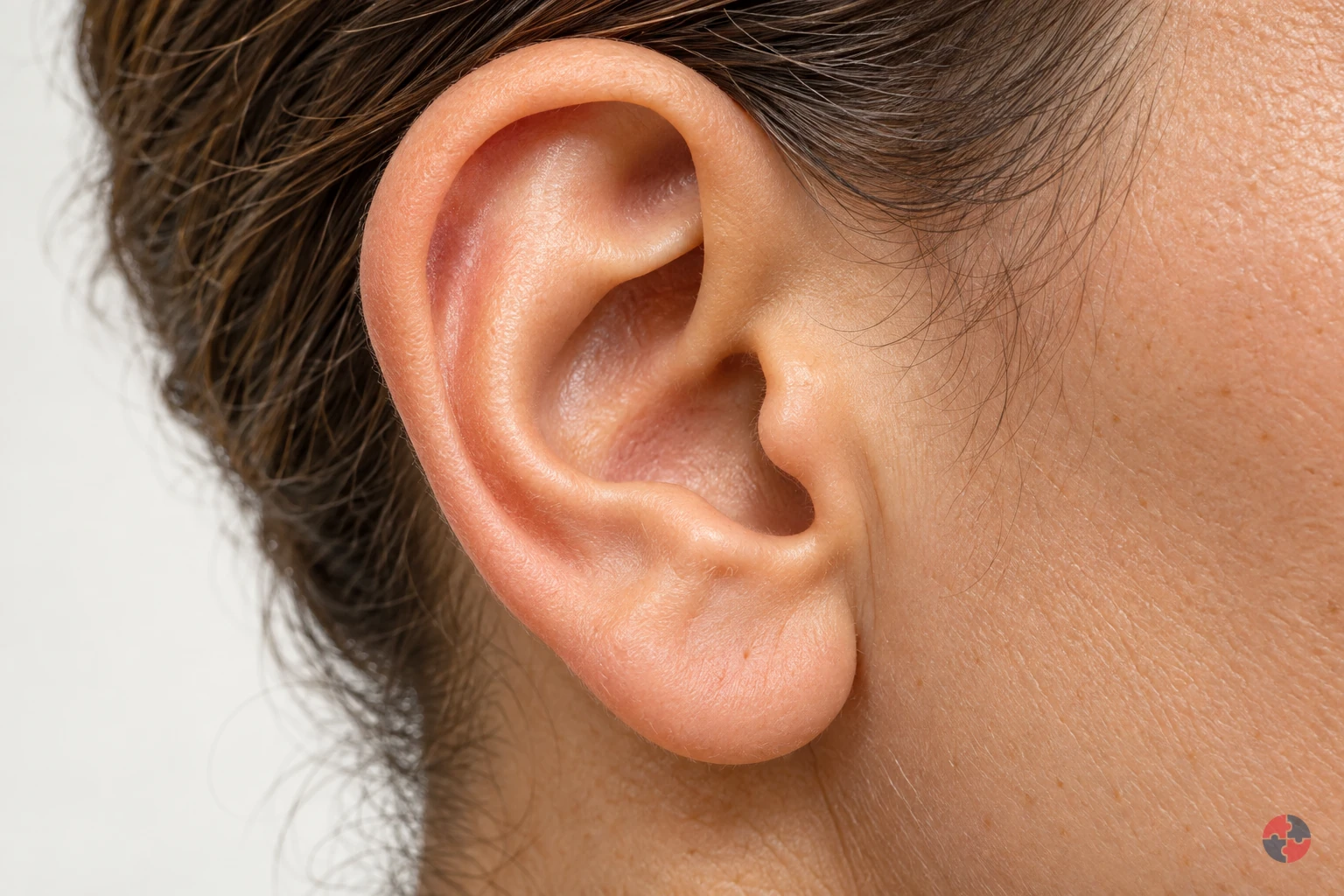
Locate the visible outer ear before considering the hearing pathway and the lesson’s noise-control decisions.
Locate the outer ear, then connect the lesson to the hearing pathway. What would reduce noise exposure at source?
educational illustration · healthy anatomy; enlarged details and teaching colours.
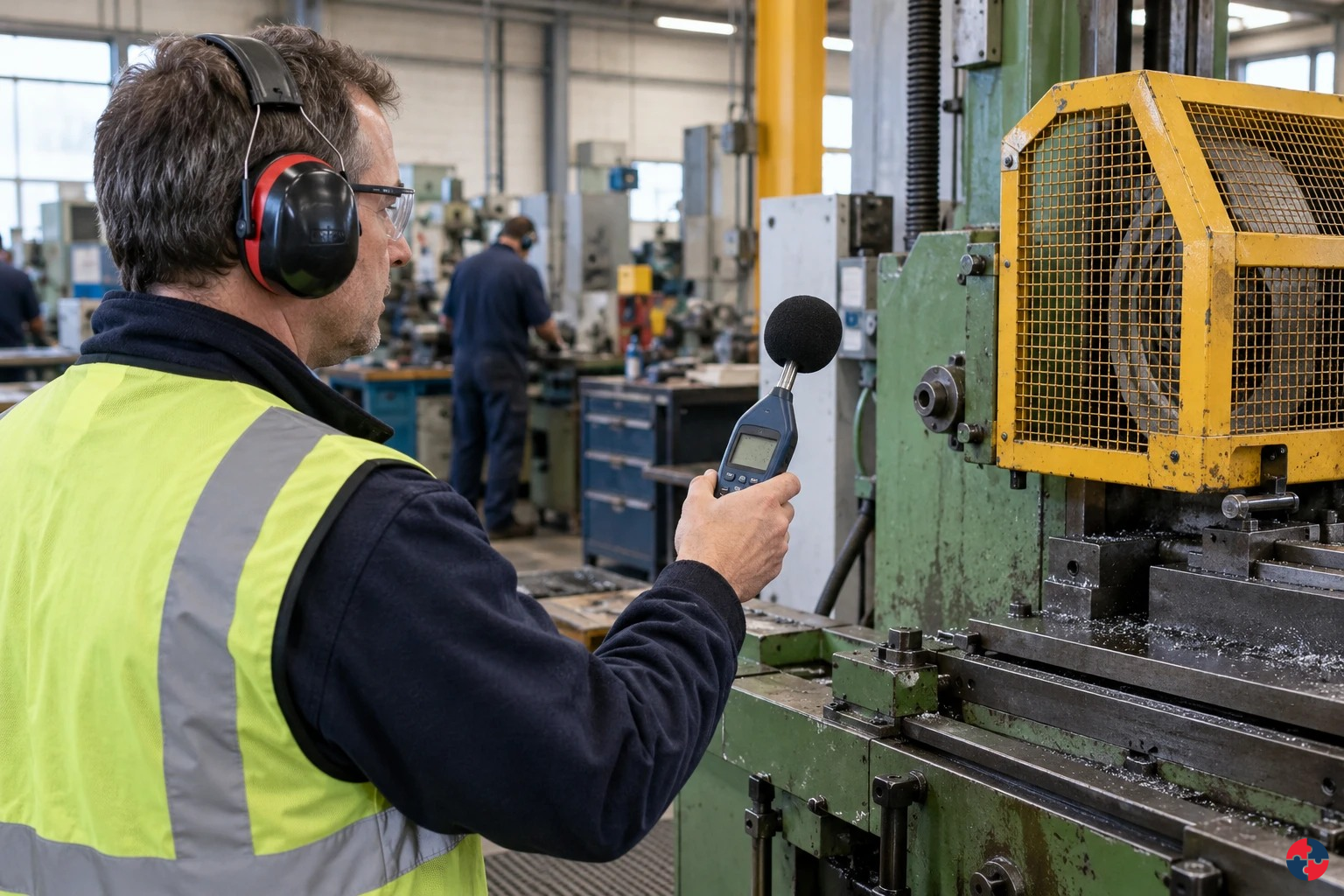
Photorealistic illustrative UK workplace scene. Review checks: Situation: A fictional press shop measures the installed line at load, calculates day and peak exposure, then verifies an enclosure and hearing programme. Decision: Before: old measurements cover one press but the new schedule doubles stroke frequency. Follow through: During: the assessor samples press cycles and positions; the engineer tests enclosure seals, and the supervisor logs time near the machine.
Dryer noise is accumulated exposure
A dryer may operate while a worker moves repeatedly between intake checks, maintenance and loading. Short visits to several noisy tasks can add to the day's exposure. Feeling accustomed to noise does not protect hearing, and lack of immediate pain does not establish control. Noise can also interfere with communication and warning recognition around vehicles and machinery.
The fictional dryer fan sounds louder after maintenance. Report the change and obtain a suitable competent assessment of actual tasks, levels and durations. Do not substitute an unverified phone reading or the model's audio for an exposure assessment. The required decisions include how to reduce exposure, whether hearing protection is needed and how other communication or warning risks will be controlled.
Source measures may include suitable quieter equipment, maintained components, enclosure, isolation of the noisy plant or remote monitoring that genuinely reduces presence. The engineering method must fit ventilation, maintenance and fire needs. Merely moving a worker into another noisy task is not necessarily a reduction. Hearing protection is part of the assessed programme where required, selected and worn correctly with training and checks. It is not permission to ignore avoidable source noise or a new defect.
Verification compares the revised work and representative exposure, not just the existence of earmuffs. Review how long people actually spend near the dryer across the full shift, including unusual breakdowns and harvest pressure. Relevant hearing concerns need appropriate occupational or clinical support and risk-based surveillance arrangements; supervisors should not diagnose damage or promise recovery. In the exercise, identify the changed source, who is exposed and the evidence needed to confirm improvement. Controls must remain usable during communication and maintenance, rather than creating a new risk while reducing sound in one location.
How is a defensible exposure estimate built?
Map tasks and variation, use reliable representative data, calculate full-shift exposure and document uncertainty and review triggers.
Sample normal and foreseeable worst operating modes, not only the quietest shift. Record meter type, calibration, location, duration and workers. Supplier sound-power or emission information cannot be copied straight into personal exposure; verify installed use. Weekly exposure can help where days vary, but assess a peak separately. If the estimate straddles an action value, improve the data and use protective controls while resolving uncertainty. Sources: HSE noise risk assessment, HSE L108 noise guidance (third edition, 2021).
So far as practicable, assess interactions between noise and ototoxic substances used at work, and between noise and vibration, as required by regulation 5(3)(c) in both jurisdictions. Record relevant chemical/process co-exposures and vibration, link the COSHH/vibration assessments and seek competent technical or occupational-health advice where needed. Do not infer causation from a worker’s medication list or place personal medical details in a noise survey.
Weekly averaging requires marked variation, a reasoned recorded justification and worker consultation; it must not increase risk or conceal a peak. See the companion calculator’s weekly-suitability explanation and L108 paragraphs 28–29 rather than assuming every variable day qualifies.
Applied case
A worker spends repeated periods at a louder dryer and then drives noisy machinery.
Decision and explanation
The actual combined tasks, exposure durations, source controls and protection arrangements.
Noise exposure accumulates across relevant work; familiarity does not protect hearing.
Lesson 6
A harvest handback joins health and mechanical controls
Verify the whole transfer system after change.
Related SHAREhub topic guide. Apply its prompts to the specific case below.
A harvest handback joins health and mechanical controls
A grain store is a connected system. Changing a transfer rate can affect dust release; replacing a guard can change access for cleaning; dryer maintenance can affect noise and ignition concerns. A repair ticket covering one component does not automatically establish readiness of the full process. The release decision needs to follow the actual work and people, not just the title of the maintenance job.
For the fictional restart, identify which controls the change could affect: intake protection, capture, grain-flow restrictions, cleaning, ignition control and worker exposure. Compare the repair record with physical handback and appropriate competent checks. Ensure people understand any revised operating limits and stop arrangements. A learner should request the right evidence without pretending to certify electrical or explosion-protection systems.
Ask workers about recurring blockages, escaped dust and difficult cleaning access. These can indicate that the process encourages unsafe workarounds. Plan improvements that reduce the need for intervention and keep people outside dangerous areas. A successful test run should take place through the competent safe method with guards restored and people clear. Any return to inspection requires the relevant isolation again; a completed test is not continuing permission to access the machinery.
The workplace transfer exercise uses a fictional audit table: claimed control, current observation, missing proof, protective hold and close-out check. Keep health measures separate from the fact that the auger rotates correctly, and keep explosion prevention separate from respiratory protection. Where evidence is unavailable, retain a defined restriction until the authorised person resolves it. Verification should reflect representative harvest conditions rather than an empty quiet store. The outcome is a usable process whose controls survive normal pressures, not a collection of favourable checklist scores that conceal one unresolved critical safeguard.
How should the selected controls be checked in practice?
ERICPD is used here as a planning mnemonic. The linked HSE five-level hierarchy is the official source for the order and relative reliability of controls; the two labels are not identical.
Start with task redesign and substitution, then engineered separation before procedures and personal protection; verify each control under real conditions.
At a fuel depot, tanker overfill can release petrol, form vapour and ignite. The assessment must identify the initiating event, people exposed and each independent prevention or mitigation barrier. Petrol cannot be substituted if the site must supply it, so the record should say why that higher-order option is unavailable for this operation and then demand strong engineered controls. HSE hierarchy of control; HSE hierarchy of control.
ERICPD is a six-stage planning aid; the HSE five-level order separates substitution, engineering and administration. Isolate is usually engineered separation, while ERICPD Control may contain both physical and administrative measures. Discipline sustains the chosen controls and is not an additional permission to expose people.
The auger is repaired but escaped dust, a new fan noise and pending spark work have not been reviewed.
Decision and explanation
The affected mechanical, exposure and ignition controls together.
A functioning transfer does not prove health and explosion controls are effective.
Lesson 7
Capture grain dust before it reaches people
Follow the dust from source to breathing zone, then verify the control performance.
Photorealistic illustrative UK workplace scene. Review checks: Assessing: the site team identifies dust, fume, mist and vapour tasks and links each LEV asset to a COSHH assessment and health risk. Specifying: LEV purchases require task description, contaminant type, worker position, capture requirement and commissioning evidence. Implementing: Operators use hoods, on-tool extraction, booths and gauges correctly, with stop-work triggers for failed capture.
Understand the activity and how harm develops
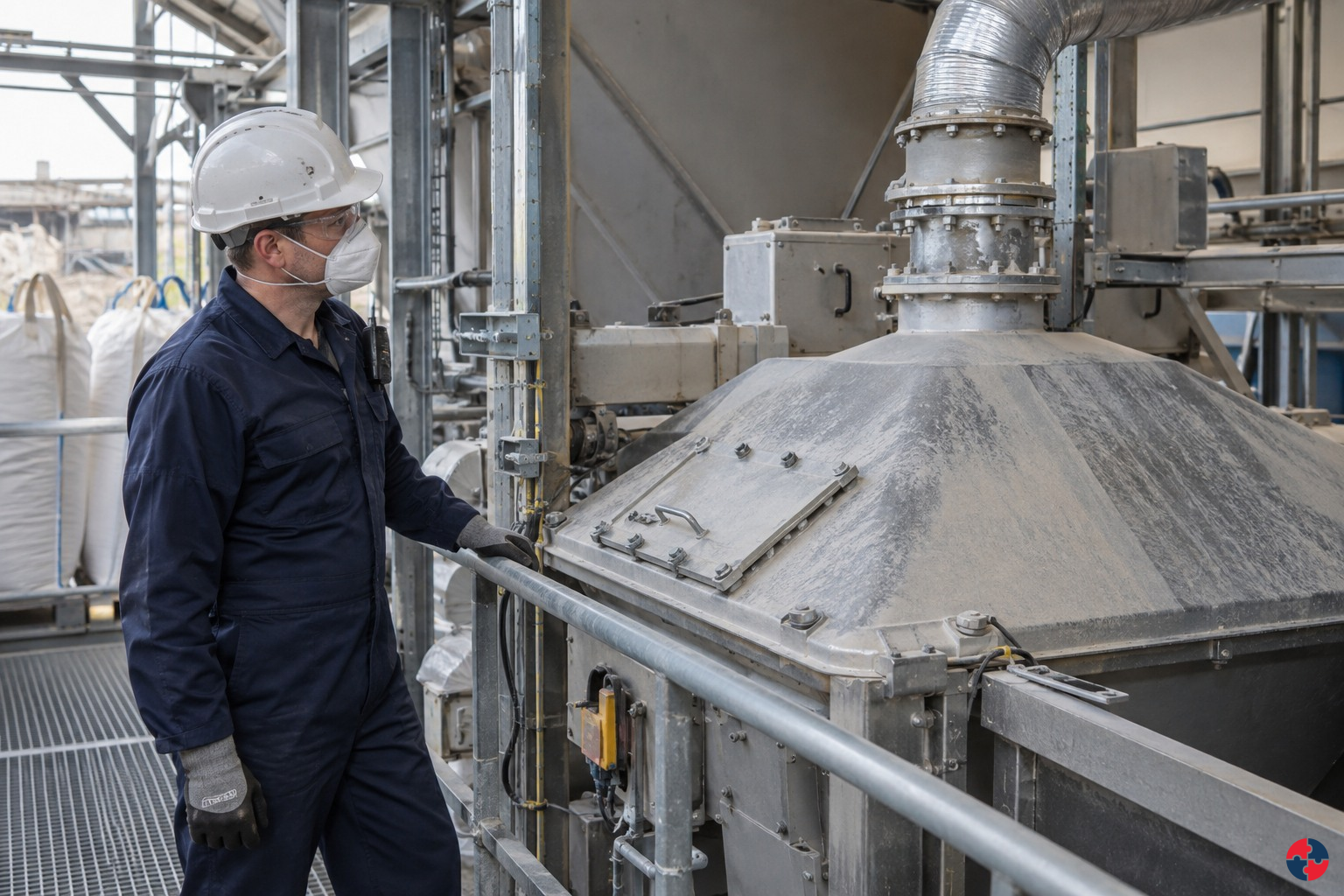
Dust escapes as cereal grain drops into the intake. The worker checks the flow from beside the release, placing their breathing zone in the dust pathway. Repeated short checks can add up across a harvest shift. The visible cloud is a useful warning, but exposure and extraction performance cannot be established from appearance alone.
Follow the handling chain from trailer tipping to conveyors, dryer and store. Dust can be released again during cleaning and maintenance. The learning task is to compare enclosure and extraction with the actual discharge pattern and worker position. A respirator may be needed under the assessment, but it does not excuse a defective dust-control system.
Recognise the evidence boundary
Question
Case evidence
What is observed?
Dust escapes around the grain intake while a worker stands nearby.
How can harm occur?
Breathing grain dust could cause serious respiratory disease.
What information is needed?
Check exposure controls and the condition of intake extraction.
Protect, manage and verify
Purpose
Practical application
Immediate protection
Enclose or extract dust and use the assessed cleaning and RPE arrangements.
Accountable work arrangement
Reduce unnecessary dust release through appropriate handling layout and controlled transfer. Enclose or extract at release points and maintain the system for the actual grain operation. Use a suitable low-dust cleaning method instead of blowing deposits into the air. Provide assessed RPE where needed, with suitable selection, face-fit arrangements for tight-fitting equipment and user training.
Release verification
Verify extraction performance and follow the exposure-monitoring plan.
Apply this at work
Repeat the assessment for feed mixing, bedding, mouldy material and maintenance tasks that disturb deposits.
What parts make up an LEV system?
A complete LEV system is an airflow chain; weakness in one part weakens the whole control.
The visible hood is only the beginning. The system includes ducts, bends, dampers, air cleaners, filters, fans, stacks, make-up air and monitoring devices. It may also include the machine guard, spray booth structure, interlocks, pressure indicators, filter alarms, airflow gauges and operating method.
A professional review follows the air path from contaminant source to safe discharge. It asks whether enough air reaches the hood, whether the duct carries contaminant without settling, whether the filter or collector is suitable, whether the fan can overcome system resistance, and whether discharge could expose other people or re-enter the building.
Component
Purpose
Common failure
Hood or enclosure
Captures or contains contaminant.
Too far away, wrong shape, damaged, obstructed or poorly used.
Ductwork
Carries contaminated air away.
Leaks, blockages, crushed flexible duct or poor bends.
Air cleaner/filter
Removes particles, mist or vapour where needed.
Blocked filters, wrong media or poor disposal of waste.
Fan/air mover
Creates airflow through the system.
Wrong rotation, worn fan, belt slip or insufficient duty.
Discharge
Releases air safely.
Discharge near doors, windows, intakes or occupied areas.
Make-up air
Replaces extracted air.
Room becomes starved, draughty or process airflow is disrupted.
Indicator/instrument
Shows whether performance is within expected range.
Gauge absent, ignored, uncalibrated or not understood.
Applied case
The intake fan runs but dust escapes whenever the trailer discharges. The worker suggests wearing a mask and carrying on.
Decision and explanation
The loss of capture, task conditions and suitable interim exposure controls.
Fan noise is not a measure of capture at the release point or protection of the breathing zone. The visible escape indicates the control needs investigation. RPE selection and any continuation decision must follow the assessed arrangements. Moving without tracing the dust pathway may expose the worker elsewhere and leaves the source failure unresolved.
Lesson 8
Keep people off grain and out of engulfment
Stopped equipment does not turn an unstable grain surface into a safe floor.
Related SHAREhub topic guide. Apply its prompts to the specific case below.
Understand the activity and how harm develops
A blockage is suspected above the discharge. Grain can bridge over a void or move suddenly when a hidden arch fails. Standing on the surface can turn a person into part of the flowing material, while an operating auger can pull grain away beneath them. The surface appearance gives no reliable evidence of support.
The scene asks for a blockage method that keeps people outside the store and controls all relevant equipment. Switching off one visible drive is not permission to enter: remote starts, stored grain and atmospheric conditions may remain. Where entry cannot be avoided, a competent specialist system is needed, including isolation and rescue planning; this learning guide does not authorise entry.
Recognise the evidence boundary
Question
Case evidence
What is observed?
Someone proposes standing on grain to break a suspected bridge.
How can harm occur?
The grain could collapse and engulf or suffocate the person.
What information is needed?
Ask how grain flow is stopped and how blockages are managed remotely.
Protect, manage and verify
Purpose
Practical application
Immediate protection
Keep people out and obtain the competent specialist intervention plan.
Accountable work arrangement
Use a suitable external or remote method to investigate and clear the blockage. Prevent access onto grain and control openings and entry points. Identify and isolate every relevant conveyor, auger and source of grain flow before intervention. Obtain competent specialist assessment and planned entry and rescue arrangements if entry is genuinely unavoidable.
Release verification
No access resumes without the required isolation and entry arrangements.
Apply this at work
Recognise similar bulk-material behaviour in feed bins, fertiliser stores and aggregate hoppers.
How can the organisation avoid entry?
Make no-entry a design and work-planning decision, with a recorded reason before any permit is considered.
For drain inspection, use a remote camera and external cleaning point if a competent assessment confirms that method is safe. For tanks, provide fixed gauges, sampling points or clean-in-place systems where practicable. Check that pressure, chemical use or jetting does not create a new uncontrolled exposure. The manager signs the selected method; if entry remains necessary, the confined-space lead records why alternatives cannot safely achieve the task. This is the elimination level of the five-level hierarchy and ERICPD, ahead of isolation, engineering, procedures and PPE.
Applied case
The auger has stopped. A worker proposes walking across the grain to break the bridge with a pole.
Decision and explanation
No; keep people out and obtain a competent external blockage-clearing method.
An observer cannot prevent a bridge collapse and may be drawn into an improvised rescue. Stopping the auger is only one issue. Unsupported or bridged grain can still collapse and engulf someone. A radio does not stop the grain collapsing or provide a safe recovery arrangement after engulfment.
Lesson 9
Guard augers and isolate before intervention
Guard during operation; isolate and verify for access.
Photorealistic illustrative UK workplace scene. Review checks: Setting: Cartons jam at a packaging transfer point. Act: Stop and hold production, keep others clear and reject the tape holding the side gate. Hold / review: Hold the line: do not start or reach in while the interlock is defeated, the drive can coast into reach, the linked feed remains energised, the air pressure is uncertain, or the task differs from the agreed method.
Understand the activity and how harm develops
The intake auger has exposed rotating flights beside a walking route. Contact can occur while someone steps over it, clears spilled grain or reaches for a tool. A familiar slow-moving screw can still draw clothing or a limb into a narrowing gap. The absence of a recent injury says nothing about the adequacy of the guard.
Inspect how people are expected to pass, clean and service the intake. The guard should prevent access to dangerous movement during normal operation. When intervention requires access, the system needs isolation and verification before work. A stop button alone does not prevent someone else starting the equipment or remove every connected energy source.
Recognise the evidence boundary
Question
Case evidence
What is observed?
The intake auger guard is missing near a walking route.
How can harm occur?
Rotating flights could entangle or amputate limbs.
What information is needed?
Check guard condition and the authorised defect response.
Protect, manage and verify
Purpose
Practical application
Immediate protection
Stop and isolate the auger until suitable guarding is restored.
Accountable work arrangement
Stop use and prevent access to the unguarded auger. Restore suitable guarding and reroute any walking path that encourages stepping over machinery. Use a task-specific isolation procedure for cleaning, blockage work and maintenance. Control restart after guards are restored and people, tools and materials are clear.
Release verification
Authorised checks confirm guards and safe operation before restart.
Apply this at work
Apply the same distinction to mixers, feed conveyors, elevators and grain-cleaning equipment.
What makes a physical guard effective?
A guard must be strong, secure and positioned so a person cannot reach dangerous parts through, over, under or around it. It must not create a new trapping or sharp-edge hazard, and workers need a usable way to do the job without removing it.
A fixed guard normally requires a tool for removal and must be refitted before use. A movable guard may suit needed access but requires an appropriate safety function. Mesh aperture, height, reach distance, transparent-panel strength and fixings are engineering design choices; they cannot be chosen from one universal gap or panel thickness. A competent designer uses the applicable current technical requirements, machine instructions and actual body/access routes. HSE L22 Safe use of work equipment.
Poor visibility, awkward cleaning and long waits are reasons people defeat protection. During the design review, watch operators perform real tasks and redesign inconvenient steps without creating a shortcut to the hazard. A new opening, tool, product or worker group can invalidate an earlier reach assessment. HSE Introduction to machinery safety.
Applied case
An operator stops the auger and asks a colleague to pull material from the exposed intake.
Decision and explanation
Apply and verify the appropriate isolation and safe intervention procedure.
Loose material can increase entanglement risk and cannot replace guarding or verified isolation. The procedure must prevent unexpected movement and control connected hazards before access, rather than relying on a normal stop. Someone watching a control does not provide secure isolation from every possible start or energy source.
Lesson 10
Prevent grain dust fires and explosions
Control combustible material and ignition together; a cleaner appearance alone is insufficient.
Photorealistic illustrative UK workplace scene. Review checks: Setting: Flour silo, connected dust filter and transfer duct at a food-processing site. Act: Reduce dust release and ignition; confirm material test data, filter and silo volumes, vent discharge path, duct connections and protection design basis. Hold / review: Stop transfer if a critical collector fails, a vent is obstructed, isolation is impaired or changed ducting has not been reassessed.
Understand the activity and how harm develops
Dust has collected near the grain dryer electrical cabinet. Deposits can become airborne during cleaning or a small disturbance, while electrical defects or hot surfaces can provide ignition. The health assessment for breathing dust and the assessment for fire and explosion are connected, but they ask different questions.
Look at where dust is released, where it settles and what equipment operates there. In this exercise the maintenance defect and housekeeping problem must be addressed together. Sweeping or blowing dust around a running dryer can move the hazard rather than control it. Any explosion protection, equipment suitability and emergency response need a competent assessment for the actual installation.
Recognise the evidence boundary
Question
Case evidence
What is observed?
Fine grain dust accumulates near an electrical fault at the dryer.
How can harm occur?
An ignition could start a fire or dust explosion.
What information is needed?
Review the dust explosion assessment and cleaning records.
Protect, manage and verify
Purpose
Practical application
Immediate protection
Control dust release, deposits and ignition sources through the assessed system.
Accountable work arrangement
Reduce dust escape and accumulation through effective enclosure, extraction and suitable cleaning. Control electrical defects, hot surfaces, hot work and other ignition sources. Use equipment and any protective systems selected through the competent dangerous-substances assessment. Coordinate maintenance and cleaning with isolation, fire precautions and a clear emergency plan.
Release verification
Confirm cleaning and protective equipment remain effective.
Apply this at work
Review the same interaction at feed mills, straw handling areas and dusty workshops.
How should dust extraction and powder handling systems be protected?
Dust systems should be protected by preventing dust escape, controlling ignition, maintaining extraction and using relief, isolation or suppression where needed.
Dust extraction and powder systems can create both process risk and building risk. A leak, blocked filter, failed housekeeping regime or modified duct can allow dust to accumulate. The primary explosion may start inside equipment, but the worst harm may occur when settled dust becomes airborne in a secondary explosion.
Protection should be chosen from the actual system: collectors, silos, mills, dryers, conveyors, filters, elevators, hoppers and ducts may each need different controls. A competent assessment should identify where ignition could occur and how an event could propagate.
A worker plans to blow dust off the dryer with compressed air while it remains running.
Decision and explanation
Stop and use the assessed cleaning and isolation arrangements while addressing the defect.
The method still disperses combustible material and leaves the possible ignition defect active. This deals with both the dust pathway and ignition conditions rather than simply relocating the deposit. Opening equipment does not establish safe cleaning conditions and may expose additional moving or electrical hazards.
Lesson 11
Assess the dryer noise across the shift
Assess the exposure people actually receive, including less frequent work.
Teaching graphic from the linked SHAREhub source section.
Understand the activity and how harm develops
Workers need to raise their voices beside the running dryer. That is a cue to investigate noise, not a measurement of exposure. Repeated checks, maintenance and grain unloading may contribute across the same shift, including for contractors who spend longer near the plant than the regular operator.
The scene asks whether readings can be obtained from a quieter position and whether fan, enclosure or maintenance improvements reduce noise at source. Hearing protection may form part of the assessment, but it must suit the person, task and communication needs. A worker also needs to hear relevant warnings; the solution cannot simply silence all communication without redesigning it.
Recognise the evidence boundary
Question
Case evidence
What is observed?
Workers must shout beside the running dryer during repeated checks.
How can harm occur?
Repeated high noise exposure could damage hearing.
What information is needed?
Request a representative noise assessment and the maintenance history.
Protect, manage and verify
Purpose
Practical application
Immediate protection
Reduce noise at source and limit exposure with assessed protection.
Accountable work arrangement
Reduce the need to approach noisy plant by providing suitable remote checks. Maintain and improve noise control at source, including appropriate enclosures and vibration control. Assess representative exposure and organise work to reduce time in affected areas. Provide suitable hearing protection, instruction and health surveillance where required by the assessment.
Release verification
Confirm the revised noise controls and hearing-protection arrangements.
Apply this at work
Combine dryer, tractor, workshop and powered-tool tasks when reviewing the working day.
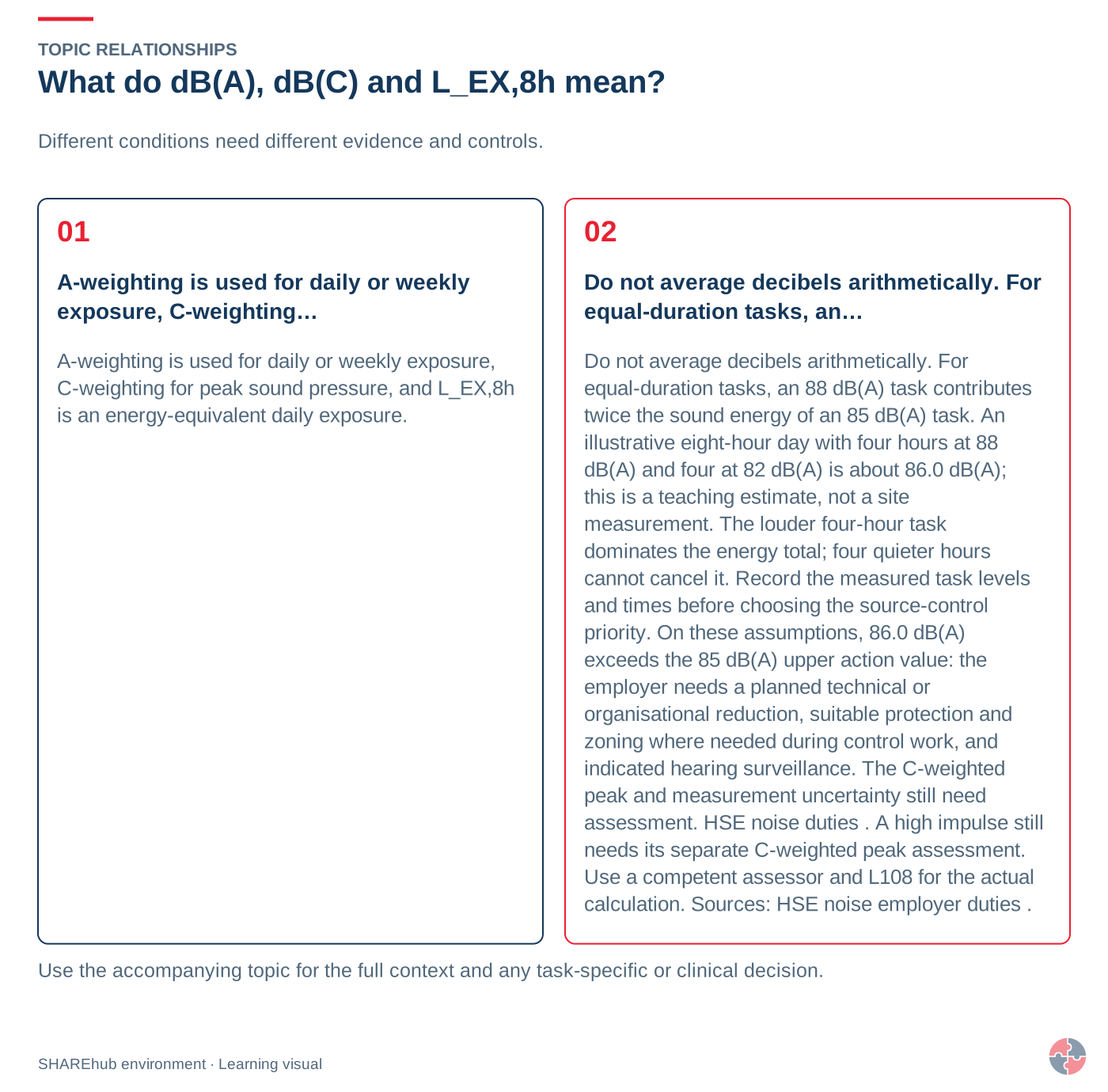
What do dB(A), dB(C) and L_EX,8h mean?
A-weighting is used for daily or weekly exposure, C-weighting for peak sound pressure, and L_EX,8h is an energy-equivalent daily exposure.
Do not average decibels arithmetically. For equal-duration tasks, an 88 dB(A) task contributes twice the sound energy of an 85 dB(A) task. An illustrative eight-hour day with four hours at 88 dB(A) and four at 82 dB(A) is about 86.0 dB(A); this is a teaching estimate, not a site measurement. The louder four-hour task dominates the energy total; four quieter hours cannot cancel it. Record the measured task levels and times before choosing the source-control priority. On these assumptions, 86.0 dB(A) exceeds the 85 dB(A) upper action value: the employer needs a planned technical or organisational reduction, suitable protection and zoning where needed during control work, and indicated hearing surveillance. The C-weighted peak and measurement uncertainty still need assessment. HSE noise duties. A high impulse still needs its separate C-weighted peak assessment. Use a competent assessor and L108 for the actual calculation. Sources: HSE noise employer duties.
Task
Unrounded energy points
88 dB(A) for 4 hours
About 99.8
82 dB(A) for 4 hours
About 25.1
Combined
About 124.8 unrounded points; 85.96293 dB(A), about 86.0
This original calculation table uses energy contributions, not arithmetic averaging of decibels. The companion calculator rounds task points separately to a total of 125; the energy result remains about 86.0 dB(A). Open the existing calculator with its peak, method and uncertainty limits, and use the NIHL concern pathway for clinical escalation.
Applied case
The assessment only covers a brief dryer check, but the harvest contractor spends hours servicing beside it.
Decision and explanation
Assess the contractor tasks and duration, then verify suitable noise controls.
Tolerance is not a reliable measure of hearing damage risk or exposure across the shift. A representative assessment needs to include the person with the longer exposure and the tasks that create it. Protection alone does not establish that the longer actual exposure and maintenance tasks have been assessed.
Lesson 12
The blocked intake: separate urgency from readiness
Defend a controlled restart after several grain-store failures.
Photorealistic illustrative UK workplace scene. Review checks: Setting: Maintenance must remove a pump spool in a fuel terminal. Act: Establish and prove initial isolation; then safely depressurise, drain and purge the section. Hold / review: Stop if pressure returns, the line identity is uncertain, isolation leaks, the drain path is blocked or the adjacent team changes the system.
The blocked intake: separate urgency from readiness
At the fictional farm, a trailer queue is building while the intake stops flowing. Dust escaped from a damaged capture connection during the last load. A worker suspects a grain bridge and suggests stepping onto the grain to break it. Another offers to remove an intake guard and clear the auger after pressing Stop. The dryer fan is louder since repair, dust remains on overhead beams and a contractor is preparing spark-producing work nearby.
Begin with a hold on the affected process. Delivery pressure does not change the consequences of engulfment, machinery contact, respiratory exposure or ignition. Arrange a suitable waiting and traffic system so the held intake does not create a new yard conflict. Keep people off the grain and outside the auger danger area. The learner must not conduct an internal inspection, invent an entry permit or assume a rope and helper make the suggested grain access acceptable.
Separate the workstreams while keeping their interaction visible. A competent person should determine a suitable no-entry response to the flow problem and the required isolation of connected equipment and material movement. Machinery repair needs an authorised safe method, not a pushbutton stop alone. Restore guarding and verify the handback before operation. The dust connection needs correction and performance checks that establish control at the actual transfer, not simply evidence that the fan motor runs.
The ignition conflict requires the competent fire and explosion decision for the material, deposits, process and proposed work. Do not assume a clean floor resolves dust on beams or that an ordinary vacuum is suitable. Use assessed cleaning and repair arrangements that avoid dispersing material or exposing a worker at height. This awareness course supplies no explosibility value, hazardous zone or equipment specification.
The changed dryer noise requires review of the worker's representative exposure and source controls across the day. Hearing protection may be required under the actual assessed programme, but issuing it does not close a maintenance defect or prove source reduction. Relevant health concerns should receive appropriate support without a lay diagnosis. Respiratory and hearing surveillance, where indicated, support prevention; they are not substitutes for effective plant controls.
Before restart, the authorised decision should identify the corrected systems, people-clear check, guard restoration, exposure verification, ignition coordination and revised briefing. Any unresolved condition remains a specific hold. A test run is controlled work; further inspection afterwards requires reapplying the safe intervention procedure. Review why blockages and rushed repairs arose and whether design or maintenance can reduce recurrence. The final case answer should explain evidence and boundaries, with no real operational forms submitted and no claim that a practice result certifies the grain store.
How should isolation be verified?
Verification proves the isolation is effective at the point of work, not just applied somewhere upstream.
Verification is the difference between a hopeful isolation and a controlled job. Electrical work needs proving dead; process work may need depressurisation, drain/vent checks, gas testing, sampling, pressure indication, bleed verification, flushing, purging or visual confirmation of blinds. See HSG253 - The safe isolation of plant and equipment.
Verification should be independent enough for the risk. A person should not simply trust the same label or drawing that could be wrong. Where consequences are high, independent verification and authoriser challenge are essential.
Hazard
Verification method
Common failure
Electrical energy
Test for dead with approved voltage indicator.
Tester not proved before/after or wrong circuit tested.
Pressure
Check gauges, vents, drains and bleed points.
Blocked gauge line gives false reading.
Flammable atmosphere
Gas test after purge and before line break.
Single test misses later vapour return.
Toxic/corrosive contents
Sample, drain, flush, isolate and PPE.
Dead leg or trapped pocket remains.
Mechanical movement
Try-start where safe, block and physical check.
Stored gravity/hydraulic energy not controlled.
Blind/spade
Visual check and blind list verification.
Wrong size/rating or wrong location.
Learning check: two apparent protections
A locked but wrongly identified isolator does not protect the work point. A correctly identified boundary still requires proof of every relevant energy/feed and each specified DBB barrier, with accepted evidence and a safe discharge destination. If identity or proof is missing, hold the intrusive work and use the roles/competence route. Do not turn this check into a generic valve-operating sequence or invent acceptance pressures.
Applied case
The queue manager asks whether a short test with the guard removed would locate the blockage faster.
Decision and explanation
Reject exposed testing and use the competent no-entry, isolation, repair and verified restart arrangements.
Urgency cannot justify exposure to grain flow or dangerous movement; use suitable controlled methods.
Lesson 13
Take a verified action into the workplace
Connect one actual task to an owner, evidence and a clear release or escalation decision.
Photorealistic illustrative UK workplace scene. Review checks: Setting: Maintenance must remove a pump spool in a fuel terminal. Act: Establish and prove initial isolation; then safely depressurise, drain and purge the section. Hold / review: Stop if pressure returns, the line identity is uncertain, isolation leaks, the drain path is blocked or the adjacent team changes the system.
Turn awareness into a practical question
Great Britain farm-work awareness. Confirm the relevant national fire, environmental and pesticide route. Specialist livestock, machinery, electrical, work-at-height, pesticide, confined-space and rescue tasks require their actual competent assessment and authorisation; this course confers none.
Choose one relevant operation from the course. Describe the person or environment at risk, the mechanism of harm and the exact condition that needs controlling. Separate an observation from a conclusion. A display, signature, badge or clean appearance answers only a limited question.
Use the included practice resources to prepare a fictional task brief, risk review or verification question. Decide which competent role owns the decision and which evidence must be available before work restarts or work is released. Keep worker protection, public exclusion, task acceptance and environmental decisions distinct where required.
At work, use your actual approved arrangements. Report uncertainty and preserve the relevant hold, restriction or safe state while it is resolved. Confirm that the action addressed the original harm route and check whether another shift, load, cleaning task or maintenance change could reintroduce it.
Course completion records awareness learning. It does not establish practical competence, certify an organisation or authorise specialist, clinical, maintenance, chemical or emergency work.
How should isolation be verified?
Verification proves the isolation is effective at the point of work, not just applied somewhere upstream.
Verification is the difference between a hopeful isolation and a controlled job. Electrical work needs proving dead; process work may need depressurisation, drain/vent checks, gas testing, sampling, pressure indication, bleed verification, flushing, purging or visual confirmation of blinds. See HSG253 - The safe isolation of plant and equipment.
Verification should be independent enough for the risk. A person should not simply trust the same label or drawing that could be wrong. Where consequences are high, independent verification and authoriser challenge are essential.
Hazard
Verification method
Common failure
Electrical energy
Test for dead with approved voltage indicator.
Tester not proved before/after or wrong circuit tested.
Pressure
Check gauges, vents, drains and bleed points.
Blocked gauge line gives false reading.
Flammable atmosphere
Gas test after purge and before line break.
Single test misses later vapour return.
Toxic/corrosive contents
Sample, drain, flush, isolate and PPE.
Dead leg or trapped pocket remains.
Mechanical movement
Try-start where safe, block and physical check.
Stored gravity/hydraulic energy not controlled.
Blind/spade
Visual check and blind list verification.
Wrong size/rating or wrong location.
Learning check: two apparent protections
A locked but wrongly identified isolator does not protect the work point. A correctly identified boundary still requires proof of every relevant energy/feed and each specified DBB barrier, with accepted evidence and a safe discharge destination. If identity or proof is missing, hold the intrusive work and use the roles/competence route. Do not turn this check into a generic valve-operating sequence or invent acceptance pressures.
Applied case
The shift action log says “training completed, issue closed”. It records no condition check, work status or task owner.
Decision and explanation
The accountable person verifies the task-specific control and records the justified decision.
Learning supports the decision; evidence that the relevant control works is needed before the responsible person closes the action.

 View full detail ↗