Full public teaching and readers are free without an account. A free learner account is required for saved LMS progress and recorded assessment. Completion and any course-completion certificate depend on the configured LMS conditions. Open the course overview.
Lesson 1
A walkway must reach the destination
Find where a protected route stops protecting its user.
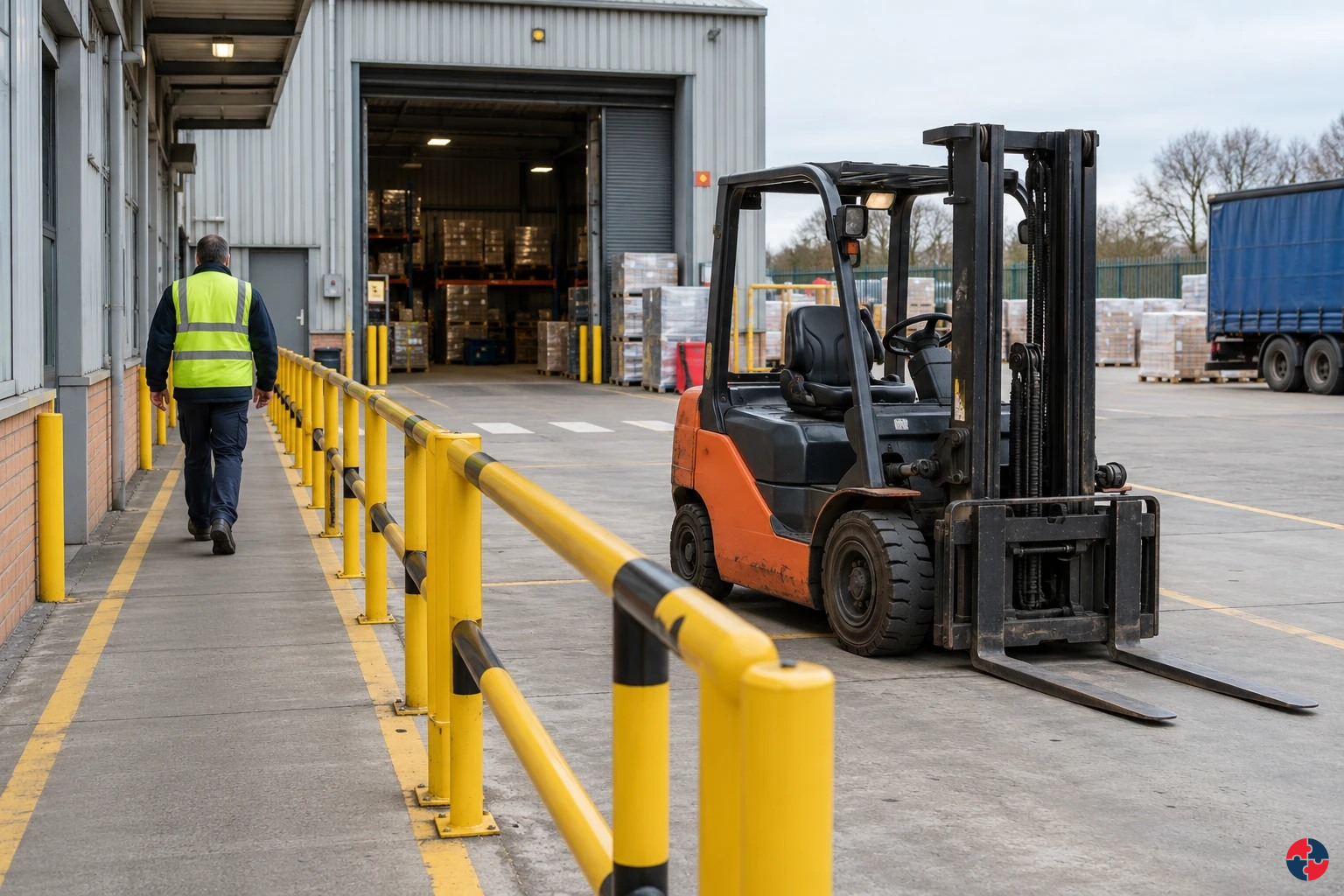
Photorealistic illustrative UK workplace scene. Review checks: Setting: Receive and unload identified palletised packaged goods from a rigid lorry using a suitable counterbalance forklift. Act: The supervisor checks the bay surface, lighting, pedestrian barriers, clear route and local unloading plan. Hold / review: Hold an unbooked vehicle, changed vehicle type, unknown load mass, damaged pallet or shifted load for the supervisor and, when needed, supplier or competent specialist.
A walkway must reach the destination
A walking route can look satisfactory on a plan while leaving its final few steps inside a turning envelope. In the fictional mixed farm, the pedestrian corridor ends before the welfare door. A tractor may clear the corridor but its trailer can follow a different path, and a driver concentrating on the intake may not see someone leaving the building. Assess the whole journey rather than counting painted lines.
Start with who needs to move: permanent workers, seasonal staff, visiting drivers, vets and family members. Trace entrances, toilets, reception and emergency exits alongside arrivals, unloading and departures. Include ordinary shortcuts and what happens when the yard is muddy or busy. A route that requires people to climb over stored equipment is not continuously usable. The model helps locate these interfaces; it does not prove a real vehicle's swept path or stopping distance.
Compare eliminating a crossing with managing one. Moving the delivery stopping point or pedestrian entrance can remove repeated contact. Suitable physical separation and a protected crossing control unavoidable interfaces more reliably than a request to be careful. Signs, clothing and briefing support the layout but depend on recognition and reaction. Choose arrangements for the actual vehicle, load, visibility and ground; no universal yard speed or clearance is taught here.
Before a changed delivery, the responsible coordinator should confirm the route is usable and explain where the driver waits. A pedestrian should stay outside a moving vehicle's path and obtain a stopped, acknowledged approach when necessary. Stop the movement if someone enters the protected space or the agreed route is unavailable. Verify the revised arrangement during a representative delivery from a safe position, including the pedestrian's return journey. Record what was observed and which part remains uncertain rather than treating a signed plan as physical separation.
How do you design safer routes and choose controls?
Map actual movements, remove unnecessary vehicle–pedestrian contact, then protect unavoidable interfaces. Physical separation and suitable layout come before signs, high-visibility clothing and expectations that people will always react correctly.
Observe the site at busy and quiet times. Draw staff routes to toilets, welfare and exits alongside forklifts, lorries, customer cars, waste collections and emergency access. Include a pedestrian’s natural walking route, not just the route drawn on the plan. A long detour that encourages shortcuts needs redesign, not repeated reminders. See HSE workplace transport risk assessment for the relevant source and scope.
Remove or reduce the movement: relocate a collection point, use drive-through arrangements or keep deliveries outside public access periods where practicable.
Separate by design: provide suitable pedestrian routes, barriers, separate doors and protected waiting areas. Select barriers for the foreseeable impact; a painted line is not a crash barrier.
Control remaining crossings: use visible, accessible crossing points away from reversing areas, suitable lighting, clear priority and enough visibility and stopping distance.
Support the design: brief routes, control access and delivery timing, supervise and enforce locally assessed speed limits. Select task-appropriate protective equipment for residual risks.
Routes must suit the largest vehicle and load that will actually use them, including turns, slopes, headroom and ground-bearing capacity. Keep surfaces drained and clear; protect vulnerable racking, fuel equipment and edges. Temporary routes need the same risk-based scrutiny. HSE HSG136 third edition (pages 9–13) provides the design principles.
There is no single safe speed, lane width or pedestrian clearance for every yard. The vehicle, load, bends, visibility, surface and users determine the decision. A posted limit is a maximum within the local system, not permission to drive at that speed when conditions are worse. HSE site speed limits describes choosing and enforcing site limits.
Applied case
A temporary feed stack blocks the last section of the welfare walkway during grain deliveries.
Decision and explanation
Restore a complete protected route or agree a safe alternative before movement.
The unprotected final section is part of the exposure. A route must work from origin to destination.
Lesson 2
A blind reverse needs a planned stop
Distinguish a reversing aid from control of the reversing area.
Photorealistic illustrative UK workplace scene. Review checks: Setting: Receive and unload identified palletised packaged goods from a rigid lorry using a suitable counterbalance forklift. Act: The supervisor checks the bay surface, lighting, pedestrian barriers, clear route and local unloading plan. Hold / review: Hold an unbooked vehicle, changed vehicle type, unknown load mass, damaged pallet or shifted load for the supervisor and, when needed, supplier or competent specialist.
A blind reverse needs a planned stop
A mirror or camera gives information; it does not remove people from the reversing space. At the fictional barn corner, stacked pallets hide a doorway from the delivery driver. A reversing alarm may be masked by the dryer, and a person emerging from the door may not know which vehicle is moving. Follow the chain from restricted visibility to a person being struck or trapped against the building.
First ask whether reversing can be avoided or reduced through a suitable arrival, turning and departure arrangement. The solution must fit the vehicle combination and preserve other safe routes. Moving the problem to a narrower corner is not improvement. If reversing remains necessary, plan the controlled area, waiting point, communication and responsibility before the vehicle enters. Visiting drivers need information they can use rather than assumptions about local knowledge.
A trained authorised signaller may form part of an assessed system, but appointing a person does not automatically make a blind manoeuvre safe. That person needs a safe position, agreed signals and a clear way to stop the movement. They must not stand in a trapping space or between vehicle and structure. If the driver loses sight of the signaller or the agreed communication fails, the movement stops under the planned arrangement. No learner is asked to direct a real vehicle through this exercise.
Inspect visibility, obstructions and the condition of the chosen controls from safe positions before the delivery. If the doorway cannot be protected, hold the vehicle at a safe waiting point while the coordinator resolves the conflict. Verification should include what happens when an unexpected person arrives, not just a demonstration with an empty yard. Review a near miss as evidence about the system rather than blaming the last person to step out. A camera and alarm remain useful aids within a controlled method; they do not authorise continuing when the danger area is uncertain.
When must the movement stop and how can it restart?
Stop the affected operation whenever its safe conditions are lost or cannot be confirmed. Keep people clear, inform the responsible supervisor and restart only after the defect or changed conditions have been assessed, controlled and communicated.
Avoid reversing wherever practicable. Where it remains necessary, provide a designated area, exclusion and suitable visibility controls. A banksman or signaller is a person guiding the driver, not a protective barrier. HSG136 treats this as a last-resort measure after other ways to control reversing risk; some vehicle and industry settings make it unsuitable. If used, the trained signaller needs an agreed signal system, a safe position and continuous visibility to the driver. If the driver loses sight of the signaller, stop immediately. HSE safe reversing. See HSE workplace transport risk assessment for the relevant source and scope.
Trigger
Immediate action
Restart evidence
Person in an operating or reversing zone
Stop vehicle and load movement safely. Keep other traffic out.
Supervisor confirms the person is clear and effective segregation and access control are restored. (HSE)
Lost signaller, obscured route or failed visibility aid
Stop the affected manoeuvre; do not continue by guesswork.
Visibility, agreed communication and all controls required by the assessed method are re-established. (HSE)
Brake, steering, restraint or other safety defect
Take the affected operation out of use and report the defect.
Competent repair and verification, or a separately assessed recovery method; no informal bypass. (HSE)
Unknown load, incompatible vehicle or changed route
Hold in a safe place and contact the host, carrier or supplier.
Identity and suitability confirmed; revised plan approved by the responsible competent people and briefed. (HSE)
Ice, spill, failed light, damaged barrier or unsafe surface
Close the affected route or bay and protect people.
Defect corrected and inspected, or an assessed and protected alternative route put into use. (HSE)
Collision, trapped person, fire or leak: stop surrounding traffic without entering its path, raise the alarm and call the local emergency response and 999 where needed. Keep clear of unstable vehicles, loads, fuel and electrical hazards. Do not attempt improvised lifting or vehicle movement to free a person; emergency responders and the site rescue arrangements must control that decision. Provide first aid only when it is safe and within competence. Preserve relevant evidence after immediate protection and emergency needs are met.
Report damage and near misses internally so the underlying route or system failure can be corrected. The responsible person must separately check whether statutory reporting applies: use HSE incident reporting for GB and HSENI report an incident for Northern Ireland. Their criteria differ; not every near miss is a reportable dangerous occurrence.
Applied case
The driver can see the signaller but not the barn doorway beside the trailer path.
Decision and explanation
People can still enter an uncontrolled blind doorway interface.
An alarm or familiar driver does not control entry from the hidden doorway.
Lesson 3
Keep the home boundary independent of supervision
Protect children without making them responsible for avoiding farm work.
Related SHAREhub topic guide. Apply its prompts to the specific case below.
Keep the home boundary independent of supervision
A working farm can be both a home and a workplace. Children may know the yard well while being unable to judge a turning trailer, moving animal or unstable object. Familiarity can encourage an adult to assume a child will wait in the usual place. That assumption becomes particularly fragile during harvest, visitors' arrival or a change in who is supervising.
The fictional domestic gate leads directly towards machinery activity. A safe family arrangement should provide effective separation, secured access and a suitable supervised place away from work. The boundary must remain usable when adults are busy and when someone makes a delivery. A warning to children is not a substitute for preventing access. Nor should a family member be asked to stand in the yard to remind a child to stay back while also conducting the work.
Look for how the boundary could be defeated: an open gate during unloading, a broken latch, stacked materials providing a climbing route or a pedestrian route that enters the vehicle area. Consider visiting children and adults unfamiliar with the farm. Work planning must protect them as well as employees. This course does not grant permission for a child or young person to operate, ride on or assist with farm machinery; specific restrictions and competence requirements require the relevant current guidance and an actual assessment.
If a child enters the working area, stop the affected operation safely, maintain separation and use the agreed adult response. Do not continue while relying on a promise that someone will watch from a cab. Before restarting, establish where the child is, who is responsible and whether the physical boundary has been restored. Check the arrangement over the whole shift, including breaks and handovers. In the exercise, identify the failed access route and corrective owner without recording private details about a real family. A successful day with no incident does not prove a gate left open was an effective control.
Who may be harmed and why does that change the assessment?
Different people have different exposure, competence, vulnerability and ability to control the risk.
Assessments often understate risk because they focus only on the trained operator. Real workplaces involve new starters, contractors, maintenance teams, cleaners, agency workers, visitors, young people, expectant mothers, disabled workers, lone workers, language barriers and people working under fatigue or production pressure.
The same hazard may require different controls for different people. A trained technician may understand isolation points; a cleaner may only encounter the equipment when a guard is open and production has stopped. That difference matters.
Group
Why they may be at risk
Assessment check
Operators
Direct exposure to task hazards and production pressures.
Training, supervision, work instructions and stop-work authority.
Maintenance workers
Higher exposure during isolation, opening, adjustment and fault-finding.
Permit, isolation, stored energy and competence controls.
Contractors
May not know site-specific hazards or emergency rules.
Prequalification, induction, supervision and interface control.
Visitors and public
May be unfamiliar with routes, alarms or site hazards.
Segregation, signs, escorting and emergency communication.
Vulnerable workers
Health, age, pregnancy, disability, language, fatigue or inexperience may affect risk.
Individual assessment, adjustments and communication.
Applied case
A pedestrian gate is wedged open to shorten the delivery worker’s route; a child is playing near the farmhouse.
Decision and explanation
Stop the affected movement and restore a secure family/work boundary with responsible adult arrangements.
The child must not carry responsibility for avoiding the moving machinery; restore effective separation.
Lesson 4
A heavy gate is a moving load
Recognise loss of support before touching damaged fixings.
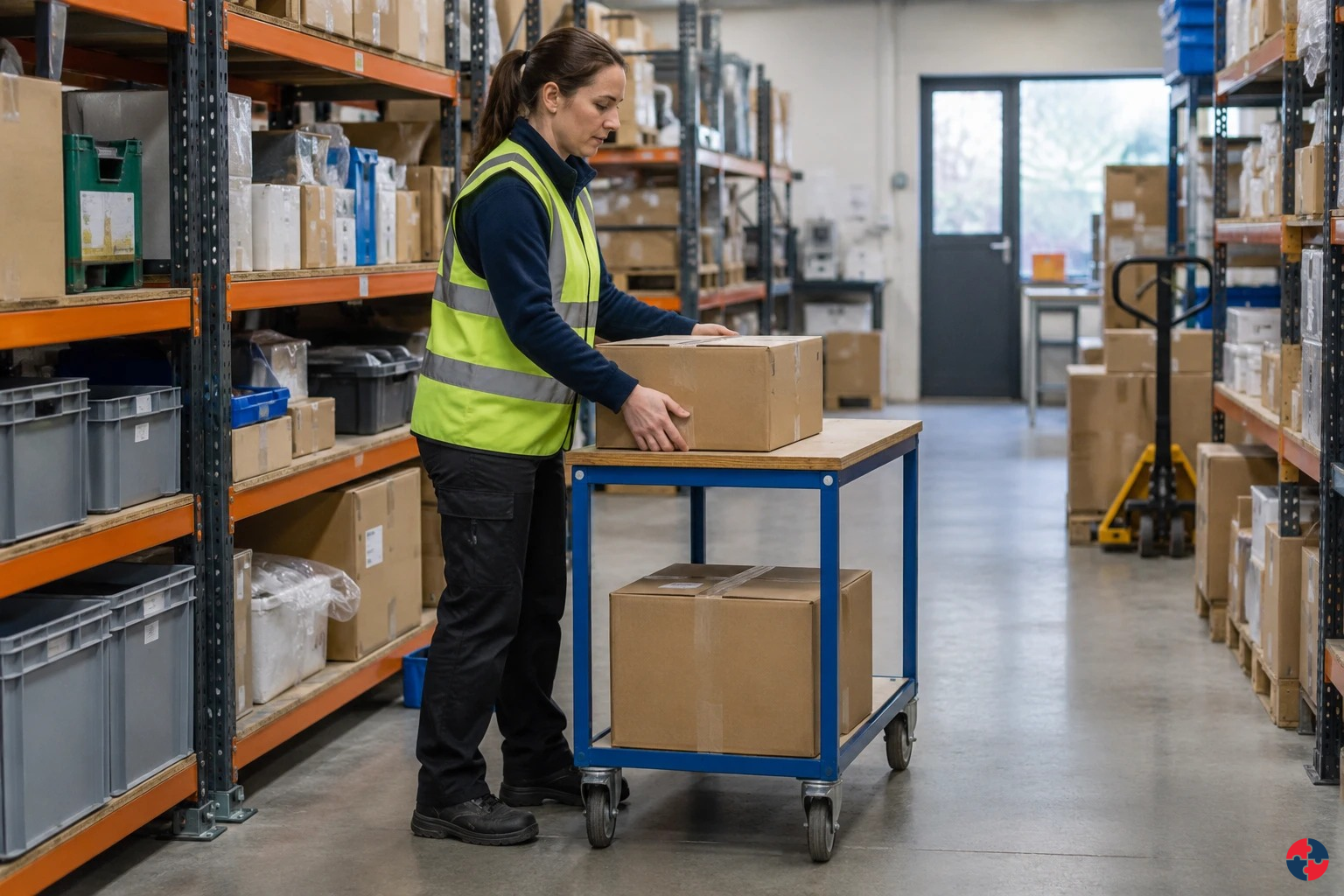
Photorealistic illustrative UK workplace scene. Review checks: Find: Heavy boxes are picked from the floor and twisted into a cage. Change: Raise the pick position, reorient the cage and repair the threshold. Verify: Maintain cage wheels and observe handling during a realistic peak.
A heavy gate is a moving load
A gate's weight is carried by hinges, posts and their fixings. If one part deteriorates, opening the gate can change the load on the remaining support and allow the whole assembly to fall or swing unexpectedly. A gate leaning against a post is not necessarily restrained. The worker may be crushed, struck or forced into nearby traffic while trying to hold it.
At the fictional cattle entrance, a hinge is loose and the gate drops as it moves. Restrict use and keep people outside the possible fall and sweep area. Do not prove the defect by repeatedly swinging it or asking somebody to hold the weight while a fixing is removed. Report the actual observation, such as the post moving or hinge pulling away, without inventing the cause or load rating.
Repair requires an appropriate competent method that controls the gate's weight before its support is disturbed. Suitable lifting or supporting equipment must fit the load, ground and task, and the method must address unexpected movement. This lesson teaches recognition and escalation, not a procedure for propping or rebuilding a gate. Manual strength, an improvised rope or a person's willingness to help is not verification that the gate cannot fall.
The supervisor also needs a usable alternative route that does not move pedestrians into a vehicle conflict or release livestock. A repair label alone cannot reopen the entrance. The responsible person should verify sound support, secure fixings and safe controlled movement under the planned handback before normal use resumes. Include arrangements that retain the gate safely in its intended positions. For the exercise, compare the claimed repair with observed stability and the people affected by the diversion. If evidence is unavailable, keep the restriction explicit. Weight, stored position and nearby activity belong in one assessment rather than separate paperwork exercises.
How should manual handling be assessed?
Assessment should observe the real task, identify risk factors and choose controls that reduce force, posture, frequency, distance and uncertainty.
A good assessment watches the task happen. It measures or estimates load weight, height, reach, distance, frequency, route, floor condition, team communication and use of aids. It asks workers what actually makes the job difficult, not just what the procedure says. Sources: HSE L23 Manual handling guidance on regulations; HSE manual handling at work
For structured assessment, HSE's Manual Handling Assessment Charts (MAC) support lifting, carrying and team handling. The Risk Assessment of Pushing and Pulling (RAPP) tool supports pushing and pulling. The Assessment of Repetitive Tasks (ART) tool supports repetitive upper-limb tasks. These tools help prioritise risk, but they do not replace judgement or the hierarchy of avoiding and reducing the task. Sources: HSE L23 Manual handling guidance on regulations; HSE manual handling at work
Question
Assessment prompt
Output
Can the handling be avoided?
Can delivery, storage, automation or process flow remove manual movement?
A hinge post rocks when a heavy gate is opened; a helper offers to hold it during repair.
Decision and explanation
Restrict access and obtain a competent method that restrains the gate before disturbing supports.
Control the moving load before releasing its support. A person cannot substitute for an assessed support method.
Use the appropriate manual handling assessment
This additional teaching takes about 2–5 minutes, in addition to the course estimate. Optional reading and workplace assessment take additional time.
Start by asking whether the hazardous handling can be removed or redesigned. Where handling remains, observe the whole operation with the people who do it and choose an assessment that fits the work.
These aids support the activity assessment. Repetitive upper-limb work may need ART; variable or complex tasks may need other HSE tools or a fuller competent assessment. Mechanical lifting, stored energy, equipment safety and health decisions retain their separate controls. A low factor score, a downloaded report or completion of this course does not approve the work.
TILEO: Task, Individual, Load, Environment and Other factors. MAC: Manual Handling Assessment Charts for appropriate lifting, carrying and team handling. RAPP: Risk Assessment of Pushing and Pulling for appropriate manual pushing and pulling.
Read the portable guide to understand selection, limitations, the mixed-task example and company-branded Word/PDF records. Your existing course checks and completion requirements remain separate.
Keep people protected while contamination is controlled.
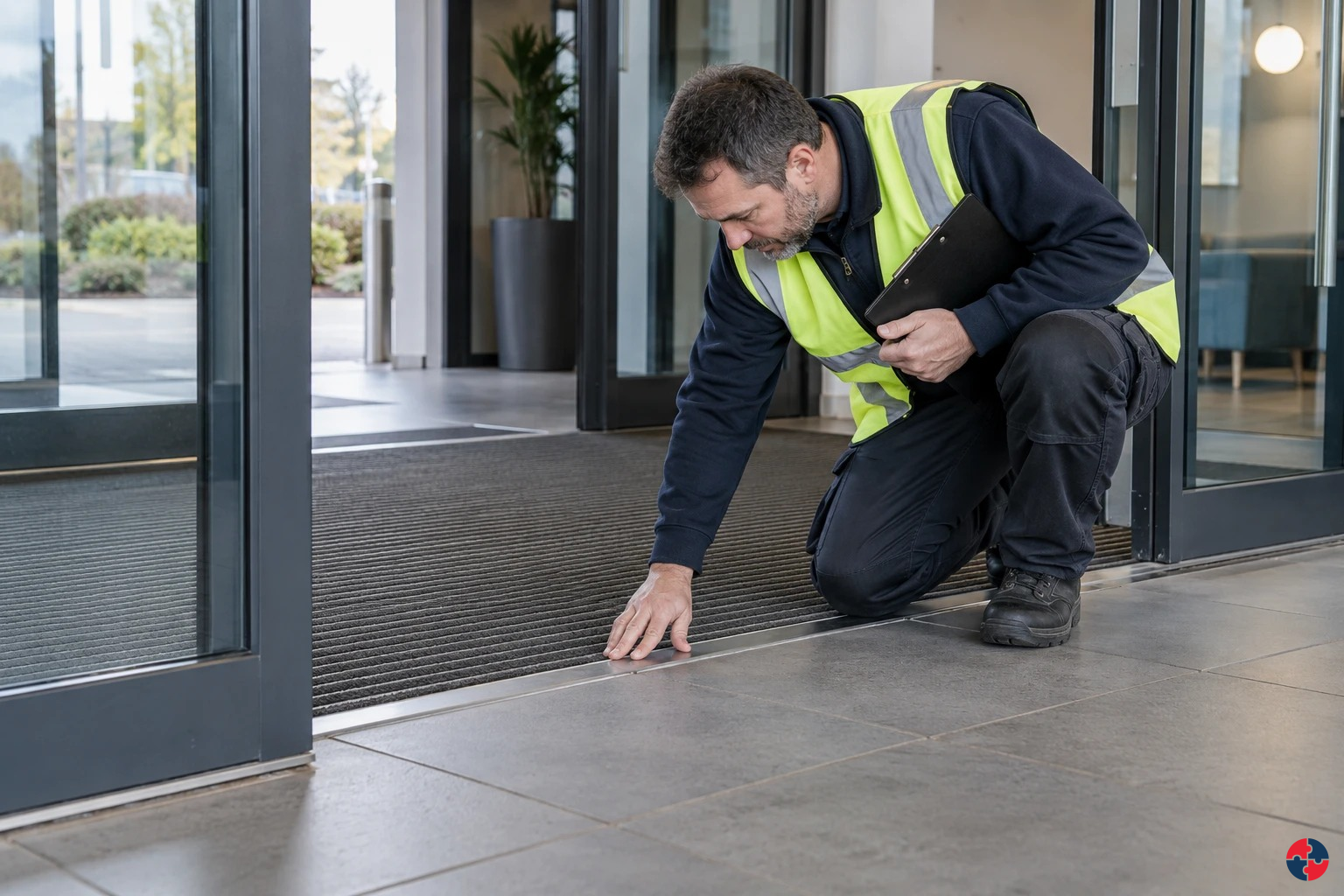
Photorealistic illustrative UK workplace scene. Review checks: Setting: Heavy rain carries water and leaves through a public leisure-centre entrance. Act: Close or physically separate the wet route, provide a safe accessible alternative, remove contamination and correct matting/drainage defects. Hold / review: Do not reopen while the hazardous condition remains or the alternative creates another hazard.
Cleaning must remove the slip pathway
Manure and water can reduce traction and travel on boots from the cattle gate into other routes. A patch may remain hazardous after a quick rinse spreads it over a wider area. Slope, drainage, surface condition, footwear and the task all affect the likelihood of slipping. The relevant question is whether the route can be used safely now, not whether cleaning was recorded earlier.
In the fictional yard, a slurry of manure collects beside the pedestrian entrance. Protect the affected route and provide a suitable diversion before cleaning starts. The diversion must be checked against moving vehicles, livestock and uneven ground. A cone informs people about a problem but does not stop contamination arriving or prevent a person using the only available route. Do not create a second uncontrolled conflict while solving the first.
Follow an appropriate cleaning method that removes the material and deals with the source and drainage. The method should not expose cleaners to live traffic or spread biological contamination into welfare. Provide usable equipment, facilities and time; footwear is a supporting measure selected for the actual conditions. Repeated contamination may require redesign of the walking route or animal movement rather than increasingly frequent reminders.
Before reopening, confirm the complete route is usable, cleaning equipment is removed and ongoing contamination is controlled. The person checking should use the assessed verification method, not deliberately skid a foot across a suspect surface. Check again when work or weather changes. A factual report describes the location, source, extent and protective action. The exercise asks learners to distinguish source prevention, temporary separation and reopening evidence. It does not infer a friction value or a real site's hygiene status from a model picture. Where the safe route cannot be maintained, restrict the affected use until an authorised alternative is established.
How should slips and trips be prevented?
Prevention should remove the cause at source before relying on warning signs or people spotting hazards.
The most reliable slip and trip controls are designed into the workplace: suitable floors, safe slopes and steps, drainage, lighting, storage, cable routes, delivery areas, mat wells, cleaning methods and pedestrian routes. A cone on a wet floor may warn people, but it does not make the floor dry or stop access.
A good control strategy asks how contamination will be prevented, how spills will be detected, who owns immediate response, how floors are cleaned, how footwear is selected, how defects are reported, how routes are inspected and how incident patterns are mapped.
Control layer
Practical control
Weak version to challenge
Design
Specify suitable floor, drainage, stairs, lighting and route width.
Trying to manage a badly designed route with signs.
Prevent contamination
Stop leaks, fit drip trays, improve entrance matting and cover outdoor transitions.
Cleaning the same recurring spill every day.
Remove hazards
Clear cables, waste, stock, hoses and uneven temporary materials.
Leaving obstacles for people to step around.
Control cleaning
Use correct method, timing, products, drying and barriers.
Wet mopping during peak footfall with cones only.
Maintain
Repair defects, curled mats, loose tiles, potholes and stair nosings.
Logging defects without interim control.
Footwear
Match footwear to surface and contaminant where work requires it.
Assuming all safety footwear is slip-resistant.
Supervise and learn
Inspect routes, map incidents and fix repeat causes.
Blaming individuals after each incident.
The prevention model applies HSE slip/trip factors to the actual route; the owners and check sequence are illustrative.
Applied case
A hose has diluted manure across the only walking route but the cleaner has signed the task sheet.
Decision and explanation
A usable route with contamination removed and ongoing spread controlled.
A completed task record does not demonstrate the current surface and route are safe to use.
Lesson 6
Handover is a control test
Turn separate yard observations into a coherent delivery decision.
Photorealistic illustrative UK workplace scene. Review checks: Setting: Receive and unload identified palletised packaged goods from a rigid lorry using a suitable counterbalance forklift. Act: The supervisor checks the bay surface, lighting, pedestrian barriers, clear route and local unloading plan. Hold / review: Hold an unbooked vehicle, changed vehicle type, unknown load mass, damaged pallet or shifted load for the supervisor and, when needed, supplier or competent specialist.
Handover is a control test
Yard risks interact. A gate repair can block the walking route, cleaning can divert people towards a trailer and a queue can leave the family gate open. Treating each checklist as a separate pass can miss the combined exposure. The delivery coordinator needs a clear picture of what is usable, what is restricted and what must change before movement begins.
Build the fictional handover around the actual delivery: vehicle combination, route, unloading point, pedestrian destinations, family boundary and changing surface conditions. Invite the driver and workers to explain where they wait and what makes them stop. An answer such as “someone will keep an eye out” reveals missing ownership rather than a finished control. Confirm arrangements for a late arrival or an unexpected visitor.
Distinguish observations from evidence still needed. A barrier is present, but its route may lead nowhere; a camera works, but a doorway remains uncontrolled; a repaired gate has paperwork, but its movement has not been handed back. Record each uncertainty with a protective restriction and a responsible role. Avoid calculating an attractive risk score to compensate for a missing physical safeguard. The assessment should change the work, not merely describe it.
Restart is a deliberate decision within the authorised system. Check repaired access, route continuity, visibility and communication at the point of work, and confirm people understand the revised method. A safe observation of a representative delivery can test whether the arrangement survives normal pressures. Continue to review when weather, storage or vehicles change. For workplace transfer, use the risk assessment and audit prompts with fictional information and identify one corrective action and a measurable close-out condition. Do not submit a real operational form or invent an appointed employee. Effective assurance joins route design, work coordination and feedback into one practical system.
How can managers tell whether the controls work?
Check the route and activity in use, ask people to explain their decisions, and follow defects through to verified closure. A tidy transport file and an absence of injuries do not show that separation is effective today.
Keep a risk-register entry for credible events such as a pedestrian being struck during a delivery or a vehicle overturning at an edge. Identify people exposed, the preventive controls, who owns each one, how its effectiveness is checked, residual concerns and actions. Give serious defects immediate protective action; assign risk-based completion dates and verify repairs in the field. See HSE transport inspection checklist for the relevant source and scope.
Sample
What to verify
Route walk-through at a busy time
Barriers and crossings are usable; welfare routes, disabled access, waiting areas and emergency access work under actual traffic conditions. (HSE)
One delivery from booking to departure
Vehicle/load information, safe waiting, briefing, exclusion and release agree across host, driver and loading team. (HSE)
A vehicle and a recent defect
Operator checks and maintenance match the equipment; the defect was made safe and repair verified before release. (HSE)
One temporary change or near miss
Contractor work, weather, layout change or recurring workaround led to a revised assessment and effective control. (HSE)
Driver and supervisor conversations
People can explain the route, operating limits and stop rules; competence records match the work observed. (HSE)
Repeated barrier damage, worn pedestrian shortcuts, queued vehicles, unbriefed visitors and recurring light or alarm faults are warning signals. Investigate the design, workload and coordination behind them. Retain current plans, delivery arrangements, training and assessment records, inspection/maintenance results and action closure evidence. Restrict personal and health information to authorised users.
Management guidance and voluntary standard: HSE management guidance provides a framework for planning, worker participation, operational controls, monitoring and improvement. Separately, the ISO catalogue identifies the voluntary ISO 45001:2018 standard with Amendment 1:2024 and a revision in development; these are not editions of HSE guidance. It does not specify a safe reversing distance, vehicle compatibility or a universal inspection interval, and certification does not establish legal compliance. HSE managing health and safety.
Keep the authorities distinct: HSE’s Plan–Do–Check–Act material is regulator management guidance. The edition/amendment description concerns the separately named voluntary ISO 45001 management standard, not an edition of HSE guidance. Neither a certificate nor an edition statement demonstrates that the transport controls work.
Three separately signed checklists say gate repair, yard cleaning and delivery briefing are complete, but the diversion crosses the reverse.
Decision and explanation
Check the combined route and conflicts at workface before authorising movement.
Controls must function together. Separate paperwork cannot remove a new conflict created by the diversion.
Lesson 7
Keep people outside the delivery envelope
A pedestrian route must connect safe destinations; a line that ends at the danger area is incomplete.
Photorealistic illustrative UK workplace scene. Review checks: Setting: Receive and unload identified palletised packaged goods from a rigid lorry using a suitable counterbalance forklift. Act: The supervisor checks the bay surface, lighting, pedestrian barriers, clear route and local unloading plan. Hold / review: Hold an unbooked vehicle, changed vehicle type, unknown load mass, damaged pallet or shifted load for the supervisor and, when needed, supplier or competent specialist.
Understand the activity and how harm develops
The working yard connects the cattle shed, welfare door and grain intake. A painted footpath that ends in the turning area leaves its users in the same space as tractor wheels and trailer overhang. Look beyond the tractor cab: the trailer follows a different path and a turning combination can sweep across the apparent pedestrian margin.
In this exercise, trace a complete journey from the visitor gate to reception. The missing final section matters as much as the protected section. A driver and pedestrian may each believe the other will wait. A usable physical route and controlled crossing make that decision explicit, including during harvest queues, darkness and muddy conditions.
Recognise the evidence boundary
Question
Case evidence
What is observed?
A footpath ends at the delivery turning area.
How can harm occur?
A pedestrian could be struck by a turning tractor or lorry.
What information is needed?
Compare the delivery plan with the actual walking route.
Protect, manage and verify
Purpose
Practical application
Immediate protection
Provide a protected pedestrian route and controlled crossing.
Accountable work arrangement
Remove routine pedestrian journeys through the unloading area by relocating access or the delivery point. Provide a continuous protected walkway with gates and an assessed crossing away from turning movements. Agree the delivery route, stopping point and pedestrian priority before the driver enters. Maintain sightlines, lighting and surfaces; use suitable footwear and visible clothing as supporting measures.
Release verification
Observe that people remain separated during a delivery.
Apply this at work
Apply the same route test to feed deliveries, milk or fuel collections and visiting vets, including temporary harvest layouts.
How do you design safer routes and choose controls?
Map actual movements, remove unnecessary vehicle–pedestrian contact, then protect unavoidable interfaces. Physical separation and suitable layout come before signs, high-visibility clothing and expectations that people will always react correctly.
Observe the site at busy and quiet times. Draw staff routes to toilets, welfare and exits alongside forklifts, lorries, customer cars, waste collections and emergency access. Include a pedestrian’s natural walking route, not just the route drawn on the plan. A long detour that encourages shortcuts needs redesign, not repeated reminders. See HSE workplace transport risk assessment for the relevant source and scope.
Remove or reduce the movement: relocate a collection point, use drive-through arrangements or keep deliveries outside public access periods where practicable.
Separate by design: provide suitable pedestrian routes, barriers, separate doors and protected waiting areas. Select barriers for the foreseeable impact; a painted line is not a crash barrier.
Control remaining crossings: use visible, accessible crossing points away from reversing areas, suitable lighting, clear priority and enough visibility and stopping distance.
Support the design: brief routes, control access and delivery timing, supervise and enforce locally assessed speed limits. Select task-appropriate protective equipment for residual risks.
Routes must suit the largest vehicle and load that will actually use them, including turns, slopes, headroom and ground-bearing capacity. Keep surfaces drained and clear; protect vulnerable racking, fuel equipment and edges. Temporary routes need the same risk-based scrutiny. HSE HSG136 third edition (pages 9–13) provides the design principles.
There is no single safe speed, lane width or pedestrian clearance for every yard. The vehicle, load, bends, visibility, surface and users determine the decision. A posted limit is a maximum within the local system, not permission to drive at that speed when conditions are worse. HSE site speed limits describes choosing and enforcing site limits.
Applied case
A grain lorry arrives while a seasonal worker leaves welfare. The marked walkway stops at the reversing apron.
Decision and explanation
Hold the movement and establish the protected route and crossing arrangement.
Visibility can help, but it leaves the pedestrian inside the vehicle movement area without a controlled crossing. This resolves who may enter the conflict area and prevents the lorry moving while the pedestrian route is unresolved. Mirrors do not remove blind areas or trailer sweep. The route still puts a pedestrian where the combination must move.
Lesson 8
Design out blind reversing
Loss of an essential movement control is a stop condition, even during a familiar delivery.
Photorealistic illustrative UK workplace scene. Review checks: Setting: Receive and unload identified palletised packaged goods from a rigid lorry using a suitable counterbalance forklift. Act: The supervisor checks the bay surface, lighting, pedestrian barriers, clear route and local unloading plan. Hold / review: Hold an unbooked vehicle, changed vehicle type, unknown load mass, damaged pallet or shifted load for the supervisor and, when needed, supplier or competent specialist.
Understand the activity and how harm develops
The trailer is approaching a doorway screened by pallets. Its driver cannot reliably see someone emerging at the same moment. The person inside the doorway also has little warning of a trailer that may travel quietly at low speed. Reversing alarms communicate movement; they do not prove that the space behind the vehicle is clear.
Inspect the layout before choosing a person to guide the manoeuvre. A forward-only route, different unloading position or removal of the blind obstruction may eliminate the conflict. If reversing remains necessary, the exercise requires a defined exclusion arrangement and communication that stops the manoeuvre immediately when control is lost.
Recognise the evidence boundary
Question
Case evidence
What is observed?
A trailer reverses towards a doorway hidden by stacked pallets.
How can harm occur?
A person emerging from the doorway could be crushed.
What information is needed?
Check the driver's sightlines and the reversing arrangement.
Protect, manage and verify
Purpose
Practical application
Immediate protection
Remove the blind manoeuvre or establish controlled exclusion.
Accountable work arrangement
Change the unloading layout to avoid reversing towards occupied doors. Keep the manoeuvring envelope clear and physically separate door users from it. Where assessed signalling is necessary, use a competent signaller in a protected position and agreed signals. Stop immediately if the driver loses sight of the signaller or anyone enters the exclusion area.
Release verification
Confirm the route is clear and the agreed movement controls work.
Apply this at work
Recheck blind reversing whenever a different trailer, contractor vehicle or temporary storage arrangement changes the yard.
How do you design safer routes and choose controls?
Map actual movements, remove unnecessary vehicle–pedestrian contact, then protect unavoidable interfaces. Physical separation and suitable layout come before signs, high-visibility clothing and expectations that people will always react correctly.
Observe the site at busy and quiet times. Draw staff routes to toilets, welfare and exits alongside forklifts, lorries, customer cars, waste collections and emergency access. Include a pedestrian’s natural walking route, not just the route drawn on the plan. A long detour that encourages shortcuts needs redesign, not repeated reminders. See HSE workplace transport risk assessment for the relevant source and scope.
Remove or reduce the movement: relocate a collection point, use drive-through arrangements or keep deliveries outside public access periods where practicable.
Separate by design: provide suitable pedestrian routes, barriers, separate doors and protected waiting areas. Select barriers for the foreseeable impact; a painted line is not a crash barrier.
Control remaining crossings: use visible, accessible crossing points away from reversing areas, suitable lighting, clear priority and enough visibility and stopping distance.
Support the design: brief routes, control access and delivery timing, supervise and enforce locally assessed speed limits. Select task-appropriate protective equipment for residual risks.
Routes must suit the largest vehicle and load that will actually use them, including turns, slopes, headroom and ground-bearing capacity. Keep surfaces drained and clear; protect vulnerable racking, fuel equipment and edges. Temporary routes need the same risk-based scrutiny. HSE HSG136 third edition (pages 9–13) provides the design principles.
There is no single safe speed, lane width or pedestrian clearance for every yard. The vehicle, load, bends, visibility, surface and users determine the decision. A posted limit is a maximum within the local system, not permission to drive at that speed when conditions are worse. HSE site speed limits describes choosing and enforcing site limits.
Applied case
The driver loses sight of the signaller halfway through reversing. A colleague suggests continuing slowly.
Decision and explanation
Stop and re-establish the agreed protected communication arrangement.
That may improve visibility but places the person in the crushing area the arrangement must avoid. The stop preserves the exclusion boundary while sightlines and signals are restored before any further movement. The alarm does not confirm that the signaller or doorway users are outside the vehicle envelope.
Lesson 9
Separate home life from working machinery
Treat a broken family boundary as an operational defect requiring an immediate response.
Photorealistic illustrative UK workplace scene. Review checks: Setting: Receive and unload identified palletised packaged goods from a rigid lorry using a suitable counterbalance forklift. Act: The supervisor checks the bay surface, lighting, pedestrian barriers, clear route and local unloading plan. Hold / review: Hold an unbooked vehicle, changed vehicle type, unknown load mass, damaged pallet or shifted load for the supervisor and, when needed, supplier or competent specialist.
Understand the activity and how harm develops
The farmhouse gate opens directly into the active yard. Children can move unpredictably and are much harder to see from a tractor than an adult. Family familiarity with a vehicle does not make its blind areas or attachments less hazardous. A quiet yard can become an operating workplace as soon as a collection driver arrives.
Follow the boundary around the whole home and play area, including gates used for carrying shopping or moving animals. In this fictional scene, a gate left open defeats the boundary even when a warning sign remains. The control must work during visits, school holidays and changes of supervising adult, rather than relying on the driver noticing a child.
Recognise the evidence boundary
Question
Case evidence
What is observed?
The farmhouse gate opens directly onto active vehicle movements.
How can harm occur?
A child could enter a driver's blind area unnoticed.
What information is needed?
Ask how the family boundary is secured during farm work.
Protect, manage and verify
Purpose
Practical application
Immediate protection
Separate children from working areas with maintained physical boundaries.
Accountable work arrangement
Provide a secure play and home boundary separated from all farm vehicle routes. Keep access gates secured and arrange a safe route that does not cross the working yard. Agree supervision and visitor arrangements before machinery operations begin. Stop work if a child enters the work area; do not treat a cab ride as a substitute for separation.
Release verification
Check the boundary is secured before machinery moves.
Apply this at work
Include contractors, visitors and temporary accommodation in the same boundary plan; do not assume everyone knows the farm.
How do you design safer routes and choose controls?
Map actual movements, remove unnecessary vehicle–pedestrian contact, then protect unavoidable interfaces. Physical separation and suitable layout come before signs, high-visibility clothing and expectations that people will always react correctly.
Observe the site at busy and quiet times. Draw staff routes to toilets, welfare and exits alongside forklifts, lorries, customer cars, waste collections and emergency access. Include a pedestrian’s natural walking route, not just the route drawn on the plan. A long detour that encourages shortcuts needs redesign, not repeated reminders. See HSE workplace transport risk assessment for the relevant source and scope.
Remove or reduce the movement: relocate a collection point, use drive-through arrangements or keep deliveries outside public access periods where practicable.
Separate by design: provide suitable pedestrian routes, barriers, separate doors and protected waiting areas. Select barriers for the foreseeable impact; a painted line is not a crash barrier.
Control remaining crossings: use visible, accessible crossing points away from reversing areas, suitable lighting, clear priority and enough visibility and stopping distance.
Support the design: brief routes, control access and delivery timing, supervise and enforce locally assessed speed limits. Select task-appropriate protective equipment for residual risks.
Routes must suit the largest vehicle and load that will actually use them, including turns, slopes, headroom and ground-bearing capacity. Keep surfaces drained and clear; protect vulnerable racking, fuel equipment and edges. Temporary routes need the same risk-based scrutiny. HSE HSG136 third edition (pages 9–13) provides the design principles.
There is no single safe speed, lane width or pedestrian clearance for every yard. The vehicle, load, bends, visibility, surface and users determine the decision. A posted limit is a maximum within the local system, not permission to drive at that speed when conditions are worse. HSE site speed limits describes choosing and enforcing site limits.
Applied case
A visiting family props the home gate open to unload their car while a tractor is about to enter.
Decision and explanation
Stop the tractor and restore the secured family boundary and supervision.
The duration does not remove the possibility of a child entering the working yard during the next vehicle movement. The immediate stop removes the active vehicle conflict while the physical separation and responsible supervision are restored. A driver cannot continuously observe every blind area while also steering and controlling an attachment.
Lesson 10
Secure gates against collapse and crushing
Secure the weight before removing the restraint.
Photorealistic illustrative UK workplace scene. Review checks: Setting: the site team’s warehouse conveyor moves bagged building material. Act: The operator stops and reports the failure; the supervisor holds the whole affected line. Hold / review: Hold if guard function, isolation, run-down, linked restart or personnel accounting is uncertain.
Understand the activity and how harm develops
A heavy gate is leaning against the barn with a damaged hinge. Its apparent resting position depends on friction and the ground beneath it. Pulling the gate, opening an adjoining door or catching it with machinery could move its centre of gravity beyond the support. A person attempting to catch it can be trapped underneath.
This is a stored-energy and equipment-condition problem before it is a lifting-technique problem. Inspect the gate from outside its fall area. A competent repair plan needs to consider its weight, hinges, posts, stops and the method of supporting it during removal. Moving the hazard somewhere else in the yard does not close the defect.
Recognise the evidence boundary
Question
Case evidence
What is observed?
A heavy gate leans on a wall with a damaged hinge.
How can harm occur?
The gate could topple onto someone opening it.
What information is needed?
Request the gate defect report and inspect from a safe position.
Protect, manage and verify
Purpose
Practical application
Immediate protection
Exclude access and arrange competent securing or replacement.
Accountable work arrangement
Close the affected route and keep people outside the gate fall and swing areas. Arrange competent assessment and secure support before anyone adjusts or removes the gate. Repair or replace the gate, posts, hinges and stops as an appropriate system. Use suitable lifting equipment and planned handling rather than workers holding the gate upright.
Release verification
Confirm stable fixings and safe gate movement before release.
Apply this at work
Use this reasoning for large doors, barriers, spare wheels and detached machinery panels elsewhere on the farm.
How can maintenance itself be made safe?
Plan intervention hazards before removing guards or opening plant. Control energy, movement, height, substances, contractors and nearby operations for the whole job.
Identify every energy source, bring equipment to the required state, securely isolate, prevent reconnection and release or restrain stored energy. A stop command or open guard is not secure isolation. Use planned exceptional powered fault-finding only with competent specialists and designed protection. Coordinate group work and shift changes. HSE maintenance of work equipment and HSE L22 Safe use of work equipment.
At handback, account for people and tools, restore guards and devices, verify the affected functions and authorise a controlled restart. A permit is a coordination tool where the risk system requires it; it does not substitute for physical controls. Contractors need equipment identity, instructions, hazard information and a defined interface.
Applied case
A worker offers to hold the leaning gate while a colleague removes its last hinge bolt.
Decision and explanation
Stop and arrange a supported removal plan using suitable equipment.
More hands do not establish a stable engineered support and can expose additional people to collapse. A planned support method controls the gate weight and movement before its remaining restraint is released. Releasing the restraint first gives the gate uncontrolled movement before a safe lowering arrangement exists.
Lesson 11
Control contamination along the walking route
Verify the outcome of cleaning, not just that cleaning happened.
Photorealistic illustrative UK workplace scene. Review checks: Setting: Heavy rain carries water and leaves through a public leisure-centre entrance. Act: Close or physically separate the wet route, provide a safe accessible alternative, remove contamination and correct matting/drainage defects. Hold / review: Do not reopen while the hazardous condition remains or the alternative creates another hazard.
Understand the activity and how harm develops
Manure has spread across the sloping path from the cattle shed. Footwear can lose traction even when the surface looks firm; rain can carry contamination beyond the obvious patch. A slip beside a vehicle or gate can also place the person into a second hazard. Cleaning must therefore consider the source, the route and where the wash water goes.
The scene links this path to the clean welfare entrance. Simply washing the patch during a busy movement period may expose the cleaner to vehicles and create a wetter surface. A planned cleaning window, protected temporary route and effective drainage make cleaning part of the work system, with inspection after animals or equipment have passed.
Recognise the evidence boundary
Question
Case evidence
What is observed?
Manure coats the sloping walkway to the cattle shed.
How can harm occur?
A worker could slip and strike the concrete or nearby equipment.
What information is needed?
Check the cleaning arrangement and identify the contamination source.
Protect, manage and verify
Purpose
Practical application
Immediate protection
Divert pedestrians while removing manure and controlling recurrence.
Accountable work arrangement
Divert pedestrians onto a usable protected route while the contaminated area is treated. Reduce manure tracking through suitable layout, collection and cleaning arrangements. Use a cleaning method that removes contamination without spreading it to welfare or drains inappropriately. Maintain the surface and drainage; select footwear for the actual conditions.
Release verification
Walkway checks confirm effective cleaning and usable drainage.
Apply this at work
Use the same source-and-route approach for spilled grain, diesel, oil and ice at farm entrances.
What is the HSE-style cause model for slips and trips?
A useful cause model looks at contamination, flooring, footwear, environment, cleaning, lighting, design, maintenance and behaviour.
This model keeps investigations away from blaming the injured person too early. HSE's prevention material separates causes such as contamination, cleaning, people or human factors, flooring, environment and footwear. A strong workplace model can expand that into the factors supervisors actually see: lighting, design, maintenance and behaviour under real task pressure.
A slip is usually about loss of grip; a trip is usually about an obstruction or unexpected change in walking surface. Some events include both: a worker carrying a box may trip on a mat edge and then slip while trying to recover balance. The cause model helps the assessor test the whole route rather than one visible hazard.
Cause area
Typical failure
What to check
Contamination
Water, oil, dust, mud, leaves, food, granules or process residue on the route.
Source prevention, spill response, drainage and cleaning method.
Flooring
Surface is too smooth, worn, damaged, uneven or unsuitable for expected contamination.
Slip resistance, condition, transitions, mats and repair history.
Footwear
Sole pattern/material does not match surface and contaminant.
Footwear selection, trial, issue and worker feedback.
Defect reporting, interim controls and close-out evidence.
Behaviour/task
People rush, carry loads, use phones, push trolleys or cannot see the floor.
Task design, supervision, workload and realistic route use.
HSE supplies the six slip factors and obstruction/uneven-surface trip causes. Lighting, layout and maintenance are expanded local audit prompts. HSE slip/trip factors.
Applied case
The path has been hosed but remains coated with a thin film. A cleaner is ready to remove the barrier.
Decision and explanation
Check the actual surface, drainage and remaining contamination before authorised reopening.
Appearance and odour are unreliable measures of remaining contamination and traction. The release decision must reflect the condition people will walk on, including any wet film and repeat contamination. A signed task record records activity; it does not establish that the surface now provides a usable walking route.
Lesson 12
Harvest arrival: defend the complete yard arrangement
Make a joined-up hold and release decision for a changed delivery.
Photorealistic illustrative UK workplace scene. Review checks: Setting: Receive and unload identified palletised packaged goods from a rigid lorry using a suitable counterbalance forklift. Act: The supervisor checks the bay surface, lighting, pedestrian barriers, clear route and local unloading plan. Hold / review: Hold an unbooked vehicle, changed vehicle type, unknown load mass, damaged pallet or shifted load for the supervisor and, when needed, supplier or competent specialist.
Harvest arrival: defend the complete yard arrangement
The fictional farm expects a grain lorry during a busy afternoon. A feed delivery has left pallets beside the barn door, the normal pedestrian route is being cleaned and a gate repair has closed another entrance. A family member asks for the domestic gate to remain open while carrying shopping. The driver has visited before and offers to reverse using a camera. These details do not describe a real farm; they supply a case in which several ordinary changes combine.
Start by tracing who would be exposed if the lorry moved now. A worker leaving the barn could enter the blind area, a cleaner could step out of the diversion and a child could reach the working yard through the domestic opening. Trailer movement can trap someone against a fixed object as well as strike them. The heavy repaired gate introduces a separate falling-load concern until its support and movement have been competently handed back. No single high-visibility vest resolves these pathways.
Choose a safe delivery hold rather than asking people to improvise around a moving vehicle. The coordinator should establish a suitable waiting arrangement and communicate it to the driver. Restore or agree a complete protected walking route, secure the family/work boundary and remove or control the doorway interface. The cleaning task needs its own protected work area and reopening check. The gate remains restricted until the appropriate repair and handback evidence exists. A delay is a work-planning decision, not a reason to lower the standard of physical protection.
Compare the evidence with each claim. A functioning camera is relevant to visibility but does not prevent doorway entry. A cleaning signature records an action but cannot demonstrate the surface's current condition. A repair invoice may identify work carried out but does not confirm the gate is safe to move. Request observations and appropriate competent checks for the actual arrangements. Where a fact cannot be confirmed, retain a specific restriction rather than assuming the gap has been closed.
When an alternative route is proposed, walk through its whole logic from safe positions. It must connect entrances, welfare and exits without moving people into livestock or vehicle activity. Check how visiting drivers receive the changed instructions and what happens if communication is lost. Confirm who stops the movement, who controls pedestrian access and who decides the area is ready. Do not appoint a learner as a real signaller during this exercise.
The final decision should name the protective hold, corrective arrangements, evidence and authorised release role. Then plan a safe observation of a representative delivery and review any shortcut or near miss. The case is complete when the controls work together through arrival, unloading and departure, not when every box is ticked. A public practice result records learning only and does not authorise farm traffic movements.
How can managers tell whether the controls work?
Check the route and activity in use, ask people to explain their decisions, and follow defects through to verified closure. A tidy transport file and an absence of injuries do not show that separation is effective today.
Keep a risk-register entry for credible events such as a pedestrian being struck during a delivery or a vehicle overturning at an edge. Identify people exposed, the preventive controls, who owns each one, how its effectiveness is checked, residual concerns and actions. Give serious defects immediate protective action; assign risk-based completion dates and verify repairs in the field. See HSE transport inspection checklist for the relevant source and scope.
Sample
What to verify
Route walk-through at a busy time
Barriers and crossings are usable; welfare routes, disabled access, waiting areas and emergency access work under actual traffic conditions. (HSE)
One delivery from booking to departure
Vehicle/load information, safe waiting, briefing, exclusion and release agree across host, driver and loading team. (HSE)
A vehicle and a recent defect
Operator checks and maintenance match the equipment; the defect was made safe and repair verified before release. (HSE)
One temporary change or near miss
Contractor work, weather, layout change or recurring workaround led to a revised assessment and effective control. (HSE)
Driver and supervisor conversations
People can explain the route, operating limits and stop rules; competence records match the work observed. (HSE)
Repeated barrier damage, worn pedestrian shortcuts, queued vehicles, unbriefed visitors and recurring light or alarm faults are warning signals. Investigate the design, workload and coordination behind them. Retain current plans, delivery arrangements, training and assessment records, inspection/maintenance results and action closure evidence. Restrict personal and health information to authorised users.
Management guidance and voluntary standard: HSE management guidance provides a framework for planning, worker participation, operational controls, monitoring and improvement. Separately, the ISO catalogue identifies the voluntary ISO 45001:2018 standard with Amendment 1:2024 and a revision in development; these are not editions of HSE guidance. It does not specify a safe reversing distance, vehicle compatibility or a universal inspection interval, and certification does not establish legal compliance. HSE managing health and safety.
Keep the authorities distinct: HSE’s Plan–Do–Check–Act material is regulator management guidance. The edition/amendment description concerns the separately named voluntary ISO 45001 management standard, not an edition of HSE guidance. Neither a certificate nor an edition statement demonstrates that the transport controls work.
The driver is waiting and says the load can be tipped quickly before the cleaner finishes.
Decision and explanation
Hold movement until the combined pedestrian, family, doorway, surface and gate arrangements are verified.
Several pathways remain active. Verify the complete arrangement before release rather than substituting attention or paperwork.
Lesson 13
Take a verified action into the workplace
Connect one actual task to an owner, evidence and a clear release or escalation decision.
Photorealistic illustrative UK workplace scene. Review checks: Setting: Receive and unload identified palletised packaged goods from a rigid lorry using a suitable counterbalance forklift. Act: The supervisor checks the bay surface, lighting, pedestrian barriers, clear route and local unloading plan. Hold / review: Hold an unbooked vehicle, changed vehicle type, unknown load mass, damaged pallet or shifted load for the supervisor and, when needed, supplier or competent specialist.
Turn awareness into a practical question
Great Britain farm-work awareness. Confirm the relevant national fire, environmental and pesticide route. Specialist livestock, machinery, electrical, work-at-height, pesticide, confined-space and rescue tasks require their actual competent assessment and authorisation; this course confers none.
Choose one relevant operation from the course. Describe the person or environment at risk, the mechanism of harm and the exact condition that needs controlling. Separate an observation from a conclusion. A display, signature, badge or clean appearance answers only a limited question.
Use the included practice resources to prepare a fictional task brief, risk review or verification question. Decide which competent role owns the decision and which evidence must be available before work restarts or work is released. Keep worker protection, public exclusion, task acceptance and environmental decisions distinct where required.
At work, use your actual approved arrangements. Report uncertainty and preserve the relevant hold, restriction or safe state while it is resolved. Confirm that the action addressed the original harm route and check whether another shift, load, cleaning task or maintenance change could reintroduce it.
Course completion records awareness learning. It does not establish practical competence, certify an organisation or authorise specialist, clinical, maintenance, chemical or emergency work.
How can managers tell whether the controls work?
Check the route and activity in use, ask people to explain their decisions, and follow defects through to verified closure. A tidy transport file and an absence of injuries do not show that separation is effective today.
Keep a risk-register entry for credible events such as a pedestrian being struck during a delivery or a vehicle overturning at an edge. Identify people exposed, the preventive controls, who owns each one, how its effectiveness is checked, residual concerns and actions. Give serious defects immediate protective action; assign risk-based completion dates and verify repairs in the field. See HSE transport inspection checklist for the relevant source and scope.
Sample
What to verify
Route walk-through at a busy time
Barriers and crossings are usable; welfare routes, disabled access, waiting areas and emergency access work under actual traffic conditions. (HSE)
One delivery from booking to departure
Vehicle/load information, safe waiting, briefing, exclusion and release agree across host, driver and loading team. (HSE)
A vehicle and a recent defect
Operator checks and maintenance match the equipment; the defect was made safe and repair verified before release. (HSE)
One temporary change or near miss
Contractor work, weather, layout change or recurring workaround led to a revised assessment and effective control. (HSE)
Driver and supervisor conversations
People can explain the route, operating limits and stop rules; competence records match the work observed. (HSE)
Repeated barrier damage, worn pedestrian shortcuts, queued vehicles, unbriefed visitors and recurring light or alarm faults are warning signals. Investigate the design, workload and coordination behind them. Retain current plans, delivery arrangements, training and assessment records, inspection/maintenance results and action closure evidence. Restrict personal and health information to authorised users.
Management guidance and voluntary standard: HSE management guidance provides a framework for planning, worker participation, operational controls, monitoring and improvement. Separately, the ISO catalogue identifies the voluntary ISO 45001:2018 standard with Amendment 1:2024 and a revision in development; these are not editions of HSE guidance. It does not specify a safe reversing distance, vehicle compatibility or a universal inspection interval, and certification does not establish legal compliance. HSE managing health and safety.
Keep the authorities distinct: HSE’s Plan–Do–Check–Act material is regulator management guidance. The edition/amendment description concerns the separately named voluntary ISO 45001 management standard, not an edition of HSE guidance. Neither a certificate nor an edition statement demonstrates that the transport controls work.