Full public teaching and readers are free without an account. A free learner account is required for saved LMS progress and recorded assessment. Completion and any course-completion certificate depend on the configured LMS conditions. Open the course overview.
Lesson 1
A roof’s appearance cannot establish support
Avoid access unless the actual fragile-surface risk is controlled.
Photorealistic illustrative UK workplace scene. Review checks: Setting: Inspect ageing rooflights without stepping on a suspect roof. Act: Review fragility and whether an internal or MEWP method can reach the task; exclude people below. Hold / review: Hold if roof strength, route or protection is uncertain or wind exceeds the equipment limit.
A roof’s appearance cannot establish support
A rooflight or weathered sheet may fail when a person steps or leans onto it. The worker may fall through the surface rather than from its edge, so concentrating only on perimeter protection misses the mechanism. A roof that supported someone previously is not evidence of current strength. Dirt, ageing and lighting can also make a rooflight difficult to distinguish from surrounding material.
First ask whether the fictional inspection or repair can be done without roof access, for example through an appropriately assessed ground-level or protected alternative. Where work at height remains necessary, a competent plan must establish the actual materials, access, support and protective arrangements. Treat surfaces as fragile unless their non-fragility has been established by a competent person. This lesson does not certify roof strength or teach the design of platforms, staging or fall protection.
Do not send a worker onto the roof to identify the material or obtain a better photograph. A ladder reaching the eaves does not establish a safe working position across the surface. Suitable access equipment also needs a competent method for the actual task, ground and surrounding activity. The diagram's access platform is a teaching option, not an automatic recommendation for every barn.
If information or protection is missing, hold the task and obtain the appropriate specialist assessment. Protect people below and coordinate other work as the competent plan requires. Verification should establish the chosen method, equipment and protective conditions before access, with communication and rescue planning where relevant. For the exercise, distinguish an observable rooflight from an unproven structural claim and state the no-access hold. A course certificate does not authorise roof work; the outcome is recognising when the task needs a safer method and competent control.
How does the work lead to harm?
A person may step through a rooflight, fall from an unprotected edge or opening, slip from unsuitable access equipment, or be struck by an object dropped from above. Distance, landing surface and obstruction affect injury, but a short fall can still be severe. Deterioration, weather and changed routes can defeat yesterday’s plan; identify the fall path and everyone below before selecting equipment.
Identify the source, route to the person, early signal, strongest practicable control and stop decision. Test that decision in real work and after change.
How does the work lead to harm? decision table
Exposure
Harm route
Control and hold point
Fragile rooflight or sheet
The surface gives way and a person falls through into the space below.
Treat as fragile until a competent check proves otherwise; use protected access and exclusion.
Edge, opening or ladder
A slip or overreach leads to a fall onto a hard or obstructed landing.
Work from ground where possible; otherwise use a suitable guarded platform and stop if edge or access control fails.
Dropped tool or material
A person below is struck even though the worker above remains protected.
Prevent falling objects, segregate the drop zone and stop when exclusion cannot be maintained.
A worker stands beside a separate anatomical overview of the heart, lungs, muscles and nerves. These normal tissues introduce the injury lesson; no electrical current path is shown.
Locate the heart, muscles and nerves as different living tissues. Follow the lesson’s isolation and competence boundaries before any intervention.
educational illustration · healthy anatomy; enlarged details and teaching colours.
Teaching graphic from the linked SHAREhub source section.
Withdraw electrical damage without approaching danger
A damaged cable in a wet work area can expose someone to electric shock or burns. Moisture and nearby metalwork can worsen the situation, but an ordinary worker should not test whether a cable is live by touch or by trying the tool. An RCD or other protective device is an additional safeguard, not permission to continue with visible damage.
At the fictional wash area, keep people clear of the damaged equipment and follow the site's safe withdrawal and isolation route. Disconnect only where that can be done safely; do not step into water or handle exposed parts to reach a plug. Prevent reuse with the actual controlled system and report the location and observed defect. This course does not teach live testing, cable repair or electrical isolation by an unqualified person.
Competent assessment should consider the actual equipment, supply, environment and cause of damage. Suitable equipment selection, cable routing, protection and maintenance can prevent repeat exposure. A new inspection label does not make a damaged lead physically sound, and a temporary tape repair is not a verified return-to-service method. The electrical professional decides the necessary repairs and tests within their competence.
Before release, verify the appropriate repair, checks and correction of the work arrangement that caused the damage, with the responsible authorisation. If the environment or supply remains unsuitable, retain the restriction even if the portable tool has been replaced. For the exercise, compare the observable split cable with the unconfirmed electrical state and identify a safe reporting action. Never recreate a wet electrical fault for a demonstration. A successful protective-device test or course quiz cannot establish that a visibly defective tool is safe for the actual work.
How can the ISO 45001 hierarchy of controls prevent electrical contact during equipment fault diagnosis?
Use HSE’s hierarchy to eliminate or substitute a hazard where practicable, then apply engineering and administrative controls before relying on PPE. Check each chosen control against the actual task and stop when it fails.
Use HSE’s hierarchy of controls: eliminate or substitute the hazard where possible, then use engineering and administrative controls; PPE is the last resort. Apply the sequence to the task and verify that each chosen barrier works. HSE hierarchy of controls (official source).
Electrical safety is a strong example of why the hierarchy matters. The best control is often to remove the need for live work, design equipment so live parts cannot be touched, use reduced voltage in high-risk conditions and isolate securely before maintenance. PPE can be important for some tasks, but it should not be the first or only control.
The hierarchy should be applied at design, procurement, installation, use, maintenance and decommissioning. If the workplace keeps relying on signs, briefings and PPE while equipment is unsuitable or poorly protected, the risk is not being controlled well.
An electrical fault is assessed before access; use competent personnel, suitable information and a method that avoids exposed live work.
How can the ERICPD hierarchy of controls prevent electrical contact during equipment fault diagnosis?
ERICPD is a planning crossmap. Its prompts do not add a sixth rung or rank Isolate above engineering. Discipline verifies and sustains every control level.
Control level
Control for this activity
Owner and verification
Stop / restart decision
Eliminate
Use external diagnostics or remove the faulty equipment from use where that avoids exposed electrical work.
Task owner verifies that the proposed change removes the named hazardous step, including foreseeable cleaning, maintenance and work transferred elsewhere.
If the hazardous step remains, keep it within the task assessment and select the stronger feasible remaining controls.
Reduce, including substitution
Use a suitable off-line test or replaceable module where it safely proves the fault without exposed live conductors.
Competent task/process owner validates suitability, compatibility and new hazards against the actual operating requirements before the alternative is adopted.
Reject an alternative if its performance is unproved or its new hazards are unresolved.
Isolate
Securely isolate relevant supplies, prevent reconnection and prove dead using the approved safe-isolation method.
Release only after competent electrical owner accepts completed tests and safe reinstatement. Retain verification and unresolved restrictions at handover.
Keep the task on hold until required reinstatement evidence and unresolved defects are accepted by the responsible owner.
How can the ISO 45001 hierarchy of controls prevent electrical contact during equipment fault diagnosis?
The hierarchy of controls in ISO 45001:2018 comes under Clause 8.1.2 (Eliminating hazards and reducing OH&S risks), which is located within Clause 8 ("Operation").
Task owner verifies that the proposed change removes the named hazardous step, including foreseeable cleaning, maintenance and work transferred elsewhere.
If the hazardous step remains, keep it within the task assessment and select the stronger feasible remaining controls.
Engineering controls
Use a suitable off-line test or replaceable module where it safely proves the fault without exposed live conductors.
Competent task/process owner validates suitability, compatibility and new hazards against the actual operating requirements before the alternative is adopted.
Reject an alternative if its performance is unproved or its new hazards are unresolved.
Engineering controls
Securely isolate relevant supplies, prevent reconnection and prove dead using the approved safe-isolation method.
Release only after competent electrical owner accepts completed tests and safe reinstatement. Retain verification and unresolved restrictions at handover.
Keep the task on hold until required reinstatement evidence and unresolved defects are accepted by the responsible owner.
Applied case
A split lead lies beside a puddle, and a worker offers to pick it up because an RCD is fitted.
Decision and explanation
Keep clear and use the safe competent withdrawal/isolation route without handling wet or exposed danger.
A protective device does not authorise contact with damaged equipment.
Lesson 3
Escape is a complete usable journey
Fire classes and fire extinguishersFire classes · agent types · dangerous mismatches
Recognise the fuel. Read the extinguisher. Protect your escape.
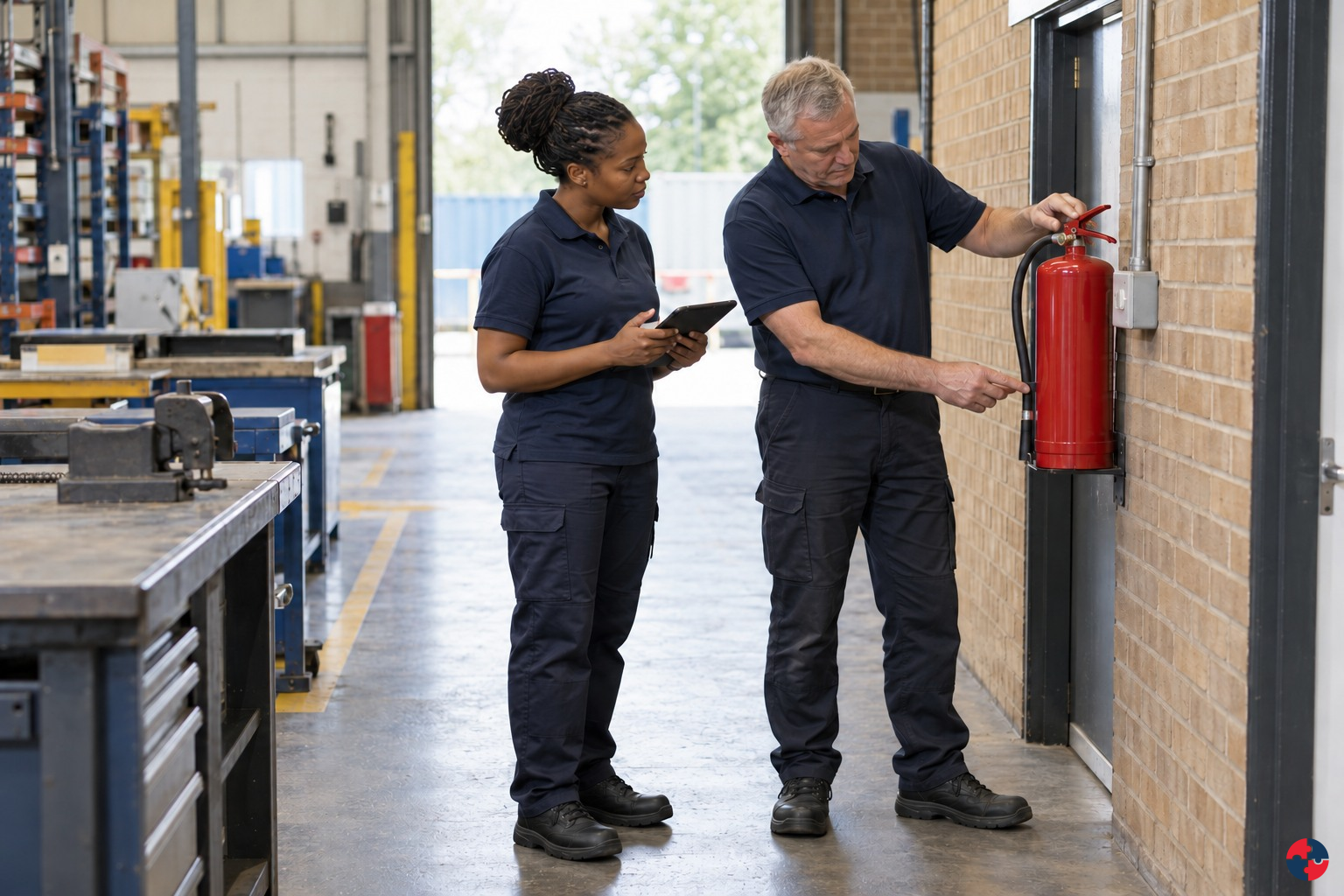
People and escape first. Raise the alarm, follow the site’s evacuation plan and arrange the emergency call to 999. Only consider a small fire in its earliest stage if you are trained, authorised, have the correct equipment and a clear escape behind you. Smoke, spreading fire, uncertainty or an unsafe approach mean withdraw. Never delay escape to fetch an extinguisher.
UK awareness reference for common and specialist portable extinguisher families. Actual ratings, exclusions and manufacturer instructions govern each unit. Reading this guide is not practical training or permission to fight a fire. Fixed systems, hose reels and specialist industrial firefighting require their own assessed arrangements.
Farm buildings: escape, the alarm and safe separation from fuel, cylinders and stored materials take priority.
Fire classes: fuel, examples and the important distinction
Class
Fuel and examples
What matters
AClass A
Solid materials
Wood, paper, textiles and many solid plastics.
Usually forms an ember or char bed. Cooling matters; check the marked A rating.
BClass B
Flammable liquids
Petrol, solvents, diesel when burning, and liquefiable solids such as wax.
Fuel can spread across a surface. An unsuitable jet can spread burning liquid; solvent compatibility matters.
CClass C
Flammable gases
Propane, butane or methane.
Not a routine employee firefighting task. Knocking down flame while gas continues to escape can create an explosive cloud. Fuel isolation requires safe, competent action under the emergency plan.
DClass D
Combustible metals
Magnesium, sodium or metallic lithium.
Needs a metal-specific specialist agent. Ordinary ABC powder is not Class D powder.
FClass F
Cooking oils and fats
Hot oil in a fryer or pan.
Very hot oil can reignite. Water can produce violent steam expansion and eject burning oil.
LClass L
Lithium-ion batteries
A lithium-ion tool, e-bike or vehicle battery in thermal runaway.
Class L is included in BS ISO 3941:2026. Toxic or flammable gas, heat propagation and reignition need specialist planning. This is different from a metallic-lithium Class D fire.
Electrical equipment: Energised electrical equipment is an additional hazard, not a UK fire class called E. Do not import US Class C electrical or Class K cooking labels into this UK guide. Isolation, only where safe and authorised, does not remove the burning fuel or stored battery energy. Use the unit’s explicit electrical suitability and limitations.
Class L is the 2026 addition to the classification standard. Existing extinguisher labels and product test claims vary; a new class name does not certify every battery product.
Compare the classes · including lithium-ion batteries
Typical = usual application for the labelled family. If rated / unit limits = confirm the actual label and manufacturer conditions. No = not a normal selection for that hazard; specialist engineered arrangements are separate. This table cannot authorise firefighting.
* Electrical is an additional hazard, not a fire class. Gas-fire and battery-fire response require the assessed specialist plan. Scroll the table sideways on a narrow screen.
Typical portable-agent applications: always confirm the actual unit
Agent family
A · solids
B · liquids
C · gases
D · metals
Electrical*
F · cooking oil
L · Li-ion
Water
Typical
No
No
No
Unit limits
No
No
Water spray / water with additives
Typical
If rated
No
No
Unit limits
No
No
Foam
Typical
Typical
No
No
Unit limits
No
No
Water mist
Typical
If rated
No
No
Unit limits
If rated
Specialist plan
ABC dry powder
Typical
Typical
Specialist plan
No
Unit limits
No
No
BC dry powder
No
Typical
Specialist plan
No
Unit limits
No
No
Class D specialist powder
No
No
No
Exact metal
No
No
No
Carbon dioxide (CO₂)
No
Typical
No
No
Unit limits
No
No
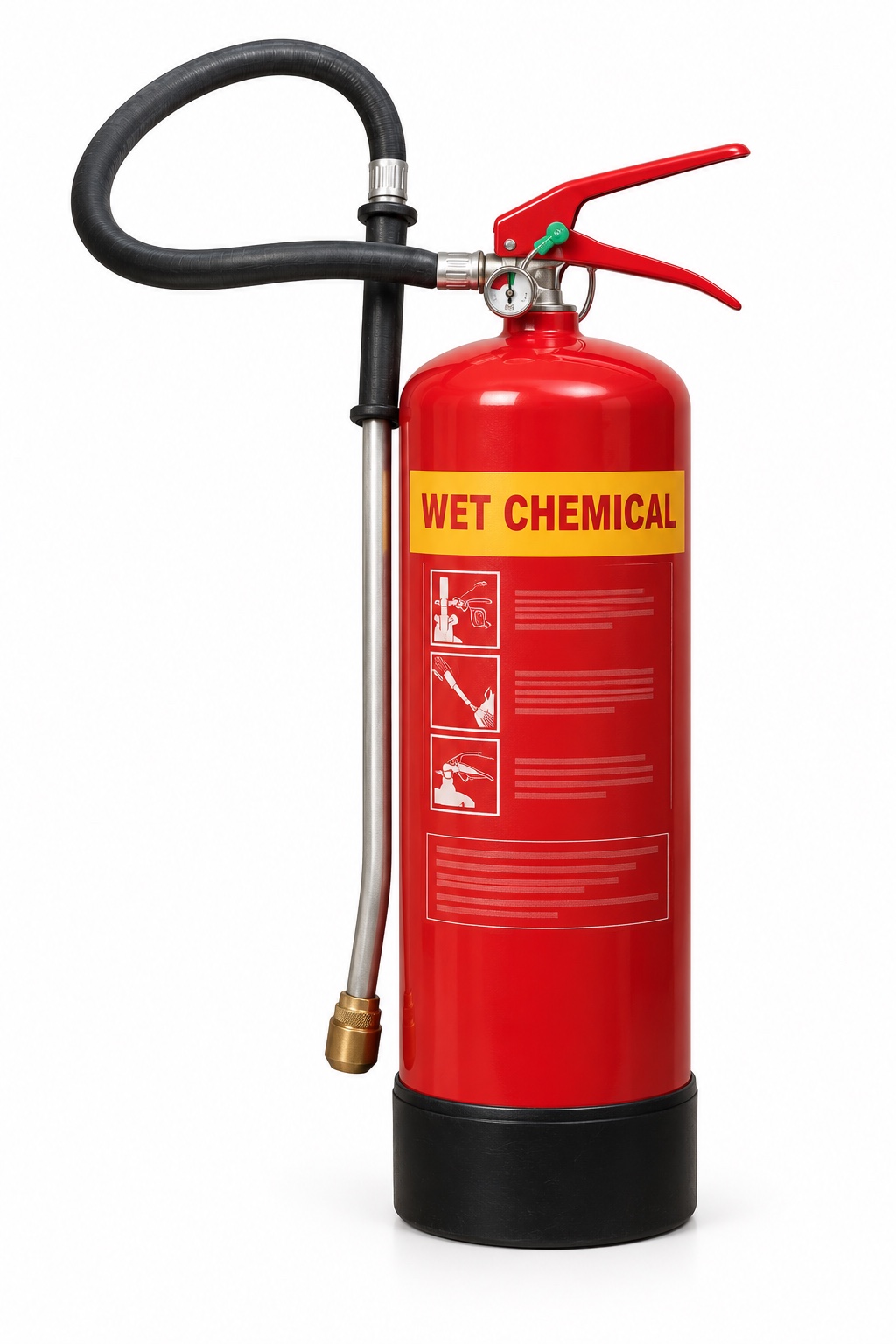
Wet chemical
If rated
If rated
No
No
Unit limits
Typical
No
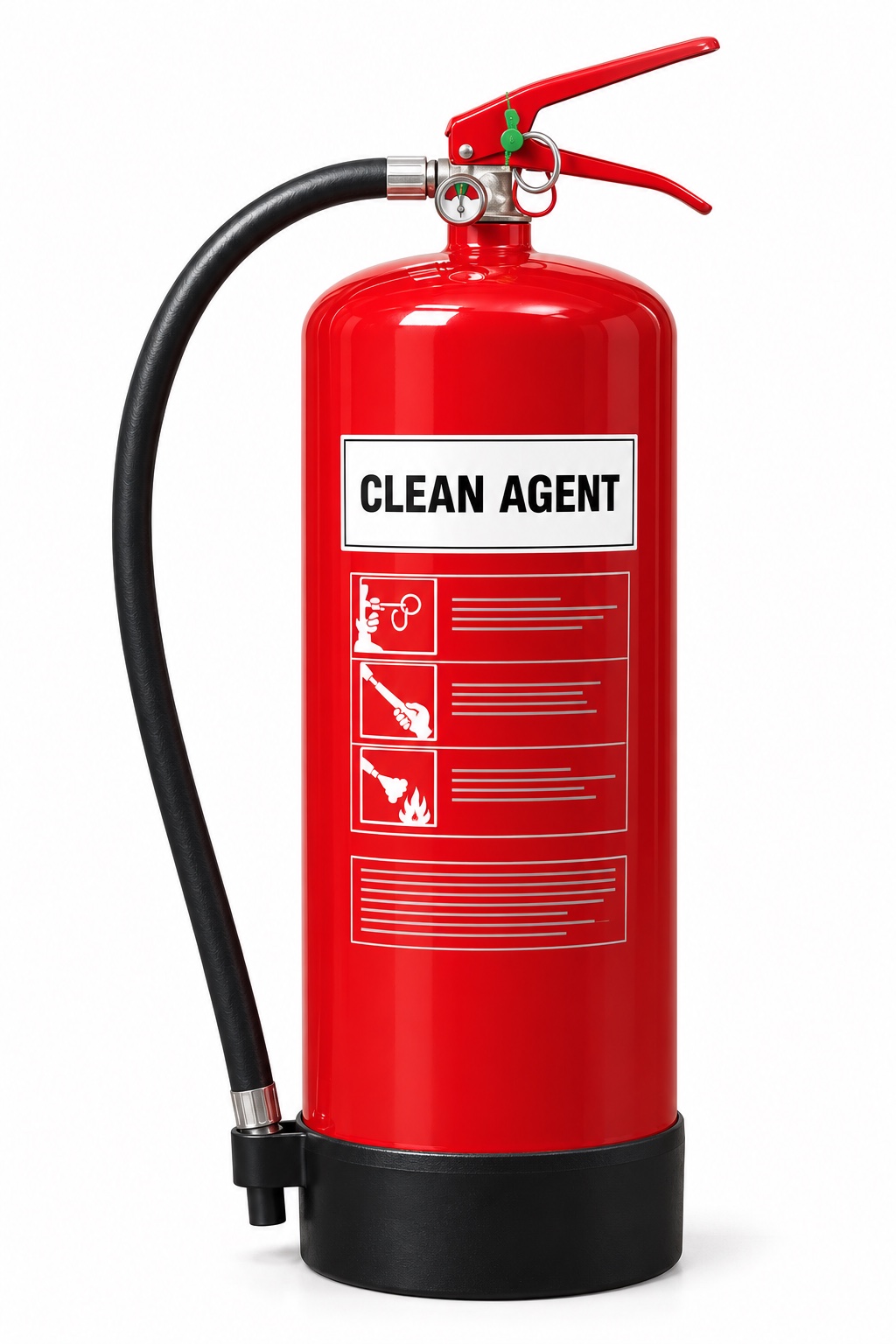
Clean agent / vaporising liquid
Unit rating
Unit rating
No
No
Unit limits
No
No
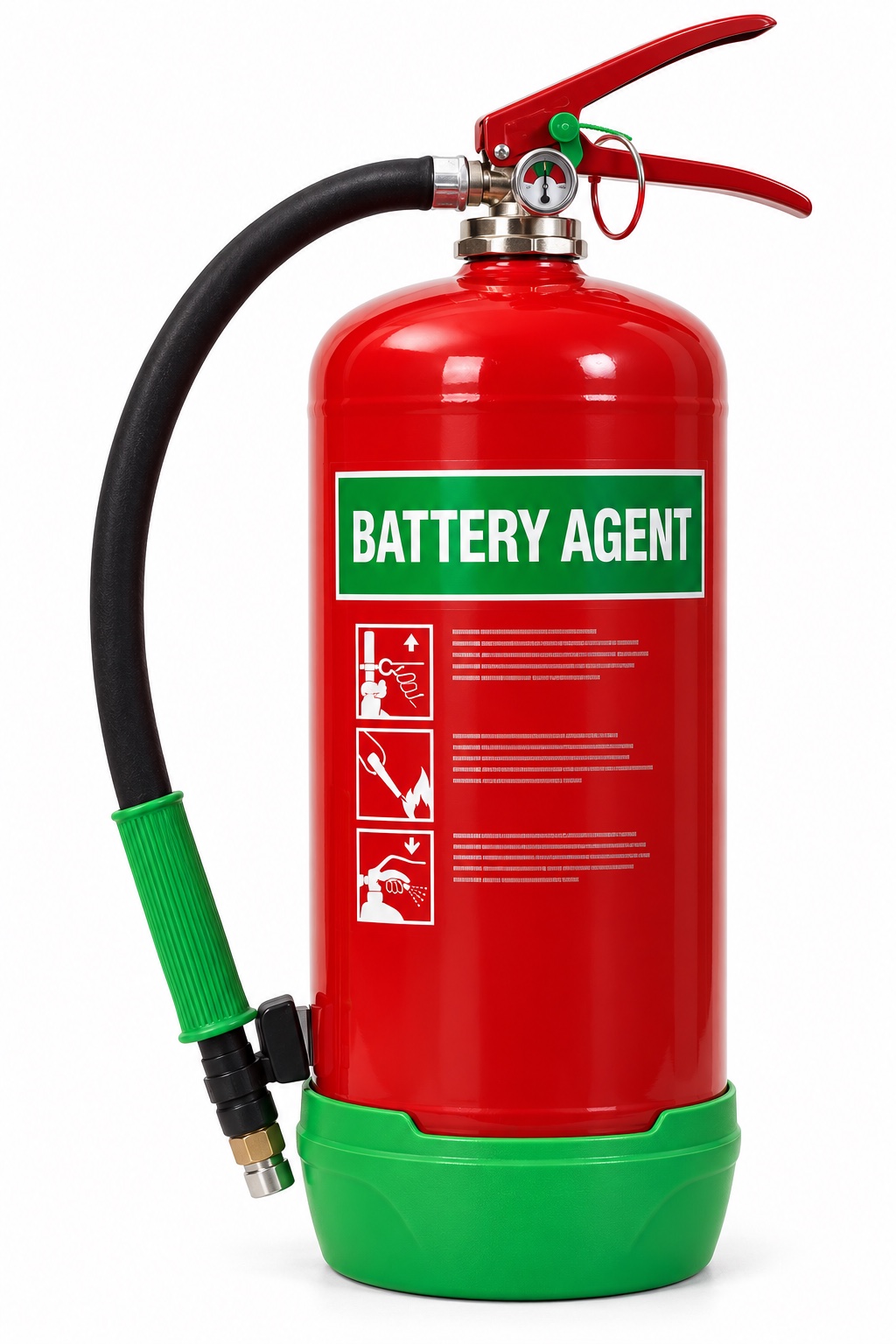
Battery-specific suppression products
If rated
No
No
No
Unit limits
No
Specified battery
Extinguisher types: uses and dangers
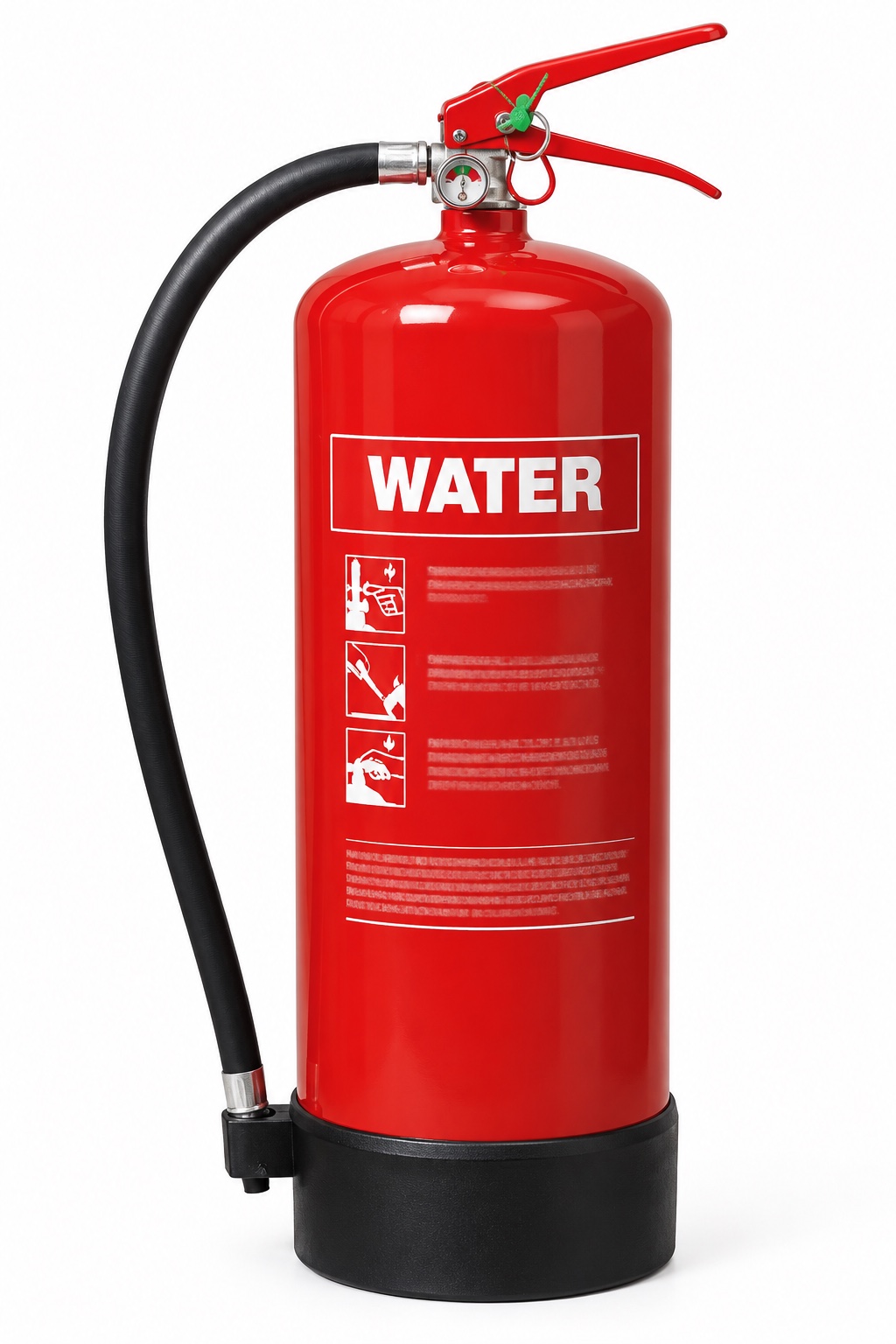
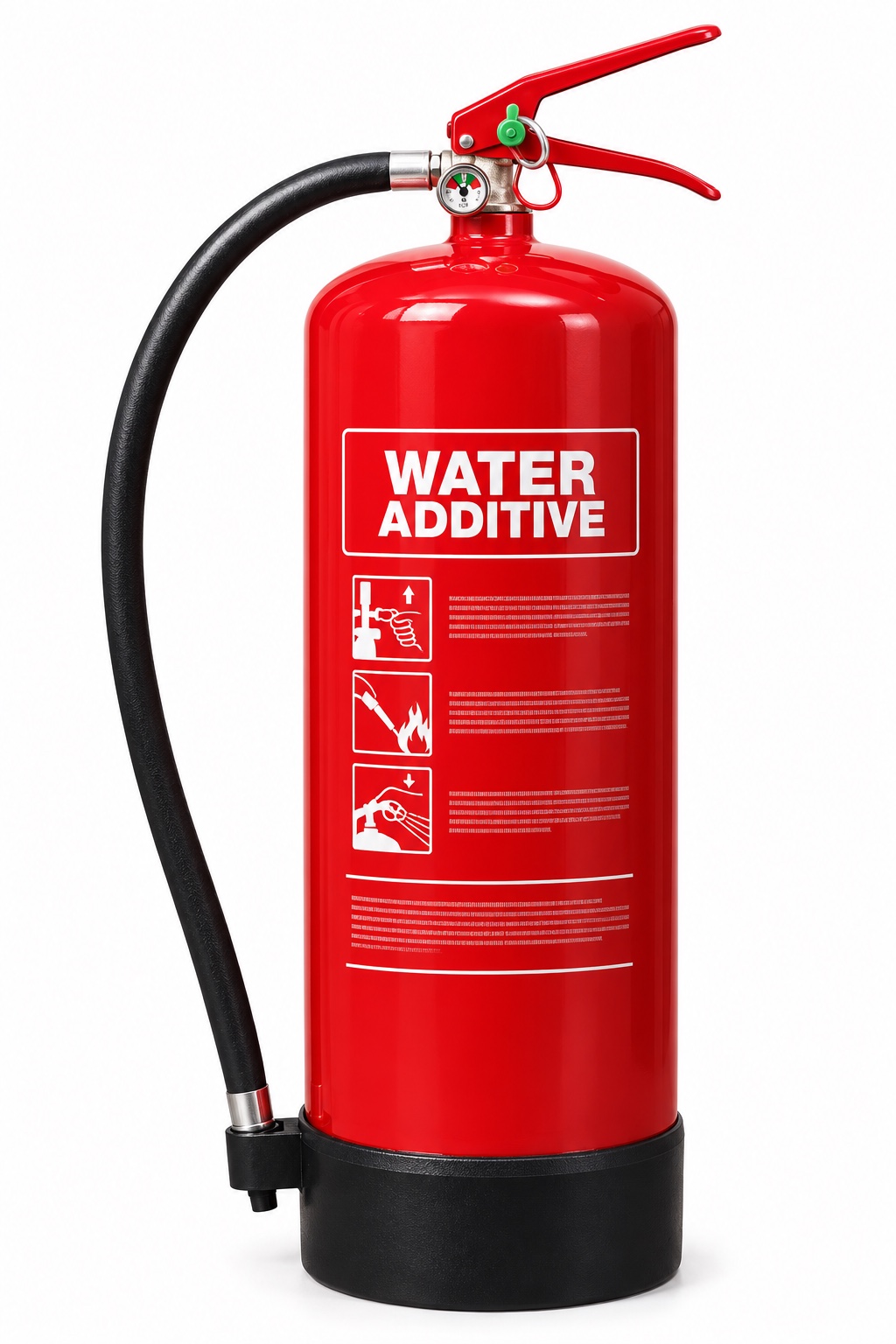
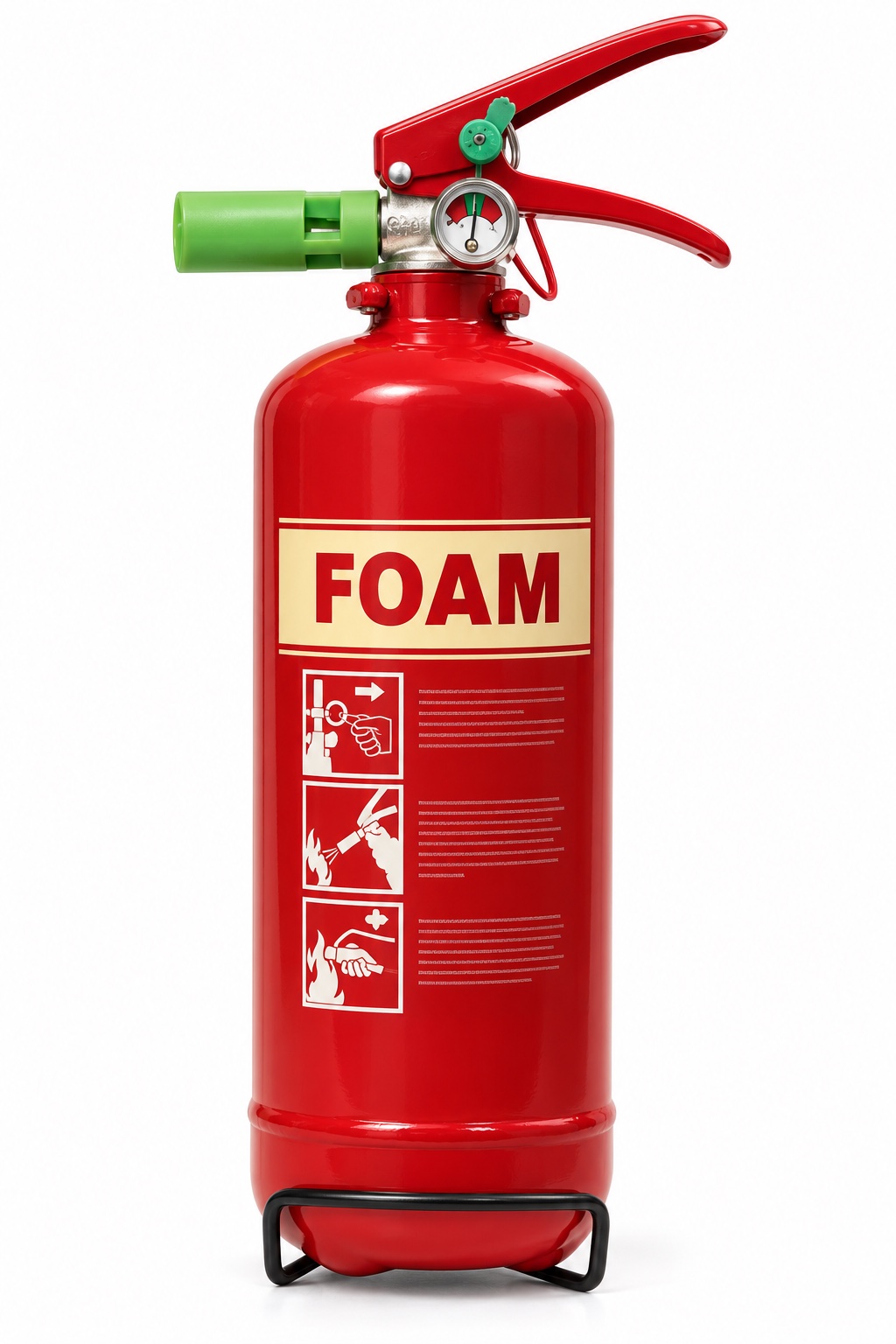
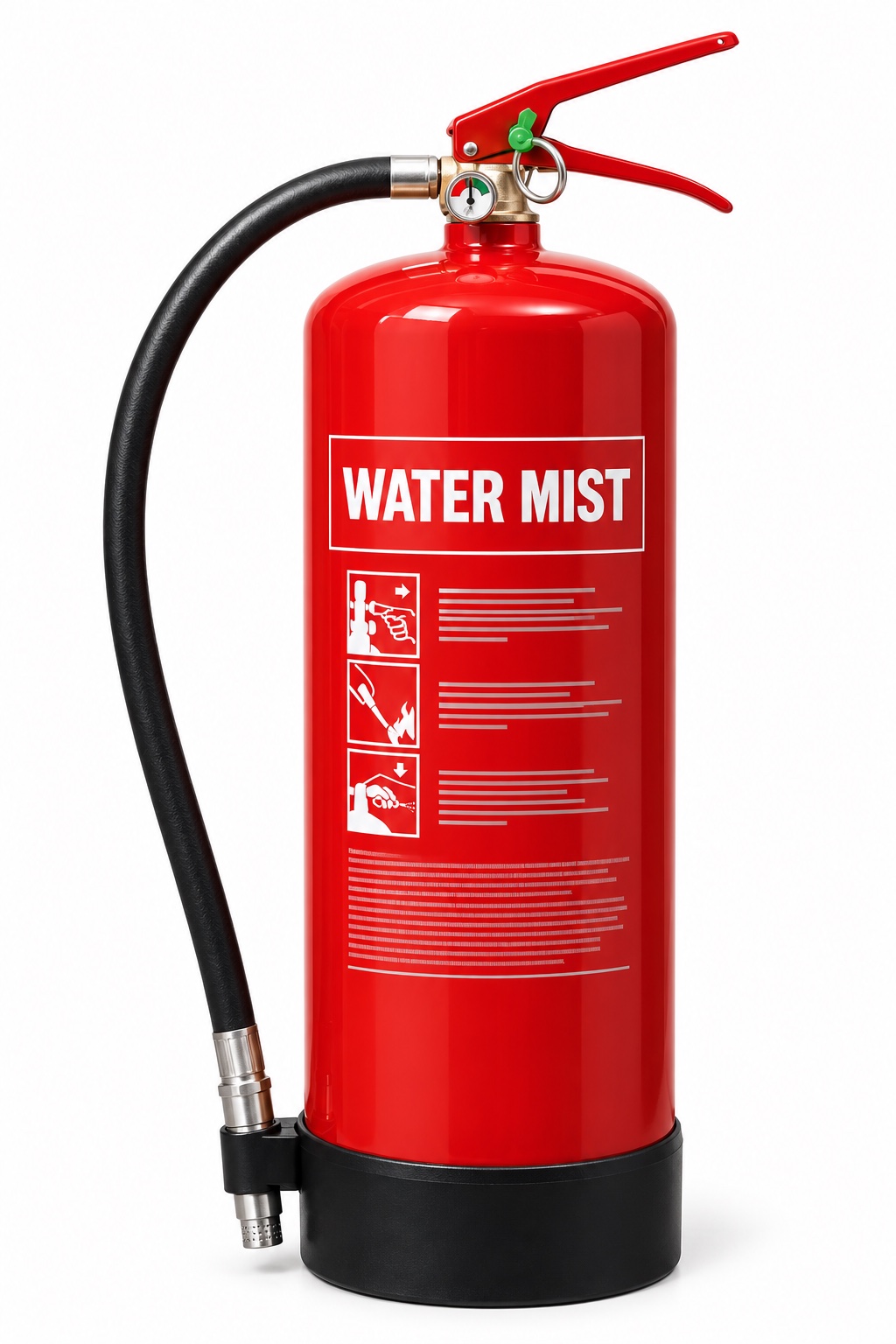
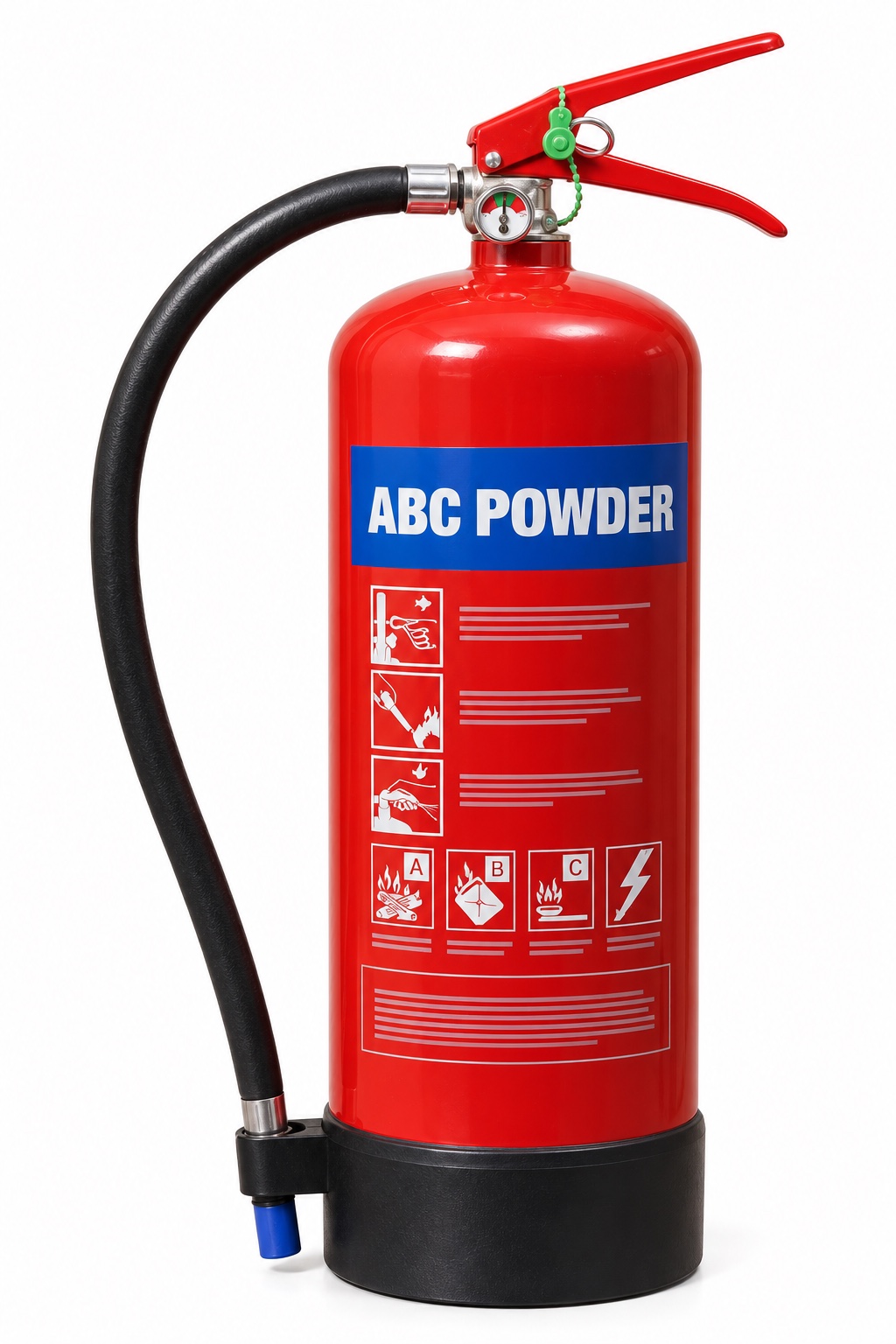
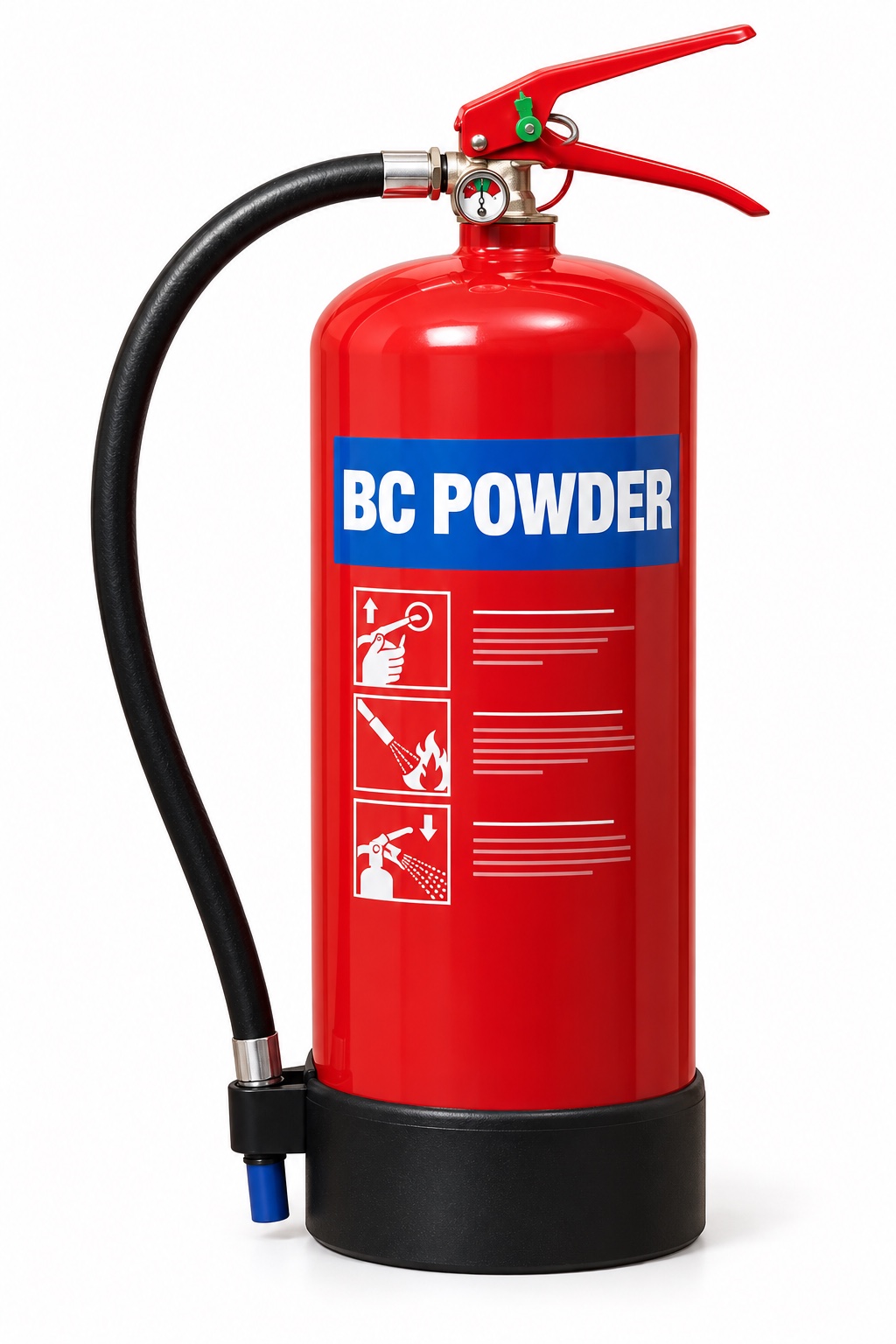
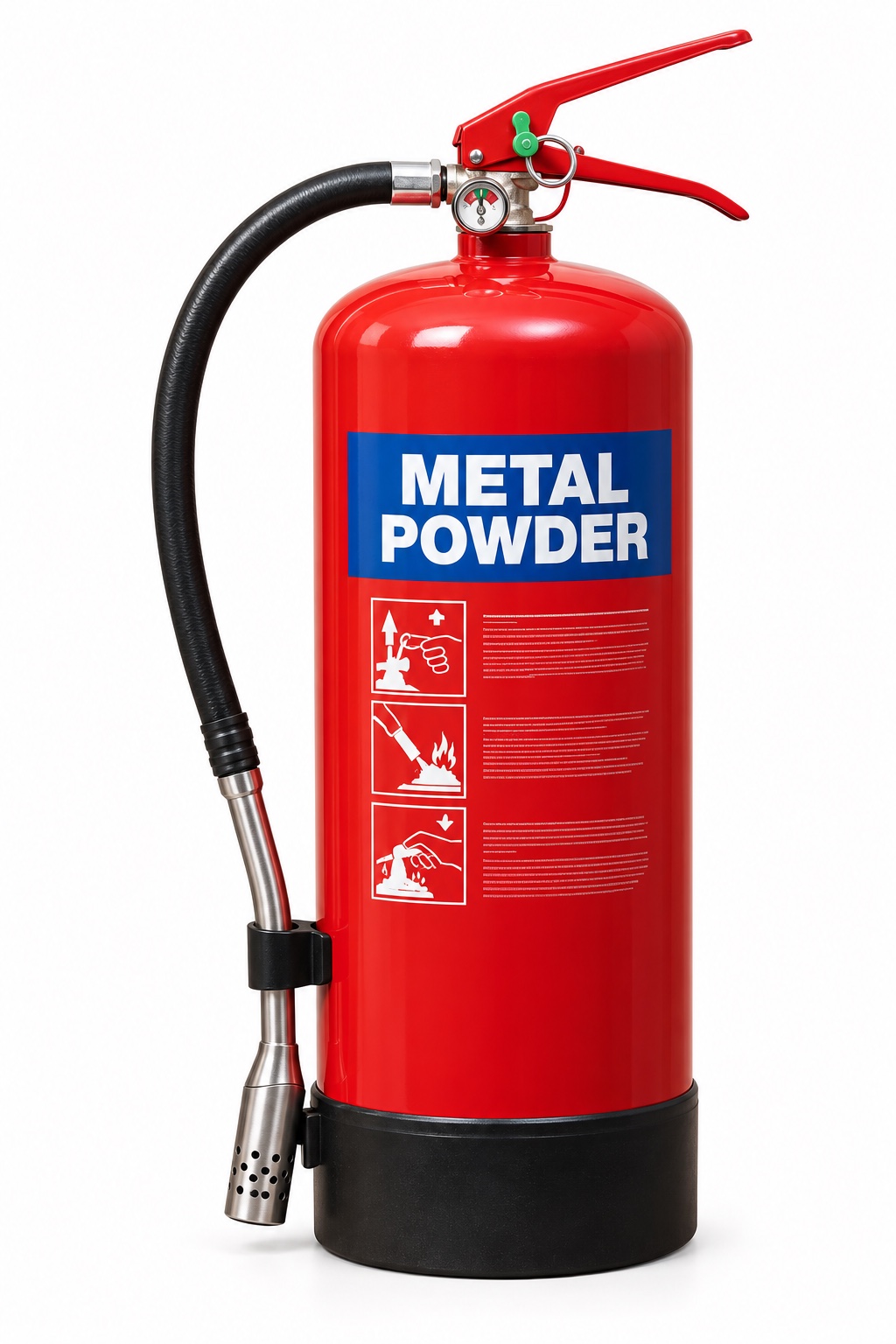
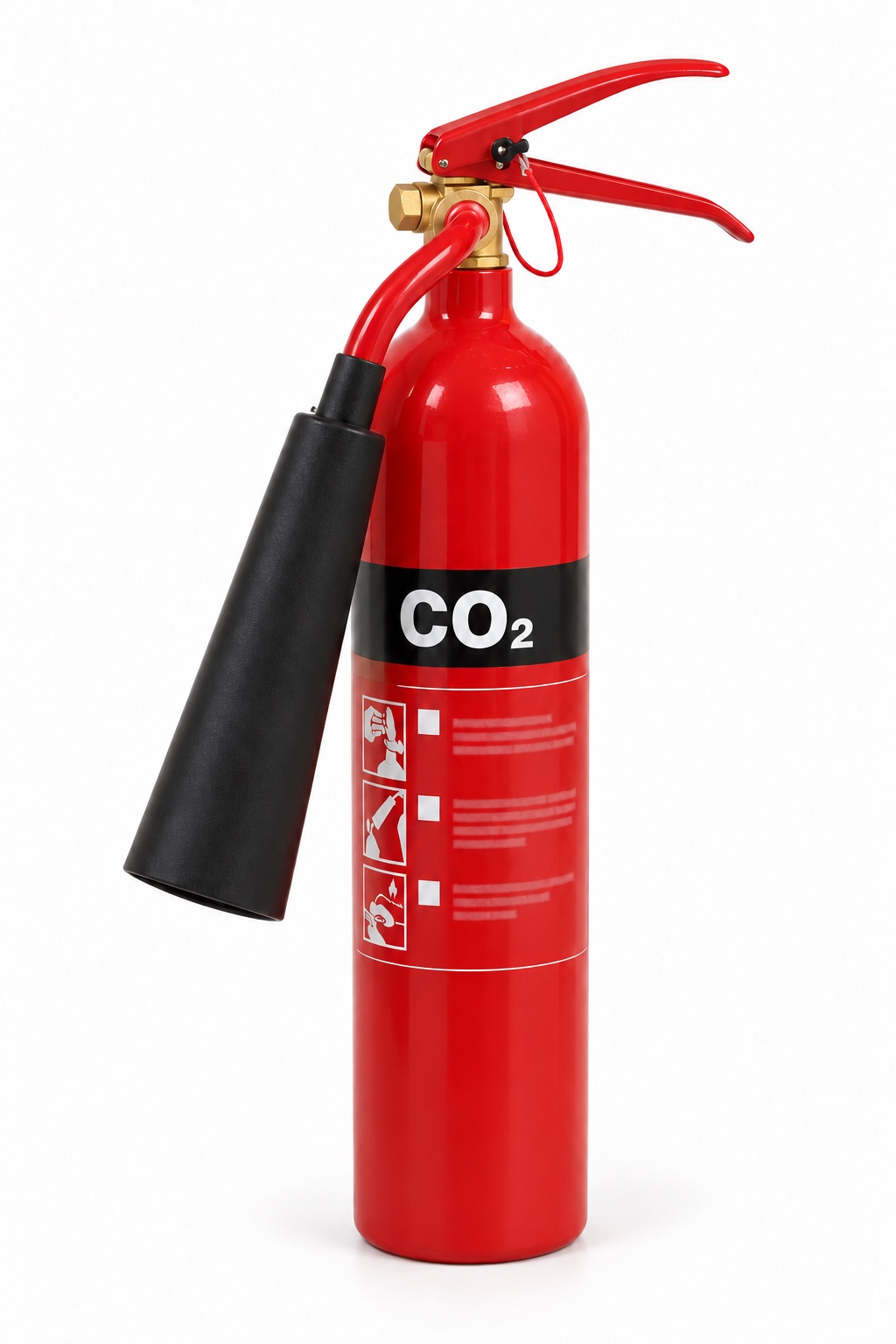
These are typical applications, not universal permissions. Check the label on the actual unit. Images are photorealistic teaching illustrations inspired by the referenced equipment; they are not photographs or certified product labels. Use Inspect the parts to explore the hardware. Band, nozzle and label details vary.
Common and specialist portable extinguisher families
Type and recognition
Typical rating and use
Wrong use: what can go wrong?
Parts in text
Cylinder
The pressure vessel holds the agent and propellant as designed. Report corrosion, dents or other damage. Do not open, refill or repair it as an awareness check.
Agent name and colour marking
Read the actual agent name, fire ratings, electrical warnings and instructions. Colour is a recognition aid; it does not prove suitability. The illustration is not an operating label.
Fixed carrying handle
The lower fixed handle supports the unit. It is different from the upper operating lever. The exact grip and operation belong in practical instruction for the model.
Operating / squeeze lever
The upper lever operates the discharge valve when the safety device is released. Do not squeeze or discharge a unit to test it during a routine visual check.
Safety pin and pull ring
The pin mechanically prevents accidental operation. A pin or ring that is missing, distorted or insecure needs reporting; its presence does not prove the unit is serviceable.
Tamper indicator / snap-lock seal
The breakable indicator or snap-lock seal shows possible disturbance. Designs can use a separate pin-retaining strap or a pin-mounted indicator. It is different from the mechanical safety pin and is not a theft lock. Report it if broken or missing.
Pressure gauge
On this stored-pressure example the gauge indicates pressure, not the mass of agent remaining. A pointer in the marked range does not prove the cylinder is full or the unit has passed its service checks.
Hose, nozzle or applicator
The flexible hose ends in the model’s discharge nozzle. The clip is for stowage; a hose being clipped in place is not a service check. Do not block, detach or test-discharge it during a visual inspection.
Base / protective boot
The boot protects the base on this example. Other models have a different foot arrangement or no separate boot. Check the approved mounting and access rather than guessing from the picture.
WaterRed / WATER marking
Normally A
Cools burning solid material such as paper, wood or fabric.
Check the limitation
Ordinary water is unsuitable for live electrical equipment, flammable-liquid pools, cooking oil and reactive metals: shock, spreading fuel or violent reaction can result.
Parts in text
Cylinder
The pressure vessel holds the agent and propellant as designed. Report corrosion, dents or other damage. Do not open, refill or repair it as an awareness check.
Agent name and colour marking
Read the actual agent name, fire ratings, electrical warnings and instructions. Colour is a recognition aid; it does not prove suitability. The illustration is not an operating label.
Fixed carrying handle
The lower fixed handle supports the unit. It is different from the upper operating lever. The exact grip and operation belong in practical instruction for the model.
Operating / squeeze lever
The upper lever operates the discharge valve when the safety device is released. Do not squeeze or discharge a unit to test it during a routine visual check.
Safety pin and pull ring
The pin mechanically prevents accidental operation. A pin or ring that is missing, distorted or insecure needs reporting; its presence does not prove the unit is serviceable.
Tamper indicator / snap-lock seal
The breakable indicator or snap-lock seal shows possible disturbance. Designs can use a separate pin-retaining strap or a pin-mounted indicator. It is different from the mechanical safety pin and is not a theft lock. Report it if broken or missing.
Pressure gauge
On this stored-pressure example the gauge indicates pressure, not the mass of agent remaining. A pointer in the marked range does not prove the cylinder is full or the unit has passed its service checks.
Hose, nozzle or applicator
The flexible hose ends in the model’s discharge nozzle. The clip is for stowage; a hose being clipped in place is not a service check. Do not block, detach or test-discharge it during a visual inspection.
Base / protective boot
The boot protects the base on this example. Other models have a different foot arrangement or no separate boot. Check the approved mounting and access rather than guessing from the picture.
Water spray / water with additivesUsually red; read the agent name
A; B only if explicitly rated
Improved wetting or spray performance can help on the hazards stated on that model’s label.
Check the limitation
An additive does not make every water extinguisher safe for electricity, oils or reactive chemicals. Check the specific exclusions.
Parts in text
Cylinder
The pressure vessel holds the agent and propellant as designed. Report corrosion, dents or other damage. Do not open, refill or repair it as an awareness check.
Agent name and colour marking
Read the actual agent name, fire ratings, electrical warnings and instructions. Colour is a recognition aid; it does not prove suitability. The illustration is not an operating label.
Fixed carrying handle
The lower fixed handle supports the unit. It is different from the upper operating lever. The exact grip and operation belong in practical instruction for the model.
Operating / squeeze lever
The upper lever operates the discharge valve when the safety device is released. Do not squeeze or discharge a unit to test it during a routine visual check.
Safety pin and pull ring
The pin mechanically prevents accidental operation. A pin or ring that is missing, distorted or insecure needs reporting; its presence does not prove the unit is serviceable.
Tamper indicator / snap-lock seal
The breakable indicator or snap-lock seal shows possible disturbance. Designs can use a separate pin-retaining strap or a pin-mounted indicator. It is different from the mechanical safety pin and is not a theft lock. Report it if broken or missing.
Pressure gauge
On this stored-pressure example the gauge indicates pressure, not the mass of agent remaining. A pointer in the marked range does not prove the cylinder is full or the unit has passed its service checks.
Direct spray nozzle
This compact foam example has a nozzle attached directly to the valve. Larger units may have a hose. Recognise the actual discharge arrangement and use only the approved agent and instructions.
Base / protective boot
The boot protects the base on this example. Other models have a different foot arrangement or no separate boot. Check the approved mounting and access rather than guessing from the picture.
FoamCream panel / FOAM
Commonly A and B
Cools and forms a surface blanket on suitable liquid fires. The agent must suit the actual fuel; some alcohols need alcohol-resistant foam.
Check the limitation
Ordinary foam is not a general answer for live electricity, cooking oil or metal fires. Unsuitable foam may break down on a solvent; a jet can spread fuel. Free-flowing fuel needs specialist response.
Parts in text
Cylinder
The pressure vessel holds the agent and propellant as designed. Report corrosion, dents or other damage. Do not open, refill or repair it as an awareness check.
Agent name and colour marking
Read the actual agent name, fire ratings, electrical warnings and instructions. Colour is a recognition aid; it does not prove suitability. The illustration is not an operating label.
Fixed carrying handle
The lower fixed handle supports the unit. It is different from the upper operating lever. The exact grip and operation belong in practical instruction for the model.
Operating / squeeze lever
The upper lever operates the discharge valve when the safety device is released. Do not squeeze or discharge a unit to test it during a routine visual check.
Safety pin and pull ring
The pin mechanically prevents accidental operation. A pin or ring that is missing, distorted or insecure needs reporting; its presence does not prove the unit is serviceable.
Tamper indicator / snap-lock seal
The breakable indicator or snap-lock seal shows possible disturbance. Designs can use a separate pin-retaining strap or a pin-mounted indicator. It is different from the mechanical safety pin and is not a theft lock. Report it if broken or missing.
Pressure gauge
On this stored-pressure example the gauge indicates pressure, not the mass of agent remaining. A pointer in the marked range does not prove the cylinder is full or the unit has passed its service checks.
Fine-mist nozzle
The specially designed nozzle creates the intended fine spray. It is not an ordinary water jet. Nozzle appearance alone does not establish any tested electrical suitability.
Base / protective boot
The boot protects the base on this example. Other models have a different foot arrangement or no separate boot. Check the approved mounting and access rather than guessing from the picture.
Water mistManufacturer marking varies
Model-specific; commonly A, some F
Fine droplets absorb heat. Some products have additional ratings or tested electrical suitability, with stated voltage and distance conditions.
Check the limitation
‘Mist’ is not universal approval. Use only the classes and electrical conditions actually declared for that model; do not assume it covers metals, liquids or batteries.
Parts in text
Cylinder
The pressure vessel holds the agent and propellant as designed. Report corrosion, dents or other damage. Do not open, refill or repair it as an awareness check.
Agent name and colour marking
Read the actual agent name, fire ratings, electrical warnings and instructions. Colour is a recognition aid; it does not prove suitability. The illustration is not an operating label.
Fixed carrying handle
The lower fixed handle supports the unit. It is different from the upper operating lever. The exact grip and operation belong in practical instruction for the model.
Operating / squeeze lever
The upper lever operates the discharge valve when the safety device is released. Do not squeeze or discharge a unit to test it during a routine visual check.
Safety pin and pull ring
The pin mechanically prevents accidental operation. A pin or ring that is missing, distorted or insecure needs reporting; its presence does not prove the unit is serviceable.
Tamper indicator / snap-lock seal
The breakable indicator or snap-lock seal shows possible disturbance. Designs can use a separate pin-retaining strap or a pin-mounted indicator. It is different from the mechanical safety pin and is not a theft lock. Report it if broken or missing.
Pressure gauge
On this stored-pressure example the gauge indicates pressure, not the mass of agent remaining. A pointer in the marked range does not prove the cylinder is full or the unit has passed its service checks.
Hose, nozzle or applicator
The flexible hose ends in the model’s discharge nozzle. The clip is for stowage; a hose being clipped in place is not a service check. Do not block, detach or test-discharge it during a visual inspection.
Base / protective boot
The boot protects the base on this example. Other models have a different foot arrangement or no separate boot. Check the approved mounting and access rather than guessing from the picture.
ABC dry powderBlue panel / ABC POWDER
A, B and C if marked
Interrupts flame chemistry; multipurpose powder also acts on Class A material. A C marking does not authorise tackling a gas leak.
Check the limitation
Powder can obscure escape and impair breathing; it is not generally recommended indoors. Limited cooling allows reignition. It is not metal-specific D powder or a substitute for F-rated cooking-oil equipment.
Parts in text
Cylinder
The pressure vessel holds the agent and propellant as designed. Report corrosion, dents or other damage. Do not open, refill or repair it as an awareness check.
Agent name and colour marking
Read the actual agent name, fire ratings, electrical warnings and instructions. Colour is a recognition aid; it does not prove suitability. The illustration is not an operating label.
Fixed carrying handle
The lower fixed handle supports the unit. It is different from the upper operating lever. The exact grip and operation belong in practical instruction for the model.
Operating / squeeze lever
The upper lever operates the discharge valve when the safety device is released. Do not squeeze or discharge a unit to test it during a routine visual check.
Safety pin and pull ring
The pin mechanically prevents accidental operation. A pin or ring that is missing, distorted or insecure needs reporting; its presence does not prove the unit is serviceable.
Tamper indicator / snap-lock seal
The breakable indicator or snap-lock seal shows possible disturbance. Designs can use a separate pin-retaining strap or a pin-mounted indicator. It is different from the mechanical safety pin and is not a theft lock. Report it if broken or missing.
Pressure gauge
On this stored-pressure example the gauge indicates pressure, not the mass of agent remaining. A pointer in the marked range does not prove the cylinder is full or the unit has passed its service checks.
Hose, nozzle or applicator
The flexible hose ends in the model’s discharge nozzle. The clip is for stowage; a hose being clipped in place is not a service check. Do not block, detach or test-discharge it during a visual inspection.
Base / protective boot
The boot protects the base on this example. Other models have a different foot arrangement or no separate boot. Check the approved mounting and access rather than guessing from the picture.
BC dry powderBlue panel / BC POWDER
B and C if marked; not A
Selected for particular liquid or gas hazards under the assessed plan. Electrical use must follow the actual unit’s instructions.
Check the limitation
Do not assume all blue powder extinguishers protect wood or paper. It has the visibility, breathing and reignition limitations of powder; it does not provide Class D or F protection.
Parts in text
Cylinder
The pressure vessel holds the agent and propellant as designed. Report corrosion, dents or other damage. Do not open, refill or repair it as an awareness check.
Agent name and colour marking
Read the actual agent name, fire ratings, electrical warnings and instructions. Colour is a recognition aid; it does not prove suitability. The illustration is not an operating label.
Fixed carrying handle
The lower fixed handle supports the unit. It is different from the upper operating lever. The exact grip and operation belong in practical instruction for the model.
Operating / squeeze lever
The upper lever operates the discharge valve when the safety device is released. Do not squeeze or discharge a unit to test it during a routine visual check.
Safety pin and pull ring
The pin mechanically prevents accidental operation. A pin or ring that is missing, distorted or insecure needs reporting; its presence does not prove the unit is serviceable.
Tamper indicator / snap-lock seal
The breakable indicator or snap-lock seal shows possible disturbance. Designs can use a separate pin-retaining strap or a pin-mounted indicator. It is different from the mechanical safety pin and is not a theft lock. Report it if broken or missing.
Pressure gauge
On this stored-pressure example the gauge indicates pressure, not the mass of agent remaining. A pointer in the marked range does not prove the cylinder is full or the unit has passed its service checks.
Specialist low-velocity applicator
The specialist applicator places the compatible metal-fire agent without unnecessarily disturbing burning material. Both agent and application method must suit the specific metal; this is not an ABC powder nozzle.
Base / protective boot
The boot protects the base on this example. Other models have a different foot arrangement or no separate boot. Check the approved mounting and access rather than guessing from the picture.
Class D specialist powderSpecific metal and agent named on label
D, for the specified metal
A specialist powder can isolate or absorb heat from a compatible burning metal. Selection requires knowledge of the metal and its form.
Check the limitation
The wrong powder can fail or react. Water, foam and CO₂ can be dangerous on certain burning metals. A powder suitable for magnesium is not automatically suitable for metallic lithium.
Parts in text
Cylinder
The narrow steel cylinder contains carbon dioxide under pressure. There is normally no pressure gauge on this portable type; service assessment includes the appropriate mass and integrity checks by competent personnel.
Agent name and colour marking
Read the actual agent name, fire ratings, electrical warnings and instructions. Colour is a recognition aid; it does not prove suitability. The illustration is not an operating label.
Fixed carrying handle
The lower fixed handle supports the unit. It is different from the upper operating lever. The exact grip and operation belong in practical instruction for the model.
Operating / squeeze lever
The upper lever operates the discharge valve when the safety device is released. Do not squeeze or discharge a unit to test it during a routine visual check.
Safety pin and pull ring
The pin mechanically prevents accidental operation. A pin or ring that is missing, distorted or insecure needs reporting; its presence does not prove the unit is serviceable.
Tamper indicator / snap-lock seal
The breakable indicator or snap-lock seal shows possible disturbance. Designs can use a separate pin-retaining strap or a pin-mounted indicator. It is different from the mechanical safety pin and is not a theft lock. Report it if broken or missing.
Horn and designated insulated grip
The flared horn directs the CO₂ discharge. Discharge parts can become extremely cold. Only the parts identified by the manufacturer as safe to hold should be gripped; not every horn is frost-free.
Displaces the atmosphere around a small flame and leaves no powder residue. Often selected around electrical equipment.
Check the limitation
Poor cooling means reignition is possible. CO₂ can create a dangerous atmosphere in enclosed spaces; discharge can cause frostbite. Hold only the designated insulated parts. Not a cooking-oil or metal-fire substitute.
Parts in text
Cylinder
The pressure vessel holds the agent and propellant as designed. Report corrosion, dents or other damage. Do not open, refill or repair it as an awareness check.
Agent name and colour marking
Read the actual agent name, fire ratings, electrical warnings and instructions. Colour is a recognition aid; it does not prove suitability. The illustration is not an operating label.
Fixed carrying handle
The lower fixed handle supports the unit. It is different from the upper operating lever. The exact grip and operation belong in practical instruction for the model.
Operating / squeeze lever
The upper lever operates the discharge valve when the safety device is released. Do not squeeze or discharge a unit to test it during a routine visual check.
Safety pin and pull ring
The pin mechanically prevents accidental operation. A pin or ring that is missing, distorted or insecure needs reporting; its presence does not prove the unit is serviceable.
Tamper indicator / snap-lock seal
The breakable indicator or snap-lock seal shows possible disturbance. Designs can use a separate pin-retaining strap or a pin-mounted indicator. It is different from the mechanical safety pin and is not a theft lock. Report it if broken or missing.
Pressure gauge
On this stored-pressure example the gauge indicates pressure, not the mass of agent remaining. A pointer in the marked range does not prove the cylinder is full or the unit has passed its service checks.
Hose, lance and spray applicator
The hose feeds the long lance and purpose-designed applicator. It helps distinguish this kitchen-fire unit from an ordinary short-nozzle extinguisher. Use requires model-specific practical training.
Base / protective boot
The boot protects the base on this example. Other models have a different foot arrangement or no separate boot. Check the approved mounting and access rather than guessing from the picture.
Wet chemicalYellow panel / WET CHEMICAL
F; often A if marked
Cools cooking oil and creates a protective surface layer through reaction with the fat. Use only within the actual unit’s rating and instructions.
Check the limitation
Do not mistake it for a general liquid-fire or electrical extinguisher. Incorrect application or moving the fryer can splash hot oil; apparent flame-out does not establish safe temperature.
Parts in text
Cylinder
The pressure vessel holds the agent and propellant as designed. Report corrosion, dents or other damage. Do not open, refill or repair it as an awareness check.
Agent name and colour marking
Read the actual agent name, fire ratings, electrical warnings and instructions. Colour is a recognition aid; it does not prove suitability. The illustration is not an operating label.
Fixed carrying handle
The lower fixed handle supports the unit. It is different from the upper operating lever. The exact grip and operation belong in practical instruction for the model.
Operating / squeeze lever
The upper lever operates the discharge valve when the safety device is released. Do not squeeze or discharge a unit to test it during a routine visual check.
Safety pin and pull ring
The pin mechanically prevents accidental operation. A pin or ring that is missing, distorted or insecure needs reporting; its presence does not prove the unit is serviceable.
Tamper indicator / snap-lock seal
The breakable indicator or snap-lock seal shows possible disturbance. Designs can use a separate pin-retaining strap or a pin-mounted indicator. It is different from the mechanical safety pin and is not a theft lock. Report it if broken or missing.
Pressure gauge
On this stored-pressure example the gauge indicates pressure, not the mass of agent remaining. A pointer in the marked range does not prove the cylinder is full or the unit has passed its service checks.
Hose, nozzle or applicator
The flexible hose ends in the model’s discharge nozzle. The clip is for stowage; a hose being clipped in place is not a service check. Do not block, detach or test-discharge it during a visual inspection.
Base / protective boot
The boot protects the base on this example. Other models have a different foot arrangement or no separate boot. Check the approved mounting and access rather than guessing from the picture.
Clean agent / vaporising liquidRead the agent; no universal colour shortcut
Product- and jurisdiction-specific
Specialist low-residue agents may protect sensitive equipment. Confirm the UK-approved application and the manufacturer’s limits.
Check the limitation
Low residue does not mean safe to breathe. Do not copy a US A:B:C rating as UK gas-fire approval. Legacy halon is restricted to permitted critical uses and applicable deadlines.
Parts in text
Cylinder
The pressure vessel holds the agent and propellant as designed. Report corrosion, dents or other damage. Do not open, refill or repair it as an awareness check.
Agent name and colour marking
This generic illustration has a green agent area and boot inspired by the supplied product. Green is not a universal Class L identification code. Read the real product name, chemistry, battery limits and instructions.
Fixed carrying handle
The lower fixed handle supports the unit. It is different from the upper operating lever. The exact grip and operation belong in practical instruction for the model.
Operating / squeeze lever
The upper lever operates the discharge valve when the safety device is released. Do not squeeze or discharge a unit to test it during a routine visual check.
Safety pin and pull ring
The pin mechanically prevents accidental operation. A pin or ring that is missing, distorted or insecure needs reporting; its presence does not prove the unit is serviceable.
Tamper indicator / snap-lock seal
The breakable indicator or snap-lock seal shows possible disturbance. Designs can use a separate pin-retaining strap or a pin-mounted indicator. It is different from the mechanical safety pin and is not a theft lock. Report it if broken or missing.
Pressure gauge
On this stored-pressure example the gauge indicates pressure, not the mass of agent remaining. A pointer in the marked range does not prove the cylinder is full or the unit has passed its service checks.
Hose, grip and applicator
The illustrated hose has a coloured ribbed grip and a small application tip. This shows the hardware family, not a tested battery capability. Follow the instructions for the actual agent and generation.
Base / protective boot
The boot protects the base on this example. Other models have a different foot arrangement or no separate boot. Check the approved mounting and access rather than guessing from the picture.
Battery-specific suppression productsNamed formulation and tested application
Check independent scope and instructions
Some products use water-based cooling or specialist media such as aqueous vermiculite for specified battery scenarios. Selection depends on chemistry, capacity and location.
Check the limitation
A ‘lithium’ label is not proof it will stop thermal runaway in a large pack. Flame suppression may not prevent reignition or gas release. Do not approach, carry or submerge a failing battery as a learner exercise.
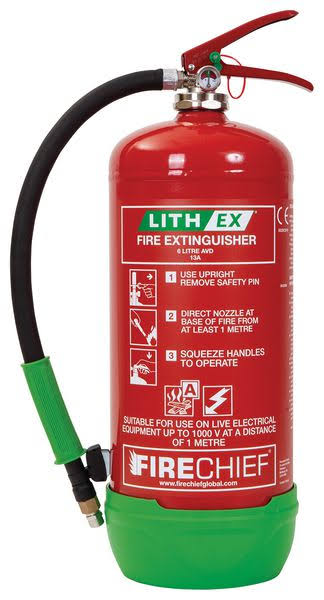
Lithium-ion product example · Firechief 6 L Lith-Ex
A named product example helps connect the generic table to an actual unit. Confirm the exact product before using its claims.
Agent and intended application
The linked Seton example uses aqueous vermiculite dispersion (AVD) for specified lithium-ion battery fire applications. Water content cools; the dispersed mineral helps form a barrier. This is not generic Class D metal-fire powder.
Read the actual rating
Seton lists a 6 L product with a 13A rating. That A rating describes its solid-material test performance; it does not, by itself, certify a universal Class L battery capability.
Match the exact model and generation
The manufacturer’s current 6 L G2 page identifies FLE6X and different discharge details from the retailer’s older listing. Do not mix their time, range or pressure values. Match the delivered label, product sheet and manual.
Check the battery scope
Confirm the allowed battery chemistry, energy capacity, state and scenario with the current manufacturer information and competent fire assessment. A large EV or energy-storage pack cannot be treated as a small-device fire.
Electrical conditions are product-specific
The supplied product label includes a voltage and minimum-distance condition. Do not transfer that condition to another battery extinguisher or infer that it makes an unsafe electrical approach acceptable.
After the flame disappears
Heat, off-gas and reignition can remain. Follow the planned withdrawal, exclusion and fire-service response; do not pick up, submerge or return a failed battery to charging.
Read the agent, fire-class letters, performance rating, electrical warnings, operating instructions and service condition. Numbers such as 13A or 55B describe standardised test performance, not a safe room size or permission to tackle that amount of fire. Colour is a clue; the actual label and assessed plan decide suitability.
What about a fire blanket?
A fire blanket is separate equipment, not an extinguisher type. It may be specified for a small contained cooking fire, but safe approach and the manufacturer’s limits still matter. Never carry a burning pan, improvise a cover or put yourself between fire and your exit.
Spot the dangerous assumption
Pause at each question, then open the explanation. These are unscored learning prompts alongside the course assessment.
A pan of cooking oil is burning. Would ordinary water help?
No. Rapid steam production can throw burning oil across the room. Raise the alarm and follow the kitchen emergency plan; never move the pan. Only a trained, authorised person should consider the specified F-rated equipment with a safe escape.
There is a C on the powder extinguisher. Should I put out the leaking gas flame?
Not as a routine response. Unburnt gas may continue escaping and form an explosive cloud. Withdraw, alarm and report the supply involved. Any safe isolation and specialist firefighting must follow the assessed emergency arrangements.
The flame around a battery has disappeared. Is the incident over?
No. Internal heat, flammable or toxic off-gas and reignition can remain. Keep clear, prevent access and tell the fire and rescue service what battery is involved. Flame-out is not permission to handle it or restart charging.
Both extinguishers have blue panels. Are the powders interchangeable?
No. Read ABC, BC or the exact Class D metal specification. Colour identifies a family; it does not establish the correct agent, rating or safe application.
A CO₂ extinguisher leaves no mess. Is it ideal in a small unventilated room?
No. A dangerous CO₂ concentration can incapacitate a person, while the fire and smoke already threaten escape. Do not enter an unsafe room. The fire plan and competent equipment selection must account for the space.
A water-mist product claims electrical suitability. Can I use any water extinguisher on a live cabinet?
No. Any tested electrical claim belongs to that particular model, with its own voltage and distance limits. It does not apply to ordinary water or another mist product, and it does not make an unsafe approach acceptable.
Source guidance and scope
UK learning context. Consult the applicable national fire guidance and your premises’ assessed plan. Manufacturer examples explain product variation; they are not product recommendations. Guidance checked 24 October 2026.
Photorealistic illustrative UK workplace scene. Review checks: Hot work possible: Permit, area clearance, fire watch and post-work check. Rear route used for deliveries: Route kept clear and delivery rules briefed. Compressor room risk: Detection, isolation and no combustible storage.
Escape is a complete usable journey
An exit sign does not create an escape route if stored material blocks the door or the path outside. A person under smoke or time pressure may not be able to move a bale, spare part or locked gate that seemed easy to shift during the day. The fictional barn escape check therefore follows the whole journey from work position to the intended safe place.
Assess the actual premises, people and foreseeable emergencies through the relevant fire and emergency arrangements. Consider contractors, seasonal workers, visitors and anyone needing assistance. Routes, doors, lighting, warning and information must fit how the building is used. Fire duties vary across UK nations and premises; this course does not replace the actual fire risk assessment or set universal exit dimensions and evacuation times.
Keep storage and temporary work from defeating the route. A quick delivery can still leave the only exit obstructed when an alarm occurs. If a necessary route is unavailable, apply the appropriate immediate restriction or alternative through the responsible competent plan rather than assuming everybody can use another door. An alternative must be assessed and communicated, not invented by a learner during the emergency.
Verify the route physically by a suitable safe check, including door operation and the onward path, without creating a real alarm or blocking an exit for practice. Check whether warning is perceptible during normal farm noise and what happens when buildings are occupied at different times. Record defects, protective action and evidence before close-out. For the fictional exercise, distinguish a route drawn on a plan from one that can actually be used now. A signed checklist and visible extinguisher do not compensate for a blocked escape or an inaccessible final gate.
When are fire emergency controls not good enough?
Controls are not good enough when they do not match the risk assessment, cannot be used in real conditions or lack evidence.
The responsible person should be cautious where controls depend on ideal behaviour: every door closed, every person trained, every route clear and every contractor compliant. Good controls include checks, supervision and fallback arrangements.
If a critical control is impaired, normal operation may need temporary restriction until protection is restored.
Trigger or questionHas the premises, occupancy or work activity changed?
Immediate actionReview the fire risk assessment and decide whether the current controls still work.
Evidence before normal operationUpdated assessment, action tracker and briefing record.
Trigger or questionIs a critical fire precaution impaired?
Immediate actionStop or restrict affected use where warning, escape or assistance cannot be relied on; obtain a competent temporary strategy, verify its effectiveness for all affected people and shifts, and restore the control.
Evidence before normal operationImpairment record, competent repair and retest evidence.
Trigger or questionIs the finding outside internal competence?
Immediate actionSeek competent fire safety advice before making assumptions.
Evidence before normal operationScope of advice, report, decision record and action closure.
Trigger or questionDid a drill, alarm, inspection or incident reveal weakness?
Immediate actionInvestigate the cause and update the arrangement.
Evidence before normal operationLearning record, corrective action and re-test.
Trigger or questionCould delay expose people to smoke, heat or blocked escape?
Immediate actionStop normal reliance on the weak arrangement until a safe interim control exists.
Evidence before normal operationTemporary control approval and communication record.
The barn exit opens but the outside route is blocked by stored machinery.
Decision and explanation
The complete route is not usable until a suitable correction or authorised alternative is established.
Escape includes the route beyond the door.
Lesson 4
Some work cannot be made suitable for a lone person
Assess delayed help as well as the initiating hazard.
Photorealistic illustrative UK workplace scene. Review checks: Assess: Check the task, location, contact arrangements and foreseeable emergency. Decide: Do not allocate work alone when the assessment requires assistance. Verify: Test contact, missed-check response and the route for summoning help.
Some work cannot be made suitable for a lone person
Lone working means a person lacks close or direct supervision or immediate help. A familiar remote task can become more serious when nobody notices a collapse, injury or missed return. The risk assessment must consider whether the work is suitable for one person at all, not simply which device they will carry. Some tasks need additional people or specialist arrangements because of the hazards and response required.
For the fictional remote repair, identify the task, location, equipment, weather, access, competence and foreseeable emergency. Consider communications and whether the worker could call after the event. Do not approve dangerous-space entry, uncontrolled machinery work or other specialist activity merely because a colleague will telephone later. A check-in is a monitoring layer, not a substitute for preventing the original exposure.
Choose stronger arrangements where needed: avoid the hazardous task, relocate it, change the method or provide suitable competent support. The actual employer should define restrictions and the authorised decision-maker. This course does not prescribe a universal check-in interval or decide an individual's medical fitness. Relevant health concerns require appropriate confidential professional advice, and workers must be able to report limitations without pressure to accept unsuitable lone work.
If the task changes or the planned support is unavailable, hold it and obtain review. A worker should know how to stop and reach a safe location within the plan. Verification asks whether the actual task can be completed within the agreed limits and whether help is credible, not whether a phone icon shows signal once. For the exercise, explain why a dangerous repair remains unacceptable even with location tracking. Technology can help detect a problem; it cannot support a load, prevent a machine starting or provide trained rescue by itself.
How should lone working be risk assessed?
The go/no-go decision depends on task severity, ability to call for help and a rehearsed response, not on a generic “lone-worker” label.
HSE lone-working guidance says employers must manage the risks before people work alone. HSENI lone-working guidance gives the separate NI context. A remote pump-site inspection may be acceptable alone only if access is safe, the task excludes high-risk intervention, communications work and a person can reach the worker within the planned time.
Check violence/abuse, driving, weather, confined space, electrical isolation and medical vulnerability as relevant. Record the worker’s expected location and return, emergency contact, escalation clock and who calls emergency services. A changed task or lost signal reopens the decision.
Question
Acceptable evidence
No-go trigger
Direct source
Task and place
Known inspection scope, stable access and no prohibited intervention.
Before an out-of-hours maintenance visit to a host employer, the sending employer obtains current hazard, access and emergency information, agrees who controls concurrent work and confirms a reachable host contact. A changed locked gate, isolated route or unavailable contact reopens the go/no-go decision; the visitor’s generic checklist cannot establish actual host conditions. Sources: HSE lone-work risk management.
Applied case
A lone worker is asked to enter an unfamiliar pit while someone promises to call later.
Decision and explanation
Hold the task for competent specialist planning; a check-in does not make the entry suitable.
Monitoring cannot replace controls and capability for the underlying hazard.
Lesson 5
A check-in needs someone who will act
Test communication, location and escalation as one system.
Photorealistic illustrative UK workplace scene. Review checks: Assess: Check the task, location, contact arrangements and foreseeable emergency. Decide: Do not allocate work alone when the assessment requires assistance. Verify: Test contact, missed-check response and the route for summoning help.
A check-in needs someone who will act
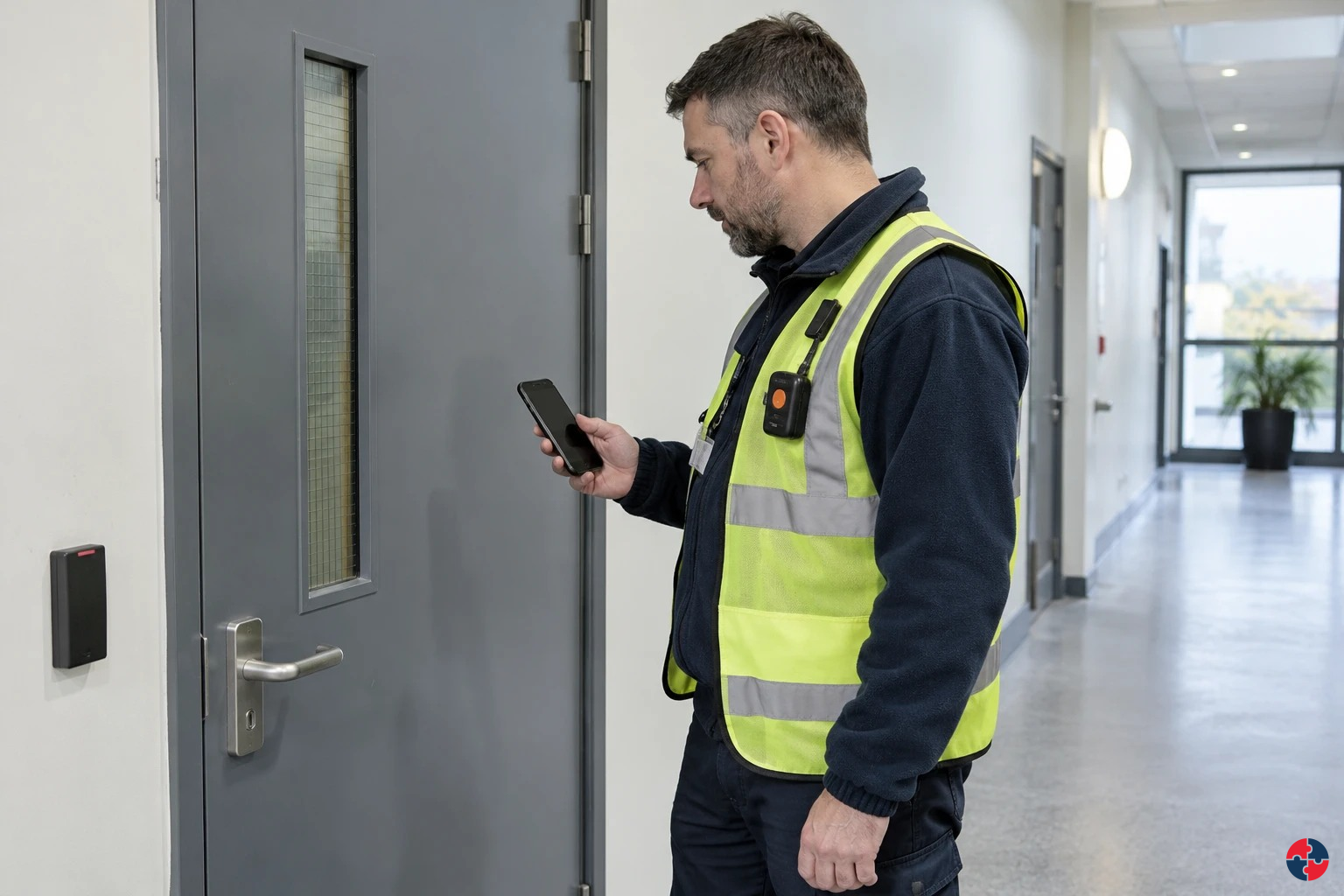
A lone-worker message has little protective value if nobody notices its absence. Likewise, a caller saying “the far field” may not provide enough information for assistance to reach them. The fictional farm's remote-work arrangement needs an identified responder, a reliable communication method, location information and a clear escalation procedure. Owning a phone or app does not establish that whole chain.
Before work, confirm the actual location, task, expected contact and return arrangements, means of access and who receives alerts or missed contacts. The responder needs relevant information, availability and authority to initiate the planned action. Cover breaks, shift changes and the possibility that the primary contact is unavailable. Do not rely on an unmonitored mailbox or assume an app automatically calls emergency services.
Test the method safely from the real working area using the agreed communication exercise. Coverage, battery condition, noise and the worker's ability to use the device may affect reliability. A test in the farm office cannot prove a remote valley has coverage. Suitable alternatives and a response to communication failure must be established before work; this course does not select a device or prescribe a universal response time.
If contact arrangements fail or a check-in is missed, follow the actual escalation plan promptly. Do not send an unprotected person into a known hazardous area to investigate. Emergency information should identify the location, access and relevant hazards factually. Record only the personal information necessary under the employer's arrangements and keep medical details confidential. For the exercise, create a fictional missed-contact timeline and identify who acts at each stage. The desired evidence is a demonstrated response chain, not simply a screenshot showing that a tracking application is installed.
Why is technology not the control by itself?
A lone-worker device is only useful when the whole response system has been designed, tested and owned.
The phrase 'we have an app' is not a lone-working control on its own. The control is the complete arrangement: risk assessment, worker training, signal coverage, device suitability, realistic check-in frequency, monitored escalation, responder competence, privacy rules and learning from alarms. If the worker is injured in a basement with no signal, if nobody monitors alerts at night or if responders do not know where the worker is, the technology has not controlled the risk.
Managers should test the system in the actual conditions of use. That means testing signal in plant rooms, remote sites and car parks; checking that workers can activate the alarm while wearing gloves or PPE; confirming that missed check-ins generate action; and making sure responders know when to call, attend, contact emergency services or escalate to senior management.
Failure mode
What it looks like
Better assurance
No signal in the real location
The device works in the office but not in basement, rural, plant-room or mobile locations.
Signal testing, backup method and location-specific controls.
Alert is not monitored
The worker presses alarm but nobody is actively responsible for response.
Named responder, monitoring hours, escalation clock and drill evidence.
Panic alarm is unreachable
Device is in a bag, vehicle or under clothing during the high-risk task.
Wearable placement, worker practice and task-specific instruction.
GPS used as productivity monitoring
Trust falls because safety tracking is used for discipline or output control.
Clear privacy wording, limited access and safety-only purpose.
Responder cannot act
Responder has no key, vehicle, site knowledge, emergency contact or authority.
Response plan, site information, access arrangements and competence.
Alarm fatigue
False alarms become normal and response quality drops.
Review nuisance alarms, maintain devices and improve trigger settings or training.
No test records
The system is assumed to work because it was bought.
Scheduled test, failed-test action, worker feedback and management review.
Applied case
The remote worker’s app sends alerts to an inbox that nobody monitors after lunch.
Decision and explanation
An available identified responder and tested escalation chain for the full work period.
Delivery of a message is not evidence that someone will act.
Lesson 6
Contractors and shifts need one current restriction picture
Coordinate maintenance boundaries and emergency readiness.
Photorealistic illustrative UK workplace scene. Review checks: Setting: the leisure operator operates a pool and public areas during an evening shift. Act: Match the first-aid needs assessment to pool hazards, public numbers, shifts and absences; check alarms, kit and responder cover. Hold / review: Missing essential first-aid or rescue cover, failed alarm or blocked access holds the affected activity.
Contractors and shifts need one current restriction picture
A contractor can repair a defect while unintentionally changing access, power or escape for another worker. A shift handover may then leave somebody relying on an old arrangement. The fictional barn coordinator needs a current picture of roof restrictions, electrical withdrawal, usable routes and remote-work status. Separate work orders are not enough if their interaction is invisible to the people affected.
Agree the actual task scope and relevant competence, access, isolation and emergency arrangements before work. Share known hazards and changes, including fragile surfaces and nearby activities. The person commissioning work must not assume a contractor automatically controls every farm interface. Contractors likewise need to report changes and hand back the actual work, not merely send an invoice. No learner should appoint themselves as a competent electrical or roof verifier.
Use a clear handover that distinguishes complete work, restrictions and unresolved evidence. A repaired tool may still need checks; a temporary access platform may obstruct an exit; a remote worker may still be out after the main team leaves. Identify who holds responsibility and how communication continues through shift changes. Keep emergency contacts and location information usable, without displaying unnecessary private details in a public course exercise.
Before release or shift end, verify the required corrections and people/accountability arrangements. Retain specific holds where information is missing and communicate them to everyone who may use the area or equipment. Use safe observations and drills to test readiness rather than creating a real electrical fault or hazardous roof access. For workplace transfer, prepare a fictional handback with task, observed condition, restriction, owner and close-out evidence. The effective outcome is that the next person knows what may proceed and what cannot, instead of discovering an unresolved risk after the previous team has left.
How should emergency procedures and first-aid arrangements be tested?
Testing should prove that people, alarms, equipment, communication and cover work in realistic conditions.
Testing can include evacuation drills, first-aid response scenarios, kit audits, radio checks, emergency contact tests, disabled-person evacuation checks, out-of-hours drills and tabletop exercises. Drills should not be treated as a pass because everyone eventually reached the assembly point.
Useful debriefs ask what was slow, confusing, missing, unsafe or dependent on one person. Actions should be tracked to verified closure.
Testing options - Testing options
Test
What it proves
Action evidence
Evacuation drill
People know routes and assembly.
Drill report and improvements.
First-aid scenario
Help can be summoned and equipment found.
Response time and debrief.
Kit check
Equipment is available and in date.
Checklist and restock record.
Out-of-hours check
Cover works beyond office hours.
Shift test results.
Emergency call test
Contact details are correct.
Contact verification.
Post-incident review
Learning improves arrangements.
Action tracker.
Applied case
A roof contractor’s platform blocks the exit while the electrical repair is handed back and a lone worker remains remote.
Decision and explanation
The combined access, repair, escape and worker-response arrangements before release or handover.
Several tasks can leave interacting restrictions and people still exposed.
Lesson 7
Treat rooflights and sheets as potentially fragile
Visible roof surfaces are not evidence of load-bearing capacity.
Teaching graphic from the linked SHAREhub source section.
Understand the activity and how harm develops
The barn rooflight looks similar to the surrounding roof when viewed from below. A worker repairing a leak may not recognise where the surface cannot support them. Weathering, dirt and previous repairs can obscure differences further. Walking carefully on a fragile surface does not provide a supporting structure.
Start with a method that avoids accessing the roof, such as suitable work from below or specialist access equipment. Necessary roof work needs competent planning, prevention of falls through and from the roof, and rescue arrangements. If old sheets may contain asbestos, identification and appropriate asbestos controls are also needed before disturbance; appearance cannot determine composition.
Recognise the evidence boundary
Question
Case evidence
What is observed?
A contractor proposes stepping beside an unmarked weathered rooflight.
How can harm occur?
The rooflight could break and cause a fatal fall.
What information is needed?
Check roof fragility information and the planned access method.
Protect, manage and verify
Purpose
Practical application
Immediate protection
Avoid roof access or use competent planned protection for fragile surfaces.
Accountable work arrangement
Avoid roof access by selecting a suitable ground-based or protected access method. Use competent roof-work planning with suitable access, collective protection and fragile-surface controls. Identify relevant building information and possible asbestos before disturbing old sheets. Control the area below and arrange a rescue plan appropriate to the access system.
Release verification
Confirm the work method and protective measures before access.
Apply this at work
Review the same issues for silo covers, canopy panels and any contractor accessing older farm buildings.
How do you apply avoid, prevent, minimise?
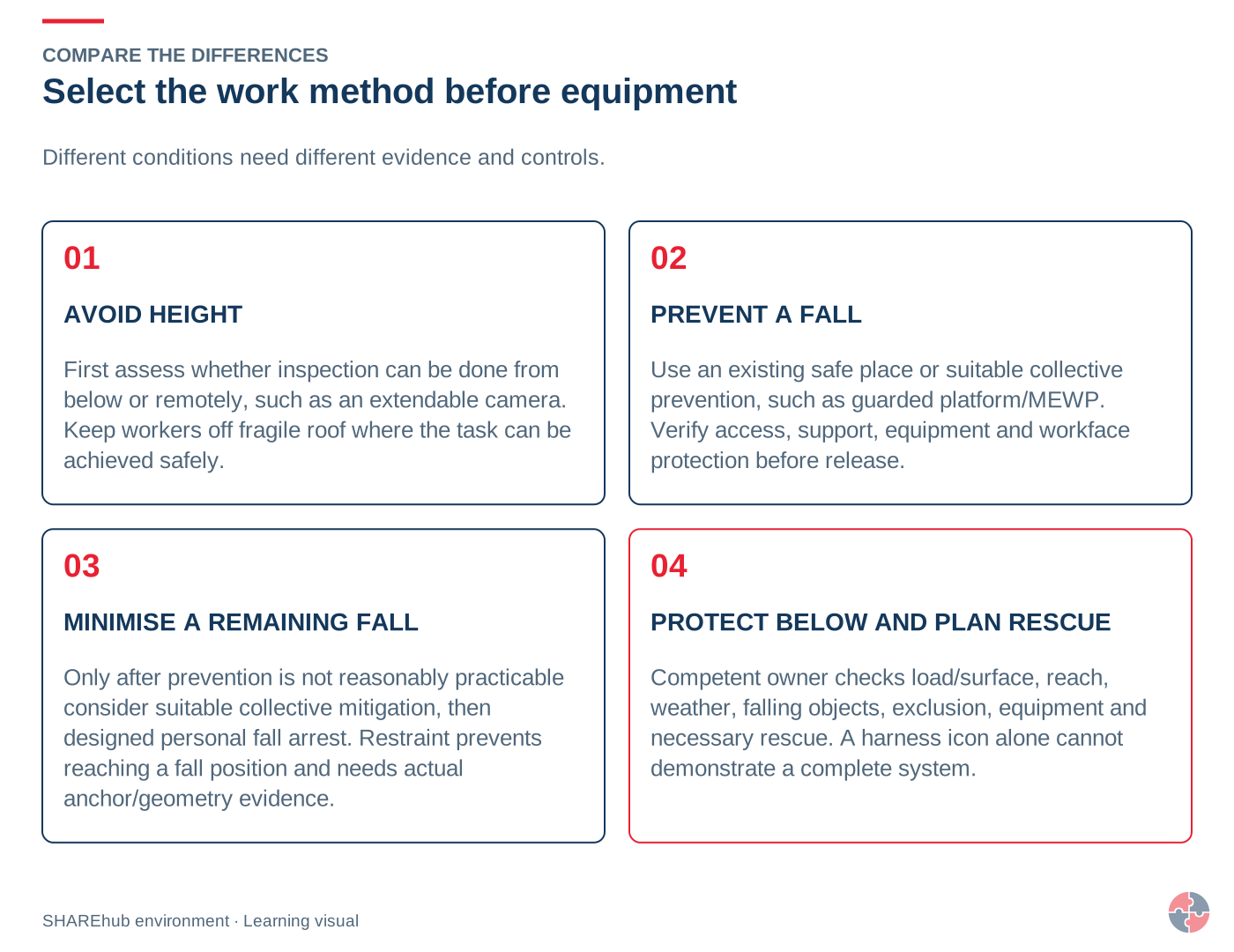
First avoid work at height where reasonably practicable. If it remains, prevent falls using a safe existing place or suitable equipment. Only then minimise the distance and consequences of a remaining fall.
At each level, consider collective protection before personal protection. A short lanyard configured as restraint prevents reaching an edge; fall arrest permits a fall and needs verified clearance and rescue. Neither makes an unsafe roof sound.
Order
Example
Decision test
Avoid
Inspect a roof from below or use extendable tools.
Can the task be done safely without going up?
Prevent, collective
Guarded scaffold, tower or suitable MEWP.
Can everyone at risk be protected without an individual action?
Prevent, personal
Verified work-restraint system.
Is the person unable to reach a fall position?
Minimise, collective
Safety net close below the work.
Is competent installation and inspection possible?
Minimise, personal
Designed fall-arrest system.
Are anchor, compatibility, clearance and timely rescue verified?
A worker proposes walking along the roof sheets because the rooflight location seems obvious.
Decision and explanation
A competent access and fall-prevention plan based on the roof condition and materials.
Recognising one rooflight does not establish that surrounding sheets are load-bearing or provide protection against falling through. Better visibility cannot make a fragile roof support a person. Observation does not provide a supporting access system, collective fall prevention or a rescue arrangement.
Lesson 8
Keep damaged electrical equipment out of use
Additional protection does not cancel a known equipment defect.
Photorealistic illustrative UK workplace scene. Review checks: Setting: the site team’s warehouse conveyor moves bagged building material. Act: The operator stops and reports the failure; the supervisor holds the whole affected line. Hold / review: Hold if guard function, isolation, run-down, linked restart or personnel accounting is uncertain.
Understand the activity and how harm develops
A damaged lead is being used on the wet barn floor. Moisture and contact with conductive surfaces can worsen the consequences of an electrical defect. Tape or a protective device cannot be assumed to make a damaged lead suitable. The task also needs equipment selected for its environment and route.
The scene distinguishes a user check from electrical repair. A worker can recognise damage and withdraw the equipment; competent repair and appropriate verification determine return to service. Pulling cables through doors or leaving connectors in water can recreate the defect. Maintenance records need to support control of the equipment actually present, including borrowed and contractor tools.
Recognise the evidence boundary
Question
Case evidence
What is observed?
A cut cable lies across wet paving outside the farm washdown area.
How can harm occur?
Contact could cause electric shock or burns.
What information is needed?
Check equipment identity and defect history without touching damaged parts.
Protect, manage and verify
Purpose
Practical application
Immediate protection
Prevent use and arrange safe isolation and competent electrical repair.
Accountable work arrangement
Stop use, prevent others using the equipment and isolate safely without approaching exposed live parts. Arrange competent assessment, repair or replacement and required verification. Select suitable equipment and electrical protection for the wet environment. Route and protect leads and connections from water, livestock and vehicle damage.
Release verification
Confirm repair and the required checks before returning equipment.
Apply this at work
Include welders, extension leads, pressure washers and portable lights in the same withdrawal and repair process.
How can maintenance itself be made safe?
Plan intervention hazards before removing guards or opening plant. Control energy, movement, height, substances, contractors and nearby operations for the whole job.
Identify every energy source, bring equipment to the required state, securely isolate, prevent reconnection and release or restrain stored energy. A stop command or open guard is not secure isolation. Use planned exceptional powered fault-finding only with competent specialists and designed protection. Coordinate group work and shift changes. HSE maintenance of work equipment and HSE L22 Safe use of work equipment.
At handback, account for people and tools, restore guards and devices, verify the affected functions and authorise a controlled restart. A permit is a coordination tool where the risk system requires it; it does not substitute for physical controls. Contractors need equipment identity, instructions, hazard information and a defined interface.
Applied case
A damaged cable is wrapped with tape and plugged into a socket protected by an RCD.
Decision and explanation
No; withdraw it and obtain competent repair or replacement and verification.
The cable defect remains unresolved. Return to service requires appropriate work and checks for that item and environment. Ordinary footwear is not a verified electrical protection system and cannot authorise use of a damaged cable. A protective device is an additional measure and does not establish that damaged equipment is safe to use.
Lesson 9
Keep escape routes usable throughout the shift
Emergency access is a daily operating requirement.
Photorealistic illustrative UK workplace scene. Review checks: Hot work possible: Permit, area clearance, fire watch and post-work check. Rear route used for deliveries: Route kept clear and delivery rules briefed. Compressor room risk: Detection, isolation and no combustible storage.
Understand the activity and how harm develops
Stored materials narrow the welfare exit. A route that is passable for one unhurried worker may fail when several people leave together, visibility is poor or someone needs assistance. A signed fire checklist does not override the present obstruction. Temporary storage becomes a continuing hazard when nobody owns its removal.
Trace escape from the occupied rooms to a place of safety, including doors, external paths and the assembly arrangement. The scene asks whether harvest deliveries or workshop work can block the route again. Suitable designated storage and supervisor checks prevent the exit becoming overflow space whenever the farm is busy.
Recognise the evidence boundary
Question
Case evidence
What is observed?
Feed sacks narrow the only marked barn escape doorway.
How can harm occur?
People could be delayed or trapped during an emergency.
What information is needed?
Compare the live exit route with the emergency plan.
Protect, manage and verify
Purpose
Practical application
Immediate protection
Remove the obstruction and provide suitable alternative storage.
Accountable work arrangement
Remove obstructions through a safe handling method and restore the required escape route. Provide designated storage that does not depend on using exits or emergency access. Keep escape doors and external routes usable under the fire and emergency plan. Brief seasonal workers and visitors on alarm, escape, assembly and reporting blocked routes.
Release verification
Check the complete route and exit remain usable during work.
Apply this at work
Check fire service access, chemical-store escape, animal-building exits and remote-field rendezvous routes too.
What should a complete fire control suite include?
A complete suite should include prevention, protection, warning, escape, response, maintenance, training and review.
Treat each credited function as a chain. A detector must produce a warning that occupied positions can receive; the escape route must stay open and protected; staff must know their role; a defect must have an owner and a temporary occupancy decision. A log of equipment checks cannot prove protection where actual warning, doors or route choice fail. Dangerous-substance and work-process ignition controls have a separate GB or NI regulatory route, but their consequences must still feed the premises emergency plan.
A responsible person should be able to explain how the controls fit together. If ignition occurs, detection should warn people. If fire grows, compartmentation should slow spread. If people move, routes and lighting should support escape. If people need help, assistance should be planned. If controls fail, defects should be escalated.
This joined-up view is what turns fire safety into a management system rather than a collection of certificates.
Emergency control suite
Control area
What good looks like
Evidence
Control areaFire prevention
What good looks likeIgnition, fuel and dangerous substances are controlled.
EvidenceInspections, permits, DSEAR/COSHH interface and housekeeping checks.
Control areaDetection and alarm
What good looks likeWarning is suitable for premises, work and people.
EvidenceTests, maintenance, audibility/visual alarm checks and impairment records.
Control areaMeans of escape
What good looks likeRoutes are short, direct, marked, lit and available.
EvidenceRoute inspections, emergency lighting tests and drill observations.
Control areaAssisted evacuation
What good looks likePeople needing help have practical arrangements.
EvidencePEEPs or generic plans, equipment and staff training.
Control areaFirefighting equipment
What good looks likeEquipment matches risk and is maintained.
EvidenceService records, visual checks at risk-assessed intervals and staff limits.
Control areaEmergency plan
What good looks likeRoles, shutdowns, communication and fire service information are clear.
EvidencePlan, drill learning, site pack and review records.
Control areaReview and assurance
What good looks likeActions are closed and controls remain effective.
EvidenceAction tracker, management review and audit findings.
The exit is partly blocked but the planned fire drill is not until next month.
Decision and explanation
Now, using a safe removal method and preventing repeat storage there.
The immediate condition needs correction, followed by a storage arrangement that keeps the escape route available throughout work. The route is needed whenever people occupy the building. A future drill cannot protect them during the current obstruction. Emergency conditions and who may need assistance cannot be predicted from present occupancy alone.
Lesson 10
Make lone-worker response work at the location
A missed check needs an owner, a trigger and a response.
Photorealistic illustrative UK workplace scene. Review checks: Assess: Check the task, location, contact arrangements and foreseeable emergency. Decide: Do not allocate work alone when the assessment requires assistance. Verify: Test contact, missed-check response and the route for summoning help.
Understand the activity and how harm develops
The worker is alone in a distant field with patchy signal. An incident may prevent them making a call, while a missed check-in can go unnoticed if nobody is responsible for acting on it. A mobile phone in a pocket is useful equipment but not a complete response system.
Assess whether this task should be done alone at all. Where lone work is suitable, agree location, communication, check-ins and a timed escalation plan that someone can carry out. The scene links field access, gates and emergency location details with the welfare office. A responder needs to find the correct worker and route without starting a new search across the entire farm.
Recognise the evidence boundary
Question
Case evidence
What is observed?
A lone worker has no agreed check-in while repairing fencing remotely.
How can harm occur?
An injury could go unnoticed and delay urgent help.
What information is needed?
Check the lone-work plan, location information and communication coverage.
Protect, manage and verify
Purpose
Practical application
Immediate protection
Plan suitable contact, escalation and tasks that are safe to undertake alone.
Accountable work arrangement
Avoid lone work for tasks whose risks require assistance or specialist arrangements. Agree the work location, task limits, check-in method and communication before departure. Assign a person to monitor checks and act on missed contact through a clear escalation plan. Provide location and access information, suitable emergency equipment and a plan for signal gaps.
Release verification
Test communication and confirm a named person will act on missed contact.
Apply this at work
Use the same arrangements for night checks, lone maintenance and contractors working away from the main yard.
When should lone work be stopped or restricted?
Stop lone work when the task, contact or rescue assumption breaks.
HSE INDG73 stresses monitoring, keeping in touch, training and supervision. A worker at a remote pumping station should withdraw to a safe location if the task becomes electrical fault-finding, if the phone/radio loses coverage, if access floods or if an aggressor appears. A missed check-in triggers a pre-agreed escalation clock rather than an indefinite wait.
The supervisor should know the last confirmed location, attempt contact, dispatch a safe responder and call emergency services when the trigger is met. Test the arrangement in drills; an alarm without response capacity is not a control.
Illustrative tabletop sequence, with timings set by the assessed emergency and achievable response: at start, the controller confirms the worker’s location, access and cover; at a missed scheduled contact, the named cover follows the agreed immediate contact/escalation steps within the documented deadline. A distress alarm or known incident triggers immediate emergency action and does not wait for the routine missed-call deadline. Record last known location, access details, who calls emergency services and out-of-hours controller cover. If a safe response cannot arrive in time, redesign or remove the lone arrangement. Responders must not enter danger for an unplanned rescue; rehearse the clock and change it if the test fails. Sources: HSE lone-work monitoring.
Applied case
The field worker misses a check-in. Their phone goes unanswered and nobody has the exact field name.
Decision and explanation
A defined escalation using recorded task, location and emergency access information.
An open-ended delay defeats the check-in purpose when the worker may be unable to call. The monitor needs an actionable plan and location details to seek help without avoidable delay or unsafe searching. Unreliable coverage requires an alternative arrangement; it does not justify removing the response trigger.
Lesson 11
The quiet barn at shift change
Verify maintenance boundaries and a credible remote response.
Photorealistic illustrative UK workplace scene. Review checks: Setting: the leisure operator operates a pool and public areas during an evening shift. Act: Match the first-aid needs assessment to pool hazards, public numbers, shifts and absences; check alarms, kit and responder cover. Hold / review: Missing essential first-aid or rescue cover, failed alarm or blocked access holds the affected activity.
The quiet barn at shift change
At the fictional farm, a contractor finishes roof work near a fragile rooflight. The work report is brief and does not explain the final access restriction. A portable tool has a damaged cable beside a wet wash area. A stored machine blocks the onward path from the barn exit, and a temporary platform obstructs another route. A remote worker is expected to check in after the main supervisor leaves, but the alert inbox will no longer be monitored.
Do not treat the quiet building or completed contractor visit as evidence that every activity is ready. Roof support and protection require competent assessment; nobody should step onto the sheets to check the contractor's work. Keep the relevant access restriction until suitable handback and the safe method are established. The awareness learner can request evidence and coordinate protection but cannot certify the roof or redesign fall protection.
Keep people clear of the damaged electrical equipment and use the appropriate safe withdrawal and competent isolation route. Do not enter the wet area or touch exposed damage to reach a plug. An RCD or inspection label does not remove the physical fault. Competent repair, required checks and correction of the damaging environment are necessary before authorised return to use. A replacement tool alone may leave an unsuitable supply or route unchanged.
The escape review follows the whole journey. Remove or control the storage and platform conflicts through the appropriate safe plan, and verify the route and doors rather than assuming an exit sign is enough. If an alternative is necessary, it must be suitable and communicated by the responsible arrangement. Do not wait for an emergency to discover that a final gate or path is blocked. Warning and assistance arrangements must suit the actual occupants and normal noise.
For the remote worker, establish whether the task remains suitable for lone work and who will receive and act on the planned contact. Test communications, location and access information safely and confirm cover after the supervisor leaves. An app sending to an unattended inbox is not an effective response system. If the necessary monitoring or support cannot be maintained, use the agreed restriction, return or alternative work arrangement before losing contact.
The final shift handover should list work complete, remaining restrictions, people still out, responsible roles and evidence needed for release. It must join contractor and farm information rather than file each separately. A fictional drill can test missed-contact escalation and responder access without exposing a volunteer to roof, electrical or remote hazards. The course result demonstrates awareness, not professional roof approval, electrical competence or emergency-service capability. Readiness means the next shift can use the arrangements and act on uncertainty before it becomes an emergency.
How should first-aid cover work across shifts, sites and remote work?
First-aid cover should be available whenever people are working, not just when the usual first aider is on site.
Common failures occur during early starts, overtime, night shifts, holidays, off-site work, lone work, home work and contractor work. The needs assessment should test these periods rather than assuming office-hours cover is enough.
Remote or mobile work may need travel first-aid kits, communication checks, lone-worker escalation, location-sharing arrangements and clear instructions on emergency services access.
Coverage considerations - Coverage considerations
Situation
Risk
Control
Night shift
No trained first aider available.
Shift-specific cover plan.
Holiday absence
First-aid role temporarily vacant.
Deputy and rota review.
Remote work
Delayed emergency help.
Mobile kit and communication plan.
Multiple floors/buildings
Kit or first aider too far away.
Distributed kits and contacts.
Public events
More casualties and public interface.
Event-specific assessment.
Contractor work
High-risk tasks outside normal arrangements.
Pre-start agreement on first-aid cover.
A name on a notice is not cover if that person is absent or too far away. Test a late shift, a remote work location and a busy public event: can someone summon help, reach the kit and start care within the plan? If a high-risk activity depends on a missing responder, hold or change the activity until cover is restored. See HSE assess your first-aid needs.
Applied case
The outgoing supervisor asks whether completed work orders are enough to close the shift.
Decision and explanation
Verify the actual roof/electrical restrictions, complete escape and monitored remote-response handover.
Physical readiness and accountable response must survive the handover.
Lesson 12
Take a verified action into the workplace
Connect one actual task to an owner, evidence and a clear release or escalation decision.
Photorealistic illustrative UK workplace scene. Review checks: Setting: the leisure operator operates a pool and public areas during an evening shift. Act: Match the first-aid needs assessment to pool hazards, public numbers, shifts and absences; check alarms, kit and responder cover. Hold / review: Missing essential first-aid or rescue cover, failed alarm or blocked access holds the affected activity.
Turn awareness into a practical question
Great Britain farm-work awareness. Confirm the relevant national fire, environmental and pesticide route. Specialist livestock, machinery, electrical, work-at-height, pesticide, confined-space and rescue tasks require their actual competent assessment and authorisation; this course confers none.
Choose one relevant operation from the course. Describe the person or environment at risk, the mechanism of harm and the exact condition that needs controlling. Separate an observation from a conclusion. A display, signature, badge or clean appearance answers only a limited question.
Use the included practice resources to prepare a fictional task brief, risk review or verification question. Decide which competent role owns the decision and which evidence must be available before work restarts or work is released. Keep worker protection, public exclusion, task acceptance and environmental decisions distinct where required.
At work, use your actual approved arrangements. Report uncertainty and preserve the relevant hold, restriction or safe state while it is resolved. Confirm that the action addressed the original harm route and check whether another shift, load, cleaning task or maintenance change could reintroduce it.
Course completion records awareness learning. It does not establish practical competence, certify an organisation or authorise specialist, clinical, maintenance, chemical or emergency work.
How should first-aid cover work across shifts, sites and remote work?
First-aid cover should be available whenever people are working, not just when the usual first aider is on site.
Common failures occur during early starts, overtime, night shifts, holidays, off-site work, lone work, home work and contractor work. The needs assessment should test these periods rather than assuming office-hours cover is enough.
Remote or mobile work may need travel first-aid kits, communication checks, lone-worker escalation, location-sharing arrangements and clear instructions on emergency services access.
Coverage considerations - Coverage considerations
Situation
Risk
Control
Night shift
No trained first aider available.
Shift-specific cover plan.
Holiday absence
First-aid role temporarily vacant.
Deputy and rota review.
Remote work
Delayed emergency help.
Mobile kit and communication plan.
Multiple floors/buildings
Kit or first aider too far away.
Distributed kits and contacts.
Public events
More casualties and public interface.
Event-specific assessment.
Contractor work
High-risk tasks outside normal arrangements.
Pre-start agreement on first-aid cover.
A name on a notice is not cover if that person is absent or too far away. Test a late shift, a remote work location and a busy public event: can someone summon help, reach the kit and start care within the plan? If a high-risk activity depends on a missing responder, hold or change the activity until cover is restored. See HSE assess your first-aid needs.
Applied case
The shift action log says “training completed, issue closed”. It records no condition check, work status or task owner.
Decision and explanation
The accountable person verifies the task-specific control and records the justified decision.
Learning supports the decision; evidence that the relevant control works is needed before the responsible person closes the action.

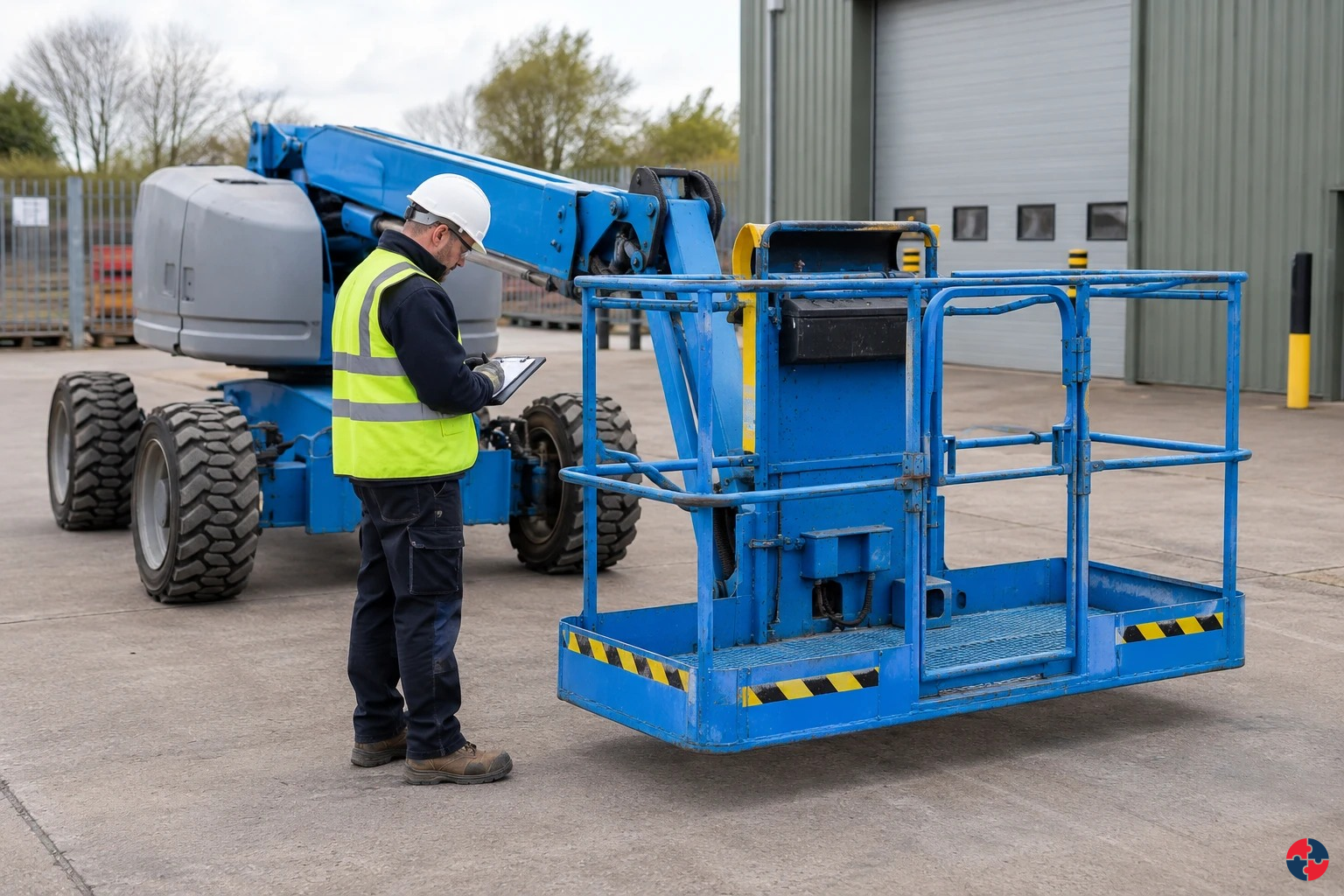
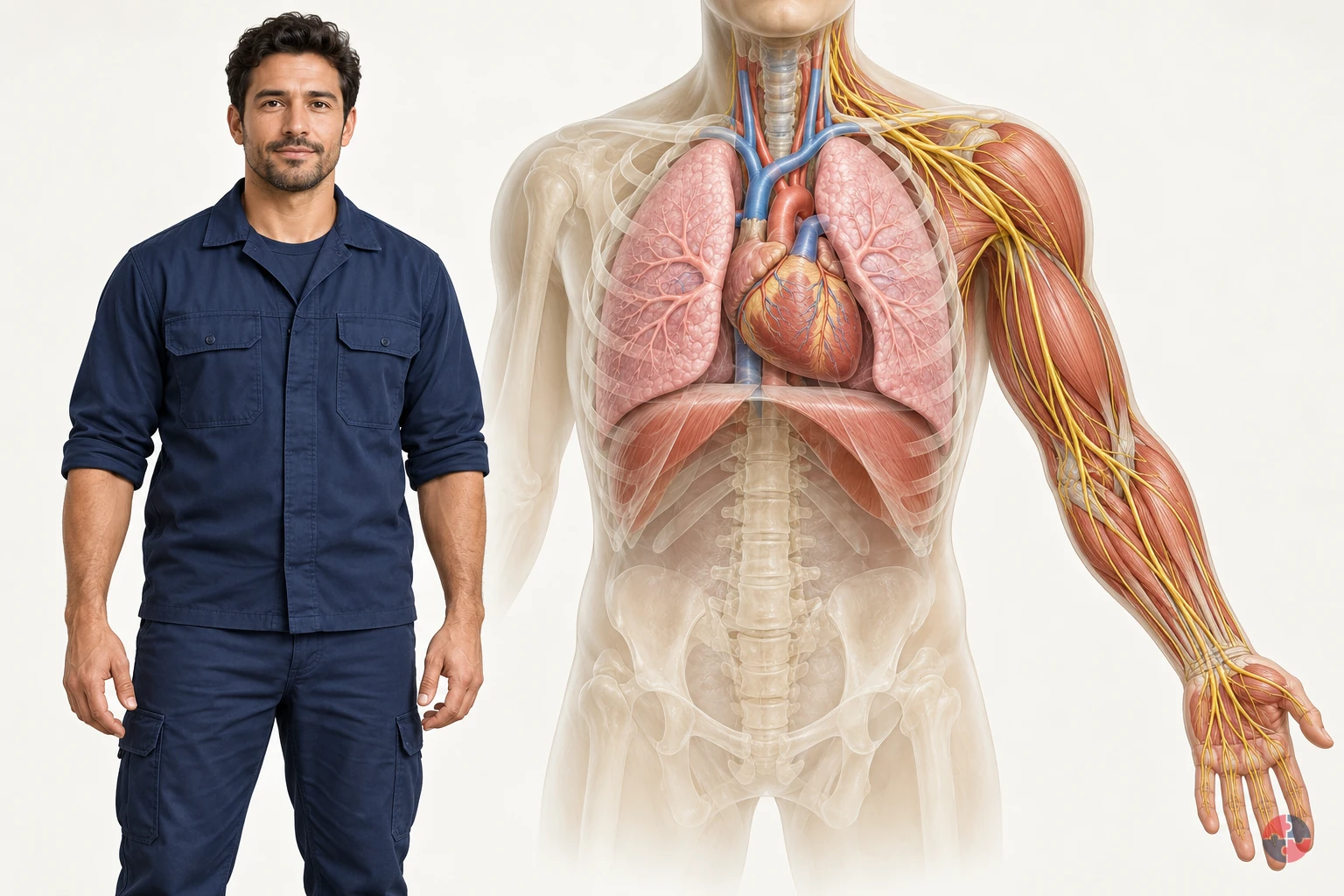
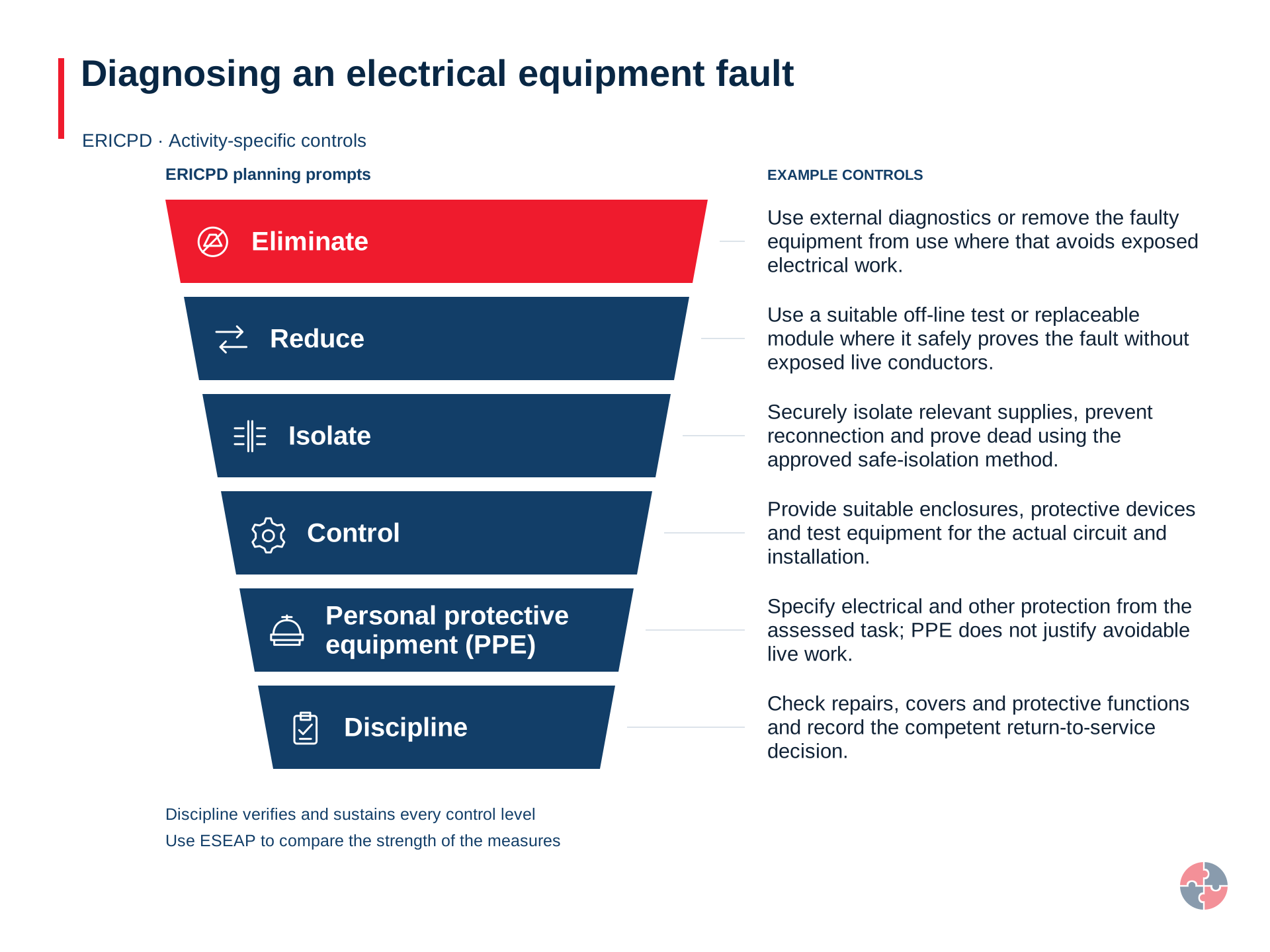
 Recognise the fuel. Read the extinguisher. Protect your escape.