Full public teaching and readers are free without an account. A free learner account is required for saved LMS progress and recorded assessment. Completion and any course-completion certificate depend on the configured LMS conditions. Open the course overview.
Lesson 1
A PTO guard must prevent access to the whole danger
Distinguish protective guarding from clothing and caution.
Photorealistic illustrative UK workplace scene. Review checks: Setting: Cartons jam at a packaging transfer point. Act: Stop and hold production, keep others clear and reject the tape holding the side gate. Hold / review: Hold the line: do not start or reach in while the interlock is defeated, the drive can coast into reach, the linked feed remains energised, the air pressure is uncertain, or the task differs from the agreed method.
A PTO guard must prevent access to the whole danger
A rotating PTO driveline can catch clothing, hair or a body part and wrap it around the shaft. The event can develop too quickly for someone to pull away or reach a stop. A gap at a coupling can remain dangerous even when the central shaft tube is covered. Looking at one visible part of the guard is not a complete check of the accessible drive.
The fictional mixer has a damaged guard at an end connection. Stop use through the safe procedure and arrange suitable repair or replacement before operation. Do not tape over the gap, step across the shaft or ask workers to keep their clothing tighter as the whole solution. Suitable clothing and training support safeguarding; they cannot remove exposed dangerous movement. Do not defeat a restraint or guard to make the equipment easier to use.
The operator's pre-use checks and manufacturer information should cover the actual driveline and its protection. A competent person must assess suitability, condition and any modification. This course does not teach guard manufacture or provide a universal dimension. Guarding during operation is also distinct from the energy-control arrangement needed for intervention. A complete guard does not permit working on a powered machine, and Safe Stop does not make a missing guard acceptable for later operation.
Verification should establish effective protection of accessible dangerous parts, correct fit and the required functional checks through a safe handback. Keep people clear during authorised testing and repeat the safe intervention procedure if further access is necessary. The exercise asks learners to identify the exposed point, protective hold and repair evidence. Nobody should approach a rotating shaft to photograph or test the guard. A “working” mixer with one unprotected coupling is not ready for use simply because it can complete the feeding task.
What makes a physical guard effective?
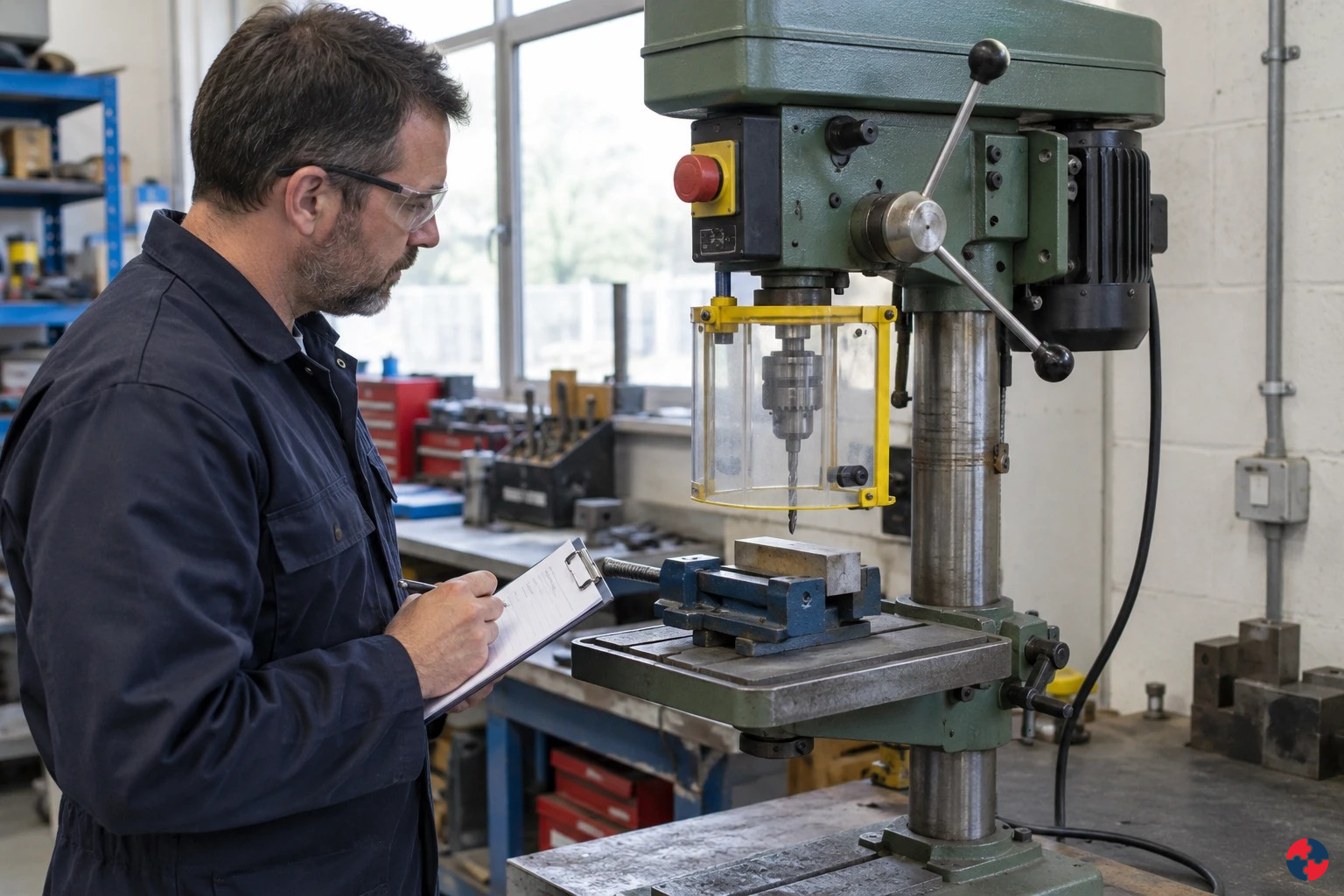
A guard must be strong, secure and positioned so a person cannot reach dangerous parts through, over, under or around it. It must not create a new trapping or sharp-edge hazard, and workers need a usable way to do the job without removing it.
A fixed guard normally requires a tool for removal and must be refitted before use. A movable guard may suit needed access but requires an appropriate safety function. Mesh aperture, height, reach distance, transparent-panel strength and fixings are engineering design choices; they cannot be chosen from one universal gap or panel thickness. A competent designer uses the applicable current technical requirements, machine instructions and actual body/access routes. HSE L22 Safe use of work equipment.
Poor visibility, awkward cleaning and long waits are reasons people defeat protection. During the design review, watch operators perform real tasks and redesign inconvenient steps without creating a shortcut to the hazard. A new opening, tool, product or worker group can invalidate an earlier reach assessment. HSE Introduction to machinery safety.
Applied case
The central PTO tube is intact but the coupling shield is broken.
Decision and explanation
Hold use until suitable complete protection is restored and verified.
The accessible coupling remains an entanglement point.
Lesson 2
Hitching creates a closing gap
Control vehicle movement before a helper approaches.
Photorealistic illustrative UK workplace scene. Review checks: Setting: Maintenance must remove a pump spool in a fuel terminal. Act: Establish and prove initial isolation; then safely depressurise, drain and purge the section. Hold / review: Stop if pressure returns, the line identity is uncertain, isolation leaks, the drain path is blocked or the adjacent team changes the system.
Hitching creates a closing gap
The space between tractor and implement can close unexpectedly during alignment or coupling. A helper standing there may be crushed even if both people intend only a small adjustment. A raised hitch or unstable trailer can also move under stored force or gravity. Familiarity between driver and helper cannot make the closing gap safe while movement remains possible.
Plan the actual coupling with suitable equipment, support, ground and clear communication. Keep the helper outside the danger area during alignment and apply the required stopped, secured condition before any necessary approach. HSE Safe Stop provides the foundation: parking brake engaged, controls neutral or equipment made safe, power stopped and key removed or supply locked off as appropriate. The actual task may require additional isolation or restraint for other sources and possible movement.
The responsible competent method must address trailer support, coupling condition, pins or retaining devices and safe access without teaching people to improvise between moving equipment. This course does not qualify a learner to operate a hitch. Use the actual manufacturer instructions and trained authorised personnel. If signals are lost, visibility is uncertain or either person is unclear about the sequence, stop rather than continuing by assumption.
Before movement, the responsible operator should verify secure coupling, appropriate supports or attachments and that everyone is clear. A shouted “done” is insufficient if a retaining component has not been checked. If a defect is found, hold the task and obtain competent correction. For the exercise, identify the point at which the helper becomes exposed and the evidence needed before approach and departure. Avoid practising with a real moving vehicle. The value of the plan is that both people know when movement is prohibited and who controls restart.
How should isolation work be planned?
Planning should start before the permit is issued and should involve operations, maintenance and competent technical input.
A strong plan identifies the work scope, isolation boundary, energy sources, drain/vent points, line contents, drawings, lock points, verification method, PPE, access, SIMOPS, emergency arrangements and handback requirements. It also defines who applies, verifies, accepts and removes isolations. See HSG253 - The safe isolation of plant and equipment; HSG250 - Guidance on permit-to-work systems.
A weak plan relies on memory or inherited labels. Older plant, temporary hoses, bypasses, cross-connections, dead legs and undocumented changes make physical verification essential.
Scope definition — Prevents isolating the wrong plant or too little plant. Permit scope and marked-up drawing.
Energy inventory — Identifies all supplied and stored energy. Isolation plan and walkdown notes.
Verification method — Defines how zero energy will be proved. Test/bleed/gas-test record.
Roles — Clarifies authoriser, isolator, accepter and verifier. Permit role signatures.
Emergency plan — Sets response if release or exposure occurs. Rescue/spill/fire arrangements.
Applied case
A helper steps between tractor and trailer while the driver makes small alignment movements.
Decision and explanation
Stop and secure the equipment under the competent hitching method before any necessary approach.
The closing gap can crush; small movement is still movement.
Lesson 3
A raised implement stores gravitational energy
Do not rely on hydraulic pressure as the support.
Photorealistic illustrative UK workplace scene. Review checks: Setting: Maintenance must remove a pump spool in a fuel terminal. Act: Establish and prove initial isolation; then safely depressurise, drain and purge the section. Hold / review: Stop if pressure returns, the line identity is uncertain, isolation leaks, the drain path is blocked or the adjacent team changes the system.
A raised implement stores gravitational energy
A raised implement can descend if a hose fails, a control moves or stored pressure changes. The engine being stopped does not remove the load's weight. A person beneath it can be crushed before they can escape. A jack or hydraulic cylinder used to lift a load is not automatically an adequate independent support for somebody working underneath.
First consider whether inspection or repair can be done with the implement safely lowered. If access beneath a raised item is genuinely necessary, a competent method must establish suitable support, isolation and prevention of movement for the actual equipment. Manufacturer information, load, support points, ground and work forces matter. This course gives no prop dimensions or construction method and does not authorise improvised wooden supports.
The fictional repairer proposes reaching under a raised attachment while another worker watches the controls. A lookout cannot prevent hose failure or hold the implement up. Use the actual safe intervention system rather than depending on vigilance. Account for gravity alongside hydraulic, mechanical and electrical sources, and prevent another person from restarting or moving the equipment. Do not enter the danger area to fit a support unless the competent method itself protects that operation.
Verification must establish that the required support and safe energy state are effective before access, with a clear responsible role. Keep the restriction if evidence is missing. After work, use the controlled handback for removing supports, restoring guards and returning equipment to service, ensuring people are clear. The exercise asks learners to distinguish “engine stopped” from “load positively controlled”. Do not test an uncertain support by placing body weight or a person beneath the implement. A maintenance record can document checks; it cannot itself resist the gravitational force.
Which energy sources must be identified?
A competent isolation plan looks beyond the obvious power switch.
Energy can be electrical, mechanical, hydraulic, pneumatic, chemical, thermal, gravitational, pressure, radiation or stored in springs, capacitors, accumulators, batteries, elevated loads and process inventory. Multi-energy systems are common in modern plant: a conveyor may have electrical drives, stored mechanical energy, pneumatic actuators, gravity hazards and automated controls. See HSG253 - The safe isolation of plant and equipment.
The isolation plan should be based on physical walkdown, drawings, operating knowledge, previous changes, site experience and challenge from the workers doing the task.
Energy source
How it can harm
Control example
Electrical
Shock, electrocution, arc flash or unexpected start.
Isolate, lock, prove dead and control back-feed.
Mechanical movement
Crushing, shearing, entanglement or amputation.
Block, pin, disengage and verify no movement.
Pressure
Injection, blast, projectile, release or burns.
Depressurise, drain, vent and verify.
Hydraulic/pneumatic
Unexpected actuator movement or stored pressure.
Isolate supply, bleed accumulators and secure parts.
Thermal
Burns from steam, hot product or cold cryogenic release.
Cool, drain, vent and wear suitable PPE.
Chemical/process inventory
Toxic, corrosive, flammable or asphyxiant release.
Clean, purge, gas test and use positive isolation where needed.
Gravity
Falling loads or drifting equipment.
Chock, prop, block or lower to safe position.
Applied case
A raised implement is held only by the hydraulic cylinder while the engine is off.
Decision and explanation
Suitable verified support and energy/movement control through the competent method.
Gravity remains even without running power; hydraulics alone are not the required support.
Lesson 4
A tiny hydraulic puncture can be an emergency
Avoid leak searching by hand and escalate suspected injection urgently.
Photorealistic illustrative UK workplace scene. Review checks: Setting: Maintenance must remove a pump spool in a fuel terminal. Act: Establish and prove initial isolation; then safely depressurise, drain and purge the section. Hold / review: Stop if pressure returns, the line identity is uncertain, isolation leaks, the drain path is blocked or the adjacent team changes the system.
A tiny hydraulic puncture can be an emergency
High-pressure hydraulic fluid can penetrate skin through a small opening. The visible wound may look minor while serious internal injury develops. A person searching along a hose with a hand can be exposed to a fine jet that is difficult to see. Gloves do not turn that inspection into a safe method, and low apparent leakage does not establish low pressure.
At the fictional apron, a leak appears near a raised attachment. Keep people clear and follow the competent safe shutdown, support and isolation arrangements for the actual system. Do not use a finger or hand to locate the leak, tighten a connection under pressure or disconnect a hose as a way of testing it. This lesson does not teach hydraulic repair, pressure-release sequencing or substitute materials for leak detection.
If injection is suspected, seek urgent medical attention immediately and explain the high-pressure fluid-injection mechanism. Do not wait for pain, swelling or the next shift to decide whether the mark matters. Provide available product and equipment information safely through the appropriate route; nobody should create further exposure by handling the leaking hose to collect evidence. The supervisor supports rapid assistance without diagnosing the injury or attempting treatment outside their competence.
Repair and testing require competent people, suitable components and the actual controlled method. Verify that gravity and other stored energy are addressed as well as the pressure source. Before return to service, the authorised person must establish repair integrity, safe testing and relevant handback conditions with others clear. For the exercise, record the suspected contact and time factually and distinguish urgent medical escalation from the separate equipment investigation. A tiny wound, reassuring appearance or brief contact cannot be used to rule out an injection injury.
What makes line breaking especially hazardous?
Line breaking is the point where containment is opened and hidden assumptions are tested.
The first crack of a flange can release pressure, vapour, liquid, sludge, solids, steam, corrosive material, toxic gas or flammable atmosphere. Even a small residual quantity can injure a worker if it is hot, under pressure, toxic or reactive. See HSG253 - The safe isolation of plant and equipment.
Line breaking should therefore use a deliberate break plan: verify isolation, control drainage, position workers out of the line of fire, loosen bolts cautiously, use drip trays or containment, wear task-specific PPE, control ignition sources and stop if unexpected pressure or material appears.
Control point
Why it matters
Good evidence
Line contents known
Controls depend on substance.
SDS/process data and sampling where needed.
Pressure removed
Prevents violent release.
Vent/drain verification.
Worker position
Avoids line of fire.
Pre-job briefing and observation.
Containment
Controls spills and exposure.
Drip tray, bunding or drain isolation.
PPE/RPE
Protects against residual risk.
Task-specific PPE assessment.
Stop criteria
Controls unexpected release.
Briefed hold points.
Applied case
A worker feels a pinprick while wiping a hydraulic leak and says it can wait because the mark is tiny.
Decision and explanation
Seek urgent medical attention immediately and identify suspected high-pressure fluid injection.
The external wound can conceal serious injury; urgent assessment is needed.
Lesson 5
A blockage may store the next movement
Plan isolation beyond a pushbutton stop.
Photorealistic illustrative UK workplace scene. Review checks: Setting: Maintenance must remove a pump spool in a fuel terminal. Act: Establish and prove initial isolation; then safely depressurise, drain and purge the section. Hold / review: Stop if pressure returns, the line identity is uncertain, isolation leaks, the drain path is blocked or the adjacent team changes the system.
A blockage may store the next movement
A mixer that has stopped turning can still contain forces that move when a blockage is removed. Material may shift, a component may unwind or another power source may operate. Someone else can also restart the plant. Silence and lack of visible motion therefore do not establish that a worker can safely put a hand or tool into the danger area.
Use Safe Stop before intervention and the task-specific competent isolation procedure for all relevant sources. Identify mechanical, hydraulic, electrical and gravitational energy and any automatic or remote start. Control run-down and stored movement and verify the safe state using the authorised method. Removing one key may be part of the arrangement but is not a universal answer for every connected or fixed machine.
At the fictional mixer, the operator proposes clearing compacted feed while a colleague stays beside the stop button. Reject that substitution for verified isolation and controlled intervention. An emergency stop is not normally an isolation point, and a tag without effective energy control cannot prevent movement. The actual safe system should define responsibility, equipment, communication and who can remove restrictions. This lesson does not instruct a learner to improvise locking devices or enter the mixer.
Investigate repeated blockages so the design or operating method can reduce the need for access. After authorised work, restore guards, remove tools, confirm people are clear and follow the controlled restart and handback procedure. If testing reveals a need for more access, repeat the safe intervention process. For the exercise, separate the operating fault from permission to clear it: the fault explains why work is needed but does not establish a safe condition. Record what sources and evidence remain unconfirmed rather than writing “off” as if it covered them all.
How should isolation be verified?
Verification proves the isolation is effective at the point of work, not just applied somewhere upstream.
Verification is the difference between a hopeful isolation and a controlled job. Electrical work needs proving dead; process work may need depressurisation, drain/vent checks, gas testing, sampling, pressure indication, bleed verification, flushing, purging or visual confirmation of blinds. See HSG253 - The safe isolation of plant and equipment.
Verification should be independent enough for the risk. A person should not simply trust the same label or drawing that could be wrong. Where consequences are high, independent verification and authoriser challenge are essential.
Hazard
Verification method
Common failure
Electrical energy
Test for dead with approved voltage indicator.
Tester not proved before/after or wrong circuit tested.
Pressure
Check gauges, vents, drains and bleed points.
Blocked gauge line gives false reading.
Flammable atmosphere
Gas test after purge and before line break.
Single test misses later vapour return.
Toxic/corrosive contents
Sample, drain, flush, isolate and PPE.
Dead leg or trapped pocket remains.
Mechanical movement
Try-start where safe, block and physical check.
Stored gravity/hydraulic energy not controlled.
Blind/spade
Visual check and blind list verification.
Wrong size/rating or wrong location.
Learning check: two apparent protections
A locked but wrongly identified isolator does not protect the work point. A correctly identified boundary still requires proof of every relevant energy/feed and each specified DBB barrier, with accepted evidence and a safe discharge destination. If identity or proof is missing, hold the intrusive work and use the roles/competence route. Do not turn this check into a generic valve-operating sequence or invent acceptance pressures.
Applied case
A colleague offers to guard the mixer’s Stop button while a blockage is cleared.
Decision and explanation
Verified task-specific isolation, stored-energy control and authorised intervention.
A person beside a control cannot substitute for isolation and control of stored movement.
Lesson 6
Return to service is its own controlled task
Verify repair, guarding and people-clear conditions before restart.
Photorealistic illustrative UK workplace scene. Review checks: Setting: Maintenance must remove a pump spool in a fuel terminal. Act: Establish and prove initial isolation; then safely depressurise, drain and purge the section. Hold / review: Stop if pressure returns, the line identity is uncertain, isolation leaks, the drain path is blocked or the adjacent team changes the system.
Return to service is its own controlled task
A machine can be correctly repaired yet unsafe to restart if a guard remains removed, a tool is inside or another worker still believes it is isolated. Conversely, restoring the guard does not prove a hydraulic repair has been safely tested. Handback must join the physical work, control of energy and communication rather than treating removal of a lock as the entire release decision.
The fictional supervisor should compare the task record with the actual condition and the competent person's required verification. Identify what was changed, which tests were performed and what restrictions remain. Confirm the right components and instructions were used and that any modification has the necessary review. The awareness learner can request this evidence but must not sign as the competent machinery or electrical verifier.
Plan testing so people are clear and the machine is in its intended protected state. Communicate the restart to affected workers and confirm control responsibility. If further inspection is required, safely stop and re-establish the intervention controls; a successful test does not leave the machine permanently safe to access. If any worker is unaccounted for or the guard cannot be restored, retain the hold rather than relying on an announcement alone.
Use the fictional audit to capture the defect, protective action, repair, verification and authorised release role. Include recurrence: a guard repeatedly damaged during normal use or a mixer continually blocking may require a design or process review. Encourage factual near-miss reporting without rewarding risky improvisation. A course badge demonstrates completion of learning, not competence to repair hydraulics or operate a specific tractor. The workplace outcome is equipment whose operation and intervention methods are both understood, with effective safeguards and no unresolved person or energy inside the restart decision.
How should handover and handback be controlled?
Isolation risk increases during shift change, job pause, recommissioning and return to service.
Handover must explain what is isolated, what is open, what is drained, what is blinded, which locks are applied, what work is incomplete and what must not be operated. Incoming teams should not inherit assumptions without walking down critical isolations where risk justifies it. See HSG253 - The safe isolation of plant and equipment.
Handback is not just removing locks. It includes checking tools and people are clear, blinds and spades are removed or correctly positioned, drains and vents are closed, guards are replaced, leak testing is complete, alarms/interlocks are restored, overrides are removed and the system is safe for restart.
Shift handover — Status misunderstood. Written and verbal isolation handover.
Job suspended — Plant condition changes while work paused. Suspend permit and secure open systems.
Reinstatement — Blind, lock or drain left in wrong state. Reinstatement checklist and second check.
Leak test — Containment not proven. Controlled pressurisation and inspection.
Restart — People or tools remain in danger zone. Final sweep and authorisation.
Applied case
A repairer has finished but one guard is still on the bench and a helper’s location is unknown.
Decision and explanation
Retain the hold until guarding, people-clear and required verification are confirmed.
Physical and people-clear conditions must be established before restart.
Lesson 7
Make the PTO guard part of the machine
A missing guard is an equipment defect, not a reminder to be careful.
Photorealistic illustrative UK workplace scene. Review checks: Setting: Cartons jam at a packaging transfer point. Act: Stop and hold production, keep others clear and reject the tape holding the side gate. Hold / review: Hold the line: do not start or reach in while the interlock is defeated, the drive can coast into reach, the linked feed remains energised, the air pressure is uncertain, or the task differs from the agreed method.
Understand the activity and how harm develops
The PTO guard is damaged near the tractor. The rotating shaft and couplings can catch loose material and pull a person into the drive. The danger can remain after a normal stop until rotation has ceased. A guard resting nearby does not protect anyone during operation.
Inspect the complete driveline arrangement, including the tractor and implement ends. Normal access, hitching and clearing should not require stepping over a running shaft. The exercise treats damaged guarding as a defect requiring the machine to be taken out of use, with repair and verification before return. Operator experience cannot replace a barrier that prevents physical contact.
Recognise the evidence boundary
Question
Case evidence
What is observed?
A split PTO guard leaves part of the rotating shaft reachable.
How can harm occur?
Clothing or hair could be drawn around the shaft.
What information is needed?
Check the complete shaft guard and its maintenance record.
Protect, manage and verify
Purpose
Practical application
Immediate protection
Stop and make safe until suitable guarding is repaired.
Accountable work arrangement
Stop use and apply Safe Stop before leaving the operating position or approaching the machinery. Isolate relevant energy and wait for all movement to stop before intervention. Restore suitable complete PTO guarding using competent repair and compatible components. Maintain a route that avoids stepping across the driveline and control restart after reinstatement.
Release verification
Confirm the guard protects the full exposed drive before use.
Apply this at work
Inspect all tractor-implement combinations, including contractor machinery and seldom-used seasonal equipment.
What makes a physical guard effective?
A guard must be strong, secure and positioned so a person cannot reach dangerous parts through, over, under or around it. It must not create a new trapping or sharp-edge hazard, and workers need a usable way to do the job without removing it.
A fixed guard normally requires a tool for removal and must be refitted before use. A movable guard may suit needed access but requires an appropriate safety function. Mesh aperture, height, reach distance, transparent-panel strength and fixings are engineering design choices; they cannot be chosen from one universal gap or panel thickness. A competent designer uses the applicable current technical requirements, machine instructions and actual body/access routes. HSE L22 Safe use of work equipment.
Poor visibility, awkward cleaning and long waits are reasons people defeat protection. During the design review, watch operators perform real tasks and redesign inconvenient steps without creating a shortcut to the hazard. A new opening, tool, product or worker group can invalidate an earlier reach assessment. HSE Introduction to machinery safety.
Applied case
The machine is needed for the last field, but the replacement PTO guard is not available.
Decision and explanation
Keep the machine out of use until suitable guarding is restored and checked.
An instruction alone leaves accessible rotating equipment in service and cannot ensure that nobody approaches unexpectedly. The critical physical barrier must be reinstated before operation, with the stop and restart procedure maintained. An improvised wrapping is not a suitable driveline guard and can introduce material into rotating components.
Lesson 8
Keep people out of the hitching crush zone
Never use a person as the physical guide inside a closing gap.
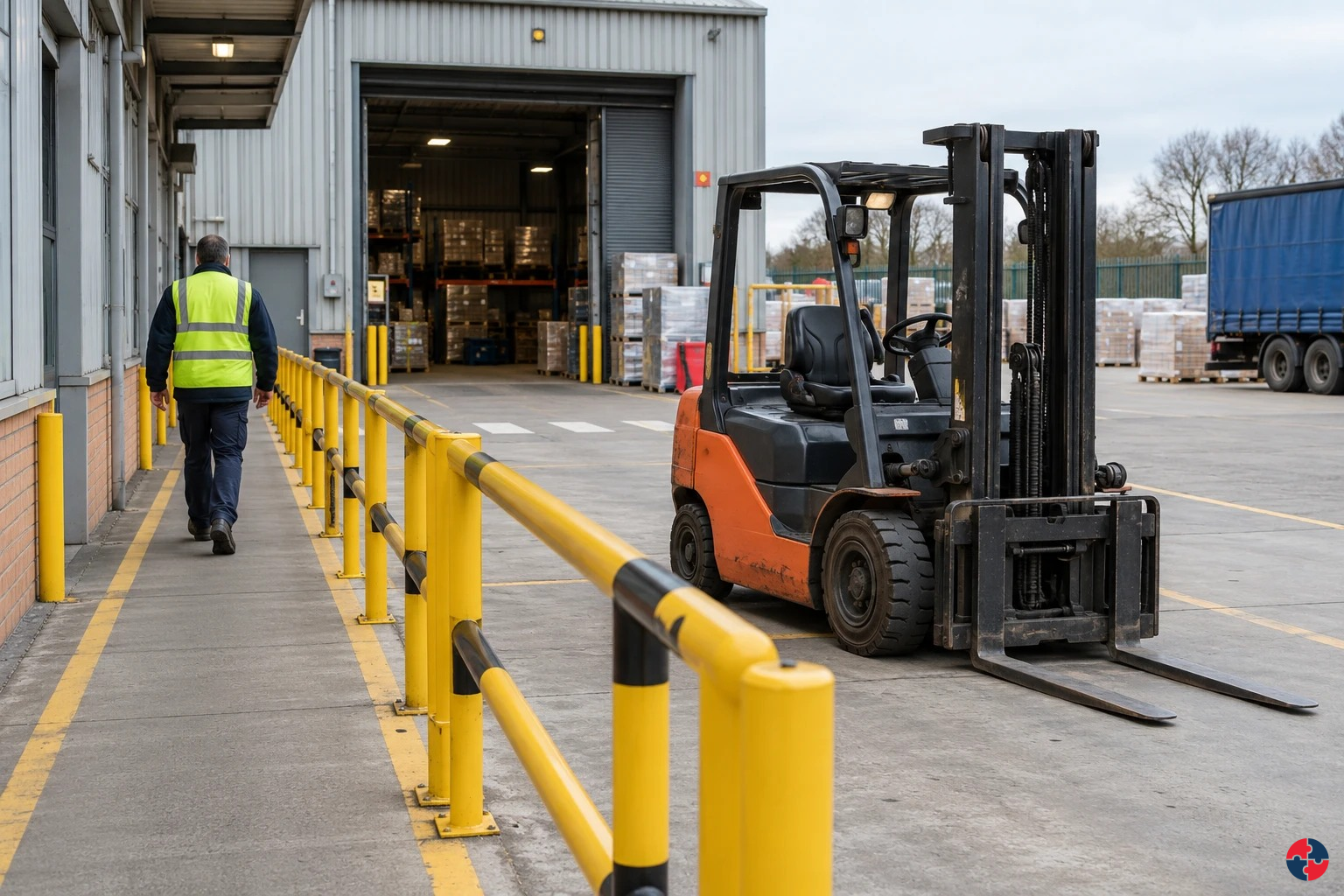
Photorealistic illustrative UK workplace scene. Review checks: Setting: Receive and unload identified palletised packaged goods from a rigid lorry using a suitable counterbalance forklift. Act: The supervisor checks the bay surface, lighting, pedestrian barriers, clear route and local unloading plan. Hold / review: Hold an unbooked vehicle, changed vehicle type, unknown load mass, damaged pallet or shifted load for the supervisor and, when needed, supplier or competent specialist.
Understand the activity and how harm develops
The worker is between tractor and implement while the tractor moves backwards. A small movement can close the available space or turn a drawbar into a crushing point. The driver may be concentrating on alignment and lose sight of the person on the ground. Shouting is unreliable beside a running engine.
The scene requires an agreed coupling method with suitable compatible equipment and a defined stopped condition before someone enters a pinch area. The worker should not guide alignment by standing where the tractor must move. Parking, slopes, brakes and stored movement all affect whether the combination is actually stable during coupling.
Recognise the evidence boundary
Question
Case evidence
What is observed?
A person stands between a moving tractor and the implement.
How can harm occur?
Unexpected movement could crush the person between them.
What information is needed?
Check the agreed hitching method and operator communication.
Protect, manage and verify
Purpose
Practical application
Immediate protection
Use the safe hitching procedure with movement stopped before approach.
Accountable work arrangement
Use a planned coupling method and compatible equipment that minimise entry into the crush zone. Keep people clear while the tractor moves; agree signals and stop if communication is lost. Apply the appropriate Safe Stop and secure the tractor and implement before close coupling work. Check pins, locking devices, hoses and stability before a controlled departure.
Release verification
Confirm secure coupling and a clear danger area before movement.
Apply this at work
Apply the same people-clear and secure-before-access sequence to attachments, loaders and towed equipment.
How do you design safer routes and choose controls?
Map actual movements, remove unnecessary vehicle–pedestrian contact, then protect unavoidable interfaces. Physical separation and suitable layout come before signs, high-visibility clothing and expectations that people will always react correctly.
Observe the site at busy and quiet times. Draw staff routes to toilets, welfare and exits alongside forklifts, lorries, customer cars, waste collections and emergency access. Include a pedestrian’s natural walking route, not just the route drawn on the plan. A long detour that encourages shortcuts needs redesign, not repeated reminders. See HSE workplace transport risk assessment for the relevant source and scope.
Remove or reduce the movement: relocate a collection point, use drive-through arrangements or keep deliveries outside public access periods where practicable.
Separate by design: provide suitable pedestrian routes, barriers, separate doors and protected waiting areas. Select barriers for the foreseeable impact; a painted line is not a crash barrier.
Control remaining crossings: use visible, accessible crossing points away from reversing areas, suitable lighting, clear priority and enough visibility and stopping distance.
Support the design: brief routes, control access and delivery timing, supervise and enforce locally assessed speed limits. Select task-appropriate protective equipment for residual risks.
Routes must suit the largest vehicle and load that will actually use them, including turns, slopes, headroom and ground-bearing capacity. Keep surfaces drained and clear; protect vulnerable racking, fuel equipment and edges. Temporary routes need the same risk-based scrutiny. HSE HSG136 third edition (pages 9–13) provides the design principles.
There is no single safe speed, lane width or pedestrian clearance for every yard. The vehicle, load, bends, visibility, surface and users determine the decision. A posted limit is a maximum within the local system, not permission to drive at that speed when conditions are worse. HSE site speed limits describes choosing and enforcing site limits.
Applied case
The helper stands between the tractor and trailer and asks the driver to reverse another few centimetres.
Decision and explanation
Stop, clear the helper and use the agreed safe alignment and coupling method.
A warning does not clear the crush zone or establish a safe coupling position. People must remain outside the moving vehicle gap; close work follows the required stopped and secured condition. Slow movement can still crush the person occupying the closing gap.
Lesson 9
Support raised implements independently
Control gravity as well as the engine and hydraulic controls.
Photorealistic illustrative UK workplace scene. Review checks: Setting: Maintenance must remove a pump spool in a fuel terminal. Act: Establish and prove initial isolation; then safely depressurise, drain and purge the section. Hold / review: Stop if pressure returns, the line identity is uncertain, isolation leaks, the drain path is blocked or the adjacent team changes the system.
Understand the activity and how harm develops
The implement is raised for inspection. Hydraulic pressure may be holding its weight, but a hose, valve or control movement can allow descent. The space beneath it can disappear before someone reacts. A person who trusts the raised position without suitable mechanical support is relying on a system that can change unexpectedly.
Plan inspection from outside the crush area where possible. If access beneath raised equipment is unavoidable, the manufacturer method and competent support arrangement must control the load and relevant energy sources. A hydraulic isolation or engine stop alone may not restrain gravity. Suitable supports need adequate strength and positioning on sound ground.
Recognise the evidence boundary
Question
Case evidence
What is observed?
A worker reaches beneath an implement supported only hydraulically.
How can harm occur?
Loss of pressure could lower the implement onto the worker.
What information is needed?
Check the manufacturer's support and isolation instructions.
Protect, manage and verify
Purpose
Practical application
Immediate protection
Lower to safety or use specified mechanical supports before intervention.
Accountable work arrangement
Lower equipment to a safe position and avoid working underneath where possible. Use manufacturer-specified mechanical support or a competent suitable support method before unavoidable access. Isolate relevant controls and stored energy and secure the tractor and implement against movement. Keep others outside the danger area and control reinstatement and removal of supports.
Release verification
Authorised checks confirm support and isolation before access.
Apply this at work
Use the same principle beneath tipping bodies, loader arms, workshop lifts and raised vehicle components.
Which energy sources must be identified?
A competent isolation plan looks beyond the obvious power switch.
Energy can be electrical, mechanical, hydraulic, pneumatic, chemical, thermal, gravitational, pressure, radiation or stored in springs, capacitors, accumulators, batteries, elevated loads and process inventory. Multi-energy systems are common in modern plant: a conveyor may have electrical drives, stored mechanical energy, pneumatic actuators, gravity hazards and automated controls. See HSG253 - The safe isolation of plant and equipment.
The isolation plan should be based on physical walkdown, drawings, operating knowledge, previous changes, site experience and challenge from the workers doing the task.
Energy source
How it can harm
Control example
Electrical
Shock, electrocution, arc flash or unexpected start.
Isolate, lock, prove dead and control back-feed.
Mechanical movement
Crushing, shearing, entanglement or amputation.
Block, pin, disengage and verify no movement.
Pressure
Injection, blast, projectile, release or burns.
Depressurise, drain, vent and verify.
Hydraulic/pneumatic
Unexpected actuator movement or stored pressure.
Isolate supply, bleed accumulators and secure parts.
Thermal
Burns from steam, hot product or cold cryogenic release.
Cool, drain, vent and wear suitable PPE.
Chemical/process inventory
Toxic, corrosive, flammable or asphyxiant release.
Clean, purge, gas test and use positive isolation where needed.
Gravity
Falling loads or drifting equipment.
Chock, prop, block or lower to safe position.
Applied case
The engine is off, but the raised implement has no mechanical support. A worker prepares to inspect underneath.
Decision and explanation
A suitable verified support arrangement and control of the remaining energy.
The time pressure is uncertain and cannot substitute for a stable supported working space. Engine stop does not restrain gravity or prove that hydraulics cannot release the load. The load needs an appropriate independent support method. Holding a lever does not provide a physical support for the raised weight.
Lesson 10
Treat hydraulic injection as a medical emergency
A tiny puncture after high-pressure contact can be a serious emergency.
Photorealistic illustrative UK workplace scene. Review checks: Setting: the site team’s warehouse conveyor moves bagged building material. Act: The operator stops and reports the failure; the supervisor holds the whole affected line. Hold / review: Hold if guard function, isolation, run-down, linked restart or personnel accounting is uncertain.
Understand the activity and how harm develops
A damaged hose is leaking high-pressure fluid. The jet may be difficult to see and a very small skin puncture can conceal serious deep injury. Searching with fingers puts the body directly in the release pathway. Protective gloves do not make that test acceptable.
The maintenance task starts with stopping, securing and safely depressurising the relevant system under its proper procedure. Repairs need suitable components and competent work, followed by a controlled test that keeps people away from release points. If injection is suspected, urgent medical assessment is needed even when the wound looks minor. Explain the fluid and equipment involved to the clinicians.
Recognise the evidence boundary
Question
Case evidence
What is observed?
A worker reaches towards a fine spray from a damaged hose.
How can harm occur?
Pressurised fluid could penetrate skin and cause severe tissue injury.
What information is needed?
Check the defect from a safe position and identify the hydraulic circuit.
Protect, manage and verify
Purpose
Practical application
Immediate protection
Make safe and obtain competent repair; never search with a hand.
Accountable work arrangement
Keep hands and other body parts away from suspected pressurised leaks. Stop, secure, isolate and safely release stored pressure under the equipment procedure. Use competent repair, suitable hoses and fittings and a protected controlled test method. For suspected injection, obtain immediate emergency medical help and communicate the substance and mechanism.
Release verification
Confirm safe repair testing; suspected injection needs urgent medical care.
Apply this at work
Include grease equipment, pressure washing and other pressurised systems in the same awareness training.
How can maintenance itself be made safe?
Plan intervention hazards before removing guards or opening plant. Control energy, movement, height, substances, contractors and nearby operations for the whole job.
Identify every energy source, bring equipment to the required state, securely isolate, prevent reconnection and release or restrain stored energy. A stop command or open guard is not secure isolation. Use planned exceptional powered fault-finding only with competent specialists and designed protection. Coordinate group work and shift changes. HSE maintenance of work equipment and HSE L22 Safe use of work equipment.
At handback, account for people and tools, restore guards and devices, verify the affected functions and authorise a controlled restart. A permit is a coordination tool where the risk system requires it; it does not substitute for physical controls. Contractors need equipment identity, instructions, hazard information and a defined interface.
Applied case
A worker feels a sharp prick while checking a leak. The visible mark is tiny and pain is initially limited.
Decision and explanation
Seek emergency medical attention immediately and describe possible high-pressure injection.
The skin appearance can conceal deep injury. Delaying assessment because the mark is small can worsen the outcome. The mechanism matters more than the apparent wound size. Communicate the fluid information while arranging urgent professional care. Improvised treatment is not an alternative to urgent medical assessment for a possible injection injury.
Lesson 11
Prevent unexpected mixer movement
A cleared blockage is not the same as a machine ready for release.
Photorealistic illustrative UK workplace scene. Review checks: Setting: Maintenance must remove a pump spool in a fuel terminal. Act: Establish and prove initial isolation; then safely depressurise, drain and purge the section. Hold / review: Stop if pressure returns, the line identity is uncertain, isolation leaks, the drain path is blocked or the adjacent team changes the system.
Understand the activity and how harm develops
Material is jammed in the mixer and a worker wants to reach inside. A normal stop can leave stored movement, connected drives or a remote start available. Another person may restart equipment without knowing the intervention has begun. The jam itself may also move suddenly when released.
Identify the complete isolation boundary before access: tractor or electrical drive, connected conveyors, stored energy and the material being handled. The scene asks how the worker keeps control of that boundary and verifies it. Reaching in while a colleague watches the switch does not provide the same protection as the required secured isolation system.
Recognise the evidence boundary
Question
Case evidence
What is observed?
A feed mixer is jammed and a colleague remains beside its controls.
How can harm occur?
Restart or stored energy could move blades and crush the person intervening.
What information is needed?
Check all power sources, stored energy and the intervention procedure.
Protect, manage and verify
Purpose
Practical application
Immediate protection
Apply Safe Stop and the required secured isolation before competent work.
Accountable work arrangement
Avoid reaching into the mixer by using the assessed external clearing method where possible. Apply Safe Stop and the task-specific isolation procedure to every relevant source. Control stored energy and material movement and verify the required safe condition before access. Reinstate guards and use an authorised all-clear and restart sequence after work.
Release verification
Authorised handback confirms people clear, guards restored and safe restart.
Apply this at work
Use the same isolation-to-reinstatement chain for augers, balers, conveyors and feed equipment.
Which energy sources must be identified?
A competent isolation plan looks beyond the obvious power switch.
Energy can be electrical, mechanical, hydraulic, pneumatic, chemical, thermal, gravitational, pressure, radiation or stored in springs, capacitors, accumulators, batteries, elevated loads and process inventory. Multi-energy systems are common in modern plant: a conveyor may have electrical drives, stored mechanical energy, pneumatic actuators, gravity hazards and automated controls. See HSG253 - The safe isolation of plant and equipment.
The isolation plan should be based on physical walkdown, drawings, operating knowledge, previous changes, site experience and challenge from the workers doing the task.
Energy source
How it can harm
Control example
Electrical
Shock, electrocution, arc flash or unexpected start.
Isolate, lock, prove dead and control back-feed.
Mechanical movement
Crushing, shearing, entanglement or amputation.
Block, pin, disengage and verify no movement.
Pressure
Injection, blast, projectile, release or burns.
Depressurise, drain, vent and verify.
Hydraulic/pneumatic
Unexpected actuator movement or stored pressure.
Isolate supply, bleed accumulators and secure parts.
Thermal
Burns from steam, hot product or cold cryogenic release.
Cool, drain, vent and wear suitable PPE.
Chemical/process inventory
Toxic, corrosive, flammable or asphyxiant release.
Clean, purge, gas test and use positive isolation where needed.
Gravity
Falling loads or drifting equipment.
Chock, prop, block or lower to safe position.
Applied case
The blockage clears unexpectedly during maintenance. Another worker asks whether they can restart immediately.
Decision and explanation
Complete reinstatement, account for people and tools, and authorise restart under the procedure.
Material condition does not establish that people, tools and guards are correctly accounted for. Restart is a controlled handover after the intervention, including guard replacement and release of isolation by the proper process. Slow movement can still entangle or crush someone and cannot replace the all-clear procedure.
Lesson 12
Feeding delay: a machinery intervention chain
Keep a stalled mixer from becoming an improvised repair.
Photorealistic illustrative UK workplace scene. Review checks: Setting: Maintenance must remove a pump spool in a fuel terminal. Act: Establish and prove initial isolation; then safely depressurise, drain and purge the section. Hold / review: Stop if pressure returns, the line identity is uncertain, isolation leaks, the drain path is blocked or the adjacent team changes the system.
Feeding delay: a machinery intervention chain
The fictional feed mixer blocks during the morning round. The PTO end shield is broken, a raised attachment is held only by hydraulics and a fine leak is visible at a hose. A helper stands between tractor and trailer while the driver aligns the hitch. Another worker suggests clearing the mixer after pressing Stop, with someone watching the controls. A small puncture appears on the helper's hand after contact near the leak.
Start with people protection and urgent assistance. Stop the affected work through the appropriate safe arrangement and keep people out of the closing gap, driveline and raised-load area. Suspected high-pressure fluid injection needs urgent medical attention immediately, even when the mark looks minor. Explain the mechanism and provide available information safely. Do not delay assistance until the equipment is repaired, and do not ask someone to recreate the contact for an investigation.
The machinery hold has several distinct reasons. Damaged PTO protection exposes a rotating entanglement point. The hitching gap can close through movement. The raised attachment retains gravitational energy after the engine stops. The hydraulic system can retain pressure, and the mixer may move when its blockage is released. A single instruction to “switch it off” does not establish that all these pathways are controlled.
The competent task plan should identify the actual energy sources, required Safe Stop, isolation, support, restart prevention and verification. Nobody enters the mixer or works beneath the implement under this awareness course. Suitable independent support and any pressure-control method must come from the actual competent system and manufacturer information. A colleague watching controls, an improvised timber or gloves are not substitutes for those measures. Coupling work needs its planned stopped/secured condition and a helper position outside movement.
Obtain competent repair of the guard and hydraulic fault with suitable parts and a controlled testing method. Investigate the recurrent blockage and damaged guard so work design or maintenance can reduce future intervention. Testing must occur with the intended safeguards and people clear, and any additional access afterwards requires the intervention procedure again. A running test does not prove every repair or exposure control has been verified.
The release decision names the completed physical corrections, verification, guard restoration, people-clear check, communication and authorised role. Keep unresolved conditions as explicit restrictions and brief the feeding team about changes. The learner's final response should distinguish urgent medical escalation from machinery handback and identify who can resolve each. A completed fictional worksheet or course certificate does not authorise a real repair, prescribe medical treatment or establish competence to operate the tractor.
Which energy sources must be identified?
A competent isolation plan looks beyond the obvious power switch.
Energy can be electrical, mechanical, hydraulic, pneumatic, chemical, thermal, gravitational, pressure, radiation or stored in springs, capacitors, accumulators, batteries, elevated loads and process inventory. Multi-energy systems are common in modern plant: a conveyor may have electrical drives, stored mechanical energy, pneumatic actuators, gravity hazards and automated controls. See HSG253 - The safe isolation of plant and equipment.
The isolation plan should be based on physical walkdown, drawings, operating knowledge, previous changes, site experience and challenge from the workers doing the task.
Energy source
How it can harm
Control example
Electrical
Shock, electrocution, arc flash or unexpected start.
Isolate, lock, prove dead and control back-feed.
Mechanical movement
Crushing, shearing, entanglement or amputation.
Block, pin, disengage and verify no movement.
Pressure
Injection, blast, projectile, release or burns.
Depressurise, drain, vent and verify.
Hydraulic/pneumatic
Unexpected actuator movement or stored pressure.
Isolate supply, bleed accumulators and secure parts.
Thermal
Burns from steam, hot product or cold cryogenic release.
Cool, drain, vent and wear suitable PPE.
Chemical/process inventory
Toxic, corrosive, flammable or asphyxiant release.
Clean, purge, gas test and use positive isolation where needed.
Gravity
Falling loads or drifting equipment.
Chock, prop, block or lower to safe position.
Applied case
The supervisor asks which single action will allow feeding to restart immediately.
Decision and explanation
There is no single shortcut: urgent injury escalation and competent verified correction of each machinery exposure are required.
Different energy and injury pathways need their own effective controls before authorised release.
Lesson 13
Take a verified action into the workplace
Connect one actual task to an owner, evidence and a clear release or escalation decision.
Photorealistic illustrative UK workplace scene. Review checks: Setting: Maintenance must remove a pump spool in a fuel terminal. Act: Establish and prove initial isolation; then safely depressurise, drain and purge the section. Hold / review: Stop if pressure returns, the line identity is uncertain, isolation leaks, the drain path is blocked or the adjacent team changes the system.
Turn awareness into a practical question
Great Britain farm-work awareness. Confirm the relevant national fire, environmental and pesticide route. Specialist livestock, machinery, electrical, work-at-height, pesticide, confined-space and rescue tasks require their actual competent assessment and authorisation; this course confers none.
Choose one relevant operation from the course. Describe the person or environment at risk, the mechanism of harm and the exact condition that needs controlling. Separate an observation from a conclusion. A display, signature, badge or clean appearance answers only a limited question.
Use the included practice resources to prepare a fictional task brief, risk review or verification question. Decide which competent role owns the decision and which evidence must be available before work restarts or work is released. Keep worker protection, public exclusion, task acceptance and environmental decisions distinct where required.
At work, use your actual approved arrangements. Report uncertainty and preserve the relevant hold, restriction or safe state while it is resolved. Confirm that the action addressed the original harm route and check whether another shift, load, cleaning task or maintenance change could reintroduce it.
Course completion records awareness learning. It does not establish practical competence, certify an organisation or authorise specialist, clinical, maintenance, chemical or emergency work.
Which energy sources must be identified?
A competent isolation plan looks beyond the obvious power switch.
Energy can be electrical, mechanical, hydraulic, pneumatic, chemical, thermal, gravitational, pressure, radiation or stored in springs, capacitors, accumulators, batteries, elevated loads and process inventory. Multi-energy systems are common in modern plant: a conveyor may have electrical drives, stored mechanical energy, pneumatic actuators, gravity hazards and automated controls. See HSG253 - The safe isolation of plant and equipment.
The isolation plan should be based on physical walkdown, drawings, operating knowledge, previous changes, site experience and challenge from the workers doing the task.
Energy source
How it can harm
Control example
Electrical
Shock, electrocution, arc flash or unexpected start.
Isolate, lock, prove dead and control back-feed.
Mechanical movement
Crushing, shearing, entanglement or amputation.
Block, pin, disengage and verify no movement.
Pressure
Injection, blast, projectile, release or burns.
Depressurise, drain, vent and verify.
Hydraulic/pneumatic
Unexpected actuator movement or stored pressure.
Isolate supply, bleed accumulators and secure parts.
Thermal
Burns from steam, hot product or cold cryogenic release.
Cool, drain, vent and wear suitable PPE.
Chemical/process inventory
Toxic, corrosive, flammable or asphyxiant release.
Clean, purge, gas test and use positive isolation where needed.
Gravity
Falling loads or drifting equipment.
Chock, prop, block or lower to safe position.
Applied case
The shift action log says “training completed, issue closed”. It records no condition check, work status or task owner.
Decision and explanation
The accountable person verifies the task-specific control and records the justified decision.
Learning supports the decision; evidence that the relevant control works is needed before the responsible person closes the action.