Full public teaching and readers are free without an account. A free learner account is required for saved LMS progress and recorded assessment. Completion and any course-completion certificate depend on the configured LMS conditions. Open the course overview.
Lesson 1
Restraint must suit the animal and the task
Explain why familiar animals still need suitable handling facilities.
Related SHAREhub topic guide. Apply its prompts to the specific case below.
Restraint must suit the animal and the task
A familiar animal remains a powerful moving source of force. It can kick, crush or move its head unexpectedly when frightened, restrained or treated. A quiet appearance does not prove that a handler can safely stand beside it. The fictional treatment task requires controlled animal movement and a protected working position, not confidence that the animal has behaved well previously.
Plan the whole handling system before bringing cattle into it. Consider the animals, race, collecting area, crush, gates, lighting, surfaces and where other animals wait. Facilities must suit the actual animal size and procedure and remain in good condition. An unsecured animal behind the crush can expose a worker who is concentrating on treatment. Visiting professionals need the same protection and an agreed understanding of who controls movement.
Compare purpose-designed restraint with a makeshift gate or several people pushing. Improvised restraint can fail suddenly and leave helpers inside the trapping area. More people do not make unsuitable facilities adequate. Handling and veterinary tasks require the necessary competence, equipment and coordination; this awareness lesson gives no authority to select drugs, administer treatment or modify a restraint system. Use the responsible stockperson and veterinary team where appropriate to plan their actual work.
Before starting, check that the intended restraint works, gates are secure and the operator has safe access and escape. Stop if equipment is defective, the animal cannot be controlled safely or another animal can reach the work position. Verification concerns the real configuration, not a photograph of an empty crush. A controlled trial or check must itself follow the competent safe method. Record the observed defect and keep the activity restricted until suitable facilities and an authorised handback are established. Protect the handler while respecting animal welfare and avoiding actions that increase agitation.
How do safeguards and barriers fit into risk assessment?
Safeguards and barriers are the controls relied on to prevent, detect, control or mitigate a scenario.
In simple work, a control may be a guard, exclusion zone, ventilation system or instruction. In process safety, the barrier model becomes more explicit: containment prevents release, detection identifies loss of control, shutdown limits escalation, relief protects equipment and emergency response mitigates consequences.
The important question is whether the barrier is real and healthy. A relief valve that is overdue for inspection, a detector in bypass, a permit issued from an office or an alarm with no response standard should not be treated as a reliable safeguard.
A visiting worker is asked to treat an unrestrained animal held only behind a loose hurdle.
Decision and explanation
Obtain suitable maintained handling facilities and a coordinated competent method.
Familiarity and extra helpers do not provide reliable restraint.
Lesson 2
A cow and calf change the approach decision
Recognise protective behaviour without provoking or testing the animal.
Teaching graphic from the linked SHAREhub source section.
A cow and calf change the approach decision
A cow may defend her calf even when she usually tolerates people. Approaching the calf can change the situation quickly, and a handler focusing on lifting or inspecting it may lose awareness of the cow's position. The relevant harm includes crushing against barriers and being struck, not merely being chased across an open space. Do not test an animal's reaction to decide whether the task is safe.
The fictional calf check needs a planned arrangement that keeps the person protected from the cow and allows safe animal movement. The responsible experienced stockperson should decide how suitable facilities and separation will be used for the actual task. The plan must preserve welfare and avoid forcing an agitated animal into an unsuitable space. A learner should not improvise ropes, chase the cow or squeeze between her and a fixed wall.
Look at the sequence as well as the initial position. A gate may separate animals at first but expose the handler when it is opened. Another animal can enter the return route, or the cow can block the only exit. Agree roles, communication and a stop response before the task. If suitable protection is unavailable or behaviour changes, withdraw through the planned safe route and obtain assistance rather than trying to finish more quickly.
Verification asks whether separation remains effective for every stage and whether the handler can leave without passing the animal. A successful approach last week is not current evidence. Changes in calving, group composition, facilities and staffing may require a fresh plan. For the exercise, report the cow's location and movement, the proposed task and the missing protective arrangement. Do not label the animal with an invented diagnosis or teach a clinical intervention. Practical competence includes recognising when the work cannot proceed within the available system, not proving bravery by entering a threatening position.
How should credible scenarios be described?
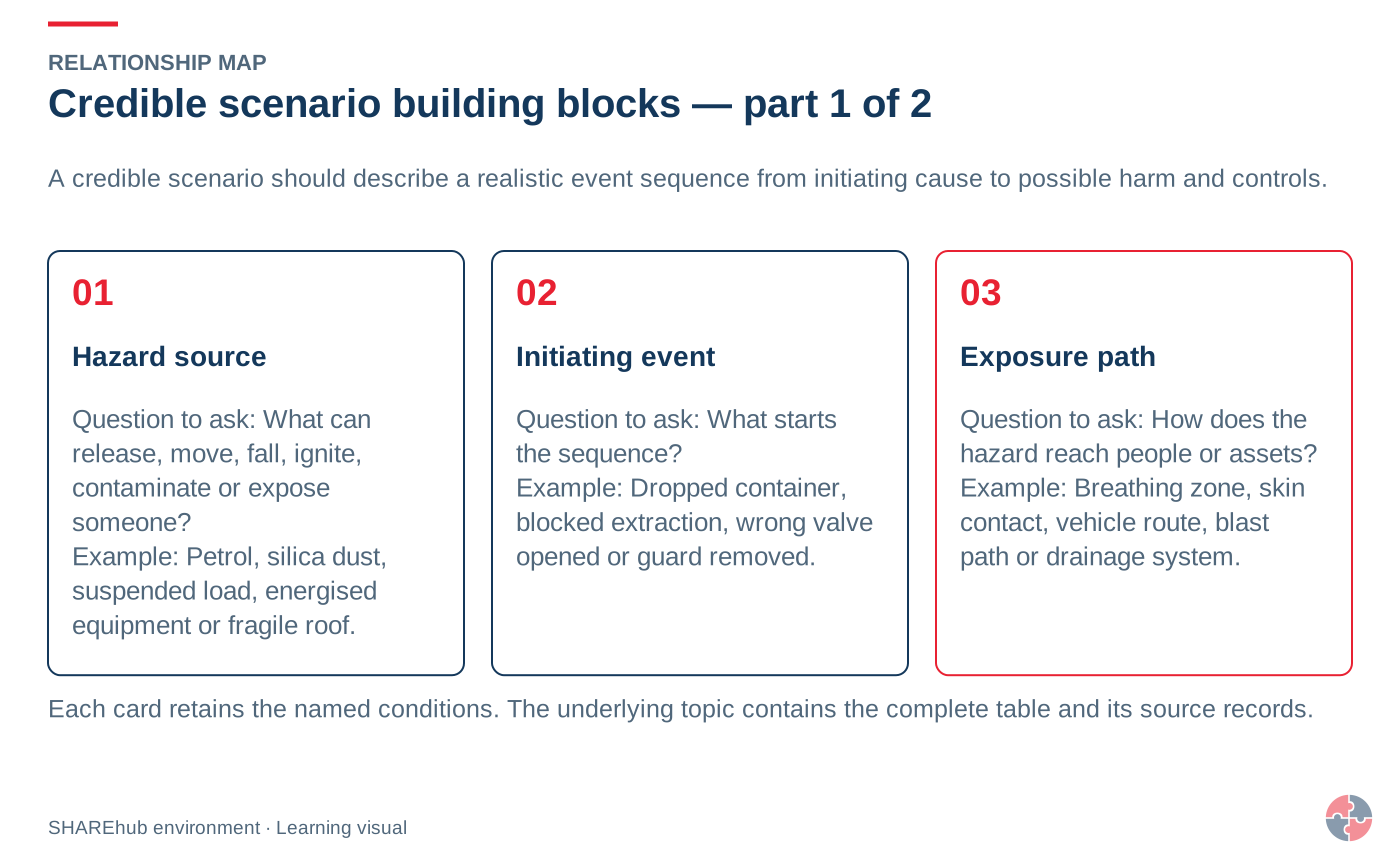
A credible scenario should describe a realistic event sequence from initiating cause to possible harm and controls.
Scenario thinking prevents shallow risk assessments. Instead of writing 'fire risk', describe the actual chain: solvent spill in a bund, vapour spreads to a drain, extraction is off, a non-rated portable tool is used and ignition occurs. That scenario immediately suggests different controls from a generic fire row.
For major accident hazards, credible scenarios should consider inventory, energy, containment, ignition, toxic release, escalation, people affected and emergency response. For everyday occupational safety, they should still show the task, person, trigger, harm and control standard.
Block
Question to ask
Example
Hazard source
What can release, move, fall, ignite, contaminate or expose someone?
Petrol, silica dust, suspended load, energised equipment or fragile roof.
Initiating event
What starts the sequence?
Dropped container, blocked extraction, wrong valve opened or guard removed.
Fatality, occupational disease, fire, explosion, toxic exposure or environmental loss.
Controls and barriers
What prevents, detects, controls or mitigates it?
Design, isolation, LEV, permit, alarm, training, supervision and emergency response.
Escalation
Could the event grow?
Fire impinges on nearby tanks, blocked exits delay evacuation or dust spreads to other areas.
Applied case
A cow moves between a calf handler and the only gate as the calf is approached.
Decision and explanation
Stop the task and use the planned safe withdrawal and competent protection arrangement.
Changed animal position removes safe protection and escape; speed is not a control.
Lesson 3
An escape route must remain available
Assess the handler’s position as cattle and gates move.
Related SHAREhub topic guide. Apply its prompts to the specific case below.
An escape route must remain available
A gate can control cattle while simultaneously trapping the person operating it. The safe position at the start of a move may disappear as the collecting pen fills. A worker then has to climb a barrier or pass between animals to leave. The existence of a gate somewhere in the pen is not evidence that an escape route remains usable from the actual working position.
In the fictional collecting area, follow the handler's route through each stage: animals arrive, the forcing gate moves, the lead animal enters the race and the next group waits. Consider where the worker stands, what could close behind them and how an agitated animal could block access. Plan protected operating positions and suitable escape facilities as part of the handling layout, with competent review of the actual system.
Do not depend on outrunning cattle or squeezing through improvised gaps. A worker trying to climb while being pushed can fall or become trapped. Nor should someone enter a crowded pen solely to demonstrate that a route exists. Evaluate and test arrangements by an appropriate safe method before the real movement. Gates, latches and surfaces need maintenance because a stuck gate can turn an otherwise workable layout into a dead end.
Brief everyone on their roles and on what stops the movement. If the agreed exit or protected position becomes unavailable, pause the work and restore the arrangement through the competent handling plan. The supervisor should verify that temporary storage, equipment and other animals do not obstruct the route. Ask workers to explain the full sequence rather than merely point at an emergency exit symbol. For workplace transfer, draw the worker's location at three stages and identify a safe response to one blocked position. Keep this a fictional planning exercise rather than experimenting with live cattle to test escape speed.
What is the chain from hazard to harm?
Describe source, trigger, route, exposed person and outcome before rating likelihood or selecting controls.
The hazard is not the same as the scenario. A forklift, solvent or pressure vessel has harmful potential; the assessor must describe the trigger, exposure route, person, consequence and each relied-on barrier. If an assumption is uncertain, record it and hold the affected decision until it is resolved.
Source
Credible initiating event and route
Possible harm
Barrier and proof
Forklift
Blind-corner vehicle and pedestrian interaction.
Crush injury.
Separated route observed at peak delivery.
Solvent
Open transfer, vapour migration and ignition.
Fire or serious burns.
Closed transfer, ignition control and tested response.
Silica-containing material
Dry cutting creates respirable dust.
Long-term lung disease.
Designed-out cutting or effective capture verified at task.
Applied case
A closed internal gate leaves the handler between a moving cattle group and a solid wall.
Decision and explanation
A protected working position and usable escape throughout the movement.
The route must be usable from the exposed position at each stage.
Lesson 4
Redesign calf movement before choosing a lift
Avoid awkward handling while keeping animal and worker protected.
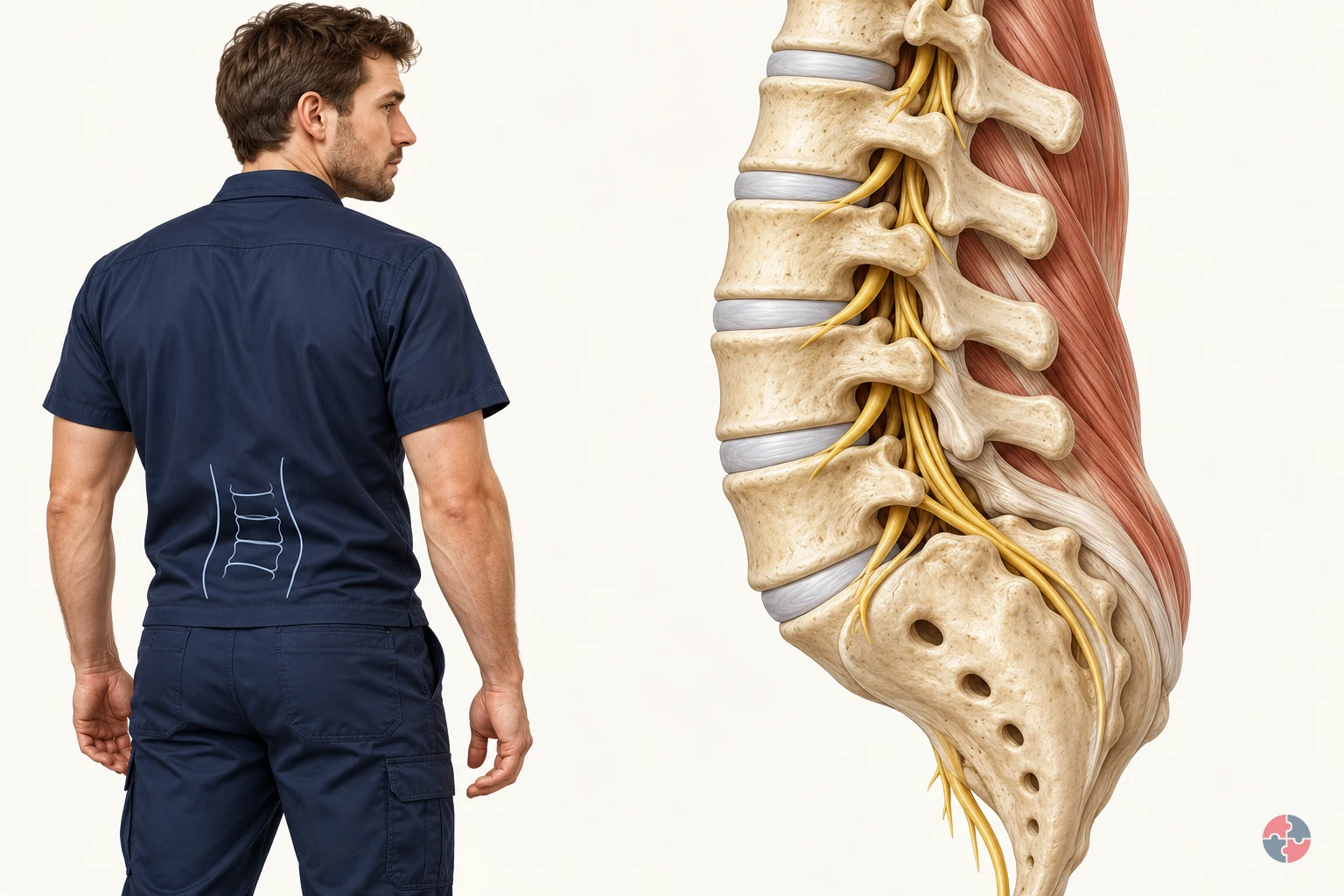
The worker locates the lower back; the separate side view enlarges its bones, discs, nerve roots and nearby muscle.
Locate the lower back. How could the load, reach, route, equipment or work pattern be changed for the task in this lesson?
educational illustration · healthy anatomy; enlarged details and teaching colours.
Teaching graphic from the linked SHAREhub source section.
Redesign calf movement before choosing a lift
A calf is a moving, variable load rather than a uniform box. Its movement, grip, position and the surrounding barriers affect the force on the handler. Lifting over a gate adds reach and height while restricting balance. The worker can strain their back or lose the animal, and a second helper can also be exposed if the animal moves unexpectedly. A familiar estimated weight does not settle those risks.
First ask whether the lift can be avoided by changing access or the handling sequence. Suitable gates, level routes and appropriate animal-handling aids may allow the calf to move without being hoisted over a barrier. The method must suit the animal, task and welfare needs, and it must protect people from other livestock. A trolley or aid is not a solution if the route is too narrow, uneven or contaminated for its use.
Where manual handling remains, a suitable assessment considers the task, individual capability, load and environment, including unpredictable movement and the need for coordination. It should be informed by competent stock-handling knowledge. This course does not prescribe a universal weight limit or a lifting manoeuvre for every calf. Generic technique training cannot compensate for an unnecessary over-barrier lift or missing equipment.
Stop when the agreed aid or safe access is unavailable rather than substituting muscle or an unplanned team lift. The responsible person should arrange a practical alternative and verify that it works over the whole transfer, including release and return. Ask handlers about awkward postures, near misses and early discomfort and arrange appropriate support without diagnosing injury. For the fictional exercise, compare the original over-gate route with an assessed level-access alternative and state what evidence is still needed. Reducing the force and awkwardness at source is a stronger outcome than praising workers for coping with the same difficult lift.
How can the ISO 45001 hierarchy of controls avoid hazardous manual handling and reduce remaining strain?
Avoid hazardous manual handling where reasonably practicable, assess what remains and reduce the injury risk. Training and gloves support the chosen method; they cannot make an unsuitable repetitive lift safe.
Illustrative decision: warehouse workers repeatedly lift stock from floor-level pallets to dispatch benches. The manager and workers examine the whole supply-to-dispatch task, including reaching, twisting, pushing, load stability and differing individual capability.
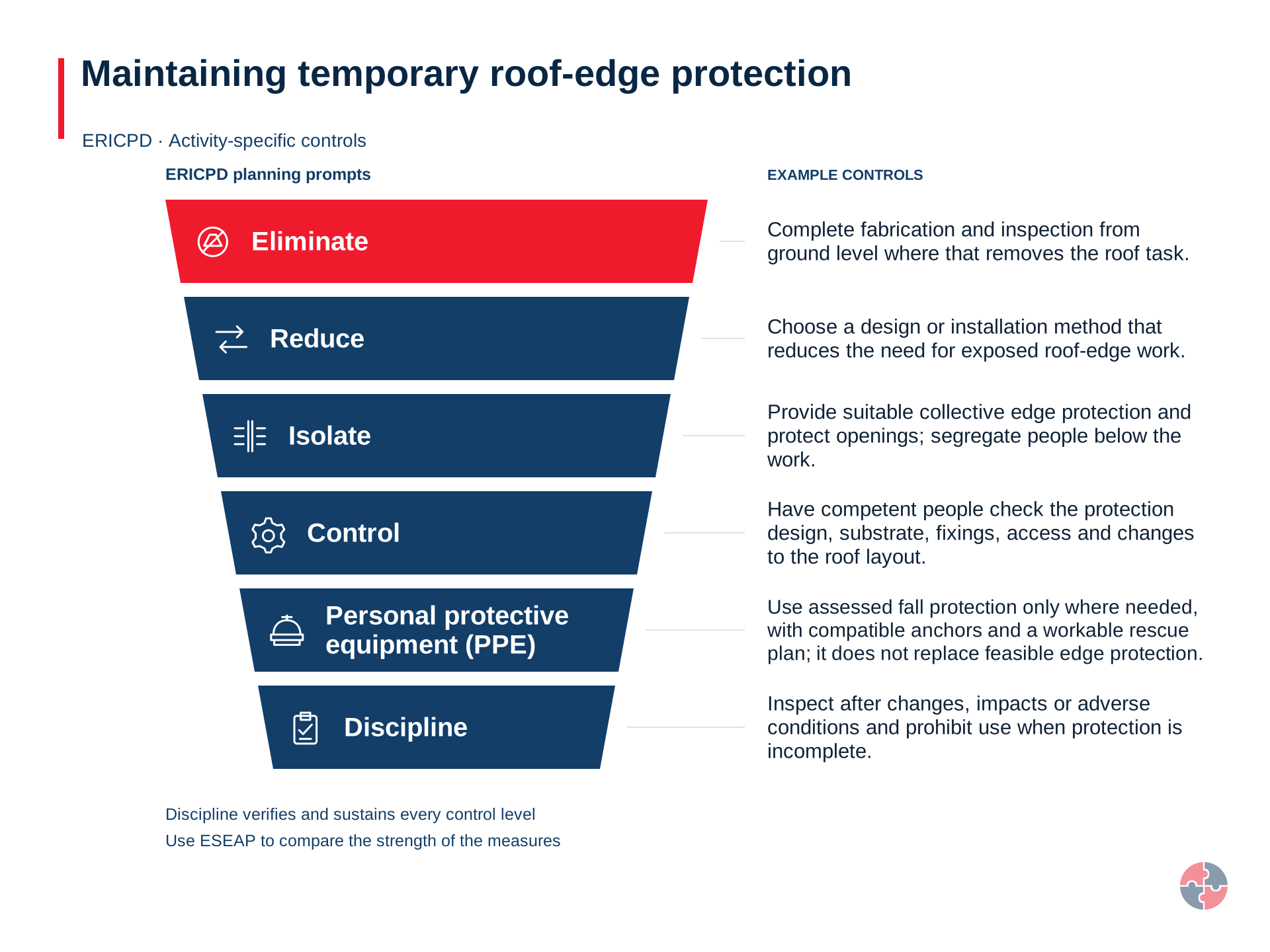
ERICPD means Eliminate, Reduce (including substitution), Isolate, Control, PPE and Discipline. The five-level hierarchy groups measures as elimination, substitution, engineering controls, administrative controls and PPE. They overlap: isolation is usually an engineering measure; control can include engineered and administrative measures. Discipline means maintaining and checking the controls, supervising the method and learning from defects, rather than blaming someone or accepting weaker protection.
How can the ERICPD hierarchy of controls avoid hazardous manual handling and reduce remaining strain?
ERICPD is a planning crossmap. Its prompts do not add a sixth rung or rank Isolate above engineering. Discipline verifies and sustains every control level.
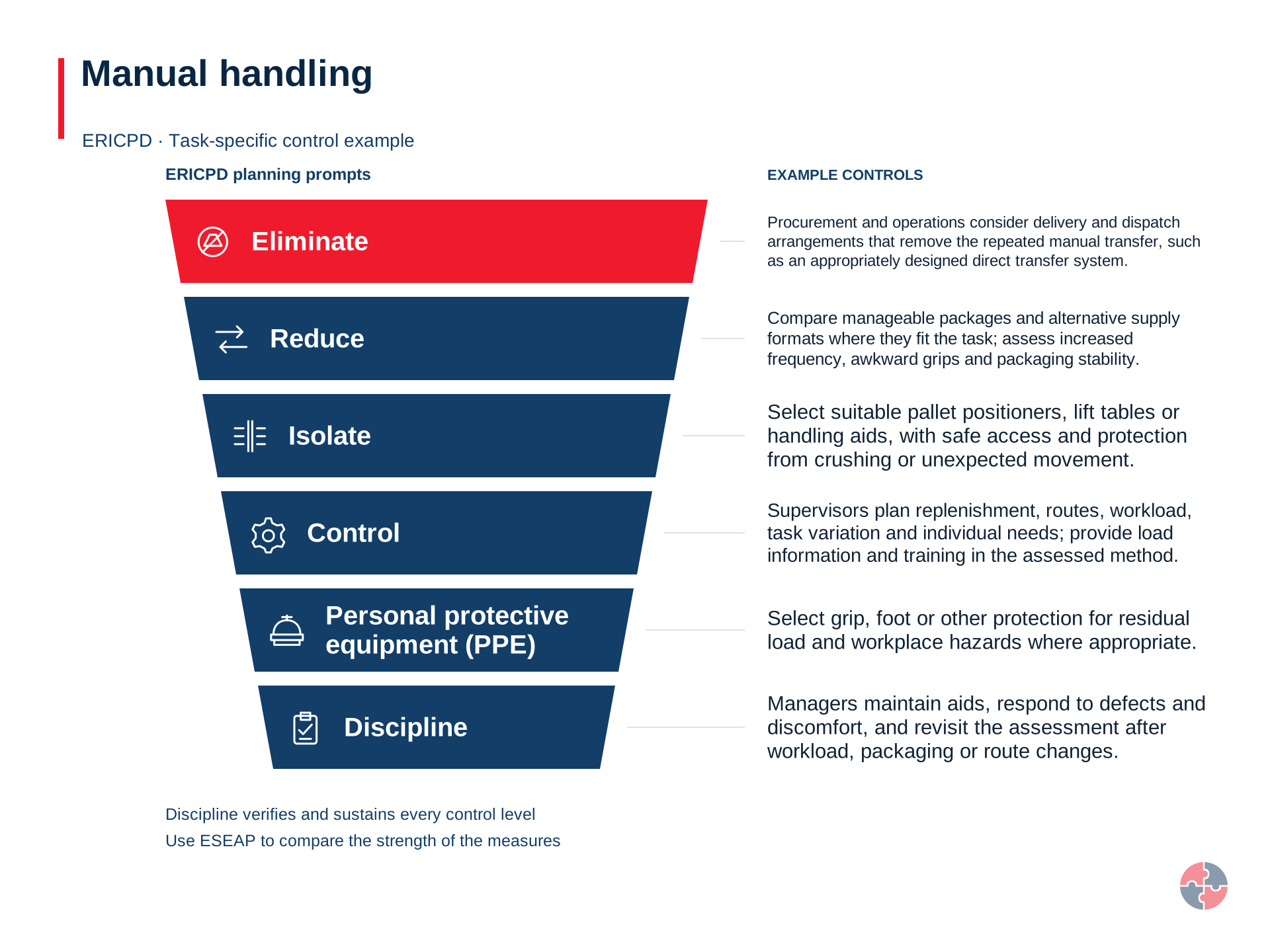
Worked activity: Task application for Manual handling
Activity and release context
ERICPD means Eliminate, Reduce (including substitution), Isolate, Control, PPE and Discipline. The five-level hierarchy groups measures as elimination, substitution, engineering controls, administrative controls and PPE. They overlap: isolation is usually an engineering measure; control can include engineered and administrative measures. Discipline means maintaining and checking the controls, supervising the method and learning from defects, rather than blaming someone or accepting weaker protection.
Procurement and operations consider delivery and dispatch arrangements that remove the repeated manual transfer, such as an appropriately designed direct transfer system.
Observe the complete flow, including replenishment and breakdown recovery. A machine that shifts the lifting burden to another worker has not eliminated the hazardous operation.
Reduce / substitution when replacing a hazard; otherwise engineering or administrative risk reduction
Compare manageable packages and alternative supply formats where they fit the task; assess increased frequency, awkward grips and packaging stability.
Record the total task exposure and worker feedback. No package weight is a universal safe limit; more smaller lifts can still create substantial risk.
Isolate / engineering
Select suitable pallet positioners, lift tables or handling aids, with safe access and protection from crushing or unexpected movement. Design reach and destination heights around the actual task.
Check load capacity, stability, condition, use and the real movement forces. An unsuitable aid or unresolved crush point prevents release of that method.
Control / administrative
Supervisors plan replenishment, routes, workload, task variation and individual needs; provide load information and training in the assessed method.
Watch work at realistic pace and include unusual loads and damaged pallets. A team lift or rotation is not an automatic solution; difficult handling returns to assessment.
PPE / PPE
Select grip, foot or other protection for residual load and workplace hazards where appropriate. Check it does not worsen handling.
Verify fit and condition. Gloves or supportive clothing do not remove musculoskeletal loading or establish a safe lift.
Discipline / sustained engineering and administrative controls
Managers maintain aids, respond to defects and discomfort, and revisit the assessment after workload, packaging or route changes.
Retain task observations and corrective actions. A failed aid or new unstable load requires a safe alternative or pause rather than routine manual workaround.
How can the ISO 45001 hierarchy of controls avoid hazardous manual handling and reduce remaining strain?
The hierarchy of controls in ISO 45001:2018 comes under Clause 8.1.2 (Eliminating hazards and reducing OH&S risks), which is located within Clause 8 ("Operation").
Worked activity: Task application for Manual handling
Activity and release context
ERICPD means Eliminate, Reduce (including substitution), Isolate, Control, PPE and Discipline. The five-level hierarchy groups measures as elimination, substitution, engineering controls, administrative controls and PPE. They overlap: isolation is usually an engineering measure; control can include engineered and administrative measures. Discipline means maintaining and checking the controls, supervising the method and learning from defects, rather than blaming someone or accepting weaker protection.
Procurement and operations consider delivery and dispatch arrangements that remove the repeated manual transfer, such as an appropriately designed direct transfer system.
Observe the complete flow, including replenishment and breakdown recovery. A machine that shifts the lifting burden to another worker has not eliminated the hazardous operation.
Reduce / substitution when replacing a hazard; otherwise engineering or administrative risk reduction
Compare manageable packages and alternative supply formats where they fit the task; assess increased frequency, awkward grips and packaging stability.
Record the total task exposure and worker feedback. No package weight is a universal safe limit; more smaller lifts can still create substantial risk.
Isolate / engineering
Select suitable pallet positioners, lift tables or handling aids, with safe access and protection from crushing or unexpected movement. Design reach and destination heights around the actual task.
Check load capacity, stability, condition, use and the real movement forces. An unsuitable aid or unresolved crush point prevents release of that method.
Control / administrative
Supervisors plan replenishment, routes, workload, task variation and individual needs; provide load information and training in the assessed method.
Watch work at realistic pace and include unusual loads and damaged pallets. A team lift or rotation is not an automatic solution; difficult handling returns to assessment.
PPE / PPE
Select grip, foot or other protection for residual load and workplace hazards where appropriate. Check it does not worsen handling.
Verify fit and condition. Gloves or supportive clothing do not remove musculoskeletal loading or establish a safe lift.
Discipline / sustained engineering and administrative controls
Managers maintain aids, respond to defects and discomfort, and revisit the assessment after workload, packaging or route changes.
Retain task observations and corrective actions. A failed aid or new unstable load requires a safe alternative or pause rather than routine manual workaround.
The comparison is an original illustrative application of the general HSE hierarchy, not a machine-specific method, permit or design approval. The employer must choose measures for the actual work and jurisdiction. Apply the separate Northern Ireland legal route where relevant; the local assessment and competent technical decision govern release.
A calf must reach the treatment area, but the route requires lifting it over a chest-high barrier.
Decision and explanation
Avoid the over-barrier lift through suitable access or a planned handling aid and route.
Task and route redesign address reach, movement and force before technique.
Use the appropriate manual handling assessment
This additional teaching takes about 2–5 minutes, in addition to the course estimate. Optional reading and workplace assessment take additional time.
Start by asking whether the hazardous handling can be removed or redesigned. Where handling remains, observe the whole operation with the people who do it and choose an assessment that fits the work.
A live animal can move unpredictably. MAC and RAPP object-handling scores do not assess lifting or restraining an animal. Retain the course's animal-specific system, facilities and competent assessment. Use these tools only for appropriate inanimate-load work such as supplies or manually moved equipment; consider changes to the whole job before choosing a lift.
TILEO: Task, Individual, Load, Environment and Other factors. MAC: Manual Handling Assessment Charts for appropriate lifting, carrying and team handling. RAPP: Risk Assessment of Pushing and Pulling for appropriate manual pushing and pulling.
Read the portable guide to understand selection, limitations, the mixed-task example and company-branded Word/PDF records. Your existing course checks and completion requirements remain separate.
Interrupt contamination between stock work and clean activities.
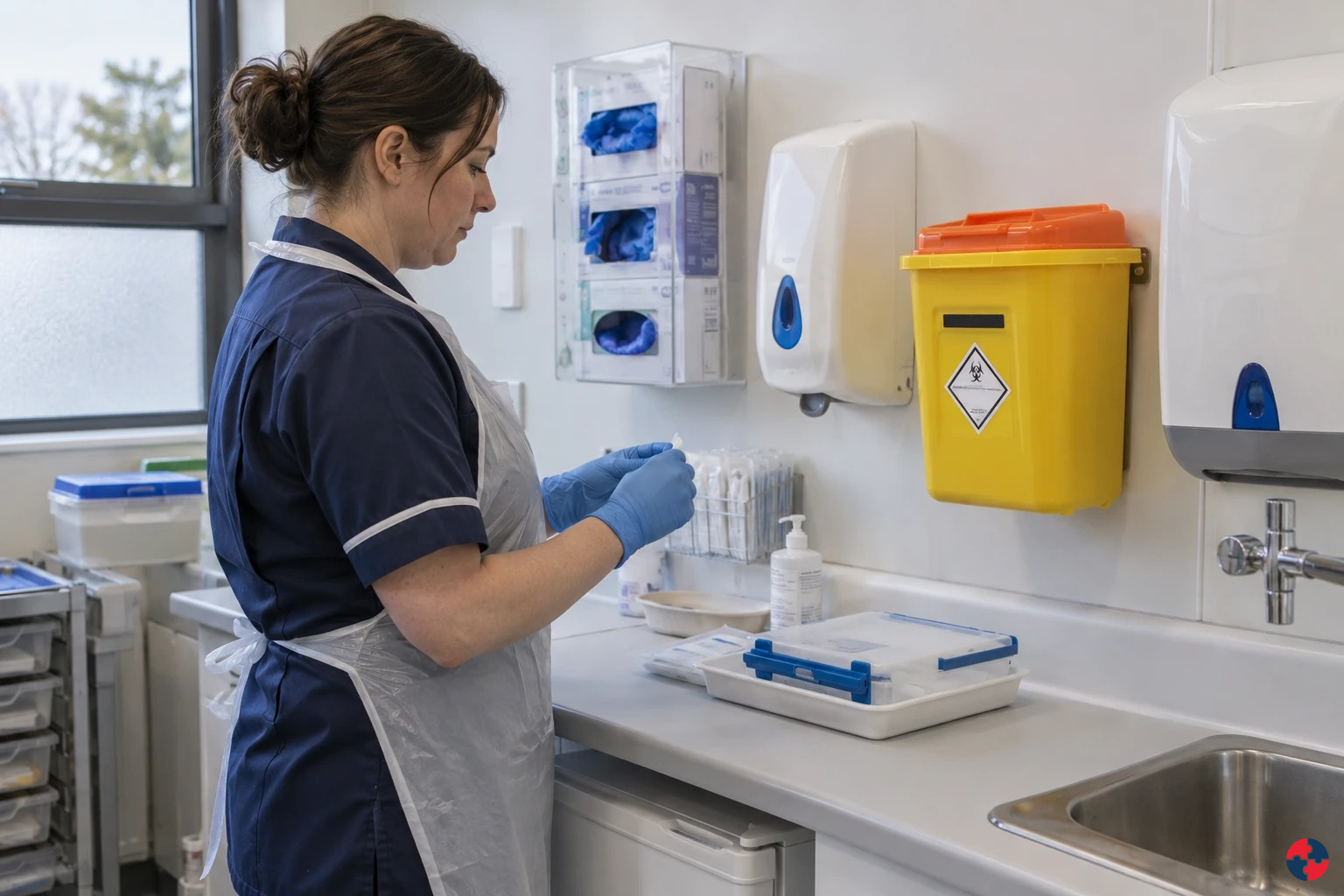
Photorealistic illustrative UK workplace scene. Review checks: Setting: A care worker is punctured by a used needle during disposal. Act: Use safer sharps and a point-of-use container before the task; train staff in a clear post-exposure route and avoid recapping. Hold / review: Do not delay clinical advice while trying to identify the source, and do not let an untrained person handle the contaminated device.
Animal contact continues on hands and clothing
Animals and their surroundings can carry microorganisms without an obvious illness or dirty appearance. Contamination may move from faeces, bedding or equipment onto hands, gloves, boots and clothing. Eating or touching the mouth with contaminated hands can complete an exposure route. A tidy pen and apparently healthy cattle do not establish that infection risk is absent.
Map the fictional worker's journey from handling cattle to removing workwear, washing and entering the meal area. Provide suitable running water, soap and hygienic drying that are actually accessible during the work. Hand gel is not a substitute for washing contaminated hands after animal contact. Keep food and drink out of the animal work area and use a clear dirty-to-clean arrangement for protective clothing and equipment.
The task assessment should also consider splash, damaged skin and any aerosol-generating cleaning, selecting suitable containment, methods and protective equipment. Gloves do not remove the need for safe removal and handwashing and must suit the task. Avoid diagnosing a particular infection from a model cue or prescribing treatment or vaccination. People with individual health concerns need appropriate confidential occupational or clinical advice, and actual work arrangements should reflect that advice.
If there is an exposure, injury or relevant illness concern, follow the reporting and assistance procedure promptly and tell the healthcare professional about the animal-work context where relevant. A supervisor should provide support without sharing private medical details in a team briefing. Verification checks facilities, supplies, route separation and whether workers can use them when the work is busiest. A basin on a floor plan is insufficient if it is locked, unstocked or reached only through the meal area in dirty boots. Record the gap and protective action; do not tick washing as complete when facilities are unavailable.
How can biological agent exposure be controlled at work?
Biological agent exposure is controlled by preventing contact with the source, interrupting transmission and supporting susceptible people.
Control should follow the hierarchy, but biological hazards often need a bundle of controls: containment, hygiene, cleaning, ventilation, vaccination, waste management, PPE, training and rapid response.
The strongest controls remove or contain the source. For example, closed waste systems, engineered sharps safety, controlled water systems and restricted access are stronger than relying only on gloves or reminders.
Discipline remains important because hygiene and reporting depend on people. However, discipline works best when the workplace provides time, facilities, equipment and supervision to make the safe method realistic.
Eliminate. Remove the biological source or avoid the task. Use closed systems, outsource specialist handling or remove contaminated material safely. Not always possible in care, waste, water or animal work.
Reduce. Reduce exposure frequency, people exposed or contamination level. Limit access, reduce aerosol-generating tasks and minimise waste handling. Residual exposure may remain.
Isolate. Separate people from the source. Containment cabinets, segregated rooms, barriers and clean/dirty zones. Breaches occur during maintenance or cleaning.
Control. Use engineering, hygiene and procedural controls. Ventilation, disinfection, handwashing, sharps containers, water treatment and waste segregation. Needs maintenance and verification.
PPE. Protect against residual contact or inhalation. Gloves, eye protection, aprons, masks or RPE depending on route. Can fail through poor selection, removal or contamination.
Discipline. Use training, supervision, reporting and behaviour controls. Hand hygiene, vaccination uptake, incident reporting and exclusion rules. Relies on good culture and adequate facilities.
What should cleaning hand-back tell the next team?
Describe the remaining exposure routes when an area is handed back after contamination work. “Cleaned” can mean visible material was removed; it does not by itself establish that an infectious source has been stopped, the chosen treatment was suitable or later work will avoid aerosolising residue. Agree the intended next use and the evidence needed for that use before the contractor starts.
For an illustrative sewage leak in a service room, the site owner and competent contractor establish which surfaces, equipment and access routes are affected, stop the source safely and use an assessed containment and cleaning method. Hand-back identifies what was treated, any inaccessible or untreated area, waste removed, remaining restrictions and who will decide whether the next task can proceed. If a later contractor needs to open contaminated equipment or use a different cleaning method, assess that activity separately. Keep worker exposure and clinical follow-up information in the appropriate private process rather than including medical details in a general area handover.
The only handwash station has no soap and workers are eating beside their dirty gloves.
Decision and explanation
Restore usable washing and clean/dirty separation before eating, with suitable task controls.
Interrupt the real contamination pathway with usable facilities and work arrangements.
Lesson 6
A handling session needs a coordinated release
Verify people, facilities, animal movement and hygiene together.
Related SHAREhub topic guide. Apply its prompts to the specific case below.
A handling session needs a coordinated release
A livestock task can involve a stockperson, vet, helper and vehicle driver who each see a different part of the operation. The plan fails if one person moves an animal while another believes treatment is about to begin. A signed briefing is useful evidence of a conversation but cannot prove the restraint, escape and hygiene arrangements work at the point of use.
Build the fictional release decision around the actual animal group and task. Check the race and crush, waiting animals, gate operation, protected work positions and the route for moving a calf. Confirm the necessary people have the relevant competence and understand communication. The learner should know their own limits and stop authority without pretending to be a veterinary clinician or livestock-system designer.
Compare observation with records. A maintenance record should lead to checking the repaired gate's safe handback, while a clean welfare checklist should be compared with soap, water and usable access. Ask what has changed since the last session: new animals, a defect, a replacement helper, weather or a blocked route. A previous successful session is useful context but is not permission to ignore the new condition.
If a required arrangement is unavailable, hold the affected task and identify who can resolve it. Keep the hold specific: treatment awaits suitable restraint; movement awaits a clear protected route; a break awaits restored washing and clean separation. An authorised restart should follow verification of the actual correction and a revised briefing where needed. The fictional audit exercise should end with a factual finding, responsible role and close-out evidence, not an invented employee appointment. A safe system allows work to proceed efficiently because the necessary conditions are known, rather than expecting people to adapt around uncontrolled animals or missing facilities.
How should the selected controls be checked in practice?
ERICPD is used here as a planning mnemonic. The linked HSE five-level hierarchy is the official source for the order and relative reliability of controls; the two labels are not identical.
Start with task redesign and substitution, then engineered separation before procedures and personal protection; verify each control under real conditions.
At a fuel depot, tanker overfill can release petrol, form vapour and ignite. The assessment must identify the initiating event, people exposed and each independent prevention or mitigation barrier. Petrol cannot be substituted if the site must supply it, so the record should say why that higher-order option is unavailable for this operation and then demand strong engineered controls. HSE hierarchy of control; HSE hierarchy of control.
ERICPD is a six-stage planning aid; the HSE five-level order separates substitution, engineering and administration. Isolate is usually engineered separation, while ERICPD Control may contain both physical and administrative measures. Discipline sustains the chosen controls and is not an additional permission to expose people.
The crush is repaired but the waiting animal can still reach the vet’s work position.
Decision and explanation
Hold treatment until the whole animal-separation and protected-position arrangement is suitable.
The work position remains exposed even if one component has been repaired.
Lesson 7
Use a suitable cattle handling system
A routine treatment still needs task-suitable restraint.
Photorealistic illustrative UK workplace scene. Review checks: Setting: A care worker is punctured by a used needle during disposal. Act: Use safer sharps and a point-of-use container before the task; train staff in a clear post-exposure route and avoid recapping. Hold / review: Do not delay clinical advice while trying to identify the source, and do not let an untrained person handle the contaminated device.
Understand the activity and how harm develops
The proposed treatment uses a loose gate as restraint. A cow can move forwards, backwards or sideways with enough force to crush the handler or vet. The gate can also transfer that force to a person trying to hold it. Familiarity with the animal does not provide a secure working position.
Look at the full treatment sequence: gathering, entering the race, securing the animal, giving treatment and release. The crush must suit the animal and procedure, with protected access for the people involved. In this exercise, a gate that works for sorting cattle is being wrongly treated as treatment restraint. The team must change the arrangement before the vet enters reach.
Recognise the evidence boundary
Question
Case evidence
What is observed?
Treatment is proposed with a cow held only by a loose gate.
How can harm occur?
The animal could crush or kick the handler or vet.
What information is needed?
Check suitable restraint, handling facilities and handler competence.
Protect, manage and verify
Purpose
Practical application
Immediate protection
Use the assessed crush and trained handlers or defer treatment.
Accountable work arrangement
Defer treatment until a suitable race and crush are available and maintained. Use the restraint features appropriate to the animal and task, with other cattle kept away. Plan protected positions, lighting and escape arrangements for handlers and the visiting vet. Use competent handlers who understand the facilities, animal behaviour and release sequence.
Release verification
Confirm the restraint and protected working positions before treatment.
Apply this at work
Reassess the facilities when animal size, temperament, treatment or visiting personnel change.
How should zoonoses be managed at work?
Zoonoses should be managed by identifying animal or environmental sources, controlling contact and maintaining hygiene, vaccination and reporting arrangements.
Zoonoses are infections that can pass from animals to humans. Workplace routes include bites, scratches, urine, faeces, birth products, bedding, aerosols, ticks, contaminated soil or water and contact with dead animals.
Higher-risk work includes farming, veterinary care, animal handling, pest control, waste, grounds maintenance, forestry, waterway work, laboratories and some construction or demolition activities.
Controls should include animal handling systems, segregation, handwashing, protective clothing, wound care, bite prevention, tick awareness, vaccination where available and prompt reporting of symptoms after exposure.
Rats and animal urine. Leptospirosis risk in water, sewers or contaminated areas. Waterproof PPE, wound covering, hygiene and information.
Livestock. Contact with birth products, faeces or respiratory agents. Segregation, hygiene, PPE and vaccination decisions.
Birds and droppings. Dusts, fungi or bacterial contamination. Wet cleaning, RPE/PPE and exclusion.
Ticks. Outdoor work exposure. Clothing, tick checks and symptom awareness.
Bites and scratches. Broken skin exposure and infection risk. Handling systems, training and first aid.
Animal bedding and waste. Aerosol, dust or contact exposure. Ventilation, dampening, gloves and cleaning.
Applied case
The usual crush is defective. The treatment is routine and the animal has been calm so far.
Decision and explanation
Defer and arrange suitable restraint with the vet and competent handlers.
Human effort against a loose gate does not provide reliable restraint and puts more people in the force path. A short procedure can still trigger a sudden movement while the handler is within crushing or kicking reach. The treatment method must match the facilities and animal. Deferral prevents improvisation around a failed critical control.
Lesson 8
Plan around protective maternal behaviour
Manage the current animal and task, including changes after calving.
Photorealistic illustrative UK workplace scene. Review checks: Setting: A care worker is punctured by a used needle during disposal. Act: Use safer sharps and a point-of-use container before the task; train staff in a clear post-exposure route and avoid recapping. Hold / review: Do not delay clinical advice while trying to identify the source, and do not let an untrained person handle the contaminated device.
Understand the activity and how harm develops
A recently calved cow is watching a worker approach her calf. The worker may focus on the calf and fail to notice how the cow is positioning herself. A cow can close the distance quickly and trap someone against a pen wall. Previous calm handling is not evidence that approaching this calf is safe today.
Consider both animals as part of one movement plan. Safe facilities allow competent handlers to control access and separation while retaining a route out. In the scene, rushing to complete a calf check would place the worker in the pen before the cow-and-calf arrangement is agreed. The decision is to change that arrangement, rather than test the cow reaction at close range.
Recognise the evidence boundary
Question
Case evidence
What is observed?
A recently calved cow turns towards a worker approaching her calf.
How can harm occur?
The cow could charge or trap the worker against the pen.
What information is needed?
Ask about calving status and the planned cow-and-calf handling method.
Protect, manage and verify
Purpose
Practical application
Immediate protection
Use competent help and facilities that protect people from the cow.
Accountable work arrangement
Arrange cow-and-calf handling with competent stockpeople and suitable facilities. Maintain effective separation or restraint appropriate to the planned check. Keep people out of trapping positions between the cow, calf and solid pen features. Agree communication, escape routes and when the check must be postponed.
Release verification
Confirm safe separation, animal movement and an available escape route.
Apply this at work
Include visiting vets, relief workers and anyone unfamiliar with maternal behaviour in the briefing.
How should zoonoses be managed at work?
Zoonoses should be managed by identifying animal or environmental sources, controlling contact and maintaining hygiene, vaccination and reporting arrangements.
Zoonoses are infections that can pass from animals to humans. Workplace routes include bites, scratches, urine, faeces, birth products, bedding, aerosols, ticks, contaminated soil or water and contact with dead animals.
Higher-risk work includes farming, veterinary care, animal handling, pest control, waste, grounds maintenance, forestry, waterway work, laboratories and some construction or demolition activities.
Controls should include animal handling systems, segregation, handwashing, protective clothing, wound care, bite prevention, tick awareness, vaccination where available and prompt reporting of symptoms after exposure.
Rats and animal urine. Leptospirosis risk in water, sewers or contaminated areas. Waterproof PPE, wound covering, hygiene and information.
Livestock. Contact with birth products, faeces or respiratory agents. Segregation, hygiene, PPE and vaccination decisions.
Birds and droppings. Dusts, fungi or bacterial contamination. Wet cleaning, RPE/PPE and exclusion.
Ticks. Outdoor work exposure. Clothing, tick checks and symptom awareness.
Bites and scratches. Broken skin exposure and infection risk. Handling systems, training and first aid.
Animal bedding and waste. Aerosol, dust or contact exposure. Ventilation, dampening, gloves and cleaning.
Applied case
A seasonal worker is asked to tag a calf alone while its mother remains loose in the pen.
Decision and explanation
A competent cow-and-calf handling plan with protective facilities and help.
Distraction is uncertain and does not provide a protected working position or reliable separation. Behaviour changes with calving and the immediate situation. Past familiarity cannot establish safe access now. The plan must control both animals and protect the worker during approach, treatment and withdrawal.
Lesson 9
Keep an escape route during cattle movement
An escape provision only works when it is usable during the actual movement.
Photorealistic illustrative UK workplace scene. Review checks: Setting: A care worker is punctured by a used needle during disposal. Act: Use safer sharps and a point-of-use container before the task; train staff in a clear post-exposure route and avoid recapping. Hold / review: Do not delay clinical advice while trying to identify the source, and do not let an untrained person handle the contaminated device.
Understand the activity and how harm develops
The handler is inside a collecting pen with a solid gate behind them. Moving cattle may occupy the apparent gap before the person can leave. Pen dimensions that suit animal flow do not automatically give people protected space. A gate can become a moving crushing surface when several animals press against it.
Trace where the handler stands at every stage of gathering and releasing the group. The safe position should not depend on climbing faster than the cattle move. In this exercise, use the working side of a suitable forcing arrangement and check escape provisions before bringing animals in. Too many cattle in the pen can defeat an otherwise workable layout.
Recognise the evidence boundary
Question
Case evidence
What is observed?
A handler stands between cattle and a closed solid gate.
How can harm occur?
Crowding cattle could crush the handler with no escape.
What information is needed?
Check pen layout, escape arrangements and the movement plan.
Protect, manage and verify
Purpose
Practical application
Immediate protection
Use protected handling positions and suitable escape arrangements.
Accountable work arrangement
Use the protected working side of purpose-designed handling facilities. Maintain suitable escape arrangements without requiring someone to enter the cattle pressure area. Control group size, animal flow and gate movements with competent handlers. Repair damaged gates and remove obstructions before starting the movement.
Release verification
Confirm the handler can leave the danger area throughout the task.
Apply this at work
Check the same trapping logic at loading ramps, feed barriers and temporary collecting pens.
How should zoonoses be managed at work?
Zoonoses should be managed by identifying animal or environmental sources, controlling contact and maintaining hygiene, vaccination and reporting arrangements.
Zoonoses are infections that can pass from animals to humans. Workplace routes include bites, scratches, urine, faeces, birth products, bedding, aerosols, ticks, contaminated soil or water and contact with dead animals.
Higher-risk work includes farming, veterinary care, animal handling, pest control, waste, grounds maintenance, forestry, waterway work, laboratories and some construction or demolition activities.
Controls should include animal handling systems, segregation, handwashing, protective clothing, wound care, bite prevention, tick awareness, vaccination where available and prompt reporting of symptoms after exposure.
Rats and animal urine. Leptospirosis risk in water, sewers or contaminated areas. Waterproof PPE, wound covering, hygiene and information.
Livestock. Contact with birth products, faeces or respiratory agents. Segregation, hygiene, PPE and vaccination decisions.
Birds and droppings. Dusts, fungi or bacterial contamination. Wet cleaning, RPE/PPE and exclusion.
Ticks. Outdoor work exposure. Clothing, tick checks and symptom awareness.
Bites and scratches. Broken skin exposure and infection risk. Handling systems, training and first aid.
Animal bedding and waste. Aerosol, dust or contact exposure. Ventilation, dampening, gloves and cleaning.
Applied case
The pen is fuller than usual and feed sacks now block the personnel escape opening.
Decision and explanation
Stop, restore the escape arrangement and adjust the cattle movement plan.
A stick cannot guarantee space or prevent crushing against the solid gate. Speed increases uncertainty and does not restore the blocked route or protected working position. The handler needs a workable route throughout the movement, with group size and gate operation matched to the facilities.
Lesson 10
Avoid lifting unpredictable live loads
Design the transfer around the animal rather than forcing the animal through poor access.
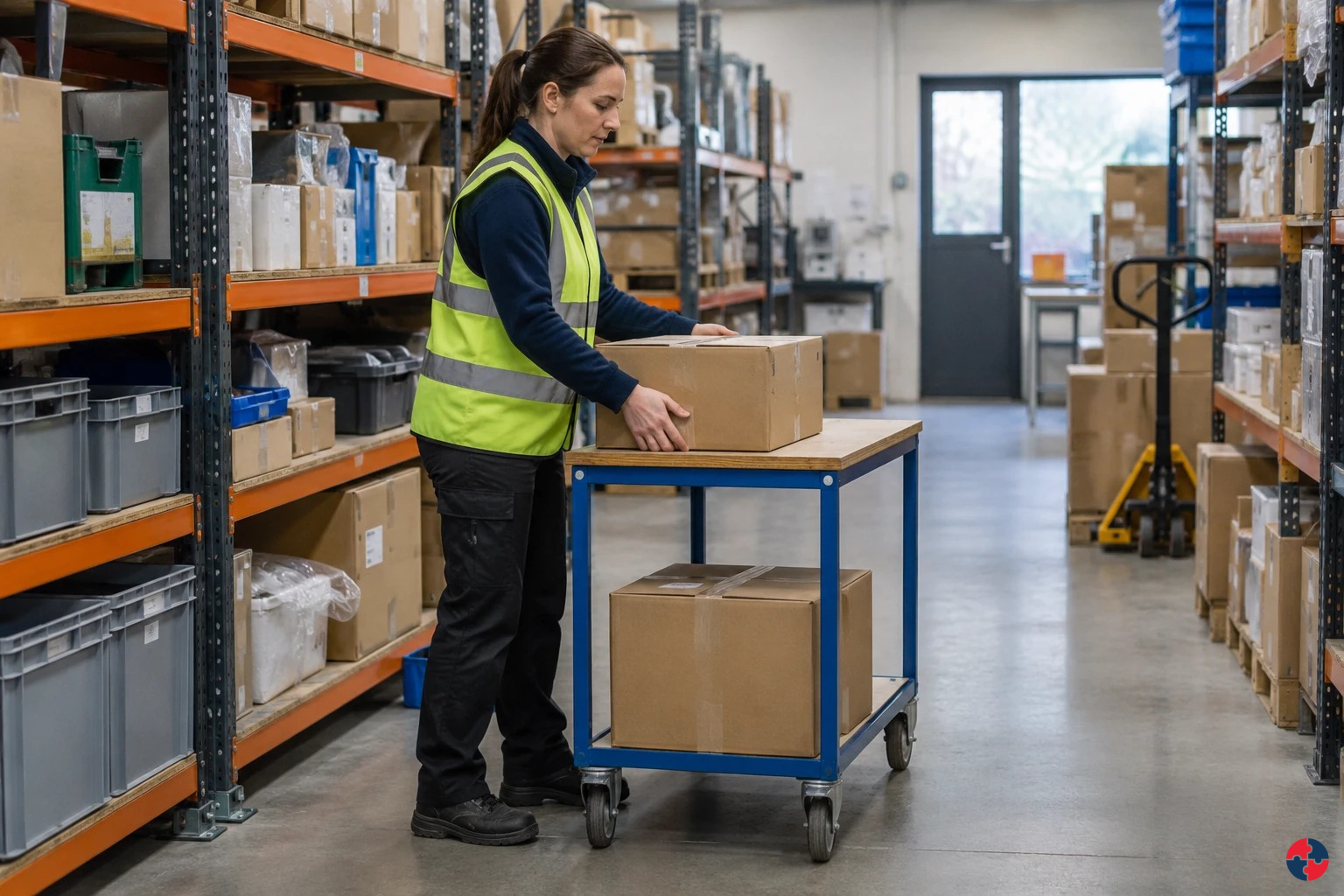
Photorealistic illustrative UK workplace scene. Review checks: Find: Heavy boxes are picked from the floor and twisted into a cage. Change: Raise the pick position, reorient the cage and repair the threshold. Verify: Maintain cage wheels and observe handling during a realistic peak.
Understand the activity and how harm develops
The calf must be moved across a high barrier. Unlike a bag of feed, it can struggle or shift its weight unexpectedly while the handler is bent and reaching. The mother may also approach during the lift. The handling assessment therefore combines the load, posture, route, equipment and animal behaviour.
Look first for a way to avoid the lift: a suitable gate, lower access or assessed handling aid may allow the calf to move without being raised over the barrier. Adding a second person can help only where the whole method is suitable and coordinated. It does not automatically solve poor access or an uncontrolled cow nearby.
Recognise the evidence boundary
Question
Case evidence
What is observed?
A worker plans to lift a struggling calf over a high barrier.
How can harm occur?
The load could twist suddenly and injure the worker's back.
What information is needed?
Assess the calf, barrier, route and available handling aids.
Protect, manage and verify
Purpose
Practical application
Immediate protection
Avoid the lift through suitable access and assessed handling equipment.
Accountable work arrangement
Change access so the calf does not need to be lifted over the barrier. Select a suitable animal handling aid and method for the size and condition of the calf. Separate or suitably control the cow before people handle the calf. Plan the route, footing, communication and any assessed team handling.
Release verification
Check the revised method works without lifting over the barrier.
Apply this at work
Apply task-load-individual-environment thinking to feed sacks, medicine crates and awkward farm spares too.
What is the difference between TILE, TILEO and TILEE?
TILE, TILEO and TILEE are practical prompts that help assess the whole handling situation rather than focusing only on load weight.
TILE is the core prompt: Task, Individual, Load and Environment. It reflects the main risk factors HSE expects employers to consider when assessing manual handling. TILEO adds Other factors, such as work organisation, time pressure, communication, PPE, fatigue, team handling, handling aids and recovery. TILEE is used by some organisations as a further extension; the final E should be defined in the organisation's standard, most usefully as Equipment, Ergonomics or Existing controls. Sources: HSE L23 Manual handling guidance on regulations; HSE manual handling at work
The important point is not which acronym is used, but whether the assessment identifies the real risk factors and produces better work design. A TILE/TILEO/TILEE assessment should lead to avoiding the handling where possible, reducing load and reach, improving equipment, changing routes and heights, reducing repetition, supporting individuals and reviewing the work after change. Sources: HSE L23 Manual handling guidance on regulations; HSE manual handling at work
The calf is heavier than expected and the only available route still involves leaning over the barrier.
Decision and explanation
Stop and arrange suitable access and a handling method for this calf.
Speed does not control unpredictable movement and can increase twisting and loss of balance. This transfers the problem to another person in a cramped position without establishing a suitable handling method. The route and aid should be selected for the real load and conditions before workers commit to the lift.
Lesson 11
Break the contamination route to welfare
Hygiene needs facilities, separation and a workable routine together.
Photorealistic illustrative UK workplace scene. Review checks: Setting: A care worker is punctured by a used needle during disposal. Act: Use safer sharps and a point-of-use container before the task; train staff in a clear post-exposure route and avoid recapping. Hold / review: Do not delay clinical advice while trying to identify the source, and do not let an untrained person handle the contaminated device.
Understand the activity and how harm develops
The worker has cleaned cattle pens and starts eating without washing. Contamination can pass from dung, bedding, gates or gloves to hands and then to the mouth. Small cuts are another possible entry route. Clean-looking hands are not evidence that this pathway has been interrupted.
Trace the journey from the pen to the welfare table. A distant or unstocked basin encourages shortcuts, especially for relief and seasonal workers. In this scene, the practical solution includes facilities people can actually use, a clear dirty-to-clean routine and an eating area that stays separate from work contamination. Gloves themselves can carry contamination and do not replace handwashing.
Recognise the evidence boundary
Question
Case evidence
What is observed?
A worker eats after cleaning pens without washing contaminated hands.
How can harm occur?
Animal contamination could enter the mouth or broken skin.
What information is needed?
Check handwashing facilities and the separation of work and eating areas.
Protect, manage and verify
Purpose
Practical application
Immediate protection
Provide washing, cover cuts and keep food in clean welfare areas.
Accountable work arrangement
Keep food, drinks and smoking in designated clean areas away from livestock work. Provide accessible running water, soap and suitable drying facilities; maintain supplies. Wash hands before eating and after contaminated work or glove removal; cover cuts appropriately. Provide task-suitable protective clothing and keep contaminated workwear out of clean welfare areas.
Release verification
Confirm facilities are stocked and workers can follow the hygiene routine.
Apply this at work
Use the same clean-boundary thinking for slurry work, rodent control, calving equipment and contaminated laundry.
How should zoonoses be managed at work?
Zoonoses should be managed by identifying animal or environmental sources, controlling contact and maintaining hygiene, vaccination and reporting arrangements.
Zoonoses are infections that can pass from animals to humans. Workplace routes include bites, scratches, urine, faeces, birth products, bedding, aerosols, ticks, contaminated soil or water and contact with dead animals.
Higher-risk work includes farming, veterinary care, animal handling, pest control, waste, grounds maintenance, forestry, waterway work, laboratories and some construction or demolition activities.
Controls should include animal handling systems, segregation, handwashing, protective clothing, wound care, bite prevention, tick awareness, vaccination where available and prompt reporting of symptoms after exposure.
Rats and animal urine. Leptospirosis risk in water, sewers or contaminated areas. Waterproof PPE, wound covering, hygiene and information.
Livestock. Contact with birth products, faeces or respiratory agents. Segregation, hygiene, PPE and vaccination decisions.
Birds and droppings. Dusts, fungi or bacterial contamination. Wet cleaning, RPE/PPE and exclusion.
Ticks. Outdoor work exposure. Clothing, tick checks and symptom awareness.
Bites and scratches. Broken skin exposure and infection risk. Handling systems, training and first aid.
Animal bedding and waste. Aerosol, dust or contact exposure. Ventilation, dampening, gloves and cleaning.
Applied case
A worker removes dirty gloves, uses hand sanitiser and starts eating beside the pen.
Decision and explanation
Use proper handwashing and the designated clean eating area.
Fresh gloves do not correct the contaminated surroundings or establish that hands and food-contact surfaces are clean. Glove removal and contaminated surfaces can transfer material. Wearing gloves does not establish that exposure was prevented. The response breaks the contamination route and moves food away from the livestock work environment.
Lesson 12
Treatment day: protect the animal-handling chain
Resolve several interacting gaps before cattle treatment begins.
Related SHAREhub topic guide. Apply its prompts to the specific case below.
Treatment day: protect the animal-handling chain
The fictional farm schedules a calf check while an adult cattle group is moving through the collecting pen. A repaired crush is available, but its handback has not been demonstrated. An unsecured animal waits behind the treatment position. The usual calf route is blocked, so a helper proposes lifting it over a gate. A recently calved cow is moving towards the helper, and the handwash station has run out of soap. These are exercise facts, not findings about a real farm.
Identify the separate harm pathways before deciding what may proceed. Inadequate restraint can expose the treatment worker to kicking, head movement or crushing. The waiting animal can reach a person who is concentrating on the calf. Protective maternal behaviour can block withdrawal. The proposed lift adds awkward reach and an unpredictable moving load. Contamination on hands and clothing can travel into the meal area. Do not collapse all of these into a single description such as “livestock risk”.
Choose a protective pause for the affected handling and treatment. The responsible stockperson and visiting professional should agree suitable facilities, animal separation, work positions and communication for their actual task. Restore a workable calf route or choose an appropriately assessed handling aid and method. Do not solve the blocked route by asking more people to lift or by sending a helper into the cow's path. Preserve animal welfare while preventing exposure; hurried or forceful improvisation can increase agitation and danger.
Request evidence that addresses each gap. A repair record should be followed by the required competent handback of the crush and gates. Confirm that other animals cannot enter or reach the treatment position and that the handler can leave at each stage. Verify the revised calf movement over its full route rather than checking only the starting position. Restore handwashing supplies and clean/dirty separation before eating or other clean tasks. A bottle of gel on the meal table is not a substitute for washing contaminated hands.
Different roles have different authority. The stockperson coordinates animal handling, the veterinary professional controls clinical decisions within their role, and the supervisor ensures facilities, staffing and restrictions are understood. Learners must not invent a treatment plan, diagnose animal behaviour or appoint themselves as competent repairers. Anyone observing an uncontrolled exposure should use the agreed stop and reporting route. The course certificate cannot create practical stock-handling competence.
Before releasing the session, explain how people remain protected from arrival through treatment, release, cleaning and the break. Include what happens if a gate jams, the cow moves unexpectedly or communication fails. Keep unresolved facts visible with a named responsible role rather than a fabricated individual's details. Review the session from safe observations and worker feedback afterwards. The final exercise decision should state the hold, controls, verification and authorised restart; a successful practice score records understanding without releasing a real livestock task.
How should the basic risk assessment process work?
The process should identify hazards, decide who may be harmed, evaluate risk, record significant findings and review the controls.
The familiar five-step model is only useful when each step is done honestly. Walking the workplace, checking incident data, speaking to workers, reviewing maintenance, reading safety data sheets and observing non-routine work will usually reveal more than a desk exercise.
The output should be understandable to the people who use it. A supervisor should know what must be in place before work starts. A worker should know the task controls and stop-work triggers. A manager should know what resources and review evidence are required.
Step
What good looks like
Evidence
Identify hazards
Task observation includes normal, abnormal, maintenance, cleaning and emergency conditions.
Walkthrough notes, worker input and hazard register.
Decide who may be harmed
Employees, contractors, visitors, public, vulnerable workers and emergency responders are considered.
People-at-risk section and consultation evidence.
Evaluate risk
Existing controls are tested, not assumed.
Inspection findings, monitoring data, maintenance records and competence checks.
Record findings
Significant risks, controls, action owners and review triggers are clear.
Assessment, action tracker and risk register.
Review
Assessment changes after incidents, changes, new information or weak control evidence.
The visiting professional is ready and the helper says the calf lift will take only seconds.
Decision and explanation
Pause the affected work until suitable restraint, separation, calf movement, escape and washing arrangements are verified.
Multiple exposure paths remain. A short task or repair receipt cannot substitute for the complete handling system.
Lesson 13
Take a verified action into the workplace
Connect one actual task to an owner, evidence and a clear release or escalation decision.
Related SHAREhub topic guide. Apply its prompts to the specific case below.
Turn awareness into a practical question
Great Britain farm-work awareness. Confirm the relevant national fire, environmental and pesticide route. Specialist livestock, machinery, electrical, work-at-height, pesticide, confined-space and rescue tasks require their actual competent assessment and authorisation; this course confers none.
Choose one relevant operation from the course. Describe the person or environment at risk, the mechanism of harm and the exact condition that needs controlling. Separate an observation from a conclusion. A display, signature, badge or clean appearance answers only a limited question.
Use the included practice resources to prepare a fictional task brief, risk review or verification question. Decide which competent role owns the decision and which evidence must be available before work restarts or work is released. Keep worker protection, public exclusion, task acceptance and environmental decisions distinct where required.
At work, use your actual approved arrangements. Report uncertainty and preserve the relevant hold, restriction or safe state while it is resolved. Confirm that the action addressed the original harm route and check whether another shift, load, cleaning task or maintenance change could reintroduce it.
Course completion records awareness learning. It does not establish practical competence, certify an organisation or authorise specialist, clinical, maintenance, chemical or emergency work.
How should the basic risk assessment process work?
The process should identify hazards, decide who may be harmed, evaluate risk, record significant findings and review the controls.
The familiar five-step model is only useful when each step is done honestly. Walking the workplace, checking incident data, speaking to workers, reviewing maintenance, reading safety data sheets and observing non-routine work will usually reveal more than a desk exercise.
The output should be understandable to the people who use it. A supervisor should know what must be in place before work starts. A worker should know the task controls and stop-work triggers. A manager should know what resources and review evidence are required.
Step
What good looks like
Evidence
Identify hazards
Task observation includes normal, abnormal, maintenance, cleaning and emergency conditions.
Walkthrough notes, worker input and hazard register.
Decide who may be harmed
Employees, contractors, visitors, public, vulnerable workers and emergency responders are considered.
People-at-risk section and consultation evidence.
Evaluate risk
Existing controls are tested, not assumed.
Inspection findings, monitoring data, maintenance records and competence checks.
Record findings
Significant risks, controls, action owners and review triggers are clear.
Assessment, action tracker and risk register.
Review
Assessment changes after incidents, changes, new information or weak control evidence.