
Hazardous substances in construction
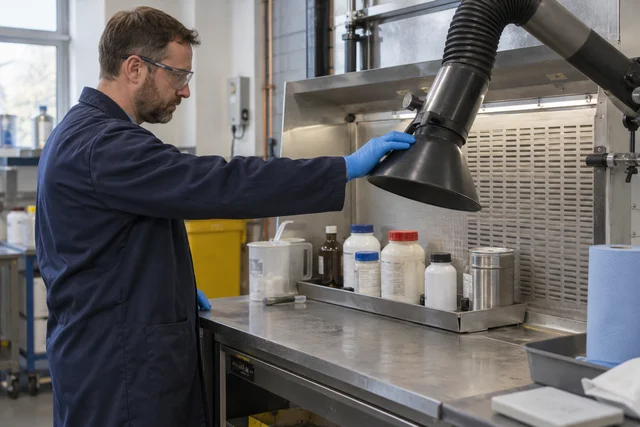

Control cement, coating and lead exposure across construction tasks and cleanup.
Full public teaching and readers are free to read without an account. A free learner account is required for confirmed saved assessment, completion and certificate records in the LMS.
What you will work through
Fictional Mill Lane refurbishment: a crew mixes cement products, applies a two-part coating and renovates old painted metalwork while other trades work nearby. Build defensible task decisions using product information, exposure assessment and verified controls. Competent people retain assessment, medical and live-work authority.
The course has 5 modules and 18 lessons, with teaching, applied activities, feedback and a check of understanding throughout. There are 3 practice pauses in the actual construction model, with an equivalent accessible text route. Public interactive practice is separate from confirmed LMS assessment and completion records.
Explore the interactive practice copy. Return to the LMS route for recorded learning.
Learning outcomes
- Use substance information to assess cement, coating and lead exposure in the actual task.
- Select source controls, separation and hygiene for the relevant exposure routes.
- Distinguish control verification, exposure monitoring and appropriate health arrangements.
Course outline
Know the task and exposure
- Map the substance to the taskAssess substances used or generated across the whole task, including other people and secondary handling.
- Use labels and safety data intelligentlyReliable identity and relevant supplier information are inputs to a workplace assessment, not substitutes for it.
- Choose controls in the right orderPrioritise elimination, substitution and source control, then coordinate remaining exposure controls for all affected people.
- Model practice: cement reaches the skinWet cement can cause serious injury; prevent prolonged contact and provide prompt suitable decontamination and response.
Control cement and coatings
- Prevent wet cement skin and eye contactPrevent contact through method and suitable protection, and make prompt washing and response practical at the workface.
- Control dry handling, mixing and cleanupControl exposure through handling, mixing and cleanup; a later dusty method can defeat the earlier source controls.
- Recognise isocyanate exposure and sensitisationProduct and application method together determine exposure; spraying needs a suitable assessed control system and protection of others.
- Model practice: the coating beside other tradesThe coating controls must protect all affected people throughout application, clearing, cleaning and re-entry.
Manage lead and protect health
- Verify extraction and respiratory protectionRespiratory protection is hazard, task and wearer specific; it supports verified source controls and cannot be selected by appearance.
- Identify lead before disturbing old finishesEstablish the material and control method before disturbance; old coatings can expose the operator and others through dust and contamination.
- Model practice: dry stripping the old paintLead control starts before disturbance and continues through cleanup, hygiene and waste; symptoms and later tests cannot replace prevention.
- Break the contamination route to the mouth and homeControl secondary contamination through usable hygiene and clothing arrangements, protecting welfare spaces and people beyond the task.
Sustain the controls
- Distinguish exposure monitoring from health surveillanceMonitoring and surveillance support prevention and response; neither overrides current control failure or removes confidentiality obligations.
- Respond to symptoms and exposure incidentsRespond promptly and use appropriate clinical and occupational-health support; do not expose someone again to test a theory.
- Store, clean and dispose safelyKeep identification and exposure controls through storage, cleaning and waste; use competent material-specific arrangements for uncertain residues.
Prove the workface decision
- Coordinate and verify the whole work zoneA relevant change triggers review when it occurs; current physical controls and shared understanding determine readiness.
- Capstone: the three-task refurbishmentEvery relevant exposure route and task interface must be addressed; a strong control for one hazard cannot cancel another unresolved critical gap.
- Create a practical control-improvement actionMeaningful improvement links the task and exposure to a specific effective control, clear ownership and physical verification.
Assessment and completion
Complete the required lessons and activities, then take the 20-question final assessment. The pass threshold is 80% plus every designated critical safety answer. Points and badges cannot compensate for a critical error.
Use the LMS to save and resume confirmed progress. Certificate availability follows its passed-completion and grade conditions. Browser practice and printed learning pages do not issue the official LMS record.
Independent construction learning. Completion records learning within the course scope; competent site assessment, practical training and task authorisation remain necessary. It does not confer a NEBOSH qualification.
Sources and learning provenance
The teaching draws on public SHAREhub topic pages and structured source records, with original fictional workface cases. Use the linked primary guidance and the applicable jurisdiction when planning a live task.
- HSE: Construction cement
- HSE: Construction isocyanates
- HSE: Construction lead
- HSE: COSHH assessment
- HSE Principles of good control practice
- HSE Chemical safety data sheets
- HSE Monitoring control of exposure
- HSE COSHH health surveillance
- HSENI Control of Substances Hazardous to Health
- HSE GB CLP Regulation (Live page updated May 2026)
- HSE UK REACH explained
- HSE G409 Exposure measurement air sampling
- HSE EH40 publication
- HSE Workplace exposure limits
- HSENI EH40 publication
- HSE L5 COSHH Approved Code of Practice (Sixth edition published 2013)
- HSE hierarchy of controls
- IOSH hierarchy of control guidance
- HSE Control measures for hazardous substances
- HSE COSHH emergencies
- HSE Health surveillance record keeping
- Control of Substances Hazardous to Health Regulations (Northern Ireland) 2003 (2003, as amended)
- Control of Substances Hazardous to Health Regulations 2002 (2002, as amended)
- HSE COSHH overview
- HSE COSHH personal protective equipment
- HSE using chemicals at work
- HSE COSHH basics
- HSE choosing protective gloves
- HSE Managing for health and safety (HSG65)
- HSENI risk assessment guidance
- HSE CLP in GB and NI
- HSE DSEAR
- HSE local exhaust ventilation
- HSENI subordinate legislation list
- RR1208: diesel and biodiesel mist testing
- About dangerous substances
- Dispensing petrol as a fuel: physical hazards
- Petrol dispensing premises: DSEAR risk assessments, GN75
- HSE chemical classification
- HSE labelling and packaging
- HSE safety data sheets
- HSE Northern Ireland notifications
- GOV.UK comply with UK REACH
- HSENI CLP
- HSENI SDS section headings
- NHS acid and chemical burns
- NHS: Eye injuries
- Health and Safety Executive: Structure and functions of the skin
- Health and Safety Executive: Understanding the causes of skin disease
- Oxford Health NHS Foundation Trust: The Skin — Community Tissue Viability Team
- NHS: Contact dermatitis — causes
- Health and Safety Executive: How do I prevent skin problems in my business?
- NHS: Cuts and grazes
- Moorfields Eye Hospital NHS Foundation Trust: What makes up your eye
- Moorfields Eye Hospital NHS Foundation Trust: Dry eye: the tear film
- Oxford University Hospitals NHS Foundation Trust: Tackling vision loss: normal signal pathway
- University Hospitals Dorset NHS Foundation Trust: Chemical injury to the eye
- HSE: Using the right type of PPE
- University Hospital Southampton NHS Foundation Trust: Eye emergency department
- HSE: Health risks from welding: arc-eye
- Guy’s and St Thomas’ NHS Foundation Trust: Corneal abrasion
- NHS Organ Donation: About cornea donation
- HSE construction dust
- HSE construction dust FAQ
- HSE respirable silica
- HSE dry sweeping
- HSE respiratory protective equipment
- HSE skin exposure controls
- HSENI occupational lung disease
- NHS: Shortness of breath
- HSE: Asphyxiation hazards in welding and allied processes
- HSG276 - Isocyanate paint spraying
- Frimley Health NHS Foundation Trust: How your lungs work
- Central and North West London NHS Foundation Trust: How do we breathe?
- University Hospitals of North Midlands NHS Trust: My lung surgery: about your lungs
- Cambridge University Hospitals NHS Foundation Trust: Breathing techniques to ease breathlessness: muscles involved
- Blackpool Teaching Hospitals NHS Foundation Trust: Pleural clinic
- HSE: Asthma: an overview
- NHS: Asthma
- HSE: Flour dust and risks to bakers
- HSE: Advice for employers: occupational asthma
- HSE: Construction dust: cutting paving blocks, kerbs and flags
- NHS: Silicosis
- HSE: Why is asbestos dangerous?
- HSE: Respiratory protective equipment at work
- Health and Safety Executive: Asbestos essentials
- Health and Safety Executive: Welding fume: protect your workers
- INDG388 - Safety in isocyanate paint spraying
- HSG53 - Respiratory protective equipment at work
- HSE - RPE for vehicle paint spraying
- HSE - Biological monitoring and paint spraying
- HSE - Health surveillance in motor vehicle repair
- GB RIDDOR reporting guidance
- HSENI - Report a disease (NI2508A)
- HSE isocyanate paint spraying
- HSE: how to manage health and safety
- HSE - Construction isocyanates: spraying
- HSE - Vehicle spray painter
- HSE - Isocyanates biological monitoring
- INDG479 - RPE fit testing
- HSE vehicle spray painters
- DAERA NI REACH
- HSE LEV commissioning
- HSE MR2 spray booth
- HSE MR3 gun cleaning
- HSE LEV examination FAQ
- HSENI health and medical surveillance
- HSE COSHH case study: employees suffered dermatitis
- HSE Media Centre: chemical burns from corrosive drain unblocker
- HSE Media Centre: workers exposed to hydrogen sulphide gas
- HSE Media Centre: welders exposed to carcinogenic fumes
- Payment at the pump: hazardous areas and vehicle refuelling
- Dangerous substances and explosive atmospheres: L138
- When are you most at risk?
- HSE control guidance
- HSE control guidance
- Control of lead at work, L132
- Lead at work
- Significant exposure
- GB lead regulations
- NI lead regulations
- Control of lead at work (L132)
- HSENI guidance for Northern Ireland
- Health effects from exposure to lead
- Workers’ health information
- ISO 45001:2018, Clause 8.1.2 within Clause 8 Operation
- Biological monitoring
- HSE MS40 appointed-doctor guidance
- NHS poisoning
- HSE CLAW exposure-values consultation
Topic records, source IDs and versions
| Public topic section | Chunk and version | Jurisdiction and source IDs |
|---|---|---|
| assessment-of-health-risks-from-hazardous-substances · substance-scope | assessment-of-health-risks-from-hazardous-substances--substance-scope Version 20261016-letter-review-1 | Great Britain, Northern Ireland hse-assessment, hse-coshh, hseni-coshh |
| chemical-safety · forms | chemical-safety--forms Version 20261016-letter-review-1 | Great Britain, Northern Ireland source-safety-hse-coshh, source-safety-hse-assess, source-safety-hse-boundary, source-safety-hseni-coshh |
| chemical-classification-reach-clp-and-safety-data-sheets · sds | chemical-classification-reach-clp-and-safety-data-sheets--sds Version 20261016-letter-review-1 | Great Britain source-class-hse-sds, source-class-hse-coshh |
| chemical-classification-reach-clp-and-safety-data-sheets · coshh-use | chemical-classification-reach-clp-and-safety-data-sheets--coshh-use Version 20261016-letter-review-1 | Great Britain, Northern Ireland source-class-hse-boundary, source-class-hse-sds, source-class-hse-coshh, source-class-hseni-clp, source-class-hse-hierarchy, source-class-hseni-coshh, share-hierarchy-iosh |
| assessment-of-health-risks-from-hazardous-substances · controls | assessment-of-health-risks-from-hazardous-substances--controls Version 20261016-letter-review-1 | Great Britain, Northern Ireland hse-control, hse-good-practice, hseni-coshh, share-hierarchy-hse, share-hierarchy-iosh |
| cement-dust · review-start | cement-dust--review-start Version 20261016-letter-review-1 | Great Britain, Northern Ireland share-hierarchy-hse, share-hierarchy-iosh |
| cement-dust · skin-eye | cement-dust--skin-eye Version 20261016-letter-review-1 | Great Britain, England source-cement-hse-cement, source-cement-hse-skin, source-cement-nhs-burn, source-cement-hse-surv |
| cement-dust · health-effects | cement-dust--health-effects Version 20261016-letter-review-1 | Great Britain, Northern Ireland source-cement-hse-cement, source-cement-hse-dust, source-cement-hseni-coshh |
| cement-dust · high-risk-tasks | cement-dust--high-risk-tasks Version 20261016-letter-review-1 | Great Britain, Northern Ireland source-cement-hse-cement, source-cement-hse-dust, source-cement-hseni-coshh |
| cement-dust · controls | cement-dust--controls Version 20261016-letter-review-1 | Great Britain, Northern Ireland source-cement-hse-cement, source-cement-hse-dust, source-cement-hseni-coshh, share-hierarchy-hse, share-hierarchy-iosh |
| isocyanate-asthma · meaning | isocyanate-asthma--meaning Version | Great Britain, Northern Ireland isoas-legacy-01, isoas-legacy-04 |
| isocyanate-asthma · exposure-sources | isocyanate-asthma--exposure-sources Version | Great Britain, Northern Ireland isoas-legacy-01, isoas-legacy-04 |
| isocyanate-asthma · mechanism | isocyanate-asthma--mechanism Version | Great Britain, Northern Ireland isoas-legacy-01, isoas-legacy-04 |
| isocyanate-asthma · assessment | isocyanate-asthma--assessment Version | Great Britain, Northern Ireland isoas-legacy-01, isoas-legacy-04, isoas-gb-coshh, isoas-ni-coshh |
| isocyanate-asthma · spraying | isocyanate-asthma--spraying Version | Great Britain, Northern Ireland isoas-legacy-01, isoas-legacy-04, isoas-legacy-05 |
| coshh-control-measures-and-health-surveillance · lev-rpe-ppe | coshh-control-measures-and-health-surveillance--lev-rpe-ppe Version 20261016-letter-review-1 | Great Britain, Northern Ireland source-coshh-hse-assess, source-coshh-hse-control, source-coshh-ni-coshh, source-coshh-ni-surv, source-coshh-mr2, source-coshh-mr3, source-coshh-lev-faq |
| isocyanate-asthma · rpe | isocyanate-asthma--rpe Version | Great Britain, Northern Ireland isoas-legacy-01, isoas-legacy-04, isoas-legacy-09, isoas-rpe-direct |
| lead-dust · where-found | lead-dust--where-found Version 3.0 | Great Britain, Northern Ireland lead-dust-hierarchy-link-03, lead-dust-src-09, lead-dust-hierarchy-link-01, lead-dust-src-03 |
| lead-dust · lead-paint | lead-dust--lead-paint Version 3.0 | Great Britain, Northern Ireland lead-dust-hierarchy-link-03, lead-dust-src-09 |
| lead-dust · refurbishment-scenario | lead-dust--refurbishment-scenario Version 3.0 | Great Britain, Northern Ireland lead-dust-hierarchy-link-03, lead-dust-src-09 |
| lead-dust · dust-control | lead-dust--dust-control Version 3.0 | Great Britain, Northern Ireland lead-dust-hierarchy-link-03, lead-dust-src-09, lead-dust-hierarchy-link-01 |
| lead-dust · hygiene | lead-dust--hygiene Version 3.0 | Great Britain, Northern Ireland lead-dust-hierarchy-link-03, lead-dust-src-09 |
| cement-dust · exposure-routes | cement-dust--exposure-routes Version 20261016-letter-review-1 | Great Britain, Northern Ireland source-cement-hse-cement, source-cement-hse-dust, source-cement-hseni-coshh |
| assessment-of-health-risks-from-hazardous-substances · monitoring | assessment-of-health-risks-from-hazardous-substances--monitoring Version 20261016-letter-review-1 | Great Britain, Northern Ireland hse-monitoring, hse-g409, hseni-coshh |
| assessment-of-health-risks-from-hazardous-substances · health-surveillance | assessment-of-health-risks-from-hazardous-substances--health-surveillance Version 20261016-letter-review-1 | Great Britain, Northern Ireland hse-surveillance, hse-health-records, hse-l5, hseni-coshh |
| lead-dust · surveillance | lead-dust--surveillance Version 3.0 | Great Britain, Northern Ireland lead-dust-hierarchy-link-03, lead-dust-src-09, lead-dust-src-05, lead-dust-src-06 |
| isocyanate-asthma · symptoms | isocyanate-asthma--symptoms Version | Great Britain, Northern Ireland isoas-legacy-01, isoas-legacy-04 |
| isocyanate-asthma · surveillance | isocyanate-asthma--surveillance Version | Great Britain, Northern Ireland isoas-legacy-01, isoas-legacy-04, isoas-legacy-08 |
| lead-poisoning · action | lead-poisoning--action Version 3.0 | Great Britain, Northern Ireland lead-poisoning-hierarchy-link-03, lead-poisoning-src-09, lead-poisoning-src-04, l-review-lead-poisoning-3-1 |
| chemical-safety · storage | chemical-safety--storage Version 20261016-letter-review-1 | Great Britain, Northern Ireland source-safety-hse-coshh, source-safety-hse-assess, source-safety-hse-boundary, source-safety-hseni-coshh |
| chemical-safety · emergency | chemical-safety--emergency Version 20261016-letter-review-1 | Great Britain source-safety-hse-using, source-safety-hse-sds |
| assessment-of-health-risks-from-hazardous-substances · training | assessment-of-health-risks-from-hazardous-substances--training Version 20261016-letter-review-1 | Great Britain, Northern Ireland hse-assessment, hse-control, hseni-coshh |
| assessment-of-health-risks-from-hazardous-substances · records | assessment-of-health-risks-from-hazardous-substances--records Version 20261016-letter-review-1 | Great Britain, Northern Ireland gb-coshh-law, ni-coshh-law, hse-l5, hse-health-records |
| coshh-control-measures-and-health-surveillance · management-system | coshh-control-measures-and-health-surveillance--management-system Version 20261016-letter-review-1 | Great Britain, Northern Ireland source-coshh-hse-assess, source-coshh-hse-control, source-coshh-ni-coshh, source-coshh-ni-surv, source-coshh-hse-hsg65, source-coshh-control-measures-and-health-surveillance-hseni-risk-copyright |
| assessment-of-health-risks-from-hazardous-substances · assessment-process | assessment-of-health-risks-from-hazardous-substances--assessment-process Version 20261016-letter-review-1 | Great Britain, Northern Ireland hse-assessment, gb-coshh-law, ni-coshh-law, hseni-coshh |
| coshh-control-measures-and-health-surveillance · register | coshh-control-measures-and-health-surveillance--register Version 20261016-letter-review-1 | Great Britain, Northern Ireland source-coshh-hse-assess, source-coshh-hse-control, source-coshh-ni-coshh, source-coshh-ni-surv |
| chemical-safety · management-system | chemical-safety--management-system Version 20261016-letter-review-1 | Great Britain, Northern Ireland source-safety-hse-coshh, source-safety-hse-assess, source-safety-hse-boundary, source-safety-hseni-coshh, source-safety-hse-hsg65, source-chemical-safety-hseni-risk-copyright |
| coshh-control-measures-and-health-surveillance · training | coshh-control-measures-and-health-surveillance--training Version 20261016-letter-review-1 | Great Britain, Northern Ireland source-coshh-hse-assess, source-coshh-hse-control, source-coshh-ni-coshh, source-coshh-ni-surv |
Course version 2026.10.20.4 · SH-CHM-01. Factual source identity and jurisdiction are retained in the .
Questions about this course
Is this course free?
Yes. The training is £0. Full public teaching and readers can be used without an account. A free learner account is required for confirmed saved assessment, completion and certificate records in the LMS.
How long should I allow?
Approx. 2h 30m–3h 20m: approximately 150–200 minutes of self-paced learning, including required activities and one final-assessment attempt. Your pace, review and retries may increase the time. Save and resume in the LMS.
Can I study without a 3D-capable browser?
Yes. The complete learning reader is available in ordinary HTML. Where this course includes model practice, an accessible text route provides the same decision sequence. Use the interactive LMS course to complete its assessed requirements.
What do I need to pass?
Complete the required learning and achieve at least 80% in the final assessment, with every critical safety answer correct. Follow the feedback and review the relevant lesson before retrying.
Where is my completion record?
The LMS holds confirmed grades, completion and certificate records for your learner account. Public browser practice has its own separate progress and is not an official completion record.
Does completion authorise construction work?
Independent construction learning. Completion records learning within the course scope; competent site assessment, practical training and task authorisation remain necessary. It does not confer a NEBOSH qualification.
Presentation and model workshop
Use the same course imagery, worked decisions and source case in a 28-slide teaching companion. Practise classification, compare explained choices and inspect the linked model case.
Open the interactive presentation workshop · Download PowerPoint
This optional companion does not replace the required course activities or final assessment.