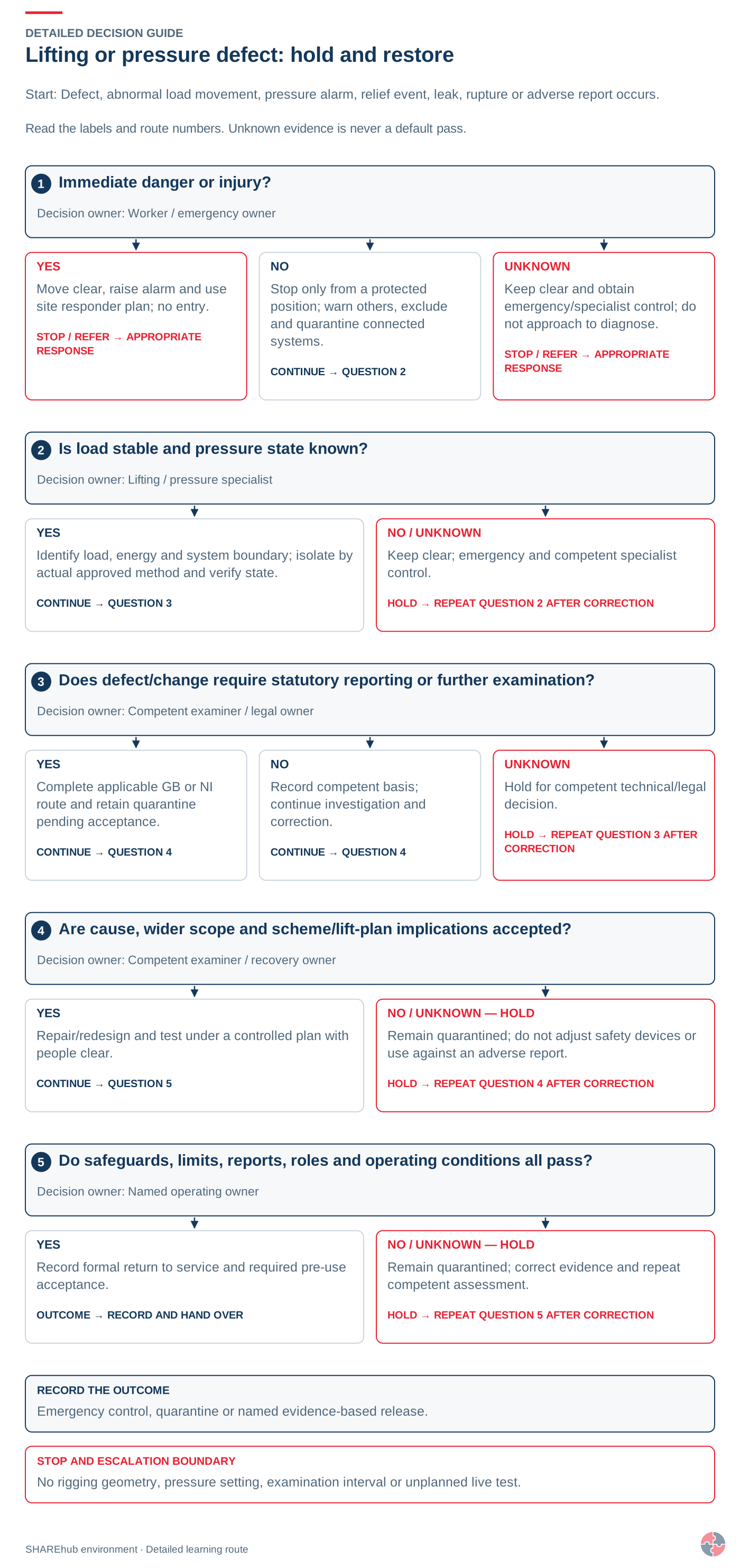
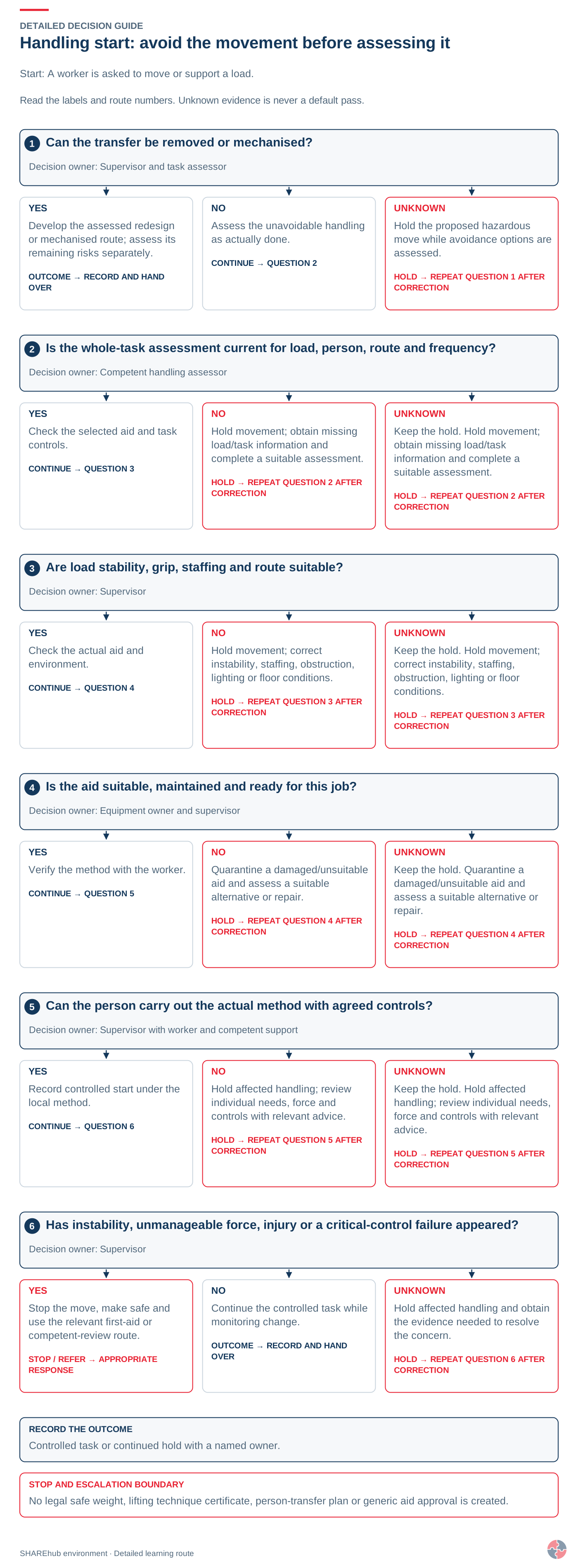
Full public teaching and readers are free without an account. A free learner account is required for saved LMS progress and recorded assessment. Completion and any course-completion certificate depend on the configured LMS conditions. Open the course overview.
Lesson 1
Plan the transfer around the person
Apply plan the transfer around the person to the current person and task.
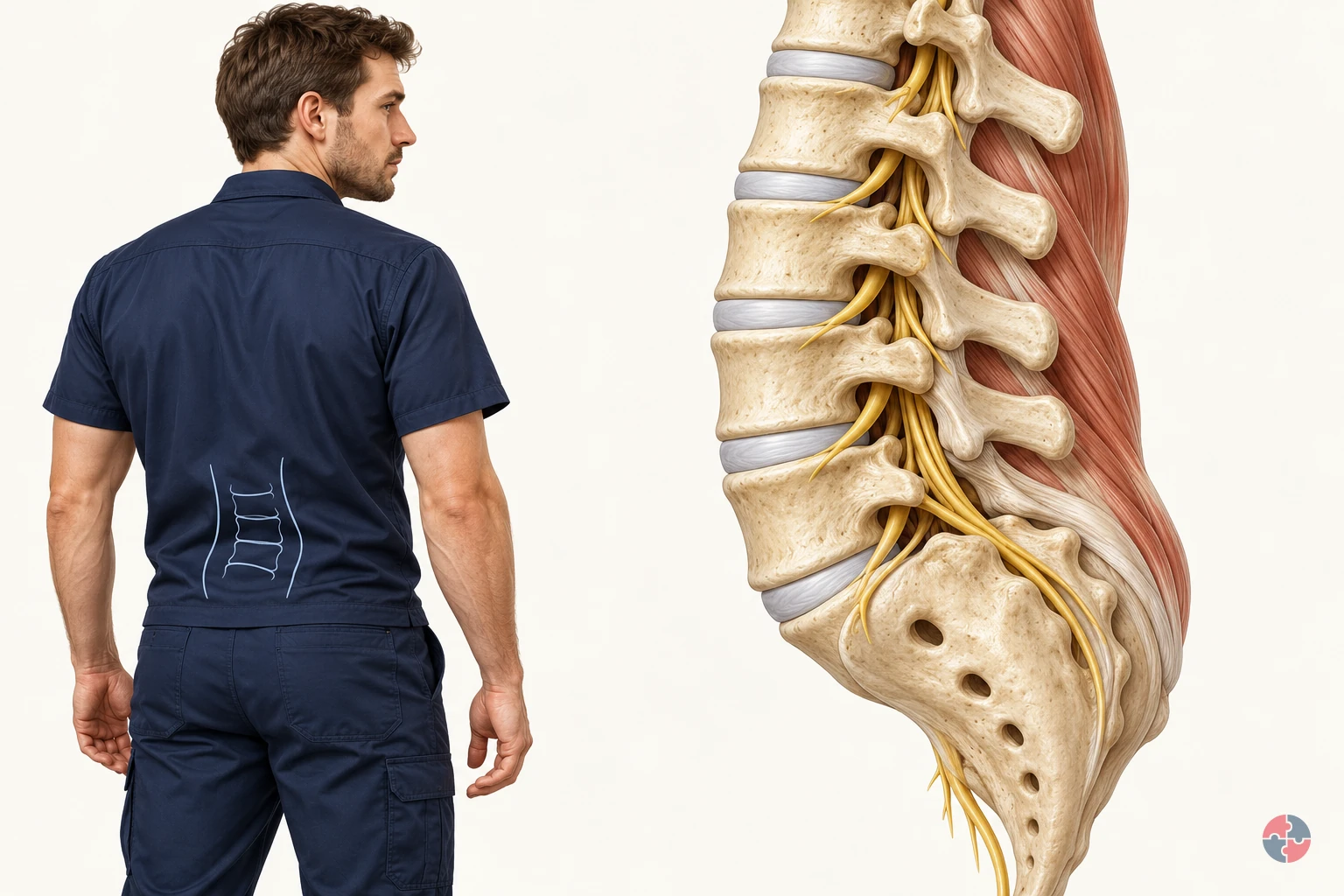
The worker locates the lower back; the separate side view enlarges its bones, discs, nerve roots and nearby muscle.
Locate the lower back. How could the load, reach, route, equipment or work pattern be changed for the task in this lesson?
educational illustration · healthy anatomy; enlarged details and teaching colours.
Original SHAREhub person-transfer teaching schematic. Current assessed needs and exact equipment identities determine suitability. The written case supplies the decision evidence.
Plan the transfer around the person
A transfer plan connects the resident’s current ability, pain, understanding, preferences and participation with the movement required. It should identify the equipment and staffing needed for that task. The ability to assist may change during illness, fatigue or recovery. Check the plan against the person’s presentation and obtain reassessment when it no longer fits.
This course develops recognition and decisions; practical hoist use requires the relevant training, supervised competence and the actual manufacturer instructions. It does not teach a universal lifting technique. Staff must know how to maintain appropriate comfort and support if a planned transfer is paused. Being late for a meal is not a reason to use damaged equipment or improvise a manual lift.
The person should be involved through suitable communication and the actual consent arrangements, including what will happen if the transfer must pause. Do not treat limited communication as consent or assume a diagnosis establishes the same needs for every movement. The care team needs to consider comfort, clothing, route and destination as well as the lifting device. A plan for the bed does not automatically apply to a bathroom or another chair.
For the fictional exercise, compare the current person's presentation with the identified plan and ask what information is missing. Do not select a sling by estimating a person's body shape from a picture. If the required staff, equipment or information is unavailable, obtain the responsible safe alternative while maintaining appropriate support and dignity. A hold should state the specific gap and escalation role. It is a protective decision, not permission to leave somebody suspended or improvise a manual lift to stay on schedule.
What does good manual handling control look like in different sectors?
The same avoid-assess-reduce principles apply, but the practical controls vary by task and setting.
Manual handling is common in construction, logistics, healthcare, retail, manufacturing, hospitality, offices, agriculture and waste work. The assessment should fit the task rather than use generic training language. Sources: HSE manual handling at work; HSENI manual handling
Sector examples help learners see that manual handling is about force, posture, repetition, distance, environment, people and recovery, not just box weight. Sources: HSE manual handling at work; HSENI manual handling
A resident can no longer participate in the way described by the transfer plan.
Decision and explanation
A current assessed arrangement with suitable equipment and trained staffing.
The plan must fit the current person and task; an arbitrary staffing number or past success is insufficient.
Use the appropriate manual handling assessment
This additional teaching takes about 2–5 minutes, in addition to the course estimate. Optional reading and workplace assessment take additional time.
Start by asking whether the hazardous handling can be removed or redesigned. Where handling remains, observe the whole operation with the people who do it and choose an assessment that fits the work.
Moving a person needs an individual, person-centred assessment, care plan, suitable equipment and competent assistance. These object-handling MAC and RAPP calculators do not assess a resident's transfer or select a hoist, sling or staffing level. TILEO can organise general task questions but does not replace the individual's care assessment. Use the tools only for appropriate inanimate-load activities such as supplies or linen trolleys, alongside the course's care-specific arrangements.
TILEO: Task, Individual, Load, Environment and Other factors. MAC: Manual Handling Assessment Charts for appropriate lifting, carrying and team handling. RAPP: Risk Assessment of Pushing and Pulling for appropriate manual pushing and pulling.
Read the portable guide to understand selection, limitations, the mixed-task example and company-branded Word/PDF records. Your existing course checks and completion requirements remain separate.
Apply compatibility is more than a connector fitting to the current person and task.
Photorealistic illustrative UK workplace scene. Review checks: Load: What is being lifted and where is the centre of gravity? Equipment: Is the lift truck and attachment suitable? Route: Can the load travel safely?
Compatibility is more than a connector fitting
Sling size, design, attachment configuration and the particular hoist must form a suitable combination. Colour coding is not universal evidence of size or compatibility. Follow the identified equipment instructions and the resident’s plan; if they conflict or are unclear, hold the transfer and ask the responsible competent person.
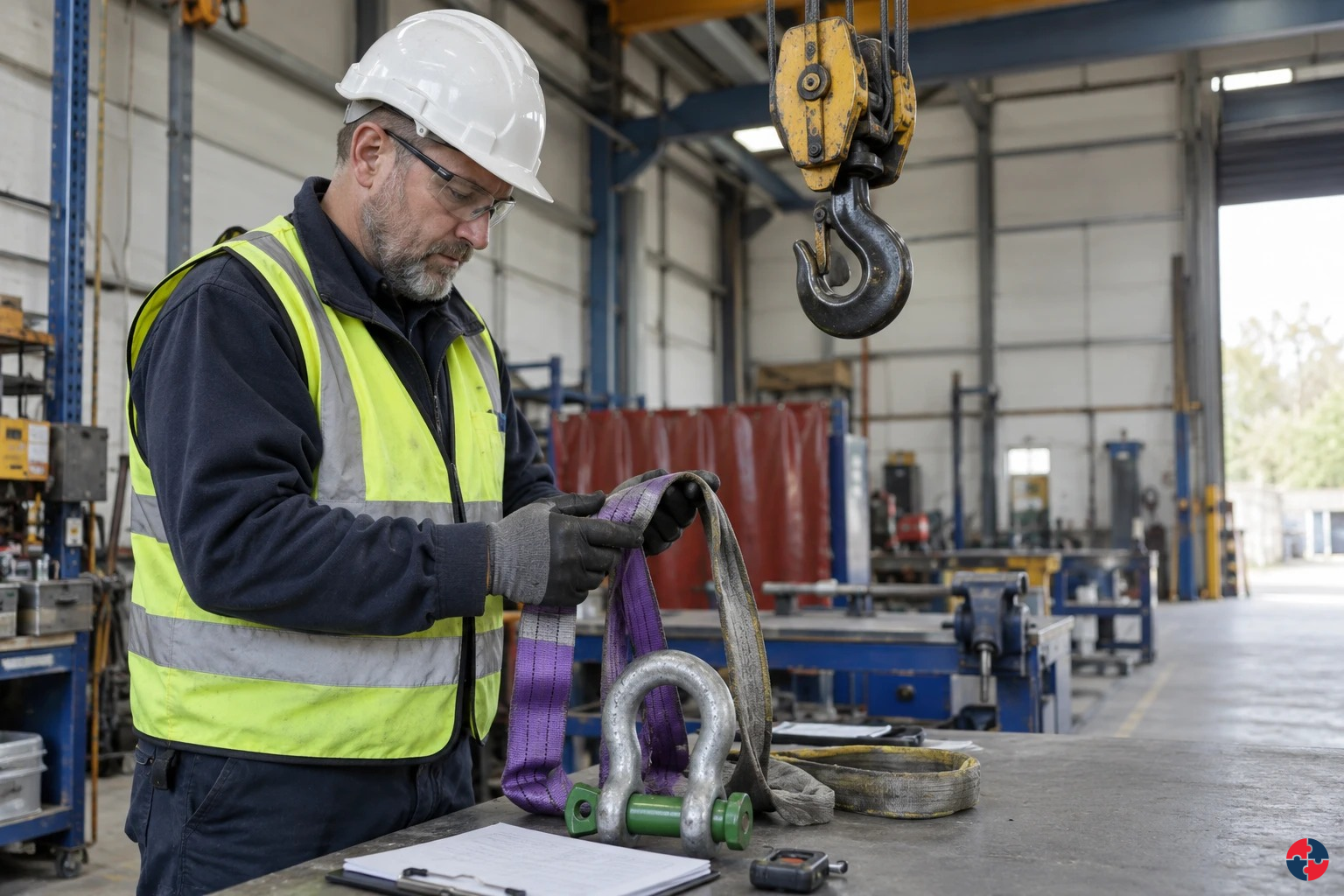
A pre-use inspection looks for immediate problems such as damaged stitching or an unidentified sling. Maintenance keeps equipment in appropriate condition, while thorough examination is a separate competent assessment under the applicable arrangements. None replaces the others. An examination report also has to relate to the actual identified equipment, with defects and due requirements resolved. Keep defective items clearly out of service so they cannot be mistaken for checked spares.
Trace identity from the equipment label through instructions, examination and the actual care plan. Similar connectors or colours can conceal a different model, attachment configuration or size. An item that physically clips on may still be unsuitable. The competent assessment must resolve the actual combination; this course does not provide a universal compatibility chart or train a learner to alter attachments.
Equipment shortages need management action rather than an assumption that all spare slings are interchangeable. Keep an unclear or defective item out of use through the controlled system and obtain a suitable verified alternative. Before relying on repaired or returned equipment, check the authorised handback and any restrictions. The person should not be exposed as a test of whether the new combination works. In the exercise, separate immediate condition checks, maintenance records and thorough examination evidence, explaining why each answers a different question about readiness.
What checks, inspections and examinations are needed?
Pre-use checks, maintenance and LOLER thorough examination answer different questions.
HSE thorough-examination guidance says that, without a competent examination scheme specifying another interval, equipment and accessories lifting people and all lifting accessories are examined every six months, while other lifting equipment is examined every 12 months. Examination may also be needed after installation/assembly or exceptional circumstances. Serious defects need immediate dutyholder notification and documented removal from use.
The operator still checks the sling, hook, controls and condition before each use. Maintenance prevents deterioration; the competent examiner independently assesses safety-critical condition. Do not use an in-date examination report to override a cracked hook or changed configuration.
Under the applicable LOLER regulation 10 route, the examiner immediately notifies the user of a defect that is or could become dangerous and supplies the required written report. Where the examiner considers there is an existing or imminent risk of serious personal injury, a copy goes to the relevant enforcing authority; immediate repair does not erase that reporting duty. The dutyholder separately quarantines, repairs and verifies recovery before release. Use the GB or NI instrument and enforcing authority applicable to the installation. Sources: HSE lifting examinations and defects.
Applied case
A spare sling clips onto the hoist, but its identity and compatibility cannot be confirmed.
Decision and explanation
Do not use that combination until suitability and compatibility are established.
A physical connection is not evidence that the sling, configuration and hoist are suitable together.
Lesson 3
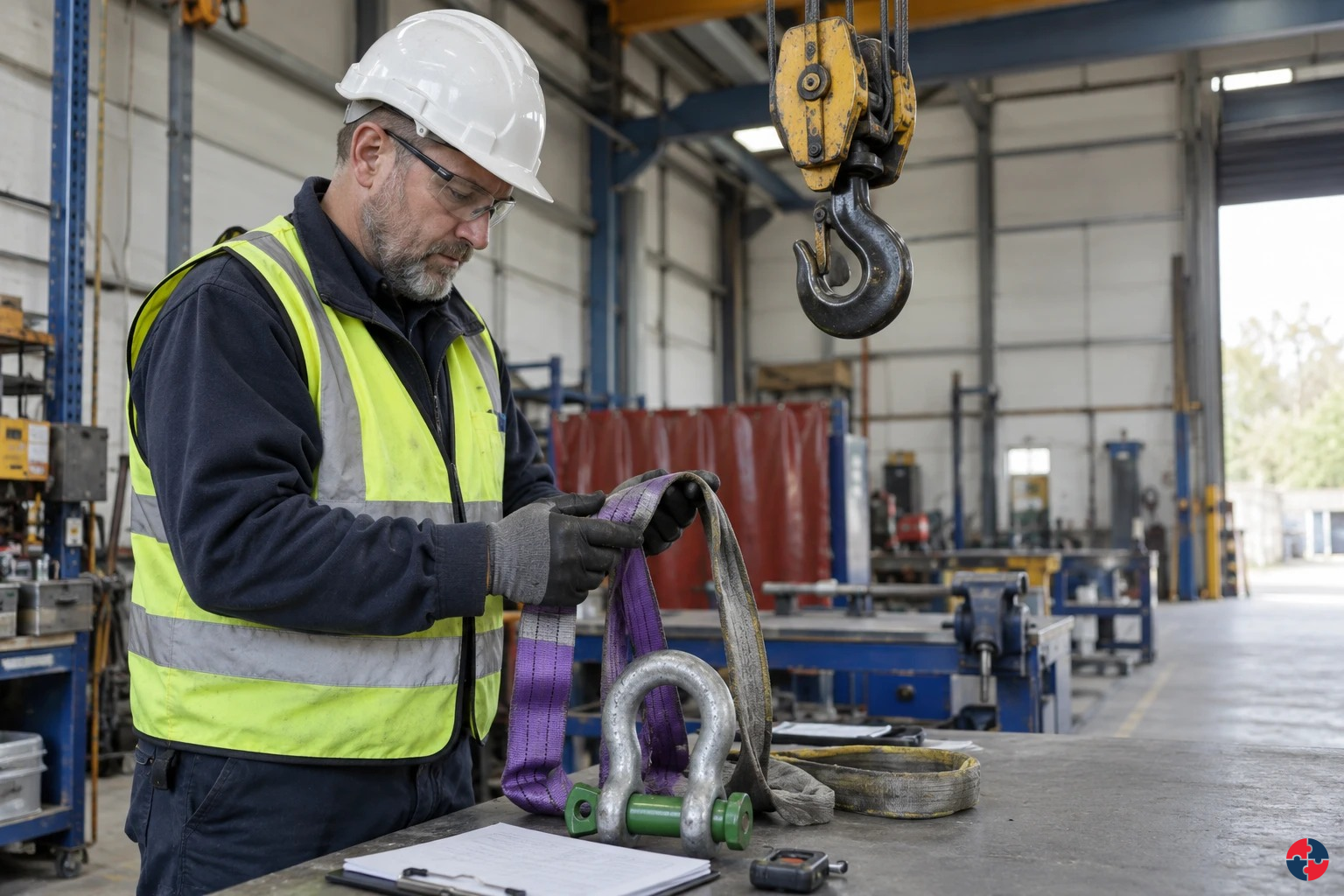
A pre-use check can stop a lift today
Act on current damage even when records are satisfactory.
Photorealistic illustrative UK workplace scene. Review checks: Load: What is being lifted and where is the centre of gravity? Equipment: Is the lift truck and attachment suitable? Route: Can the load travel safely?
A pre-use check can stop a lift today
Sling stitching, fabric and attachments help support a person during a planned transfer. Damage can compromise that support even if the sling was satisfactory at an earlier inspection. A current thorough-examination report cannot cancel a tear found today. The relevant question is whether the actual identified item remains suitable now, not whether one record has a recent date.
Use the trained pre-use checks, manufacturer information and the person's plan. If damage, uncertain identity or another relevant defect is found, withdraw the affected item through the home's controlled process and obtain the responsible decision. Do not conceal a tear with tape, sew a repair without authority or use the person to prove the remaining strength. This awareness lesson does not teach sling inspection competence or repair methods.
Provide suitable immediate support while an assessed alternative is arranged. Another sling from the cupboard must be confirmed compatible and appropriate, not selected merely because it looks similar. Equipment withdrawal should be clear enough that the next worker cannot mistake the defective item for a checked spare. The care, equipment and procurement teams may need to coordinate if a shortage repeatedly encourages unsafe substitution.
Verification should address both the physical condition and the actual person/equipment combination before the transfer resumes. Record factual damage and the protective action without inventing a structural failure rating. Review cleaning, storage and use that may contribute to deterioration through the appropriate competent system. For the fictional exercise, compare a satisfactory historical report with visible torn stitching and explain why the current defect governs the immediate decision. A course certificate or completed checklist cannot establish that a damaged sling is safe to lift a person.
What checks, inspections and examinations are needed?
Pre-use checks, maintenance and LOLER thorough examination answer different questions.
HSE thorough-examination guidance says that, without a competent examination scheme specifying another interval, equipment and accessories lifting people and all lifting accessories are examined every six months, while other lifting equipment is examined every 12 months. Examination may also be needed after installation/assembly or exceptional circumstances. Serious defects need immediate dutyholder notification and documented removal from use.
The operator still checks the sling, hook, controls and condition before each use. Maintenance prevents deterioration; the competent examiner independently assesses safety-critical condition. Do not use an in-date examination report to override a cracked hook or changed configuration.
Under the applicable LOLER regulation 10 route, the examiner immediately notifies the user of a defect that is or could become dangerous and supplies the required written report. Where the examiner considers there is an existing or imminent risk of serious personal injury, a copy goes to the relevant enforcing authority; immediate repair does not erase that reporting duty. The dutyholder separately quarantines, repairs and verifies recovery before release. Use the GB or NI instrument and enforcing authority applicable to the installation. Sources: HSE lifting examinations and defects.
Applied case
A sling’s stitching is torn but its examination report is current.
Decision and explanation
The current defect requires withdrawal and suitable resolution before lifting.
Historical assurance does not remove present damage.
Lesson 4
An examination report must match the actual equipment
Distinguish examination, maintenance and task readiness.
Photorealistic illustrative UK workplace scene. Review checks: Load: What is being lifted and where is the centre of gravity? Equipment: Is the lift truck and attachment suitable? Route: Can the load travel safely?
An examination report must match the actual equipment
Thorough examination is a competent assessment under the applicable lifting arrangements. It is separate from routine maintenance and the checks before a particular transfer. A report stored in a folder may relate to another hoist, sling or attachment. Its date alone is insufficient if identity, findings, restrictions or required follow-up do not match the item at the bedside.
The responsible equipment system should provide reliable identification and the relevant records, with defects and due requirements resolved. Staff need to know how to obtain confirmation within their role rather than guessing from colour or location. This course does not specify universal examination intervals or qualify the learner as an examiner. Applicable requirements and the actual scheme need competent management.
If the record cannot be verified or a restriction remains unresolved, hold the affected use and arrange a suitable alternative under the person's plan. Do not create a new examination label or borrow paperwork from a similar item. A maintenance visit may restore a component but does not automatically provide every necessary examination or task-specific check. The distinctions should be clear in procurement, return from repair and shift handover.
Before the transfer, confirm the actual current arrangement: equipment condition and compatibility, person-specific method, trained staffing, route and support. A valid report supports one link in readiness rather than authorising any lift in any setting. For the fictional exercise, match the identified item to the relevant record and identify the unanswered question. Keep all serial numbers invented for training and avoid entering a real equipment database. The outcome is confidence grounded in traceable evidence, with a clear hold when identity or required assurance cannot be established.
Why does a satisfactory examination report not release every lifting task?
Examination, maintenance, user checks and lift planning answer different questions. A thorough examination records the competent examiner’s findings within its scope and date. It does not select the machine for today’s load, establish the floor condition or prove that the current rigging arrangement is correct. Related guidance: Thorough examination of lifting equipment.
Match the report to the actual asset and accessories and read defects, due dates and any examination scheme. A report for a similar hoist or an accessory with a different identity is not evidence for the item being used. A serious defect needs the response required by the applicable law and competent examiner, not an administrative extension because replacement equipment is late. Related guidance: Thorough examination of lifting equipment.
A newly damaged sling remains held even if its next periodic examination is months away. Conversely, ordinary maintenance is not itself the statutory thorough examination. Where exceptional damage, failure, installation or other circumstances raise an examination requirement, obtain the competent decision for that equipment and applicable legal route before relying on it. Related guidance: Thorough examination of lifting equipment.
The person undertaking examination needs the relevant theoretical and practical equipment competence and sufficient independence and impartiality. HSE distinguishes this role from the person doing routine maintenance to avoid assessing their own maintenance. Do not treat an employer job title as evidence of that competence. Record the actual report, defect response and equipment release; separately verify the task-specific lift plan. Related guidance: Thorough examination of lifting equipment.
The only available report names a different hoist model and its restrictions are unclear.
Decision and explanation
Hold affected use pending reliable equipment-specific assurance and a suitable alternative.
Evidence must match the actual item and unresolved conditions.
Lesson 5
Attendance and support continue through a paused transfer
Do not leave a person suspended while solving another task.
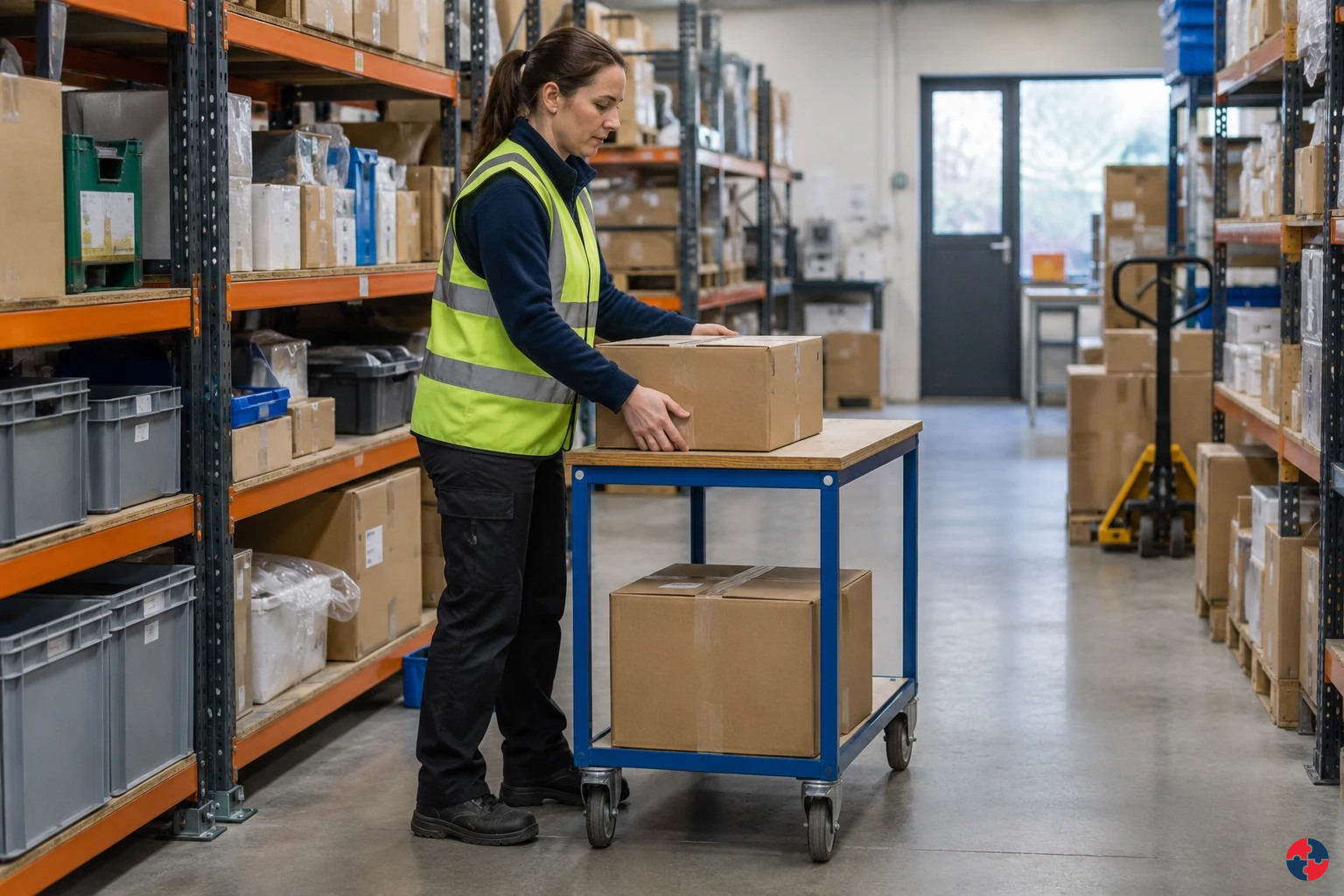
Photorealistic illustrative UK workplace scene. Review checks: Find: Heavy boxes are picked from the floor and twisted into a cage. Change: Raise the pick position, reorient the cage and repair the threshold. Verify: Maintain cage wheels and observe handling during a realistic peak.
Attendance and support continue through a paused transfer
A person supported by lifting equipment remains dependent on the planned assistance and equipment arrangement. A pause to fetch clothing, open a door or answer another call can become unsafe if the person is left suspended unattended. The fact that the hoist holds its position does not establish that the person's comfort, support or emergency needs are met.
Plan the full transfer before beginning: destination, route, equipment, required staff, privacy, communication and what happens if the task pauses. Use the actual person-specific assessment and manufacturer instructions through trained competent workers. This course does not teach emergency lowering or a lifting manoeuvre. Staff must know their own trained procedure and obtain appropriate help if the arrangement cannot continue as planned.
Check that supplies and the receiving position are ready so workers do not need to leave halfway through. A staffing shortage or competing call needs a managed response rather than assuming another person will notice. Do not ask a resident or visitor to become the unassessed attendant. If a problem occurs, maintain suitable attendance and support under the actual plan and call the responsible assistance; do not improvise a manual rescue from this lesson.
Verification should consider realistic interruptions and the capability available on the shift, not only an uninterrupted demonstration. Ask staff to explain who remains responsible and how help is obtained. For the fictional exercise, separate the need for a towel from the person's continuing dependence and choose the appropriate supportive pause. Records should describe facts and escalation without private details. A completed transfer on a previous day does not prove the current staffing or supplies are adequate, and a course pass cannot replace practical competence for the actual hoist system.
What does good manual handling control look like in different sectors?
The same avoid-assess-reduce principles apply, but the practical controls vary by task and setting.
Manual handling is common in construction, logistics, healthcare, retail, manufacturing, hospitality, offices, agriculture and waste work. The assessment should fit the task rather than use generic training language. Sources: HSE manual handling at work; HSENI manual handling
Sector examples help learners see that manual handling is about force, posture, repetition, distance, environment, people and recovery, not just box weight. Sources: HSE manual handling at work; HSENI manual handling
A worker plans to leave the resident suspended while fetching a towel.
Decision and explanation
Appropriate attendance and support under the actual trained plan.
A suspended person must not be left unattended while another task is solved.
Lesson 6
A safe transfer needs the complete current arrangement
Verify changes rather than relying on one suitable component.
Related SHAREhub topic guide. Apply its prompts to the specific case below.
A safe transfer needs the complete current arrangement
A correct sling cannot compensate for an untrained worker, an obstructed route or a changed support need. Transfer readiness combines the person, equipment, method, staff capability and environment. The fictional home has a new sling delivered while the usual second trained worker is absent. Treat the missing capability as a real gap, not a reason to assume the new equipment simplifies every task.
The responsible team should confirm the current care plan and relevant competence, using the person's views and appropriate professional input. Changes in fatigue, pain or participation may require reassessment. This course does not decide clinical capability or teach a manual alternative. Consent and willingness matter but cannot turn an unsafe method into a suitable one.
Before starting, verify equipment identity and condition, compatibility, required assurance, trained assistance and a clear route and destination. Check whether cleaning or room rearrangement has changed space or access to help. If a necessary condition cannot be confirmed, pause with suitable support and obtain the authorised alternative. Do not average favourable checks to offset an unresolved critical condition.
After repair or plan change, the handover should identify the actual correction and any continuing restriction. A new signature is useful only when it corresponds to a workable arrangement. Use safe observations and staff explanation to check understanding, without exposing a resident to an experimental transfer. For the fictional audit, state the claim, current evidence, missing proof, protective hold and verification role. Keep private person-specific information within authorised records. The practical lesson is that equipment availability is one part of readiness, and a learner's score cannot authorise a real lift or substitute for supervised practical competence.
How should the selected controls be checked in practice?
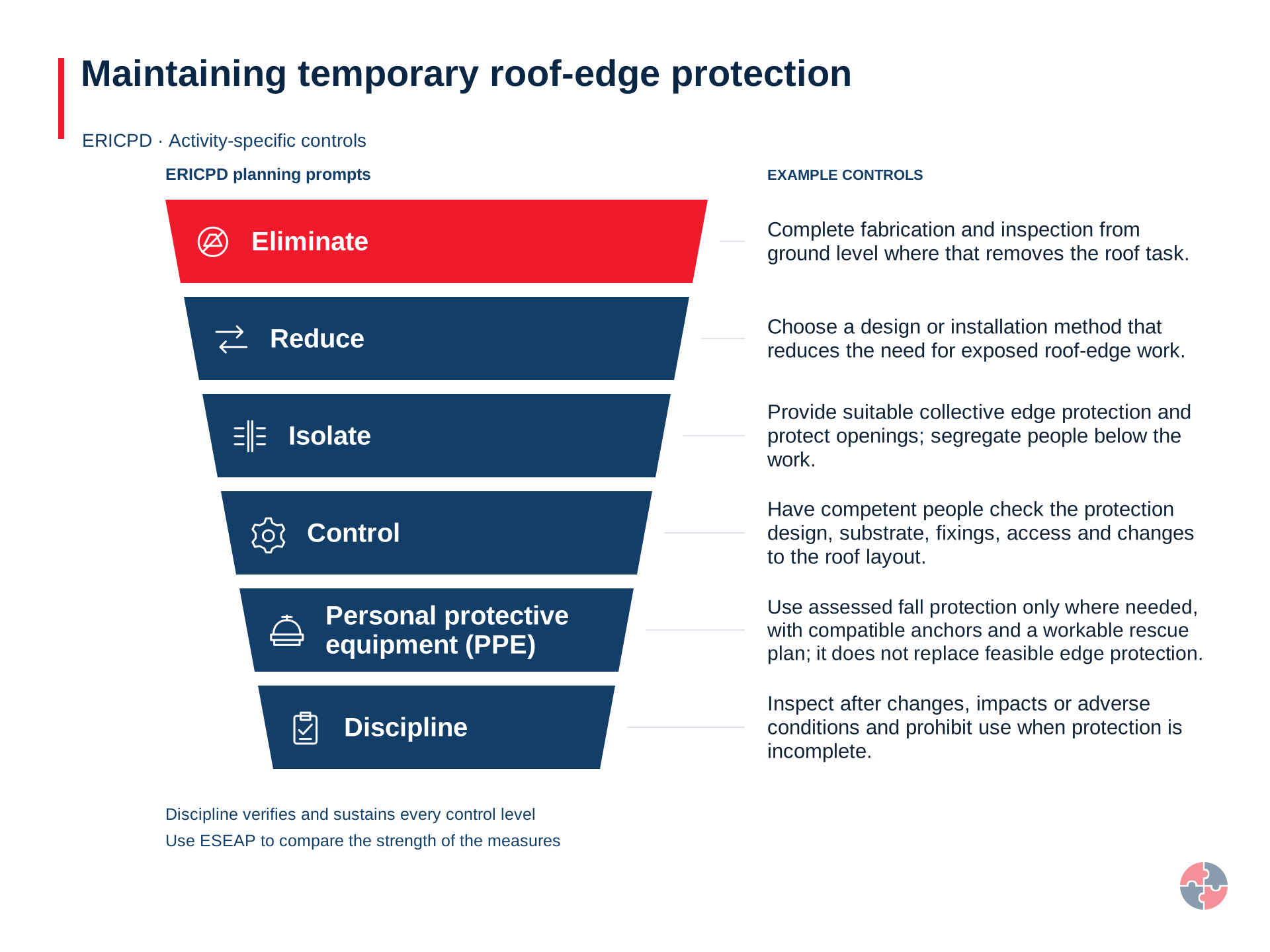
ERICPD is used here as a planning mnemonic. The linked HSE five-level hierarchy is the official source for the order and relative reliability of controls; the two labels are not identical.
Start with task redesign and substitution, then engineered separation before procedures and personal protection; verify each control under real conditions.
At a fuel depot, tanker overfill can release petrol, form vapour and ignite. The assessment must identify the initiating event, people exposed and each independent prevention or mitigation barrier. Petrol cannot be substituted if the site must supply it, so the record should say why that higher-order option is unavailable for this operation and then demand strong engineered controls. HSE hierarchy of control; HSE hierarchy of control.
ERICPD is a six-stage planning aid; the HSE five-level order separates substitution, engineering and administration. Isolate is usually engineered separation, while ERICPD Control may contain both physical and administrative measures. Discipline sustains the chosen controls and is not an additional permission to expose people.
The new sling is suitable but the plan’s trained staffing and route are unavailable.
Decision and explanation
No; establish the complete assessed arrangement or an authorised suitable alternative.
All necessary conditions must be available together.
Lesson 7
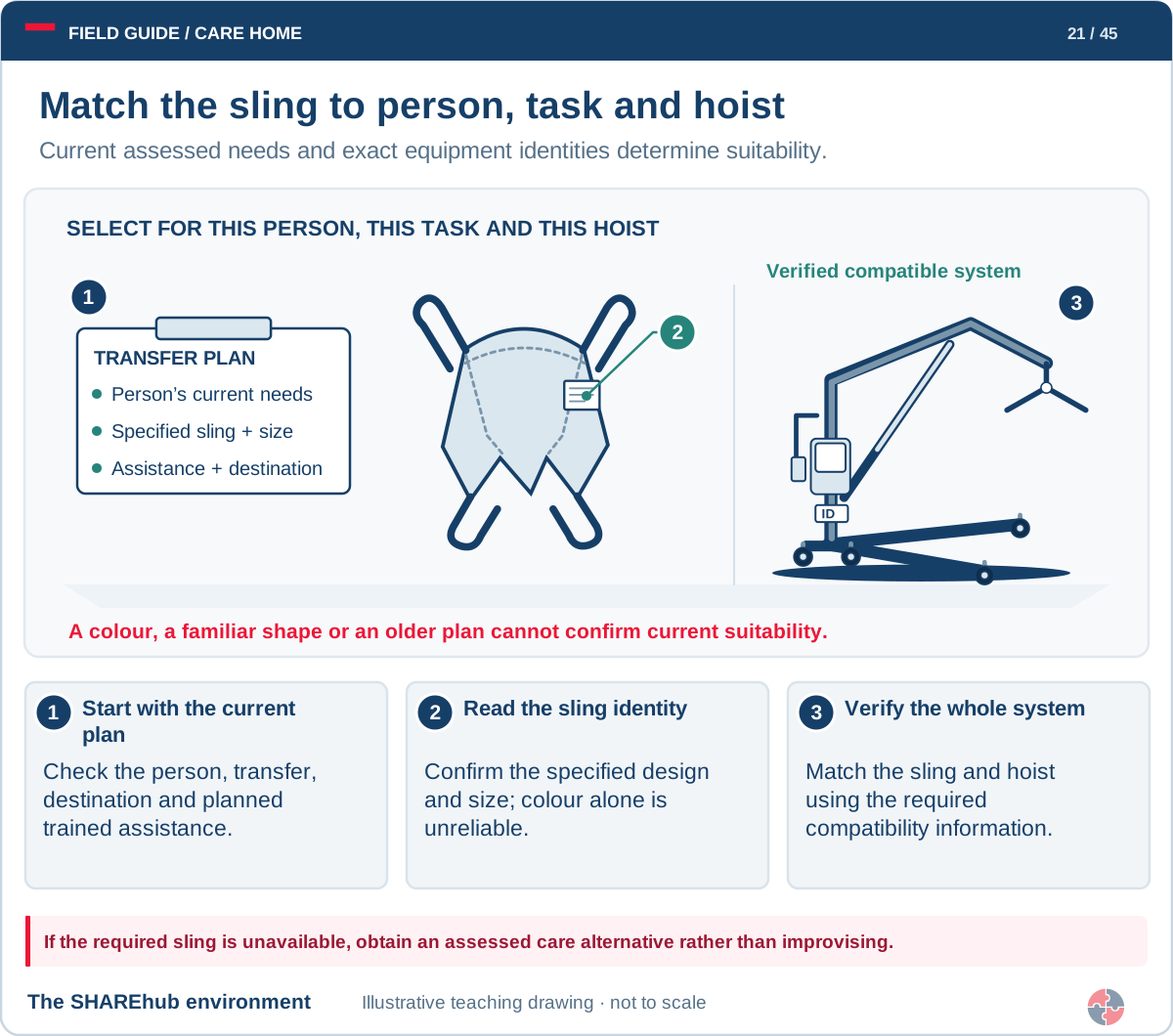
Select the sling for this person and this transfer
Treat equipment identity as part of the care decision; availability pressure must not replace individual suitability.
Original SHAREhub person-transfer teaching schematic. Current assessed needs and exact equipment identities determine suitability. The written case supplies the decision evidence.
Understand the activity and how harm develops
A sling that is too large can allow a person to slip through; one that is too small may give inadequate support, pain or pressure. Colour coding alone is unreliable across products. The person’s assessed needs, sling design, size, configuration and hoist compatibility must be considered together.
The individual transfer plan should identify the equipment and trained assistance required. A busy shift is not a reason to borrow the nearest sling or estimate fit from appearance. Changes in body size, posture, condition or comfort can require reassessment, even when the label still matches an older plan.
Recognise the evidence boundary
Question
Case evidence
What is observed?
The selected sling size differs from the person's current transfer plan.
How can harm occur?
Poor fit can cause discomfort, loss of support or a fall.
What information is needed?
Check sling identity and size against the individual plan and manufacturer instructions.
Protect, manage and verify
Purpose
Practical application
Immediate protection
Pause transfer and obtain the assessed suitable sling and competent support.
Accountable work arrangement
Care lead and competent moving-and-handling assessor or equipment supplier. Size, design, identity or current individual suitability does not match the plan.
Release verification
Verify the actual equipment and arrangement before an authorised trained team proceeds.
Apply this at work
Treat equipment identity as part of the care decision; availability pressure must not replace individual suitability.
What does good manual handling control look like in different sectors?
The same avoid-assess-reduce principles apply, but the practical controls vary by task and setting.
Manual handling is common in construction, logistics, healthcare, retail, manufacturing, hospitality, offices, agriculture and waste work. The assessment should fit the task rather than use generic training language. Sources: HSE manual handling at work; HSENI manual handling
Sector examples help learners see that manual handling is about force, posture, repetition, distance, environment, people and recovery, not just box weight. Sources: HSE manual handling at work; HSENI manual handling
The specified sling is unavailable. Another has the same colour label but a different size code.
Decision and explanation
Obtain a verified suitable sling and review any uncertainty before lifting.
Colour is not evidence that the product or size fits the person and hoist. Different manufacturers and product ranges can use different coding. Improvised adjustment does not establish correct support or compatibility.
Lesson 8
A connection that appears to fit may still be incompatible
Control interfaces between products as carefully as each product itself, especially when stock or suppliers change.
Teaching graphic from the linked SHAREhub source section.
Understand the activity and how harm develops
Sling attachments and hoist spreader bars form a safety-critical interface. An incorrect clip, loop or connector can disengage under load even if it seems to sit in place when empty. Different product systems are not interchangeable simply because their parts look similar.
Use the manufacturer’s specified compatibility information and the person’s approved plan. Staff should not add improvised hooks or alter attachments to make a set fit. Where information is missing or conflicting, hold the transfer and obtain suitable equipment and competent clarification; a trial lift with a person is never a compatibility test.
Recognise the evidence boundary
Question
Case evidence
What is observed?
The sling attachment does not match the hoist's specified connection.
How can harm occur?
An insecure connection can fail and drop the person.
What information is needed?
Confirm hoist and sling compatibility using manufacturer information and the care plan.
Protect, manage and verify
Purpose
Practical application
Immediate protection
Do not improvise attachments; obtain a verified compatible assessed arrangement.
Accountable work arrangement
Equipment lead and competent assessor, with manufacturer clarification if necessary. The attachment type or specified compatibility cannot be verified.
Release verification
Check the correct connection and equipment identity before use.
Apply this at work
Control interfaces between products as carefully as each product itself, especially when stock or suppliers change.
What should a worker do before using work equipment?
Confirm the equipment is the right type for the task, check guards and controls, inspect for obvious damage, understand the safe method and emergency response, keep others clear, and stop if condition or permission is uncertain.
Best-practice guide · six simple steps
Best-practice guide: Work Equipment, Lifting Equipment and Pressure Systems
Start with the key actions, then explore value, a workplace example, harm, stronger controls and further help. Choose a step or use Previous and Next; the guide does not advance automatically.
Keep one card or the full set for social sharing, team briefings and learning. Each PDF contains one card per page. Read the full topic for explanations, questions and source links.
Read all six steps as text
1. What should a worker do before using work equipment?
Confirm the equipment is the right type for the task, check guards and controls, inspect for obvious damage, understand the safe method and emergency response, keep others clear, and stop if condition or permission is uncertain.
Avoid / redesign: Avoid an unnecessary suspended lift or pressure-dependent step by redesigning flow or assembling at a safe accessible position.
Control the task: Provide designed physical safeguards: separation from suspended loads, suitable lifting installation and pressure-system protective devices.
Verify before release: Process and engineering owners verify the revised task and residual energy.
Confirm the equipment is the right type for the task, check guards and controls, inspect for obvious damage, understand the safe method and emergency response, keep others clear, and stop if condition or permission is uncertain. A machine, lifting device or pressure system may have overlapping duties, but a single certificate does not close every risk.
Apply it: Which part of this plan would you check at the workface before authorising the task?
2. Turn work equipment, lifting equipment and pressure systems knowledge into a decision
Use the evidence to improve the actual work arrangement.
Change at source: Avoid an unnecessary suspended lift or pressure-dependent step by redesigning flow or assembling at a safe accessible position.
Make it observable: Process and engineering owners verify the revised task and residual energy.
Keep useful evidence: Authorisation, pre-use check, task briefing, any defect report and supervisor release.
A machine, lifting device or pressure system may have overlapping duties, but a single certificate does not close every risk. Identify the actual task and equipment, apply the workplace-use rules, then test whether lifting or qualifying pressure-system duties add planning, examination, written-scheme and competent-person requirements. Authorisation, pre-use check, task briefing, any defect report and supervisor release.
Apply it: What evidence would show that the change improves this task, rather than only completing a record?
Fictional example: a practical application of the existing topic lesson.
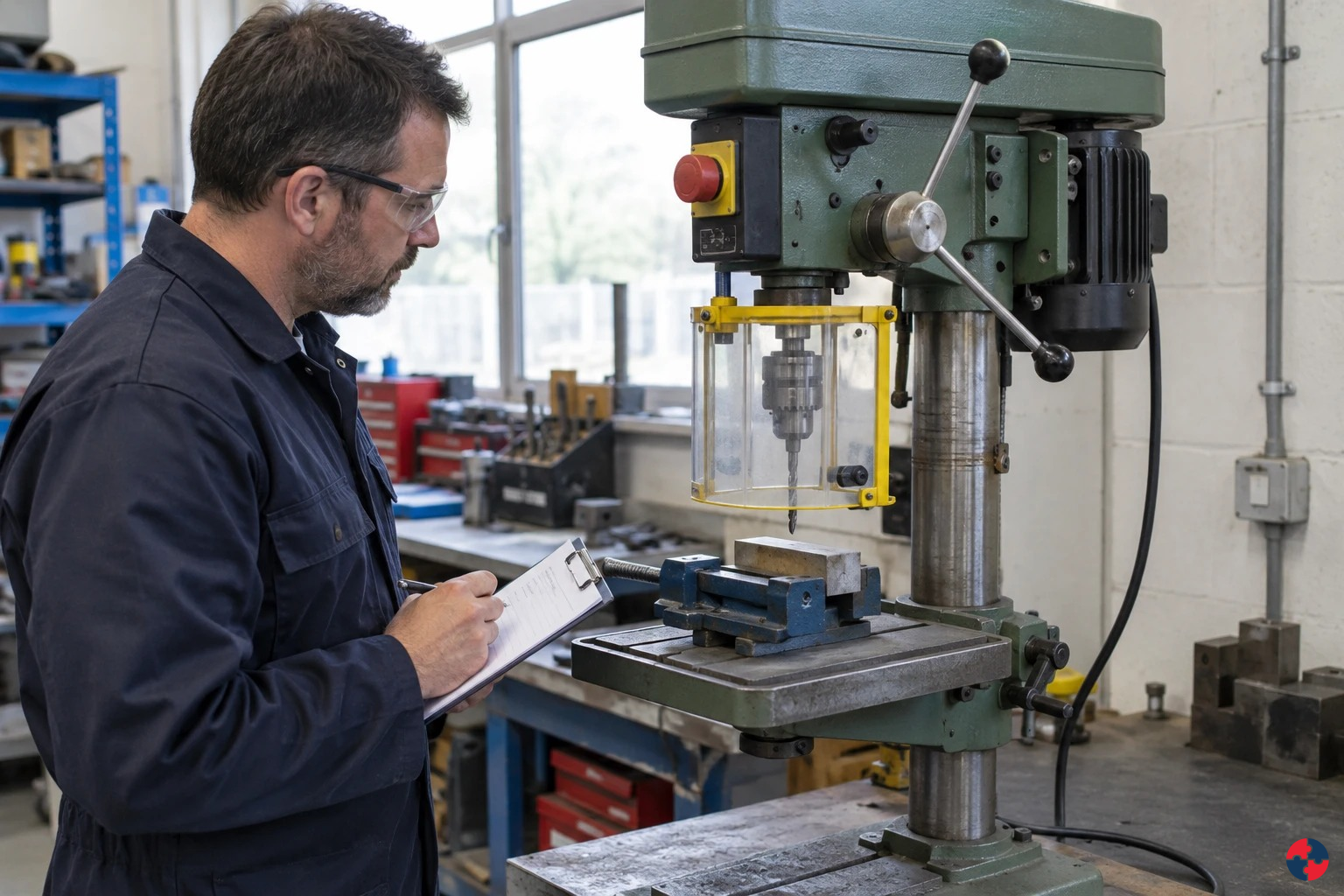
Setting: Fictional training only, not authorisation for a real drill.
Act: Confirm the task and material, inspect the drill, guard, workholding and emergency control, remove loose items, set the work securely and keep others outside the operating space.
Hold / review: Do not start or continue for a loose workpiece, damaged bit, missing or defeated guard, unreliable control, unusual movement, unexpected material response or unauthorised person in the area.
Keep the guard and workholding in position, use the intended controls, observe sound, movement and swarf, and stop before any adjustment or clearing. Stop through the normal control, wait for movement to cease, leave the machine and area clean through the safe method, record any defect and hand back in a known state.
Apply it: At which point would you hold this example, and what evidence would allow it to proceed?
4. How can lifting or pressure failures harm people? decision table
Connect the task, the route to the person and the control that can fail.
Load or attachment exceeds rated configuration: Collapse or dropped load can crush people below.
Defective lifting accessory: A sling or hook fails and the load swings or falls.
Pressure system exceeds safe limit: Rupture or release causes blast, scald or toxic exposure.
Load or attachment exceeds rated configuration: Collapse or dropped load can crush people below. Defective lifting accessory: A sling or hook fails and the load swings or falls. Pressure system exceeds safe limit: Rupture or release causes blast, scald or toxic exposure.
Apply it: Who could be exposed, including other trades, cleaners, maintainers and people nearby?
5. Choose controls for work equipment, lifting equipment and pressure systems
Start with the stronger practicable options and verify their effect.
Eliminate: Avoid an unnecessary suspended lift or pressure-dependent step by redesigning flow or assembling at a safe accessible position.
Reduce, including substitution: Choose a lifting or process method with suitable capacity and controlled interfaces for the actual load, radius, pressure and substance.
Isolate: Provide designed physical safeguards: separation from suspended loads, suitable lifting installation and pressure-system protective devices.
Control: Plan and supervise lifting to its complexity and define pressure-system operating limits and required written scheme/examination arrangements.
PPE: Select PPE for remaining handling, splash or other task exposure, checking fit and compatibility.
Eliminate: Avoid an unnecessary suspended lift or pressure-dependent step by redesigning flow or assembling at a safe accessible position. Reduce, including substitution: Choose a lifting or process method with suitable capacity and controlled interfaces for the actual load, radius, pressure and substance. Isolate: Provide designed physical safeguards: separation from suspended loads, suitable lifting installation and pressure-system protective devices. Control: Plan and supervise lifting to its complexity and define pressure-system operating limits and required written scheme/examination arrangements. PPE: Select PPE for remaining handling, splash or other task exposure, checking fit and compatibility. Read the full control table for qualifications, ownership and verification. Use the actual task and applicable jurisdiction; existing technical approval remains unchanged.
Apply it: Which stronger option can be used here, and who will verify it before accepting the remaining risk?
6. Use the full work equipment, lifting equipment and pressure systems lesson
Follow the official sources below and retain the task-specific evidence.
Official guidance: HSE INDG229 Using work equipment safely
Official guidance: HSE PUWER guidance and topic index
Task decision: Authorisation, pre-use check, task briefing, any defect report and supervisor release.
Use the full topic for the decision points, practical examples, detailed control tables and source scope. HSE guidance applies to Great Britain; use HSENI for the Northern Ireland route and the source’s stated jurisdiction. A simplified guide does not change the page’s technical-review or approval status.
Apply it: Which official source and full-topic section will you use to resolve the next decision?
Simplified learning guide. Use the full topic, current official guidance and the actual work arrangements. Workplace scenarios labelled fictional are illustrative examples.
Do not begin because the equipment ran yesterday, carries a conformity mark or belongs to a contractor. Check any recorded limitation, attachment, inspection status and local authorisation that the task actually requires.
Identify equipment and task. During use: Use within assessed conditions.; At completion: Stop safely and leave controlled.
Check guards, controls and condition. During use: Watch for change or defect.; At completion: Report defects and hand back.
Confirm competence and area. During use: Keep others protected.; At completion: Record any hold or release.
What counts as work equipment and use?
Work equipment includes machinery, appliances, apparatus, tools and installations used at work, while use includes starting, stopping, programming, setting, transporting, repairing, modifying, maintaining, servicing and cleaning.
A hand tool, office appliance, machine line, scaffold component, ladder, lift truck or process installation may be work equipment. The applicable controls depend on the actual use and risk, not the label or purchase value.
Tool or appliance. Why it is in scope: Used to perform work.; Decision: Suitability and safe use.
Machine or installation. Why it is in scope: Creates mechanical or other energy hazards.; Decision: Guarding, controls and lifecycle evidence.
Cleaning or adjustment. Why it is in scope: It is use under Provision and Use of Work Equipment Regulations (PUWER).; Decision: Safe state and competent method.
Transport or modification. Why it is in scope: Can change condition or risk.; Decision: Planning, inspection and change control.
How do workplace-use duties differ from product-supply duties?
PUWER controls equipment provided or used at work; product-supply rules govern placing products on a market. A CE, UK Conformity Assessed (UKCA) or CE and UK Northern Ireland (UKNI) route does not by itself prove workplace suitability, correct installation or safe use.
Choose the GB or NI market route and the product sector before relying on conformity documentation. Separately complete workplace selection, risk assessment, guarding, installation, competence, inspection and maintenance decisions.
Who will use it and for what? Workplace-use route: PUWER and other workplace law.; Product-supply route: Not the main market decision.
May this product be placed on this market? Workplace-use route: Does not answer safe-use question.; Product-supply route: Current GB or NI sector rules.
Was it modified or assembled? Workplace-use route: Reassess safe use.; Product-supply route: May create manufacturer obligations.
The sling clip sits loosely on the available spreader bar. A colleague suggests using a spare hook.
Decision and explanation
Stop and obtain the verified compatible equipment arrangement.
Manual holding cannot provide a reliable load-bearing connection. The attachment interface must be specified and suitable, without improvised components. An unverified component and live trial expose the person to a fall.
Lesson 9
Damaged stitching is a stop point for a lifting sling
Make defect segregation work across care, laundry and stores so unsafe equipment cannot quietly re-enter circulation.
Photorealistic illustrative UK workplace scene. Review checks: Setting: the site team’s warehouse conveyor moves bagged building material. Act: The operator stops and reports the failure; the supervisor holds the whole affected line. Hold / review: Hold if guard function, isolation, run-down, linked restart or personnel accounting is uncertain.
Understand the activity and how harm develops
The stitching carries load through the sling. Tears, fraying or damaged seams may worsen during use and cannot be assessed safely by pulling the fabric by hand. Washing, storage damage and wear can affect strength even when the sling still looks broadly usable.
Pre-use checks complement maintenance and thorough examination; a current report does not cancel a new visible defect. Remove the sling from circulation with clear identification and arrange a suitable assessed replacement. Follow manufacturer care instructions, and avoid improvised stitching, labels or markings that could weaken load-bearing material.
Recognise the evidence boundary
Question
Case evidence
What is observed?
Load-bearing sling stitching is visibly damaged.
How can harm occur?
The sling may fail during lifting and cause a serious fall.
What information is needed?
Check the sling identity, defect and relevant equipment records.
Protect, manage and verify
Purpose
Practical application
Immediate protection
Remove it from service, label or segregate it and obtain a suitable assessed replacement.
Accountable work arrangement
Equipment owner and care lead, with competent supplier or repair advice. There is damage, uncertain identity or another failed pre-use condition check.
Release verification
Verify replacement condition and compatibility and close the defect through the equipment process.
Apply this at work
Make defect segregation work across care, laundry and stores so unsafe equipment cannot quietly re-enter circulation.
How should defects be controlled?
Report and classify the defect, keep dangerous equipment out of use, repair competently and prove the affected function before release.
A missing guard, failed brake, cracked lifting part or uncertain pressure protection needs a clear stop-use decision. Tagging helps communicate a hold but does not physically prevent reuse on its own; choose isolation or access control as needed. Record who may remove the hold and what evidence they require. Repeated defects call for cause investigation and a changed plan. HSE maintenance of work equipment and HSE thorough examination of lifting equipment.
Separate a service defect from an examination report
An ordinary service defect is recorded, quarantined and resolved through the equipment system. A statutory examiner’s finding follows its own report route as well as the work restriction. For GB LOLER, the examiner immediately informs the dutyholder of dangerous defects; serious existing or potential dangerous defects require the prescribed written report and a copy to the enforcing authority as soon as practicable. Respect any specified remedy deadline and prohibition on continued use. HSE: lifting examinations and dangerous-defect reports.
For GB PSSR, the competent person’s imminent-danger process includes immediate notification, a written report to the user/owner and a copy to the enforcing authority within 14 days; prevent operation until the required remedy is made. HSE: pressure systems. NI has separate LOLER/PSSR instruments and enforcing routes: apply the corresponding current provisions and competent advice. A manager cannot waive an examiner’s restriction; not every minor maintenance defect is externally reportable.
Applied case
A sling has torn stitching but was examined recently. The next scheduled transfer is urgent.
Decision and explanation
The visible defect requires removal and a suitable alternative.
A past examination is not assurance against subsequent damage. Unapproved repair can leave unknown strength in a load-bearing component. New damage can invalidate the condition established at an earlier examination.
Lesson 10
Link the lifting examination to the actual equipment
Trace safety evidence from the physical asset to the report, scope, findings and verified defect closure.
Photorealistic illustrative UK workplace scene. Review checks: Setting: A fictional workshop receives an identified air-receiver system with connected pipework and protective devices. Act: The competent owners establish applicability and system boundary, then distinguish written scheme, examination findings and maintenance work. Hold / review: Keep affected operation held until required evidence, actions and operating acceptance are resolved; a document title alone is not release.
Understand the activity and how harm develops
A report for an unidentified or different hoist does not establish the condition of the item beside the resident. Equipment and lifting accessories need traceable identity so the relevant examinations, defects and restrictions can be checked. Servicing and a thorough examination are different activities.
Under LOLER, lifting equipment used for people and lifting accessories normally require examination at intervals no greater than six months, or under a suitable written examination scheme. Additional circumstances can require examination sooner. Pre-use checks remain necessary. A missing record needs competent resolution and a suitable continuity plan, rather than assuming that a service sticker is enough.
Recognise the evidence boundary
Question
Case evidence
What is observed?
The hoist's examination record cannot be matched to its identifier.
How can harm occur?
A serious defect may remain unknown when equipment is used to lift a person.
What information is needed?
Request the correct examination, maintenance and pre-use evidence for the actual hoist and sling.
Protect, manage and verify
Purpose
Practical application
Immediate protection
Keep uncertain equipment out of use pending competent assessment and suitable alternatives.
Accountable work arrangement
Equipment owner and competent lifting-equipment examiner; care lead for transfer continuity. Identity, current examination status or resolution of a safety-critical defect cannot be established.
Release verification
Confirm identified equipment is fit for use and required defects are resolved.
Apply this at work
Trace safety evidence from the physical asset to the report, scope, findings and verified defect closure.
How is LOLER thorough examination different from inspection?
A LOLER thorough examination is a competent person's systematic, detailed assessment with a written report under the applicable law or competent examination scheme; a user check, PUWER inspection and maintenance are separate controls.
The applicable law or scheme determines the examination timing and scope. Initial installation, reassembly, deterioration and exceptional events may trigger examination. Do not publish a universal site interval, use an old sticker alone, or treat routine overload testing as automatic. See HSE Thorough examinations and inspections of lifting equipment.
What happens when a lifting examination finds a defect?
A dangerous or potentially dangerous finding must be communicated and acted on through the applicable reporting route; withdraw equipment from use as required, control the area and use the competent report to decide repair, re-examination and release.
Do not treat a passed sticker, a maintenance action or production pressure as authority to override the report. The competent examiner and dutyholder have distinct reporting responsibilities; the exact statutory route depends on GB or NI law and the finding.
Dangerous defect. Immediate action: Stop and prevent use.; Evidence: Report, quarantine and notification.
Time-limited defect. Immediate action: Meet the report requirement or stop use.; Evidence: Action owner and deadline.
Repair complete. Immediate action: Obtain required verification before use.; Evidence: Technical evidence and named release.
What must be checked when lifting equipment is hired or moved?
The receiving organisation must verify equipment identity, suitability, condition, instructions and required examination evidence before use, while supplier, hirer and site owners coordinate their distinct duties.
Reassembly at a new site or an exceptional event can trigger further examination. Transfer records should follow the equipment; a delivery note is not a lift plan or proof of safe assembly.
Supplier to hirer. Check: Identity, instructions, condition and reports.; Hold: Missing or mismatched evidence.
Site assembly. Check: Competent installation and examination trigger.; Hold: Unverified assembly.
Site to operator. Check: Task plan, competence, site limits and defects.; Hold: Unbriefed operator or changed site.
For GB LOLER, unless a competent examination scheme specifies another interval, the usual periodic categories are six months for equipment lifting people and lifting accessories, and twelve months for other lifting equipment. Initial-use evidence, installation or reassembly and exceptional events need separate checks; a current periodic date does not cancel those triggers. The competent examiner determines the actual scheme and report requirements. Use the separate NI LOLER instrument and HSENI route for NI equipment, rather than transplanting this GB summary.
Applied case
A hoist has a service sticker, but the examination report lists a different serial number.
Decision and explanation
Resolve identity and examination status through the equipment lead and competent person.
The evidence must apply to this item and any relevant defects. Servicing does not by itself satisfy the thorough-examination evidence requirement. Editing the identifier cannot establish what was actually examined.
Lesson 11
A person in a hoist needs the planned continuous support
Design care routines around predictable interruptions, so staff can finish safety-critical movements without competing tasks.
Teaching graphic from the linked SHAREhub source section.
Understand the activity and how harm develops
Suspension can be frightening and physically uncomfortable. A person may move unexpectedly or need reassurance, positioning support or prompt help. Leaving the room interrupts the care arrangement at a stage where the person may be unable to help themselves.
Plan the transfer before it begins: prepare the destination, equipment and staff required by the individual assessment. The number of carers depends on the person, equipment, environment and task; there is no universal number that substitutes for assessment. Interruptions should be managed without leaving the person unsupported or trying an unfamiliar emergency-lowering technique.
Recognise the evidence boundary
Question
Case evidence
What is observed?
A worker leaves the room while a person remains supported in a hoist.
How can harm occur?
A movement, equipment problem or distress may lead to a fall or delayed assistance.
What information is needed?
Review the individual transfer plan, staffing and actual supervision arrangements.
Protect, manage and verify
Purpose
Practical application
Immediate protection
Maintain appropriate support and arrange the trained assistance needed for a safe completion.
Accountable work arrangement
The trained transfer team and care lead responsible for staffing and support. Required trained assistance or a prepared safe destination is unavailable.
Release verification
Verify the transfer arrangement prevents unsafe unattended suspension and preserves dignity.
Apply this at work
Design care routines around predictable interruptions, so staff can finish safety-critical movements without competing tasks.
When should manual handling stop or escalate?
Stop or escalate when the load, route, frequency, posture, handling aid, environment or worker capability makes injury likely.
Workers and supervisors should not wait for injury. Stop points should include unknown weight, unstable load, blocked route, damaged trolley, inadequate staffing for team handling, pain or discomfort, poor lighting, slippery floor, fatigue or a task that cannot be done as assessed. Sources: HSE manual handling at work; HSENI manual handling
Escalation should lead to redesign, equipment, staffing, changed delivery, competent assessment or occupational health support where individual restrictions are involved. Sources: HSE manual handling at work; HSENI manual handling
A phone rings outside the room while a resident is suspended. The only worker present says they will be back in a moment.
Decision and explanation
Maintain support and summon the trained assistance required by the plan.
An untrained substitute cannot replace the assessed competent team. The person’s safety and dignity take priority over the unrelated interruption. A brake does not provide observation, reassurance or the planned assistance.
Lesson 12
The transfer interrupted by a shortage
Make a complete readiness decision without compromising support.
Related SHAREhub topic guide. Apply its prompts to the specific case below.
The transfer interrupted by a shortage
In the fictional home, a resident needs support to move to the dining area. Their current participation differs from the written plan. The available sling has a familiar colour but a different manufacturer, one attachment is unverified and stitching is torn. A report in the office names another item. The usual trained helper is absent, the route is narrowed by furniture and a worker plans to fetch a towel after the person has been raised.
Begin by maintaining suitable immediate support, comfort, privacy and communication. Do not start a lift to save time while resolving these gaps. The resident should be involved appropriately through the actual consent and care arrangements, but agreement does not make an unsafe unverified method suitable. A change in participation calls for the responsible competent review; the learner must not diagnose the cause or choose an improvised manual lift.
Equipment identity and compatibility need reliable confirmation for the actual person, hoist, sling and attachments. Colour or a connector physically fitting is insufficient. The torn sling should be withdrawn clearly so it cannot re-enter use as a spare. Do not tape, sew or load-test it with a resident. Obtain a suitable assessed alternative through the equipment system. If supply shortages recur, management should address the underlying availability and process rather than expecting staff to substitute under pressure.
The examination and maintenance evidence must match the actual identified equipment, with relevant defects and due requirements resolved. A report for another item is not transferable approval. Even a valid report would not replace current condition checks, compatibility or the person's transfer plan. This course teaches the distinction and appropriate questions; it does not qualify a worker to examine lifting equipment or operate a hoist.
Restore the required trained staffing, route, destination and supplies before beginning. The plan must preserve attendance and support if a pause occurs. A suspended person must not be left unattended while a worker fetches a towel, and a visitor is not an automatic replacement for trained staff. Any difficulty during a real transfer follows the actual trained response and appropriate help; do not improvise rescue instructions from this case.
The release statement should identify each confirmed condition, unresolved hold, responsible role and evidence before resumption. Communicate changes to the next shift and review whether room layout or work scheduling created avoidable interruptions. Use the fictional resources without submitting a real care or equipment record. A practice pass records understanding, not permission to lift. The case is resolved only when the complete person, equipment, staff and environment arrangement can be relied on through the whole transfer.
How should the basic risk assessment process work?
The process should identify hazards, decide who may be harmed, evaluate risk, record significant findings and review the controls.
The familiar five-step model is only useful when each step is done honestly. Walking the workplace, checking incident data, speaking to workers, reviewing maintenance, reading safety data sheets and observing non-routine work will usually reveal more than a desk exercise.
The output should be understandable to the people who use it. A supervisor should know what must be in place before work starts. A worker should know the task controls and stop-work triggers. A manager should know what resources and review evidence are required.
Step
What good looks like
Evidence
Identify hazards
Task observation includes normal, abnormal, maintenance, cleaning and emergency conditions.
Walkthrough notes, worker input and hazard register.
Decide who may be harmed
Employees, contractors, visitors, public, vulnerable workers and emergency responders are considered.
People-at-risk section and consultation evidence.
Evaluate risk
Existing controls are tested, not assumed.
Inspection findings, monitoring data, maintenance records and competence checks.
Record findings
Significant risks, controls, action owners and review triggers are clear.
Assessment, action tracker and risk register.
Review
Assessment changes after incidents, changes, new information or weak control evidence.
The team asks to lift first so the resident is not late for lunch.
Decision and explanation
Maintain suitable support and hold the lift until the current plan, equipment, assurance, staffing and route are verified.
Time pressure does not resolve several critical readiness gaps.
Lesson 13
Take a verified action into the workplace
Connect one actual task to an owner, evidence and a clear release or escalation decision.
Related SHAREhub topic guide. Apply its prompts to the specific case below.
Turn awareness into a practical question
Care-home safety awareness with a Great Britain workplace baseline. CQC, DHSC and cited residential-care examples apply to England where stated; confirm the relevant national regime. This course does not confer clinical, medicines, lifting, restraint, maintenance or emergency-response competence or authorisation.
Choose one relevant operation from the course. Describe the person or environment at risk, the mechanism of harm and the exact condition that needs controlling. Separate an observation from a conclusion. A display, signature, badge or clean appearance answers only a limited question.
Use the included practice resources to prepare a fictional task brief, risk review or verification question. Decide which competent role owns the decision and which evidence must be available before work restarts or work is released. Keep worker protection, public exclusion, task acceptance and environmental decisions distinct where required.
At work, use your actual approved arrangements. Report uncertainty and preserve the relevant hold, restriction or safe state while it is resolved. Confirm that the action addressed the original harm route and check whether another shift, load, cleaning task or maintenance change could reintroduce it.
Course completion records awareness learning. It does not establish practical competence, certify an organisation or authorise specialist, clinical, maintenance, chemical or emergency work.
How should the basic risk assessment process work?
The process should identify hazards, decide who may be harmed, evaluate risk, record significant findings and review the controls.
The familiar five-step model is only useful when each step is done honestly. Walking the workplace, checking incident data, speaking to workers, reviewing maintenance, reading safety data sheets and observing non-routine work will usually reveal more than a desk exercise.
The output should be understandable to the people who use it. A supervisor should know what must be in place before work starts. A worker should know the task controls and stop-work triggers. A manager should know what resources and review evidence are required.
Step
What good looks like
Evidence
Identify hazards
Task observation includes normal, abnormal, maintenance, cleaning and emergency conditions.
Walkthrough notes, worker input and hazard register.
Decide who may be harmed
Employees, contractors, visitors, public, vulnerable workers and emergency responders are considered.
People-at-risk section and consultation evidence.
Evaluate risk
Existing controls are tested, not assumed.
Inspection findings, monitoring data, maintenance records and competence checks.
Record findings
Significant risks, controls, action owners and review triggers are clear.
Assessment, action tracker and risk register.
Review
Assessment changes after incidents, changes, new information or weak control evidence.

 View full detail ↗