Full public teaching and readers are free without an account. A free learner account is required for saved LMS progress and recorded assessment. Completion and any course-completion certificate depend on the configured LMS conditions. Open the course overview.
Lesson 1
The emergency plan has to work on the hardest shift
Apply the emergency plan has to work on the hardest shift to the current person and task.
Photorealistic illustrative UK workplace scene. Review checks: Setting: the leisure operator operates a pool and public areas during an evening shift. Act: Match the first-aid needs assessment to pool hazards, public numbers, shifts and absences; check alarms, kit and responder cover. Hold / review: Missing essential first-aid or rescue cover, failed alarm or blocked access holds the affected activity.
The emergency plan has to work on the hardest shift
A care-home fire response depends on the building’s protection, current residents, available staff and the assessed strategy. The arrangements may include assisted evacuation and staged movement, but the actual premises plan determines what people do. This course does not authorise an improvised rescue or a generic evacuation technique.
Check the conditions under which the plan is expected to work: night staffing, staff familiarity, resident mobility, hearing or other sensory needs, equipment and route availability. A daytime drill with extra staff cannot by itself demonstrate night capability. Changes in resident needs or staffing require the responsible review, with a workable interim response where an essential assumption fails.
Ask what each worker is expected to do and whether the actual training, equipment, staffing and building protection support it. A plan cannot gain capability simply by naming a method. Residents' changing movement, communication and sensory needs belong in the appropriate individual and premises review. Staff should know the immediate instructions for a real alarm without relying on a course example as the evacuation procedure.
Use safe realistic exercises to test assumptions, including the shift with the least available support. Do not expose residents to hazardous lifting or distressing surprise drills for verification. A desk exercise may reveal a gap but cannot prove every physical movement is achievable; select suitable competent validation for the actual plan. Any interim arrangement needs the responsible assessment and resources. Record facts and limits honestly rather than declaring capability because an annual attendance sheet is complete. The course does not teach rescue or authorise an improvised evacuation technique.
How should first-aid cover work across shifts, sites and remote work?
First-aid cover should be available whenever people are working, not just when the usual first aider is on site.
Common failures occur during early starts, overtime, night shifts, holidays, off-site work, lone work, home work and contractor work. The needs assessment should test these periods rather than assuming office-hours cover is enough.
Remote or mobile work may need travel first-aid kits, communication checks, lone-worker escalation, location-sharing arrangements and clear instructions on emergency services access.
Coverage considerations - Coverage considerations
Situation
Risk
Control
Night shift
No trained first aider available.
Shift-specific cover plan.
Holiday absence
First-aid role temporarily vacant.
Deputy and rota review.
Remote work
Delayed emergency help.
Mobile kit and communication plan.
Multiple floors/buildings
Kit or first aider too far away.
Distributed kits and contacts.
Public events
More casualties and public interface.
Event-specific assessment.
Contractor work
High-risk tasks outside normal arrangements.
Pre-start agreement on first-aid cover.
A name on a notice is not cover if that person is absent or too far away. Test a late shift, a remote work location and a busy public event: can someone summon help, reach the kit and start care within the plan? If a high-risk activity depends on a missing responder, hold or change the activity until cover is restored. See HSE assess your first-aid needs.
Applied case
The night plan assumes more trained helpers than are available on the shift.
Decision and explanation
Escalate the capability gap and establish an appropriate workable arrangement through the fire-risk and care-planning process.
The actual response resources must match the plan’s assumptions; a document cannot supply absent capability.
Lesson 2
Protection is a chain of physical and human controls
Apply protection is a chain of physical and human controls to the current person and task.
Photorealistic illustrative UK workplace scene. Review checks: Hot work possible: Permit, area clearance, fire watch and post-work check. Rear route used for deliveries: Route kept clear and delivery rules briefed. Compressor room risk: Detection, isolation and no combustible storage.
Protection is a chain of physical and human controls
A fire door helps control smoke and fire spread when it is able to perform its intended function. Wedging it open can undermine that protection. A clear corridor must also provide the space needed for the actual assistance and equipment; storage that leaves a walking gap may still obstruct an evacuation arrangement.
An alarm must be perceived and responded to by the people who need it. Appropriate alternative alerting or staff assistance may be required under the assessment. Ignition prevention is equally important. Emollient residue on clothing and bedding can increase fabric fire risk, including with paraffin-free products. Washing may reduce contamination but does not reliably remove the risk. Follow the individual care advice and keep contaminated fabrics away from ignition sources; do not stop prescribed treatment without appropriate advice.
Each link should be checked for its actual function. A door can be present but not close as required, a corridor can look clear but be too narrow for assessed equipment and an alarm can sound while remaining imperceptible to someone. These are different findings with appropriate technical or care owners. The learner should report them precisely and avoid substituting a general instruction to be careful.
Prevention and response must work together. Review sources of ignition, resident support and contaminated fabrics through the actual care and fire arrangements, with relevant professional advice. Do not remove prescribed emollient treatment on a learner's initiative or assume laundering removes every fire concern. After correction, communicate the verified arrangement and review trigger to the next shift. The fictional exercise should identify evidence, capability and responsibility without displaying private resident details or creating a false fire-safety approval. A practice score is a learning record rather than certification of the premises strategy.
What should a complete fire control suite include?
A complete suite should include prevention, protection, warning, escape, response, maintenance, training and review.
Treat each credited function as a chain. A detector must produce a warning that occupied positions can receive; the escape route must stay open and protected; staff must know their role; a defect must have an owner and a temporary occupancy decision. A log of equipment checks cannot prove protection where actual warning, doors or route choice fail. Dangerous-substance and work-process ignition controls have a separate GB or NI regulatory route, but their consequences must still feed the premises emergency plan.
A responsible person should be able to explain how the controls fit together. If ignition occurs, detection should warn people. If fire grows, compartmentation should slow spread. If people move, routes and lighting should support escape. If people need help, assistance should be planned. If controls fail, defects should be escalated.
This joined-up view is what turns fire safety into a management system rather than a collection of certificates.
Emergency control suite
Control area
What good looks like
Evidence
Control areaFire prevention
What good looks likeIgnition, fuel and dangerous substances are controlled.
EvidenceInspections, permits, DSEAR/COSHH interface and housekeeping checks.
Control areaDetection and alarm
What good looks likeWarning is suitable for premises, work and people.
EvidenceTests, maintenance, audibility/visual alarm checks and impairment records.
Control areaMeans of escape
What good looks likeRoutes are short, direct, marked, lit and available.
EvidenceRoute inspections, emergency lighting tests and drill observations.
Control areaAssisted evacuation
What good looks likePeople needing help have practical arrangements.
EvidencePEEPs or generic plans, equipment and staff training.
Control areaFirefighting equipment
What good looks likeEquipment matches risk and is maintained.
EvidenceService records, visual checks at risk-assessed intervals and staff limits.
Control areaEmergency plan
What good looks likeRoles, shutdowns, communication and fire service information are clear.
EvidencePlan, drill learning, site pack and review records.
Control areaReview and assurance
What good looks likeActions are closed and controls remain effective.
EvidenceAction tracker, management review and audit findings.
A corridor has a narrow gap around parked equipment and the fire door is wedged open for convenience.
Decision and explanation
Restore the required door function and usable route through the premises arrangements.
The route and compartmentation both need to work. Convenience or a warning does not replace either control.
Lesson 3
A fire door must perform its intended function
Do not trade compartment protection for convenience.
Photorealistic illustrative UK workplace scene. Review checks: Hot work possible: Permit, area clearance, fire watch and post-work check. Rear route used for deliveries: Route kept clear and delivery rules briefed. Compressor room risk: Detection, isolation and no combustible storage.
A fire door must perform its intended function
A fire door can help limit smoke and fire spread when its required function is maintained. A wedge may make everyday movement easier but can defeat the protection the emergency strategy relies on. The relevant issue is not the appearance of the corridor or whether a worker intends to remove the wedge later. The door must work when the event occurs, including outside the busy period.
Use the actual premises fire arrangements and competent assessment for the specific door and system. If an approved hold-open device is used, it needs its intended compatible operation, maintenance and checks; a physical wedge is not automatically equivalent. This awareness lesson does not certify a door, specify hardware or authorise modification. Report damage or failure through the responsible premises route.
Resolve the reason for the workaround. Delivery routes, heavy equipment or access needs may require a suitable assessed solution that preserves fire protection and everyday usability. Removing the wedge alone without considering the repeated difficulty can lead to its return. Do not invent a permanent closure or access restriction for residents without the appropriate review. Care and premises teams should coordinate support and safe routes.
Verify the required function through an appropriate safe competent check and communicate any remaining restriction. A new inspection label cannot close a physical gap or make a door latch. For the fictional exercise, identify the claim the emergency plan makes about the door and the observation that undermines it. Do not create a smoke release or obstruct a real door to demonstrate the issue. The outcome is a working protective arrangement and a practical response to failure, not merely a photograph showing that a door exists in the model.
What should a complete fire control suite include?
A complete suite should include prevention, protection, warning, escape, response, maintenance, training and review.
Treat each credited function as a chain. A detector must produce a warning that occupied positions can receive; the escape route must stay open and protected; staff must know their role; a defect must have an owner and a temporary occupancy decision. A log of equipment checks cannot prove protection where actual warning, doors or route choice fail. Dangerous-substance and work-process ignition controls have a separate GB or NI regulatory route, but their consequences must still feed the premises emergency plan.
A responsible person should be able to explain how the controls fit together. If ignition occurs, detection should warn people. If fire grows, compartmentation should slow spread. If people move, routes and lighting should support escape. If people need help, assistance should be planned. If controls fail, defects should be escalated.
This joined-up view is what turns fire safety into a management system rather than a collection of certificates.
Emergency control suite
Control area
What good looks like
Evidence
Control areaFire prevention
What good looks likeIgnition, fuel and dangerous substances are controlled.
EvidenceInspections, permits, DSEAR/COSHH interface and housekeeping checks.
Control areaDetection and alarm
What good looks likeWarning is suitable for premises, work and people.
EvidenceTests, maintenance, audibility/visual alarm checks and impairment records.
Control areaMeans of escape
What good looks likeRoutes are short, direct, marked, lit and available.
EvidenceRoute inspections, emergency lighting tests and drill observations.
Control areaAssisted evacuation
What good looks likePeople needing help have practical arrangements.
EvidencePEEPs or generic plans, equipment and staff training.
Control areaFirefighting equipment
What good looks likeEquipment matches risk and is maintained.
EvidenceService records, visual checks at risk-assessed intervals and staff limits.
Control areaEmergency plan
What good looks likeRoles, shutdowns, communication and fire service information are clear.
EvidencePlan, drill learning, site pack and review records.
Control areaReview and assurance
What good looks likeActions are closed and controls remain effective.
EvidenceAction tracker, management review and audit findings.
A fire door is wedged for trolley access and the plan relies on the compartment boundary.
Decision and explanation
The required door function and a suitable access arrangement that preserves it.
Protection must remain effective when needed.
Lesson 4
A walking gap may not be an evacuation route
Check the actual assisted movement and equipment space.
Photorealistic illustrative UK workplace scene. Review checks: Hot work possible: Permit, area clearance, fire watch and post-work check. Rear route used for deliveries: Route kept clear and delivery rules briefed. Compressor room risk: Detection, isolation and no combustible storage.
A walking gap may not be an evacuation route
Stored equipment can leave enough room for one walking adult while preventing the movement specified by the emergency plan. A resident may need assistance, a mobility aid or assessed evacuation equipment that uses more space. A narrow gap can also delay staff or create a trapping point. Judge the route against the actual strategy and people rather than a worker squeezing through it.
Follow the premises assessment and person-specific arrangements, checking the complete journey, doors, onward route and destination. Temporary storage and deliveries need suitable locations that preserve the necessary space. This course does not prescribe universal route widths or teach use of evacuation equipment. The relevant competent roles must establish what the actual building and assistance method require.
If a necessary route is obstructed, apply the immediate protective correction or suitable interim arrangement through the actual plan. Do not wait for a drill or assume staff will shift heavy equipment during an alarm. An alternative route must be assessed and communicated; the learner must not invent a new strategy for the premises. Maintain dignity and appropriate support while any access issue is resolved.
Verification should establish that the route supports the assessed movement under relevant conditions and staffing, not simply that storage has moved a little. Coordinate with door protection, alarm and assistance arrangements so one correction does not defeat another. For the fictional exercise, compare a walking adult's passage with the specified equipment and helpers. Use safe checks and appropriate competent validation rather than experimenting on residents. A tidy corridor photo or signed housekeeping sheet cannot prove that a night evacuation arrangement can actually use the space available.
When are fire emergency controls not good enough?
Controls are not good enough when they do not match the risk assessment, cannot be used in real conditions or lack evidence.
The responsible person should be cautious where controls depend on ideal behaviour: every door closed, every person trained, every route clear and every contractor compliant. Good controls include checks, supervision and fallback arrangements.
If a critical control is impaired, normal operation may need temporary restriction until protection is restored.
Trigger or questionHas the premises, occupancy or work activity changed?
Immediate actionReview the fire risk assessment and decide whether the current controls still work.
Evidence before normal operationUpdated assessment, action tracker and briefing record.
Trigger or questionIs a critical fire precaution impaired?
Immediate actionStop or restrict affected use where warning, escape or assistance cannot be relied on; obtain a competent temporary strategy, verify its effectiveness for all affected people and shifts, and restore the control.
Evidence before normal operationImpairment record, competent repair and retest evidence.
Trigger or questionIs the finding outside internal competence?
Immediate actionSeek competent fire safety advice before making assumptions.
Evidence before normal operationScope of advice, report, decision record and action closure.
Trigger or questionDid a drill, alarm, inspection or incident reveal weakness?
Immediate actionInvestigate the cause and update the arrangement.
Evidence before normal operationLearning record, corrective action and re-test.
Trigger or questionCould delay expose people to smoke, heat or blocked escape?
Immediate actionStop normal reliance on the weak arrangement until a safe interim control exists.
Evidence before normal operationTemporary control approval and communication record.
A corridor gap admits a worker but not the assistance equipment specified in the plan.
Decision and explanation
The route is not verified usable for the actual assessed movement.
Match space to the actual strategy and assistance.
Lesson 5
An alarm needs an effective human response
Fire classes and fire extinguishersFire classes · agent types · dangerous mismatches
Recognise the fuel. Read the extinguisher. Protect your escape.
People and escape first. Raise the alarm, follow the site’s evacuation plan and arrange the emergency call to 999. Only consider a small fire in its earliest stage if you are trained, authorised, have the correct equipment and a clear escape behind you. Smoke, spreading fire, uncertainty or an unsafe approach mean withdraw. Never delay escape to fetch an extinguisher.
UK awareness reference for common and specialist portable extinguisher families. Actual ratings, exclusions and manufacturer instructions govern each unit. Reading this guide is not practical training or permission to fight a fire. Fixed systems, hose reels and specialist industrial firefighting require their own assessed arrangements.
Care settings: follow the assessed evacuation and assistance plan. Do not abandon people who depend on your assigned response to investigate a fire.
Fire classes: fuel, examples and the important distinction
Class
Fuel and examples
What matters
AClass A
Solid materials
Wood, paper, textiles and many solid plastics.
Usually forms an ember or char bed. Cooling matters; check the marked A rating.
BClass B
Flammable liquids
Petrol, solvents, diesel when burning, and liquefiable solids such as wax.
Fuel can spread across a surface. An unsuitable jet can spread burning liquid; solvent compatibility matters.
CClass C
Flammable gases
Propane, butane or methane.
Not a routine employee firefighting task. Knocking down flame while gas continues to escape can create an explosive cloud. Fuel isolation requires safe, competent action under the emergency plan.
DClass D
Combustible metals
Magnesium, sodium or metallic lithium.
Needs a metal-specific specialist agent. Ordinary ABC powder is not Class D powder.
FClass F
Cooking oils and fats
Hot oil in a fryer or pan.
Very hot oil can reignite. Water can produce violent steam expansion and eject burning oil.
LClass L
Lithium-ion batteries
A lithium-ion tool, e-bike or vehicle battery in thermal runaway.
Class L is included in BS ISO 3941:2026. Toxic or flammable gas, heat propagation and reignition need specialist planning. This is different from a metallic-lithium Class D fire.
Electrical equipment: Energised electrical equipment is an additional hazard, not a UK fire class called E. Do not import US Class C electrical or Class K cooking labels into this UK guide. Isolation, only where safe and authorised, does not remove the burning fuel or stored battery energy. Use the unit’s explicit electrical suitability and limitations.
Class L is the 2026 addition to the classification standard. Existing extinguisher labels and product test claims vary; a new class name does not certify every battery product.
Compare the classes · including lithium-ion batteries
Typical = usual application for the labelled family. If rated / unit limits = confirm the actual label and manufacturer conditions. No = not a normal selection for that hazard; specialist engineered arrangements are separate. This table cannot authorise firefighting.
* Electrical is an additional hazard, not a fire class. Gas-fire and battery-fire response require the assessed specialist plan. Scroll the table sideways on a narrow screen.
Typical portable-agent applications: always confirm the actual unit
Agent family
A · solids
B · liquids
C · gases
D · metals
Electrical*
F · cooking oil
L · Li-ion
Water
Typical
No
No
No
Unit limits
No
No
Water spray / water with additives
Typical
If rated
No
No
Unit limits
No
No
Foam
Typical
Typical
No
No
Unit limits
No
No
Water mist
Typical
If rated
No
No
Unit limits
If rated
Specialist plan
ABC dry powder
Typical
Typical
Specialist plan
No
Unit limits
No
No
BC dry powder
No
Typical
Specialist plan
No
Unit limits
No
No
Class D specialist powder
No
No
No
Exact metal
No
No
No
Carbon dioxide (CO₂)
No
Typical
No
No
Unit limits
No
No
Wet chemical
If rated
If rated
No
No
Unit limits
Typical
No
Clean agent / vaporising liquid
Unit rating
Unit rating
No
No
Unit limits
No
No
Battery-specific suppression products
If rated
No
No
No
Unit limits
No
Specified battery
Extinguisher types: uses and dangers
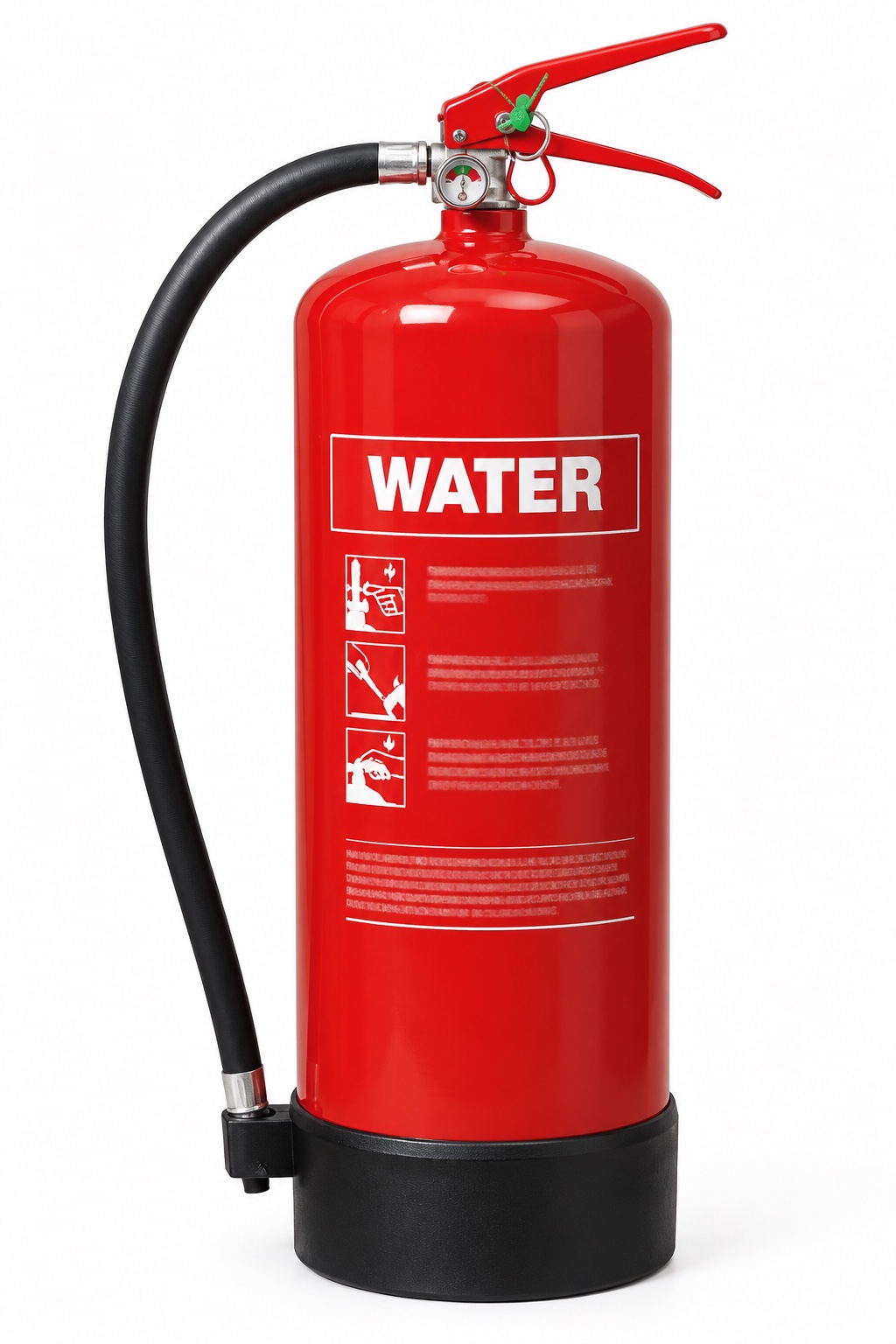
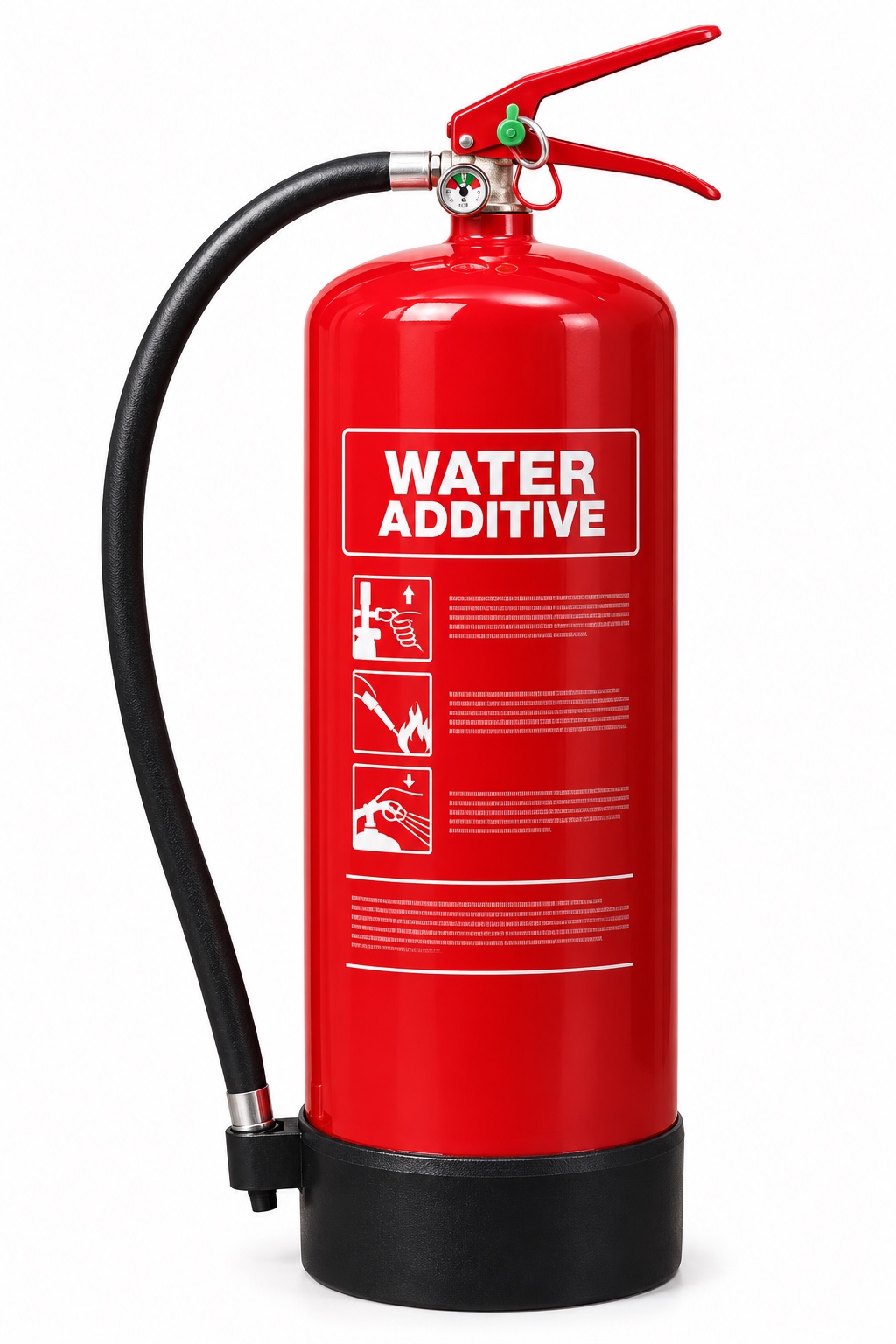
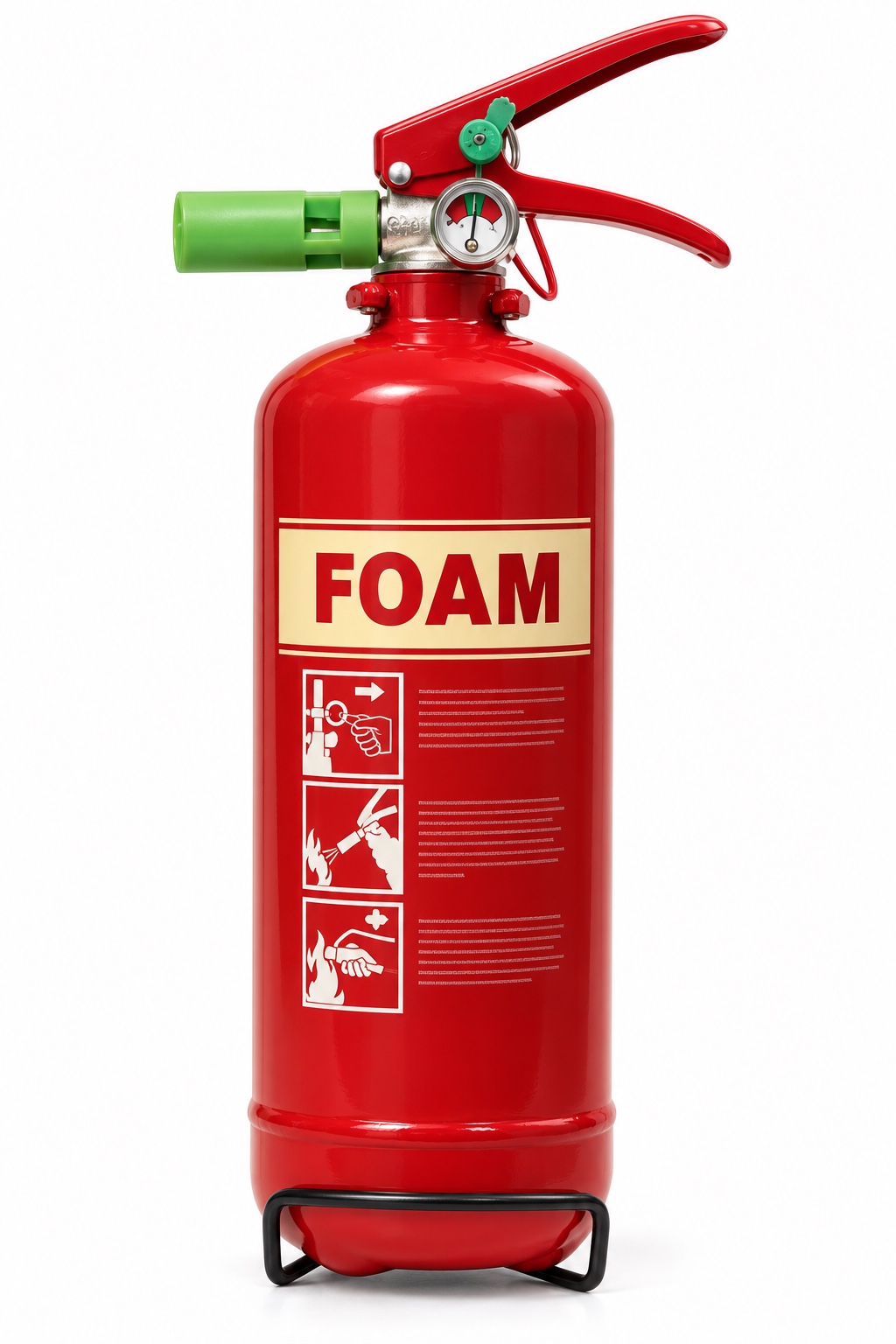
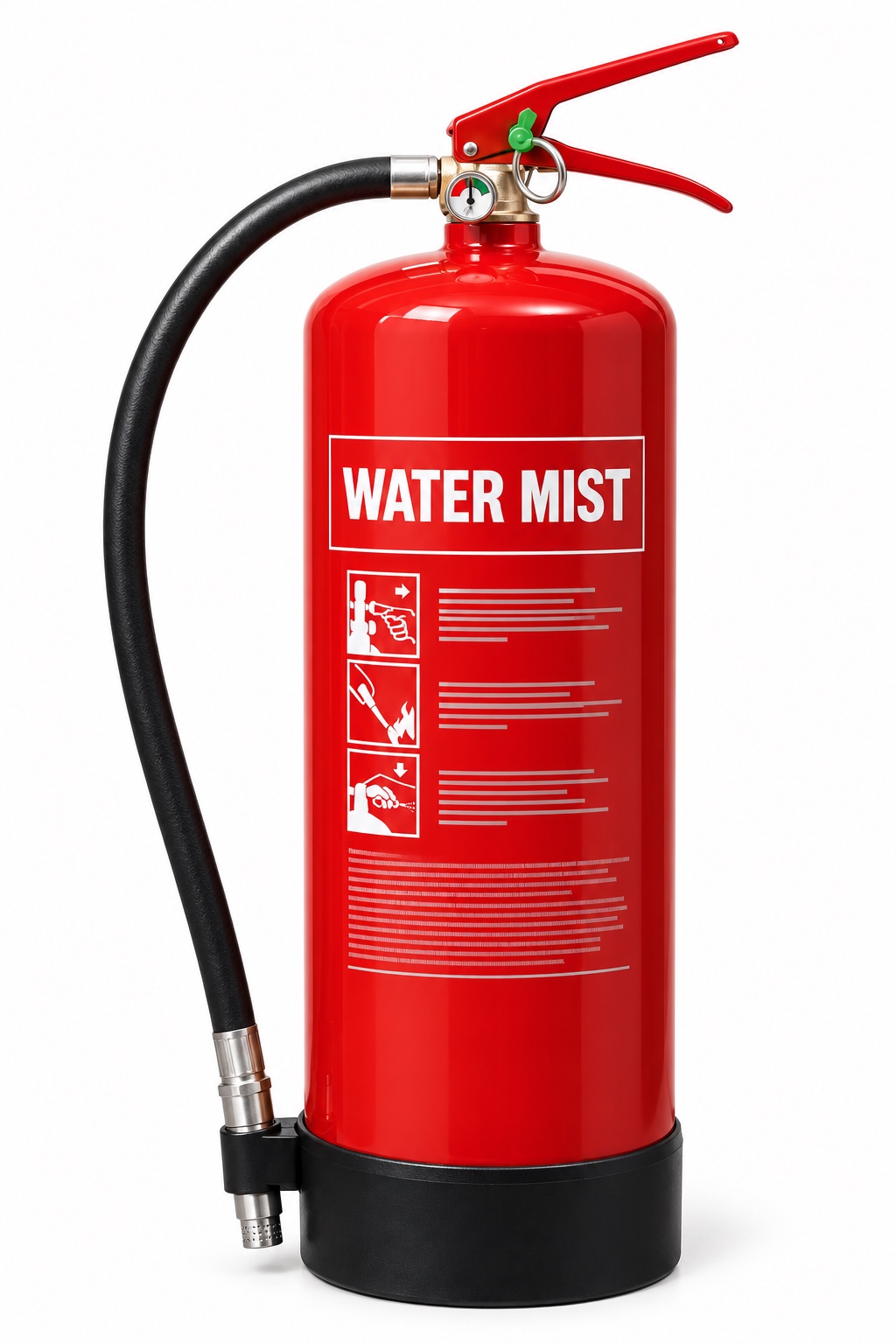
These are typical applications, not universal permissions. Check the label on the actual unit. Images are photorealistic teaching illustrations inspired by the referenced equipment; they are not photographs or certified product labels. Use Inspect the parts to explore the hardware. Band, nozzle and label details vary.
Common and specialist portable extinguisher families
Type and recognition
Typical rating and use
Wrong use: what can go wrong?
Parts in text
Cylinder
The pressure vessel holds the agent and propellant as designed. Report corrosion, dents or other damage. Do not open, refill or repair it as an awareness check.
Agent name and colour marking
Read the actual agent name, fire ratings, electrical warnings and instructions. Colour is a recognition aid; it does not prove suitability. The illustration is not an operating label.
Fixed carrying handle
The lower fixed handle supports the unit. It is different from the upper operating lever. The exact grip and operation belong in practical instruction for the model.
Operating / squeeze lever
The upper lever operates the discharge valve when the safety device is released. Do not squeeze or discharge a unit to test it during a routine visual check.
Safety pin and pull ring
The pin mechanically prevents accidental operation. A pin or ring that is missing, distorted or insecure needs reporting; its presence does not prove the unit is serviceable.
Tamper indicator / snap-lock seal
The breakable indicator or snap-lock seal shows possible disturbance. Designs can use a separate pin-retaining strap or a pin-mounted indicator. It is different from the mechanical safety pin and is not a theft lock. Report it if broken or missing.
Pressure gauge
On this stored-pressure example the gauge indicates pressure, not the mass of agent remaining. A pointer in the marked range does not prove the cylinder is full or the unit has passed its service checks.
Hose, nozzle or applicator
The flexible hose ends in the model’s discharge nozzle. The clip is for stowage; a hose being clipped in place is not a service check. Do not block, detach or test-discharge it during a visual inspection.
Base / protective boot
The boot protects the base on this example. Other models have a different foot arrangement or no separate boot. Check the approved mounting and access rather than guessing from the picture.
WaterRed / WATER marking
Normally A
Cools burning solid material such as paper, wood or fabric.
Check the limitation
Ordinary water is unsuitable for live electrical equipment, flammable-liquid pools, cooking oil and reactive metals: shock, spreading fuel or violent reaction can result.
Parts in text
Cylinder
The pressure vessel holds the agent and propellant as designed. Report corrosion, dents or other damage. Do not open, refill or repair it as an awareness check.
Agent name and colour marking
Read the actual agent name, fire ratings, electrical warnings and instructions. Colour is a recognition aid; it does not prove suitability. The illustration is not an operating label.
Fixed carrying handle
The lower fixed handle supports the unit. It is different from the upper operating lever. The exact grip and operation belong in practical instruction for the model.
Operating / squeeze lever
The upper lever operates the discharge valve when the safety device is released. Do not squeeze or discharge a unit to test it during a routine visual check.
Safety pin and pull ring
The pin mechanically prevents accidental operation. A pin or ring that is missing, distorted or insecure needs reporting; its presence does not prove the unit is serviceable.
Tamper indicator / snap-lock seal
The breakable indicator or snap-lock seal shows possible disturbance. Designs can use a separate pin-retaining strap or a pin-mounted indicator. It is different from the mechanical safety pin and is not a theft lock. Report it if broken or missing.
Pressure gauge
On this stored-pressure example the gauge indicates pressure, not the mass of agent remaining. A pointer in the marked range does not prove the cylinder is full or the unit has passed its service checks.
Hose, nozzle or applicator
The flexible hose ends in the model’s discharge nozzle. The clip is for stowage; a hose being clipped in place is not a service check. Do not block, detach or test-discharge it during a visual inspection.
Base / protective boot
The boot protects the base on this example. Other models have a different foot arrangement or no separate boot. Check the approved mounting and access rather than guessing from the picture.
Water spray / water with additivesUsually red; read the agent name
A; B only if explicitly rated
Improved wetting or spray performance can help on the hazards stated on that model’s label.
Check the limitation
An additive does not make every water extinguisher safe for electricity, oils or reactive chemicals. Check the specific exclusions.
Parts in text
Cylinder
The pressure vessel holds the agent and propellant as designed. Report corrosion, dents or other damage. Do not open, refill or repair it as an awareness check.
Agent name and colour marking
Read the actual agent name, fire ratings, electrical warnings and instructions. Colour is a recognition aid; it does not prove suitability. The illustration is not an operating label.
Fixed carrying handle
The lower fixed handle supports the unit. It is different from the upper operating lever. The exact grip and operation belong in practical instruction for the model.
Operating / squeeze lever
The upper lever operates the discharge valve when the safety device is released. Do not squeeze or discharge a unit to test it during a routine visual check.
Safety pin and pull ring
The pin mechanically prevents accidental operation. A pin or ring that is missing, distorted or insecure needs reporting; its presence does not prove the unit is serviceable.
Tamper indicator / snap-lock seal
The breakable indicator or snap-lock seal shows possible disturbance. Designs can use a separate pin-retaining strap or a pin-mounted indicator. It is different from the mechanical safety pin and is not a theft lock. Report it if broken or missing.
Pressure gauge
On this stored-pressure example the gauge indicates pressure, not the mass of agent remaining. A pointer in the marked range does not prove the cylinder is full or the unit has passed its service checks.
Direct spray nozzle
This compact foam example has a nozzle attached directly to the valve. Larger units may have a hose. Recognise the actual discharge arrangement and use only the approved agent and instructions.
Base / protective boot
The boot protects the base on this example. Other models have a different foot arrangement or no separate boot. Check the approved mounting and access rather than guessing from the picture.
FoamCream panel / FOAM
Commonly A and B
Cools and forms a surface blanket on suitable liquid fires. The agent must suit the actual fuel; some alcohols need alcohol-resistant foam.
Check the limitation
Ordinary foam is not a general answer for live electricity, cooking oil or metal fires. Unsuitable foam may break down on a solvent; a jet can spread fuel. Free-flowing fuel needs specialist response.
Parts in text
Cylinder
The pressure vessel holds the agent and propellant as designed. Report corrosion, dents or other damage. Do not open, refill or repair it as an awareness check.
Agent name and colour marking
Read the actual agent name, fire ratings, electrical warnings and instructions. Colour is a recognition aid; it does not prove suitability. The illustration is not an operating label.
Fixed carrying handle
The lower fixed handle supports the unit. It is different from the upper operating lever. The exact grip and operation belong in practical instruction for the model.
Operating / squeeze lever
The upper lever operates the discharge valve when the safety device is released. Do not squeeze or discharge a unit to test it during a routine visual check.
Safety pin and pull ring
The pin mechanically prevents accidental operation. A pin or ring that is missing, distorted or insecure needs reporting; its presence does not prove the unit is serviceable.
Tamper indicator / snap-lock seal
The breakable indicator or snap-lock seal shows possible disturbance. Designs can use a separate pin-retaining strap or a pin-mounted indicator. It is different from the mechanical safety pin and is not a theft lock. Report it if broken or missing.
Pressure gauge
On this stored-pressure example the gauge indicates pressure, not the mass of agent remaining. A pointer in the marked range does not prove the cylinder is full or the unit has passed its service checks.
Fine-mist nozzle
The specially designed nozzle creates the intended fine spray. It is not an ordinary water jet. Nozzle appearance alone does not establish any tested electrical suitability.
Base / protective boot
The boot protects the base on this example. Other models have a different foot arrangement or no separate boot. Check the approved mounting and access rather than guessing from the picture.
Water mistManufacturer marking varies
Model-specific; commonly A, some F
Fine droplets absorb heat. Some products have additional ratings or tested electrical suitability, with stated voltage and distance conditions.
Check the limitation
‘Mist’ is not universal approval. Use only the classes and electrical conditions actually declared for that model; do not assume it covers metals, liquids or batteries.
Parts in text
Cylinder
The pressure vessel holds the agent and propellant as designed. Report corrosion, dents or other damage. Do not open, refill or repair it as an awareness check.
Agent name and colour marking
Read the actual agent name, fire ratings, electrical warnings and instructions. Colour is a recognition aid; it does not prove suitability. The illustration is not an operating label.
Fixed carrying handle
The lower fixed handle supports the unit. It is different from the upper operating lever. The exact grip and operation belong in practical instruction for the model.
Operating / squeeze lever
The upper lever operates the discharge valve when the safety device is released. Do not squeeze or discharge a unit to test it during a routine visual check.
Safety pin and pull ring
The pin mechanically prevents accidental operation. A pin or ring that is missing, distorted or insecure needs reporting; its presence does not prove the unit is serviceable.
Tamper indicator / snap-lock seal
The breakable indicator or snap-lock seal shows possible disturbance. Designs can use a separate pin-retaining strap or a pin-mounted indicator. It is different from the mechanical safety pin and is not a theft lock. Report it if broken or missing.
Pressure gauge
On this stored-pressure example the gauge indicates pressure, not the mass of agent remaining. A pointer in the marked range does not prove the cylinder is full or the unit has passed its service checks.
Hose, nozzle or applicator
The flexible hose ends in the model’s discharge nozzle. The clip is for stowage; a hose being clipped in place is not a service check. Do not block, detach or test-discharge it during a visual inspection.
Base / protective boot
The boot protects the base on this example. Other models have a different foot arrangement or no separate boot. Check the approved mounting and access rather than guessing from the picture.
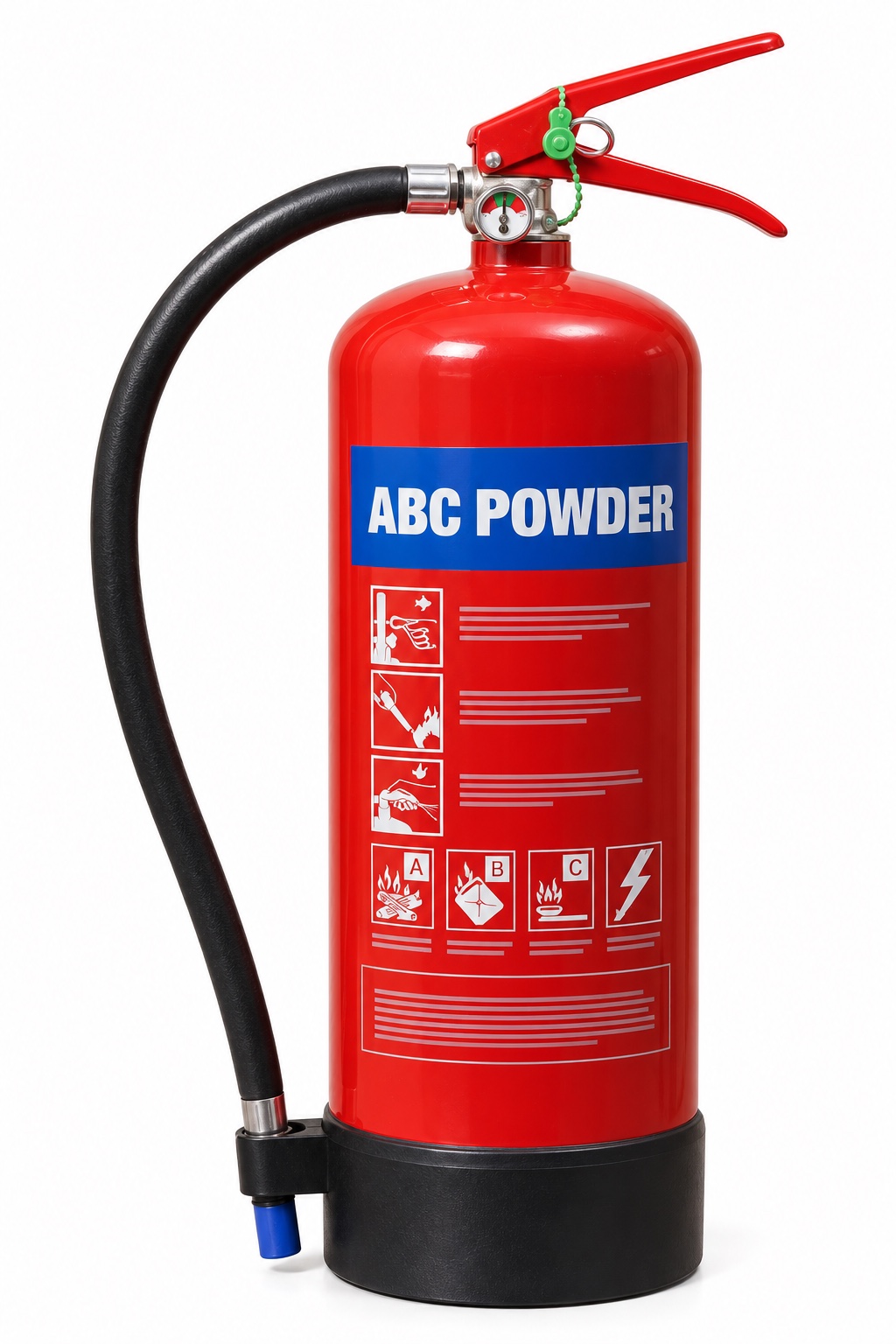
ABC dry powderBlue panel / ABC POWDER
A, B and C if marked
Interrupts flame chemistry; multipurpose powder also acts on Class A material. A C marking does not authorise tackling a gas leak.
Check the limitation
Powder can obscure escape and impair breathing; it is not generally recommended indoors. Limited cooling allows reignition. It is not metal-specific D powder or a substitute for F-rated cooking-oil equipment.
Parts in text
Cylinder
The pressure vessel holds the agent and propellant as designed. Report corrosion, dents or other damage. Do not open, refill or repair it as an awareness check.
Agent name and colour marking
Read the actual agent name, fire ratings, electrical warnings and instructions. Colour is a recognition aid; it does not prove suitability. The illustration is not an operating label.
Fixed carrying handle
The lower fixed handle supports the unit. It is different from the upper operating lever. The exact grip and operation belong in practical instruction for the model.
Operating / squeeze lever
The upper lever operates the discharge valve when the safety device is released. Do not squeeze or discharge a unit to test it during a routine visual check.
Safety pin and pull ring
The pin mechanically prevents accidental operation. A pin or ring that is missing, distorted or insecure needs reporting; its presence does not prove the unit is serviceable.
Tamper indicator / snap-lock seal
The breakable indicator or snap-lock seal shows possible disturbance. Designs can use a separate pin-retaining strap or a pin-mounted indicator. It is different from the mechanical safety pin and is not a theft lock. Report it if broken or missing.
Pressure gauge
On this stored-pressure example the gauge indicates pressure, not the mass of agent remaining. A pointer in the marked range does not prove the cylinder is full or the unit has passed its service checks.
Hose, nozzle or applicator
The flexible hose ends in the model’s discharge nozzle. The clip is for stowage; a hose being clipped in place is not a service check. Do not block, detach or test-discharge it during a visual inspection.
Base / protective boot
The boot protects the base on this example. Other models have a different foot arrangement or no separate boot. Check the approved mounting and access rather than guessing from the picture.
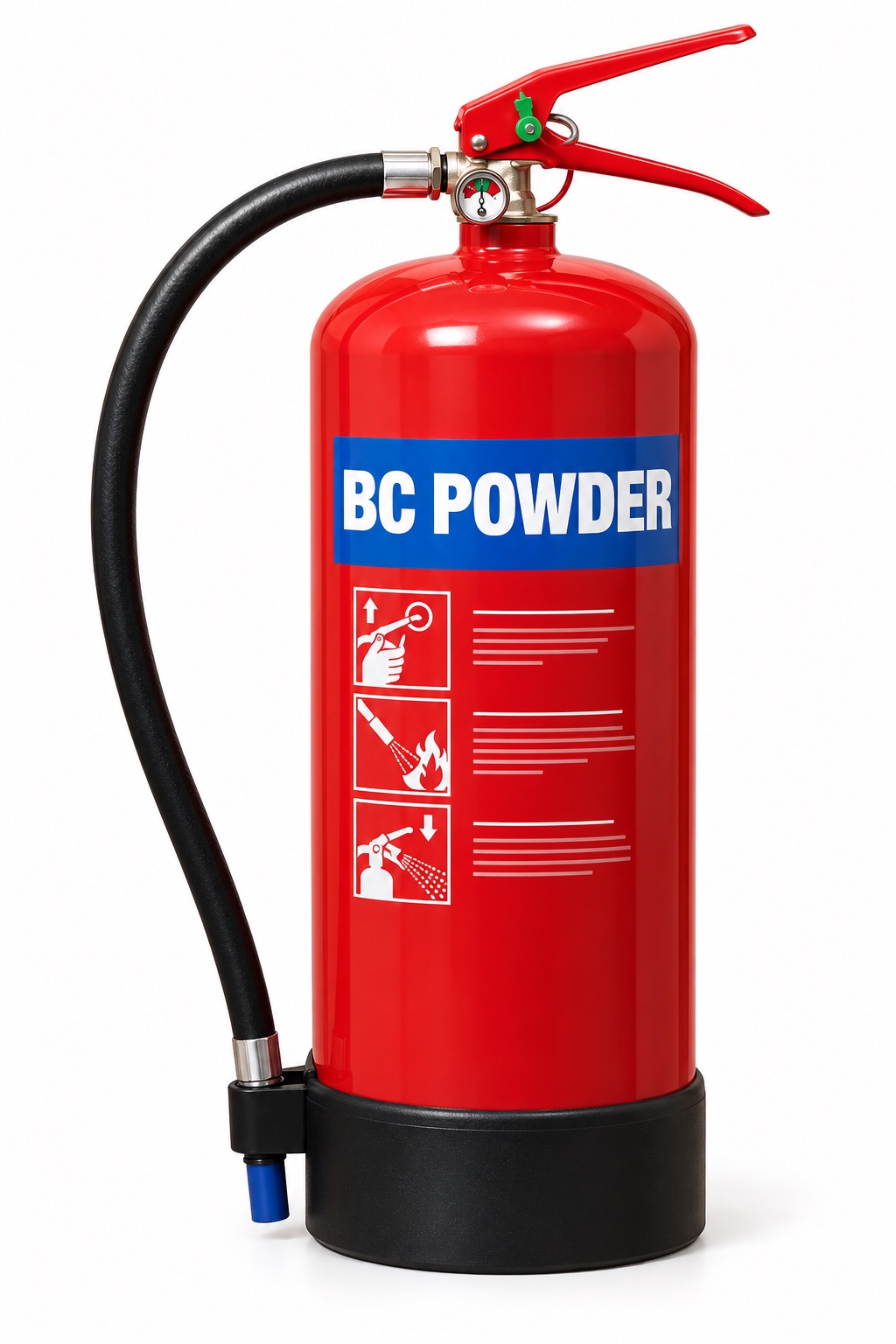
BC dry powderBlue panel / BC POWDER
B and C if marked; not A
Selected for particular liquid or gas hazards under the assessed plan. Electrical use must follow the actual unit’s instructions.
Check the limitation
Do not assume all blue powder extinguishers protect wood or paper. It has the visibility, breathing and reignition limitations of powder; it does not provide Class D or F protection.
Parts in text
Cylinder
The pressure vessel holds the agent and propellant as designed. Report corrosion, dents or other damage. Do not open, refill or repair it as an awareness check.
Agent name and colour marking
Read the actual agent name, fire ratings, electrical warnings and instructions. Colour is a recognition aid; it does not prove suitability. The illustration is not an operating label.
Fixed carrying handle
The lower fixed handle supports the unit. It is different from the upper operating lever. The exact grip and operation belong in practical instruction for the model.
Operating / squeeze lever
The upper lever operates the discharge valve when the safety device is released. Do not squeeze or discharge a unit to test it during a routine visual check.
Safety pin and pull ring
The pin mechanically prevents accidental operation. A pin or ring that is missing, distorted or insecure needs reporting; its presence does not prove the unit is serviceable.
Tamper indicator / snap-lock seal
The breakable indicator or snap-lock seal shows possible disturbance. Designs can use a separate pin-retaining strap or a pin-mounted indicator. It is different from the mechanical safety pin and is not a theft lock. Report it if broken or missing.
Pressure gauge
On this stored-pressure example the gauge indicates pressure, not the mass of agent remaining. A pointer in the marked range does not prove the cylinder is full or the unit has passed its service checks.
Specialist low-velocity applicator
The specialist applicator places the compatible metal-fire agent without unnecessarily disturbing burning material. Both agent and application method must suit the specific metal; this is not an ABC powder nozzle.
Base / protective boot
The boot protects the base on this example. Other models have a different foot arrangement or no separate boot. Check the approved mounting and access rather than guessing from the picture.
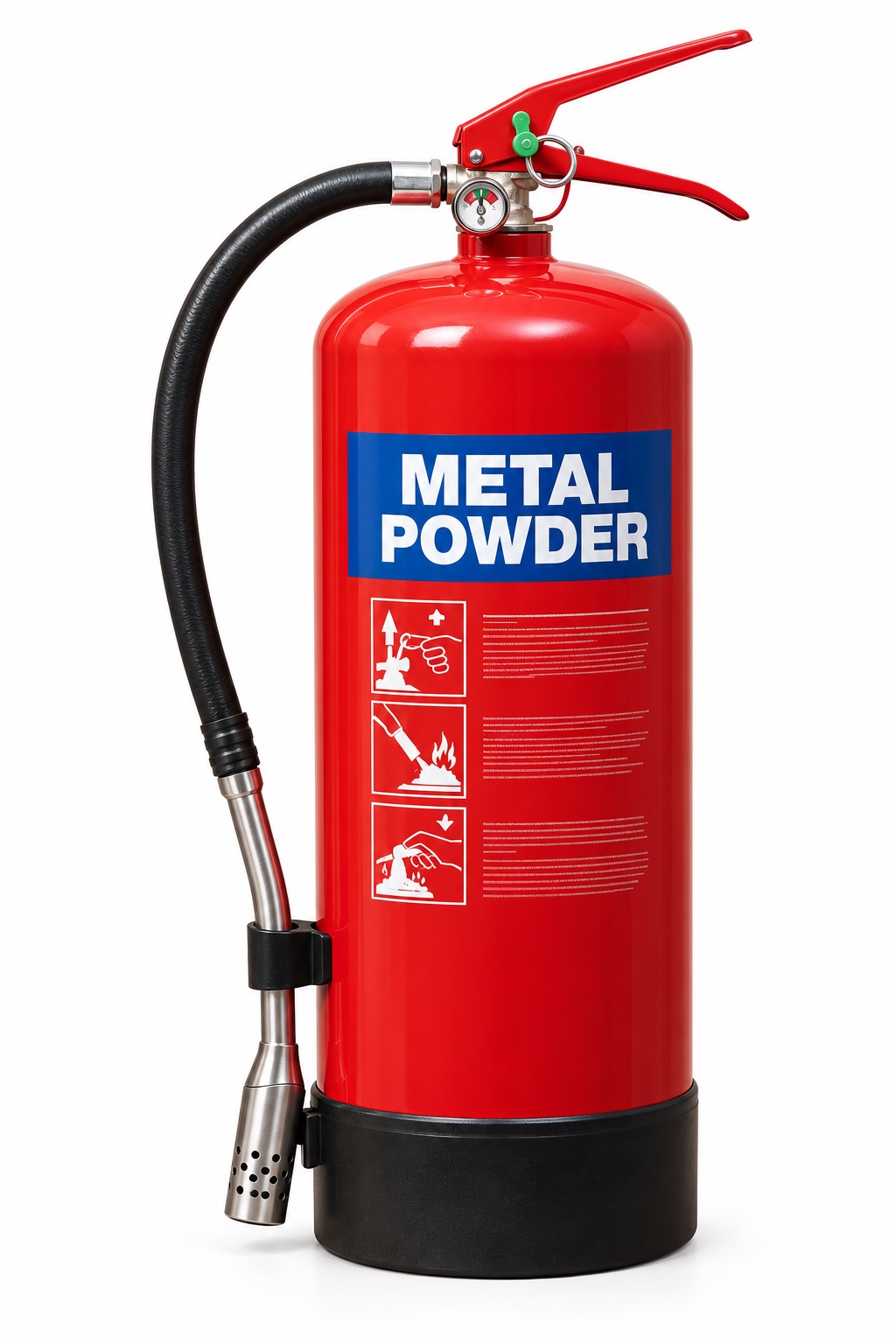
Class D specialist powderSpecific metal and agent named on label
D, for the specified metal
A specialist powder can isolate or absorb heat from a compatible burning metal. Selection requires knowledge of the metal and its form.
Check the limitation
The wrong powder can fail or react. Water, foam and CO₂ can be dangerous on certain burning metals. A powder suitable for magnesium is not automatically suitable for metallic lithium.
Parts in text
Cylinder
The narrow steel cylinder contains carbon dioxide under pressure. There is normally no pressure gauge on this portable type; service assessment includes the appropriate mass and integrity checks by competent personnel.
Agent name and colour marking
Read the actual agent name, fire ratings, electrical warnings and instructions. Colour is a recognition aid; it does not prove suitability. The illustration is not an operating label.
Fixed carrying handle
The lower fixed handle supports the unit. It is different from the upper operating lever. The exact grip and operation belong in practical instruction for the model.
Operating / squeeze lever
The upper lever operates the discharge valve when the safety device is released. Do not squeeze or discharge a unit to test it during a routine visual check.
Safety pin and pull ring
The pin mechanically prevents accidental operation. A pin or ring that is missing, distorted or insecure needs reporting; its presence does not prove the unit is serviceable.
Tamper indicator / snap-lock seal
The breakable indicator or snap-lock seal shows possible disturbance. Designs can use a separate pin-retaining strap or a pin-mounted indicator. It is different from the mechanical safety pin and is not a theft lock. Report it if broken or missing.
Horn and designated insulated grip
The flared horn directs the CO₂ discharge. Discharge parts can become extremely cold. Only the parts identified by the manufacturer as safe to hold should be gripped; not every horn is frost-free.
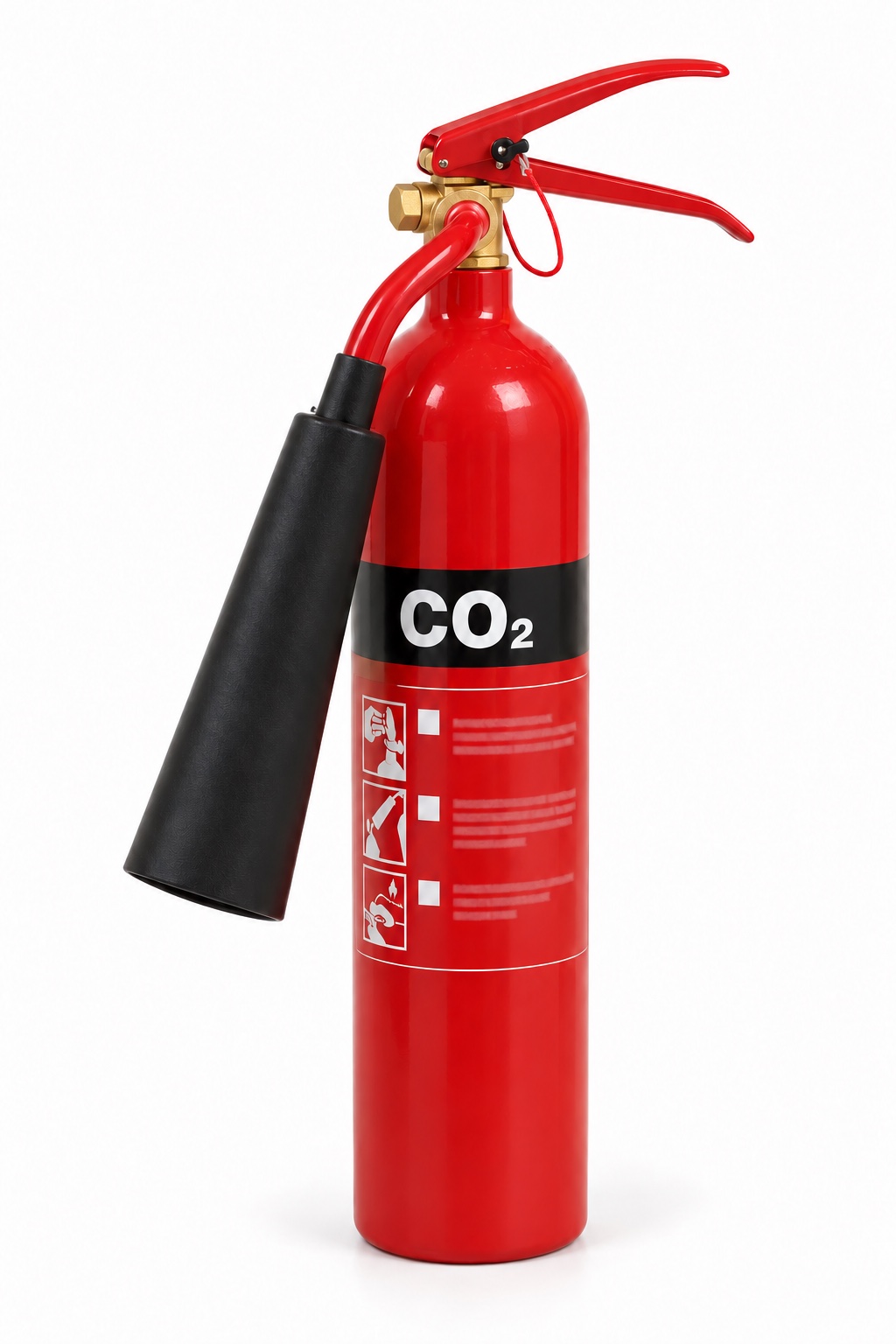
Displaces the atmosphere around a small flame and leaves no powder residue. Often selected around electrical equipment.
Check the limitation
Poor cooling means reignition is possible. CO₂ can create a dangerous atmosphere in enclosed spaces; discharge can cause frostbite. Hold only the designated insulated parts. Not a cooking-oil or metal-fire substitute.
Parts in text
Cylinder
The pressure vessel holds the agent and propellant as designed. Report corrosion, dents or other damage. Do not open, refill or repair it as an awareness check.
Agent name and colour marking
Read the actual agent name, fire ratings, electrical warnings and instructions. Colour is a recognition aid; it does not prove suitability. The illustration is not an operating label.
Fixed carrying handle
The lower fixed handle supports the unit. It is different from the upper operating lever. The exact grip and operation belong in practical instruction for the model.
Operating / squeeze lever
The upper lever operates the discharge valve when the safety device is released. Do not squeeze or discharge a unit to test it during a routine visual check.
Safety pin and pull ring
The pin mechanically prevents accidental operation. A pin or ring that is missing, distorted or insecure needs reporting; its presence does not prove the unit is serviceable.
Tamper indicator / snap-lock seal
The breakable indicator or snap-lock seal shows possible disturbance. Designs can use a separate pin-retaining strap or a pin-mounted indicator. It is different from the mechanical safety pin and is not a theft lock. Report it if broken or missing.
Pressure gauge
On this stored-pressure example the gauge indicates pressure, not the mass of agent remaining. A pointer in the marked range does not prove the cylinder is full or the unit has passed its service checks.
Hose, lance and spray applicator
The hose feeds the long lance and purpose-designed applicator. It helps distinguish this kitchen-fire unit from an ordinary short-nozzle extinguisher. Use requires model-specific practical training.
Base / protective boot
The boot protects the base on this example. Other models have a different foot arrangement or no separate boot. Check the approved mounting and access rather than guessing from the picture.
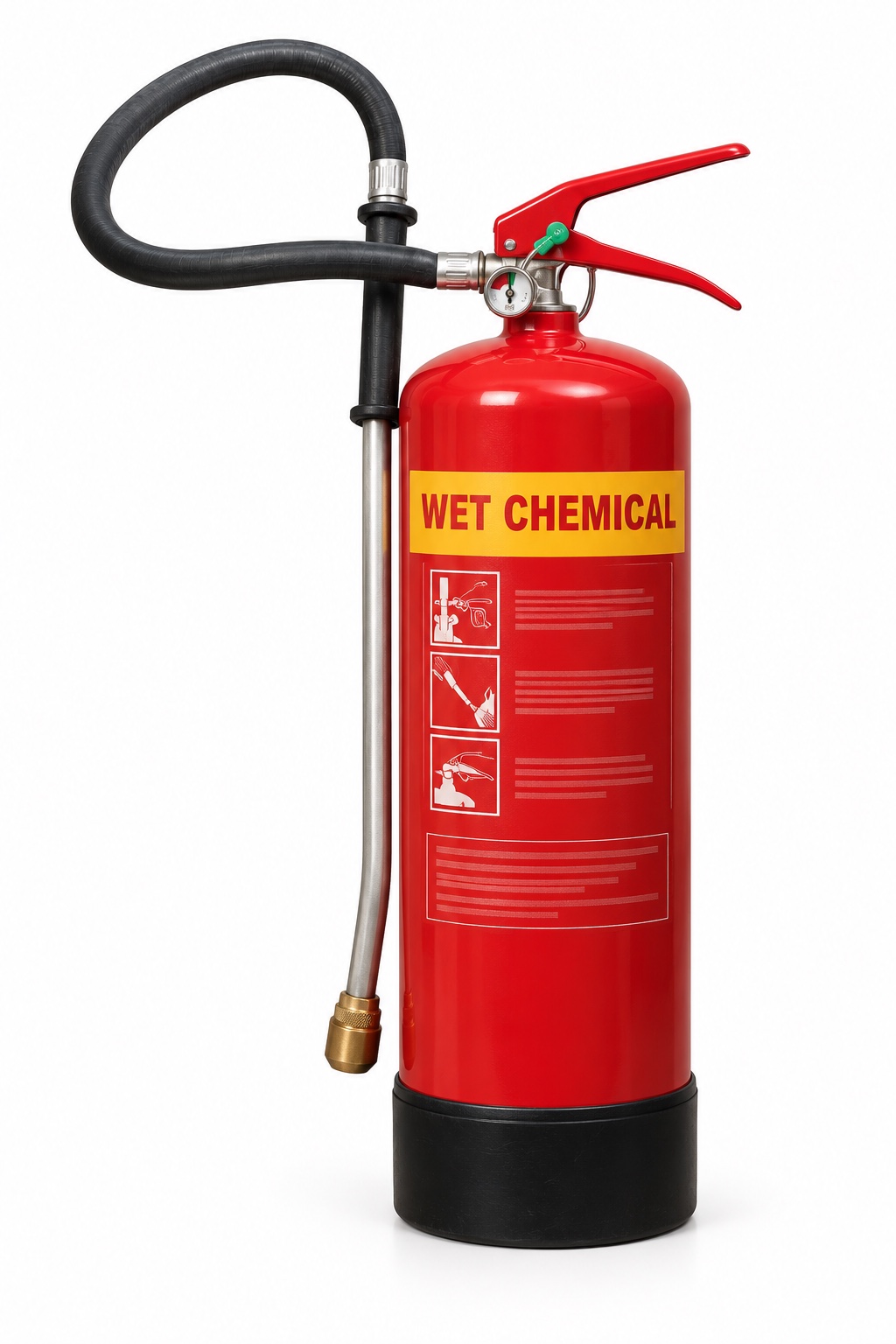
Wet chemicalYellow panel / WET CHEMICAL
F; often A if marked
Cools cooking oil and creates a protective surface layer through reaction with the fat. Use only within the actual unit’s rating and instructions.
Check the limitation
Do not mistake it for a general liquid-fire or electrical extinguisher. Incorrect application or moving the fryer can splash hot oil; apparent flame-out does not establish safe temperature.
Parts in text
Cylinder
The pressure vessel holds the agent and propellant as designed. Report corrosion, dents or other damage. Do not open, refill or repair it as an awareness check.
Agent name and colour marking
Read the actual agent name, fire ratings, electrical warnings and instructions. Colour is a recognition aid; it does not prove suitability. The illustration is not an operating label.
Fixed carrying handle
The lower fixed handle supports the unit. It is different from the upper operating lever. The exact grip and operation belong in practical instruction for the model.
Operating / squeeze lever
The upper lever operates the discharge valve when the safety device is released. Do not squeeze or discharge a unit to test it during a routine visual check.
Safety pin and pull ring
The pin mechanically prevents accidental operation. A pin or ring that is missing, distorted or insecure needs reporting; its presence does not prove the unit is serviceable.
Tamper indicator / snap-lock seal
The breakable indicator or snap-lock seal shows possible disturbance. Designs can use a separate pin-retaining strap or a pin-mounted indicator. It is different from the mechanical safety pin and is not a theft lock. Report it if broken or missing.
Pressure gauge
On this stored-pressure example the gauge indicates pressure, not the mass of agent remaining. A pointer in the marked range does not prove the cylinder is full or the unit has passed its service checks.
Hose, nozzle or applicator
The flexible hose ends in the model’s discharge nozzle. The clip is for stowage; a hose being clipped in place is not a service check. Do not block, detach or test-discharge it during a visual inspection.
Base / protective boot
The boot protects the base on this example. Other models have a different foot arrangement or no separate boot. Check the approved mounting and access rather than guessing from the picture.
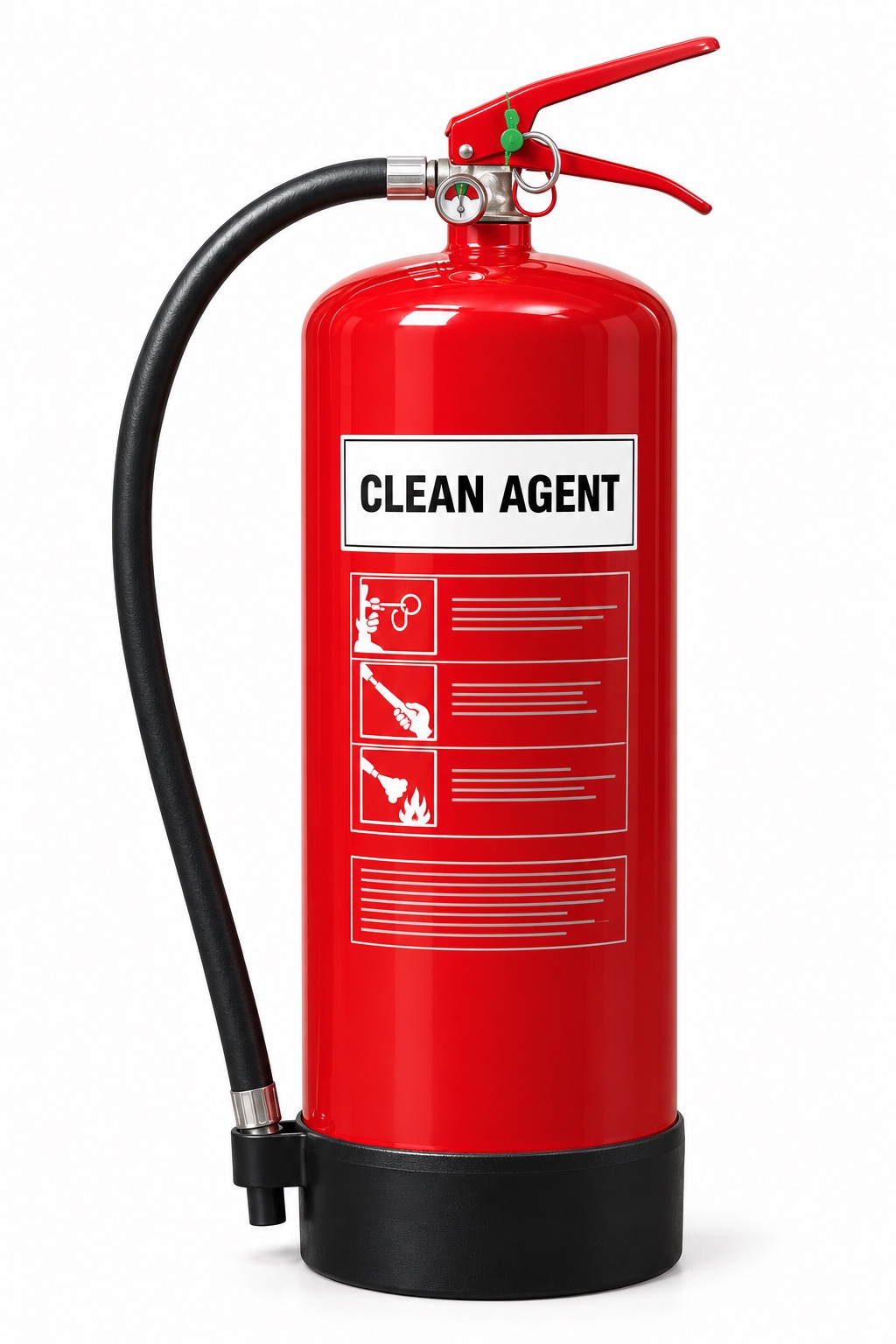
Clean agent / vaporising liquidRead the agent; no universal colour shortcut
Product- and jurisdiction-specific
Specialist low-residue agents may protect sensitive equipment. Confirm the UK-approved application and the manufacturer’s limits.
Check the limitation
Low residue does not mean safe to breathe. Do not copy a US A:B:C rating as UK gas-fire approval. Legacy halon is restricted to permitted critical uses and applicable deadlines.
Parts in text
Cylinder
The pressure vessel holds the agent and propellant as designed. Report corrosion, dents or other damage. Do not open, refill or repair it as an awareness check.
Agent name and colour marking
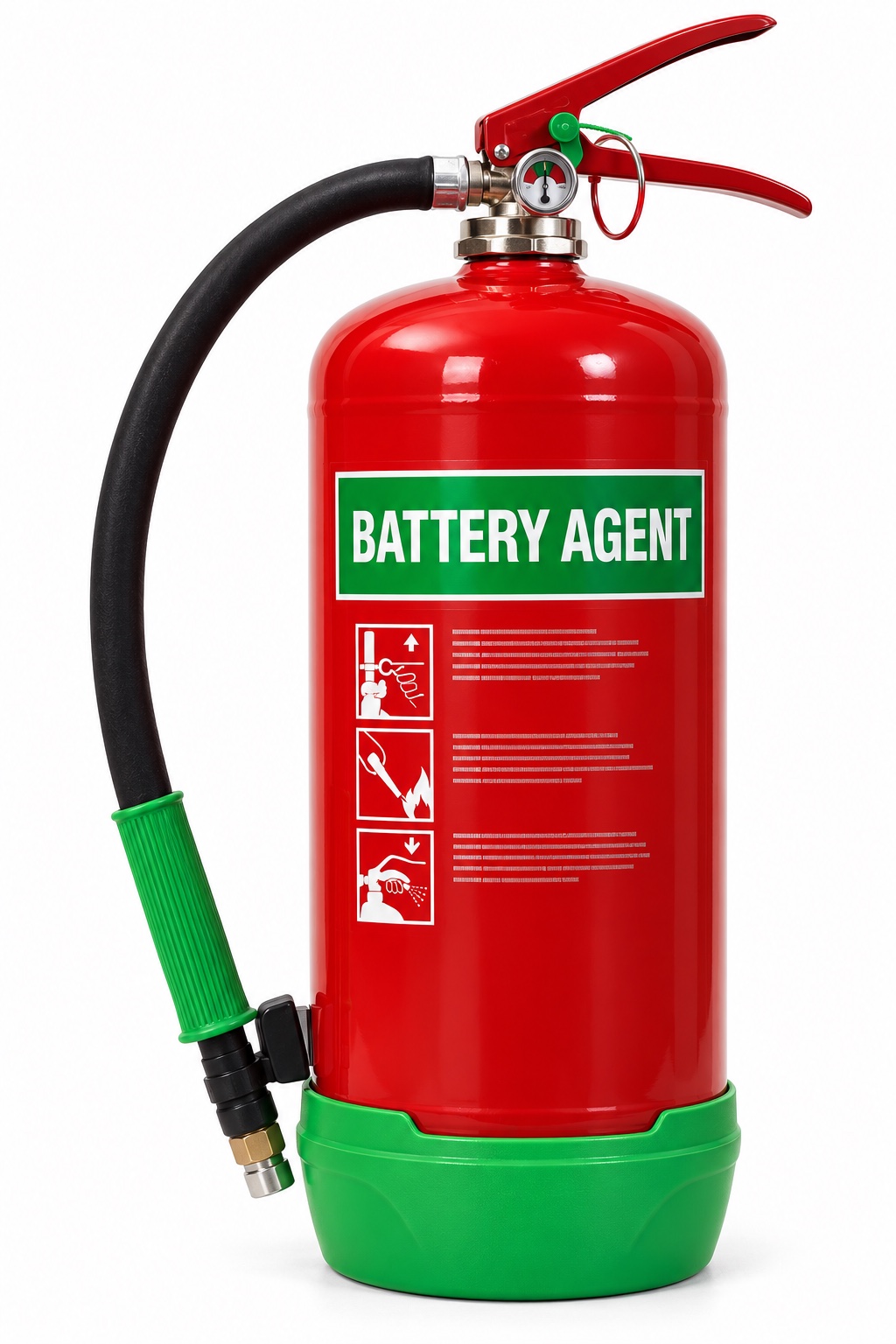
This generic illustration has a green agent area and boot inspired by the supplied product. Green is not a universal Class L identification code. Read the real product name, chemistry, battery limits and instructions.
Fixed carrying handle
The lower fixed handle supports the unit. It is different from the upper operating lever. The exact grip and operation belong in practical instruction for the model.
Operating / squeeze lever
The upper lever operates the discharge valve when the safety device is released. Do not squeeze or discharge a unit to test it during a routine visual check.
Safety pin and pull ring
The pin mechanically prevents accidental operation. A pin or ring that is missing, distorted or insecure needs reporting; its presence does not prove the unit is serviceable.
Tamper indicator / snap-lock seal
The breakable indicator or snap-lock seal shows possible disturbance. Designs can use a separate pin-retaining strap or a pin-mounted indicator. It is different from the mechanical safety pin and is not a theft lock. Report it if broken or missing.
Pressure gauge
On this stored-pressure example the gauge indicates pressure, not the mass of agent remaining. A pointer in the marked range does not prove the cylinder is full or the unit has passed its service checks.
Hose, grip and applicator
The illustrated hose has a coloured ribbed grip and a small application tip. This shows the hardware family, not a tested battery capability. Follow the instructions for the actual agent and generation.
Base / protective boot
The boot protects the base on this example. Other models have a different foot arrangement or no separate boot. Check the approved mounting and access rather than guessing from the picture.
Battery-specific suppression productsNamed formulation and tested application
Check independent scope and instructions
Some products use water-based cooling or specialist media such as aqueous vermiculite for specified battery scenarios. Selection depends on chemistry, capacity and location.
Check the limitation
A ‘lithium’ label is not proof it will stop thermal runaway in a large pack. Flame suppression may not prevent reignition or gas release. Do not approach, carry or submerge a failing battery as a learner exercise.
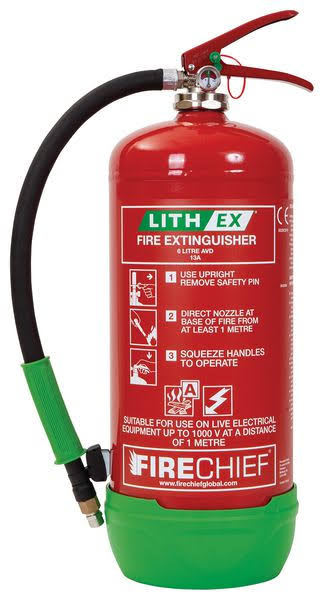
Lithium-ion product example · Firechief 6 L Lith-Ex
A named product example helps connect the generic table to an actual unit. Confirm the exact product before using its claims.
Agent and intended application
The linked Seton example uses aqueous vermiculite dispersion (AVD) for specified lithium-ion battery fire applications. Water content cools; the dispersed mineral helps form a barrier. This is not generic Class D metal-fire powder.
Read the actual rating
Seton lists a 6 L product with a 13A rating. That A rating describes its solid-material test performance; it does not, by itself, certify a universal Class L battery capability.
Match the exact model and generation
The manufacturer’s current 6 L G2 page identifies FLE6X and different discharge details from the retailer’s older listing. Do not mix their time, range or pressure values. Match the delivered label, product sheet and manual.
Check the battery scope
Confirm the allowed battery chemistry, energy capacity, state and scenario with the current manufacturer information and competent fire assessment. A large EV or energy-storage pack cannot be treated as a small-device fire.
Electrical conditions are product-specific
The supplied product label includes a voltage and minimum-distance condition. Do not transfer that condition to another battery extinguisher or infer that it makes an unsafe electrical approach acceptable.
After the flame disappears
Heat, off-gas and reignition can remain. Follow the planned withdrawal, exclusion and fire-service response; do not pick up, submerge or return a failed battery to charging.
Read the agent, fire-class letters, performance rating, electrical warnings, operating instructions and service condition. Numbers such as 13A or 55B describe standardised test performance, not a safe room size or permission to tackle that amount of fire. Colour is a clue; the actual label and assessed plan decide suitability.
What about a fire blanket?
A fire blanket is separate equipment, not an extinguisher type. It may be specified for a small contained cooking fire, but safe approach and the manufacturer’s limits still matter. Never carry a burning pan, improvise a cover or put yourself between fire and your exit.
Spot the dangerous assumption
Pause at each question, then open the explanation. These are unscored learning prompts alongside the course assessment.
A pan of cooking oil is burning. Would ordinary water help?
No. Rapid steam production can throw burning oil across the room. Raise the alarm and follow the kitchen emergency plan; never move the pan. Only a trained, authorised person should consider the specified F-rated equipment with a safe escape.
There is a C on the powder extinguisher. Should I put out the leaking gas flame?
Not as a routine response. Unburnt gas may continue escaping and form an explosive cloud. Withdraw, alarm and report the supply involved. Any safe isolation and specialist firefighting must follow the assessed emergency arrangements.
The flame around a battery has disappeared. Is the incident over?
No. Internal heat, flammable or toxic off-gas and reignition can remain. Keep clear, prevent access and tell the fire and rescue service what battery is involved. Flame-out is not permission to handle it or restart charging.
Both extinguishers have blue panels. Are the powders interchangeable?
No. Read ABC, BC or the exact Class D metal specification. Colour identifies a family; it does not establish the correct agent, rating or safe application.
A CO₂ extinguisher leaves no mess. Is it ideal in a small unventilated room?
No. A dangerous CO₂ concentration can incapacitate a person, while the fire and smoke already threaten escape. Do not enter an unsafe room. The fire plan and competent equipment selection must account for the space.
A water-mist product claims electrical suitability. Can I use any water extinguisher on a live cabinet?
No. Any tested electrical claim belongs to that particular model, with its own voltage and distance limits. It does not apply to ordinary water or another mist product, and it does not make an unsafe approach acceptable.
Source guidance and scope
UK learning context. Consult the applicable national fire guidance and your premises’ assessed plan. Manufacturer examples explain product variation; they are not product recommendations. Guidance checked 24 October 2026.
Verify perception, assistance and capability on the actual shift.
Photorealistic illustrative UK workplace scene. Review checks: Setting: the leisure operator operates a pool and public areas during an evening shift. Act: Match the first-aid needs assessment to pool hazards, public numbers, shifts and absences; check alarms, kit and responder cover. Hold / review: Missing essential first-aid or rescue cover, failed alarm or blocked access holds the affected activity.
An alarm needs an effective human response
An alarm that staff hear may not alert every resident. Hearing, vision, cognition, location or sleep can affect how a person perceives and responds. The assessment may require appropriate alternative alerting or staff assistance. Do not assume another resident will always notice and help; that is not a reliable assigned response arrangement.
Use the actual premises and person-specific plan to establish what needs to happen. Confirm suitable technical provision, staff training, communication and available capability, including the night shift. This awareness lesson does not design an alarm system or teach an evacuation manoeuvre. A device functioning in a test is only one link if nobody can provide the required support after the alert.
Changes in resident needs or staffing require appropriate review. A daytime exercise with additional helpers cannot demonstrate that fewer night staff can perform the same actions. The responsible manager and competent fire/care roles should identify gaps and establish workable interim arrangements promptly. Do not promise to carry people or use unfamiliar equipment without the necessary assessment, training and resources.
Verify the response through safe suitable exercises and relevant physical checks, respecting residents and avoiding hazardous surprise. Ask workers to explain their actual roles and how help is summoned. Record limits and unresolved assumptions honestly, rather than declaring capability because an attendance sheet is signed. For the fictional exercise, connect a resident's alerting need with the real shift resources and identify the competent review required. The aim is an effective response system that supports the individual, not a label that an alarm is “audible” somewhere in the building or an invented guarantee that everybody can evacuate within a fixed time.
How should first-aid cover work across shifts, sites and remote work?
First-aid cover should be available whenever people are working, not just when the usual first aider is on site.
Common failures occur during early starts, overtime, night shifts, holidays, off-site work, lone work, home work and contractor work. The needs assessment should test these periods rather than assuming office-hours cover is enough.
Remote or mobile work may need travel first-aid kits, communication checks, lone-worker escalation, location-sharing arrangements and clear instructions on emergency services access.
Coverage considerations - Coverage considerations
Situation
Risk
Control
Night shift
No trained first aider available.
Shift-specific cover plan.
Holiday absence
First-aid role temporarily vacant.
Deputy and rota review.
Remote work
Delayed emergency help.
Mobile kit and communication plan.
Multiple floors/buildings
Kit or first aider too far away.
Distributed kits and contacts.
Public events
More casualties and public interface.
Event-specific assessment.
Contractor work
High-risk tasks outside normal arrangements.
Pre-start agreement on first-aid cover.
A name on a notice is not cover if that person is absent or too far away. Test a late shift, a remote work location and a busy public event: can someone summon help, reach the kit and start care within the plan? If a high-risk activity depends on a missing responder, hold or change the activity until cover is restored. See HSE assess your first-aid needs.
Applied case
A resident cannot perceive the alarm and the night plan assumes more trained helpers than are present.
Decision and explanation
Effective individual alerting/assistance and a verified strategy matching actual shift capability.
Perception and response resources must match the actual people and shift.
Lesson 6
Emollient residue changes fabric fire risk
Control ignition without changing treatment outside authority.
Teaching graphic from the linked SHAREhub source section.
Emollient residue changes fabric fire risk
Emollient residue can build up on clothing, bedding and other fabrics and make them ignite more easily. The concern includes paraffin-free products; it is not removed simply by choosing a label that sounds less flammable. Washing can reduce contamination but does not reliably eliminate the fire risk. The cream itself need not appear alight for contaminated fabric to create a serious pathway.
Use the individual's care advice and the premises fire assessment to manage ignition exposure and practical support. Relevant smoking, flame or other heat sources need competent consideration with the person. This course does not instruct staff to stop prescribed treatment, change a medicine or impose a blanket restriction. Appropriate healthcare and lawful person-centred decisions must remain with the authorised roles.
Explain the fabric and ignition concern in a way the person and relevant supporters can understand. Review bedding, clothing, laundering and source control through the actual arrangements without treating washing as a guarantee. Staff need an understandable reporting route for a new ignition conflict. Do not test a fabric sample with a flame or create a demonstration near residents.
If a current exposure is unsafe, follow the immediate protective and escalation plan, preserving appropriate care while the responsible team resolves it. Verify that the chosen measures remain usable in ordinary life and across shifts, including replacement clothing and bedding. For the fictional exercise, distinguish preventing ignition from unilaterally altering treatment. A course answer cannot prescribe a product or decide a person's restrictions. The effective outcome is a coordinated care and fire arrangement that addresses residue and ignition together, with honest recognition that a washed or paraffin-free fabric is not automatically risk-free.
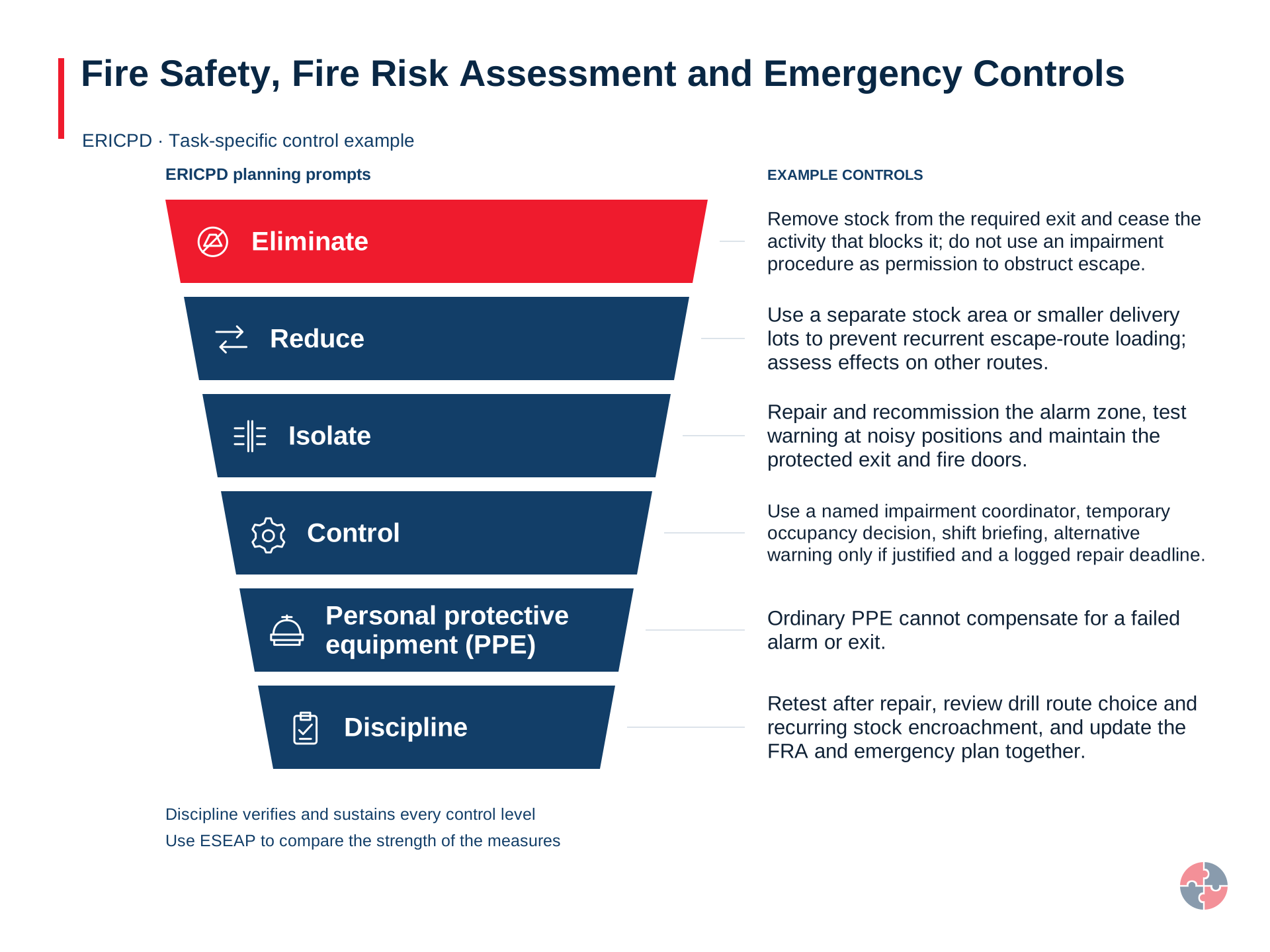
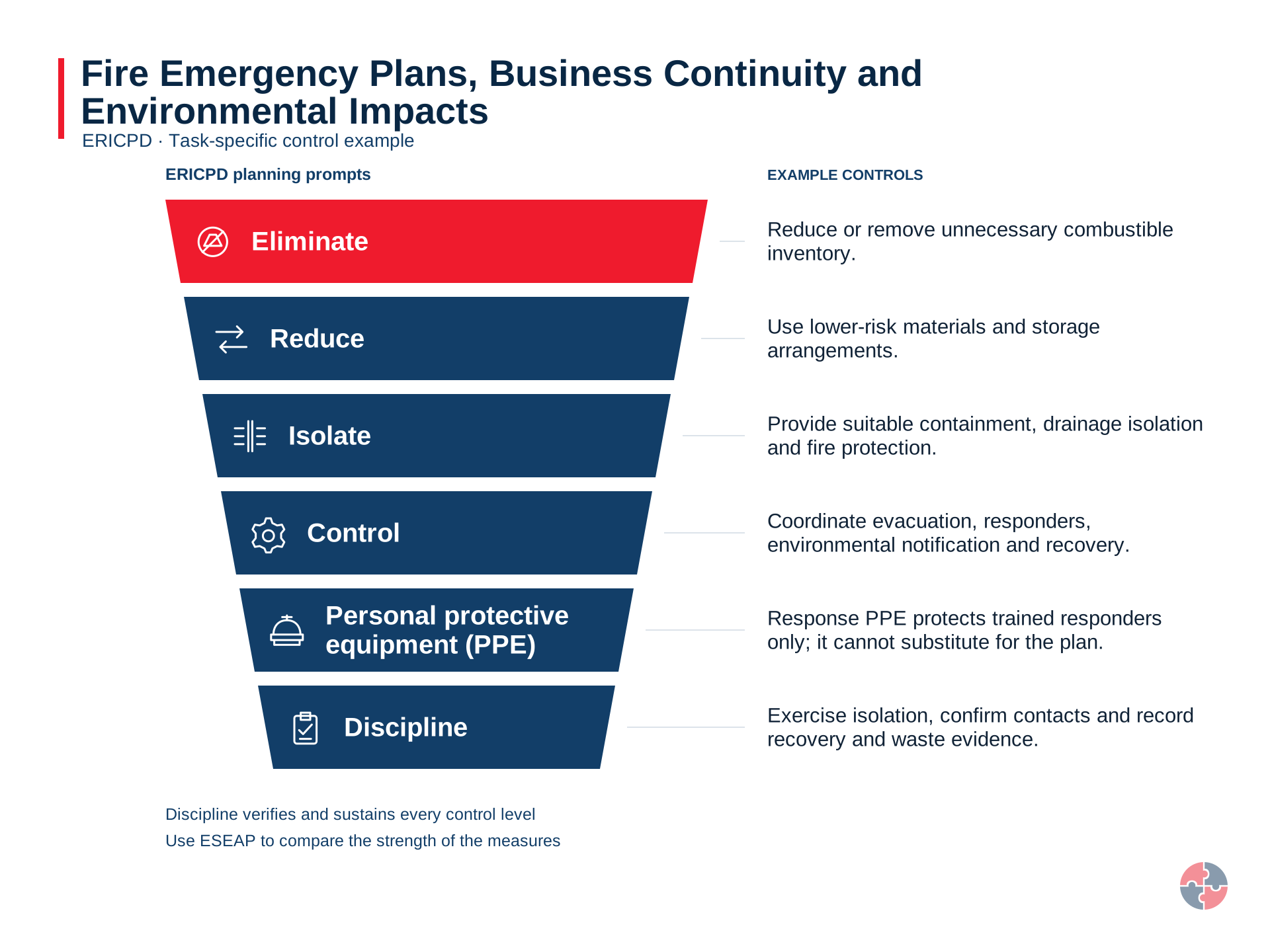
How can the ISO 45001 hierarchy of controls prioritise fire prevention, protection and emergency controls?
Use ERICPD and the five-level HSE hierarchy as related decision aids. Begin with removal and substitution, then verify engineered barriers before relying on procedures or PPE.
Task matrices are illustrations; premises-specific suitability, implementation and specialist design approval remain held for competent review.
Stock blocks an exit while one alarm zone is isolated; a packaging fire can outrun the assumed warning and escape pathway.
Vapour, sparks and changed doors create both a work-process fire and an escape/compartment problem.
How can the ERICPD hierarchy of controls prioritise fire prevention, protection and emergency controls?
ERICPD is a planning crossmap. Its prompts do not add a sixth rung or rank Isolate above engineering. Discipline verifies and sustains every control level.
Worked activity: Task application for Fire Safety, Fire Risk Assessment and Emergency Controls
Activity and release context
In a care setting, staffing and protected movement change the emergency sequence; on a construction site, temporary compartments and contractor work change both process and premises risks. The dutyholder verifies the actual strategy and restricts use where a credited barrier is impaired.
Task measure and feasibilityRemove stock from the required exit and cease the activity that blocks it; do not use an impairment procedure as permission to obstruct escape. Source: official guidance.
Owner, test and evidenceFactory manager witnesses clear route and records stop; no operation in the affected area until safe escape is restored.
Failure and stop decisionRequired exit remains blocked: stop affected operations until immediately clear.
Hazard and harm routeSame scenario
ERICPD → five-level controlReduce → Substitution
Task measure and feasibilityUse a separate stock area or smaller delivery lots to prevent recurrent escape-route loading; assess effects on other routes. Source: official guidance.
Owner, test and evidenceOperations lead verifies storage plan during peak delivery; reject displacement of the hazard.
Failure and stop decisionDeliveries reoccupy a different exit: reject the storage change.
Hazard and harm routeSame scenario
ERICPD → five-level controlIsolate → Engineering
Task measure and feasibilityRepair and recommission the alarm zone, test warning at noisy positions and maintain the protected exit and fire doors. Source: official guidance.
Owner, test and evidenceCompetent alarm maintainer records test and fire lead confirms route condition; restrict affected occupancy until functions work.
Failure and stop decisionAlarm zone fails recommissioning or exit is unusable: restrict affected occupancy.
Task measure and feasibilityUse a named impairment coordinator, temporary occupancy decision, shift briefing, alternative warning only if justified and a logged repair deadline. Source: official guidance.
Owner, test and evidenceResponsible person compares plan to field conditions each shift; stop if staff cannot be warned and evacuated.
Failure and stop decisionTemporary warning cannot reach every person and shift: stop use until effective warning returns.
Hazard and harm routeSame scenario
ERICPD → five-level controlPPE → PPE
Task measure and feasibilityOrdinary PPE cannot compensate for a failed alarm or exit. Task PPE for the alarm technician follows a separate work assessment. Source: official guidance.
Owner, test and evidenceAssessor records zero PPE credit for occupant life safety.
Failure and stop decisionOccupant safety depends on PPE despite failed warning or escape: reject that occupancy decision.
Task measure and feasibilityRetest after repair, review drill route choice and recurring stock encroachment, and update the FRA and emergency plan together. Source: official guidance.
Owner, test and evidenceFire lead signs hand-back and samples next shift; reopen only on evidence.
Failure and stop decisionRepair test or next-shift route check fails: keep the restriction and reopen the FRA.
Hazard and harm routeSolvent cleaning and hot work during refurbishment
Task measure and feasibilitySchedule prefabrication off site so no hot work occurs near solvent cleaning; remove solvent from the task where feasible. Source: official guidance.
Owner, test and evidenceProject engineer approves method before permit issue; halt the combined activity.
Failure and stop decisionHot work and solvent cleaning remain simultaneous: halt both and redesign schedule.
Hazard and harm routeSame scenario
ERICPD → five-level controlReduce → Substitution
Task measure and feasibilityChoose a suitable non-flammable cleaner and cold joining method only after compatibility and quality checks; minimise remaining dangerous inventory. Source: official guidance.
Owner, test and evidencePurchaser and engineer verify specification and safety data; unknown compatibility blocks substitution.
Failure and stop decisionCleaner or cold joint is incompatible or unverified: do not substitute or begin work.
Hazard and harm routeSame scenario
ERICPD → five-level controlIsolate → Engineering
Task measure and feasibilitySeparate work physically, isolate fuel and services, maintain fire doors, provide suitable extraction and verify detection/escape during the change. Source: official guidance.
Owner, test and evidenceCompetent lead checks isolation and warning; stop on unknown vapour or breached protected route.
Failure and stop decisionVapour, isolation or protected route is uncertain: stop hot work and evacuate as required.
Task measure and feasibilityCoordinate one work permit with DSEAR assessment, fire-impairment log, fire watch, emergency briefing and named hand-back authority. Source: official guidance.
Owner, test and evidencePermit issuer witnesses before/during/after checks; a signature alone never proves fuel removal.
Failure and stop decisionFire watch or post-work monitoring is absent: suspend permit and work.
Hazard and harm routeSame scenario
ERICPD → five-level controlPPE → PPE
Task measure and feasibilitySelect task-specific welding eye, hand and body protection for competent workers; it cannot protect bystanders from flash fire or replace vapour control. Source: official guidance.
Owner, test and evidenceContractor supervisor inspects PPE and retreat route.
Failure and stop decisionBystanders need PPE against flash fire: reject the work-zone plan.
Task measure and feasibilityTrend permit deviations and repeat smoke/door defects; update the FRA, process assessment and plan before restarting routine work. Source: official guidance.
Owner, test and evidenceDutyholder signs field closeout and rechecks after change.
Failure and stop decisionRepeat permit or door defect remains open: no routine restart until field closeout.
How can the ISO 45001 hierarchy of controls prioritise fire prevention, protection and emergency controls?
The hierarchy of controls in ISO 45001:2018 comes under Clause 8.1.2 (Eliminating hazards and reducing OH&S risks), which is located within Clause 8 ("Operation").
Worked activity: Task application for Fire Safety, Fire Risk Assessment and Emergency Controls
Activity and release context
In a care setting, staffing and protected movement change the emergency sequence; on a construction site, temporary compartments and contractor work change both process and premises risks. The dutyholder verifies the actual strategy and restricts use where a credited barrier is impaired.
Task measure and feasibilityRemove stock from the required exit and cease the activity that blocks it; do not use an impairment procedure as permission to obstruct escape. Source: official guidance.
Owner, test and evidenceFactory manager witnesses clear route and records stop; no operation in the affected area until safe escape is restored.
Failure and stop decisionRequired exit remains blocked: stop affected operations until immediately clear.
Hazard and harm routeSame scenario
ERICPD → five-level controlReduce → Substitution
Task measure and feasibilityUse a separate stock area or smaller delivery lots to prevent recurrent escape-route loading; assess effects on other routes. Source: official guidance.
Owner, test and evidenceOperations lead verifies storage plan during peak delivery; reject displacement of the hazard.
Failure and stop decisionDeliveries reoccupy a different exit: reject the storage change.
Hazard and harm routeSame scenario
ERICPD → five-level controlIsolate → Engineering
Task measure and feasibilityRepair and recommission the alarm zone, test warning at noisy positions and maintain the protected exit and fire doors. Source: official guidance.
Owner, test and evidenceCompetent alarm maintainer records test and fire lead confirms route condition; restrict affected occupancy until functions work.
Failure and stop decisionAlarm zone fails recommissioning or exit is unusable: restrict affected occupancy.
Task measure and feasibilityUse a named impairment coordinator, temporary occupancy decision, shift briefing, alternative warning only if justified and a logged repair deadline. Source: official guidance.
Owner, test and evidenceResponsible person compares plan to field conditions each shift; stop if staff cannot be warned and evacuated.
Failure and stop decisionTemporary warning cannot reach every person and shift: stop use until effective warning returns.
Hazard and harm routeSame scenario
ERICPD → five-level controlPPE → PPE
Task measure and feasibilityOrdinary PPE cannot compensate for a failed alarm or exit. Task PPE for the alarm technician follows a separate work assessment. Source: official guidance.
Owner, test and evidenceAssessor records zero PPE credit for occupant life safety.
Failure and stop decisionOccupant safety depends on PPE despite failed warning or escape: reject that occupancy decision.
Task measure and feasibilityRetest after repair, review drill route choice and recurring stock encroachment, and update the FRA and emergency plan together. Source: official guidance.
Owner, test and evidenceFire lead signs hand-back and samples next shift; reopen only on evidence.
Failure and stop decisionRepair test or next-shift route check fails: keep the restriction and reopen the FRA.
Hazard and harm routeSolvent cleaning and hot work during refurbishment
Task measure and feasibilitySchedule prefabrication off site so no hot work occurs near solvent cleaning; remove solvent from the task where feasible. Source: official guidance.
Owner, test and evidenceProject engineer approves method before permit issue; halt the combined activity.
Failure and stop decisionHot work and solvent cleaning remain simultaneous: halt both and redesign schedule.
Hazard and harm routeSame scenario
ERICPD → five-level controlReduce → Substitution
Task measure and feasibilityChoose a suitable non-flammable cleaner and cold joining method only after compatibility and quality checks; minimise remaining dangerous inventory. Source: official guidance.
Owner, test and evidencePurchaser and engineer verify specification and safety data; unknown compatibility blocks substitution.
Failure and stop decisionCleaner or cold joint is incompatible or unverified: do not substitute or begin work.
Hazard and harm routeSame scenario
ERICPD → five-level controlIsolate → Engineering
Task measure and feasibilitySeparate work physically, isolate fuel and services, maintain fire doors, provide suitable extraction and verify detection/escape during the change. Source: official guidance.
Owner, test and evidenceCompetent lead checks isolation and warning; stop on unknown vapour or breached protected route.
Failure and stop decisionVapour, isolation or protected route is uncertain: stop hot work and evacuate as required.
Task measure and feasibilityCoordinate one work permit with DSEAR assessment, fire-impairment log, fire watch, emergency briefing and named hand-back authority. Source: official guidance.
Owner, test and evidencePermit issuer witnesses before/during/after checks; a signature alone never proves fuel removal.
Failure and stop decisionFire watch or post-work monitoring is absent: suspend permit and work.
Hazard and harm routeSame scenario
ERICPD → five-level controlPPE → PPE
Task measure and feasibilitySelect task-specific welding eye, hand and body protection for competent workers; it cannot protect bystanders from flash fire or replace vapour control. Source: official guidance.
Owner, test and evidenceContractor supervisor inspects PPE and retreat route.
Failure and stop decisionBystanders need PPE against flash fire: reject the work-zone plan.
Task measure and feasibilityTrend permit deviations and repeat smoke/door defects; update the FRA, process assessment and plan before restarting routine work. Source: official guidance.
Owner, test and evidenceDutyholder signs field closeout and rechecks after change.
Failure and stop decisionRepeat permit or door defect remains open: no routine restart until field closeout.
In a care setting, staffing and protected movement change the emergency sequence; on a construction site, temporary compartments and contractor work change both process and premises risks. The dutyholder verifies the actual strategy and restricts use where a credited barrier is impaired.
Official context: HSE hierarchy; HSG168 Fire safety in construction. HSE GB guidance supplies five levels; ERICPD and the task matrices are illustrative applications. Evidence retains its own nation/premises/activity scope and specialist design remains held.
Applied case
Paraffin-free emollient residue is on bedding near an ignition source, and staff suggest stopping treatment themselves.
Decision and explanation
Control the ignition exposure through the actual plan and obtain authorised care advice without unilateral treatment change.
Fabric risk and treatment authority require coordinated but separate decisions.
Lesson 7
Fire doors preserve the protected time and space for assistance
When a safety measure is routinely bypassed, correct the practical reason and verify that the protected function remains effective.
Photorealistic illustrative UK workplace scene. Review checks: Setting: Install a data cable through a warehouse compartment wall beside an occupied office and protected corridor. Act: Consider a route that avoids a new breach. Hold / review: Stop on unknown wall construction or material, unexpected services, unsupported product substitution, damage to the boundary or loss of the agreed route.
Understand the activity and how harm develops
A wedged fire door can allow smoke and heat into a corridor or neighbouring compartment. In a care home, residents may need staff assistance to move, so the building’s fire separation is closely connected to the evacuation strategy and available response time.
Remove an unauthorised wedge when safe and report defects that prevent the door working correctly. If staff need doors open for normal access, investigate a suitable approved arrangement linked to the fire strategy rather than accepting wedges. A door that closes but does not latch where required, or has damaged seals, still needs competent attention.
Recognise the evidence boundary
Question
Case evidence
What is observed?
A fire door is wedged open on the bedroom corridor.
How can harm occur?
Smoke and fire can spread through a separation intended to protect people.
What information is needed?
Check the door function and the current fire strategy rather than assuming any hold-open is suitable.
Protect, manage and verify
Purpose
Practical application
Immediate protection
Remove the unauthorised obstruction when safe and arrange assessment of door defects or access needs.
Accountable work arrangement
Duty manager and competent fire-door or fire-safety specialist. An unauthorised wedge, failed closure or significant door defect compromises the intended barrier.
Release verification
Verify the door closes correctly and the approved access arrangement preserves protection.
Apply this at work
When a safety measure is routinely bypassed, correct the practical reason and verify that the protected function remains effective.
What should people check and report?
Check that the intended barrier is present, undamaged and usable, and report a defect before relying on it. Ordinary observation identifies concerns; it does not certify hidden fire resistance or authorise a repair. Sources: HSE explains passive protection performance and deterioration; NIFRS guidance.
The following prompts help a worker or supervisor recognise a change that needs action. Use the approved site design and inspection criteria for the actual system. Do not disturb unknown coatings, insulation or concealed construction simply to investigate; arrange a safe survey, including asbestos information where relevant.
Defects and immediate reporting decisions
Barrier
Warning sign
Action and limit
Fire door and protected route
Door wedged or not closing; damaged frame, seals or glazing; route obstructed.
Pallets, skip, vehicle or contractor cabin within a protected area; changed stock or process.
Hold the placement or affected activity pending assessment. Compare the real layout with the approved drawing and record who authorises restoration. Sources: HSE plant-layout guidance; NIFRS guidance.
Bunding, drainage and emergency access
Unknown drain destination, blocked channel, unexpected valve position or obstructed access.
Follow the authorised drainage/isolation plan; never release contents to clear a bund. Escalate uncertainty and protect routes without approaching a release. Sources: HSG176; NIFRS guidance.
Inspection intervals and defect priorities should follow the risk, specific legal requirements for the premises, manufacturer instructions and competent assessment. There is no single weekly or annual interval for everything on this page. Recheck after damage, alterations, severe weather or other events that could affect the barrier.
Applied case
A bedroom-corridor fire door is wedged because staff find it difficult to move a trolley through it.
Decision and explanation
Restore protection and assess a suitable approved access solution.
That changes a safety-critical assembly without competent approval. The access difficulty needs correction without bypassing the fire strategy. A fire can occur during those periods and the smoke barrier is still defeated.
Lesson 8
Escape routes must fit assisted movement in practice
Check escape as a complete assisted journey, including route geometry, doors, equipment parking and staffing.
Photorealistic illustrative UK workplace scene. Review checks: Assessment: Each venue fire risk assessment records likely users, maximum occupancy, pool users, disabled visitors, children, events, contractors and out-of-hours workers. Warning and communication: Pool alarms, public address, visual warnings where needed and staff radios are tested in live background noise conditions. Wayfinding: Alternative exits, changing-room routes, emergency lighting and signs are checked after layout changes, events or refurbishments.
Understand the activity and how harm develops
A trolley narrowing a corridor may prevent a wheelchair, evacuation aid or staff team from passing when assistance is needed. The route is a system of doors, turns, refuges or compartments and destinations; clear floor markings alone do not establish usable escape.
Keep designated routes free from storage and provide convenient alternative parking for equipment. The fire-risk assessment and strategy determine what assistance and movement are required. Check the actual equipment and staffing in a safe exercise rather than assuming a nominal width is enough. Nobody should enter smoke or undertake an unplanned rescue to retrieve parked equipment.
Recognise the evidence boundary
Question
Case evidence
What is observed?
A laundry trolley reduces the width of the designated escape route.
How can harm occur?
People and assisting staff can be delayed or obstructed during an emergency.
What information is needed?
Compare the actual route with the site fire-risk assessment and evacuation arrangements.
Protect, manage and verify
Purpose
Practical application
Immediate protection
Remove unauthorised storage and provide suitable equipment parking.
Accountable work arrangement
Duty manager and fire-safety lead with the care team. The designated route cannot accommodate the assessed assisted movement or a necessary door cannot be used.
Release verification
Verify practical assisted movement and keep the route available throughout use.
Apply this at work
Check escape as a complete assisted journey, including route geometry, doors, equipment parking and staffing.
How should people who may need assistance be included?
Escape planning should be dignified, practical and based on consultation, not assumptions.
Disabled people, older people, children, pregnant workers, people with temporary injuries, people with sensory impairment, people with neurodivergent needs, visitors unfamiliar with the building and people responsible for others may all need consideration. The fire risk assessment should identify who may be present, not only who is employed.
A personal emergency escape plan should be agreed where a known person may need assistance. For visitors, a generic emergency escape plan may be needed. A workplace evacuation plan should not rely on the fire and rescue service to remove people from the building; the separate in-scope English residential PEEPs process supports fire-service response where required.
The corridor is technically passable on foot, but the evacuation aid cannot turn past the parked linen trolley.
Decision and explanation
The route is not practically available for the assessed assisted movement.
Unassisted walking is not the relevant test for this route. Emergency work should not depend on clearing avoidable storage first. The evacuation arrangement must fit the real people, aid and turns.
Lesson 9
Match the night fire plan to the team who can actually deliver it
Test emergency plans against the least-resourced realistic shift and the current dependency of the people who need assistance.
Related SHAREhub topic guide. Apply its prompts to the specific case below.
Understand the activity and how harm develops
An evacuation plan can look complete on paper while demanding more trained assistance than is present at night. Residents’ mobility, cognition, sensory needs and medical support can change. Staffing, building compartments, detection and the evacuation strategy need to work as one assessed arrangement.
Compare each stage of the plan with the real roster and competing duties, including raising the alarm and calling emergency services. Do not assume the fire and rescue service will arrive in time to make an otherwise undeliverable initial plan work. Management must implement suitable protective arrangements and validate the plan through competent assessment and proportionate exercises.
Recognise the evidence boundary
Question
Case evidence
What is observed?
The night roster cannot perform the assistance described in the emergency plan.
How can harm occur?
People needing help may be left exposed while fire and smoke spread.
What information is needed?
Check current resident assistance needs, staffing capabilities and the competent fire strategy.
Protect, manage and verify
Purpose
Practical application
Immediate protection
Escalate the mismatch and implement appropriate protective arrangements through accountable management.
Accountable work arrangement
Registered manager and competent fire-risk assessor, with operational care and staffing leads. The actual shift cannot deliver the assessed assistance, communication or response arrangements.
Release verification
Validate a realistic plan with suitable staffing, training and exercises before accepting normal operation.
Apply this at work
Test emergency plans against the least-resourced realistic shift and the current dependency of the people who need assistance.
What evidence shows fire emergency plans, business continuity and environmental impacts is controlled?
Evidence should show that fire precautions are suitable, available, maintained, tested, understood and reviewed.
Fire evidence should connect the fire risk assessment to real controls. A log book alone is not enough if defects remain open, staff do not know the procedure or equipment cannot be reached during normal work.
Good records show what was checked, what failed, who owned the action, when it was closed and how the responsible person knows the arrangement still protects relevant persons.
Fire Emergency Plans, Business Continuity and Environmental Impacts evidence pack
Evidence item
What it should show
Assurance question
Evidence itemEmergency plan
What it should showRoles, actions, contacts, assistance and fire service information are defined.
Assurance questionDoes it match the current premises?
Evidence itemDrill/tabletop records
What it should showPlans are rehearsed and learning is captured.
Assurance questionWere actions closed?
Evidence itemPEEP/general evacuation records
What it should showPeople needing assistance are supported privately.
Assurance questionAre plans current after changes?
Evidence itemEnvironmental plan
What it should showRun-off, hazardous substances and waste routes are considered.
The plan needs three trained staff for an initial assisted movement, but only two are rostered overnight.
Decision and explanation
Resolve the capability mismatch and verify a deliverable protective arrangement.
The plan needs resources that exist when it must be used. Daytime capacity does not resolve the overnight gap. An initial care-home strategy cannot rely on an unverified response time or capacity.
Lesson 10
An alarm must lead to an effective warning and response for everyone
Verify warning systems by the protective action they produce for each intended user, including at night and during faults.
Photorealistic illustrative UK workplace scene. Review checks: Assessment: Each venue fire risk assessment records likely users, maximum occupancy, pool users, disabled visitors, children, events, contractors and out-of-hours workers. Warning and communication: Pool alarms, public address, visual warnings where needed and staff radios are tested in live background noise conditions. Wayfinding: Alternative exits, changing-room routes, emergency lighting and signs are checked after layout changes, events or refurbishments.
Understand the activity and how harm develops
A sounder that passes an electrical test may still fail to warn a resident who cannot hear or recognise it. Sleep, sensory impairment and cognitive needs can affect the response. The person may need an assessed warning device, staff assistance or a combination consistent with the fire strategy.
Check from the person’s normal position and with the actual response team. A vibrating or visual device is not automatically suitable for every person or sleeping arrangement. The individual plan, system design and staff responsibilities should agree, with a contingency for faults and changes in needs. Do not expose someone to a distressing unplanned test.
Recognise the evidence boundary
Question
Case evidence
What is observed?
A resident cannot perceive the alarm signal from their normal room position.
How can harm occur?
The person may not receive timely warning and assistance.
What information is needed?
Discuss needs with the person and review the assessed warning and assistance arrangements.
Protect, manage and verify
Purpose
Practical application
Immediate protection
Provide an appropriate assessed alarm or staff-assistance arrangement.
Accountable work arrangement
Care lead and competent fire-warning system or fire-safety specialist. A resident cannot perceive the agreed warning or the planned response is not reliably available.
Release verification
Test the arrangement with the person and actual response team without relying on sound alone.
Apply this at work
Verify warning systems by the protective action they produce for each intended user, including at night and during faults.
How should alarms and emergency communication influence behaviour?
Alarms should trigger a known action, not create confusion.
A ringing bell may be enough in simple premises with trained staff and familiar occupants. Larger, public, noisy, sleeping, multi-occupied or complex premises may need voice alarms, staged messages, visual alarms, staff radios, evacuation teams or different procedures for different zones. Home Office fire risk assessment offices and shops
Communication should be tested in real conditions. A message that sounds clear in a quiet office may fail in a swimming pool, nightclub, warehouse, kitchen, construction site or plant room. Drills should test audibility, visibility, language, staff confidence and visitor response.
The fire alarm works in the corridor, but a resident cannot perceive it from bed.
Decision and explanation
A suitable individual warning and assistance arrangement with the actual response team.
That is not an assessed or reliable staff response arrangement. System operation alone does not establish effective protection for this person. Loudness may not address the sensory need and can create other problems.
Lesson 11
Emollient residue changes the fire risk of fabric
Connect medicines and skin care to fire prevention; risks can emerge where products, fabrics, ignition and assistance needs meet.
Related SHAREhub topic guide. Apply its prompts to the specific case below.
Understand the activity and how harm develops
Residue from emollient products can build up in clothing, bedding and dressings and make fabric ignite more easily and burn intensely. The risk is associated with contaminated fabric near ignition, including smoking and naked flames; products marketed as paraffin-free are not automatically exempt.
Do not stop prescribed skin treatment without appropriate clinical advice. Discuss the fire risk with the person and agree suitable ignition controls, safer arrangements and laundering. Washing can reduce residue but does not remove all fire risk. Link the individual plan to fire prevention and assistance needs, including where someone cannot move away quickly.
Recognise the evidence boundary
Question
Case evidence
What is observed?
A person wearing cream-contaminated clothing sits beside a naked flame.
How can harm occur?
Residues on fabric can accelerate ignition and severe burns.
What information is needed?
Review the person's emollient use, smoking or heating preferences and individual fire-risk plan.
Protect, manage and verify
Purpose
Practical application
Immediate protection
Explain the risk and agree controls on ignition and fabric care without stopping prescribed treatment.
Accountable work arrangement
Care lead and fire-safety lead, with the prescribing clinician or pharmacist for treatment questions. Contaminated clothing or bedding is close to smoking, flame or another relevant ignition source.
Release verification
Verify the agreed arrangement with the person and staff; washing alone does not remove all risk.
Apply this at work
Connect medicines and skin care to fire prevention; risks can emerge where products, fabrics, ignition and assistance needs meet.
What should a fire emergency plan include?
The plan should describe actions, roles, communications, assistance, shutdowns, information and review.
A good plan is specific enough to work on the day. It names roles, deputies, call-out arrangements, assembly points, vulnerable-person support, contractor and visitor arrangements, high-risk areas, fire service information, emergency contacts and post-incident decision routes.
It should be tested through drills and reviewed after changes, near misses, false alarms, building works, occupancy changes, enforcement findings or lessons from incidents.
Fire emergency plan contents
Plan area
What to define
Evidence
Plan areaAlarm action
What to defineWhat people do when alarm sounds.
EvidenceProcedure and drill record.
Plan areaRoles
What to defineWardens, deputies, incident lead and reception/security roles.
EvidenceRole list and training.
Plan areaVulnerable people
What to definePEEPs or general assistance arrangements.
EvidencePrivate plan and review.
Plan areaShutdowns
What to defineOnly planned safe shutdowns and competent isolation.
EvidenceShutdown instruction.
Plan areaFire service information
What to definePlans, hazards, utilities, access and contacts.
EvidencePremises information pack.
Plan areaRecovery
What to defineWho authorises re-entry and restart.
A resident wearing cream-contaminated clothing sits next to a candle. The clothes were washed yesterday.
Decision and explanation
Address the ignition risk and agree safer support without stopping prescribed treatment.
Residual contamination can remain after washing. Treatment changes need appropriate clinical advice and do not replace fire-risk controls. Washing does not guarantee removal of the fire risk, so ignition control remains necessary.
Lesson 12
Night readiness after several changes
Test the protection chain against actual residents and capability.
Photorealistic illustrative UK workplace scene. Review checks: Setting: the leisure operator operates a pool and public areas during an evening shift. Act: Match the first-aid needs assessment to pool hazards, public numbers, shifts and absences; check alarms, kit and responder cover. Hold / review: Missing essential first-aid or rescue cover, failed alarm or blocked access holds the affected activity.
Night readiness after several changes
In the fictional care home, a fire door is wedged open for deliveries and stored equipment narrows the route. A resident cannot perceive the standard alarm, another needs more assistance than the old plan records and the night team has fewer trained helpers than the strategy assumes. Emollient-contaminated bedding is close to an ignition source. The daytime drill used additional staff and its attendance record is offered as proof of readiness.
Describe the separate links in the protection chain. The door affects smoke and fire separation, the route affects the movement and equipment the plan requires, alerting affects recognition and assistance, and staffing affects whether the actual response can be delivered. Fabric residue and ignition create a prevention issue alongside response. A favourable condition in one link cannot compensate for failure in another.
Use the actual immediate protective arrangements for the wedge, obstruction and ignition exposure, obtaining appropriate responsible help. Do not create a different route or evacuation strategy on the learner's initiative. Resolve the access need that encouraged wedging so the workaround does not return. Confirm the route is suitable for assessed assistance and equipment, not merely a walking adult. Suitable competent checks should establish physical function without creating smoke or exposing residents for a demonstration.
The manager and relevant fire and care roles need to review current residents, alerting, assistance, training, equipment and the hardest-shift capability. A plan cannot gain staff or practical competence by listing them. The daytime drill is useful information but does not prove the night arrangement. Establish a workable assessed interim response where assumptions fail and ensure workers know the actual instructions for a real alarm. This course does not teach rescue or an improvised carrying method.
The emollient concern needs individual care and fire coordination. Paraffin-free residue can still increase fabric risk, and laundering is not a guaranteed removal. Control relevant ignition exposure while obtaining appropriate advice; do not stop prescribed treatment or impose a restriction outside the authorised lawful process. Communicate respectfully with the person and relevant supporters and keep private information within appropriate records.
The final handover lists corrections, unresolved holds, capability gaps, responsible roles and verification. Test the revised arrangement with safe suitable exercises and honest limits, avoiding distressing or hazardous trial movements. Use fictional risk and audit prompts rather than producing a real premises approval. A course certificate is not proof of evacuation capability or fire compliance. The case is resolved when the physical safeguards and human response can function together for the actual occupants and shift, with clear action if conditions change again.
How should emergency procedures and first-aid arrangements be tested?
Testing should prove that people, alarms, equipment, communication and cover work in realistic conditions.
Testing can include evacuation drills, first-aid response scenarios, kit audits, radio checks, emergency contact tests, disabled-person evacuation checks, out-of-hours drills and tabletop exercises. Drills should not be treated as a pass because everyone eventually reached the assembly point.
Useful debriefs ask what was slow, confusing, missing, unsafe or dependent on one person. Actions should be tracked to verified closure.
Testing options - Testing options
Test
What it proves
Action evidence
Evacuation drill
People know routes and assembly.
Drill report and improvements.
First-aid scenario
Help can be summoned and equipment found.
Response time and debrief.
Kit check
Equipment is available and in date.
Checklist and restock record.
Out-of-hours check
Cover works beyond office hours.
Shift test results.
Emergency call test
Contact details are correct.
Contact verification.
Post-incident review
Learning improves arrangements.
Action tracker.
Applied case
The team asks to accept the daytime drill certificate while night capability remains uncertain.
Decision and explanation
Resolve and verify the actual door, route, alerting, assistance, staffing and ignition arrangements through the responsible plan.
Evidence must match the actual strategy, occupants and available capability.
Lesson 13
Take a verified action into the workplace
Connect one actual task to an owner, evidence and a clear release or escalation decision.
Photorealistic illustrative UK workplace scene. Review checks: Setting: the leisure operator operates a pool and public areas during an evening shift. Act: Match the first-aid needs assessment to pool hazards, public numbers, shifts and absences; check alarms, kit and responder cover. Hold / review: Missing essential first-aid or rescue cover, failed alarm or blocked access holds the affected activity.
Turn awareness into a practical question
Care-home safety awareness with a Great Britain workplace baseline. CQC, DHSC and cited residential-care examples apply to England where stated; confirm the relevant national regime. This course does not confer clinical, medicines, lifting, restraint, maintenance or emergency-response competence or authorisation.
Choose one relevant operation from the course. Describe the person or environment at risk, the mechanism of harm and the exact condition that needs controlling. Separate an observation from a conclusion. A display, signature, badge or clean appearance answers only a limited question.
Use the included practice resources to prepare a fictional task brief, risk review or verification question. Decide which competent role owns the decision and which evidence must be available before work restarts or work is released. Keep worker protection, public exclusion, task acceptance and environmental decisions distinct where required.
At work, use your actual approved arrangements. Report uncertainty and preserve the relevant hold, restriction or safe state while it is resolved. Confirm that the action addressed the original harm route and check whether another shift, load, cleaning task or maintenance change could reintroduce it.
Course completion records awareness learning. It does not establish practical competence, certify an organisation or authorise specialist, clinical, maintenance, chemical or emergency work.
How should emergency procedures and first-aid arrangements be tested?
Testing should prove that people, alarms, equipment, communication and cover work in realistic conditions.
Testing can include evacuation drills, first-aid response scenarios, kit audits, radio checks, emergency contact tests, disabled-person evacuation checks, out-of-hours drills and tabletop exercises. Drills should not be treated as a pass because everyone eventually reached the assembly point.
Useful debriefs ask what was slow, confusing, missing, unsafe or dependent on one person. Actions should be tracked to verified closure.
Testing options - Testing options
Test
What it proves
Action evidence
Evacuation drill
People know routes and assembly.
Drill report and improvements.
First-aid scenario
Help can be summoned and equipment found.
Response time and debrief.
Kit check
Equipment is available and in date.
Checklist and restock record.
Out-of-hours check
Cover works beyond office hours.
Shift test results.
Emergency call test
Contact details are correct.
Contact verification.
Post-incident review
Learning improves arrangements.
Action tracker.
Applied case
The shift action log says “training completed, issue closed”. It records no condition check, work status or task owner.
Decision and explanation
The accountable person verifies the task-specific control and records the justified decision.
Learning supports the decision; evidence that the relevant control works is needed before the responsible person closes the action.

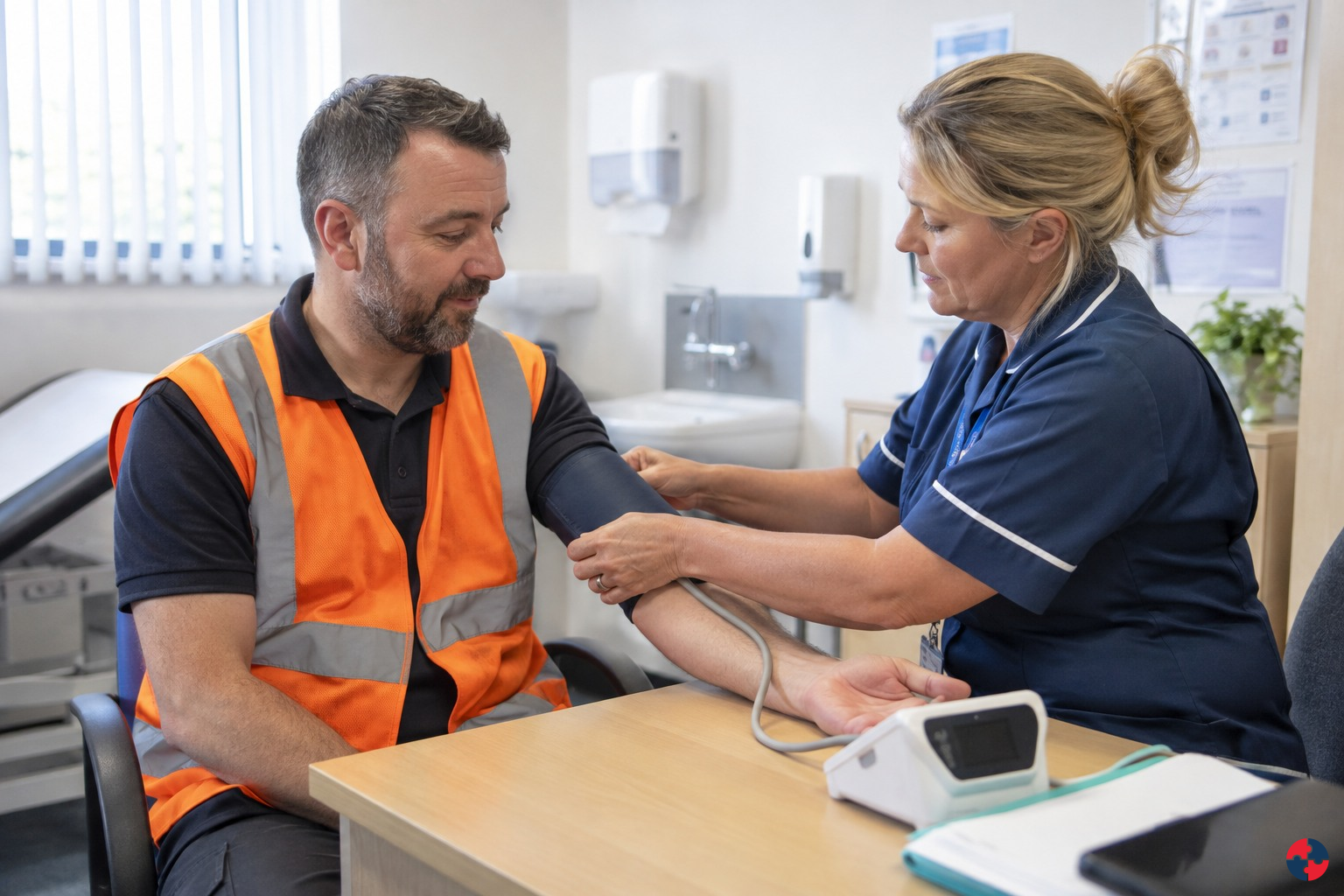
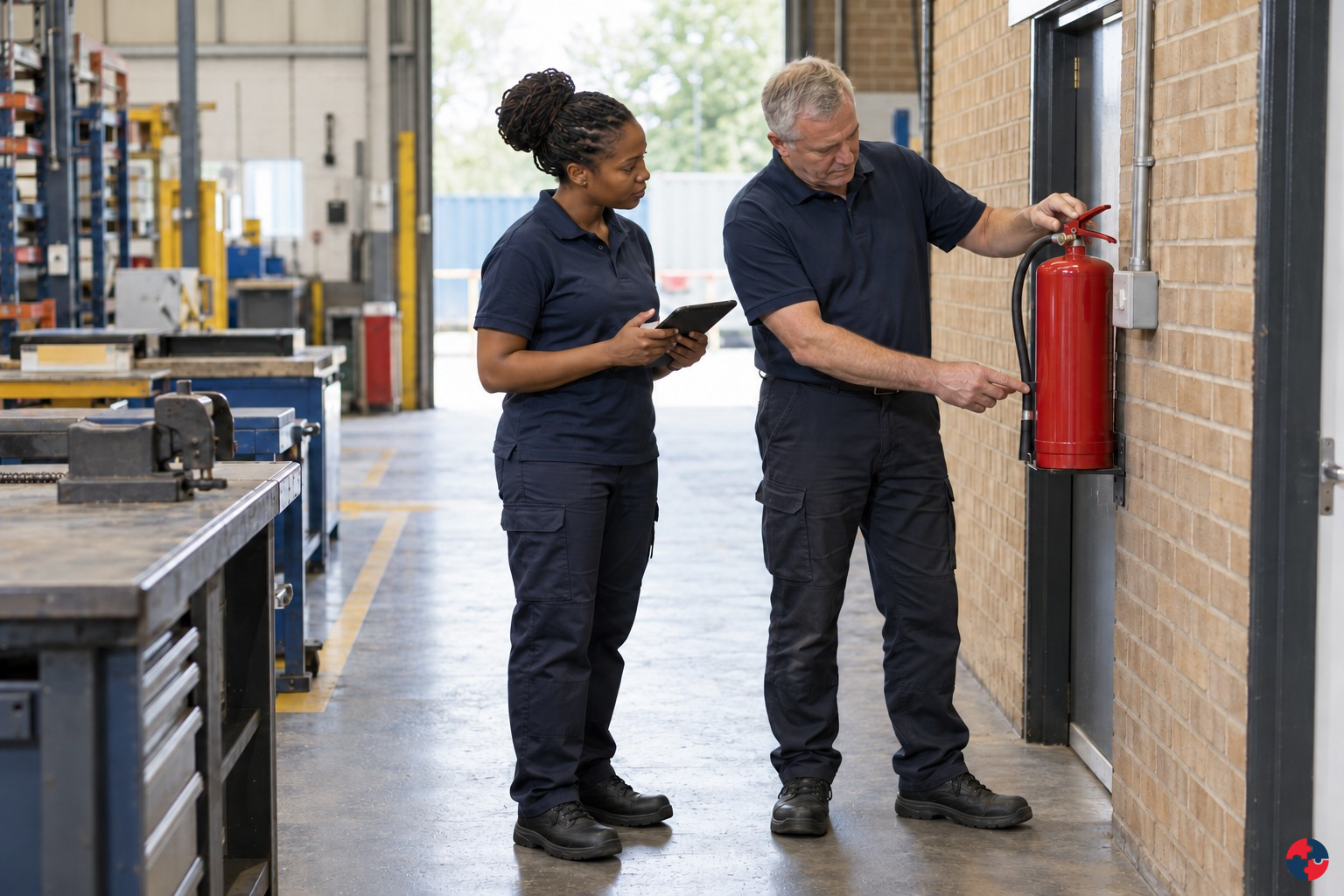
 Recognise the fuel. Read the extinguisher. Protect your escape.