Full public teaching and readers are free without an account. A free learner account is required for saved LMS progress and recorded assessment. Completion and any course-completion certificate depend on the configured LMS conditions. Open the course overview.
Lesson 1
Safety should enable ordinary life
Apply safety should enable ordinary life to the current person and task.
Photorealistic illustrative UK workplace scene. Review checks: Customers and visitors: Controls slips, access, supervision, emergencies and information. Workers: Manages training, workload, stress, lone work and task risks. Contractors: Checks competence, provides information and monitors work.
Safety should enable ordinary life
Tea, meals, visitors and shared activities help make a home feel like home. The aim is a workable arrangement that supports the person’s choice. A blanket ban on hot drinks or independent movement may remove valued activities without addressing the particular hazard. Discuss what the person can do comfortably and what assistance they want or need.
Consider chair height and stability, table position, clear routes, vision, grip and fatigue together. A change of furniture or a cable added for an activity can disrupt a previously workable layout. Keep prescribed swallowing or fluid instructions with the clinical plan: this awareness course does not authorise a change to food texture, fluid thickness or treatment. Refer uncertainty to the appropriate care professional.
The room should support ordinary life rather than be arranged solely for staff convenience. Ask the person about seating, drinks and participation, and use the relevant support plan. Equipment or furniture suitable for one resident may not fit another. Keep nutritional, texture or clinical decisions with the appropriate qualified team; this course does not prescribe diets or feeding techniques.
The fictional exercise connects several ordinary transitions: a hot drink arrives, a person moves to a dining chair, a cable crosses the route and a substitute meal is offered. Review the whole sequence and the staff support actually available. A neat layout can still leave someone unable to move comfortably or obtain help. If a specific arrangement is uncertain, pause it and provide a suitable alternative through the care plan. Do not use a blanket ban on shared activities to avoid individual assessment. Record what the person wants, what protection is needed and who can resolve the gap.
Who may be owed a duty of care?
A duty of care may be owed to workers, contractors, visitors, customers, tenants, service users and members of the public.
Health and safety duties extend beyond direct employees. Section 3 of HSWA covers people not in employment who may be affected by the undertaking. Civil duties may arise through occupiers' liability, negligence, product safety or contractual relationships. The precise route depends on the facts, but the management question is similar: who could be harmed by what we do or fail to do?
Organisations should map groups of people because different groups need different controls. Employees can be trained and supervised; visitors may need signage, barriers, escorting or information; contractors need coordination; customers need safe premises; members of the public need protection from site activities.
People who may be affected - People who may be affected
Group
Duty of care issue
Example control
Employees and workers
Work activities, environment, equipment and health risks.
A resident’s usual cup is moved to a narrow table beyond comfortable reach.
Decision and explanation
Discuss a stable reachable arrangement and appropriate support with the resident.
Change the exposure while preserving choice; do not substitute a general rule for the person’s needs.
Lesson 2
Keep information intact between the kitchen and the person
Apply keep information intact between the kitchen and the person to the current person and task.
Related SHAREhub topic guide. Apply its prompts to the specific case below.
Keep information intact between the kitchen and the person
A meal is a chain of decisions: the person’s documented needs, ingredient information, preparation, substitution, plating, identification and service. Allergy information can be lost at any handover. A familiar dish name or previous experience is not enough when ingredients change. Staff must resolve uncertainty before the affected food is served.
The same attention to communication applies to distress. A behaviour change may communicate discomfort, fear, unmet needs or illness. Follow the person’s agreed support plan, use calm communication and seek appropriate help. Avoid labelling someone difficult or applying unassessed restraint. Sudden confusion needs immediate medical help; other changes require the response appropriate to their severity and the individual plan.
Verification should test whether the arrangement meets its intended purpose without exposing a resident to an uncertain hazard. Do not ask somebody to try a damaged chair or taste a meal to test its suitability. Use reliable records, appropriate competent advice and safe physical checks before relying on the item. A supplier label or familiar product name is not automatically the complete evidence for the person's current needs.
After a change, communicate the actual correction and any remaining restriction to the dining, kitchen and care teams. The person should receive an understandable explanation and a suitable choice within the actual plan. A report is not closed simply because the faulty item has been removed if support or a replacement remains unavailable. Review any near miss for system causes such as substitutions, poor cable routing or missing support information rather than blaming the person for using the room differently from staff expectations.
How should the selected controls be checked in practice?
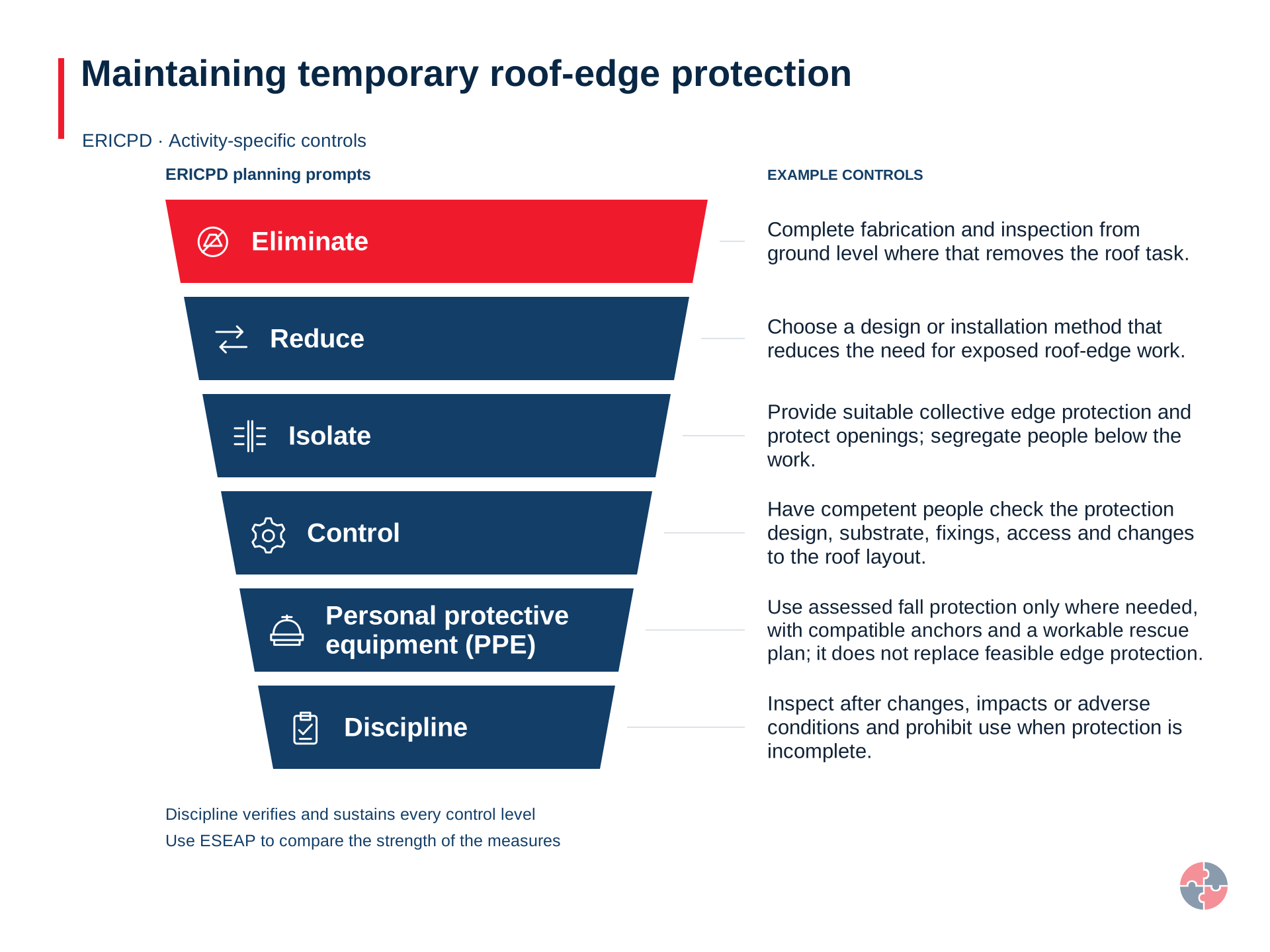
ERICPD is used here as a planning mnemonic. The linked HSE five-level hierarchy is the official source for the order and relative reliability of controls; the two labels are not identical.
Start with task redesign and substitution, then engineered separation before procedures and personal protection; verify each control under real conditions.
At a fuel depot, tanker overfill can release petrol, form vapour and ignite. The assessment must identify the initiating event, people exposed and each independent prevention or mitigation barrier. Petrol cannot be substituted if the site must supply it, so the record should say why that higher-order option is unavailable for this operation and then demand strong engineered controls. HSE hierarchy of control; HSE hierarchy of control.
ERICPD is a six-stage planning aid; the HSE five-level order separates substitution, engineering and administration. Isolate is usually engineered separation, while ERICPD Control may contain both physical and administrative measures. Discipline sustains the chosen controls and is not an additional permission to expose people.
The kitchen substitutes a sauce and the server cannot confirm its ingredients against the resident’s allergy information.
Decision and explanation
Hold the uncertain meal and obtain reliable ingredient and individual-plan checks before offering a suitable option.
Do not test an uncertain food on a person. Verify the actual ingredients and applicable allergy arrangements.
Lesson 3
A meal substitution must keep the information chain intact
Check the actual meal and person before service.
Photorealistic illustrative UK workplace scene. Review checks: Assessing: Map all food activities including cafe, vending, events, party food, contractors and staff kitchen use. Analysing: Separate high-risk foods, allergens, vulnerable groups and temporary events. Implementing: Use trained handlers, temperature checks, cleaning, pest control and supplier approval.
A meal substitution must keep the information chain intact
A substitute meal can have different ingredients from the planned item even when it looks similar. A resident's allergy information must remain connected from kitchen preparation to the person receiving the plate. Familiar packaging, a verbal assurance or removing a visible ingredient cannot establish that an allergen is absent. Cross-contact and changed recipe information may also matter.
Use the home's approved food-safety and person-specific support arrangements. The responsible trained team should verify reliable information for the actual ingredients, recipe and service, including substitutions. Where information conflicts or is missing, hold the affected meal and obtain clarification and a suitable alternative. Do not ask the resident to taste it or serve first while checking. This course does not diagnose allergy, prescribe a diet or authorise a texture or feeding change.
Keep the person informed respectfully and preserve choice through a safe suitable alternative rather than treating the uncertainty as their inconvenience. Share only necessary care information with the people responsible for preparing and serving food. Do not assume that all people with a similar diagnosis require the same meal or support. The current approved plan and actual product evidence guide the task.
Verification should follow the meal to the right person and confirm that kitchen and care information match. A completed kitchen matrix may be outdated after substitution, while a correctly prepared plate may still be delivered to the wrong resident. For the fictional exercise, identify the missing link and the role who can reconcile it. Record the hold and confirmed alternative without creating a real care record. If a reaction is suspected, use the actual emergency procedure and appropriate urgent assistance; this lesson provides no treatment instructions or authority to administer medication.
How should allergen risk be managed?
Keep ingredient, recipe, substitution and cross-contact information current so customers receive accurate allergen information. Apply the correct nation and food-format labelling route; stop service when the ingredient or allergen status cannot be confirmed.
Allergens deserve their own control route because ordinary cleanliness is not enough. A small amount of allergen can be serious for a sensitised person. Controls need to cover recipes, substitutions, supplier changes, menu wording, staff handover, cleaning and serving practices.
The safest culture is one where staff do not guess. If allergen information is uncertain, the answer should be checked before food is served.
Allergen control points
Control point
What good looks like
Failure scenario
Control pointSupplier and ingredient control
What good looks likeApproved suppliers and checked ingredient changes.
Failure scenarioA substitute product contains an undeclared allergen.
Control pointRecipe and menu control
What good looks likeCurrent recipes and allergen matrix match what is actually cooked.
Failure scenarioKitchen changes a sauce but the menu is not updated.
Control pointCross-contact control
What good looks likeSeparate utensils, storage, cleaning and preparation for allergen-sensitive meals.
Failure scenarioShared tongs transfer allergen to a supposedly safe meal.
Control pointCommunication
What good looks likeStaff know how to answer and when to check.
Failure scenarioFront-of-house staff reassure a customer without verifying.
Control pointIncident response
What good looks likeAllergic reaction triggers first aid, investigation and review.
Failure scenarioNear miss is treated as customer preference rather than safety failure.
A substitute dessert arrives without current ingredient information for a resident with a recorded allergy.
Decision and explanation
Hold the affected item and obtain reliable clarification and a suitable confirmed alternative.
Similarity or removing a visible ingredient does not establish allergen safety.
Lesson 4
Hot drinks need a usable support arrangement
Reduce burns without removing valued choices automatically.
Teaching graphic from the linked SHAREhub source section.
Hot drinks need a usable support arrangement
A hot drink can spill when placed beyond comfortable reach, on an unstable surface or where someone may knock it during movement. A person with reduced grip or ability to move away may have a different exposure from the staff member carrying it. The cup's placement and support are part of the task, not minor details after service.
Ask the person how they want to enjoy the drink and use the relevant individual assessment. Suitable positioning, furniture, equipment and assistance should support their choice while controlling the actual spill and contact pathway. A blanket ban on hot drinks is not a substitute for person-centred planning. This course does not prescribe a universal drinking temperature or choose adaptive equipment without assessment.
Compare changing the arrangement with asking the person to be more careful. A stable reachable surface and suitable assistance can reduce the need to stretch or cross a walking route. Keep leads and other obstructions away from the movement. Check whether the chosen cup or table is suitable for the person, rather than assuming an item labelled “care” will work for everyone. The method should preserve dignity and independence where possible.
If the current arrangement is unsafe or the person's ability changes, provide appropriate immediate support and obtain review before repeating it. Do not test tolerance by asking the person to hold a hot item they cannot safely manage. Verify the revised arrangement through suitable safe checks and the person's feedback. For the fictional exercise, distinguish a visible spill pathway from an unconfirmed temperature or clinical finding. A clean table and signed drinks round cannot prove the cup is usable. The outcome is a specific supportive arrangement, not a generic instruction to stop a resident doing an ordinary activity.
How should credible scenarios be described?
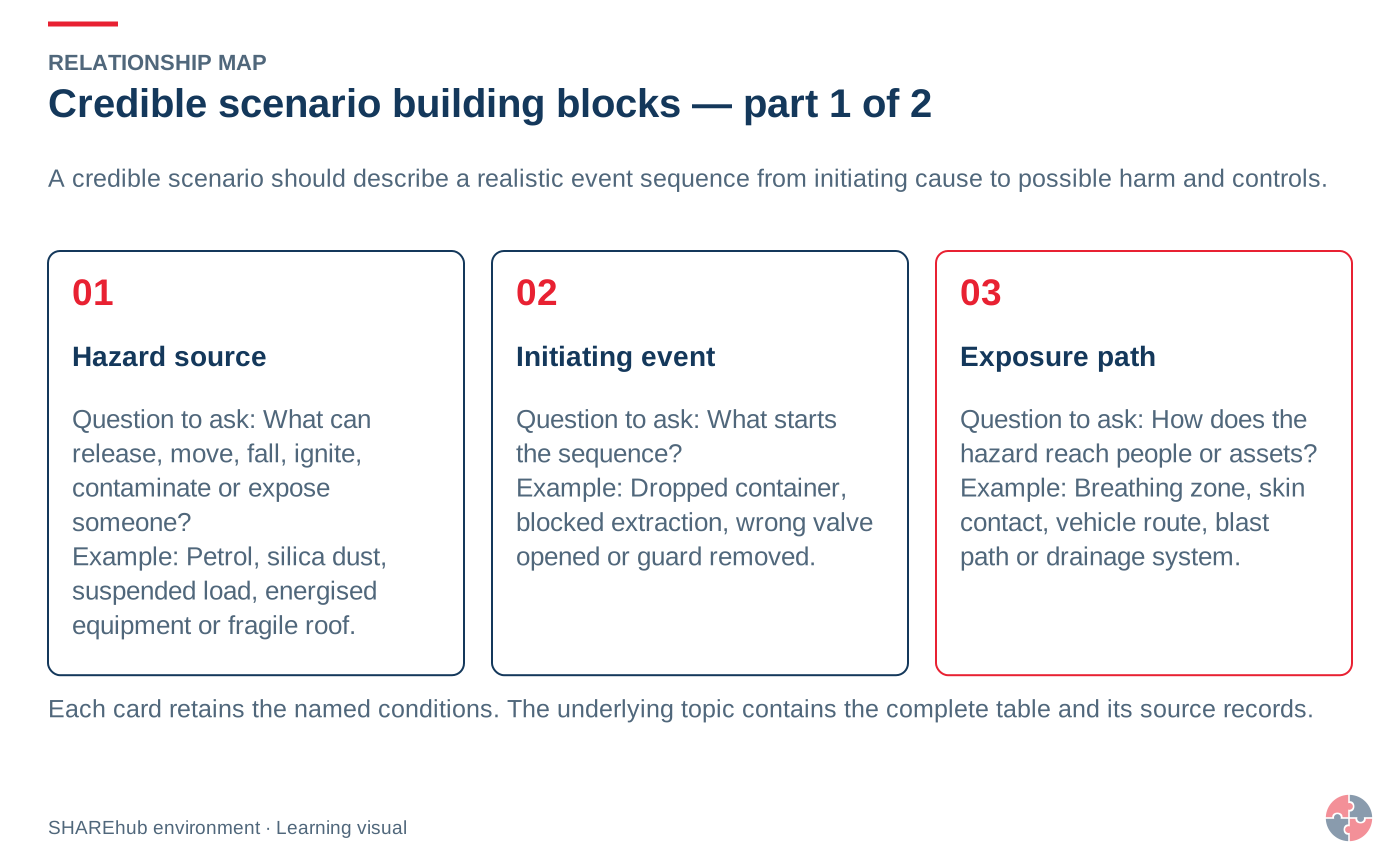
A credible scenario should describe a realistic event sequence from initiating cause to possible harm and controls.
Scenario thinking prevents shallow risk assessments. Instead of writing 'fire risk', describe the actual chain: solvent spill in a bund, vapour spreads to a drain, extraction is off, a non-rated portable tool is used and ignition occurs. That scenario immediately suggests different controls from a generic fire row.
For major accident hazards, credible scenarios should consider inventory, energy, containment, ignition, toxic release, escalation, people affected and emergency response. For everyday occupational safety, they should still show the task, person, trigger, harm and control standard.
Block
Question to ask
Example
Hazard source
What can release, move, fall, ignite, contaminate or expose someone?
Petrol, silica dust, suspended load, energised equipment or fragile roof.
Initiating event
What starts the sequence?
Dropped container, blocked extraction, wrong valve opened or guard removed.
Fatality, occupational disease, fire, explosion, toxic exposure or environmental loss.
Controls and barriers
What prevents, detects, controls or mitigates it?
Design, isolation, LEV, permit, alarm, training, supervision and emergency response.
Escalation
Could the event grow?
Fire impinges on nearby tanks, blocked exits delay evacuation or dust spreads to other areas.
Applied case
A hot cup is on an unstable tray beyond the person’s comfortable reach.
Decision and explanation
The actual placement, support, equipment and individual assistance arrangement.
Control the spill pathway while supporting the person’s choice.
Lesson 5
Seating and cables shape the whole movement
Check support and access before the person sits down.
Photorealistic illustrative UK workplace scene. Review checks: Find: Heavy boxes are picked from the floor and twisted into a cage. Change: Raise the pick position, reorient the cage and repair the threshold. Verify: Maintain cage wheels and observe handling during a realistic peak.
Seating and cables shape the whole movement
A dining chair can be unsuitable because of its condition or because it does not fit the person's assessed needs. A low unstable seat or missing support can affect transfers and comfort. A cable across the approach adds a separate trip or mobility-aid obstruction. Solving only one item may leave the person exposed during the journey or while seated.
Use the current person-specific plan and appropriate competent equipment advice. Check the actual chair, route and assistance before relying on them. This course does not choose a seating prescription or teach a transfer technique. A chair used safely by another resident is not automatically suitable, and a staff member sitting on it is not a complete test of the intended support.
Remove or reroute unnecessary cable crossings through a suitable safe method, addressing the equipment function and electrical condition. Do not create a new exposed lead or disconnect an essential support without the agreed alternative. A cable cover may be part of an assessed arrangement but is not automatically suitable for every mobility aid or route. Maintain the space needed by both the person and the assisting worker.
If the chair or route cannot be confirmed suitable, pause the affected move and arrange support and an assessed alternative. Verify the correction before the person uses it, including the return transfer and changes during shared activities. For the fictional exercise, identify the separate seating and route evidence needed and who can establish it. A warning sign or tidy furniture row cannot provide support or clearance. Keep personal care information confidential and avoid asking a resident to demonstrate a risky movement simply so a course participant can observe it.
How should manual handling be assessed?
Assessment should observe the real task, identify risk factors and choose controls that reduce force, posture, frequency, distance and uncertainty.
A good assessment watches the task happen. It measures or estimates load weight, height, reach, distance, frequency, route, floor condition, team communication and use of aids. It asks workers what actually makes the job difficult, not just what the procedure says. Sources: HSE L23 Manual handling guidance on regulations; HSE manual handling at work
For structured assessment, HSE's Manual Handling Assessment Charts (MAC) support lifting, carrying and team handling. The Risk Assessment of Pushing and Pulling (RAPP) tool supports pushing and pulling. The Assessment of Repetitive Tasks (ART) tool supports repetitive upper-limb tasks. These tools help prioritise risk, but they do not replace judgement or the hierarchy of avoiding and reducing the task. Sources: HSE L23 Manual handling guidance on regulations; HSE manual handling at work
Question
Assessment prompt
Output
Can the handling be avoided?
Can delivery, storage, automation or process flow remove manual movement?
The available chair is unstable and a charging lead crosses the mobility-aid route.
Decision and explanation
A suitable verified chair and usable route with the required support.
Both the destination and approach must be suitable.
Use the appropriate manual handling assessment
This additional teaching takes about 2–5 minutes, in addition to the course estimate. Optional reading and workplace assessment take additional time.
Start by asking whether the hazardous handling can be removed or redesigned. Where handling remains, observe the whole operation with the people who do it and choose an assessment that fits the work.
Moving a person needs an individual, person-centred assessment, care plan, suitable equipment and competent assistance. These object-handling MAC and RAPP calculators do not assess a resident's transfer or select a hoist, sling or staffing level. TILEO can organise general task questions but does not replace the individual's care assessment. Use the tools only for appropriate inanimate-load activities such as supplies or linen trolleys, alongside the course's care-specific arrangements.
TILEO: Task, Individual, Load, Environment and Other factors. MAC: Manual Handling Assessment Charts for appropriate lifting, carrying and team handling. RAPP: Risk Assessment of Pushing and Pulling for appropriate manual pushing and pulling.
Read the portable guide to understand selection, limitations, the mixed-task example and company-branded Word/PDF records. Your existing course checks and completion requirements remain separate.
Follow the individual plan and seek appropriate help.
Photorealistic illustrative UK workplace scene. Review checks: Setting: Resolve bookings and entry at an evening leisure-centre reception with a growing queue. Act: Confirm peak cover, waiting information, access control, safe staff route and emergency roles. Hold / review: Pause service, withdraw to staff space and call 999 if violence is happening or danger is immediate.
Distress is information for support, not a label
A person becoming distressed may be communicating discomfort, confusion, fear, pain or another unmet need. The visible behaviour does not identify a diagnosis or justify a standard coercive response. A noisy crowded dining room, an unexpected change or difficulty communicating can influence the situation. Recognise the person and context rather than describing them as the hazard.
Use the agreed person-specific support and escalation plan, appropriate communication and staff competence. Give space and preserve dignity while protecting everyone through the actual procedure. Where immediate danger or serious illness is suspected, obtain appropriate urgent help. This awareness course does not teach clinical diagnosis, medication decisions, physical restraint or a universal de-escalation technique.
Ask what has changed and share factual relevant observations with the responsible care lead. Do not assume that previous behaviour means today's cause is the same. Avoid crowding, threats or punishment as improvised control measures. Any restriction must follow the applicable lawful and professional arrangements, not a learner's judgement that it would make the room easier to manage. Staff safety and resident wellbeing need coordinated support rather than opposing goals.
After the immediate situation is supported, review environmental triggers, communication, staffing and the care plan through the appropriate team. Document facts respectfully and keep private details out of public training records. For the fictional exercise, distinguish “the person repeatedly covers their ears as the room becomes noisy” from a diagnosis or blame statement. Verification asks whether staff have the current plan, relevant capability and a way to obtain help. A completed behaviour form cannot substitute for support, and a course badge does not authorise restraint or treatment. The useful decision is recognising limits and involving the right role promptly.
What staffing and communication arrangements are needed?
Staffing must match the foreseeable event and response, with clear roles, rapid help, handover of material risk information and no pressure to continue unsafe contact alone.
Set who leads, who calls emergency services, who supports other people, who meets responders and who preserves records. Cover breaks, arrivals, closures, remote areas, temporary and agency staff, language or communication needs and likely responder travel time. A second person who is untrained, unavailable or unable to intervene safely is not an effective two-person control. Test radios, coded messages and handovers in realistic noise and coverage conditions.
A resident becomes increasingly distressed after an unexpected meal and noise change, but staff lack the current support plan.
Decision and explanation
Provide appropriate immediate support and obtain the agreed plan and competent help through escalation.
Use person-specific support and qualified assessment rather than labels or improvisation.
Lesson 7
Support safe drinking without taking away choice
Practical care controls should make the chosen activity easier to carry out safely, with review when ability or furniture changes.
Photorealistic illustrative UK workplace scene. Review checks: Customers and visitors: Controls slips, access, supervision, emergencies and information. Workers: Manages training, workload, stress, lone work and task risks. Contractors: Checks competence, provides information and monitors work.
Understand the activity and how harm develops
A hot drink placed on an unstable surface or beyond a comfortable reach can spill onto the person’s lap. Grip, tremor, vision, posture and the ability to move away affect the risk. The resident’s preferred drink and way of taking it should be part of the discussion, rather than applying a blanket ban.
Look at the actual cup, table position and support needed. An assessed cup or assistance may help, but must remain usable and acceptable to the person. Keep drinks separate from awkward transfers and sudden furniture movement. Staff should notice when a different chair or increased fatigue changes an arrangement that previously worked.
Recognise the evidence boundary
Question
Case evidence
What is observed?
A hot drink is placed where a resident can accidentally knock it onto their lap.
How can harm occur?
Spilled hot liquid can cause burns or scalds.
What information is needed?
Discuss the person's preferences, abilities and appropriate drinking support.
Protect, manage and verify
Purpose
Practical application
Immediate protection
Agree a usable placement and suitable assistance that preserve choice.
Accountable work arrangement
Care lead and staff responsible for the person’s dining and drinking support. The cup is unstable, the reach is unsafe or the agreed drinking support is unavailable.
Release verification
Check the person can use the arrangement as intended and staff follow the agreed support.
Apply this at work
Practical care controls should make the chosen activity easier to carry out safely, with review when ability or furniture changes.
What does reasonable care look like in practice?
Reasonable care is proportionate, risk-based action that a competent organisation can explain and evidence.
Reasonable care normally starts with a suitable risk assessment, but it does not end there. The control must be implemented, communicated, maintained and checked. The level of care expected increases where the harm is severe, the hazard is well known, the control is straightforward or the people affected are vulnerable.
For example, it is reasonable to expect a shop or leisure centre to inspect public walkways, respond to spillages, provide clear warning, repair defects and record significant issues. It is reasonable to expect an employer to assess DSE and work-related stress, not just physical injury hazards. It is reasonable to expect a contractor to protect others from the hazards created by its work.
Reasonable care examples - Reasonable care examples
Situation
Reasonable care includes
Weak practice
Slip risk
Cleaning regime, inspections, matting, repairs and prompt response.
A resident wants their usual tea, but the new side table requires a long sideways reach.
Decision and explanation
Agree a stable reachable position and any assessed assistance.
A blanket restriction overlooks the person’s wishes and suitable support. The difficult reach and unstable arrangement remain unchanged. The exposure can be reduced while preserving the person’s chosen drink.
Lesson 8
Remove the cable from the walking route
Check temporary activity layouts before residents return; familiar routes need protection from new leads, bags and furniture.
Teaching graphic from the linked SHAREhub source section.
Understand the activity and how harm develops
A cable across the lounge can catch a foot, walking-frame tip or wheelchair caster. Residents may follow a familiar route without expecting a new obstruction, and reduced balance can make a minor snag difficult to recover from. A cable cover is not automatically suitable for every mobility aid.
Start with the room layout and power supply. Reposition equipment or provide a properly arranged supply so the route remains clear. Avoid overloading sockets or adding new leads as an improvised solution. The usable route includes enough width for a person and assistance, access to seats and the emergency movement plan.
Recognise the evidence boundary
Question
Case evidence
What is observed?
An extension cable runs across a route used with walking aids.
How can harm occur?
A trip or snag can cause a fall.
What information is needed?
Check the room layout and residents' usual routes and equipment needs.
Protect, manage and verify
Purpose
Practical application
Immediate protection
Reroute the supply safely or reposition equipment while preserving usable access.
Accountable work arrangement
Premises lead with care and activity staff. A lead or cover catches the actual mobility aid or reduces the usable route.
Release verification
Walk the route with relevant aids and confirm the cable no longer obstructs movement.
Apply this at work
Check temporary activity layouts before residents return; familiar routes need protection from new leads, bags and furniture.
How can the ISO 45001 hierarchy of controls remove slip and trip hazards from workplace routes?
Control classification: Classify the mechanism separately from its upkeep: physical floor repair, drainage, barriers, protected routes, compartmentation, fire doors and suitable disposal facilities are physical measures where specified. Cleaning schedules, inspections, policies, funding, supervision and verification are administrative arrangements maintaining them. A verbal instruction is not a physical barrier. Read this correction with the source table. Retained overview and stage artwork requires the matching classification update.
Remove or reduce the hazard before relying on procedures or personal protection.
For slips and trips, assess the actual task and first look for a way to remove the hazard. Where that is not possible, consider a safer substitute, engineered separation and then clear work procedures. PPE protects against remaining exposure; it does not make an uncontrolled task safe. HSE hierarchy of controls
The selected measures need a named owner, a usable stop point and a check that they still work when the task or conditions change. In Northern Ireland, verify the separate legal route and site instructions.
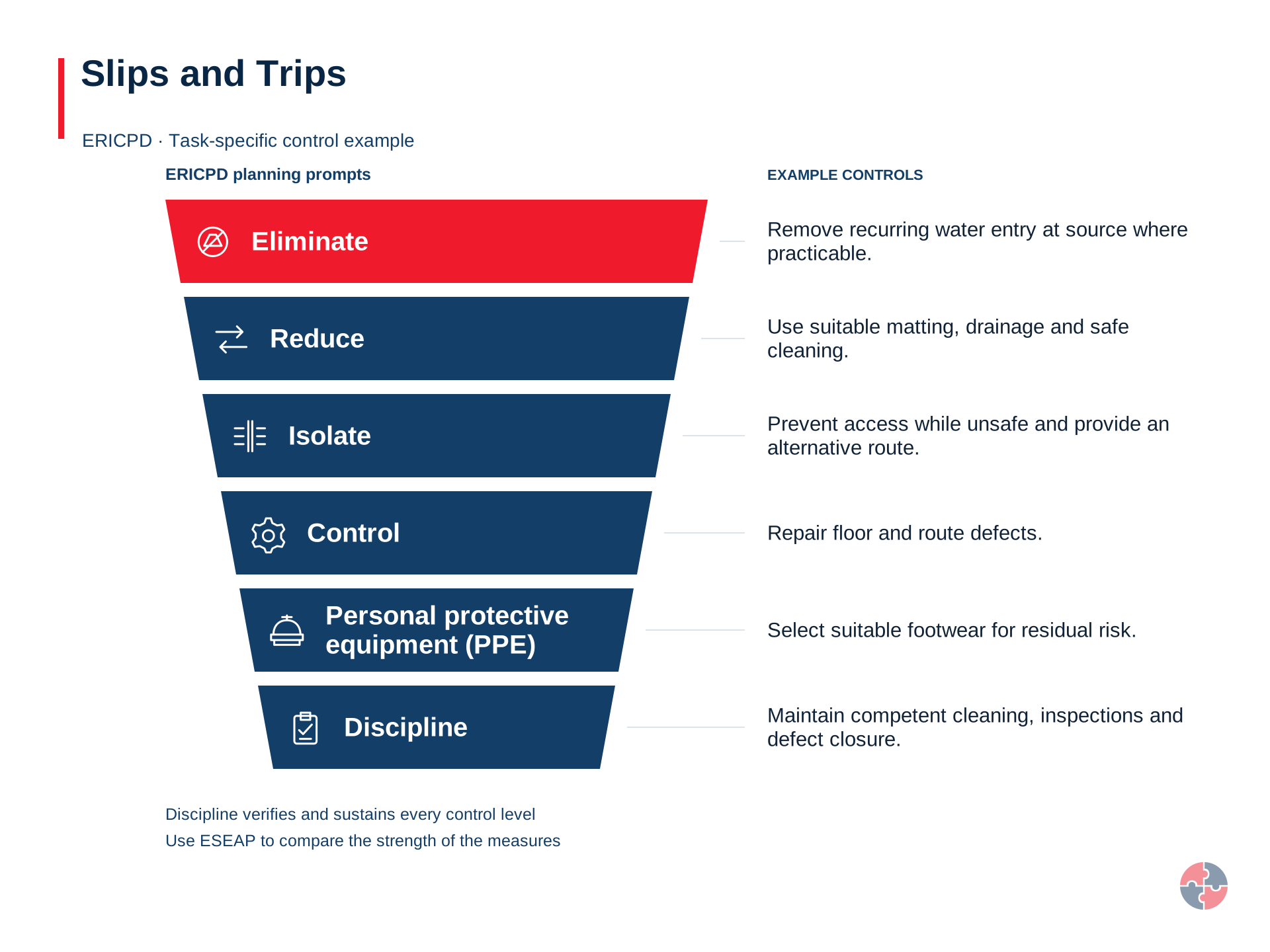
For the wet entrance, eliminate recurring water entry at source where practicable. Reduce contamination with suitable matting, drainage and a cleaning method that leaves the route safe; physically prevent access while unsafe and provide an alternative. Repair floor and route defects, then select footwear for residual risk and sustain checks. ERICPD (Eliminate, Reduce, Isolate, Control, PPE, Discipline) is a teaching prompt; Discipline means competent cleaning, supervision and defect closure. HSE slip and trip factors; HSE barriers and cleaning.
How can the ERICPD hierarchy of controls remove slip and trip hazards from workplace routes?
ERICPD is a planning crossmap. Its prompts do not add a sixth rung or rank Isolate above engineering. Discipline verifies and sustains every control level.
Worked activity: Wet leisure-centre entrance
Activity and exposure
Wet entrance at a public leisure centre during heavy rain.
Before work
Wet leaves and rainwater carried through an entrance onto a smooth floor; no mat change or drainage response.
During the activity
Close or physically separate the wet route, give a safe alternative, remove contamination and inspect matting and drainage.
Hold or stop
Do not reopen while the floor remains wet or the alternate route creates another hazard.
Hand-back and release
Repair the recurrent water source, choose suitable matting/flooring, brief cleaners and reopen after a dry-floor check.
Evidence to retain
Record weather trigger, barrier time, floor condition, repair owner, worker feedback and repeat incidents.
How can the ISO 45001 hierarchy of controls remove slip and trip hazards from workplace routes?
The hierarchy of controls in ISO 45001:2018 comes under Clause 8.1.2 (Eliminating hazards and reducing OH&S risks), which is located within Clause 8 ("Operation").
ESEAP mapping crosswalk: these are retained ERICPD source rows, mapped to the five ESEAP levels. Read the control-classification correction for mixed physical and administrative measures; six source rows do not mean six ESEAP levels.
Five-level control stage(s)
Topic-specific example
Source and full task context
Elimination
Remove recurring water entry at source where practicable.
Tape has been placed over the cable, but a walking-frame tip still catches at the raised strip.
Decision and explanation
Arrange the equipment and supply so the accessible route is clear.
The observed snag shows that the temporary cover has not resolved access. More material may enlarge the obstruction without changing the cable route. That may be inaccessible and transfers the burden to the person.
Lesson 9
Seating is part of the mobility arrangement
Link furniture procurement, room layouts and individual care plans; “available” does not necessarily mean suitable.
Photorealistic illustrative UK workplace scene. Review checks: Find: Heavy boxes are picked from the floor and twisted into a cage. Change: Raise the pick position, reorient the cage and repair the threshold. Verify: Maintain cage wheels and observe handling during a realistic peak.
Understand the activity and how harm develops
A dining chair affects posture, stability, comfort and the effort needed to stand. Seat height, depth, arms and the person’s abilities all matter. A chair that is safe for another resident may make this person slide, strain or need an unplanned lift.
Ask about comfort and observe the difficulty without asking the person to repeat an unsafe movement. Follow the assessed seating and transfer advice and seek appropriate review when it no longer fits. Improvised cushions, lifting under the arms or a blanket rule that all chairs must match can introduce additional risks and reduce independence.
Recognise the evidence boundary
Question
Case evidence
What is observed?
A resident struggles to rise from a chair that differs from their assessed seating.
How can harm occur?
Unstable or unsuitable seating can cause falls or difficult handling.
What information is needed?
Ask about comfort and review the person's seating and mobility assessment.
Protect, manage and verify
Purpose
Practical application
Immediate protection
Provide appropriate assessed seating and support without making an improvised clinical decision.
Accountable work arrangement
Care lead with appropriate occupational therapy, physiotherapy or seating expertise where needed. The person cannot sit or rise as planned, or the assessed chair has been replaced without review.
Release verification
Verify the person can use the chair safely and update staff information.
Apply this at work
Link furniture procurement, room layouts and individual care plans; “available” does not necessarily mean suitable.
What does good manual handling control look like in different sectors?
The same avoid-assess-reduce principles apply, but the practical controls vary by task and setting.
Manual handling is common in construction, logistics, healthcare, retail, manufacturing, hospitality, offices, agriculture and waste work. The assessment should fit the task rather than use generic training language. Sources: HSE manual handling at work; HSENI manual handling
Sector examples help learners see that manual handling is about force, posture, repetition, distance, environment, people and recovery, not just box weight. Sources: HSE manual handling at work; HSENI manual handling
The assessed armchair is elsewhere. A colleague proposes stacking cushions on a low dining chair.
Decision and explanation
A suitable assessed seat and the agreed assistance.
That introduces an unplanned handling method and risk of injury. The whole seating and movement arrangement needs to fit the person. An improvised stack can shift and has not been assessed for stability or posture.
Lesson 10
An allergy check must survive a meal substitution
A substitution is a new decision gate. Keep allergy, identity and any separate swallowing requirements connected to the actual meal.
Photorealistic illustrative UK workplace scene. Review checks: Assessing: Map all food activities including cafe, vending, events, party food, contractors and staff kitchen use. Analysing: Separate high-risk foods, allergens, vulnerable groups and temporary events. Implementing: Use trained handlers, temperature checks, cleaning, pest control and supplier approval.
Understand the activity and how harm develops
The meal has changed, so the previous ingredient check no longer establishes suitability. A topping, sauce, garnish or shared utensil can introduce an allergen. Staff need reliable information that follows the meal from preparation to the named person, including any separate texture or swallowing requirements.
Hold an uncertain meal and obtain a verified suitable option through authorised staff. Do not guess from appearance, remove a visible ingredient or ask the person to “try a little”. If a reaction is suspected, follow the individual emergency plan and urgent medical response; suspected anaphylaxis requires an immediate 999 ambulance response.
Recognise the evidence boundary
Question
Case evidence
What is observed?
A replacement meal is offered without checking the person's recorded allergy.
How can harm occur?
An allergen exposure can cause a serious reaction.
What information is needed?
Reconcile the person's current allergy information with the actual ingredients and supplier information.
Protect, manage and verify
Purpose
Practical application
Immediate protection
Hold the uncertain meal and obtain a suitable verified option through authorised staff.
Accountable work arrangement
Catering lead and care lead; emergency or clinical services if a reaction is suspected. Ingredients, cross-contact controls or the intended resident’s requirements cannot be confirmed.
Release verification
Confirm the served meal matches the person's needs and communicate the substitution.
Apply this at work
A substitution is a new decision gate. Keep allergy, identity and any separate swallowing requirements connected to the actual meal.
How should allergen risk be managed?
Keep ingredient, recipe, substitution and cross-contact information current so customers receive accurate allergen information. Apply the correct nation and food-format labelling route; stop service when the ingredient or allergen status cannot be confirmed.
Allergens deserve their own control route because ordinary cleanliness is not enough. A small amount of allergen can be serious for a sensitised person. Controls need to cover recipes, substitutions, supplier changes, menu wording, staff handover, cleaning and serving practices.
The safest culture is one where staff do not guess. If allergen information is uncertain, the answer should be checked before food is served.
Allergen control points
Control point
What good looks like
Failure scenario
Control pointSupplier and ingredient control
What good looks likeApproved suppliers and checked ingredient changes.
Failure scenarioA substitute product contains an undeclared allergen.
Control pointRecipe and menu control
What good looks likeCurrent recipes and allergen matrix match what is actually cooked.
Failure scenarioKitchen changes a sauce but the menu is not updated.
Control pointCross-contact control
What good looks likeSeparate utensils, storage, cleaning and preparation for allergen-sensitive meals.
Failure scenarioShared tongs transfer allergen to a supposedly safe meal.
Control pointCommunication
What good looks likeStaff know how to answer and when to check.
Failure scenarioFront-of-house staff reassure a customer without verifying.
Control pointIncident response
What good looks likeAllergic reaction triggers first aid, investigation and review.
Failure scenarioNear miss is treated as customer preference rather than safety failure.
The planned dessert is unavailable. A replacement looks similar, but its ingredients have not been checked.
Decision and explanation
Hold it and obtain a verified suitable replacement.
Allergenic material may remain in the food or be present in other ingredients. Deliberate trial exposure is not a safe verification method. Similar appearance does not establish ingredients or cross-contact control.
Lesson 11
Respond to distress as information about unmet needs
Review pressure, staffing and surroundings after distress events; staff support and person-centred care reinforce one another.
Photorealistic illustrative UK workplace scene. Review checks: Person: Was the worker competent, fatigued, interrupted or under pressure? Task: Was the procedure usable and was isolation practical for blockage clearing? Equipment: Could the blockage be cleared without removing the guard?
Understand the activity and how harm develops
Distress may be a response to pain, fear, communication difficulty, noise, fatigue or a disliked activity. Continuing because the task is on the schedule can escalate the situation and harm the resident or staff. Describe what is happening without labelling the person as the hazard.
Pause, give space and use the person’s agreed communication and support approach. Seek trained assistance and appropriate clinical review for a sudden or unexplained change. Restrictions or medication decisions require the relevant authorised process; an exercise scenario cannot authorise them. Review staff workload and the environment as well as the individual care plan.
Recognise the evidence boundary
Question
Case evidence
What is observed?
A resident becomes distressed while staff continue a disliked activity.
How can harm occur?
Escalation can harm the person or others and undermine dignity.
What information is needed?
Listen to the person and check their agreed communication and support plan.
Protect, manage and verify
Purpose
Practical application
Immediate protection
Pause, provide space and appropriate support, and seek trained assistance when needed.
Accountable work arrangement
Care lead and appropriately trained support team; relevant clinician for a new health change. Distress is increasing, consent is uncertain, or staff cannot provide the agreed safe support.
Release verification
Review the person's wellbeing and whether the agreed approach remains appropriate.
Apply this at work
Review pressure, staffing and surroundings after distress events; staff support and person-centred care reinforce one another.
What do human failures, human factors and human reliability mean?
Human failure and fair investigation
Human failure is failure of required safe performance. An unintentional error and a deliberate departure from a rule differ: a shortcut may achieve the person’s immediate production aim while breaching the safe system. HSG48’s routine, situational and exceptional violation categories do not determine blame or a disciplinary outcome. Establish context, intent, system conditions and evidence separately.
The topic explains how people interact with work systems and how organisations can reduce predictable failure.
Human failures are not all the same. Some are unintended errors, such as selecting the wrong control, forgetting a step or misunderstanding a situation. Others are violations, where a person deliberately departs from a rule. Even violations need careful analysis because the rule may be impractical, conflicting, poorly supervised or routinely undermined by work pressure. HSE introduction to human factors
Human factors is the wider discipline that studies the job, the person and the organisation. Human reliability is the practical question: if this person is a barrier in the risk assessment, can we rely on that action under the real conditions?
Concept
Plain-English meaning
Workplace example
Human failure
An action or decision that fails to achieve what was intended.
A resident becomes increasingly distressed during a noisy group activity. Staff are under pressure to finish the session.
Decision and explanation
Pause and offer the agreed calm support while checking what is distressing them.
Reducing the trigger and understanding the person’s need can prevent escalation. Continuing a disliked activity may intensify distress and overrides the support plan. A change may reflect pain, illness or other needs requiring appropriate review.
Lesson 12
A changed lunch service
Keep meal information, comfort and support connected.
Related SHAREhub topic guide. Apply its prompts to the specific case below.
A changed lunch service
In the fictional lounge, the planned meal is replaced with a similar-looking product whose current allergen information is missing. A hot drink is placed on an unstable tray beyond a resident's comfortable reach. The available dining chair is unsuitable for the person's current transfer plan and a charging cable crosses the route. The room becomes noisy, and the person shows increasing distress while the usual support plan cannot be found.
Separate the decisions without losing the person's experience. The meal-information gap can create an allergy exposure; hot-drink placement can create a spill and burn; the chair and cable affect movement and support; distress needs appropriate individual help. Do not describe the person as the problem or use a diagnosis to choose a restrictive response. Ask about preferences and comfort using suitable communication and keep them involved appropriately.
Hold the affected meal until reliable ingredient, substitution and person-specific information are reconciled by the responsible trained team. Similar appearance and removal of a topping are insufficient. Provide a suitable confirmed alternative rather than serving first and checking later. The course does not authorise diet, texture, feeding or medication decisions. A suspected reaction requires the home's emergency procedure and appropriate urgent assistance, not a treatment improvised from a training answer.
Review the drink support and placement so the person can enjoy their choice without an unassessed reach. A blanket ban is not the only response. Obtain a suitable chair and safe route under the current support plan before movement. Reroute the cable through an appropriate safe arrangement without creating another electrical or care-function gap. Do not use the person to trial an unstable chair or a difficult transfer.
For distress, follow the agreed immediate support and escalation route, obtaining the current plan and appropriate competent assistance. Consider factual changes in noise, routine, communication and comfort. Do not diagnose, punish, restrain or alter medicine outside the relevant authorised process. Staff also need clear ways to seek help and protect others within their actual training. Any restriction must follow applicable lawful arrangements rather than convenience.
The final handover joins kitchen, care and premises actions: reliable meal evidence, suitable drink and seating support, clear route, current person-specific plan and any continuing hold. Verify corrections and communicate changes respectfully without unnecessary private details. Use the fictional resource exercises rather than a real resident's record. A quiet room or completed lunch sheet does not prove the individual arrangement works. The case is resolved when ordinary dining and shared life are supported through effective, person-centred and competent arrangements.
How should the basic risk assessment process work?
The process should identify hazards, decide who may be harmed, evaluate risk, record significant findings and review the controls.
The familiar five-step model is only useful when each step is done honestly. Walking the workplace, checking incident data, speaking to workers, reviewing maintenance, reading safety data sheets and observing non-routine work will usually reveal more than a desk exercise.
The output should be understandable to the people who use it. A supervisor should know what must be in place before work starts. A worker should know the task controls and stop-work triggers. A manager should know what resources and review evidence are required.
Step
What good looks like
Evidence
Identify hazards
Task observation includes normal, abnormal, maintenance, cleaning and emergency conditions.
Walkthrough notes, worker input and hazard register.
Decide who may be harmed
Employees, contractors, visitors, public, vulnerable workers and emergency responders are considered.
People-at-risk section and consultation evidence.
Evaluate risk
Existing controls are tested, not assumed.
Inspection findings, monitoring data, maintenance records and competence checks.
Record findings
Significant risks, controls, action owners and review triggers are clear.
Assessment, action tracker and risk register.
Review
Assessment changes after incidents, changes, new information or weak control evidence.
Staff propose serving the substitute while another worker searches for the support plan.
Decision and explanation
Hold the uncertain meal and unsafe arrangements while providing suitable immediate support and obtaining competent clarification.
Protect specific pathways while preserving appropriate choice and support.
Lesson 13
Take a verified action into the workplace
Connect one actual task to an owner, evidence and a clear release or escalation decision.
Related SHAREhub topic guide. Apply its prompts to the specific case below.
Turn awareness into a practical question
Care-home safety awareness with a Great Britain workplace baseline. CQC, DHSC and cited residential-care examples apply to England where stated; confirm the relevant national regime. This course does not confer clinical, medicines, lifting, restraint, maintenance or emergency-response competence or authorisation.
Choose one relevant operation from the course. Describe the person or environment at risk, the mechanism of harm and the exact condition that needs controlling. Separate an observation from a conclusion. A display, signature, badge or clean appearance answers only a limited question.
Use the included practice resources to prepare a fictional task brief, risk review or verification question. Decide which competent role owns the decision and which evidence must be available before work restarts or work is released. Keep worker protection, public exclusion, task acceptance and environmental decisions distinct where required.
At work, use your actual approved arrangements. Report uncertainty and preserve the relevant hold, restriction or safe state while it is resolved. Confirm that the action addressed the original harm route and check whether another shift, load, cleaning task or maintenance change could reintroduce it.
Course completion records awareness learning. It does not establish practical competence, certify an organisation or authorise specialist, clinical, maintenance, chemical or emergency work.
How should the basic risk assessment process work?
The process should identify hazards, decide who may be harmed, evaluate risk, record significant findings and review the controls.
The familiar five-step model is only useful when each step is done honestly. Walking the workplace, checking incident data, speaking to workers, reviewing maintenance, reading safety data sheets and observing non-routine work will usually reveal more than a desk exercise.
The output should be understandable to the people who use it. A supervisor should know what must be in place before work starts. A worker should know the task controls and stop-work triggers. A manager should know what resources and review evidence are required.
Step
What good looks like
Evidence
Identify hazards
Task observation includes normal, abnormal, maintenance, cleaning and emergency conditions.
Walkthrough notes, worker input and hazard register.
Decide who may be harmed
Employees, contractors, visitors, public, vulnerable workers and emergency responders are considered.
People-at-risk section and consultation evidence.
Evaluate risk
Existing controls are tested, not assumed.
Inspection findings, monitoring data, maintenance records and competence checks.
Record findings
Significant risks, controls, action owners and review triggers are clear.
Assessment, action tracker and risk register.
Review
Assessment changes after incidents, changes, new information or weak control evidence.