Full public teaching and readers are free without an account. A free learner account is required for saved LMS progress and recorded assessment. Completion and any course-completion certificate depend on the configured LMS conditions. Open the course overview.
Lesson 1
Follow the route, not just the clean-looking surface
Apply follow the route, not just the clean-looking surface to the current person and task.
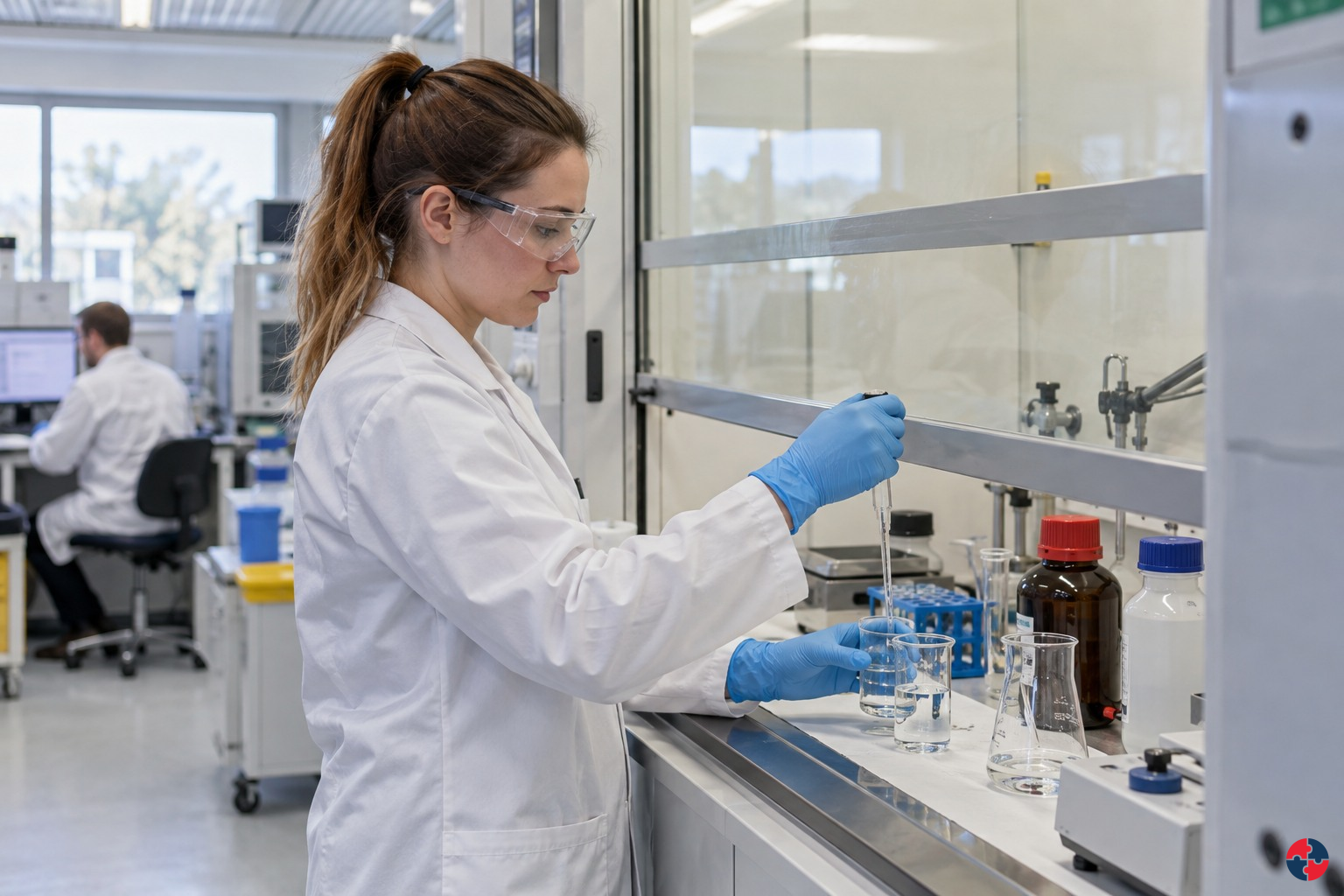
Photorealistic illustrative UK workplace scene. Review checks: Assessing: Map infection routes across toilets, changing rooms, poolside, cafe, first aid, cleaning, waste, parties and shared workstations. Analysing: Identify higher-risk points such as body-fluid cleaning, food handling, repeated illness, new/expectant mothers and crowded events. Implementing: Provide soap, drying, cleaning schedules, body-fluid spill kits, staff sickness rules and food-area hygiene controls.
Follow the route, not just the clean-looking surface
Infection prevention depends on how people, equipment and materials move. Used linen can contaminate clean linen through surfaces, hands, containers or an intersecting workflow. A bag labelled clean does not protect its contents if it rests on a contaminated trolley. Follow the linen from the resident’s room through collection, processing, storage and return.
Use the home’s infection-prevention arrangements and appropriate training for the type of linen and contamination. Keep clean and used handling routes separated, minimise unnecessary handling and avoid actions that spread contamination. Resolve shortages or awkward layouts with the responsible lead rather than making the labelled categories meaningless. Cleanliness must be supported by the correct process, not judged by smell or appearance alone.
Follow hands, clothing and equipment through transitions as well as the linen bags. A worker handling used items can contaminate a clean trolley handle or shelf even when the bags never touch. Arrange space, suitable containers, hand hygiene and the actual processing route so separation is practical when the laundry is busy. The England adult-social-care guidance informs this example; use the relevant national and local arrangements for the real service.
For the fictional exercise, draw the clean return path and the used collection path and identify their crossing. Do not invent a universal wash temperature or classify a real contaminated item from appearance. The approved process depends on the linen, contamination and system. If separation or processing cannot be maintained, restrict the affected handling and obtain the infection-prevention lead's decision. A clean-looking result is not proof that the required process occurred, and completed bags must remain protected through storage and delivery to the resident.
How do infections spread in workplaces?
An infectious agent needs a source, a route into another person and an opportunity for exposure; the controls depend on that route.
Contaminated hands can transfer material from toilets, food, animals, waste or shared equipment to the mouth, eyes or a wound. Respiratory infections can spread through close contact and air in poorly ventilated spaces. Blood or body-fluid contact, including a sharps injury, needs a different response from routine desk cleaning. The person affected is not the hazard: the infectious agent and the work conditions that allow its transfer are the risk source.
Handwashing breaks contact transfer but cannot fix poor ventilation or a sharps procedure. Symptoms may follow hours or days later, so absence of immediate illness does not prove that an exposure was harmless. Stop a task when contamination or a protective barrier is uncontrolled, isolate the area safely and obtain competent advice for the suspected agent and route.
Source and task
Route and possible harm
Early sign or warning
Stop and escalate
Toilet, food or shared-tool contamination
Hands transfer organisms to mouth or eyes; gastrointestinal or other infection can follow.
Restore washing and cleaning before resuming food or shared work; seek public-health or clinical advice for illness.
Close contact in a poorly ventilated room
Respiratory organisms can reach others; fever, cough or more serious illness may result.
Ill person at work, repeated cases, poor ventilation.
Reduce exposure, support staying away when infectious and review ventilation; escalate clusters.
Body fluids, sharps, sewage or animal waste
Contact with broken skin, mucosa or a puncture can transmit a specific biological agent.
Spill, puncture, damaged glove or unknown waste.
Stop routine cleaning, use the assessed exposure-response route and seek prompt medical advice after suspected exposure.
The risk assessment must identify the likely agent where possible, exposed workers and others, route, vulnerable groups and credible failures. HSE incidental infection guidance.
Applied case
Clean linen is placed temporarily on a trolley used for unprocessed linen.
Decision and explanation
Treat the crossed workflow as a contamination concern and resolve it through the linen/infection-control procedure.
The handling history matters. A clean appearance cannot establish that the contamination route was controlled.
Lesson 2
Design the cleaning task to prevent exposure
Apply design the cleaning task to prevent exposure to the current person and task.
Teaching graphic from the linked SHAREhub source section.
Design the cleaning task to prevent exposure
Identify the product, dilution, application and exposure route before cleaning. Follow the assessment and label instructions; never mix products to make a stronger cleaner. Transferring a chemical into a drinks bottle removes reliable identity and creates a foreseeable ingestion risk. Keep the correct labelled container and secure storage arrangements.
Skin protection needs a complete system: reduce avoidable wet work and contact, use suitable task-specific protection, follow hand-care arrangements and report early symptoms. Gloves are not interchangeable and should not create prolonged contamination inside them. Trolley loading and route design also matter. Split or redesign an overloaded load rather than relying on strength or asking a second person to compensate for poor equipment and an unsuitable route.
The assessment should make the safe method workable: suitable equipment, facilities, time and trained support must be available during normal demands. A worker should not compensate for a leaking dispenser with a gloved hand or for poor trolley condition with extra force. Controls must fit both infection prevention and worker health rather than treating damage or persistent skin symptoms as an unavoidable part of care work.
Separate the immediate protective response from later investigation. An unidentified container remains out of use while the competent person establishes identity and disposition. A mixing incident needs the actual emergency procedure, not a stronger ventilation guess. Repaired equipment and revised methods need appropriate verification before release. For the fictional worksheet, record observed conditions, people affected, protective holds and the role who can resolve each. Do not enter a real cleaning, chemical or health-surveillance record as a training demonstration.
How can the ISO 45001 hierarchy of controls reduce workplace skin exposure and irritation?
Control classification: The assessed change to a genuinely safer material, product, process or consumable belongs in Substitution. Check its effectiveness and other hazards before adoption; administrative planning is a separate measure. Read this correction with the source table. Retained overview and stage artwork requires the matching classification update.
Address work-created hazards at source, then agree proportionate task controls and personal support.
For skin health, assess the work itself: staffing, scheduling, exposure, equipment or interpersonal conditions as applicable. Remove or reduce hazards where possible, then agree practical procedures and review whether they work. A personal health condition calls for clinical advice and suitable work adjustments, not a generic control or diagnosis by a manager. HSE hierarchy of controls
Document who will act, what triggers a pause or referral, and when the arrangement will be reviewed. Apply the correct GB or NI duties and site instructions.
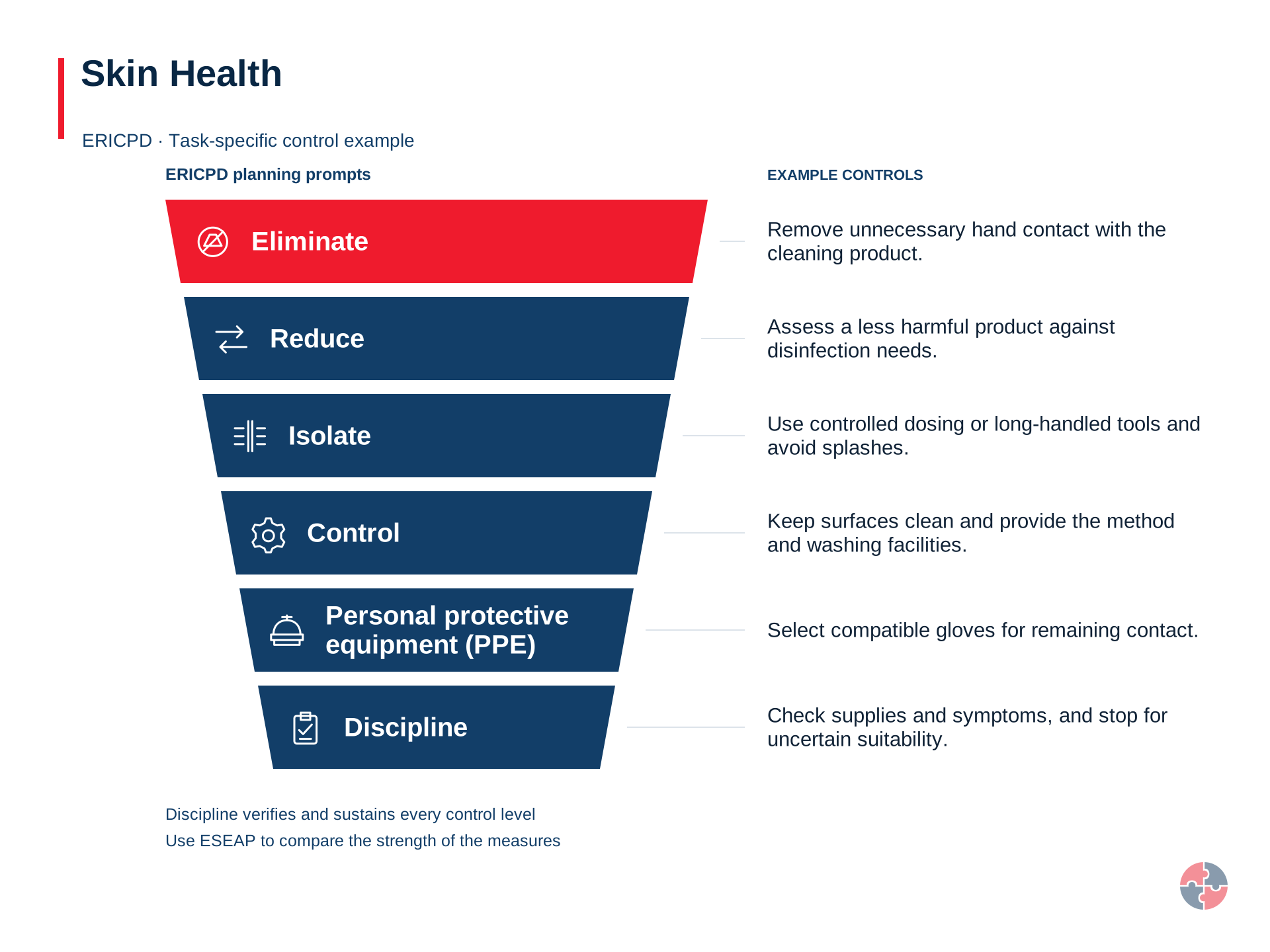
For the cleaner, remove unnecessary hand contact, choose a suitable less harmful product while checking disinfection needs, and use controlled dosing or long-handled tools. Separate people from splashes, keep work surfaces clean and select compatible gloves for remaining contact. The manager supplies the method and facilities; the supervisor stops when product identity, dosing or glove suitability is uncertain. Skin care and symptom checks support the controls. ERICPD (Eliminate, Reduce, Isolate, Control, PPE, Discipline) is a teaching prompt; Discipline means training, supervision, maintenance and learning. HSE avoid, protect and check.
How can the ERICPD hierarchy of controls reduce workplace skin exposure and irritation?
ERICPD is a planning crossmap. Its prompts do not add a sixth rung or rank Isolate above engineering. Discipline verifies and sustains every control level.
Worked activity: Prevent dermatitis during daily cleaning
Activity and exposure
A cleaner repeatedly handles diluted detergent and disinfectant and washes hands many times per shift.
Before work
The manager checks product identity, reduces wet work, selects a less harmful product where suitable, provides dosing and long-handled tools, and verifies glove compatibility.
During the activity
Workers use the tools, change contaminated or damaged gloves, wash and dry gently and moisturise after work.
Hold or stop
Stop contact with an unknown product, failed dosing or unsuitable glove; report persistent redness, itching or cracks promptly.
Hand-back and release
The manager fixes the source and reviews other exposed workers; occupational health or a GP assesses symptoms confidentially.
Evidence to retain
Keep the product assessment, glove specification and replacement checks, training observation and restricted referral record.
Decision owner
Cleaning manager with workers and occupational-health adviser
How can the ISO 45001 hierarchy of controls reduce workplace skin exposure and irritation?
The hierarchy of controls in ISO 45001:2018 comes under Clause 8.1.2 (Eliminating hazards and reducing OH&S risks), which is located within Clause 8 ("Operation").
Worked activity: Prevent dermatitis during daily cleaning
Activity and exposure
A cleaner repeatedly handles diluted detergent and disinfectant and washes hands many times per shift.
Before work
The manager checks product identity, reduces wet work, selects a less harmful product where suitable, provides dosing and long-handled tools, and verifies glove compatibility.
During the activity
Workers use the tools, change contaminated or damaged gloves, wash and dry gently and moisturise after work.
Hold or stop
Stop contact with an unknown product, failed dosing or unsuitable glove; report persistent redness, itching or cracks promptly.
Hand-back and release
The manager fixes the source and reviews other exposed workers; occupational health or a GP assesses symptoms confidentially.
Evidence to retain
Keep the product assessment, glove specification and replacement checks, training observation and restricted referral record.
Decision owner
Cleaning manager with workers and occupational-health adviser
ESEAP mapping crosswalk: these are retained ERICPD source rows, mapped to the five ESEAP levels. Read the control-classification correction for mixed physical and administrative measures; six source rows do not mean six ESEAP levels.
Five-level control stage(s)
Topic-specific example
Source and full task context
Elimination
Remove unnecessary hand contact with the cleaning product.
The lower-hazard product/material/process example is a proposed genuine replacement, conditional on competent selection and verification of function and other hazards. An assessment alone is planning; it becomes a substitution control only when the suitable replacement is actually adopted.
Applied case
A worker mixes an acidic cleaner with bleach because a stain remains.
Decision and explanation
Stop the unsafe activity, keep people away and follow the emergency arrangements for the exposure.
Mixing incompatible products can release harmful gas. Do not improvise a remedy that increases exposure.
Lesson 3
Mixing cleaners can create a new exposure
Chemical hazard pictograms · examples and checksOptional reference · all nine symbols · does not change assessment requirements
READ THE LABEL · UNDERSTAND THE TASK
Recognise the symbol. Read the full label. Assess the actual task.
Examples illustrate possible uses of a symbol, not the classification of every formulation. A product can carry several pictograms. Check its current label, hazard statements and matching safety data sheet (SDS).
Care cleaning: never decide that two products can be mixed from their pictograms.
CLP/GHS hazard pictograms: meanings and illustrative examples
Pictogram and hazard
What it can mean
Example and question before work
ExplosiveGHS01
Explosion, blast or projection hazards; also certain self-reactive substances and organic peroxides.
Example: Certain fireworks or reactive chemical products.Ask: Does the authorised task account for impact, heat and the product’s stability limits?
FlammableGHS02
Can ignite; also used for certain self-heating, pyrophoric or water-reactive hazards.
Example: Petrol or some solvent-based products.Ask: What could release vapour or ignite it during this task, including nearby work?
OxidisingGHS03
Can cause or intensify fire; some strong oxidisers present an explosion hazard.
Example: Oxygen or certain oxidising chemicals.Ask: What incompatible materials and contamination must the assessed storage and connection keep apart?
Gas under pressureGHS04
Pressurised gas may burst if heated; refrigerated gas can cause cold burns.
Example: Compressed-gas cylinders.Ask: Have the gas identity, cylinder, connection and pressure or temperature hazards been checked?
CorrosiveGHS05
May damage metals, cause severe skin burns or cause serious eye damage; read the stated hazard.
Example: Certain drain cleaners, acids or alkalis.Ask: Which contact and splash routes must be prevented in this actual handling or dilution task?
Acute toxicityGHS06
Can be toxic or fatal after short exposure through the stated route.
Example: Methanol or certain pesticide products.Ask: Which exposure routes and emergency arrangements does this product’s information identify?
Harmful / irritantGHS07
May indicate harmful acute toxicity, irritation, skin sensitisation, drowsiness or dizziness; also ozone-layer hazards.
Example: Some detergents or cleaning products.Ask: What do the hazard statements say? Do not dismiss this as a harmless or mild product.
Serious health hazardGHS08
Can indicate cancer, genetic or reproductive harm, organ damage, respiratory sensitisation or aspiration hazard.
Example: Petrol or some sensitising chemical products.Ask: Which particular health effect is stated, and how does the task prevent the relevant exposure?
Hazardous to the environmentGHS09
Hazardous to aquatic life, potentially with long-lasting effects.
Example: Certain pesticides, biocides or fuels.Ask: How will the assessed arrangements prevent release to drains, water or soil?
Read beyond the picture · Open a prompt to compare the explanation.
Is the exclamation mark the same as the chest-starburst symbol?
No. The two symbols communicate different groups of hazards. Read the actual hazard statements: skin sensitisation and respiratory sensitisation are not interchangeable, and neither symbol specifies the complete task controls.
Does a bottle with no pictogram prove the task is safe?
No. Work may generate hazardous dust, fume or mist, and exposure depends on the task. Resolve missing or conflicting identification before use. A pictogram is not a compatibility chart or a complete workplace risk assessment.
Which information turns recognition into a useful work decision?
Match the product and SDS revision. Read the hazard statements and relevant SDS sections for handling, storage, exposure control, emergencies and reactivity together. Then check the actual task assessment and controls. A safety data sheet is not itself a COSHH assessment.
Fisher Scientific UK · BP2618 range · CAS 67-63-0 Revision 19 · 13 October 2023
This learning example refers to the identified supplier edition. It is not a replacement SDS or confirmation that this is the latest sheet for a product you hold. Obtain the current matching supplier SDS before real use.
Below is SHARE’s learning annotation, not a rebranded supplier document or a complete safety data sheet.
Identity
Propan-2-ol / isopropanol; the referenced sheet identifies a laboratory-grade product.
Section 2 signals
Danger; flame and exclamation-mark pictograms. H225, H319 and H336 identify flammability, eye irritation and possible drowsiness/dizziness.
Section 3 composition
The referenced sheet lists isopropyl alcohol above 95% by weight.
Section 8 decision
Engineering measures and several glove-material options appear. Check the complete conditions; no single glove or respirator is selected by this lesson.
Section 9 example
A 12°C closed-cup flash point is listed. This is product data, not a workplace exposure reading or an automatic safe-temperature limit.
Explore every section
1. Identification
Match the product, supplier, intended use and emergency contact to the actual container. A familiar chemical name alone may not identify a formulation.
2. Hazards identification
Read classification, pictograms, signal word and hazard/precautionary statements together. Identify the routes and outcomes the task must prevent.
3. Composition / ingredients
Check concentration and relevant ingredients. A diluted mixture, hardener or changed formulation may need different information and assessment.
4. First-aid measures
Prepare product-specific first-aid arrangements and ready access to the full sheet. Do not replace the workplace emergency procedure with a memory exercise.
5. Firefighting measures
Provide the relevant information to the site fire-planning route. An SDS does not authorise an untrained worker to fight a chemical fire.
6. Accidental release
Plan who raises the alarm, isolates the area and deals with a spill within their training. Confirm available equipment and the boundary for specialist help.
7. Handling and storage
Translate the supplier conditions into the actual transfer, storage, access and housekeeping method. Consider other work and incompatible neighbours.
8. Exposure controls / PPE
Read exposure limits, engineering controls and residual PPE together. Check jurisdiction, units and averaging period. Verify control performance and exact glove/RPE suitability.
9. Physical / chemical properties
Consider volatility, flash point, state and other relevant properties at the actual temperature and method. Odour is not a reliable exposure measurement.
10. Stability / reactivity
Identify incompatible materials, conditions to avoid and possible decomposition. Check the whole process and waste stream, not just separate containers.
11. Toxicological information
Connect the health effects to possible inhalation, skin, eye and ingestion exposure. Use competent advice where specialist interpretation is needed.
12. Ecological information
Plan to prevent environmental release, including drains and water. Lack of a fish/tree symbol does not grant permission to discharge.
13. Disposal considerations
Specify the responsible waste route for the product, contaminated materials and containers. Do not assume evaporation or dilution is an acceptable disposal method.
14. Transport information
Check transport classification through the relevant competent route. Supply pictograms and transport labels have different functions.
15. Regulatory information
Identify relevant restrictions and market scope, then check workplace duties separately. A regulatory entry is not a completed COSHH assessment.
16. Other information
Check revision history, abbreviations and supporting statements. Trace material changes into the assessment, instructions, storage and briefing.
Worked COSHH application · fictional laboratory proposal
Define the proposed use
Fictional laboratory task: wipe small parts for 10 minutes twice per shift, using a proposed 50mL working quantity at ambient temperature. Record the exact product, method, location, people and frequency. These are exercise assumptions, not authorised operating limits.
Find the exposure and application differences
Compare a controlled dispensing/wiping proposal with spraying the same liquid over an open surface near other work. Spray, surface area, ventilation, duration, splashes and nearby people change the assessment even though the SDS is unchanged. Confirm the proposed use is suitable.
Work through the control hierarchy
First ask whether the task can avoid the chemical or use a verified safer method. If it remains necessary, assess release prevention, suitable dispensing, enclosure or ventilation before residual PPE. Do not invent a dilution or declare a small quantity safe.
Specify and verify the real controls
Use sections 7–10 together with competent task assessment. Identify ventilation performance, compatible equipment and the exact glove selection/breakthrough evidence for the job. Consider fire and explosion controls alongside health exposure. Do not copy a generic PPE line and call the work controlled.
Plan the whole job
Include setup, transfer, use, cleaning, storage, waste, maintenance and foreseeable upset. Identify who is exposed, who owns each action, training, first aid, spill arrangements and the separate emergency response boundary.
Record, brief and review
Record significant findings, remaining actions and evidence needed before release. Check controls in use. Reassess for changed product, concentration, quantity, temperature, spraying, location, equipment, symptoms, incidents or new supplier information.
Worked decision: HOLD the proposed task until the matching product/use information, exposure and ignition assessment, control verification and emergency arrangements are resolved by the responsible competent people. This learning example does not issue an operational assessment or authorise work.
Prevent incompatible contact and avoid improvised neutralisation.
Photorealistic illustrative UK workplace scene. Review checks: Chemical register: Compatibility class, SDS section 10, storage, owner and approved use. Transfer verification: Right product, tank, hose, valve lineup and ullage confirmed. Storage segregation: Acids, alkalis, oxidisers, flammables and wastes separated.
Mixing cleaners can create a new exposure
Combining cleaning products can release harmful substances or cause other dangerous reactions. A product's suitability when used correctly does not establish its safety mixed with another product. Bleach and acidic cleaners are a particular concern, but an awareness worker should not treat a short list as proof that every other combination is compatible. The actual substances and conditions need reliable information.
Use the assessed product and method, label instructions and appropriate dispensing arrangements. Do not add another product to make the cleaner stronger or pour residues together for disposal. Shared buckets, decanted containers and drains can create inadvertent mixing even if nobody deliberately combines stock. The fictional case follows both the application and waste routes.
If mixing occurs or a harmful release is suspected, withdraw from exposure, protect others and follow the actual emergency procedure, obtaining appropriate urgent assistance. Do not enter to smell the mixture, add a neutralising substance or move the bucket without the required competent response. Opening a window is not automatically sufficient or safe, and this course does not provide a chemical-spill operating technique.
The responsible team should identify the products safely, assess exposure and obtain trained cleanup and disposal through the appropriate route. Restart needs correction of the handling system, suitable equipment and verification that relevant restrictions can be lifted. Review labels, storage, dispenser design, training and time pressure so the event does not recur. For the fictional exercise, record the known products and observed actions without inventing a gas concentration or medical diagnosis. A course result cannot authorise a chemical response; it can establish why preventing contact and staying within the emergency plan are necessary.
What if incompatible chemicals are mixed?
Stop the task, move people away and activate the site emergency plan; do not approach a reacting container or improvise a neutraliser.
Heat, pressure, hissing, gas, bubbling, bulging, new odour or unexpected colour are stop-and-evacuate cues. Call 999 when there is a suspected toxic release, fire, explosion, serious injury or threat beyond local control. Trained responders need substance identity, SDS, inventory, drainage and site plan. Shut off remotely only where the procedure makes that safe. Untrained staff must not enter a plume, move a bulging container, pour another chemical into it or clean up before the incident is made safe. Reopen only after competent investigation and barrier repair.
On a small screen, scroll this table sideways to read all columns.
Inadvertent-mixing response
Signal
Immediate owner/action
Restart gate
Wrong connection before flow
Operator holds transfer; supervisor confirms identity and route.
Independent route recheck.
Unexpected heat, gas or pressure
Stop remotely if safe, evacuate and call emergency services.
Specialist declares scene safe.
Waste or drain reaction
Isolate people and drain route if safe; notify environmental responder.
Waste characterization and drain control corrected.
Applied case
A worker adds acidic cleaner to a bleach bucket and a strong odour develops.
Decision and explanation
Withdraw from exposure, protect others and use the emergency and competent-response arrangements.
Do not create further exposure or mixing while seeking help.
Lesson 4
A drinks bottle is not chemical identification
Keep unknown products out of use and accessible resident areas.
Photorealistic illustrative UK workplace scene. Review checks: Chemical register: Compatibility class, SDS section 10, storage, owner and approved use. Transfer verification: Right product, tank, hose, valve lineup and ullage confirmed. Storage segregation: Acids, alkalis, oxidisers, flammables and wastes separated.
A drinks bottle is not chemical identification
A cleaning liquid in a drinks bottle can be swallowed or selected as the wrong product. The label has lost the reliable identity needed for safe use, and familiar colour or odour cannot restore it. In a care setting, the container may also be reached by a resident or visitor who reasonably believes it is a drink. This is both a worker exposure and access-control problem.
Keep the unidentified item out of use and prevent access through the appropriate safe process. Do not sniff, taste or pour it into a labelled bottle to make the shelf look orderly. A worker's memory of the decanting is not sufficient evidence of composition or concentration. The responsible competent person should establish reliable identity and safe disposition, using the actual chemical and waste arrangements.
Maintain suitable labelled containers, controlled storage and an inventory that matches the actual products. Equipment and dispensing should reduce unnecessary decanting, and staff need clear reporting without pressure to finish an uncertain task. Cleaning materials must not be left in resident-accessible areas while someone searches for a label. An untrained worker should not handle a leaking unknown substance to obtain a better photograph.
If ingestion or another exposure is suspected, obtain appropriate urgent assistance through the actual emergency procedure and communicate the uncertainty honestly. Do not prescribe treatment or guess a substance to reassure responders. Verify the container correction, safe disposition and prevention of recurrence before closing the action. For the fictional exercise, identify the location, access and missing information, then state the protective hold and escalation role. A completed stock sheet does not create identity, and a public training answer must not contain real resident or medical details.
How should chemical compatibility be assessed?
Compatibility should be assessed by reviewing the chemical inventory, SDS information, reaction hazards, storage locations, transfer routes, drains, waste streams and credible mixing scenarios.
Start with the inventory. List all chemicals, wastes, residues, cleaning chemicals, intermediates, off-spec materials and process fluids. Then identify what could meet what: shelves, bunds, drains, hoses, fill points, waste containers, shared equipment, cleaning routines and emergency response materials.
The SDS is important, especially sections on handling, storage, stability and reactivity, but it does not know your pipework, drain route, container choices or work sequence. A site-specific compatibility review should connect the SDS with the physical workplace.
For higher-risk operations, create credible scenarios: acid into hypochlorite tank, oxidiser into solvent waste, wrong road tanker connection, incompatible drain discharge, cleaning chemical into process residue, rainwater into water-reactive store, or waste drum bulking error.
Compatibility assessment steps
Step
What to assess
Evidence
Inventory
Products, raw materials, intermediates, wastes, residues and cleaners.
Chemical register and waste register.
SDS review
Sections 7, 8, 10, 11 and 13.
SDS review record.
Compatibility matrix
Which substances or classes must be separated.
Matrix or segregation chart.
Physical layout
Stores, bunds, shelves, tanks, drains, transfer points and routes.
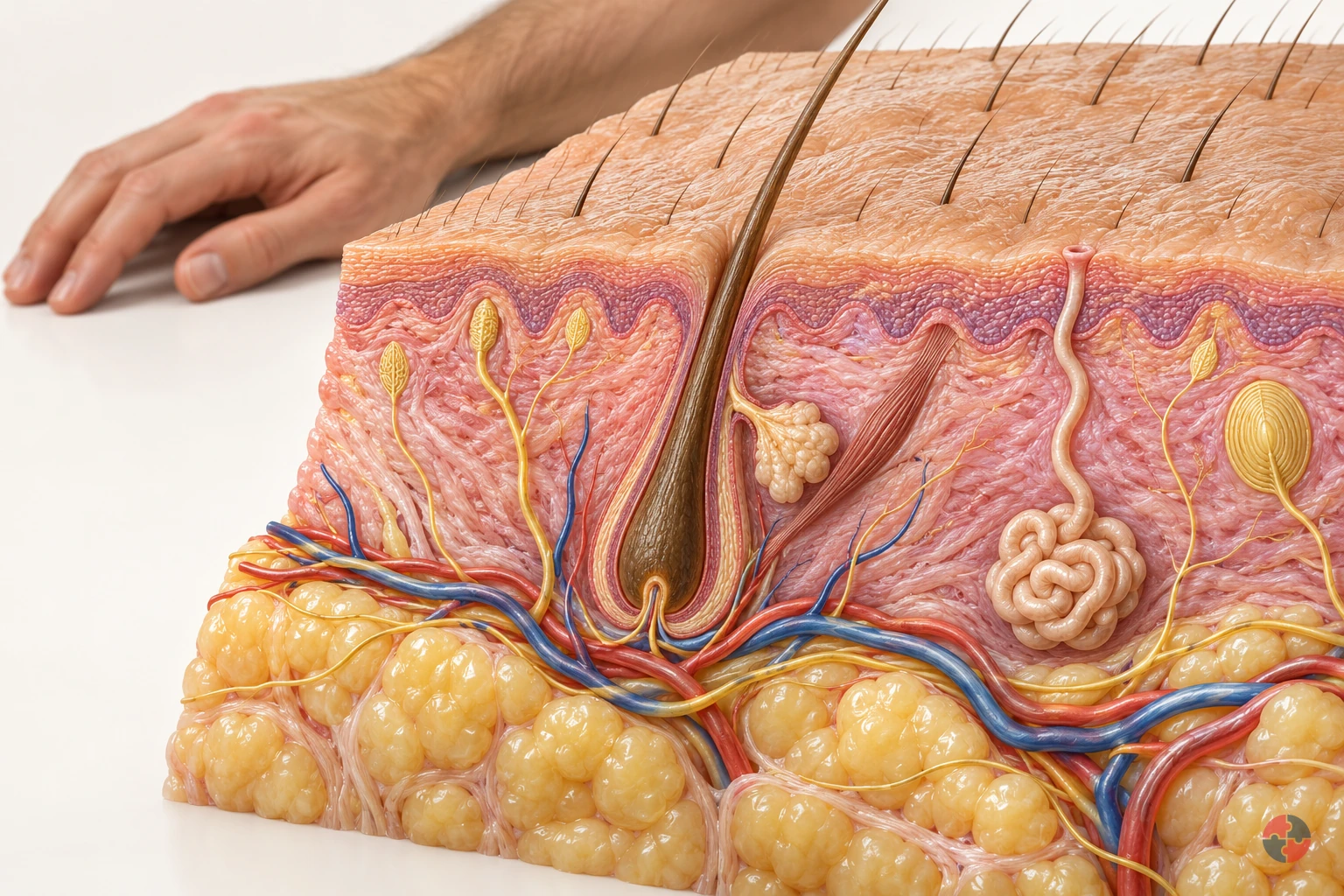
Explore an enlarged section of hair-bearing skin, with a hand and forearm for context. Layers, glands, nerves and vessels are enlarged for clarity.
Use the task in this lesson to identify contact, repeated wet work or contamination. Which change reduces contact before relying on gloves?
educational illustration · healthy anatomy; enlarged details and teaching colours.
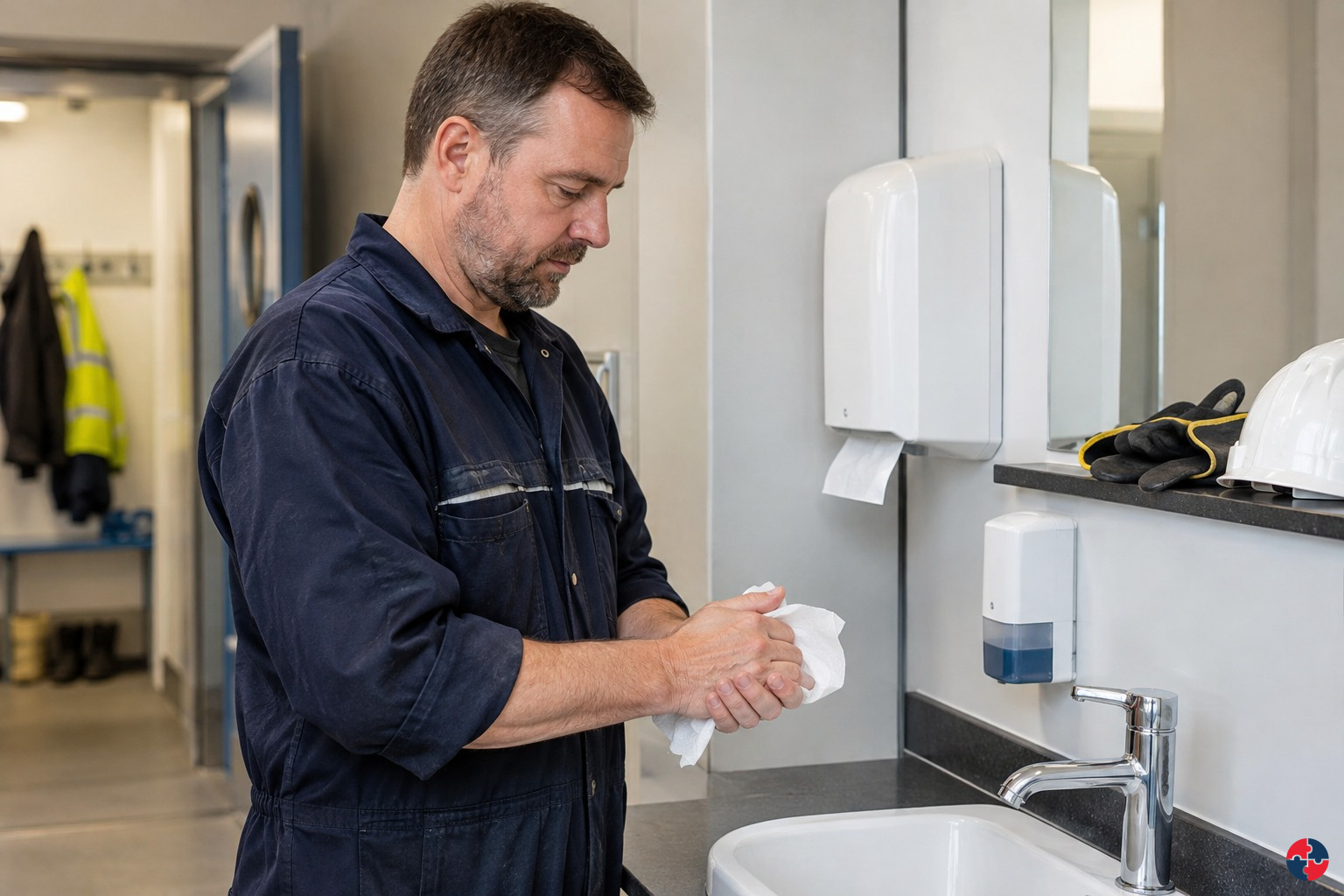
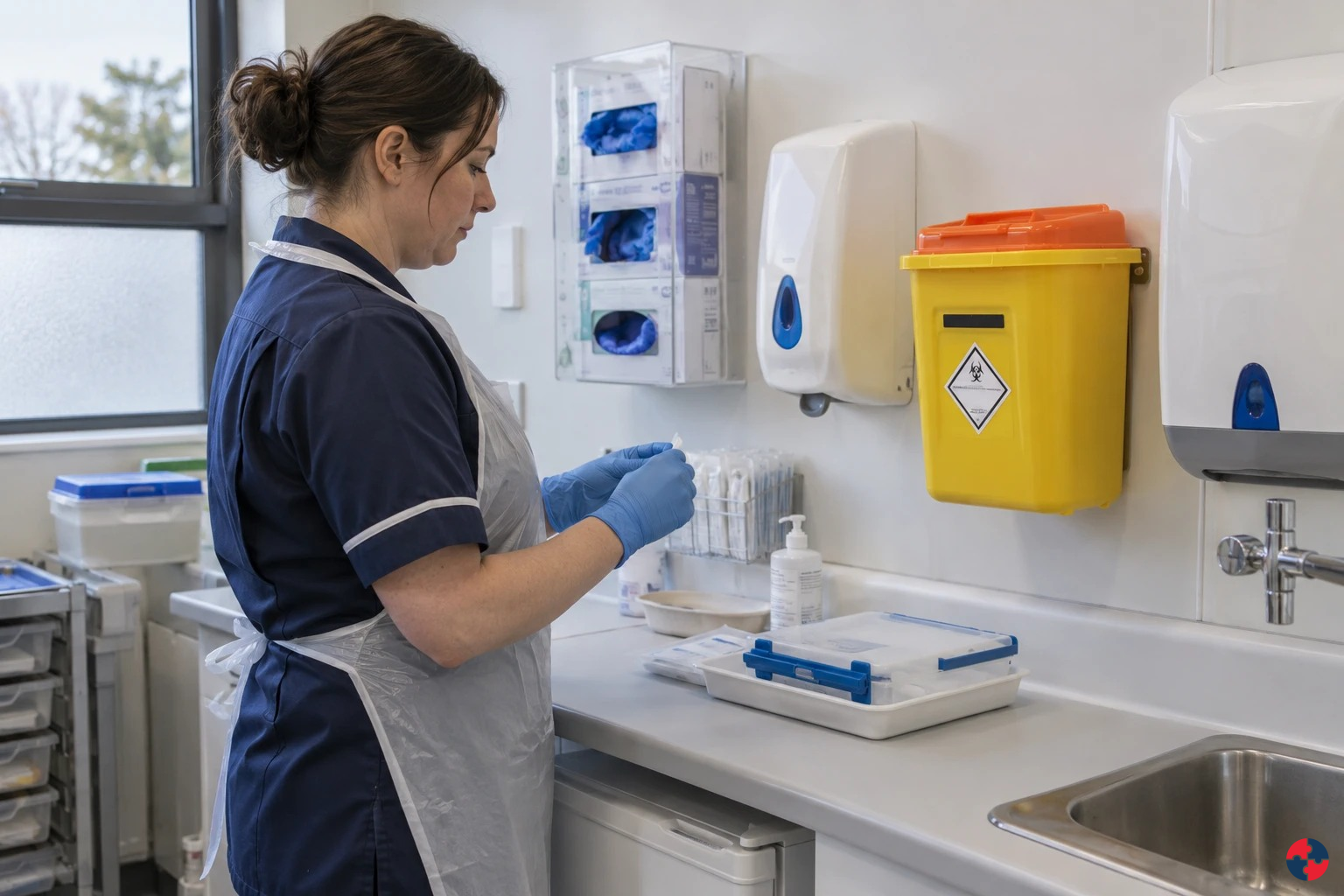
Photorealistic illustrative UK workplace scene. Review checks: Setting: A cleaner repeatedly handles diluted detergent and disinfectant and washes hands many times per shift. Act: The manager checks product identity, reduces wet work, selects a less harmful product where suitable, provides dosing and long-handled tools, and verifies glove compatibility. Hold / review: Stop contact with an unknown product, failed dosing or unsuitable glove; report persistent redness, itching or cracks promptly.
Skin protection starts with reducing exposure
Repeated wet work and chemical contact can damage the skin barrier, leading to soreness, cracking or other symptoms. Hands can be exposed during cleaning, glove use and removal, not only when a visible spill occurs. Persistent symptoms deserve prompt reporting and appropriate support; they are not proof of poor personal hygiene or something a worker must simply tolerate.
Assess the actual tasks, products, contact duration and methods. Reduce unnecessary wet work or direct contact through suitable equipment and process design, while maintaining required infection prevention. Choose protection for the real substance and task using competent advice. Gloves are not interchangeable, and contamination or prolonged moisture inside them can create problems. This course does not prescribe a glove material or diagnose dermatitis.
Provide usable facilities, appropriate skin-care arrangements and training in the actual method, including safe removal of protection. Do not reduce essential hand hygiene on a learner's initiative to protect skin; obtain a coordinated infection-prevention and occupational-health decision. Nor should stronger chemicals be substituted merely because they allow a shorter clean. Review the full exposure and effectiveness rather than one convenient feature.
If symptoms or a failed control are reported, arrange protective review and appropriate qualified advice promptly, respecting confidentiality. Risk-based skin checks or surveillance, where required, support prevention but cannot replace source control. Verify revised equipment, products and workload in representative conditions and ask workers whether the method is usable. For the fictional exercise, separate an observable report of sore skin from a clinical diagnosis. Record the task, exposure and support requested without publishing private health details. A box ticked for gloves does not establish suitable selection, condition or effective use through the whole cleaning task.
When should skin-health concerns trigger action or escalation?
Escalate when symptoms appear, exposure is uncontrolled, glove suitability is uncertain, sensitisation is suspected or work ability is affected.
HSE skin-prevention guidance prevention advice supports action at the first signs of damaged skin or failed controls.
Skin-health escalation should happen early. Waiting until hands are cracked, bleeding or infected can make recovery harder and may turn a manageable exposure issue into long absence or permanent work restriction.
The immediate management question is not 'what is the diagnosis?' It is 'what work exposure could be causing or worsening this, and what must change today while competent advice is sought?'
Trigger
Why it matters
Action
Dry, itchy, red or cracked skin reported
Early dermatitis may be developing.
Review exposure and arrange skin check/OH route.
Blistering, swelling, weeping or pain
More serious skin reaction or infection risk.
Remove from exposure and seek medical/OH advice.
Symptoms improve away from work and return at work
Work-related cause is possible.
Investigate tasks, substances and PPE.
More than one worker affected
System control failure likely.
Review substance, process, hygiene and surveillance.
Glove reaction suspected
Latex/rubber chemical or occlusion issue possible.
Review glove material and seek competent advice.
Wet work cannot be reduced
Barrier damage may continue.
Escalate for task redesign, staffing or equipment change.
The table illustrates early workplace action, not a clinical diagnosis or treatment plan. HSG262 supports contact control and early reporting; a qualified clinician assesses persistent or serious symptoms. HSE exposure and symptom context.
Emergency exception: a rapidly developing reaction with breathing difficulty, throat/tongue swelling or fainting needs 999 and emergency instructions immediately. Ordinary dermatitis or local swelling is not automatically anaphylaxis; routine early reporting and clinical/OH assessment still apply.NHS anaphylaxis: immediate emergency action
Applied case
A cleaner reports persistent sore skin and says gloves stay wet inside through long tasks.
Decision and explanation
Review actual exposure and protection promptly and arrange appropriate qualified support.
Reduce exposure while maintaining coordinated infection prevention and proper support.
Lesson 6
A linen trolley needs a suitable load and route
Reduce pushing risk without defeating infection separation.
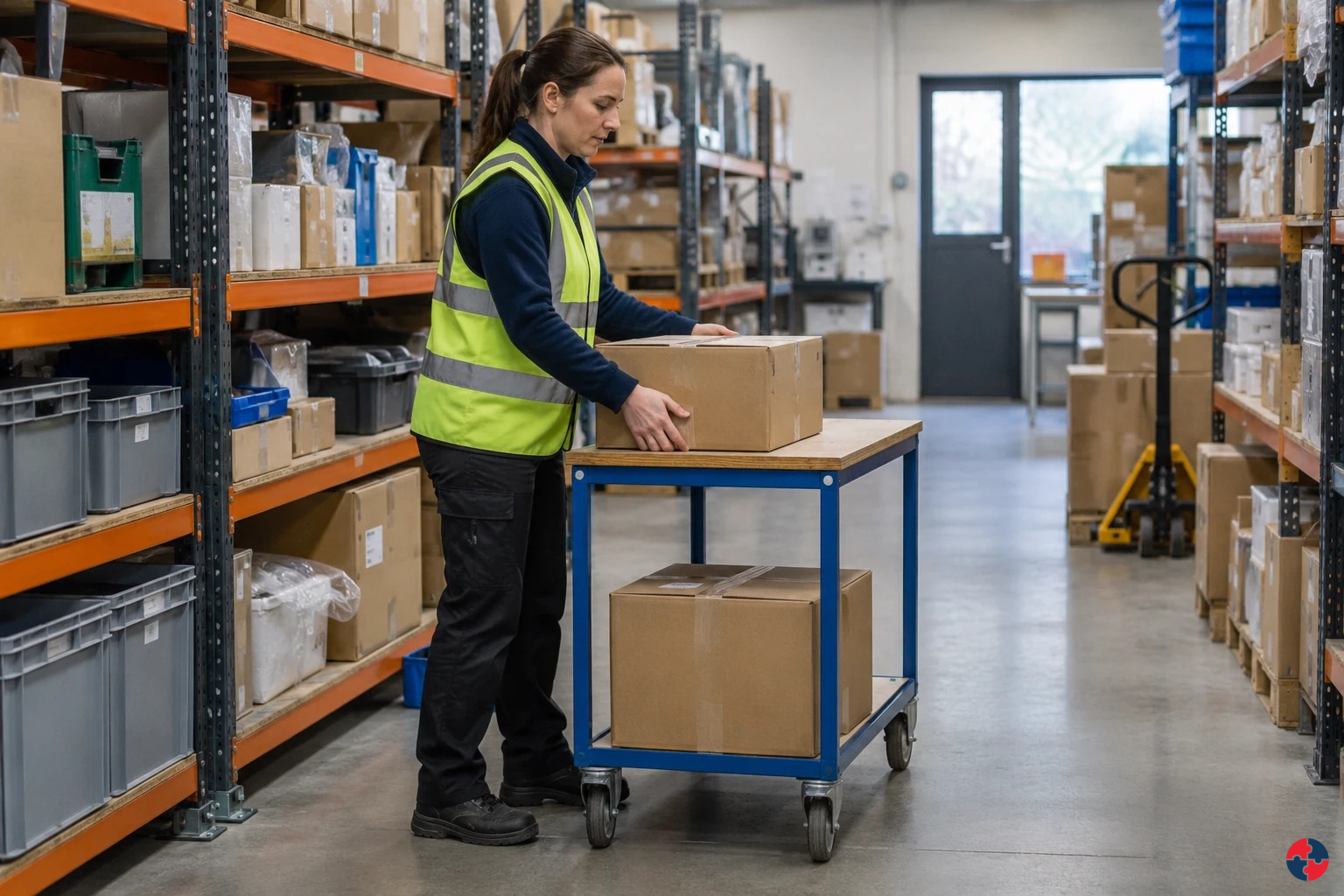
Photorealistic illustrative UK workplace scene. Review checks: Find: Heavy boxes are picked from the floor and twisted into a cage. Change: Raise the pick position, reorient the cage and repair the threshold. Verify: Maintain cage wheels and observe handling during a realistic peak.
A linen trolley needs a suitable load and route
An overloaded trolley can be difficult to start, steer or stop. The worker may twist, use excessive force or lose control near a resident. A load that obscures the route also creates a collision pathway. Wheel condition, gradients, thresholds, doors and available space affect the real task; the trolley's existence alone does not establish manual-handling control.
Avoid unnecessary handling and plan suitable load size, equipment and route. Use the actual assessment, maintenance and training arrangements, including the distinction between clean and used-linen equipment. Combining categories to make one trip may reduce travel but defeat infection prevention. A second worker is not an automatic substitute for unsuitable wheels, overload or a hazardous route.
If a trolley becomes hard to control, stop safely and obtain the responsible correction rather than pushing harder or travelling faster. Do not unload contaminated linen onto an unsuitable floor or into clean storage as an improvised fix. The planned alternative should control both handling forces and contamination. This course does not set a universal weight limit or provide a pushing technique for every person and trolley.
Verification should follow the complete journey, including doors, slopes, stopping positions and the return path. Check the actual equipment condition and whether staff can see and use the route safely. Review repeated difficulty and early discomfort with appropriate support rather than accepting it as normal. For the fictional exercise, compare load reduction and route improvement with a request to “use better technique” alone. Record the observed control problem, safe hold and close-out evidence. A delivery target or signed trolley check cannot compensate for the current inability to steer the loaded equipment safely.
How should manual handling be assessed?
Assessment should observe the real task, identify risk factors and choose controls that reduce force, posture, frequency, distance and uncertainty.
A good assessment watches the task happen. It measures or estimates load weight, height, reach, distance, frequency, route, floor condition, team communication and use of aids. It asks workers what actually makes the job difficult, not just what the procedure says. Sources: HSE L23 Manual handling guidance on regulations; HSE manual handling at work
For structured assessment, HSE's Manual Handling Assessment Charts (MAC) support lifting, carrying and team handling. The Risk Assessment of Pushing and Pulling (RAPP) tool supports pushing and pulling. The Assessment of Repetitive Tasks (ART) tool supports repetitive upper-limb tasks. These tools help prioritise risk, but they do not replace judgement or the hierarchy of avoiding and reducing the task. Sources: HSE L23 Manual handling guidance on regulations; HSE manual handling at work
Question
Assessment prompt
Output
Can the handling be avoided?
Can delivery, storage, automation or process flow remove manual movement?
A linen trolley blocks the worker’s view and is difficult to steer through a resident corridor.
Decision and explanation
The load, equipment and route arrangement through a suitable assessment and safe correction.
Control force and visibility without defeating infection separation.
Use the appropriate manual handling assessment
This additional teaching takes about 2–5 minutes, in addition to the course estimate. Optional reading and workplace assessment take additional time.
Start by asking whether the hazardous handling can be removed or redesigned. Where handling remains, observe the whole operation with the people who do it and choose an assessment that fits the work.
These aids support the activity assessment. Repetitive upper-limb work may need ART; variable or complex tasks may need other HSE tools or a fuller competent assessment. Mechanical lifting, stored energy, equipment safety and health decisions retain their separate controls. A low factor score, a downloaded report or completion of this course does not approve the work.
TILEO: Task, Individual, Load, Environment and Other factors. MAC: Manual Handling Assessment Charts for appropriate lifting, carrying and team handling. RAPP: Risk Assessment of Pushing and Pulling for appropriate manual pushing and pulling.
Read the portable guide to understand selection, limitations, the mixed-task example and company-branded Word/PDF records. Your existing course checks and completion requirements remain separate.
Check the entire linen journey, not only the washing cycle; interfaces and shortages often create the exposure route.
Photorealistic illustrative UK workplace scene. Review checks: Assessing: Map infection routes across toilets, changing rooms, poolside, cafe, first aid, cleaning, waste, parties and shared workstations. Analysing: Identify higher-risk points such as body-fluid cleaning, food handling, repeated illness, new/expectant mothers and crowded events. Implementing: Provide soap, drying, cleaning schedules, body-fluid spill kits, staff sickness rules and food-area hygiene controls.
Understand the activity and how harm develops
Used linen can contaminate hands, trolley surfaces and clean bedding, creating a route between residents. Shaking or sorting it in the room can spread contamination. The fact that bedding has passed through a wash does not protect it from becoming contaminated again during storage or delivery.
Plan a clear clean-to-used workflow with suitable containers, hand hygiene and task-specific precautions. Bag used linen at the point of removal through the approved process; infectious linen requires its specified handling arrangement. Avoid placing used items on a clean trolley or carrying them against clothing. Staff need enough space and supplies to follow the process reliably.
Recognise the evidence boundary
Question
Case evidence
What is observed?
Unbagged used linen is placed on a trolley carrying clean bedding.
How can harm occur?
Microorganisms can transfer to clean linen and residents.
What information is needed?
Check the laundry flow and handling practice between used and clean items.
Protect, manage and verify
Purpose
Practical application
Immediate protection
Separate used and clean linen and follow the approved handling and cleaning procedure.
Accountable work arrangement
Infection-prevention lead with laundry and care staff. Clean and used streams cross, required containers are missing or contamination is suspected.
Release verification
Verify the storage and transport route prevents cross-contamination.
Apply this at work
Check the entire linen journey, not only the washing cycle; interfaces and shortages often create the exposure route.
What does hand hygiene and infection prevention mean in practice?
It means interrupting the routes by which infectious agents move from source to person.
Hand hygiene is one part of infection prevention. A strong workplace system also considers cleaning, ventilation, waste, PPE, welfare, food hygiene, sharps, body fluids, animal contact, sickness absence, vaccination signposting and protection of people at greater risk.
For ordinary offices and welfare areas, simple controls can be enough. For care settings, schools, leisure venues, laboratories, animal work, sewage, waste or healthcare, the control standard may need to be much more formal.
Building block
Purpose
Example
Source control
Reduce infectious material at source.
Stay away when infectious, cover wounds and manage contaminated waste.
Hand hygiene
Remove contamination before it spreads.
Wash after toilet use, coughing, cleaning, food handling or animal contact.
Surface control
Reduce transfer from shared touchpoints.
Clean handles, taps, desks, controls and shared tools.
Respiratory hygiene
Reduce droplets and aerosols.
Cover coughs, dispose of tissues and improve ventilation.
Welfare
Make hygiene behaviour easy.
Soap, water, drying, bins and suitable rest/eating areas.
Escalation
Recognise when routine control is not enough.
Outbreak review, occupational-health or public-health advice.
Applied case
Used bedding is put onto a trolley holding freshly laundered sheets because the used-linen bag is missing.
Decision and explanation
Separate the streams, manage affected stock and restore the correct collection supplies.
Gloves do not protect the clean linen or replace task changes and hand hygiene. The workflow and equipment need to prevent recontamination. Covering the load does not reverse contact contamination.
Lesson 8
Incompatible cleaning chemicals can create a gas emergency
Prevent the wrong combination before pouring starts, and keep emergency actions simple enough to use under pressure.
Photorealistic illustrative UK workplace scene. Review checks: Chemical register: Compatibility class, SDS section 10, storage, owner and approved use. Transfer verification: Right product, tank, hose, valve lineup and ullage confirmed. Storage segregation: Acids, alkalis, oxidisers, flammables and wastes separated.
Understand the activity and how harm develops
Bleach mixed with an acidic product can release toxic chlorine gas. Mixing products in an ordinary bucket, container or drain may create an exposure that spreads beyond the cleaner to residents who cannot leave quickly. Odour is not a safe way to identify the mixture or establish that the air has cleared.
Stop the activity, withdraw people from exposure and activate the home’s chemical emergency arrangements. Do not add another product to neutralise the mixture or re-enter to open a window. Seek emergency help where needed and provide product information from a safe place. Competent clearance and corrected storage and dosing arrangements are needed before reuse.
Recognise the evidence boundary
Question
Case evidence
What is observed?
Two incompatible cleaners are poured into the same container.
How can harm occur?
A toxic gas release can injure workers and residents.
What information is needed?
Identify products from labels and safety information from a safe position.
Protect, manage and verify
Purpose
Practical application
Immediate protection
Stop the activity, withdraw people and activate the designated chemical response.
Accountable work arrangement
Duty manager and trained emergency responders; cleaning lead for prevention and follow-up. Products have been mixed unexpectedly, or irritation, fumes or a suspected chemical release occurs.
Release verification
Require competent clearance and corrected chemical arrangements before reuse.
Apply this at work
Prevent the wrong combination before pouring starts, and keep emergency actions simple enough to use under pressure.
Which major accident barriers control compatibility and inadvertent mixing?
Major accident barriers should prevent, detect, control and mitigate wrong-substance mixing before it becomes toxic release, fire, explosion, overpressure or escalation.
For process safety, a compatibility failure should be placed on the major accident hazard register where it could cause a serious release. The register should state the scenario: for example, acid transferred into hypochlorite tank, oxidiser into solvent waste, incompatible drainage discharge, or wrong raw material charged to a reactor.
Barriers should be named and owned. A label is a barrier only if it is maintained, visible and understood. A procedure is a barrier only if people can use it under real delivery conditions. An interlock is a barrier only if it is tested and managed through change control.
Assurance evidence matters. If the same fill point has confusing labels, repeated near misses or drivers asking which line to use, the barrier is degraded even if the paperwork says the system exists.
Dedicated fill points, unique couplings, segregation and approved transfer route.
Inspection and proof-test records.
Detection
High-level alarms, abnormal pressure/temperature, gas detection or operator observation.
Alarm test and response drill.
Control
Emergency shut-off, isolation valves, bunding and drain isolation.
Functional test and maintenance.
Mitigation
Evacuation, ventilation, emergency response, spill containment and incident command.
Drill and emergency-plan review.
Organisational
Competence, handover, permit, independent verification and management of change.
Training, audit and MOC records.
Applied case
A cleaner mixes bleach with limescale remover and an irritating smell develops beside an occupied corridor.
Decision and explanation
Withdraw people and activate the designated chemical emergency response.
Further mixing can worsen the reaction and exposure. Deliberate inhalation increases exposure and cannot determine safety. Protection and trained response take priority; staff should not approach to experiment.
Lesson 9
Never put cleaning products in drinks containers
Packaging is a safety control: use the right container, reliable identity and secure storage before considering user behaviour.
Photorealistic illustrative UK workplace scene. Review checks: Risk register and procurement: The company keeps a COSHH register for each project and reviews products before purchase. Construction dust control: Dry cutting is avoided where reasonably practicable. Cement, resins and skin protection: Wet cement and epoxy products are treated as skin hazards.
Understand the activity and how harm develops
A familiar drinks bottle invites the wrong interpretation, especially where someone has impaired vision, memory or understanding. An unlabelled liquid can also lead staff to use the wrong product or concentration. A handwritten warning does not make a drinks container suitable chemical packaging.
Secure the container against unintended access and obtain authorised identification and disposal. Do not smell, taste or mix it to find out what it is. If exposure or possible ingestion has occurred, obtain prompt appropriate medical help; do not induce vomiting. Store chemicals in suitable identified containers through the approved system, separately from food, drink and medicines.
Recognise the evidence boundary
Question
Case evidence
What is observed?
An unlabelled drinks bottle contains cleaning liquid.
How can harm occur?
A person may swallow the chemical or use it incorrectly.
What information is needed?
Check product identity and the approved storage and dispensing procedure.
Protect, manage and verify
Purpose
Practical application
Immediate protection
Secure the unknown container and arrange authorised identification and safe disposal.
Accountable work arrangement
Cleaning lead and duty manager; appropriate clinical or emergency service for exposure. The product is unknown, packaging is misleading or unintended access is possible.
Release verification
Verify chemicals are correctly identified and inaccessible to unintended users.
Apply this at work
Packaging is a safety control: use the right container, reliable identity and secure storage before considering user behaviour.
How do REACH, CLP, safety data sheets and hazard pictograms support COSHH?
UK REACH and GB CLP govern chemical supply information in Great Britain; EU REACH and EU CLP apply in Northern Ireland. COSHH still requires a task-specific exposure assessment and controls for the work location.
HSE UK REACH guidance explains the GB supply regime. HSE GB and NI CLP guidance distinguishes GB CLP from EU CLP in NI; DAERA NI REACH guidance confirms EU REACH applies in NI. Check where a substance is supplied and used before selecting the current label and safety-data-sheet rules.
REACH is mainly concerned with the registration, evaluation, authorisation and restriction of chemicals in the supply chain. In practical terms for a COSHH user, it helps make sure chemical information flows from manufacturers, importers and suppliers to downstream users. CLP is the classification, labelling and packaging system. It governs how hazardous substances and mixtures are classified and how labels, pictograms, signal words, hazard statements and precautionary statements communicate that hazard.
A safety data sheet is not a COSHH assessment. It is supplier information that helps the employer understand hazardous properties, first-aid measures, firefighting measures, accidental release measures, handling, storage, exposure controls, personal protective equipment (PPE), stability, reactivity, toxicology and disposal. The COSHH assessment must then ask a different question: how is this substance actually used here, by whom, in what quantity, for how long, with what ventilation, and what controls prove exposure is prevented or adequately controlled?
Typical CLP hazard pictograms used in COSHH assessment
Typical pictogram or label signal
What it can indicate
COSHH management point
Exploding bomb
Explosive, self-reactive substances or organic peroxides.
Consider DSEAR, storage compatibility, heat, shock, contamination and emergency arrangements as well as health risk.
Flame
Flammable gases, liquids, solids, aerosols or substances that may ignite easily.
Control ignition sources, vapour release, ventilation, storage quantities and spill response.
Flame over circle
Oxidising substances that can intensify fire.
Keep away from combustibles and incompatible materials; check storage segregation and emergency plans.
Corrosion
Skin corrosion, serious eye damage or corrosive to metals.
Assess splash risk, decanting methods, eye/face protection, chemical gloves, emergency drench arrangements and first aid.
Skull and crossbones
Acute toxicity that may be fatal or toxic after exposure.
Question whether the substance can be eliminated or substituted, then tightly control access, exposure route, storage and emergency response.
Exclamation mark
Harmful, irritant, skin sensitiser, serious eye irritation or similar lower-category hazards.
Do not dismiss it as minor; repeated skin or respiratory exposure can still create reportable occupational disease.
Health hazard silhouette
Serious health hazards such as carcinogenicity, respiratory sensitisation, reproductive toxicity, mutagenicity or target organ toxicity.
Treat as a high-priority COSHH risk. Exposure may need to be reduced as low as reasonably practicable, with monitoring and health surveillance considered.
Primarily an environmental signal, but it should still trigger controls for storage, bunding, spills, drainage and disposal.
Applied case
A clear liquid in a lemonade bottle is found on a cleaning trolley in the lounge.
Decision and explanation
Secure access and arrange authorised handling of the unknown product.
The drink-like packaging creates an ingestion risk even before identity is established. Smelling an unknown chemical creates exposure and unreliable identification. A note does not provide suitable packaging, identity or controlled access.
Lesson 10
Protect skin while maintaining effective hygiene
Staff health is part of reliable care. Make early reporting and task redesign routine rather than waiting for severe disease.
Photorealistic illustrative UK workplace scene. Review checks: Setting: A cleaner repeatedly handles diluted detergent and disinfectant and washes hands many times per shift. Act: The manager checks product identity, reduces wet work, selects a less harmful product where suitable, provides dosing and long-handled tools, and verifies glove compatibility. Hold / review: Stop contact with an unknown product, failed dosing or unsuitable glove; report persistent redness, itching or cracks promptly.
Understand the activity and how harm develops
Repeated contact with water, detergents and contaminated gloves can damage the skin barrier and cause occupational dermatitis. Early dryness, redness or cracking should be reported rather than accepted as part of care work. Damaged skin may make hygiene painful and affect a worker’s ability to continue normal tasks.
Reduce unnecessary wet contact and select gloves for the actual chemical and task. Gloves can themselves cause problems if contaminated inside or worn for prolonged inappropriate periods. Hand hygiene must still meet infection-prevention requirements. Skin protection needs a coordinated method, suitable products, worker consultation and early occupational-health support.
Recognise the evidence boundary
Question
Case evidence
What is observed?
A worker repeatedly handles damp cleaning cloths with contaminated gloves.
How can harm occur?
Wet work and cleaning products can cause dermatitis.
What information is needed?
Review tasks, glove selection, changing practice and skin concerns.
Protect, manage and verify
Purpose
Practical application
Immediate protection
Reduce contact and provide suitable task-specific skin-protection arrangements.
Accountable work arrangement
Line manager and COSHH assessor, supported by occupational health or an appropriate clinician. Skin symptoms appear, gloves are contaminated or the agreed exposure controls are unavailable.
Release verification
Check practice with workers and ensure early concerns reach appropriate support.
Apply this at work
Staff health is part of reliable care. Make early reporting and task redesign routine rather than waiting for severe disease.
How should gloves be selected and managed?
Gloves must match the substance, task, contact time, dexterity, tear risk, wearer and compatibility with other controls.
HSE glove guidance requires the material and duration to match the product and task.
Gloves are useful but often misunderstood. The right glove for one chemical may fail against another. A glove that is safe for cleaning may create entanglement risk around rotating machinery. A glove that protects against splashes may fail during immersion or long contact. A glove worn too long may trap sweat and worsen dermatitis.
The assessment should use SDS information, manufacturer compatibility data and task observation. It should also consider glove length, cuff, thickness, grip, dexterity, puncture risk, change frequency, storage, removal technique and whether workers need liners or alternative products.
Decision
What to check
Failure to avoid
Chemical compatibility
Will glove material resist the substance for the contact time?
A worker has cracked painful hands and keeps the same wet gloves on for the whole cleaning round.
Decision and explanation
Review exposure and glove use and arrange early appropriate support.
Glove suitability, condition and contamination determine their protection. Control the wet-work pathway while maintaining necessary hygiene. Removing infection controls creates a different risk and does not provide a coordinated plan.
Lesson 11
Make the loaded trolley manageable and visible
Assess pushing and pulling with the actual load and route; wheels do not automatically remove manual-handling risk.
Photorealistic illustrative UK workplace scene. Review checks: Find: Heavy boxes are picked from the floor and twisted into a cage. Change: Raise the pick position, reorient the cage and repair the threshold. Verify: Maintain cage wheels and observe handling during a realistic peak.
Understand the activity and how harm develops
An overloaded trolley blocks the operator’s view and increases the force needed to start, stop or turn. A stiff caster can cause a sudden change in effort or direction. The task is a manual-handling risk even though the load is on wheels, and the trolley can also strike a resident on a shared corridor.
Reduce the load and correct the wheel defect rather than asking staff to push harder. Check slopes, thresholds, doorways and equipment parking. Deliveries may need smaller batches or different timing so the route stays accessible. Technique training alone does not compensate for a defective trolley and a poorly arranged job.
Recognise the evidence boundary
Question
Case evidence
What is observed?
A linen trolley blocks its operator's view and has a stiff caster.
How can harm occur?
High pushing force or poor visibility can cause strain or a collision.
What information is needed?
Assess load, caster condition, route and the actual pushing task.
Protect, manage and verify
Purpose
Practical application
Immediate protection
Reduce loads, repair the trolley and use a suitable route and handling method.
Accountable work arrangement
Laundry or stores lead and equipment maintainer. The operator cannot see ahead, the trolley pulls unpredictably or excessive force is needed.
Release verification
Verify an ordinary loaded run is manageable and the route remains clear.
Apply this at work
Assess pushing and pulling with the actual load and route; wheels do not automatically remove manual-handling risk.
What evidence shows manual handling is controlled?
Evidence should show that hazardous handling has been avoided where possible, assessed where unavoidable and reduced through work design.
Useful evidence includes task observation, manual-handling assessment, MAC/RAPP records where useful, photos of layout, load information, handling-aid inspection, worker consultation, training, early discomfort reports, task redesign actions, occupational health advice where needed and review after change. Sources: HSE L23 Manual handling guidance on regulations; HSE Manual Handling Assessment Charts
A trolley is piled above eye level and pulls sideways. A worker suggests taking a run-up over the threshold.
Decision and explanation
Reduce the load, correct the caster defect and review the route.
Speed reduces control and increases collision and strain risk. Extra force does not correct the defect or establish a safe coordinated task. The equipment and task conditions create the force and visibility problem.
Lesson 12
The busy laundry handover
Keep chemical, contamination and handling controls working together.
Related SHAREhub topic guide. Apply its prompts to the specific case below.
The busy laundry handover
In the fictional laundry, clean linen is placed on a trolley used for soiled items. The clean return route crosses used-linen collection. A drinks bottle contains unidentified cleaner, and a worker adds another product to a bleach bucket. An odour develops. Another cleaner reports persistent sore hands while an overloaded trolley is difficult to steer towards the resident corridor.
Begin with the suspected chemical release. Withdraw from exposure, protect others and use the actual emergency procedure and competent response, obtaining urgent help where needed. Do not investigate by smelling, add a neutraliser or carry the bucket through the home. Identify known product information safely and communicate uncertainty honestly. This awareness course provides no spill-cleanup or medical treatment instructions.
Keep the unidentified bottle out of use and prevent access through the appropriate safe process. A familiar colour or worker's memory cannot restore reliable identity. The competent team should establish disposition and correct containers, labels, storage and dispensing. Review how mixing and decanting arose rather than only removing today's items. Waste and drains also need the authorised route; dilution does not make disposal automatically acceptable.
The linen pathway needs infection-prevention review. Labels alone cannot protect clean items from contaminated hands, trolley surfaces or crossing routes. Use the approved collection, processing, storage and return arrangements, with suitable separation, equipment and hand hygiene. Do not invent a universal wash setting or classify linen solely from appearance. A clean-looking result is not evidence that the required process occurred. Appropriate trained roles should decide how affected stock is managed.
Address skin exposure and the trolley task without trading one control for another. Review wet work, product contact, glove suitability and usable skin-care support, arranging appropriate qualified advice for symptoms. Do not stop essential infection-prevention practices on an unqualified suggestion. Reduce or redesign the trolley load, route and equipment so it remains controllable without mixing clean and used items. More effort or an extra helper cannot automatically solve a defective system.
The final handover should identify person support, area restrictions, competent cleanup, linen disposition, equipment correction and verification before release. Check that the next shift understands what remains unavailable and who will resolve it. Use fictional audit and briefing prompts rather than entering a real resident or health record. A signed cleaning schedule does not establish chemical compatibility, clean-linen protection or safe pushing. The case is complete when the actual workflow can maintain infection prevention and worker health together under normal demands.
How should the basic risk assessment process work?
The process should identify hazards, decide who may be harmed, evaluate risk, record significant findings and review the controls.
The familiar five-step model is only useful when each step is done honestly. Walking the workplace, checking incident data, speaking to workers, reviewing maintenance, reading safety data sheets and observing non-routine work will usually reveal more than a desk exercise.
The output should be understandable to the people who use it. A supervisor should know what must be in place before work starts. A worker should know the task controls and stop-work triggers. A manager should know what resources and review evidence are required.
Step
What good looks like
Evidence
Identify hazards
Task observation includes normal, abnormal, maintenance, cleaning and emergency conditions.
Walkthrough notes, worker input and hazard register.
Decide who may be harmed
Employees, contractors, visitors, public, vulnerable workers and emergency responders are considered.
People-at-risk section and consultation evidence.
Evaluate risk
Existing controls are tested, not assumed.
Inspection findings, monitoring data, maintenance records and competence checks.
Record findings
Significant risks, controls, action owners and review triggers are clear.
Assessment, action tracker and risk register.
Review
Assessment changes after incidents, changes, new information or weak control evidence.
The shift lead proposes completing laundry first and investigating the odour and skin report afterwards.
Decision and explanation
Protect people now, use the competent chemical response and resolve the contamination, skin and handling gaps before affected work resumes.
Current exposure and failed workflow controls need action, not deferred paperwork.
Lesson 13
Take a verified action into the workplace
Connect one actual task to an owner, evidence and a clear release or escalation decision.
Related SHAREhub topic guide. Apply its prompts to the specific case below.
Turn awareness into a practical question
Care-home safety awareness with a Great Britain workplace baseline. CQC, DHSC and cited residential-care examples apply to England where stated; confirm the relevant national regime. This course does not confer clinical, medicines, lifting, restraint, maintenance or emergency-response competence or authorisation.
Choose one relevant operation from the course. Describe the person or environment at risk, the mechanism of harm and the exact condition that needs controlling. Separate an observation from a conclusion. A display, signature, badge or clean appearance answers only a limited question.
Use the included practice resources to prepare a fictional task brief, risk review or verification question. Decide which competent role owns the decision and which evidence must be available before work restarts or work is released. Keep worker protection, public exclusion, task acceptance and environmental decisions distinct where required.
At work, use your actual approved arrangements. Report uncertainty and preserve the relevant hold, restriction or safe state while it is resolved. Confirm that the action addressed the original harm route and check whether another shift, load, cleaning task or maintenance change could reintroduce it.
Course completion records awareness learning. It does not establish practical competence, certify an organisation or authorise specialist, clinical, maintenance, chemical or emergency work.
How should the basic risk assessment process work?
The process should identify hazards, decide who may be harmed, evaluate risk, record significant findings and review the controls.
The familiar five-step model is only useful when each step is done honestly. Walking the workplace, checking incident data, speaking to workers, reviewing maintenance, reading safety data sheets and observing non-routine work will usually reveal more than a desk exercise.
The output should be understandable to the people who use it. A supervisor should know what must be in place before work starts. A worker should know the task controls and stop-work triggers. A manager should know what resources and review evidence are required.
Step
What good looks like
Evidence
Identify hazards
Task observation includes normal, abnormal, maintenance, cleaning and emergency conditions.
Walkthrough notes, worker input and hazard register.
Decide who may be harmed
Employees, contractors, visitors, public, vulnerable workers and emergency responders are considered.
People-at-risk section and consultation evidence.
Evaluate risk
Existing controls are tested, not assumed.
Inspection findings, monitoring data, maintenance records and competence checks.
Record findings
Significant risks, controls, action owners and review triggers are clear.
Assessment, action tracker and risk register.
Review
Assessment changes after incidents, changes, new information or weak control evidence.
The shift action log says “training completed, issue closed”. It records no condition check, work status or task owner.
Decision and explanation
The accountable person verifies the task-specific control and records the justified decision.
Learning supports the decision; evidence that the relevant control works is needed before the responsible person closes the action.
Match the nine hazard symbols
End-of-course revision · Drag each symbol to its hazard name, or use the menu on each card with touch or keyboard. This is practice alongside the separate final assessment.
Acute toxicity
Corrosive
Explosive
Flammable
Gas under pressure
Harmful / irritant
Hazardous to the environment
Oxidising
Serious health hazard
Match all nine symbols, then check your choices.
Need the reference table?Chemical hazard pictograms · examples and checksOptional reference · all nine symbols · does not change assessment requirements
READ THE LABEL · UNDERSTAND THE TASK
Recognise the symbol. Read the full label. Assess the actual task.
Examples illustrate possible uses of a symbol, not the classification of every formulation. A product can carry several pictograms. Check its current label, hazard statements and matching safety data sheet (SDS).
CLP/GHS hazard pictograms: meanings and illustrative examples
Pictogram and hazard
What it can mean
Example and question before work
ExplosiveGHS01
Explosion, blast or projection hazards; also certain self-reactive substances and organic peroxides.
Example: Certain fireworks or reactive chemical products.Ask: Does the authorised task account for impact, heat and the product’s stability limits?
FlammableGHS02
Can ignite; also used for certain self-heating, pyrophoric or water-reactive hazards.
Example: Petrol or some solvent-based products.Ask: What could release vapour or ignite it during this task, including nearby work?
OxidisingGHS03
Can cause or intensify fire; some strong oxidisers present an explosion hazard.
Example: Oxygen or certain oxidising chemicals.Ask: What incompatible materials and contamination must the assessed storage and connection keep apart?
Gas under pressureGHS04
Pressurised gas may burst if heated; refrigerated gas can cause cold burns.
Example: Compressed-gas cylinders.Ask: Have the gas identity, cylinder, connection and pressure or temperature hazards been checked?
CorrosiveGHS05
May damage metals, cause severe skin burns or cause serious eye damage; read the stated hazard.
Example: Certain drain cleaners, acids or alkalis.Ask: Which contact and splash routes must be prevented in this actual handling or dilution task?
Acute toxicityGHS06
Can be toxic or fatal after short exposure through the stated route.
Example: Methanol or certain pesticide products.Ask: Which exposure routes and emergency arrangements does this product’s information identify?
Harmful / irritantGHS07
May indicate harmful acute toxicity, irritation, skin sensitisation, drowsiness or dizziness; also ozone-layer hazards.
Example: Some detergents or cleaning products.Ask: What do the hazard statements say? Do not dismiss this as a harmless or mild product.
Serious health hazardGHS08
Can indicate cancer, genetic or reproductive harm, organ damage, respiratory sensitisation or aspiration hazard.
Example: Petrol or some sensitising chemical products.Ask: Which particular health effect is stated, and how does the task prevent the relevant exposure?
Hazardous to the environmentGHS09
Hazardous to aquatic life, potentially with long-lasting effects.
Example: Certain pesticides, biocides or fuels.Ask: How will the assessed arrangements prevent release to drains, water or soil?
Read beyond the picture · Open a prompt to compare the explanation.
Is the exclamation mark the same as the chest-starburst symbol?
No. The two symbols communicate different groups of hazards. Read the actual hazard statements: skin sensitisation and respiratory sensitisation are not interchangeable, and neither symbol specifies the complete task controls.
Does a bottle with no pictogram prove the task is safe?
No. Work may generate hazardous dust, fume or mist, and exposure depends on the task. Resolve missing or conflicting identification before use. A pictogram is not a compatibility chart or a complete workplace risk assessment.
Which information turns recognition into a useful work decision?
Match the product and SDS revision. Read the hazard statements and relevant SDS sections for handling, storage, exposure control, emergencies and reactivity together. Then check the actual task assessment and controls. A safety data sheet is not itself a COSHH assessment.

 READ THE LABEL · UNDERSTAND THE TASK
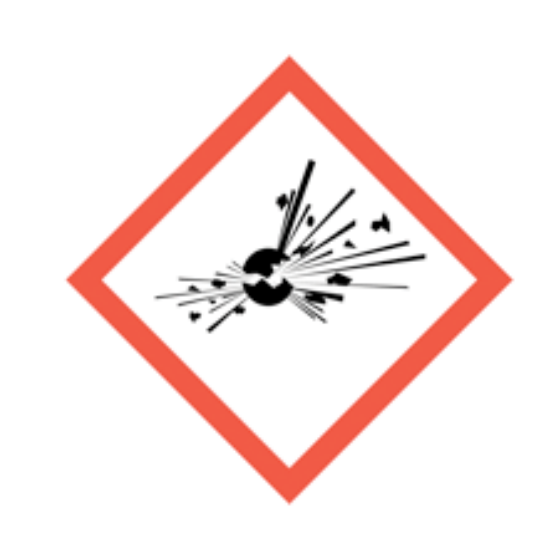 Explosive
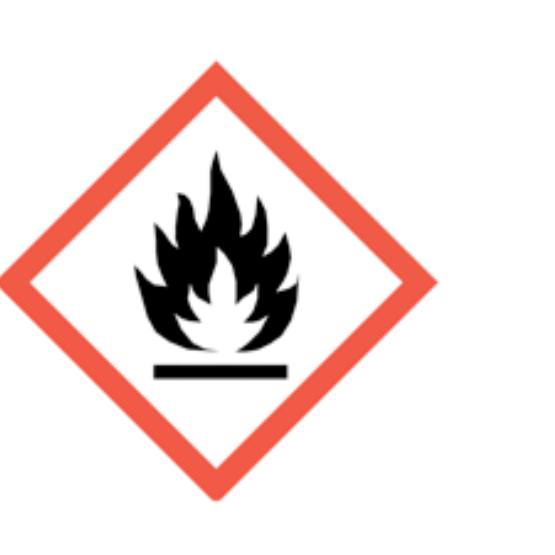 Flammable
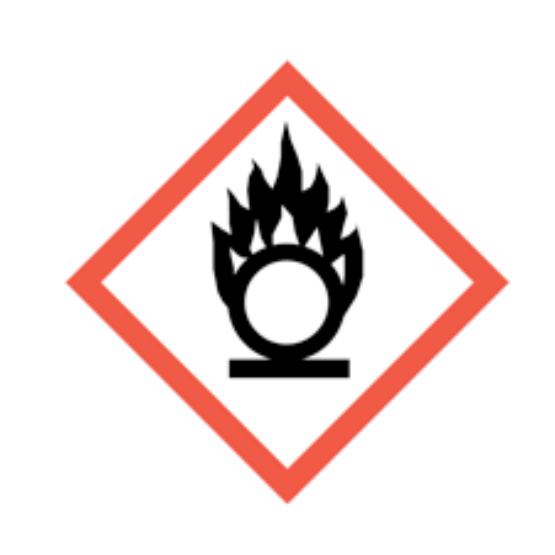 Oxidising
 Gas under pressure
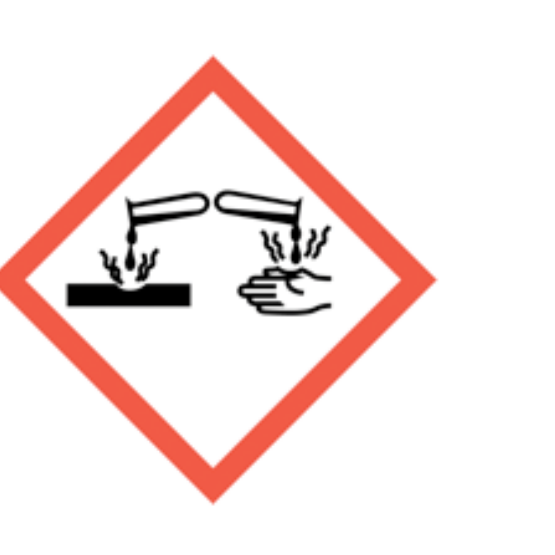 Corrosive
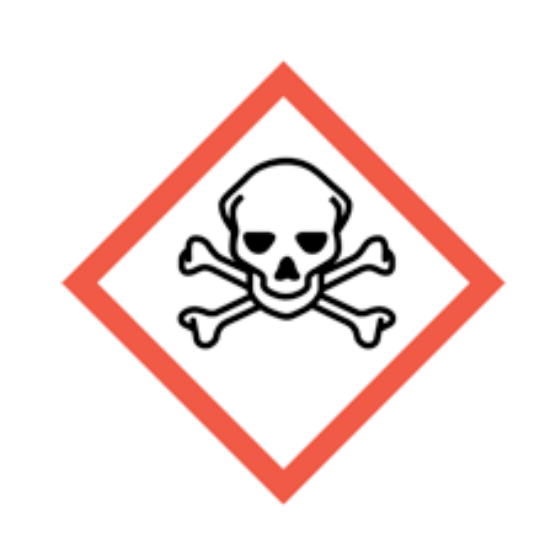 Acute toxicity
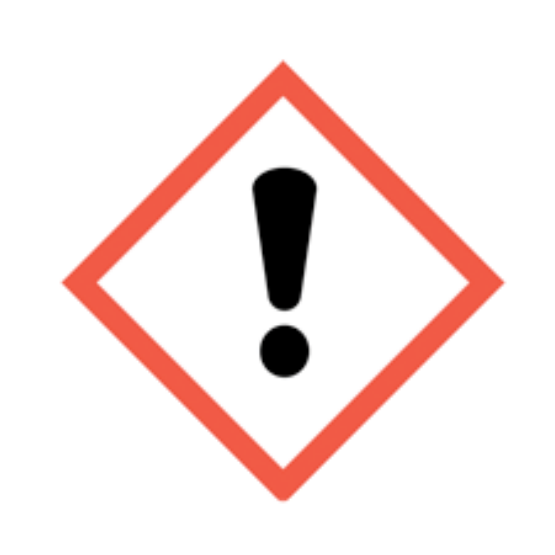 Harmful / irritant
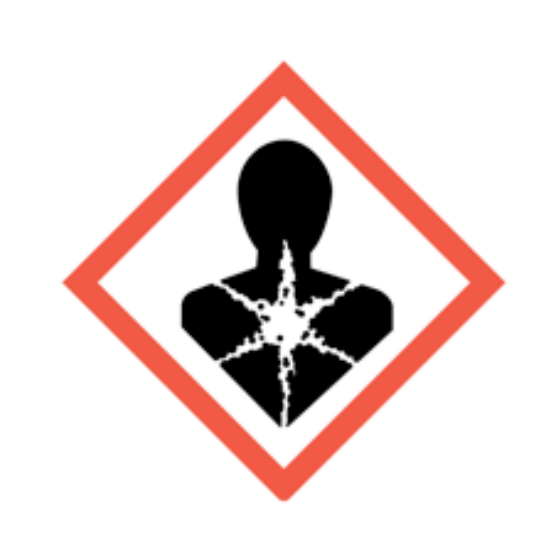 Serious health hazard
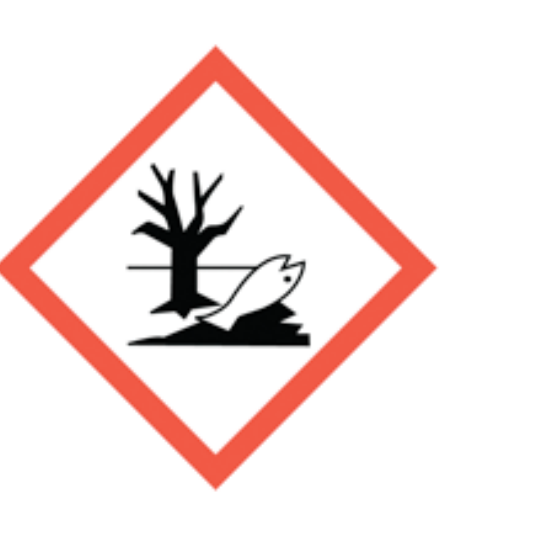 Hazardous to the environment