Full public teaching and readers are free without an account. A free learner account is required for saved LMS progress and recorded assessment. Completion and any course-completion certificate depend on the configured LMS conditions. Open the course overview.
Lesson 1
The person and the room form one safety arrangement
Apply the person and the room form one safety arrangement to the current person and task.
Related SHAREhub topic guide. Apply its prompts to the specific case below.
The person and the room form one safety arrangement
A bedroom is a private living space as well as a place where care and equipment are used. The resident’s usual movement, understanding, comfort, preferences and ability to summon help affect the arrangement. Ask the person how they reach the bell, get in and out of bed and use the window or radiator area. A room may look tidy while leaving its occupant unable to obtain assistance.
Changes to one item can alter another risk. A replacement mattress may change rail gaps or effective height. Moving a bedside table may place a lead under tension or put a call bell beyond reach. Equipment selected for another resident may not suit this person. Use the individual assessment and manufacturer information together, and involve competent staff when the combination or the person’s needs change.
Review the room when care needs or equipment change, and involve the person in ways they can understand. Ask whether the agreed assistance and help system remain usable from their normal positions rather than assuming that a tidy layout is comfortable. Staff should not infer a person's understanding or capacity from a diagnosis or choose restrictive equipment for convenience. Relevant decisions belong within the actual person-centred assessment and lawful process.
For the exercise, trace the person, movement, bed configuration and response to a call. Distinguish observable placement from information still needed, such as manufacturer compatibility or the person's current support plan. When a gap matters, provide a suitable interim arrangement through the responsible team and record what prevents reliance on the equipment. A course answer cannot authorise a real bed-rail arrangement. The model illustrates interfaces but cannot measure every gap or assess the occupant.
Who may be harmed and why does that change the assessment?
Different people have different exposure, competence, vulnerability and ability to control the risk.
Assessments often understate risk because they focus only on the trained operator. Real workplaces involve new starters, contractors, maintenance teams, cleaners, agency workers, visitors, young people, expectant mothers, disabled workers, lone workers, language barriers and people working under fatigue or production pressure.
The same hazard may require different controls for different people. A trained technician may understand isolation points; a cleaner may only encounter the equipment when a guard is open and production has stopped. That difference matters.
Group
Why they may be at risk
Assessment check
Operators
Direct exposure to task hazards and production pressures.
Training, supervision, work instructions and stop-work authority.
Maintenance workers
Higher exposure during isolation, opening, adjustment and fault-finding.
Permit, isolation, stored energy and competence controls.
Contractors
May not know site-specific hazards or emergency rules.
Prequalification, induction, supervision and interface control.
Visitors and public
May be unfamiliar with routes, alarms or site hazards.
Segregation, signs, escorting and emergency communication.
Vulnerable workers
Health, age, pregnancy, disability, language, fatigue or inexperience may affect risk.
Individual assessment, adjustments and communication.
Applied case
A new mattress is fitted and the call bell is placed neatly on a distant table.
Decision and explanation
The complete bed/rail combination and the person’s usable access to help.
Both equipment compatibility and access to assistance can change even though the room looks orderly.
Lesson 2
Recognise a defect without improvising a repair
Apply recognise a defect without improvising a repair to the current person and task.
Teaching graphic from the linked SHAREhub source section.
Recognise a defect without improvising a repair
Care staff need to recognise conditions that require action, but recognition does not authorise an improvised electrical repair or an adjustment outside training. Protect the resident using the agreed support arrangements, report the specific equipment and defect, and prevent further use where the risk requires it. Record the equipment identity so a checked replacement is not confused with the item awaiting repair.
The response should preserve necessary care. Removing a damaged appliance may be straightforward; changing a bed-rail arrangement or restricting a window may need a person-specific assessment and competent decision. Explain the interim arrangements at handover. Before closing the issue, establish that the equipment and support work for this resident, that staff understand the change and that any maintenance requirement has been addressed.
An electrical lead trapped under a bed can deteriorate through repeated movement. If damage is seen, keep the person and others clear and use the safe withdrawal and competent repair route. Disconnect only by a safe method; do not touch exposed damage or ask the resident to test the item. A protective device or inspection label does not remove a visible defect.
The replacement arrangement must still meet the person's needs. Removing a bedside item without suitable support may leave help or another essential function unavailable. The care and premises teams should coordinate an interim solution and competent handback. Verify that the corrected route prevents repeat damage when the bed moves and that any repositioned call bell remains usable. An invoice or new sticker cannot establish the whole bedroom is ready for the person to rely on it.
How can the ISO 45001 hierarchy of controls prevent electrical contact during equipment fault diagnosis?
Use HSE’s hierarchy to eliminate or substitute a hazard where practicable, then apply engineering and administrative controls before relying on PPE. Check each chosen control against the actual task and stop when it fails.
Use HSE’s hierarchy of controls: eliminate or substitute the hazard where possible, then use engineering and administrative controls; PPE is the last resort. Apply the sequence to the task and verify that each chosen barrier works. HSE hierarchy of controls (official source).
Electrical safety is a strong example of why the hierarchy matters. The best control is often to remove the need for live work, design equipment so live parts cannot be touched, use reduced voltage in high-risk conditions and isolate securely before maintenance. PPE can be important for some tasks, but it should not be the first or only control.
The hierarchy should be applied at design, procurement, installation, use, maintenance and decommissioning. If the workplace keeps relying on signs, briefings and PPE while equipment is unsuitable or poorly protected, the risk is not being controlled well.
An electrical fault is assessed before access; use competent personnel, suitable information and a method that avoids exposed live work.
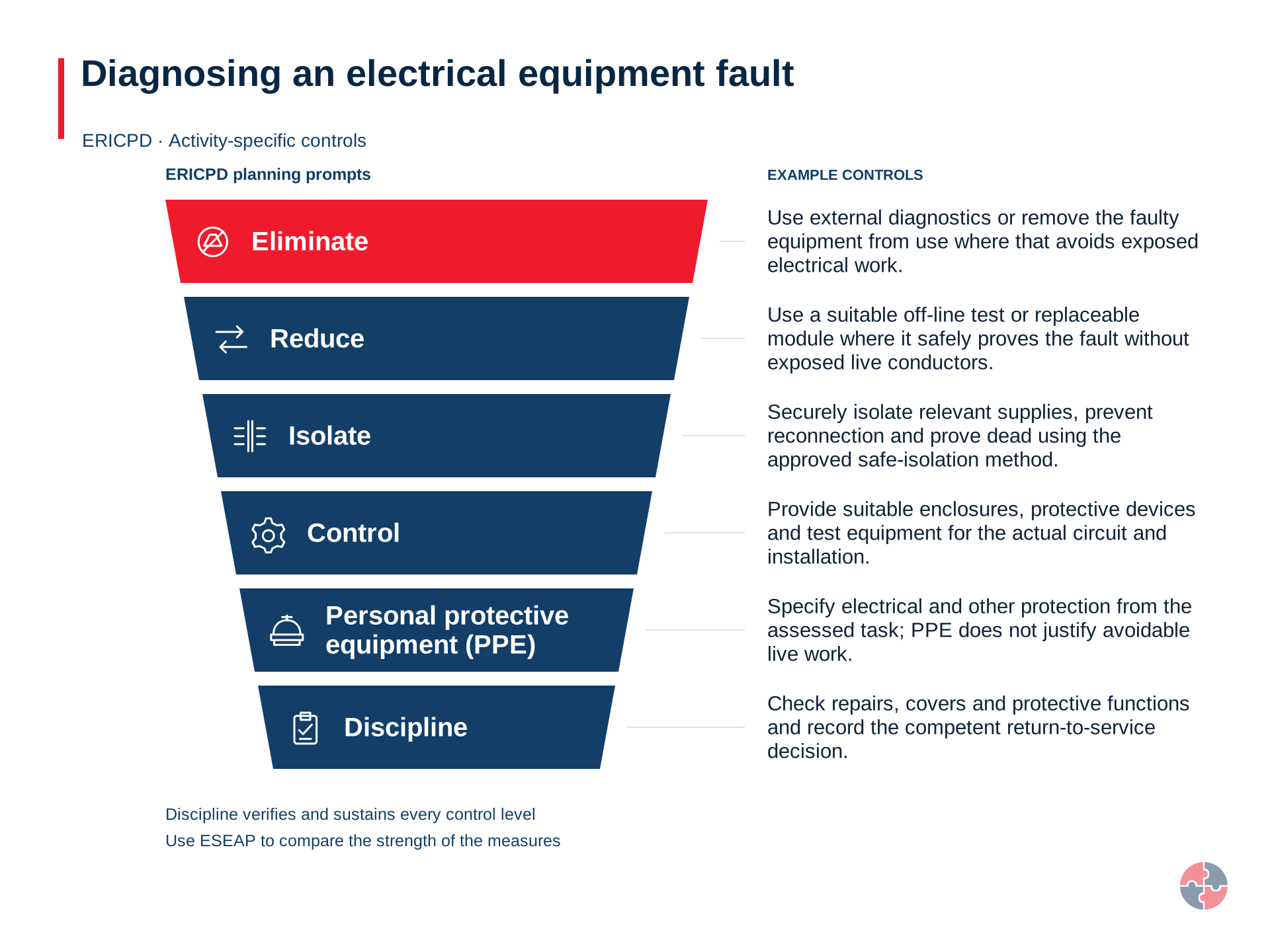
How can the ERICPD hierarchy of controls prevent electrical contact during equipment fault diagnosis?
ERICPD is a planning crossmap. Its prompts do not add a sixth rung or rank Isolate above engineering. Discipline verifies and sustains every control level.
Control level
Control for this activity
Owner and verification
Stop / restart decision
Eliminate
Use external diagnostics or remove the faulty equipment from use where that avoids exposed electrical work.
Task owner verifies that the proposed change removes the named hazardous step, including foreseeable cleaning, maintenance and work transferred elsewhere.
If the hazardous step remains, keep it within the task assessment and select the stronger feasible remaining controls.
Reduce, including substitution
Use a suitable off-line test or replaceable module where it safely proves the fault without exposed live conductors.
Competent task/process owner validates suitability, compatibility and new hazards against the actual operating requirements before the alternative is adopted.
Reject an alternative if its performance is unproved or its new hazards are unresolved.
Isolate
Securely isolate relevant supplies, prevent reconnection and prove dead using the approved safe-isolation method.
Release only after competent electrical owner accepts completed tests and safe reinstatement. Retain verification and unresolved restrictions at handover.
Keep the task on hold until required reinstatement evidence and unresolved defects are accepted by the responsible owner.
How can the ISO 45001 hierarchy of controls prevent electrical contact during equipment fault diagnosis?
The hierarchy of controls in ISO 45001:2018 comes under Clause 8.1.2 (Eliminating hazards and reducing OH&S risks), which is located within Clause 8 ("Operation").
Task owner verifies that the proposed change removes the named hazardous step, including foreseeable cleaning, maintenance and work transferred elsewhere.
If the hazardous step remains, keep it within the task assessment and select the stronger feasible remaining controls.
Engineering controls
Use a suitable off-line test or replaceable module where it safely proves the fault without exposed live conductors.
Competent task/process owner validates suitability, compatibility and new hazards against the actual operating requirements before the alternative is adopted.
Reject an alternative if its performance is unproved or its new hazards are unresolved.
Engineering controls
Securely isolate relevant supplies, prevent reconnection and prove dead using the approved safe-isolation method.
Release only after competent electrical owner accepts completed tests and safe reinstatement. Retain verification and unresolved restrictions at handover.
Keep the task on hold until required reinstatement evidence and unresolved defects are accepted by the responsible owner.
Applied case
An electrical lead has exposed damage, but staff say the appliance was tested last month.
Decision and explanation
Protect the person, stop use of the damaged item as appropriate and obtain competent repair or replacement.
A previous test does not override a current defect; repairs need the appropriate competence and verification.
Lesson 3
Bed rails change more than the risk of rolling out
Assess the occupant and equipment combination before relying on it.
Related SHAREhub topic guide. Apply its prompts to the specific case below.
Bed rails change more than the risk of rolling out
Bed rails can help some people but can also introduce entrapment or climbing-related falls. A replacement mattress, overlay or accessory can change gaps and effective rail height. The fact that individual items are undamaged does not establish that their combination is suitable. An apparently narrow gap may still need competent assessment against the actual equipment and person.
Use the individual assessment and current manufacturer instructions for the bed, mattress, rails and accessories together. Include the person's movement, comfort, preferences and relevant care needs. Involve the appropriate competent staff and the person or relevant representatives through the lawful process. This awareness course does not supply universal gap measurements, choose rails for a resident or authorise a restriction.
Do not fill a mismatch with pillows, improvised padding or a part from another system. Such changes can create another trapping space or defeat the intended function. If a mismatch or changed behaviour is identified, use the actual immediate support and escalation arrangements rather than leaving the person in an unverified configuration. Alternative measures must also be suitable and person-specific; simply removing every rail without a plan is not a complete response.
Verification should establish the actual fitted configuration, competent assessment and usable care arrangement before reliance. Review again after relevant equipment or person changes, not only at a fixed calendar date. For the fictional exercise, identify the changed item and the unanswered compatibility question. A photo or course schematic cannot certify a device combination. Keep observations factual and do not ask the resident to enter an uncertain gap to test it. The outcome is an appropriately reviewed system that supports the person without creating a new hidden entrapment pathway.
How do safeguards and barriers fit into risk assessment?
Safeguards and barriers are the controls relied on to prevent, detect, control or mitigate a scenario.
In simple work, a control may be a guard, exclusion zone, ventilation system or instruction. In process safety, the barrier model becomes more explicit: containment prevents release, detection identifies loss of control, shutdown limits escalation, relief protects equipment and emergency response mitigates consequences.
The important question is whether the barrier is real and healthy. A relief valve that is overdue for inspection, a detector in bypass, a permit issued from an office or an alarm with no response standard should not be treated as a reliable safeguard.
An overlay mattress is added while the existing rails remain in the same position.
Decision and explanation
The person and complete bed/mattress/rail/accessory arrangement through competent assessment.
A change can alter gaps and effective rail height.
Lesson 4
A call bell must reach a working response
Check use from the person’s actual positions.
Photorealistic illustrative UK workplace scene. Review checks: Setting: the leisure operator operates a pool and public areas during an evening shift. Act: Match the first-aid needs assessment to pool hazards, public numbers, shifts and absences; check alarms, kit and responder cover. Hold / review: Missing essential first-aid or rescue cover, failed alarm or blocked access holds the affected activity.
A call bell must reach a working response
A call bell can be electrically functional yet unavailable to the person who needs it. It may be placed neatly on a table beyond reach, trapped beneath bedding or unusable with the person's current hand movement. If a person tries to get up without the assistance they need because help cannot be summoned, the equipment placement has become part of another harm pathway.
Ask the person how they use the system and assess it from their relevant resting and sitting positions. Communication or sensory needs may require an appropriate alternative within the care plan. Do not assume that a resident can use a device simply because a staff member can operate it. Avoid deciding from diagnosis alone; use the actual person-specific information and appropriate competent advice.
The response chain also matters. A signal needs to reach staff who can recognise and act through the home's arrangements. A lamp or audible tone at a desk is not enough if the team cannot respond appropriately. This course does not prescribe a universal response time or clinical prioritisation rule. Managers need actual staffing, monitoring and escalation arrangements suited to the people and service.
If the bell or response is unavailable, arrange suitable immediate support and escalate rather than leaving the person with a promise that somebody will check eventually. Verify the corrected placement and method safely with the person where appropriate, and confirm the staff response arrangement. Review after cleaning, bed movement and shift handover because these can change reach. The fictional exercise should distinguish electrical function, individual usability and response capability. A maintenance sticker on the handset proves none of the other two, and no private resident information belongs in a public training answer.
How should a workplace decide what emergency and first-aid cover it needs?
Match foreseeable harm, numbers of people and work pattern to trained responders, equipment, communication and emergency access; test the arrangements when normal cover is absent.
A leisure centre with a pool and evening staff cannot rely on a daytime first aider. Managers should map incidents by area and shift, check rescue and emergency-service access, train the needed responders and hold an activity if essential cover fails.
Applied case
The bell sounds at the desk but the resident cannot reach it after the bed is moved.
Decision and explanation
Usable access to help for that person in the actual room arrangement.
Function, reach and response are separate necessary links.
Lesson 5
Hot surfaces need a person-specific protection plan
Prevent sustained contact without removing comfort blindly.
Teaching graphic from the linked SHAREhub source section.
Hot surfaces need a person-specific protection plan
A radiator or pipe can burn a person who cannot move away quickly or recognise the heat. A room temperature that feels comfortable does not establish that a contact surface is safe. The relevant pathway is the person's possible contact and ability to respond, not only the heating system's normal operation. Clothing or bedding may also change how contact occurs.
Assess the actual room, person and care activities, using competent premises information and the support plan. Suitable guards, covers, insulation or other arrangements may be needed where risk is identified. Their design and installation must suit the heating system and environment. This lesson does not certify a cover or provide a universal technical specification. Do not use a hand-touch test as the only measurement or expose the resident to check tolerance.
Care and facilities teams should coordinate comfort, ventilation and burn prevention. Turning off all heating indefinitely may introduce other health and wellbeing concerns and does not constitute a complete assessed solution. A temporary response should keep the person safe and supported while the responsible team obtains appropriate correction. A resident's consent does not turn an unsafe unverified arrangement into suitable care.
Before release, verify the physical correction and its suitability under relevant operating conditions, then confirm the room still supports the person's daily activities. The competent system should determine any required measurements and maintenance. Review changes in furniture, mobility or care support that bring the person closer to the surface. For the fictional exercise, state the contact route, immediate protective support and evidence needed. A photograph can show an exposed radiator but cannot establish its actual temperature or the occupant's ability to move away. Keep those uncertainties explicit rather than inventing a reading.
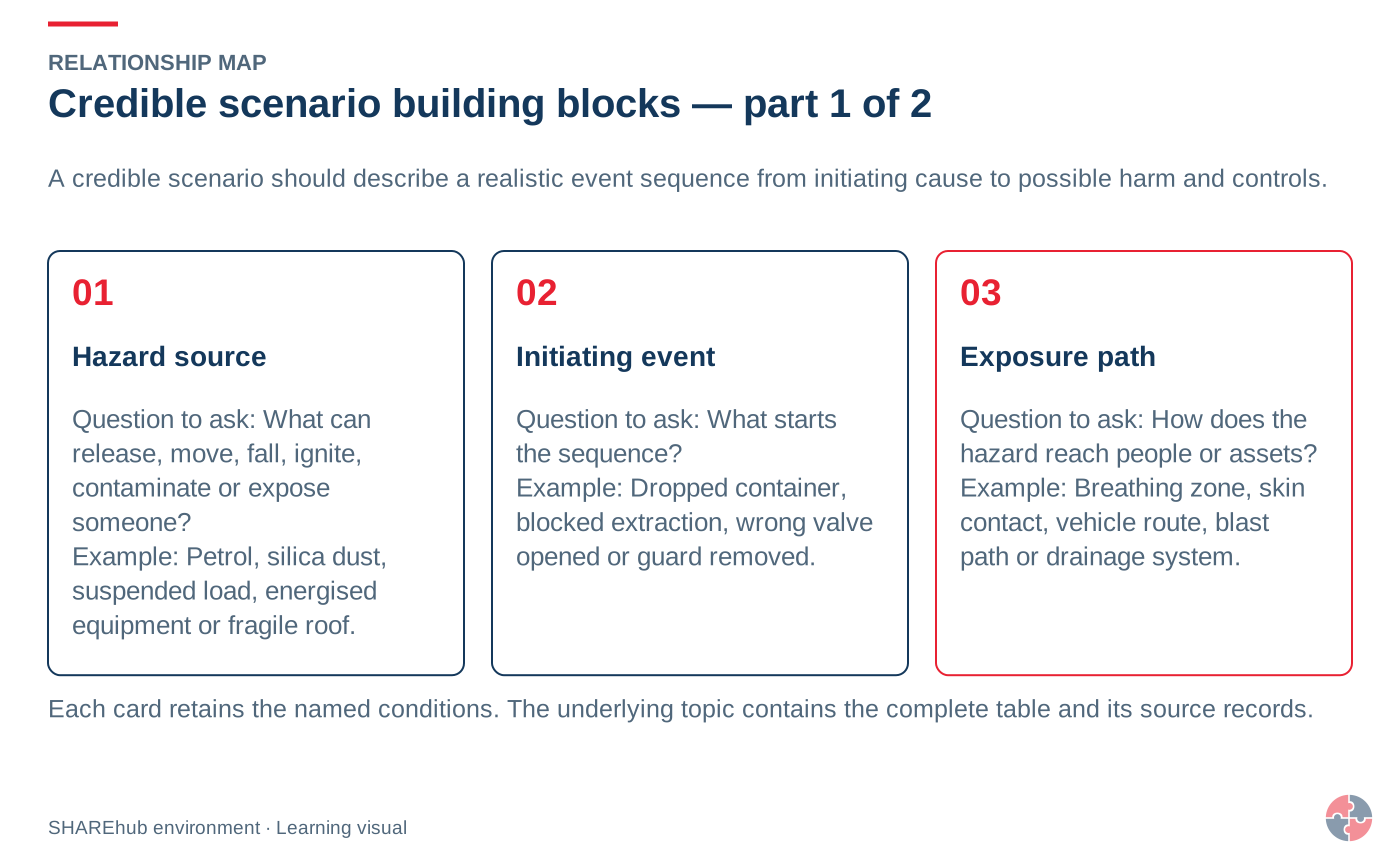
How should credible scenarios be described?
A credible scenario should describe a realistic event sequence from initiating cause to possible harm and controls.
Scenario thinking prevents shallow risk assessments. Instead of writing 'fire risk', describe the actual chain: solvent spill in a bund, vapour spreads to a drain, extraction is off, a non-rated portable tool is used and ignition occurs. That scenario immediately suggests different controls from a generic fire row.
For major accident hazards, credible scenarios should consider inventory, energy, containment, ignition, toxic release, escalation, people affected and emergency response. For everyday occupational safety, they should still show the task, person, trigger, harm and control standard.
Block
Question to ask
Example
Hazard source
What can release, move, fall, ignite, contaminate or expose someone?
Petrol, silica dust, suspended load, energised equipment or fragile roof.
Initiating event
What starts the sequence?
Dropped container, blocked extraction, wrong valve opened or guard removed.
Fatality, occupational disease, fire, explosion, toxic exposure or environmental loss.
Controls and barriers
What prevents, detects, controls or mitigates it?
Design, isolation, LEV, permit, alarm, training, supervision and emergency response.
Escalation
Could the event grow?
Fire impinges on nearby tanks, blocked exits delay evacuation or dust spreads to other areas.
Applied case
A radiator is exposed beside the person’s usual chair and their ability to move away has changed.
Decision and explanation
The contact pathway, individual support and suitable verified surface protection.
Room comfort and contact-burn prevention require different evidence.
Lesson 6
Window protection must remain effective and proportionate
Escalate a disengaged restrictor through the actual assessed arrangement.
Related SHAREhub topic guide. Apply its prompts to the specific case below.
Window protection must remain effective and proportionate
A window may provide light and ventilation while also creating a fall pathway for a person at risk. A restrictor can be present but disengaged, damaged or inappropriate for the actual situation. The word “fitted” in a maintenance record does not establish effective protection now. Assess the person and window arrangement rather than assuming all occupants have identical needs.
Use competent premises assessment and the individual's care and lawful decision-making arrangements. Where protection is required, its design, operation and maintenance must suit the actual window and risks. This awareness lesson does not set a universal opening dimension or authorise an improvised restraint. Do not test a window by leaning out or asking a resident to approach an uncertain opening.
If a required restrictor is disengaged, provide immediate appropriate support and control access to the danger through the actual procedure while obtaining competent correction. The response must also consider comfort, ventilation and any other safety function. A blanket permanent lock on every window is not a substitute for an individual assessed approach. Staff must not make capacity or restriction findings outside their role.
Verify the restored protective function by the appropriate safe method and confirm how authorised operation and maintenance will prevent recurrence. Communicate the arrangement to care, cleaning and premises staff so routine work does not defeat it. For the fictional exercise, separate the visible disengagement from the unconfirmed reason and current person-specific risk. Record the protective action and owner without private details. A course result cannot approve a real window installation or a person's restriction. It can demonstrate recognising that protection must function in practice and remain appropriate for the person who lives there.
How should the selected controls be checked in practice?
ERICPD is used here as a planning mnemonic. The linked HSE five-level hierarchy is the official source for the order and relative reliability of controls; the two labels are not identical.
Start with task redesign and substitution, then engineered separation before procedures and personal protection; verify each control under real conditions.
At a fuel depot, tanker overfill can release petrol, form vapour and ignite. The assessment must identify the initiating event, people exposed and each independent prevention or mitigation barrier. Petrol cannot be substituted if the site must supply it, so the record should say why that higher-order option is unavailable for this operation and then demand strong engineered controls. HSE hierarchy of control; HSE hierarchy of control.
ERICPD is a six-stage planning aid; the HSE five-level order separates substitution, engineering and administration. Isolate is usually engineered separation, while ERICPD Control may contain both physical and administrative measures. Discipline sustains the chosen controls and is not an additional permission to expose people.
A bedroom restrictor is disengaged after cleaning and the resident’s assessment requires protection.
Decision and explanation
Provide suitable immediate support and obtain competent restoration and verification through the actual plan.
The required protective function is unavailable now.
Lesson 7
Assess the person, bed, mattress and rails as one system
Equipment changes are care-plan changes. Review the whole interacting system and involve the person, rather than approving one component in isolation.
Teaching graphic from the linked SHAREhub source section.
Understand the activity and how harm develops
The replacement mattress changes the relationship between the rail, bed frame and occupant. Compressible edges, overlays and profiling movement can create entrapment gaps or reduce effective rail height. A rail that once fitted is not automatically suitable after a mattress change.
Bed rails are not a universal falls solution. They can introduce climbing, entrapment and restriction risks, so a competent individual assessment must consider whether they are appropriate at all. Follow the manufacturers’ compatibility information and the current MHRA guidance; a drawing or generic gap measurement cannot approve a particular configuration.
Recognise the evidence boundary
Question
Case evidence
What is observed?
A replacement mattress leaves a new gap beside the fitted rail.
How can harm occur?
A resident can become entrapped, fall or suffer serious injury.
What information is needed?
Check the resident assessment and compatibility of the actual bed, mattress and rail combination.
Protect, manage and verify
Purpose
Practical application
Immediate protection
Provide an assessed safe interim arrangement and obtain competent reassessment.
Accountable work arrangement
Care lead and a competent bed-equipment assessor, with manufacturer advice where needed. Compatibility, condition or individual suitability is uncertain, especially after a mattress, rail or ability change.
Release verification
Verify the approved configuration and update the person's plan and handover.
Apply this at work
Equipment changes are care-plan changes. Review the whole interacting system and involve the person, rather than approving one component in isolation.
What should a worker do before using work equipment?
Confirm the equipment is the right type for the task, check guards and controls, inspect for obvious damage, understand the safe method and emergency response, keep others clear, and stop if condition or permission is uncertain.
Best-practice guide · six simple steps
Best-practice guide: Work Equipment, Lifting Equipment and Pressure Systems
Start with the key actions, then explore value, a workplace example, harm, stronger controls and further help. Choose a step or use Previous and Next; the guide does not advance automatically.
Keep one card or the full set for social sharing, team briefings and learning. Each PDF contains one card per page. Read the full topic for explanations, questions and source links.
Read all six steps as text
1. What should a worker do before using work equipment?
Confirm the equipment is the right type for the task, check guards and controls, inspect for obvious damage, understand the safe method and emergency response, keep others clear, and stop if condition or permission is uncertain.
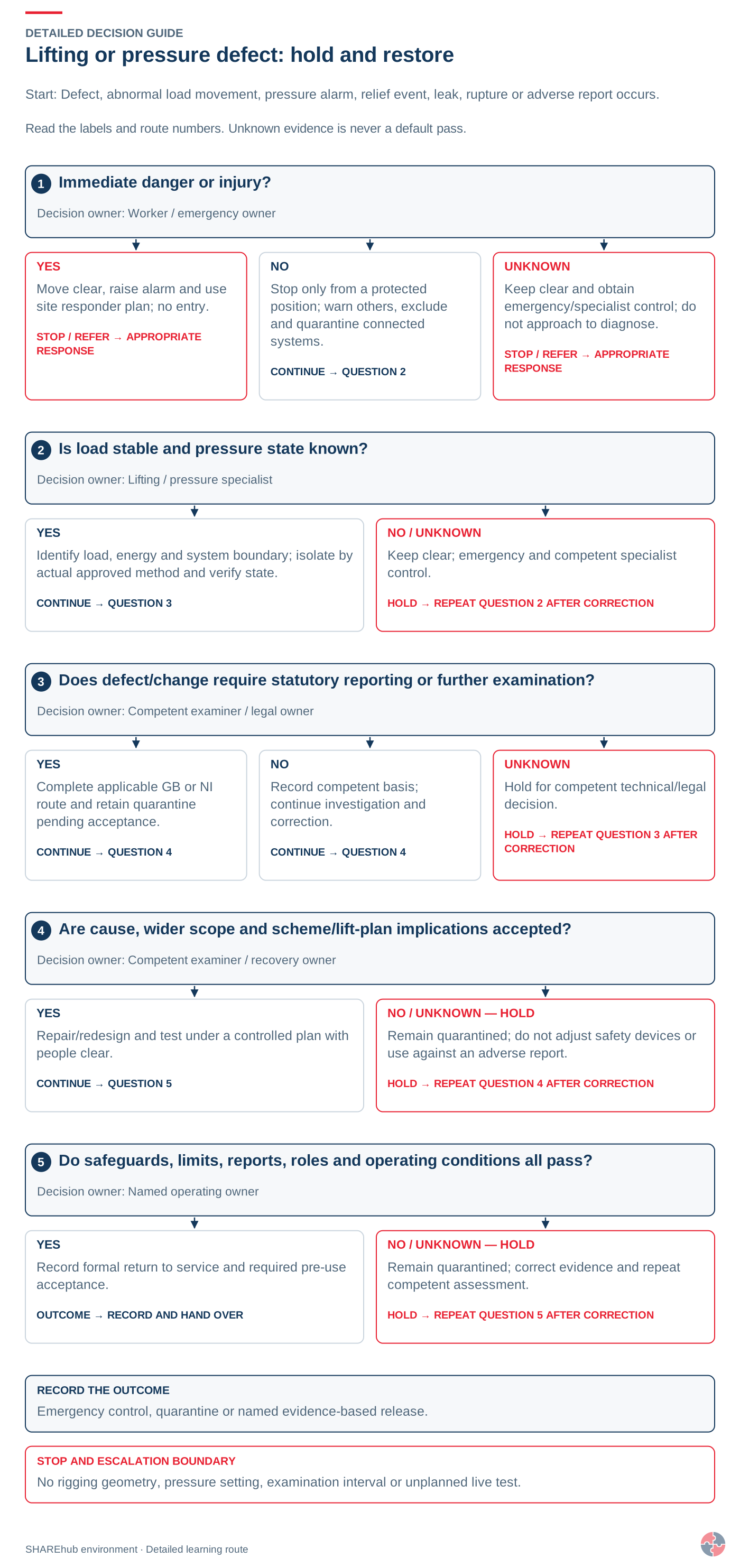
Avoid / redesign: Avoid an unnecessary suspended lift or pressure-dependent step by redesigning flow or assembling at a safe accessible position.
Control the task: Provide designed physical safeguards: separation from suspended loads, suitable lifting installation and pressure-system protective devices.
Verify before release: Process and engineering owners verify the revised task and residual energy.
Confirm the equipment is the right type for the task, check guards and controls, inspect for obvious damage, understand the safe method and emergency response, keep others clear, and stop if condition or permission is uncertain. A machine, lifting device or pressure system may have overlapping duties, but a single certificate does not close every risk.
Apply it: Which part of this plan would you check at the workface before authorising the task?
2. Turn work equipment, lifting equipment and pressure systems knowledge into a decision
Use the evidence to improve the actual work arrangement.
Change at source: Avoid an unnecessary suspended lift or pressure-dependent step by redesigning flow or assembling at a safe accessible position.
Make it observable: Process and engineering owners verify the revised task and residual energy.
Keep useful evidence: Authorisation, pre-use check, task briefing, any defect report and supervisor release.
A machine, lifting device or pressure system may have overlapping duties, but a single certificate does not close every risk. Identify the actual task and equipment, apply the workplace-use rules, then test whether lifting or qualifying pressure-system duties add planning, examination, written-scheme and competent-person requirements. Authorisation, pre-use check, task briefing, any defect report and supervisor release.
Apply it: What evidence would show that the change improves this task, rather than only completing a record?
Fictional example: a practical application of the existing topic lesson.
Setting: Fictional training only, not authorisation for a real drill.
Act: Confirm the task and material, inspect the drill, guard, workholding and emergency control, remove loose items, set the work securely and keep others outside the operating space.
Hold / review: Do not start or continue for a loose workpiece, damaged bit, missing or defeated guard, unreliable control, unusual movement, unexpected material response or unauthorised person in the area.
Keep the guard and workholding in position, use the intended controls, observe sound, movement and swarf, and stop before any adjustment or clearing. Stop through the normal control, wait for movement to cease, leave the machine and area clean through the safe method, record any defect and hand back in a known state.
Apply it: At which point would you hold this example, and what evidence would allow it to proceed?
4. How can lifting or pressure failures harm people? decision table
Connect the task, the route to the person and the control that can fail.
Load or attachment exceeds rated configuration: Collapse or dropped load can crush people below.
Defective lifting accessory: A sling or hook fails and the load swings or falls.
Pressure system exceeds safe limit: Rupture or release causes blast, scald or toxic exposure.
Load or attachment exceeds rated configuration: Collapse or dropped load can crush people below. Defective lifting accessory: A sling or hook fails and the load swings or falls. Pressure system exceeds safe limit: Rupture or release causes blast, scald or toxic exposure.
Apply it: Who could be exposed, including other trades, cleaners, maintainers and people nearby?
5. Choose controls for work equipment, lifting equipment and pressure systems
Start with the stronger practicable options and verify their effect.
Eliminate: Avoid an unnecessary suspended lift or pressure-dependent step by redesigning flow or assembling at a safe accessible position.
Reduce, including substitution: Choose a lifting or process method with suitable capacity and controlled interfaces for the actual load, radius, pressure and substance.
Isolate: Provide designed physical safeguards: separation from suspended loads, suitable lifting installation and pressure-system protective devices.
Control: Plan and supervise lifting to its complexity and define pressure-system operating limits and required written scheme/examination arrangements.
PPE: Select PPE for remaining handling, splash or other task exposure, checking fit and compatibility.
Eliminate: Avoid an unnecessary suspended lift or pressure-dependent step by redesigning flow or assembling at a safe accessible position. Reduce, including substitution: Choose a lifting or process method with suitable capacity and controlled interfaces for the actual load, radius, pressure and substance. Isolate: Provide designed physical safeguards: separation from suspended loads, suitable lifting installation and pressure-system protective devices. Control: Plan and supervise lifting to its complexity and define pressure-system operating limits and required written scheme/examination arrangements. PPE: Select PPE for remaining handling, splash or other task exposure, checking fit and compatibility. Read the full control table for qualifications, ownership and verification. Use the actual task and applicable jurisdiction; existing technical approval remains unchanged.
Apply it: Which stronger option can be used here, and who will verify it before accepting the remaining risk?
6. Use the full work equipment, lifting equipment and pressure systems lesson
Follow the official sources below and retain the task-specific evidence.
Official guidance: HSE INDG229 Using work equipment safely
Official guidance: HSE PUWER guidance and topic index
Task decision: Authorisation, pre-use check, task briefing, any defect report and supervisor release.
Use the full topic for the decision points, practical examples, detailed control tables and source scope. HSE guidance applies to Great Britain; use HSENI for the Northern Ireland route and the source’s stated jurisdiction. A simplified guide does not change the page’s technical-review or approval status.
Apply it: Which official source and full-topic section will you use to resolve the next decision?
Simplified learning guide. Use the full topic, current official guidance and the actual work arrangements. Workplace scenarios labelled fictional are illustrative examples.
Do not begin because the equipment ran yesterday, carries a conformity mark or belongs to a contractor. Check any recorded limitation, attachment, inspection status and local authorisation that the task actually requires.
Identify equipment and task. During use: Use within assessed conditions.; At completion: Stop safely and leave controlled.
Check guards, controls and condition. During use: Watch for change or defect.; At completion: Report defects and hand back.
Confirm competence and area. During use: Keep others protected.; At completion: Record any hold or release.
What counts as work equipment and use?
Work equipment includes machinery, appliances, apparatus, tools and installations used at work, while use includes starting, stopping, programming, setting, transporting, repairing, modifying, maintaining, servicing and cleaning.
A hand tool, office appliance, machine line, scaffold component, ladder, lift truck or process installation may be work equipment. The applicable controls depend on the actual use and risk, not the label or purchase value.
Tool or appliance. Why it is in scope: Used to perform work.; Decision: Suitability and safe use.
Machine or installation. Why it is in scope: Creates mechanical or other energy hazards.; Decision: Guarding, controls and lifecycle evidence.
Cleaning or adjustment. Why it is in scope: It is use under Provision and Use of Work Equipment Regulations (PUWER).; Decision: Safe state and competent method.
Transport or modification. Why it is in scope: Can change condition or risk.; Decision: Planning, inspection and change control.
How do workplace-use duties differ from product-supply duties?
PUWER controls equipment provided or used at work; product-supply rules govern placing products on a market. A CE, UK Conformity Assessed (UKCA) or CE and UK Northern Ireland (UKNI) route does not by itself prove workplace suitability, correct installation or safe use.
Choose the GB or NI market route and the product sector before relying on conformity documentation. Separately complete workplace selection, risk assessment, guarding, installation, competence, inspection and maintenance decisions.
Who will use it and for what? Workplace-use route: PUWER and other workplace law.; Product-supply route: Not the main market decision.
May this product be placed on this market? Workplace-use route: Does not answer safe-use question.; Product-supply route: Current GB or NI sector rules.
Was it modified or assembled? Workplace-use route: Reassess safe use.; Product-supply route: May create manufacturer obligations.
A thicker pressure-relieving mattress is fitted. A worker suggests padding the gap with towels.
Decision and explanation
Hold the unassessed setup and obtain a compatible assessed arrangement.
The system has changed; competent assessment and manufacturer compatibility are needed. Improvised packing may move or compress and creates an unverified configuration. Rail height alone does not resolve entrapment, compatibility or individual suitability.
Lesson 8
A call system works only when the person can use it
Test safety systems from the user’s starting position, including the response at the other end of the system.
Photorealistic illustrative UK workplace scene. Review checks: Customers and visitors: Controls slips, access, supervision, emergencies and information. Workers: Manages training, workload, stress, lone work and task risks. Contractors: Checks competence, provides information and monitors work.
Understand the activity and how harm develops
The call bell is a link between a person needing help and a team able to respond. If it is behind furniture, too difficult to operate or not understood, the system can fail before any electrical fault occurs. A person may try to stand or transfer alone because they cannot summon assistance.
Recheck the arrangement after cleaning, bed movement and changes in ability. Ask the resident to show how they would call from their normal position. Where a standard button is unsuitable, an assessed alternative and response arrangement are needed; staff reassurance that they will “keep an eye out” is not an equivalent tested system.
Recognise the evidence boundary
Question
Case evidence
What is observed?
The call bell hangs behind furniture beyond the resident's reach.
How can harm occur?
Assistance can be delayed and the person may attempt an unsafe movement.
What information is needed?
Ask the resident to demonstrate their preferred usable means of summoning help.
Protect, manage and verify
Purpose
Practical application
Immediate protection
Position and adapt assistance arrangements to the person's assessed abilities and choices.
Accountable work arrangement
Care lead and call-system maintainer, with relevant communication or access support. The person cannot demonstrate the agreed way to summon help or the call is not received.
Release verification
Test the actual call and response with the resident after the room change.
Apply this at work
Test safety systems from the user’s starting position, including the response at the other end of the system.
What evidence shows duty of care has been met?
Evidence should show what was known, what was assessed, what was done, who was trained and how issues were reviewed.
Evidence is not about creating paperwork after an incident. It is about running the business in a way that leaves a reliable trail of reasonable decisions. Good evidence is timely, specific, complete and connected to action. Poor evidence is generic, unsigned, out of date or impossible to link to the real hazard.
In civil claims, records may be used to understand whether reasonable care was taken. In enforcement, records may show whether statutory duties were met. In management, records help leaders see whether controls are actually working.
The bell sounds when a worker presses it, but the resident cannot reach it from the chair.
Decision and explanation
The resident uses the agreed method and staff receive and respond to the call.
Voice may be unsuitable and the response has not been assessed or tested. A working circuit is only one part of an accessible assistance system. That does not demonstrate that the intended user can summon help.
Lesson 9
Prevent prolonged contact with hot surfaces
Treat furniture changes as a trigger to recheck hot surfaces, call access, cables and the person’s ability to leave the position.
Related SHAREhub topic guide. Apply its prompts to the specific case below.
Understand the activity and how harm develops
A hot radiator beside a chair presents a contact-burn risk that differs from a brief touch by a mobile adult. A resident may have reduced sensation, fragile skin or difficulty moving away. The hazard depends on accessible surface temperature, duration of contact and the person’s ability to respond.
Moving furniture can create a new exposure without changing the heating system. Assess the actual seated and lying positions, pipes and covers. A suitable low-temperature design or guard may be needed, while preserving comfortable room conditions and safe circulation. Turning the entire building cold is not a proportionate substitute for controlling the exposed surface.
Recognise the evidence boundary
Question
Case evidence
What is observed?
A resident's chair has been moved directly beside an unprotected hot radiator.
How can harm occur?
Prolonged contact can cause burns where the person cannot move away promptly.
What information is needed?
Assess the surface and the person's contact, mobility and sensory risks.
Protect, manage and verify
Purpose
Practical application
Immediate protection
Provide suitable protection or a safe arrangement agreed with the resident.
Accountable work arrangement
Care lead and premises or heating specialist. A resident can remain in contact with an unprotected surface, or the guard is damaged or unsuitable.
Release verification
Verify accessible surfaces and the actual seating arrangement control the assessed risk.
Apply this at work
Treat furniture changes as a trigger to recheck hot surfaces, call access, cables and the person’s ability to leave the position.
How should the basic risk assessment process work?
The process should identify hazards, decide who may be harmed, evaluate risk, record significant findings and review the controls.
The familiar five-step model is only useful when each step is done honestly. Walking the workplace, checking incident data, speaking to workers, reviewing maintenance, reading safety data sheets and observing non-routine work will usually reveal more than a desk exercise.
The output should be understandable to the people who use it. A supervisor should know what must be in place before work starts. A worker should know the task controls and stop-work triggers. A manager should know what resources and review evidence are required.
Step
What good looks like
Evidence
Identify hazards
Task observation includes normal, abnormal, maintenance, cleaning and emergency conditions.
Walkthrough notes, worker input and hazard register.
Decide who may be harmed
Employees, contractors, visitors, public, vulnerable workers and emergency responders are considered.
People-at-risk section and consultation evidence.
Evaluate risk
Existing controls are tested, not assumed.
Inspection findings, monitoring data, maintenance records and competence checks.
Record findings
Significant risks, controls, action owners and review triggers are clear.
Assessment, action tracker and risk register.
Review
Assessment changes after incidents, changes, new information or weak control evidence.
A chair is moved next to a radiator to improve the television view. The resident cannot move the chair independently.
Decision and explanation
The new contact risk and a protected seating arrangement agreed with the resident.
Absence of an incident does not establish acceptable contact conditions. An instruction cannot overcome reduced sensation or inability to move away. A layout change has introduced a different exposure despite unchanged heating equipment.
Lesson 10
Control window falls while maintaining suitable ventilation
Assess protective devices in the conditions that tempt people to bypass them, and provide a workable alternative.
Teaching graphic from the linked SHAREhub source section.
Understand the activity and how harm develops
An open window can look harmless until someone leans, loses balance or mistakes it for an exit. Assessment should consider the fall height, opening, glazing, furniture footholds and the individual’s needs. Do not assume a ground-level model view represents every real bedroom in a multistorey home.
HSE guidance identifies restrained openings of 100 mm or less where people are at risk of falling, with restrictors disengaged only by a special tool or key. Device strength, installation and maintenance also matter. A hot room needs an assessed ventilation response; defeating a restrictor trades heat discomfort for a potentially fatal fall.
Recognise the evidence boundary
Question
Case evidence
What is observed?
A bedroom window opens beyond the assessed restricted position.
How can harm occur?
A person can fall from height through an unsuitable opening.
What information is needed?
Check the individual window-risk assessment, restrictor condition and ventilation needs.
Protect, manage and verify
Purpose
Practical application
Immediate protection
Keep the defective arrangement controlled and obtain competent repair or a suitable alternative.
Accountable work arrangement
Premises lead with the care team and a competent window or glazing specialist. A restrictor is released, damaged or not appropriate to the assessed fall risk.
Release verification
Verify the intended opening restraint and practical ventilation after repair.
Apply this at work
Assess protective devices in the conditions that tempt people to bypass them, and provide a workable alternative.
What should a worker do before using work equipment?
Confirm the equipment is the right type for the task, check guards and controls, inspect for obvious damage, understand the safe method and emergency response, keep others clear, and stop if condition or permission is uncertain.
Best-practice guide · six simple steps
Best-practice guide: Work Equipment, Lifting Equipment and Pressure Systems
Start with the key actions, then explore value, a workplace example, harm, stronger controls and further help. Choose a step or use Previous and Next; the guide does not advance automatically.
Keep one card or the full set for social sharing, team briefings and learning. Each PDF contains one card per page. Read the full topic for explanations, questions and source links.
Read all six steps as text
1. What should a worker do before using work equipment?
Confirm the equipment is the right type for the task, check guards and controls, inspect for obvious damage, understand the safe method and emergency response, keep others clear, and stop if condition or permission is uncertain.
Avoid / redesign: Avoid an unnecessary suspended lift or pressure-dependent step by redesigning flow or assembling at a safe accessible position.
Control the task: Provide designed physical safeguards: separation from suspended loads, suitable lifting installation and pressure-system protective devices.
Verify before release: Process and engineering owners verify the revised task and residual energy.
Confirm the equipment is the right type for the task, check guards and controls, inspect for obvious damage, understand the safe method and emergency response, keep others clear, and stop if condition or permission is uncertain. A machine, lifting device or pressure system may have overlapping duties, but a single certificate does not close every risk.
Apply it: Which part of this plan would you check at the workface before authorising the task?
2. Turn work equipment, lifting equipment and pressure systems knowledge into a decision
Use the evidence to improve the actual work arrangement.
Change at source: Avoid an unnecessary suspended lift or pressure-dependent step by redesigning flow or assembling at a safe accessible position.
Make it observable: Process and engineering owners verify the revised task and residual energy.
Keep useful evidence: Authorisation, pre-use check, task briefing, any defect report and supervisor release.
A machine, lifting device or pressure system may have overlapping duties, but a single certificate does not close every risk. Identify the actual task and equipment, apply the workplace-use rules, then test whether lifting or qualifying pressure-system duties add planning, examination, written-scheme and competent-person requirements. Authorisation, pre-use check, task briefing, any defect report and supervisor release.
Apply it: What evidence would show that the change improves this task, rather than only completing a record?
Fictional example: a practical application of the existing topic lesson.
Setting: Fictional training only, not authorisation for a real drill.
Act: Confirm the task and material, inspect the drill, guard, workholding and emergency control, remove loose items, set the work securely and keep others outside the operating space.
Hold / review: Do not start or continue for a loose workpiece, damaged bit, missing or defeated guard, unreliable control, unusual movement, unexpected material response or unauthorised person in the area.
Keep the guard and workholding in position, use the intended controls, observe sound, movement and swarf, and stop before any adjustment or clearing. Stop through the normal control, wait for movement to cease, leave the machine and area clean through the safe method, record any defect and hand back in a known state.
Apply it: At which point would you hold this example, and what evidence would allow it to proceed?
4. How can lifting or pressure failures harm people? decision table
Connect the task, the route to the person and the control that can fail.
Load or attachment exceeds rated configuration: Collapse or dropped load can crush people below.
Defective lifting accessory: A sling or hook fails and the load swings or falls.
Pressure system exceeds safe limit: Rupture or release causes blast, scald or toxic exposure.
Load or attachment exceeds rated configuration: Collapse or dropped load can crush people below. Defective lifting accessory: A sling or hook fails and the load swings or falls. Pressure system exceeds safe limit: Rupture or release causes blast, scald or toxic exposure.
Apply it: Who could be exposed, including other trades, cleaners, maintainers and people nearby?
5. Choose controls for work equipment, lifting equipment and pressure systems
Start with the stronger practicable options and verify their effect.
Eliminate: Avoid an unnecessary suspended lift or pressure-dependent step by redesigning flow or assembling at a safe accessible position.
Reduce, including substitution: Choose a lifting or process method with suitable capacity and controlled interfaces for the actual load, radius, pressure and substance.
Isolate: Provide designed physical safeguards: separation from suspended loads, suitable lifting installation and pressure-system protective devices.
Control: Plan and supervise lifting to its complexity and define pressure-system operating limits and required written scheme/examination arrangements.
PPE: Select PPE for remaining handling, splash or other task exposure, checking fit and compatibility.
Eliminate: Avoid an unnecessary suspended lift or pressure-dependent step by redesigning flow or assembling at a safe accessible position. Reduce, including substitution: Choose a lifting or process method with suitable capacity and controlled interfaces for the actual load, radius, pressure and substance. Isolate: Provide designed physical safeguards: separation from suspended loads, suitable lifting installation and pressure-system protective devices. Control: Plan and supervise lifting to its complexity and define pressure-system operating limits and required written scheme/examination arrangements. PPE: Select PPE for remaining handling, splash or other task exposure, checking fit and compatibility. Read the full control table for qualifications, ownership and verification. Use the actual task and applicable jurisdiction; existing technical approval remains unchanged.
Apply it: Which stronger option can be used here, and who will verify it before accepting the remaining risk?
6. Use the full work equipment, lifting equipment and pressure systems lesson
Follow the official sources below and retain the task-specific evidence.
Official guidance: HSE INDG229 Using work equipment safely
Official guidance: HSE PUWER guidance and topic index
Task decision: Authorisation, pre-use check, task briefing, any defect report and supervisor release.
Use the full topic for the decision points, practical examples, detailed control tables and source scope. HSE guidance applies to Great Britain; use HSENI for the Northern Ireland route and the source’s stated jurisdiction. A simplified guide does not change the page’s technical-review or approval status.
Apply it: Which official source and full-topic section will you use to resolve the next decision?
Simplified learning guide. Use the full topic, current official guidance and the actual work arrangements. Workplace scenarios labelled fictional are illustrative examples.
Do not begin because the equipment ran yesterday, carries a conformity mark or belongs to a contractor. Check any recorded limitation, attachment, inspection status and local authorisation that the task actually requires.
Identify equipment and task. During use: Use within assessed conditions.; At completion: Stop safely and leave controlled.
Check guards, controls and condition. During use: Watch for change or defect.; At completion: Report defects and hand back.
Confirm competence and area. During use: Keep others protected.; At completion: Record any hold or release.
What counts as work equipment and use?
Work equipment includes machinery, appliances, apparatus, tools and installations used at work, while use includes starting, stopping, programming, setting, transporting, repairing, modifying, maintaining, servicing and cleaning.
A hand tool, office appliance, machine line, scaffold component, ladder, lift truck or process installation may be work equipment. The applicable controls depend on the actual use and risk, not the label or purchase value.
Tool or appliance. Why it is in scope: Used to perform work.; Decision: Suitability and safe use.
Machine or installation. Why it is in scope: Creates mechanical or other energy hazards.; Decision: Guarding, controls and lifecycle evidence.
Cleaning or adjustment. Why it is in scope: It is use under Provision and Use of Work Equipment Regulations (PUWER).; Decision: Safe state and competent method.
Transport or modification. Why it is in scope: Can change condition or risk.; Decision: Planning, inspection and change control.
How do workplace-use duties differ from product-supply duties?
PUWER controls equipment provided or used at work; product-supply rules govern placing products on a market. A CE, UK Conformity Assessed (UKCA) or CE and UK Northern Ireland (UKNI) route does not by itself prove workplace suitability, correct installation or safe use.
Choose the GB or NI market route and the product sector before relying on conformity documentation. Separately complete workplace selection, risk assessment, guarding, installation, competence, inspection and maintenance decisions.
Who will use it and for what? Workplace-use route: PUWER and other workplace law.; Product-supply route: Not the main market decision.
May this product be placed on this market? Workplace-use route: Does not answer safe-use question.; Product-supply route: Current GB or NI sector rules.
Was it modified or assembled? Workplace-use route: Reassess safe use.; Product-supply route: May create manufacturer obligations.
On a warm afternoon a worker releases the restrictor fully and moves a chair beside the window.
Decision and explanation
Restore assessed fall protection and arrange safe ventilation and comfort measures.
Temperature control and fall prevention must be resolved together. Heat does not remove the foreseeable fall route. That ignores ventilation, overheating and individual needs.
Lesson 11
Protect electrical leads from bed movement and damage
Use pre-use observations and change-triggered checks alongside planned maintenance; a label is evidence of a past check.
Teaching graphic from the linked SHAREhub source section.
Understand the activity and how harm develops
A bed caster can crush insulation or trap a lead as the bed is moved or profiled. Conductors may become exposed, connections may loosen and a damaged cable can cause shock, burns or fire. A previous inspection label does not establish the condition after a new trapping event.
The resident may depend on the affected equipment, so removal needs a safe continuity arrangement rather than simply unplugging everything. Staff should follow the defect process, avoid touching exposed live parts and prevent further use until competent assessment. The final layout must allow bed movement without tension, crushing or a trip across the room.
Recognise the evidence boundary
Question
Case evidence
What is observed?
A frayed lead is trapped beneath a bed caster.
How can harm occur?
Damaged insulation can cause electric shock, burns or fire.
What information is needed?
Check the appliance and lead through the home's defect procedure.
Protect, manage and verify
Purpose
Practical application
Immediate protection
Remove defective equipment from use and arrange competent inspection and replacement.
Accountable work arrangement
Duty manager, responsible care staff and a competent electrical maintainer. There is visible damage, overheating, sparking or an unsafe trapped lead.
Release verification
Confirm safe routing and equipment condition before return to the resident.
Apply this at work
Use pre-use observations and change-triggered checks alongside planned maintenance; a label is evidence of a past check.
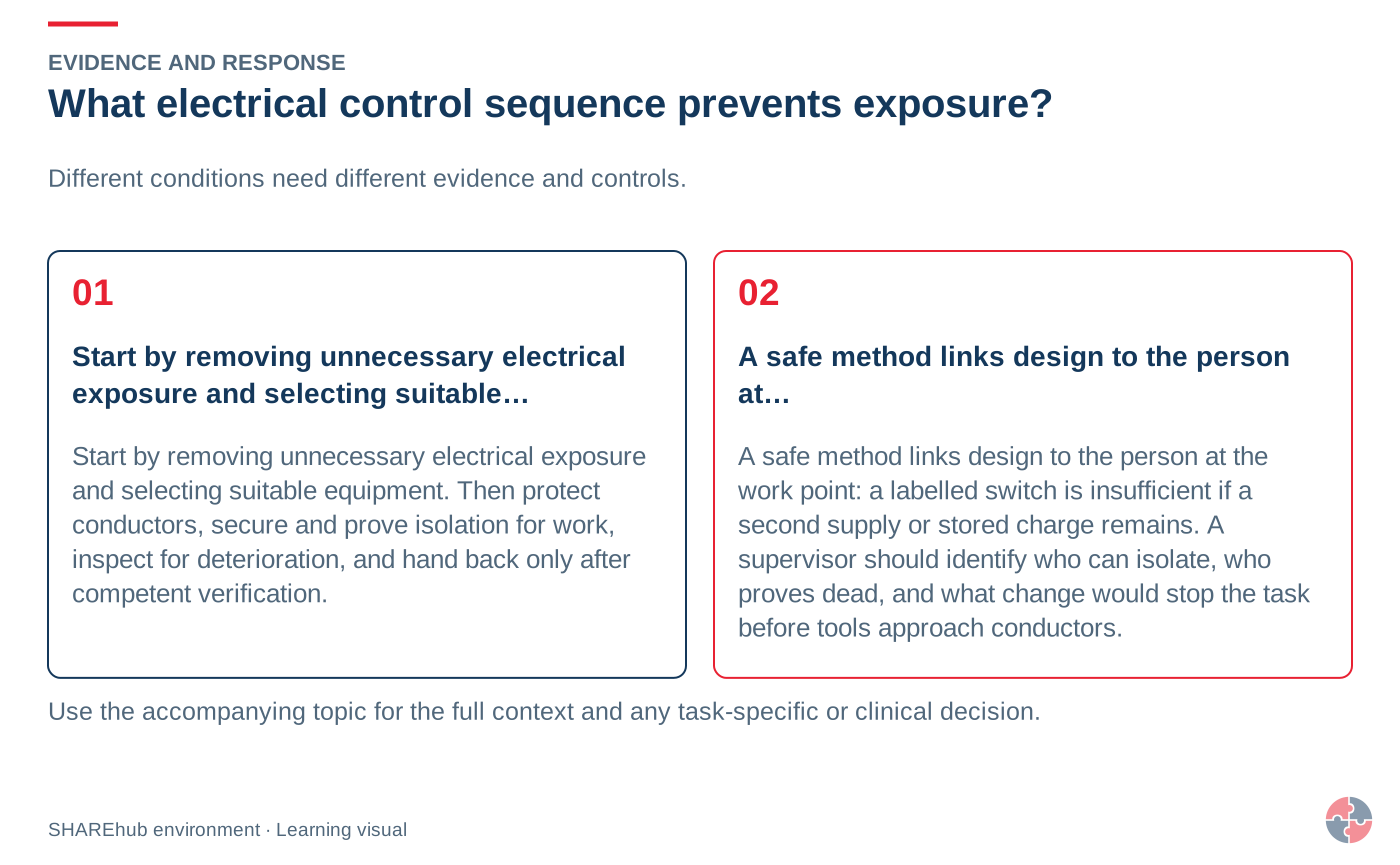
What electrical control sequence prevents exposure?
Start by removing unnecessary electrical exposure and selecting suitable equipment. Then protect conductors, secure and prove isolation for work, inspect for deterioration, and hand back only after competent verification.
Best-practice guide · six simple steps
Best-practice guide: Electrical control measures, safe systems and inspection
Start with the key actions, then explore value, a workplace example, harm, stronger controls and further help. Choose a step or use Previous and Next; the guide does not advance automatically.
Keep one card or the full set for social sharing, team briefings and learning. Each PDF contains one card per page. Read the full topic for explanations, questions and source links.
Read all six steps as text
1. What electrical control sequence prevents exposure?
Start by removing unnecessary electrical exposure and selecting suitable equipment.
Avoid / redesign: Use external diagnostics or remove the faulty equipment from use where that avoids exposed electrical work.
Control the task: Securely isolate relevant supplies, prevent reconnection and prove dead using the approved safe-isolation method.
Verify before release: If the hazardous step remains, keep it within the task assessment and select the stronger feasible remaining controls.
Start by removing unnecessary electrical exposure and selecting suitable equipment. Then protect conductors, secure and prove isolation for work, inspect for deterioration, and hand back only after competent verification. Electrical safety depends on suitable design, protection, secure isolation and inspection that finds defects before people are exposed.
Apply it: Which part of this plan would you check at the workface before authorising the task?
2. Turn electrical control measures, safe systems and inspection knowledge into a decision
Use the evidence to improve the actual work arrangement.
Change at source: Use external diagnostics or remove the faulty equipment from use where that avoids exposed electrical work.
Make it observable: If the hazardous step remains, keep it within the task assessment and select the stronger feasible remaining controls.
Keep useful evidence: Revised work pack, isolation and test record, briefing, certificate and defect closure.
Electrical safety depends on suitable design, protection, secure isolation and inspection that finds defects before people are exposed. A damaged conductor, failed protective device or unexpected supply can cause shock, arc injury or fire even where a test label is current. Revised work pack, isolation and test record, briefing, certificate and defect closure.
Apply it: What evidence would show that the change improves this task, rather than only completing a record?
Fictional example: a practical application of the existing topic lesson.
Setting: the site team opens a refurbished wall where a cable route is uncertain.
Act: Stop intrusive work, protect the area, identify all possible supplies and agree a revised method.
Hold / review: Any unidentified conductor, unexpected voltage or changed scope stops the job.
Competent lead locates, isolates and proves the circuit dead at the work point; supervisor keeps other trades clear. Restore guards and supply only after people clear; give the client an updated circuit record.
Apply it: At which point would you hold this example, and what evidence would allow it to proceed?
Connect the task, the route to the person and the control that can fail.
Electric shock: Current passes through the body after contact with live parts.
Electrical burns: Current heats tissue or arc energy burns skin and eyes.
Loss of muscle control: Shock causes spasm, inability to let go or a fall.
Electric shock: Current passes through the body after contact with live parts. Electrical burns: Current heats tissue or arc energy burns skin and eyes. Loss of muscle control: Shock causes spasm, inability to let go or a fall.
Apply it: Who could be exposed, including other trades, cleaners, maintainers and people nearby?
5. Choose controls for electrical control measures, safe systems and inspection
Start with the stronger practicable options and verify their effect.
Elimination: Use external diagnostics or remove the faulty equipment from use where that avoids exposed electrical work.
Engineering controls: Use a suitable off-line test or replaceable module where it safely proves the fault without exposed live conductors.
Engineering controls: Securely isolate relevant supplies, prevent reconnection and prove dead using the approved safe-isolation method.
Engineering controls: Provide suitable enclosures, protective devices and test equipment for the actual circuit and installation.
Administrative controls: Confirm circuit identity, competence, test scope and restart authority; separately justify and control any unavoidable energised test.
Elimination: Use external diagnostics or remove the faulty equipment from use where that avoids exposed electrical work. Engineering controls: Use a suitable off-line test or replaceable module where it safely proves the fault without exposed live conductors. Engineering controls: Securely isolate relevant supplies, prevent reconnection and prove dead using the approved safe-isolation method. Engineering controls: Provide suitable enclosures, protective devices and test equipment for the actual circuit and installation. Administrative controls: Confirm circuit identity, competence, test scope and restart authority; separately justify and control any unavoidable energised test. Read the full control table for qualifications, ownership and verification. Use the actual task and applicable jurisdiction; existing technical approval remains unchanged.
Apply it: Which stronger option can be used here, and who will verify it before accepting the remaining risk?
6. Use the full electrical control measures, safe systems and inspection lesson
Follow the official sources below and retain the task-specific evidence.
Official guidance: HSE - Introduction to electrical safety
Official guidance: HSE - Electricity at work: safe working practices HSG85
Task decision: Revised work pack, isolation and test record, briefing, certificate and defect closure.
Use the full topic for the decision points, practical examples, detailed control tables and source scope. HSE guidance applies to Great Britain; use HSENI for the Northern Ireland route and the source’s stated jurisdiction. A simplified guide does not change the page’s technical-review or approval status.
Apply it: Which official source and full-topic section will you use to resolve the next decision?
Simplified learning guide. Use the full topic, current official guidance and the actual work arrangements. Workplace scenarios labelled fictional are illustrative examples.
A safe method links design to the person at the work point: a labelled switch is insufficient if a second supply or stored charge remains. A supervisor should identify who can isolate, who proves dead, and what change would stop the task before tools approach conductors.
Applied case
The frayed lead has a recent inspection sticker. A worker proposes covering it with tape until the next inspection.
Decision and explanation
Remove the defect from use safely and arrange competent correction and continuity.
Concealing damage leaves the electrical hazard present. A visible new defect overrides reassurance from an earlier inspection label. Tape is not a competent repair or evidence of safe insulation.
Lesson 12
After the bedroom rearrangement
Resolve compatibility and access to help before relying on the room.
Related SHAREhub topic guide. Apply its prompts to the specific case below.
After the bedroom rearrangement
In the fictional home, a bedroom is rearranged after a new mattress and overlay arrive. The old bed rails remain, the call bell is left on a distant table and a bedside electrical lead is trapped beneath a moving bed section. The radiator is exposed beside the chair, and the window restrictor has been disengaged during cleaning. A worker says that all items are familiar and the room looks tidy.
Begin with the person's needs, wishes and current support rather than a judgement from the doorway. Several changes can affect different harm pathways. The bed configuration can create entrapment or alter rail effectiveness. The call bell may not provide usable help. The lead may be damaged by movement. Sustained radiator contact may cause a burn, and the window may present a fall pathway for the person assessed as needing protection. The model cannot measure device gaps or temperatures or establish individual capacity.
Arrange suitable immediate support and hold reliance on any unverified unsafe equipment through the home's procedure. Refer the complete bed, mattress, rail and accessory combination for competent person-specific assessment using current manufacturer instructions. Do not fill gaps with pillows or modify parts. An alternative arrangement must itself be assessed; neither automatic rail use nor automatic removal is a complete answer for every person.
Restore a usable help arrangement, checking reach and operation from the relevant positions and the staff response chain. Keep the person involved appropriately and avoid an unassessed climb or transfer to test the system. Withdraw damaged electrical equipment by a safe method and obtain competent repair and required checks, including prevention of repeat cable trapping. A new inspection label is not sufficient if the route remains damaging.
The care and premises teams should review the contact-burn and window protection arrangements without creating unnecessary restrictions or removing comfort blindly. Required safeguards need competent restoration and verification under actual conditions. Any person-specific restriction follows the applicable consent and lawful process, with appropriate involvement and review. This course cannot authorise that decision or diagnose a resident's ability.
The final handover should state what is safe to rely on, what remains held, interim support, responsible roles and evidence needed before release. Review the arrangement after ordinary cleaning and bed movement because they can change access again. Use the fictional worksheet without copying a real care record. A tidy room and familiar items do not prove compatibility or person-centred usability. The case is resolved when the complete arrangement supports the occupant with effective safeguards and a working route to help.
How should the basic risk assessment process work?
The process should identify hazards, decide who may be harmed, evaluate risk, record significant findings and review the controls.
The familiar five-step model is only useful when each step is done honestly. Walking the workplace, checking incident data, speaking to workers, reviewing maintenance, reading safety data sheets and observing non-routine work will usually reveal more than a desk exercise.
The output should be understandable to the people who use it. A supervisor should know what must be in place before work starts. A worker should know the task controls and stop-work triggers. A manager should know what resources and review evidence are required.
Step
What good looks like
Evidence
Identify hazards
Task observation includes normal, abnormal, maintenance, cleaning and emergency conditions.
Walkthrough notes, worker input and hazard register.
Decide who may be harmed
Employees, contractors, visitors, public, vulnerable workers and emergency responders are considered.
People-at-risk section and consultation evidence.
Evaluate risk
Existing controls are tested, not assumed.
Inspection findings, monitoring data, maintenance records and competence checks.
Record findings
Significant risks, controls, action owners and review triggers are clear.
Assessment, action tracker and risk register.
Review
Assessment changes after incidents, changes, new information or weak control evidence.
A worker proposes leaving everything until the next equipment review because the room is newly cleaned.
Decision and explanation
Provide appropriate support and resolve the current compatibility, help-access and physical defects before reliance.
Current person and equipment conditions require specific verification.
Lesson 13
Take a verified action into the workplace
Connect one actual task to an owner, evidence and a clear release or escalation decision.
Related SHAREhub topic guide. Apply its prompts to the specific case below.
Turn awareness into a practical question
Care-home safety awareness with a Great Britain workplace baseline. CQC, DHSC and cited residential-care examples apply to England where stated; confirm the relevant national regime. This course does not confer clinical, medicines, lifting, restraint, maintenance or emergency-response competence or authorisation.
Choose one relevant operation from the course. Describe the person or environment at risk, the mechanism of harm and the exact condition that needs controlling. Separate an observation from a conclusion. A display, signature, badge or clean appearance answers only a limited question.
Use the included practice resources to prepare a fictional task brief, risk review or verification question. Decide which competent role owns the decision and which evidence must be available before work restarts or work is released. Keep worker protection, public exclusion, task acceptance and environmental decisions distinct where required.
At work, use your actual approved arrangements. Report uncertainty and preserve the relevant hold, restriction or safe state while it is resolved. Confirm that the action addressed the original harm route and check whether another shift, load, cleaning task or maintenance change could reintroduce it.
Course completion records awareness learning. It does not establish practical competence, certify an organisation or authorise specialist, clinical, maintenance, chemical or emergency work.
How should the basic risk assessment process work?
The process should identify hazards, decide who may be harmed, evaluate risk, record significant findings and review the controls.
The familiar five-step model is only useful when each step is done honestly. Walking the workplace, checking incident data, speaking to workers, reviewing maintenance, reading safety data sheets and observing non-routine work will usually reveal more than a desk exercise.
The output should be understandable to the people who use it. A supervisor should know what must be in place before work starts. A worker should know the task controls and stop-work triggers. A manager should know what resources and review evidence are required.
Step
What good looks like
Evidence
Identify hazards
Task observation includes normal, abnormal, maintenance, cleaning and emergency conditions.
Walkthrough notes, worker input and hazard register.
Decide who may be harmed
Employees, contractors, visitors, public, vulnerable workers and emergency responders are considered.
People-at-risk section and consultation evidence.
Evaluate risk
Existing controls are tested, not assumed.
Inspection findings, monitoring data, maintenance records and competence checks.
Record findings
Significant risks, controls, action owners and review triggers are clear.
Assessment, action tracker and risk register.
Review
Assessment changes after incidents, changes, new information or weak control evidence.