Full public teaching and readers are free without an account. A free learner account is required for saved LMS progress and recorded assessment. Completion and any course-completion certificate depend on the configured LMS conditions. Open the course overview.
Lesson 1
Prepare the whole activity before the person is exposed
Apply prepare the whole activity before the person is exposed to the current person and task.
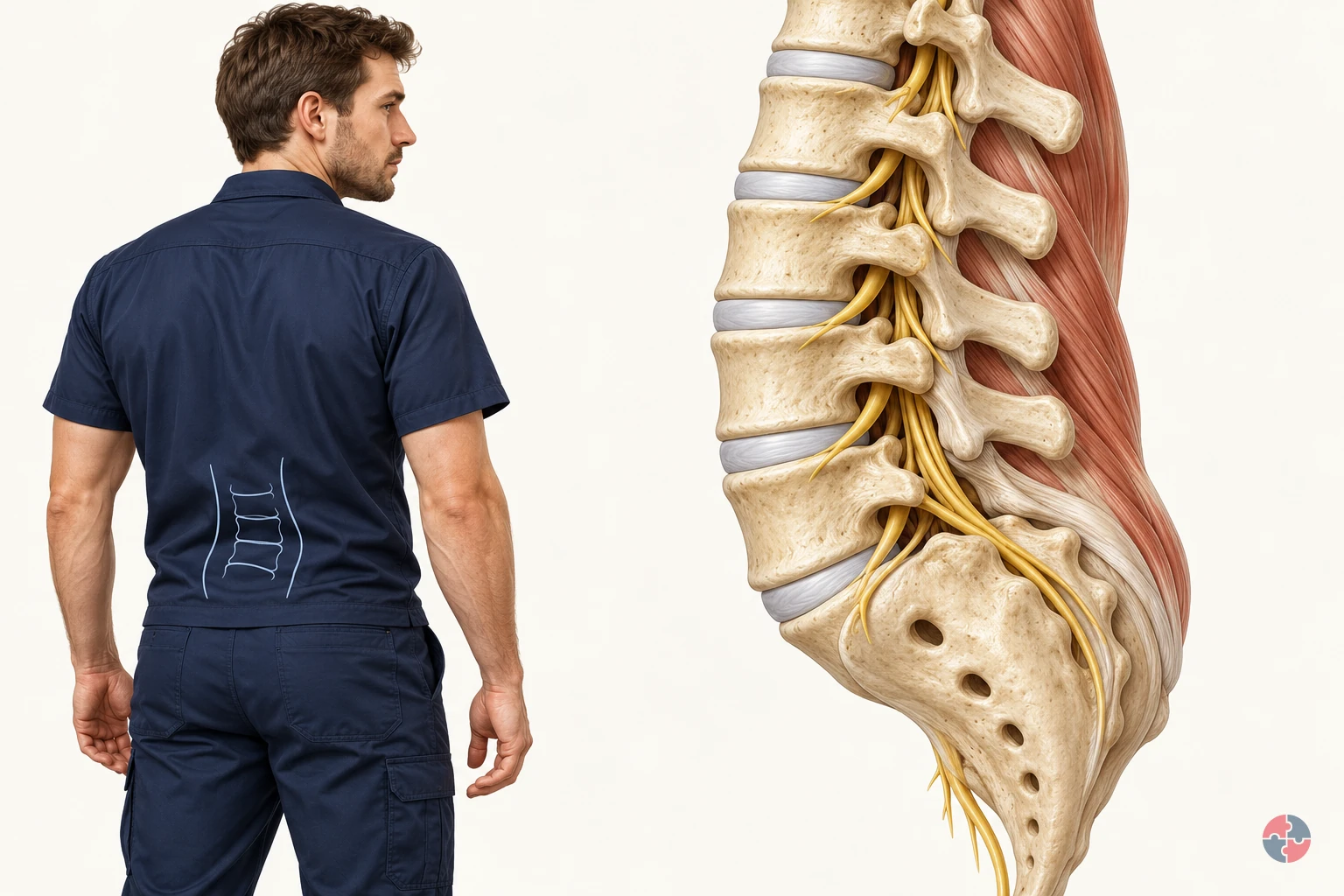
The worker locates the lower back; the separate side view enlarges its bones, discs, nerve roots and nearby muscle.
Locate the lower back. How could the load, reach, route, equipment or work pattern be changed for the task in this lesson?
educational illustration · healthy anatomy; enlarged details and teaching colours.
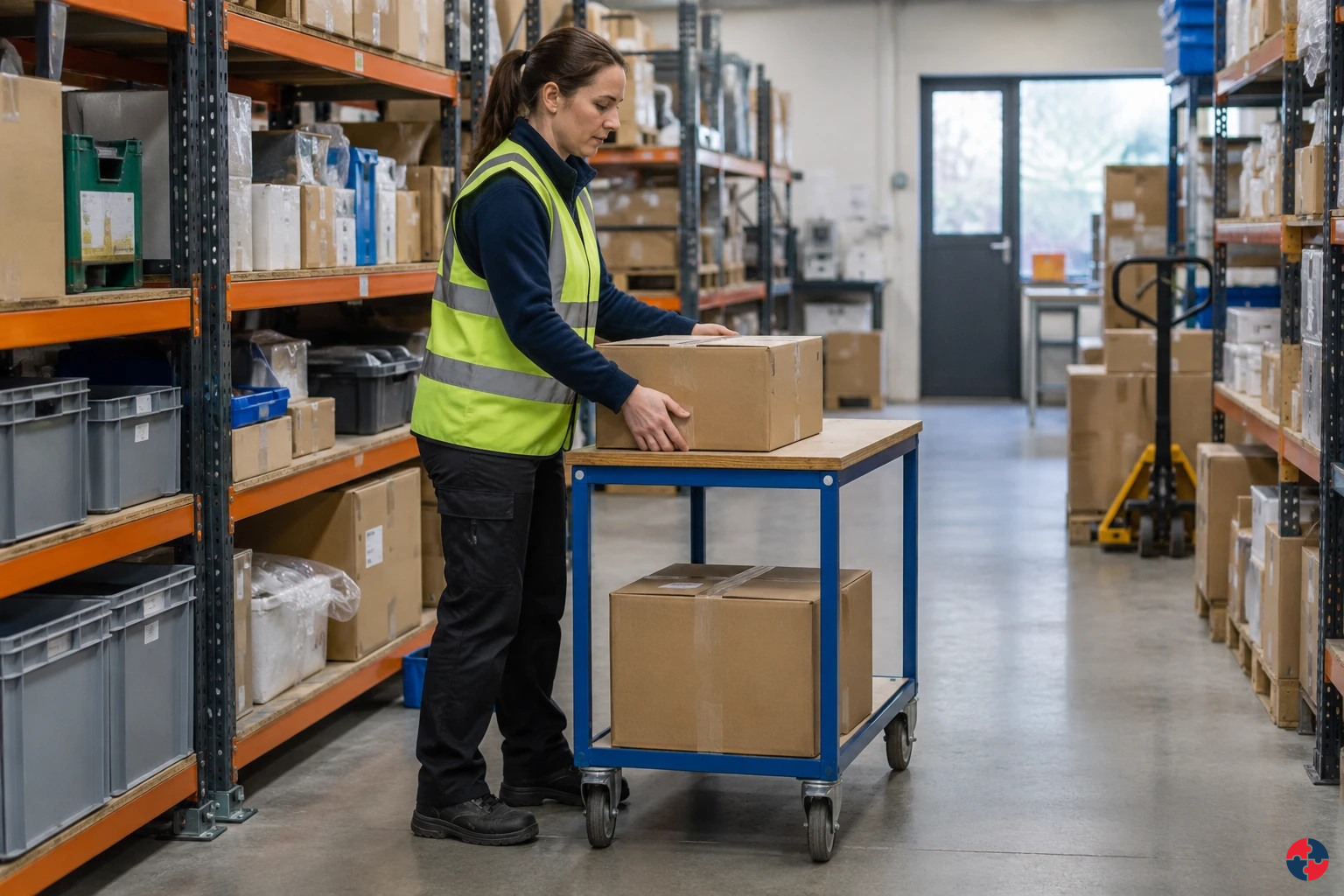
Photorealistic illustrative UK workplace scene. Review checks: Find: Heavy boxes are picked from the floor and twisted into a cage. Change: Raise the pick position, reorient the cage and repair the threshold. Verify: Maintain cage wheels and observe handling during a realistic peak.
Prepare the whole activity before the person is exposed
Bathing involves a sequence: preparing the room, supporting movement, using the water, washing, drying and returning comfortably. The resident’s balance, fatigue, pain, communication, preferences and ability to move away from heat affect that sequence. Review the current care and moving-and-handling arrangements before starting, and explain the activity in a way the person can understand.
A wet floor, damaged chair or changed ability can make the planned sequence unsuitable. The fact that yesterday’s bath went well is useful history, not proof of today’s conditions. Make the environment and equipment ready before the transfer. If an unexpected problem appears, maintain an agreed safe and dignified position while obtaining help; do not improvise a lift or leave a person unsupported to fetch equipment.
Invite the person to explain comfort, preferred timing and the support that works, using appropriate communication. A change in fatigue or pain is relevant to the planned task even when the equipment has not changed. Do not use age or diagnosis as a substitute for current assessment. Staff need the actual care plan and relevant training, and must know how to pause and obtain assistance without leaving the person exposed or unsupported.
For the fictional exercise, follow each transition between dry and wet areas and between seats. Check whether the support remains available when another worker answers a call. A safe starting position does not resolve the return transfer or drying stage. Suitable interim arrangements should preserve warmth, privacy and choice while a problem is resolved. Do not turn a delayed bath into an automatic permanent restriction; identify the precise gap, responsible role and condition for reviewing the plan.
What does good manual handling control look like in different sectors?
The same avoid-assess-reduce principles apply, but the practical controls vary by task and setting.
Manual handling is common in construction, logistics, healthcare, retail, manufacturing, hospitality, offices, agriculture and waste work. The assessment should fit the task rather than use generic training language. Sources: HSE manual handling at work; HSENI manual handling
Sector examples help learners see that manual handling is about force, posture, repetition, distance, environment, people and recovery, not just box weight. Sources: HSE manual handling at work; HSENI manual handling
The person is more unsteady today and the transfer area is wet, but the bathroom slot is almost over.
Decision and explanation
Pause the planned transfer, provide suitable support and resolve the changed needs and environment.
Service pressure does not establish a safe transfer arrangement or remove the need for current assessment.
Lesson 2
Keep scald prevention and water hygiene connected
Apply keep scald prevention and water hygiene connected to the current person and task.
Related SHAREhub topic guide. Apply its prompts to the specific case below.
Keep scald prevention and water hygiene connected
Hot-water systems have to control microbiological risk while preventing harmful exposure at the point of use. Lowering the whole system temperature without competent assessment can undermine the water-safety arrangements. An outlet needs the appropriate mixing, control, checks and maintenance, with the individual’s vulnerability taken into account.
Staff should know which checks their role requires, what readings or behaviour trigger a stop and who receives the report. A tap that feels acceptable at first can change temperature during use. An installed mixing device is not proof that it performs correctly. Record and investigate fluctuations, failed checks and equipment defects through the home’s arrangements; only competent authorised staff adjust or maintain the system.
Compare the record with the outlet and equipment that will actually be used. A satisfactory reading at another tap cannot establish this shower's control, and a chair inspected last week may now be damaged. Checks must be completed by the appropriate trained role using the home's method. The learner should request the relevant evidence without inventing a numerical threshold or performing a hazardous test on a resident.
If a check cannot be completed or a result is outside the approved arrangement, pause the affected activity and obtain the responsible decision. Do not ask somebody to tolerate uncertain water while staff investigate. After correction, verify both the equipment and the complete bathing support, including access, staff capability and the return journey. A repair ticket can support handback but does not prove the person-specific task is ready. Communicate restrictions clearly so another shift does not use the item by mistake.
How should the selected controls be checked in practice?
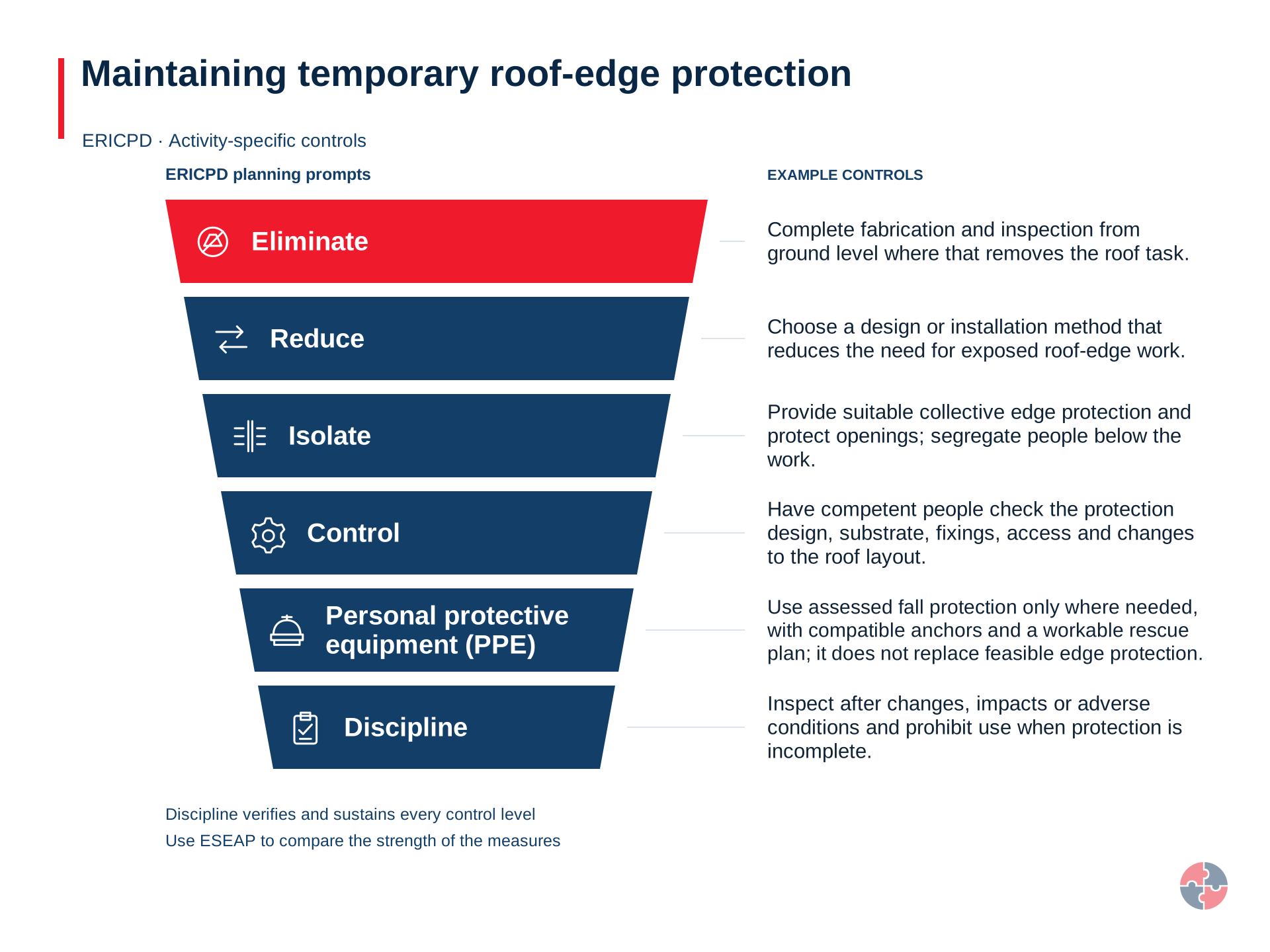
ERICPD is used here as a planning mnemonic. The linked HSE five-level hierarchy is the official source for the order and relative reliability of controls; the two labels are not identical.
Start with task redesign and substitution, then engineered separation before procedures and personal protection; verify each control under real conditions.
At a fuel depot, tanker overfill can release petrol, form vapour and ignite. The assessment must identify the initiating event, people exposed and each independent prevention or mitigation barrier. Petrol cannot be substituted if the site must supply it, so the record should say why that higher-order option is unavailable for this operation and then demand strong engineered controls. HSE hierarchy of control; HSE hierarchy of control.
ERICPD is a six-stage planning aid; the HSE five-level order separates substitution, engineering and administration. Isolate is usually engineered separation, while ERICPD Control may contain both physical and administrative measures. Discipline sustains the chosen controls and is not an additional permission to expose people.
A shower temperature varies unexpectedly. A colleague suggests turning down the whole hot-water system.
Decision and explanation
Stop the affected use, support the person and report for competent investigation of the outlet and system controls.
The two risks need coordinated control. A fitted device or improvised plant adjustment does not establish safe bathing.
Lesson 3
A comfortable touch test is not bathing verification
Keep outlet protection and the individual bathing procedure effective.
Related SHAREhub topic guide. Apply its prompts to the specific case below.
A comfortable touch test is not bathing verification
Hot water can scald a person who cannot move away quickly or recognise the heat. Whole-body bathing can expose a large area, and a person may rely on staff to recognise a problem. The water feeling comfortable to one worker's hand is not the home's complete verification method. A thermometer reading is also useful only when taken and interpreted through the actual trained procedure.
Use the current bathing plan and approved outlet controls, with competent maintenance of thermostatic devices and relevant checks. Confirm the actual outlet, method, equipment and person-specific support. This course does not invent a universal operating setpoint or authorise staff to adjust a mixing valve. The safe conditions must follow the applicable guidance, competent assessment and the home's controlled procedure.
If a result is outside the approved condition or cannot be confirmed, hold bathing at that outlet and arrange a suitable person-centred alternative. Do not proceed while someone investigates, and do not expose the resident to test the water. Keep the person warm, comfortable, informed and appropriately supported. An alternative bathroom must be suitable for the same mobility and support needs rather than chosen only because its water is available.
Facilities and care staff should resolve the fault together. Water-temperature changes can affect both scalding and Legionella controls, so an unplanned global reduction of system temperature is not a complete solution. Competent repair and verification must address the actual system before return to use. For the fictional exercise, compare the failed outlet check with the earlier service record. Current conditions govern the protective response; a service visit cannot guarantee every later bathing operation. Record the hold, responsible role and evidence needed without presenting the model as a live temperature measurement.
How do safeguards and barriers fit into risk assessment?
Safeguards and barriers are the controls relied on to prevent, detect, control or mitigate a scenario.
In simple work, a control may be a guard, exclusion zone, ventilation system or instruction. In process safety, the barrier model becomes more explicit: containment prevents release, detection identifies loss of control, shutdown limits escalation, relief protects equipment and emergency response mitigates consequences.
The important question is whether the barrier is real and healthy. A relief valve that is overdue for inspection, a detector in bypass, a permit issued from an office or an alarm with no response standard should not be treated as a reliable safeguard.
The actual bath outlet check is outside the home’s approved condition, but yesterday’s service record is satisfactory.
Decision and explanation
Hold use of the affected outlet and obtain competent correction and verified suitable bathing arrangements.
Current outlet and person protection must be established before exposure.
Lesson 4
Changed mobility changes the transfer plan
Pause safely when the person’s current ability no longer matches.
Photorealistic illustrative UK workplace scene. Review checks: Find: Heavy boxes are picked from the floor and twisted into a cage. Change: Raise the pick position, reorient the cage and repair the threshold. Verify: Maintain cage wheels and observe handling during a realistic peak.
Changed mobility changes the transfer plan
A transfer plan reflects the person's ability and needs at a particular time. Pain, fatigue, illness or another change can alter weight bearing, balance or participation. A familiar transfer can then expose the person to a fall and staff to excessive force. The presence of the usual chair or hoist does not establish that the old method remains suitable today.
Observe and communicate respectfully within the worker's role. Ask how the person feels and use the actual escalation process for changes, without diagnosing a condition. A competent person-specific assessment should determine the revised equipment, assistance and method. This awareness lesson does not teach a manual lift, clinical assessment or hoist operation and cannot authorise an extra helper as a universal fix.
If the planned transfer cannot be carried out safely, pause and maintain suitable immediate support through the actual procedure. Do not pull the person across a wet floor, encourage an unassessed stand or leave them unsupported while searching for equipment. Respect consent, privacy and comfort while help is arranged. The person should understand why the task is paused and what suitable alternatives are being considered.
Before resuming, confirm the current plan, appropriate equipment, trained staff and environmental conditions. A revised entry in a care record needs to correspond to a practical workable arrangement. Check the return transfer and whether fatigue after bathing changes assistance needs. For the fictional exercise, distinguish a changed observation from a clinical diagnosis and identify who must reassess. A successful transfer yesterday is useful history, not current clearance. Learning to recognise a mismatch and obtain competent review is a protective skill rather than failure to complete a routine task on schedule.
How should manual handling be assessed?
Assessment should observe the real task, identify risk factors and choose controls that reduce force, posture, frequency, distance and uncertainty.
A good assessment watches the task happen. It measures or estimates load weight, height, reach, distance, frequency, route, floor condition, team communication and use of aids. It asks workers what actually makes the job difficult, not just what the procedure says. Sources: HSE L23 Manual handling guidance on regulations; HSE manual handling at work
For structured assessment, HSE's Manual Handling Assessment Charts (MAC) support lifting, carrying and team handling. The Risk Assessment of Pushing and Pulling (RAPP) tool supports pushing and pulling. The Assessment of Repetitive Tasks (ART) tool supports repetitive upper-limb tasks. These tools help prioritise risk, but they do not replace judgement or the hierarchy of avoiding and reducing the task. Sources: HSE L23 Manual handling guidance on regulations; HSE manual handling at work
Question
Assessment prompt
Output
Can the handling be avoided?
Can delivery, storage, automation or process flow remove manual movement?
The resident can no longer bear weight as described in the old bathroom plan.
Decision and explanation
Pause with suitable support and obtain competent review of the current transfer arrangement.
Changed ability can invalidate the planned movement and assistance.
Use the appropriate manual handling assessment
This additional teaching takes about 2–5 minutes, in addition to the course estimate. Optional reading and workplace assessment take additional time.
Start by asking whether the hazardous handling can be removed or redesigned. Where handling remains, observe the whole operation with the people who do it and choose an assessment that fits the work.
Moving a person needs an individual, person-centred assessment, care plan, suitable equipment and competent assistance. These object-handling MAC and RAPP calculators do not assess a resident's transfer or select a hoist, sling or staffing level. TILEO can organise general task questions but does not replace the individual's care assessment. Use the tools only for appropriate inanimate-load activities such as supplies or linen trolleys, alongside the course's care-specific arrangements.
TILEO: Task, Individual, Load, Environment and Other factors. MAC: Manual Handling Assessment Charts for appropriate lifting, carrying and team handling. RAPP: Risk Assessment of Pushing and Pulling for appropriate manual pushing and pulling.
Read the portable guide to understand selection, limitations, the mixed-task example and company-branded Word/PDF records. Your existing course checks and completion requirements remain separate.
Related SHAREhub topic guide. Apply its prompts to the specific case below.
A shower chair is a whole support system
A shower chair supports a person in a wet environment where slipping and unexpected movement can have serious consequences. Cracked seating, loose fixings, damaged feet or unsuitable adjustment can undermine support. The chair remaining upright while empty does not establish its suitability for the person. A clean appearance or an old inspection sticker does not cancel a current defect.
Follow the manufacturer's information, the individual assessment and the home's trained checks. Confirm the actual equipment and compatibility with the person and task, including transfer access and support. This course does not specify load limits, adjustment settings or a repair technique. Do not use a resident as a test load, prop a damaged leg with a towel or replace a fixing with an unverified part.
If damage is found, prevent reuse through the actual withdrawal process and provide suitable immediate support or an assessed alternative. The replacement must meet the person's needs and the bathroom method; another available chair is not automatically interchangeable. Coordinate facilities, equipment and care roles so an item removed for repair does not quietly return without handback.
Verification should establish the competent repair or suitable replacement, relevant checks and current person-specific use before the next bath. Review how damage occurred and whether cleaning, storage or repeated adjustment contributes. For the fictional exercise, record the observed crack, affected function, protective hold and evidence required. Avoid claiming a precise structural failure from a model image. The practical outcome is a reliable support arrangement and clear stop response, with no assumption that cleanliness, availability or a supplier label substitutes for current condition and suitability. Keep privacy and comfort central while resolving the equipment issue rather than leaving the person waiting in an exposed position.
What warning signs show risk assessment is weak?
Weak assessment usually shows up as generic wording, missed scenarios, poor control evidence and unchanged assessments after change or incidents.
Warning sign
How it can cause harm
What to do
Generic hazard lists
People do not know the real scenario or required controls.
Rewrite around task-specific harm routes.
No worker input
Shortcuts, access problems and degraded controls are missed.
Walk the task and consult those doing it.
No review after change
New equipment, substances or contractors create unassessed risk.
Trigger review through MOC, procurement and project controls.
Controls not verified
Failed guards, LEV, alarms or permits are credited as if working.
Inspect, test and record control health.
Action tracker ignored
Known gaps remain open until an incident occurs.
Assign owners, dates and senior review.
No stop-work triggers
Workers continue when assumptions are no longer true.
Add clear conditions for stopping and escalating.
Applied case
A shower chair has a cracked seat support but is the only chair currently in the room.
Decision and explanation
Withdraw it and arrange suitable support or an assessed alternative before use.
Availability does not make damaged support suitable.
Lesson 6
Drying and return are part of the bathing task
Prevent the wet-floor pathway without abandoning the person.
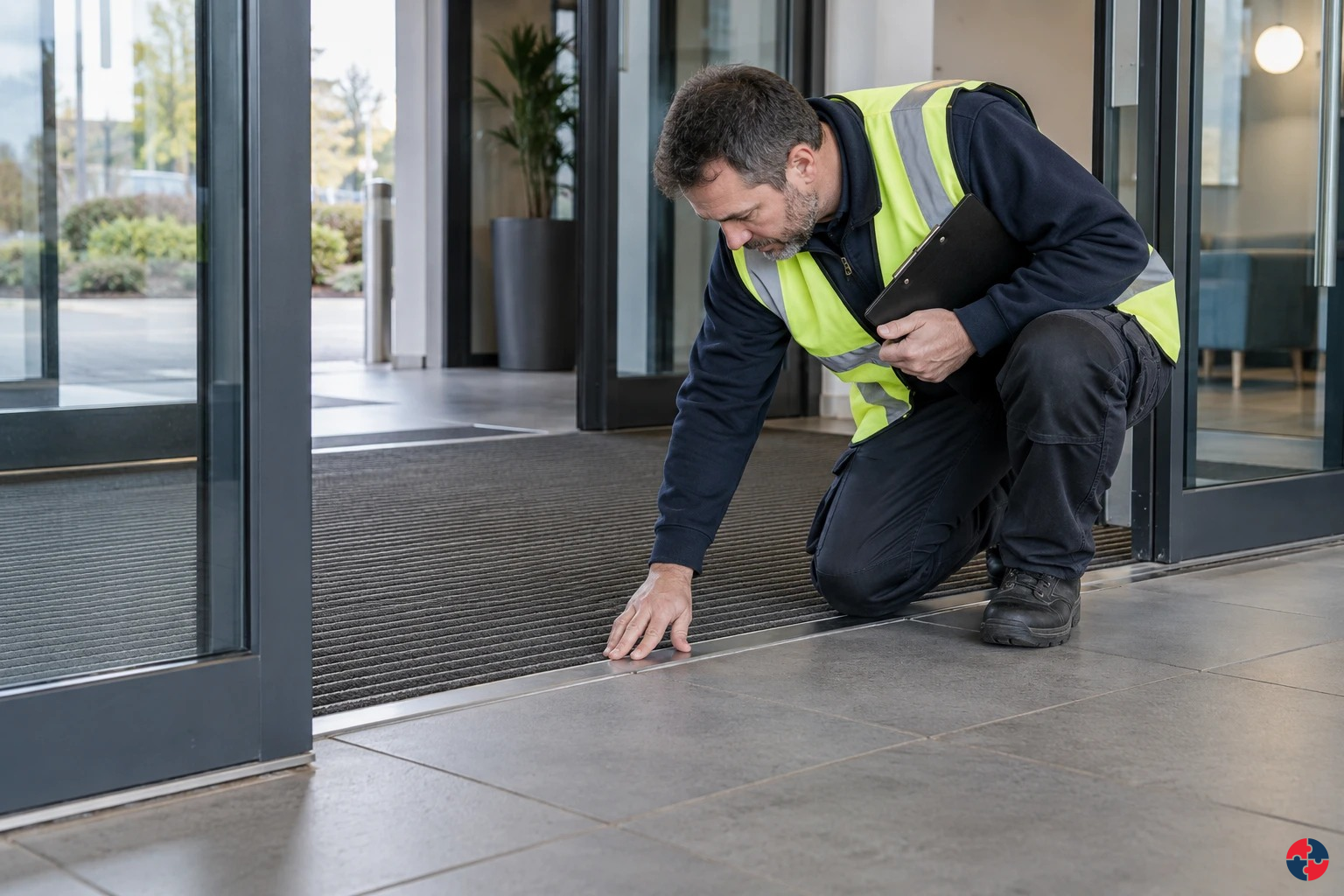
Photorealistic illustrative UK workplace scene. Review checks: Setting: Heavy rain carries water and leaves through a public leisure-centre entrance. Act: Close or physically separate the wet route, provide a safe accessible alternative, remove contamination and correct matting/drainage defects. Hold / review: Do not reopen while the hazardous condition remains or the alternative creates another hazard.
Drying and return are part of the bathing task
Water on a transfer area can reduce traction for a person, staff member or mobility aid. A worker carrying towels may not see a hose or wet patch, while another concentrates on supporting the resident. Cleaning after the bath does not prevent a fall during the return journey. Follow the entire sequence from entry through drying and departure.
Plan source control, drainage, suitable surfaces, hose management and cleaning through the actual assessed arrangement. Keep the person supported while a defect is addressed and provide a suitable dry or otherwise controlled route. A warning sign does not provide secure footing and can itself narrow the available space. Do not solve the wet patch by moving the transfer into an unassessed confined gap.
Coordinate tasks so assistance remains available when the floor needs attention. Staff must not leave a person unsupported or suspended while fetching equipment or cleaning. The actual plan determines safe support, staffing and response. This awareness lesson does not teach a lifting manoeuvre or substitute for transfer training. A change in the person's ability or the equipment condition requires review rather than a stronger grip.
Verify that the route, support and equipment are suitable before the next movement and that any ongoing leak is controlled. Use an appropriate safe checking method, not a deliberate slip test. Include the return transfer, fatigue after bathing and the person's comfort and privacy. The fictional exercise asks learners to distinguish cleaning completion from readiness for use. A signed sheet cannot dry a surface or establish that the required helper is available. If safe conditions cannot be achieved, pause and obtain the responsible alternative rather than treating the timetable as permission to continue.
How should slips and trips be prevented?
Prevention should remove the cause at source before relying on warning signs or people spotting hazards.
The most reliable slip and trip controls are designed into the workplace: suitable floors, safe slopes and steps, drainage, lighting, storage, cable routes, delivery areas, mat wells, cleaning methods and pedestrian routes. A cone on a wet floor may warn people, but it does not make the floor dry or stop access.
A good control strategy asks how contamination will be prevented, how spills will be detected, who owns immediate response, how floors are cleaned, how footwear is selected, how defects are reported, how routes are inspected and how incident patterns are mapped.
Control layer
Practical control
Weak version to challenge
Design
Specify suitable floor, drainage, stairs, lighting and route width.
Trying to manage a badly designed route with signs.
Prevent contamination
Stop leaks, fit drip trays, improve entrance matting and cover outdoor transitions.
Cleaning the same recurring spill every day.
Remove hazards
Clear cables, waste, stock, hoses and uneven temporary materials.
Leaving obstacles for people to step around.
Control cleaning
Use correct method, timing, products, drying and barriers.
Wet mopping during peak footfall with cones only.
Maintain
Repair defects, curled mats, loose tiles, potholes and stair nosings.
Logging defects without interim control.
Footwear
Match footwear to surface and contaminant where work requires it.
Assuming all safety footwear is slip-resistant.
Supervise and learn
Inspect routes, map incidents and fix repeat causes.
Blaming individuals after each incident.
The prevention model applies HSE slip/trip factors to the actual route; the owners and check sequence are illustrative.
Applied case
A wet return route remains and the second helper has left to fetch towels.
Decision and explanation
Suitable support, staffing and a controlled usable route under the actual plan.
The whole return sequence must remain protected.
Lesson 7
Control bathing temperature at the point of use
Check the final exposure and the upstream system together; resolving one hazard must not create another.
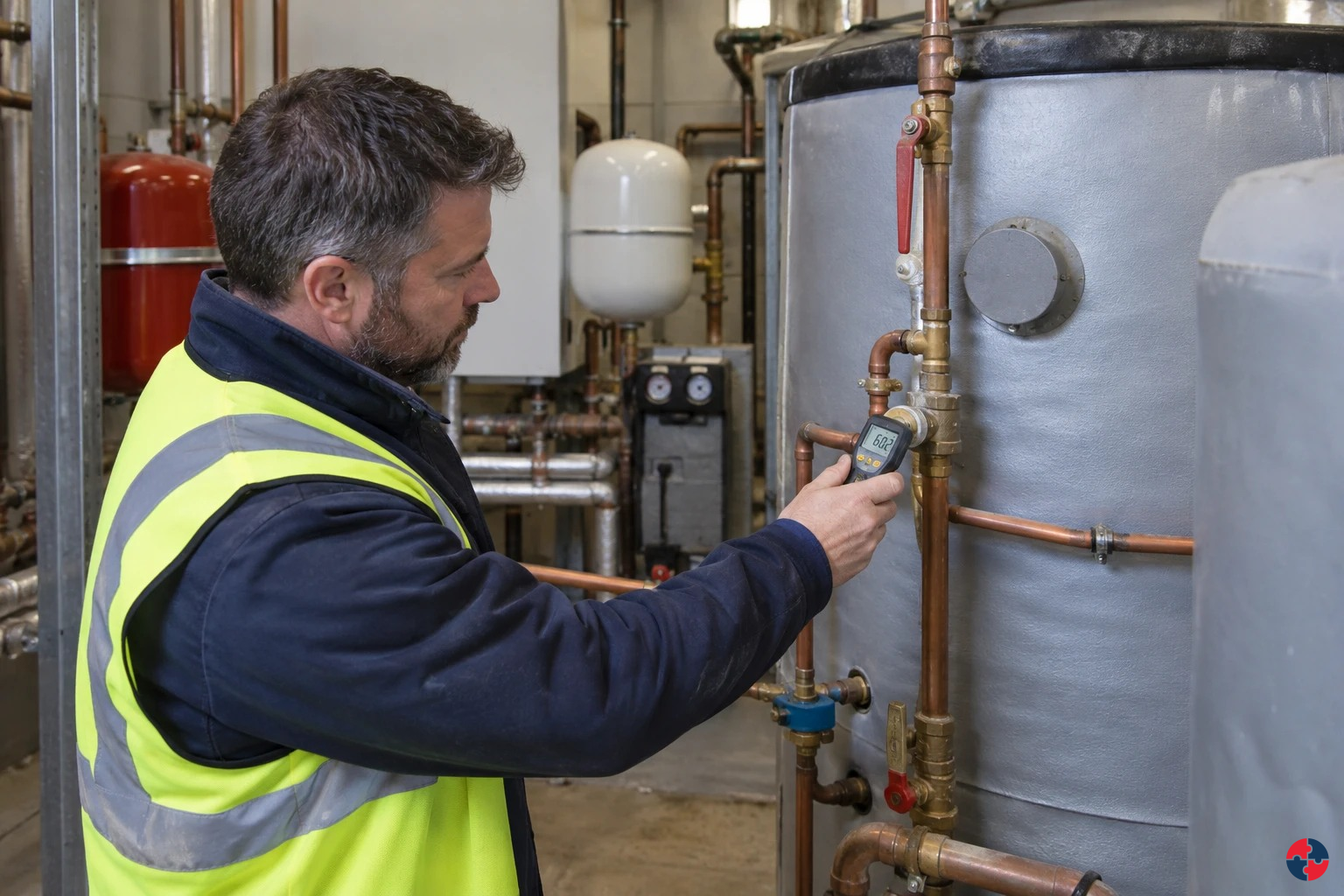
Photorealistic illustrative UK workplace scene. Review checks: Assessing: Riverside maps showers, spa features, tanks, calorifiers, little-used outlets and vulnerable users. Analysing: Temperature trends, missed flushing, contractor reports and repairs are reviewed monthly. Implementing: A written scheme defines monitoring, cleaning, sampling, action levels and escalation.
Understand the activity and how harm develops
A person receiving bathing assistance may be unable to recognise heat promptly, move away or communicate distress. Bath water that feels acceptable to one worker is not evidence of a controlled system. The pre-use check is an important final barrier, supported by suitable mixing controls and competent maintenance.
HSE identifies 44°C as a maximum bathing-water temperature for vulnerable people where scalding risk is present; an individual plan may require a lower limit. Follow the assessed procedure and reliable measurement method. Keep outlet scald protection separate from the wider water-hygiene programme, because lowering the whole stored-water system is not an appropriate improvised fix.
Recognise the evidence boundary
Question
Case evidence
What is observed?
The bath supply is unexpectedly hot during the pre-use check.
How can harm occur?
A person may be scalded before they can recognise or escape the heat.
What information is needed?
Check the bathing procedure, outlet-control status and relevant maintenance records.
Protect, manage and verify
Purpose
Practical application
Immediate protection
Stop the unsafe bath and provide suitable support and an assessed alternative.
Accountable work arrangement
Care lead and responsible water-system maintainer. The pre-use check fails, control is unreliable or the individual bathing limit is not established.
Release verification
Competent correction and a reliable outlet check must precede renewed use.
Apply this at work
Check the final exposure and the upstream system together; resolving one hazard must not create another.
How does temperature control work?
For hot and cold water systems using temperature as the main control, keep cold water below 20°C where possible, hot water stored at least 60°C and outlets at 50°C within one minute (55°C in healthcare).
HSE hot-and-cold system guidance gives these control benchmarks and says system size and type matter. The outlet reading must be taken at the relevant measurement point, including upstream of a thermostatic mixing valve where fitted. A scalding risk requires a suitable separate control. These numbers are not a universal design for a cooling tower, spa pool or chemical-control regime.
The responsible person writes location-specific limits, frequency, method, action and escalation into the scheme. A warm cold-water outlet, slow hot-water rise, dead leg or failed mixing-valve check needs investigation and an interim exposure decision; record repair and a confirming test. HSG274 Part 2 supplies technical detail for hot and cold systems. The HSG274 second-edition update in March 2024 applies to Part 1 only.
Check
Hot/cold-system benchmark
Decision if outside scheme
Source
Cold storage/distribution
Below 20°C where possible.
Find heat gain or stagnation, apply interim measures and retest.
The measured bath outlet exceeds the person’s assessed limit. Adding cold water would let the timetable continue.
Decision and explanation
Stop this bath and arrange competent investigation and an assessed alternative.
An unassessed system change can compromise Legionella controls. A failed temperature-control barrier needs correction rather than timetable-driven improvisation. This does not establish that the outlet control is reliable for the next user.
Lesson 8
Restore stable footing before an assisted transfer
Check environmental conditions before handling starts; cleaning, maintenance and care teams need one coordinated plan.
Photorealistic illustrative UK workplace scene. Review checks: Setting: Heavy rain carries water and leaves through a public leisure-centre entrance. Act: Close or physically separate the wet route, provide a safe accessible alternative, remove contamination and correct matting/drainage defects. Hold / review: Do not reopen while the hazardous condition remains or the alternative creates another hazard.
Understand the activity and how harm develops
A wet transfer area affects the person receiving support and the workers who need stable positions around them. A walking aid, hoist wheel or carer’s foot may slide at the point where movement is hardest to recover. Rushing to complete the transfer can turn a small leak into a resident fall and a staff handling injury.
Find the source: a leaking fitting, shower overspray, cleaning residue or poor drainage may keep recreating the hazard. A warning sign does not give people dry footing. Coordinate the cleaning, equipment and care plan so the person remains comfortable and supported while a genuinely usable transfer space is restored.
Recognise the evidence boundary
Question
Case evidence
What is observed?
Water lies across the space used for a supported transfer.
How can harm occur?
A resident or worker can slip during a movement needing stable footing.
What information is needed?
Check the leak source, drainage, cleaning response and planned transfer route.
Protect, manage and verify
Purpose
Practical application
Immediate protection
Keep the person comfortable while restoring a dry, suitable transfer area or assessed alternative.
Accountable work arrangement
Care lead, cleaning team and premises staff for leaks or drainage defects. Any part of the planned standing or equipment route remains unsuitable.
Release verification
Verify the actual route and equipment placement before the transfer proceeds.
Apply this at work
Check environmental conditions before handling starts; cleaning, maintenance and care teams need one coordinated plan.
Why are cones and signs not the control?
Cones and signs are warning aids; they do not remove contamination, repair a defect or stop access to danger.
This is one of the key teaching points for slips and trips: signs are not the primary control. They may be useful while a temporary hazard is being controlled, but they do not dry a floor, remove a cable, repair a mat, increase lighting or stop people entering a dangerous route.
HSE retail guidance is particularly useful here: signs and cones warn, but they do not prevent people entering a wet area. If the hazard is serious or the floor is smooth and wet, access may need to be stopped with barriers, locked doors or cleaning in sections.
Barrier the section or divert pedestrians until dry.
Damaged floor tile
Sign remains for weeks.
Repair, isolate or create temporary safe route.
Oil leak
Cone warns but contamination spreads.
Stop source, absorb/clean correctly and prevent recurrence.
Trailing cable
Warning does not remove trip point.
Route cable overhead, cover it properly or remove it.
Poor lighting
Warning cannot make hazard visible.
Improve lighting and mark edges/changes.
HSE wet-floor access controls supports barriers or closed routes for unsafe wet floors. The cable and lighting responses are local hazard-control examples.
Applied case
The floor is wet. A colleague offers to hold the resident more tightly so the transfer can continue.
Decision and explanation
Pause and restore a suitable dry transfer area or assessed alternative.
That adds handling strain while leaving the slip mechanism present. The sign neither dries the floor nor provides a workable transfer space. Extra grip cannot replace stable footing or the planned handling arrangement.
Lesson 9
A change in mobility triggers a new transfer decision
Use changed needs, near misses and repeated difficulty as review triggers before the next movement takes place.
Photorealistic illustrative UK workplace scene. Review checks: Find: Heavy boxes are picked from the floor and twisted into a cage. Change: Raise the pick position, reorient the cage and repair the threshold. Verify: Maintain cage wheels and observe handling during a realistic peak.
Understand the activity and how harm develops
The resident’s ability today may differ from the assessment written last week. Pain, fatigue, illness or medication changes can affect standing, balance and participation. The person’s own report and staff observations are evidence that the plan may no longer fit the task.
Do not substitute an improvised manual lift or assume that adding one worker makes the old method suitable. Obtain appropriate reassessment and the prescribed equipment and staffing. Support independence where it is appropriate, while explaining why a proposed movement is paused and escalating new symptoms through the home’s clinical response arrangements.
Recognise the evidence boundary
Question
Case evidence
What is observed?
Staff report new difficulty standing but the transfer plan is unchanged.
How can harm occur?
An unsuitable transfer can cause a resident fall and worker injury.
What information is needed?
Ask the person and staff about the change and obtain appropriate reassessment.
Protect, manage and verify
Purpose
Practical application
Immediate protection
Pause the proposed unsafe transfer and seek the assessed equipment, staffing and support arrangement.
Accountable work arrangement
Care lead with the relevant clinician or moving-and-handling specialist. The person cannot participate as expected, reports new pain or shows a significant change in mobility.
Release verification
Confirm the updated plan is workable and communicated before proceeding.
Apply this at work
Use changed needs, near misses and repeated difficulty as review triggers before the next movement takes place.
What does good manual handling control look like in different sectors?
The same avoid-assess-reduce principles apply, but the practical controls vary by task and setting.
Manual handling is common in construction, logistics, healthcare, retail, manufacturing, hospitality, offices, agriculture and waste work. The assessment should fit the task rather than use generic training language. Sources: HSE manual handling at work; HSENI manual handling
Sector examples help learners see that manual handling is about force, posture, repetition, distance, environment, people and recovery, not just box weight. Sources: HSE manual handling at work; HSENI manual handling
A resident who normally stands with support now cannot bear weight as usual. The existing plan still describes a standing transfer.
Decision and explanation
Pause that transfer, support the person and obtain appropriate reassessment.
Changed ability is a decision trigger, not a reason to force the previous technique. That exposes the person and workers to a method that may no longer be suitable. An extra worker does not validate an unsafe improvised handling technique.
Quarantine needs to be physical and communicated. A defect label should lead to a verified outcome and a suitable continuity plan.
Photorealistic illustrative UK workplace scene. Review checks: Setting: the site team’s warehouse conveyor moves bagged building material. Act: The operator stops and reports the failure; the supervisor holds the whole affected line. Hold / review: Hold if guard function, isolation, run-down, linked restart or personnel accounting is uncertain.
Understand the activity and how harm develops
A shower chair carries the person’s weight in a wet environment while staff may be helping with personal care. A cracked seat or loose attachment can affect strength, stability or support. The absence of collapse during the previous bath gives no assurance about the next use.
Equipment suitability also includes the individual’s size, posture and transfer needs, the chair’s intended use and the bathroom layout. Staff should identify and segregate the defective item so it cannot return accidentally. A replacement needs its own suitability and condition check; borrowing a different chair is not automatically an acceptable transfer plan.
Recognise the evidence boundary
Question
Case evidence
What is observed?
A shower chair has a cracked seat and loose foot attachment.
How can harm occur?
Collapse or instability can cause a fall or injury.
What information is needed?
Check equipment identity, condition and defect-reporting information.
Protect, manage and verify
Purpose
Practical application
Immediate protection
Quarantine the defective chair and provide a suitable assessed alternative.
Accountable work arrangement
Equipment owner and care lead, with competent repair or supplier support. Structural damage, loose supports or replacement suitability is uncertain.
Release verification
Verify replacement suitability and safe condition before the person uses it.
Apply this at work
Quarantine needs to be physical and communicated. A defect label should lead to a verified outcome and a suitable continuity plan.
How should defects be controlled?
Report and classify the defect, keep dangerous equipment out of use, repair competently and prove the affected function before release.
A missing guard, failed brake, cracked lifting part or uncertain pressure protection needs a clear stop-use decision. Tagging helps communicate a hold but does not physically prevent reuse on its own; choose isolation or access control as needed. Record who may remove the hold and what evidence they require. Repeated defects call for cause investigation and a changed plan. HSE maintenance of work equipment and HSE thorough examination of lifting equipment.
Separate a service defect from an examination report
An ordinary service defect is recorded, quarantined and resolved through the equipment system. A statutory examiner’s finding follows its own report route as well as the work restriction. For GB LOLER, the examiner immediately informs the dutyholder of dangerous defects; serious existing or potential dangerous defects require the prescribed written report and a copy to the enforcing authority as soon as practicable. Respect any specified remedy deadline and prohibition on continued use. HSE: lifting examinations and dangerous-defect reports.
For GB PSSR, the competent person’s imminent-danger process includes immediate notification, a written report to the user/owner and a copy to the enforcing authority within 14 days; prevent operation until the required remedy is made. HSE: pressure systems. NI has separate LOLER/PSSR instruments and enforcing routes: apply the corresponding current provisions and competent advice. A manager cannot waive an examiner’s restriction; not every minor maintenance defect is externally reportable.
Applied case
A cracked shower chair is put back in the bathroom with a note saying “use carefully”.
Decision and explanation
Remove it from service and provide a suitable checked alternative.
The cushion conceals the defect without restoring structural safety. Segregation prevents accidental reuse and the alternative still needs individual suitability. Staff cannot establish residual strength or suitability by guessing a lower load.
Lesson 11
A fluctuating shower needs a reliable engineering correction
Verify controls across realistic operating conditions, including other demands on shared building systems.
Photorealistic illustrative UK workplace scene. Review checks: Setting: the site team’s warehouse conveyor moves bagged building material. Act: The operator stops and reports the failure; the supervisor holds the whole affected line. Hold / review: Hold if guard function, isolation, run-down, linked restart or personnel accounting is uncertain.
Understand the activity and how harm develops
The shower may begin at an acceptable temperature and change when another outlet is used. A person receiving assistance may not be able to reach the control or step away. The relevant exposure is the changing water at the shower head, not simply the boiler setting or yesterday’s maintenance entry.
Temperature regulation depends on a suitable installed and maintained system, supply conditions and pre-use checks. A worker staying beside the person is not a substitute for a reliable mixing control. Arrange an assessed alternative while the defect is investigated, and verify performance under the conditions that produced the fluctuation.
Recognise the evidence boundary
Question
Case evidence
What is observed?
The shower temperature fluctuates during a staff pre-use check.
How can harm occur?
Unexpected hot water can scald a person unable to move away quickly.
What information is needed?
Review the mixing-control defect, supply conditions and the person's bathing plan.
Protect, manage and verify
Purpose
Practical application
Immediate protection
Stop use and arrange an appropriate alternative and competent investigation.
Accountable work arrangement
Care lead and competent shower or water-system maintainer. The output changes unexpectedly, becomes unstable or fails the approved pre-use check.
Release verification
Confirm stable safe outlet control using the approved checks before reopening.
Apply this at work
Verify controls across realistic operating conditions, including other demands on shared building systems.
How should a safety function be tested?
Specify the function, safe test position, expected response, acceptance criteria and restoration before a competent person tests it.
For an interlock, confirm the guard state, stopped or prevented motion, run-down and restart behaviour for the real access route. A green indicator alone is not proof. Test from a protected position and record failures; do not put a person in danger to demonstrate the function. After repair or modification, consider the whole linked system, not only the replaced component. HSE L22 Safe use of work equipment and HSE maintenance of work equipment.
Applied case
The shower becomes suddenly hotter when the next room’s tap is opened. It settles again after a few seconds.
Decision and explanation
Competent correction and verification of stable safe outlet control.
Supervision does not prevent the unexpected exposure reaching the resident. That omits the dangerous fluctuation the control needs to prevent. A transient hot surge can still cause injury; the relevant operating condition must be checked.
Lesson 12
The bathroom change of plan
Preserve dignity while resolving equipment, water and transfer gaps.
Related SHAREhub topic guide. Apply its prompts to the specific case below.
The bathroom change of plan
In the fictional bathroom, the resident wants their usual bath but is more tired and cannot participate as described in the old transfer plan. The bath outlet check is outside the home's approved condition, a shower-chair support is cracked and the return area is wet. A helper suggests using another shower while a colleague adjusts the mixing valve. The second trained worker is temporarily unavailable.
Begin with suitable immediate support, warmth, privacy and explanation. The resident's wishes matter, but consent alone cannot make an unverified unsafe method suitable. Do not begin immersion or the changed transfer while staff investigate. Keep the person involved appropriately and identify a realistic alternative rather than cancelling choice without explanation or leaving them unsupported.
The changed ability needs competent person-specific review. The plan should establish the actual method, suitable equipment and staff capability for the current task, including the return transfer. Adding a helper or using more force is not an automatic answer. The damaged shower chair should be withdrawn through the controlled process and any replacement assessed for the person and bathroom. Nobody should use the resident to test a suspect support or an unfamiliar transfer arrangement.
The outlet fault needs competent premises assessment and repair with the relevant verification. A previous service record does not override the current check. Staff should not improvise a mixing-valve adjustment or globally lower water-system temperatures: scalding prevention and Legionella control must be coordinated. The alternative shower also needs its actual outlet and person-support conditions confirmed, rather than being chosen solely because it is nearby.
Resolve the wet-floor source and provide a suitable protected route while preserving the required assistance. A sign does not create traction, and a clean-floor record does not prove the route is usable now. Do not leave the person unsupported while cleaning or fetching towels. Separate the immediate care response, equipment withdrawal, water repair and mobility review into actions with appropriate responsible roles.
Before resuming, verify the corrected arrangements and update the relevant care and premises handover. State what remains held, what support is available and what evidence will permit release. Use a safe exercise to test the sequence without exposing a person to hot water, a damaged chair or an unassessed transfer. This course develops awareness and escalation; it does not confer clinical, hoist-operating or plumbing competence. The case is complete when the whole bathing journey supports the person's current needs with effective safeguards and a clear response to further change.
How should the basic risk assessment process work?
The process should identify hazards, decide who may be harmed, evaluate risk, record significant findings and review the controls.
The familiar five-step model is only useful when each step is done honestly. Walking the workplace, checking incident data, speaking to workers, reviewing maintenance, reading safety data sheets and observing non-routine work will usually reveal more than a desk exercise.
The output should be understandable to the people who use it. A supervisor should know what must be in place before work starts. A worker should know the task controls and stop-work triggers. A manager should know what resources and review evidence are required.
Step
What good looks like
Evidence
Identify hazards
Task observation includes normal, abnormal, maintenance, cleaning and emergency conditions.
Walkthrough notes, worker input and hazard register.
Decide who may be harmed
Employees, contractors, visitors, public, vulnerable workers and emergency responders are considered.
People-at-risk section and consultation evidence.
Evaluate risk
Existing controls are tested, not assumed.
Inspection findings, monitoring data, maintenance records and competence checks.
Record findings
Significant risks, controls, action owners and review triggers are clear.
Assessment, action tracker and risk register.
Review
Assessment changes after incidents, changes, new information or weak control evidence.
The team proposes using the other shower immediately because the resident has agreed.
Decision and explanation
Confirm suitable current transfer, staffing, equipment, route and outlet conditions before the alternative is used.
Consent and availability do not establish the safety of an unverified method.
Lesson 13
Take a verified action into the workplace
Connect one actual task to an owner, evidence and a clear release or escalation decision.
Related SHAREhub topic guide. Apply its prompts to the specific case below.
Turn awareness into a practical question
Care-home safety awareness with a Great Britain workplace baseline. CQC, DHSC and cited residential-care examples apply to England where stated; confirm the relevant national regime. This course does not confer clinical, medicines, lifting, restraint, maintenance or emergency-response competence or authorisation.
Choose one relevant operation from the course. Describe the person or environment at risk, the mechanism of harm and the exact condition that needs controlling. Separate an observation from a conclusion. A display, signature, badge or clean appearance answers only a limited question.
Use the included practice resources to prepare a fictional task brief, risk review or verification question. Decide which competent role owns the decision and which evidence must be available before work restarts or work is released. Keep worker protection, public exclusion, task acceptance and environmental decisions distinct where required.
At work, use your actual approved arrangements. Report uncertainty and preserve the relevant hold, restriction or safe state while it is resolved. Confirm that the action addressed the original harm route and check whether another shift, load, cleaning task or maintenance change could reintroduce it.
Course completion records awareness learning. It does not establish practical competence, certify an organisation or authorise specialist, clinical, maintenance, chemical or emergency work.
How should the basic risk assessment process work?
The process should identify hazards, decide who may be harmed, evaluate risk, record significant findings and review the controls.
The familiar five-step model is only useful when each step is done honestly. Walking the workplace, checking incident data, speaking to workers, reviewing maintenance, reading safety data sheets and observing non-routine work will usually reveal more than a desk exercise.
The output should be understandable to the people who use it. A supervisor should know what must be in place before work starts. A worker should know the task controls and stop-work triggers. A manager should know what resources and review evidence are required.
Step
What good looks like
Evidence
Identify hazards
Task observation includes normal, abnormal, maintenance, cleaning and emergency conditions.
Walkthrough notes, worker input and hazard register.
Decide who may be harmed
Employees, contractors, visitors, public, vulnerable workers and emergency responders are considered.
People-at-risk section and consultation evidence.
Evaluate risk
Existing controls are tested, not assumed.
Inspection findings, monitoring data, maintenance records and competence checks.
Record findings
Significant risks, controls, action owners and review triggers are clear.
Assessment, action tracker and risk register.
Review
Assessment changes after incidents, changes, new information or weak control evidence.

 View full detail ↗