Free training · Approx. 2h–2h 30m · estimated self-paced learning, including activities and assessment.
Public teaching is free without an account. A free learner account is required for confirmed LMS assessment, completion and certificate records. See the full course outline and access routes.
This reader contains the full learning text. Interactive completion, grading and the learning record are available in the course player.
Awareness boundaryRecognise, check, avoid disturbance, stop and report. This course does not qualify anyone to undertake asbestos work.
Redevelopment illustration from the supplied deck. Earlier buildings and demolition history can remain relevant to today’s work.
Asbestos is the name for a group of naturally occurring fibrous minerals. It was used for heat resistance, fire protection, strength and durability. In a construction job, that history translates into insulation, boards, cement products, coatings, floors and old plant. The hazard can sit behind an ordinary finish.
The UK ban on new use did not remove materials already installed. A building built or refurbished before 2000 is a prompt to check the asbestos information. It is not a test that proves whether any particular material contains asbestos. A newer surface can conceal older layers, and redevelopment ground may contain demolition material from an earlier building.
Think about the action, not just the address
A room being in use does not mean it is safe to drill into its ceiling. A clear floor does not mean the adhesive beneath it has been assessed. An empty factory can have a full asbestos register and still have an unsurveyed service void.
Your workface questionWhat exactly will this job touch, penetrate, open, break, lift or move — and what reliable information covers that material and location?
The useful habit is to check before setting up an intrusive task, then check again if the route, method, material or condition changes. Your first contribution is to prevent an avoidable disturbance.
OPTIONAL WORKFACE PRACTICE
Spot the three planning checkpoints
Select the numbered points or their labelled buttons. Identify the evidence needed before disturbing fabric.
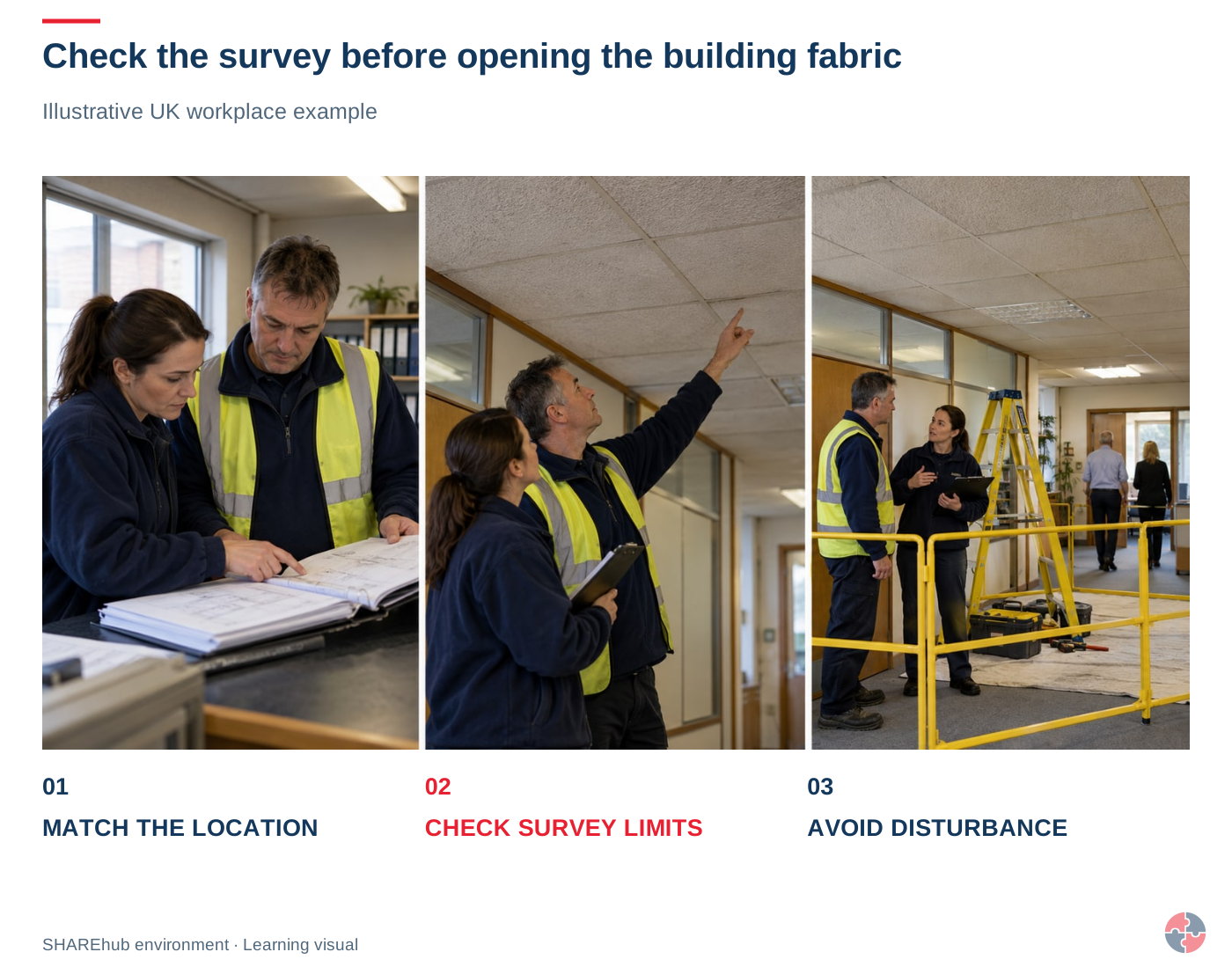
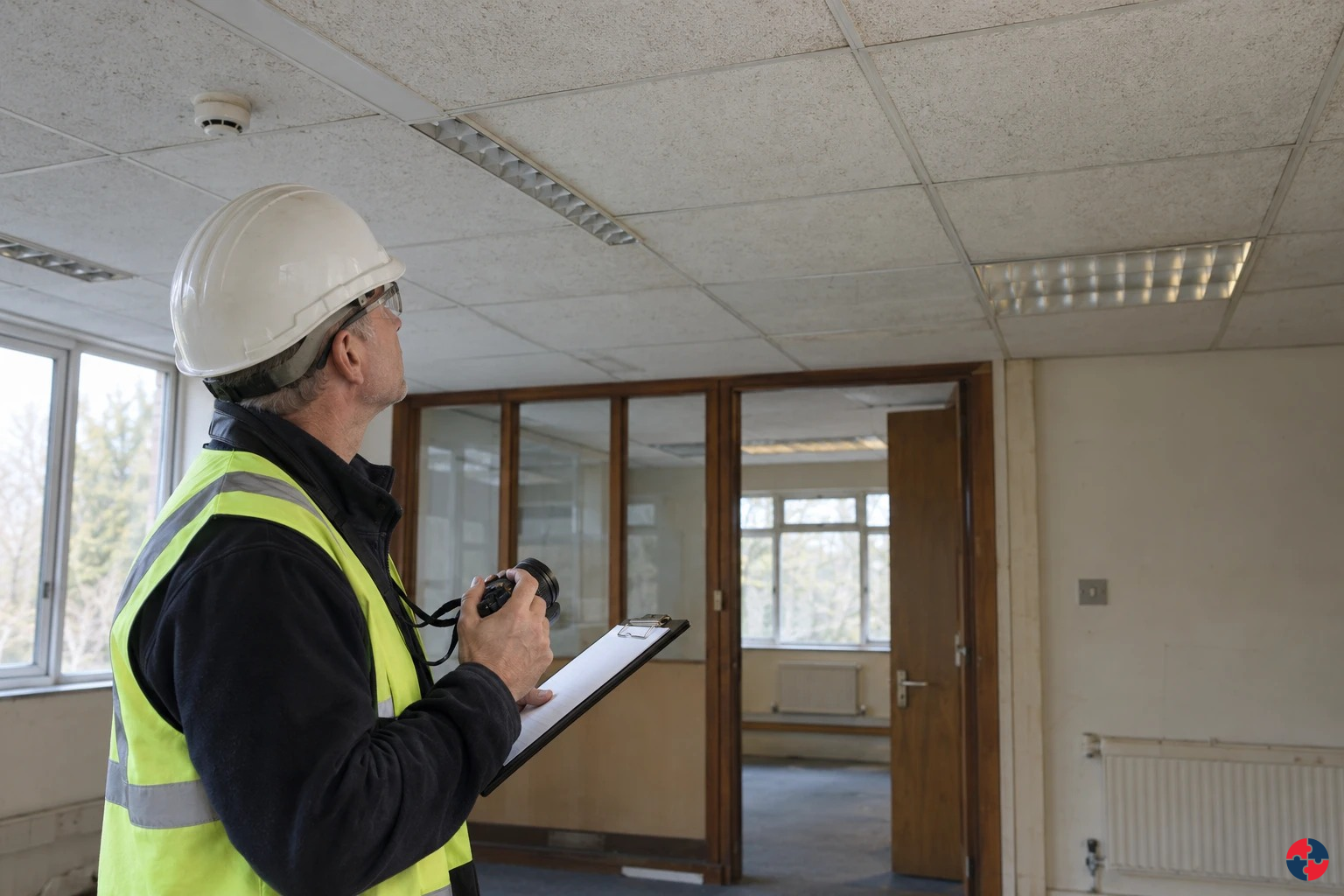
Existing Hub workplace illustration. The scene prompts questions; appearance cannot establish whether material contains asbestos.Document pack
Match the exact task and location to current information. Having a folder is not evidence that the route is covered.
Ceiling and hidden space
Check survey scope and exclusions for the actual void and fixing points. An intact surface does not reveal everything above it.
Access and other people
Plan safe access and protect others while the uncertainty is resolved. A barrier does not authorise opening the fabric.
Optional practice; it does not change your assessment or completion requirements.
Learning check
A unit was refurbished in 1995. You are asked to drill new fixings. What comes first?
Drill a small test hole
Check task-matched asbestos information
Assume refurbishment removed all asbestos
Explanation
The age triggers a check. The exact fixing position and material must be covered before drilling; a test hole can itself disturb asbestos.
Sources: Your supplied construction operatives PowerPoint (59 slides), SHARE Knowledge Hub: asbestos management and safety, HSE: why asbestos is dangerous and where it can be found
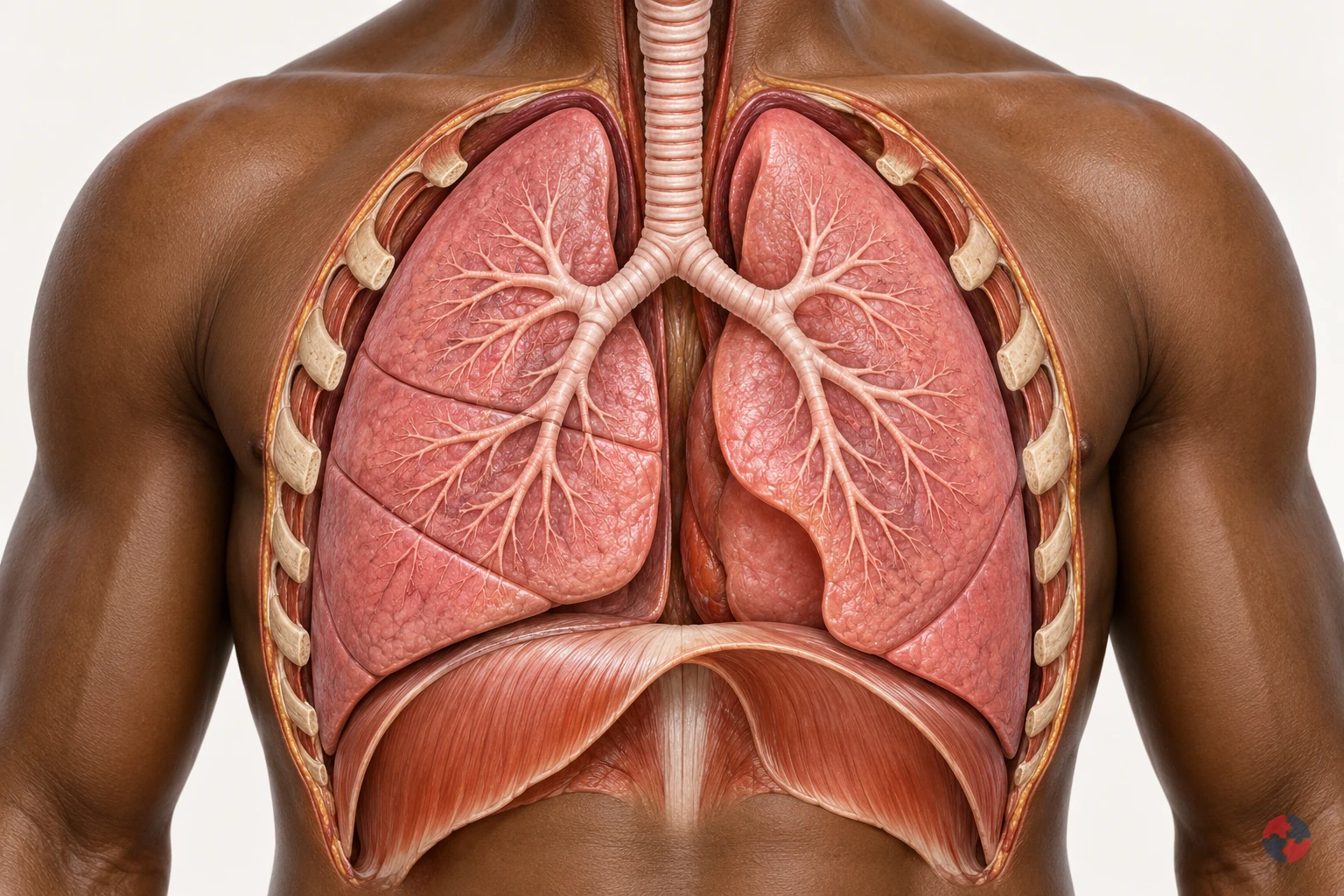
Locate the lungs, branching airways and diaphragm below them. The cutaway reveals structures normally hidden by the chest wall.
Trace the source-to-breathing-zone route in this lesson. Which change would prevent the contaminant reaching the person?
educational illustration · healthy anatomy; enlarged details and teaching colours.
Asbestos becomes a health concern when fibres are released into the air and inhaled. Individual fibres are too small to use as a visible warning. You cannot use smell, a lack of visible dust, or feeling well at the end of the shift to confirm that an activity was safe.
Asbestos-related diseases include mesothelioma, asbestos-related lung cancer, asbestosis and diffuse pleural thickening. Asbestosis is scarring of lung tissue; established scarring cannot simply be reversed. These diseases can emerge many years after exposure. Prevention has to happen at the point of work, long before symptoms could provide a warning.
Keep the health message accurate
Risk depends on what was released and inhaled, as well as the duration and pattern of exposure. A suspected incident does not establish a diagnosis or mean that disease is inevitable. Equally, the absence of symptoms is not reassurance that the task was acceptable. Smoking increases lung cancer risk further in workers exposed to asbestos; stopping smoking supports health but does not make asbestos exposure safe.
If you are worried about a possible work exposure, use your employer’s reporting route and seek qualified advice through your GP or occupational health. Give factual work and exposure history, rather than a guessed dose. Managers and colleagues should not diagnose illness or offer medical guarantees.
The site lessonControl exposure now. Record incidents accurately. Use clinicians for individual health concerns.
OPTIONAL WORKFACE PRACTICE
Three reassuring claims to challenge
Open each claim before deciding what evidence it really provides.
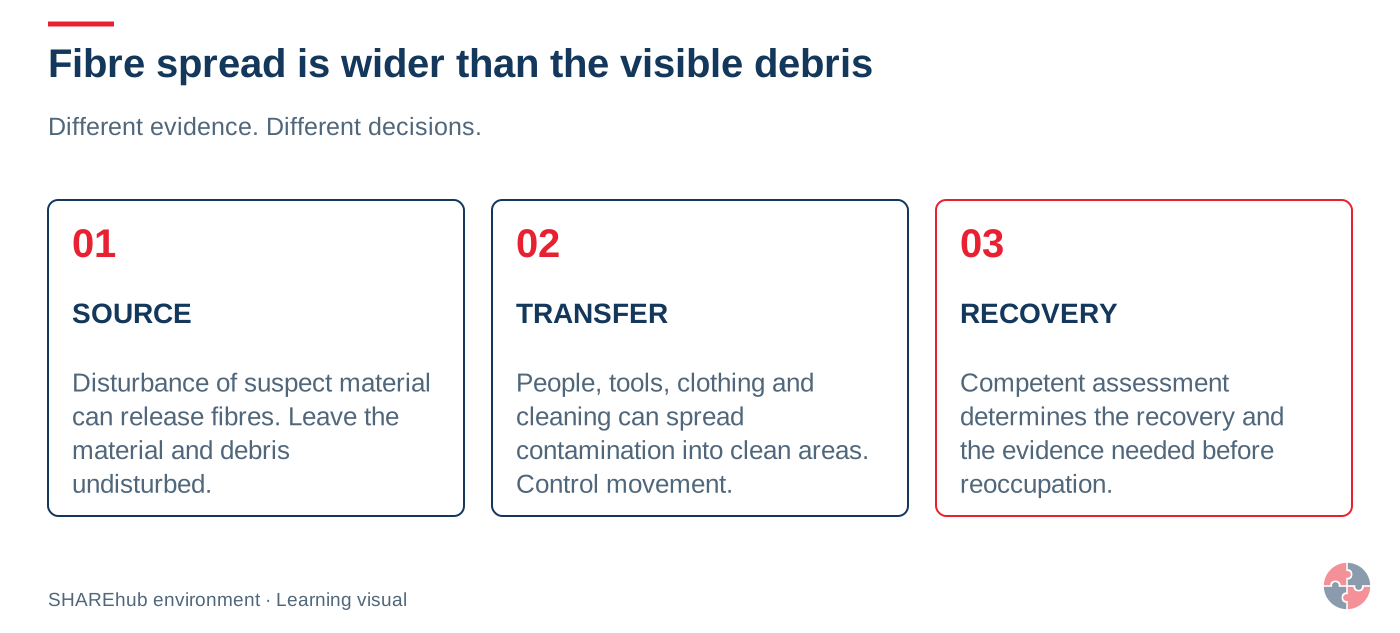
Existing Hub explanation of fibre spread. It is a route model, not a measurement of this workface.“There is no smell.”
Asbestos cannot be reliably detected by smell. The absence of an odour does not establish that the task is safe.
“I cannot see any dust.”
Fibres may not be visible. Absence of a visible cloud is not a measurement of airborne fibres or proof of no exposure.
“I feel fine today.”
Symptoms and their timing cannot clear a task or determine someone’s exposure. Record concerns and use qualified medical advice for an individual.
Optional practice; it does not change your assessment or completion requirements.
Learning check
After a dusty disturbance, someone feels completely well. What does that tell you?
The material was not asbestos
Nothing reliable about whether fibres were inhaled
The work can restart after a break
Explanation
Asbestos-related illness is delayed. Feeling well does not establish what happened; report the event and follow competent incident and health advice.
Sources: Your supplied construction operatives PowerPoint (59 slides), SHARE Knowledge Hub: asbestosis, HSE: exposure, health concerns and other questions
LESSON 3 / Understand the risk
Bonded, friable and damaged: why the task matters
A product label is not a permission slip.
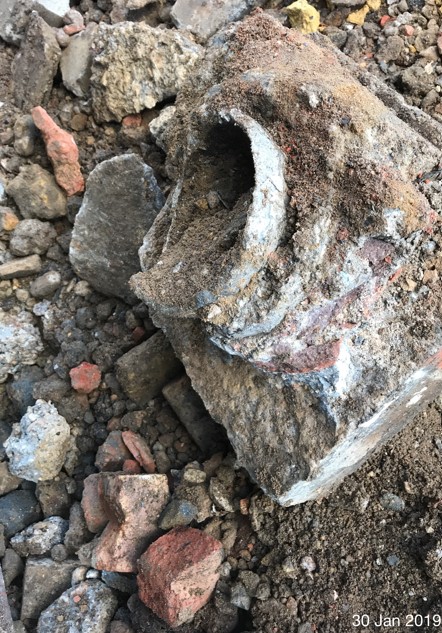
Supplied example labelled “cement flue in concrete”. The photograph supports recognition of a situation; it is not a method of confirming material identity.
Asbestos was used in many different products. Chrysotile, amosite and crocidolite are often called white, brown and blue asbestos. Those familiar names do not let you identify a material on site: products are mixed, painted, dirty, weathered or hidden. All asbestos types require control.
More readily released
Loose insulation, lagging, sprayed coatings and damaged insulation products can release fibres readily. Asbestos insulating board (AIB) can look like an ordinary board. Crumbling, delamination or loose residues are reasons to stop, not to test the material by hand.
More firmly bound when intact
Cement sheets, pipes, flues and some flooring products may hold fibres within a matrix. Cutting, crushing, drilling, breaking or severe deterioration can change the release potential. “It looks like cement” does not settle the work decision.
Condition and disturbance have to be considered together. An intact panel protected from contact presents a different situation from a small damaged fragment on a busy route. Quantity alone does not establish safety. Nor does a short task, working outside, rain, a mask or a dust suppression hose authorise an unknown asbestos task.
Competent people determine the material and work category, using suitable information and the actual method. Your awareness-level action is to recognise uncertainty, prevent disturbance and report it. You do not prove identity by bending, snapping, scratching or lifting the product.
OPTIONAL WORKFACE PRACTICE
Separate appearance from a release mechanism
Classify each statement before checking the explanation.
Choose between: Useful task consideration / Does not establish safety.
A breaker will strike the cement-like flue.
Useful task consideration. The proposed force and disturbance matter. Hold the task until suitable information and competent direction cover it.
The material is only a small fragment.
Does not establish safety. Size cannot identify the material or establish the extent of contamination.
The board looks sound from this position.
Does not establish safety. Appearance is an observation, not permission to drill or open it.
The plan avoids contact with the identified material.
Useful task consideration. An assessed no-disturbance route can be useful; it must match the task and remain within its authorised limits.
Optional practice; it does not change your assessment or completion requirements.
Learning check
A solid-looking cement flue is fixed inside concrete. Is breaking the concrete automatically safe?
Yes, the fibres are bonded
No — breaking may damage the flue and needs competent assessment
Yes, if the breaker operator wears a mask
Explanation
Bonded material can be damaged by demolition. Appearance and PPE do not authorise the task.
Sources: Your supplied construction operatives PowerPoint (59 slides), SHARE Knowledge Hub: asbestos management and safety, HSE: locations and taking the right action
LESSON 4 / Understand the risk
What this course prepares you to do
Awareness has a clear boundary.
This course is for construction operatives, trades, plant operators and supervisors who may encounter asbestos during normal work. It develops recognition, pre-work checks, avoidance and an appropriate response to discovery or disturbance. It does not train or authorise you to work on asbestos-containing materials.
Three different training needs
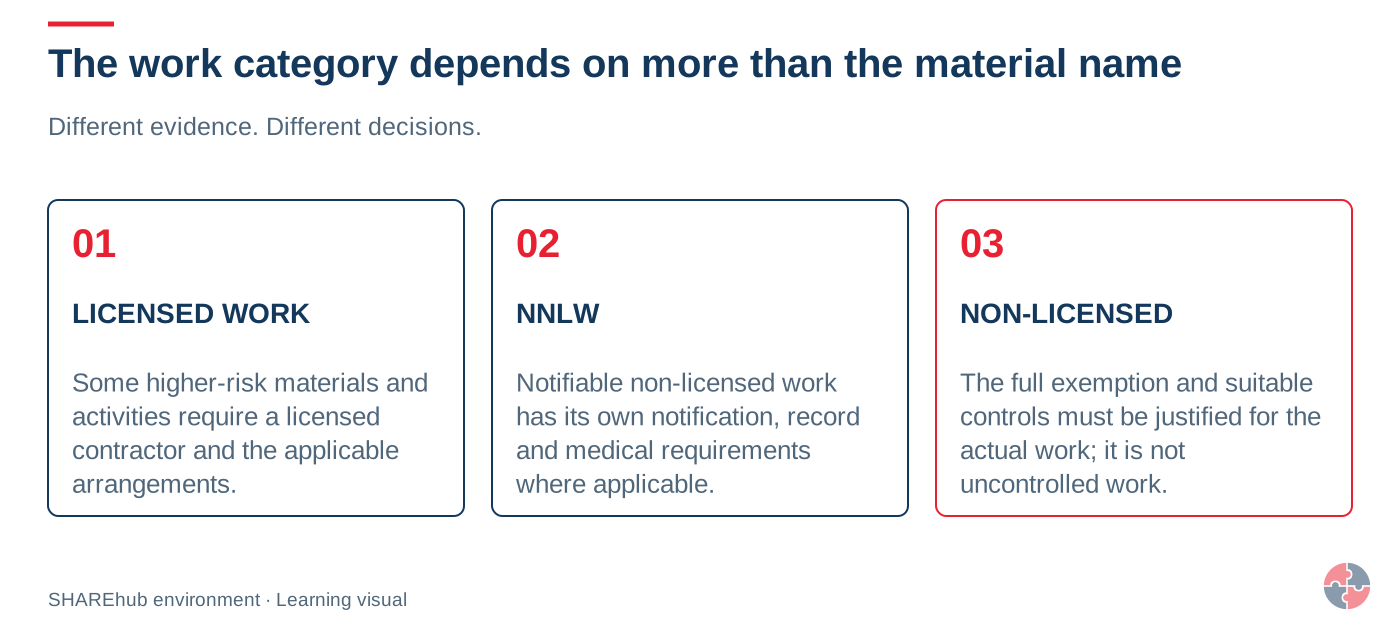
Awareness training helps people avoid disturbing asbestos. Non-licensable asbestos work, including notifiable non-licensed work (NNLW), needs additional task-appropriate instruction, training and controls. Licensable work needs the appropriate specialist contractor, trained workers and arrangements. “Non-licensed” does not mean untrained or uncontrolled.
Sampling, cleaning up suspect debris, removal, encapsulation and handling asbestos waste are not ordinary awareness-level activities. You must not decide that a job fits an exception from a photograph, a small area, short duration or someone’s confidence.
Completion and competence
The final assessment checks learning from this course. A completion record does not prove practical competence, issue a licence or replace an employer’s training-needs assessment, supervision or site briefing. Refresher learning should address needs and changes; there is no automatic requirement to repeat a full awareness course every year.
One sentence to rememberI am trained to recognise the risk and avoid disturbance; I need the right additional training and authorisation before any asbestos work.
OPTIONAL WORKFACE PRACTICE
Which actions fit awareness training?
Sort the proposed actions; awareness is a boundary, not a work licence.
Existing Hub work-category comparison. Awareness alone authorises none of these asbestos-work routes.
Stop an unexpected intrusive task and report the uncertainty.
Awareness-level response. Recognising a limit and reporting it is an awareness-level action.
Take a piece away to find out what it is.
Needs competent specialist/task arrangements. Do not sample or handle it on the strength of awareness training.
Use the authorised briefing and avoid identified materials.
Awareness-level response. Follow the assessed task and its restrictions, stopping on a change.
Choose the legal category and method for removing insulation.
Needs competent specialist/task arrangements. Competent people must determine the category, training and controls for the actual work.
Optional practice; it does not change your assessment or completion requirements.
Learning check
Which task falls within the awareness role taught here?
Take a small sample for the laboratory
Stop a suspect task and report the information gap
Bag a few suspect fragments from the haul road
Explanation
Awareness supports recognition, checking, stopping and reporting. Sampling and recovery need a competent, properly controlled route.
Sources: Your supplied construction operatives PowerPoint (59 slides), HSE: information, instruction and training
LESSON 5 / Check before tools start
Explore the building: what could your task disturb?
Look beyond the visible surface.
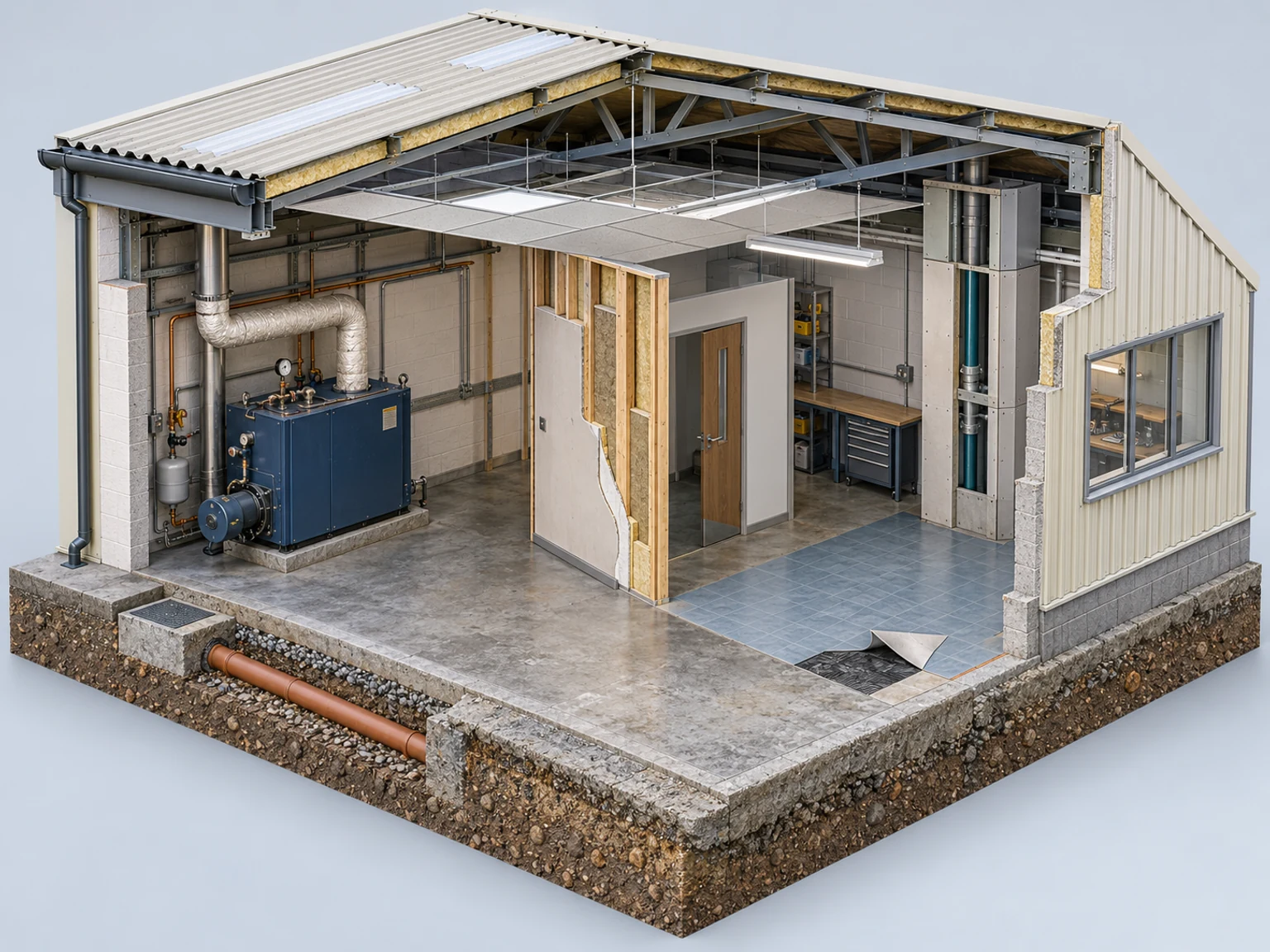
Use the cutaway to explore typical locations. The numbered locations are examples of where asbestos may occur, not a survey of a real building. Finding a similar-looking item on site does not confirm asbestos; an unmarked or unfamiliar location is not cleared by this diagram.
Start with your proposed task. Cable installation can reach above a suspended ceiling and through firebreaks. Plumbing can open boxing and expose lagging. Floor preparation can lift tiles and abrade adhesive. Roofing, scaffolding and cladding work can disturb soffits, fixings and rainwater goods. Groundworks can encounter old drainage, buried roof debris and residues near former plant.
Labels can help communicate known materials, but their absence proves nothing. A label may be missing, hidden or relate only to one item. Check the register, survey scope, drawings and work instructions. Look at the exact location from a safe position without lifting finishes to investigate.
ActivityOpen all eight location cards. For each one, connect the possible material to the action that could disturb it and the information you would request.
Select a red numbered dot to open the explanation, or read all eight locations below.
Architectural cutaway showing the eight learning locations. Illustrative only; not a survey or material identification.
Roof, soffit and rainwater goods
Possible material: Cement sheets, undercloak, soffit panels, gutters or downpipes. Task: Roof repair, scaffold fixing, cladding and drainage changes. Check: Exact product/location and condition; planned access and fixing method. Fragile-roof controls are a separate requirement. Stop: Unknown product, damage, new drilling or unsafe roof access.
Ceilings and hidden voids
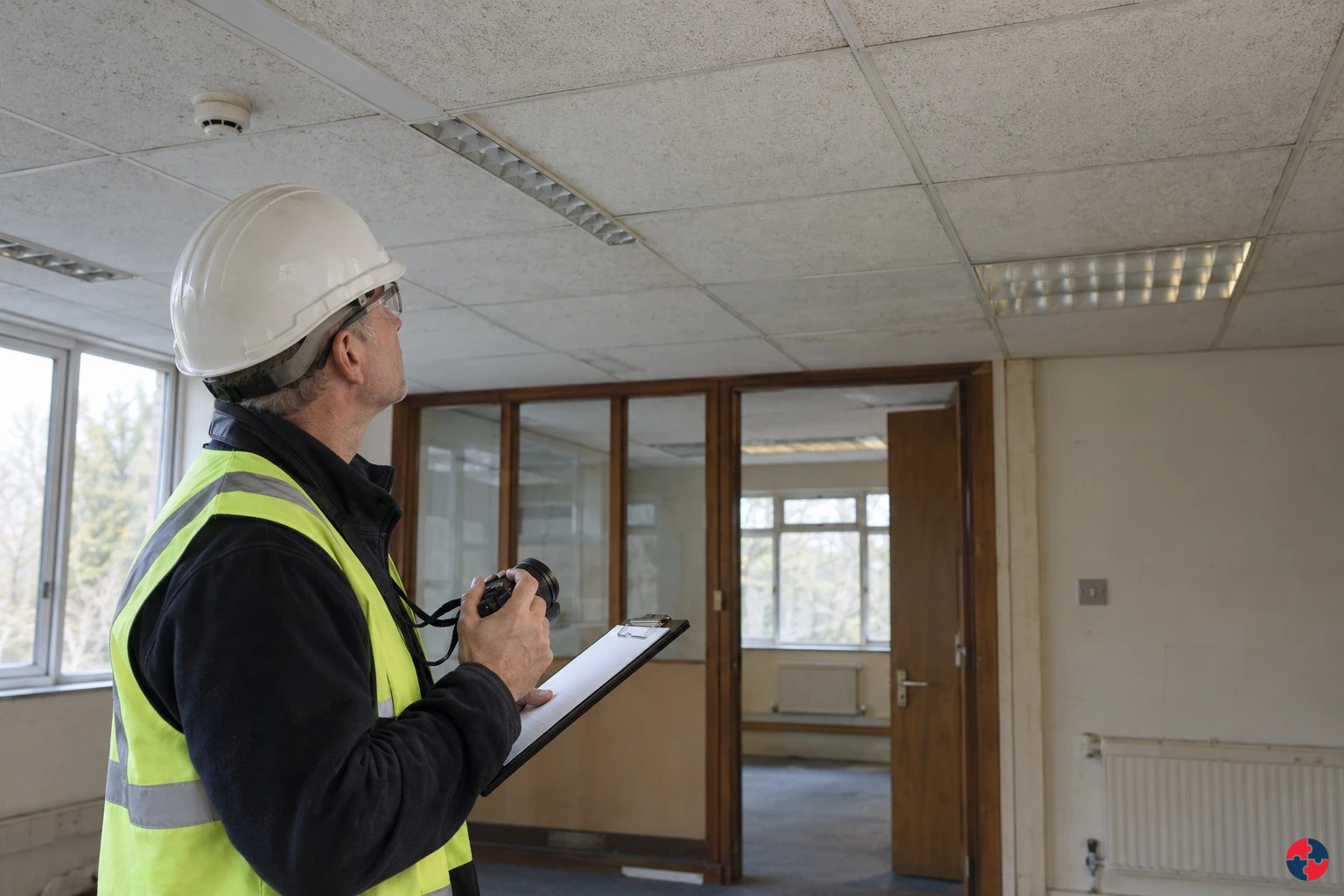
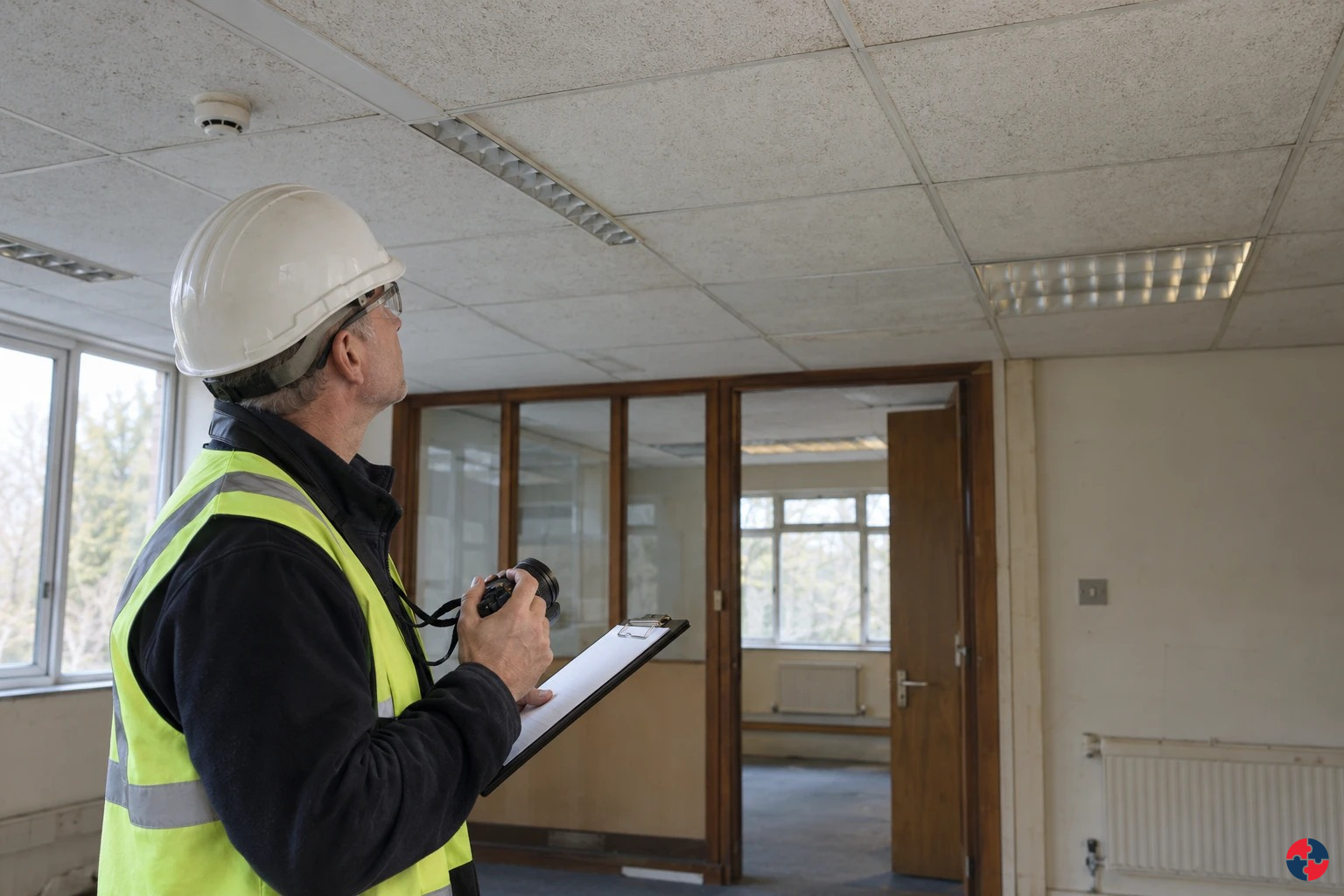
Possible material: AIB tiles, sprayed coatings, firebreaks or debris above the ceiling. Task: Cable routes, lighting, detectors and accessing services. Check: Survey scope for both visible ceiling and concealed void; exclusions and route. Stop: No-access caveat, unexpected board, loose debris or changed route.
Risers, boxing and fire protection
Possible material: AIB lining, packers, ducts or fire-protection panels. Task: Opening boxing, installing services, chasing and new penetrations. Check: Exact riser and layers assessed; restrictions on openings and fixings. Stop: Unsurveyed lining, material differing from the report, damaged panel.
Partitions and wall panels
Possible material: AIB partitions, panels, linings and window infill. Task: Demolition, drilling, joinery and fixing new fittings. Check: Both faces and hidden layers within the affected area, including proposed depth. Stop: New layer, uncertain board or task outside survey scope.
Floors and adhesive
Possible material: Vinyl tiles, bitumen adhesive, old layers and concealed debris. Task: Lifting floors, sanding, grinding or preparing new finishes. Check: Whether the floor build-up and method are covered, not just the surface finish. Stop: Unknown adhesive, concealed layer or proposed abrasion not assessed.
Plant and pipework
Possible material: Lagging, boiler insulation, gaskets, ropes, flues and residues. Task: Plumbing, HVAC maintenance, equipment removal and opening services. Check: Asset-specific information and condition; isolations as well as asbestos controls. Stop: Crumbling insulation, damaged lagging or unknown gasket/lining.
External cladding and openings
Possible material: Cement cladding, panels, window boards and external service ducts. Task: Facade work, fixings, scaffold ties, replacements and strip-out. Check: Exact panel and fixing location, access and risk to people below. Stop: New fixing through a suspect panel, broken edges or unexpected debris.
Slabs, trenches and made ground
Possible material: Buried pipes/flues, demolition fragments, lagging residues or contaminated fill. Task: Breaking slabs, digging, loading, screening and crushing. Check: Ground and historical service information; do not rely on a building-only survey. Stop: Suspect fragment, unexpected service, changed depth or affected spoil route.
OPTIONAL WORKFACE PRACTICE
Turn a location into a task question
Choose a response, read the explanation, then try another if needed.
You need to fix a cable beside one of the illustrated risers. What must your first question establish?
Whether this exact fixing route and the layers it will disturb are covered by suitable information.
Whether the riser looks like another one you used before.
Whether the course illustration labels it as a possible location.
Check the reasoning
Correct. Connect the real task, location and disturbance to the information and its limits.
Optional practice; it does not change your assessment or completion requirements.
Learning check
The diagram does not mark your proposed fixing point. What follows?
It is clear of asbestos
Only marked items need checking
You still need information for the exact fixing location
Explanation
A learning diagram is not site evidence. Match the exact location, depth, layers and method to competent information.
Sources: Your supplied construction operatives PowerPoint (59 slides), SHARE Knowledge Hub: asbestos management and safety, HSE: locations and taking the right action
LESSON 6 / Check before tools start
The survey must answer your job’s question
A document title alone is not enough.
A management survey supports the management of asbestos during normal occupation and routine maintenance. It can include sampling and some limited intrusion, but it is not a blanket clearance for opening up the building. Read its scope, drawings, assumptions and exclusions.
A refurbishment or demolition survey is designed to find asbestos in the area affected before intrusive refurbishment or demolition. It needs to be scoped to the planned work, including hidden materials and relevant voids. A report for a different floor, earlier scheme or limited phase cannot answer a new question automatically.
“No access” means unresolved
An entry such as “ceiling void not accessed”, “beneath slab excluded” or “live equipment not inspected” is a limitation. It does not mean no asbestos was found there. The employer and supervisor need competent advice to resolve the gap or redesign the job to avoid disturbance before authorising it.
Operatives should not open a concealed area themselves to help complete a survey. Intrusive surveys need competent planning, including control of other people and fit-for-reoccupation arrangements. Work can also encounter an unexpected layer despite existing information; stop and resolve that difference rather than extending the original assumption.
Ask at the briefingShow me where this report covers our route and what it could not inspect.
OPTIONAL WORKFACE PRACTICE
Find the gap in the work pack
A new cable route enters a ceiling void. Decide whether each item resolves that task.
Existing Hub workplace illustration. The scene prompts questions; appearance cannot establish whether material contains asbestos.
Choose between: Relevant evidence to check / Does not resolve this route.
A marked drawing that covers the proposed fixing points and void.
Relevant evidence to check. Check the relevant findings and limitations, not the drawing title alone.
A survey note saying the void was inaccessible.
Does not resolve this route. Inaccessible is unresolved. Do not lift tiles to investigate on your own authority.
A management survey from a different building.
Does not resolve this route. A different building cannot establish the status of this route.
A competent task review resolving exclusions before release.
Relevant evidence to check. The decision must actually address the route and any remaining restrictions.
Optional practice; it does not change your assessment or completion requirements.
Learning check
The cable route enters a void marked “not accessed” in a management survey. Choose the response.
Open one tile to look
Hold the intrusive work until the gap is competently resolved
Use a dust mask and continue slowly
Explanation
An inaccessible area remains uncertain. Resolve the scope before access or change the design through the planning route.
Sources: Your supplied construction operatives PowerPoint (59 slides), SHARE Knowledge Hub: asbestos management and safety, HSE: arrange an asbestos survey
LESSON 7 / Check before tools start
Read the register like a work instruction
Where. What. Condition. Restriction.
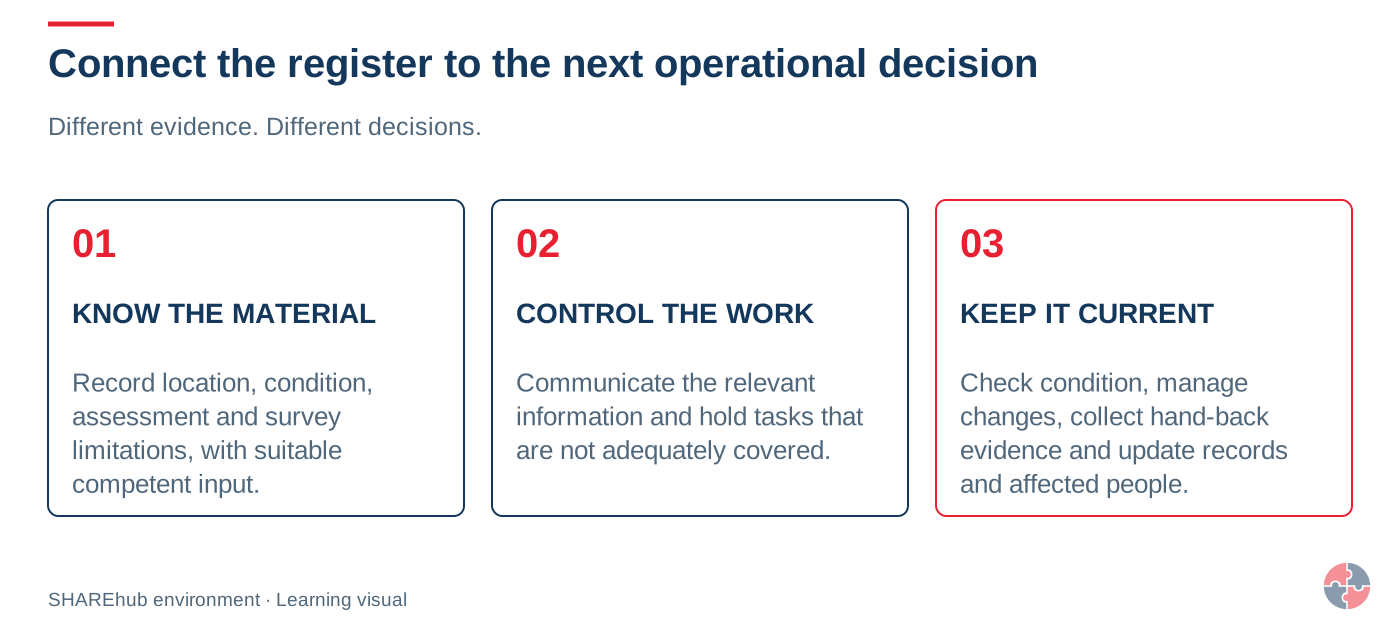
The register records known or presumed asbestos locations. The management plan sets out what will be done, by whom and when. A useful register is specific enough to match the workface: room or asset reference, drawing, material, extent, condition, restrictions and an inspection or update record. Ask how your task relates to it.
A register that says “AIB in service riser” is a warning to understand the route and avoid disturbing that material. It is not a licence to work beside it by any method. A “good condition” entry can still be unsuitable for a new penetration. Current appearance or work plans can change the disturbance risk even if the record has not caught up.
Illustrative register extract — fictional training example
Hold access until competent information resolves the gap
Yard / buried drainage route
Outside building survey scope
Request ground / service information; do not treat building report as clearance
Read the actual site report, not this example. If the record is vague, unavailable, inconsistent with the location or missing limitations, pause and ask. Before starting, know the named reporting contact and who can release the task after a change.
OPTIONAL WORKFACE PRACTICE
Read the register beyond its colour
Select the three fields that turn an entry into a useful instruction.
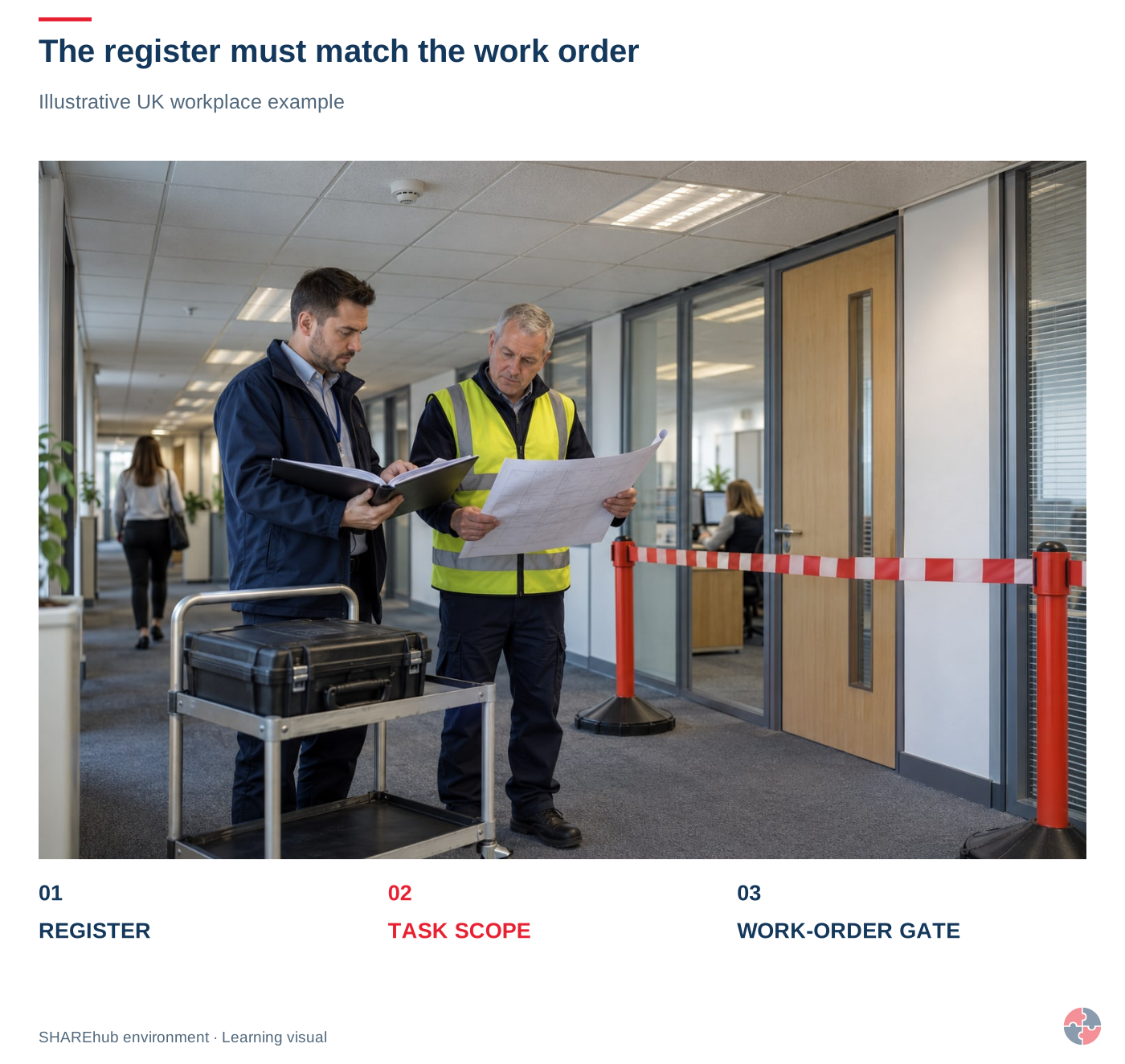
Existing Hub illustration: the register must match the work order, location and method.Location and extent
Find the exact item and the relevant limits. A room name may not cover a void, service penetration or hidden layer.
Condition and restrictions
Read what is known and what must not happen. Do not disturb material to check whether the entry is correct.
Task and change
Compare the planned method to the record. A changed fixing point or newly exposed layer sends the task back for review.
Optional practice; it does not change your assessment or completion requirements.
Learning check
An intact AIB panel is recorded as “no drilling”. You need a new fixing through it. What changes?
Nothing, because the recorded condition is good
The proposed disturbance requires a new competent decision
The entry authorises one small hole
Explanation
Condition and the planned task both matter. A good condition entry does not authorise drilling.
Sources: Your supplied construction operatives PowerPoint (59 slides), SHARE Knowledge Hub: asbestos management and safety, SHARE Knowledge Hub: risk management and compliance
LESSON 8 / Check before tools start
Make the check relevant to your trade
Choose a work task, then look for its hidden interface.
A generic induction is a starting point. Before your own task, identify the materials, layers, routes and access points that it could disturb. Consider the work needed to get to the task as well as the finished result: lifting access panels, moving plant, preparing a floor or fixing a scaffold can matter.
Select a trade below for a practical briefing prompt. Everyone can review every trade. If the work is outside your usual role, treat that as a reason to ask for the right briefing and competence, rather than borrowing another team’s assumptions.
Make the conversation specific
“We checked asbestos” is not enough. A stronger exchange is: “Our new pipe route enters the boxed riser on drawing R2. This survey excludes the boxing. We are holding opening work until the route is assessed or redesigned.”
Ask how other trades could affect your area. A crew breaking a nearby wall, a roofer dropping debris or an excavator tracking through suspect spoil can introduce a new risk after your own task was briefed. Tell the supervisor if shared routes, adjacent work or occupied areas are affected.
Personal promptWhich part of your next normal job could expose a layer that you cannot see now?
OPTIONAL WORKFACE PRACTICE
A small change can change the job
Choose a response, read the explanation, then try another if needed.
Photorealistic illustrative UK workplace scene. Review checks: FIND: The survey excludes the ceiling void. HOLD: Do not lift tiles or drill to investigate. RESOLVE: Arrange competent information and reassess the route.
A planned surface cable route changes to pass through an unassessed boxing. What happens next?
Continue because the cable and trade are unchanged.
Hold that change and ask for suitable information and a revised task decision.
Open a small inspection hole before asking.
Check the reasoning
Correct. The changed route needs its own evidence and authorised method before disturbance.
Optional practice; it does not change your assessment or completion requirements.
Learning check
The RAMS says “check for asbestos” but nobody can show information for your route. What do you do?
Treat the generic RAMS as clearance
Pause and ask for the exact workface evidence
Make a small opening to confirm the route
Explanation
A generic instruction does not close an information gap. The brief must connect reliable information to the actual work.
Sources: Your supplied construction operatives PowerPoint (59 slides), SHARE Knowledge Hub: asbestos management and safety
LESSON 9 / Check before tools start
Five checks before the tool touches fabric
Scope → information → briefing → workface → change.
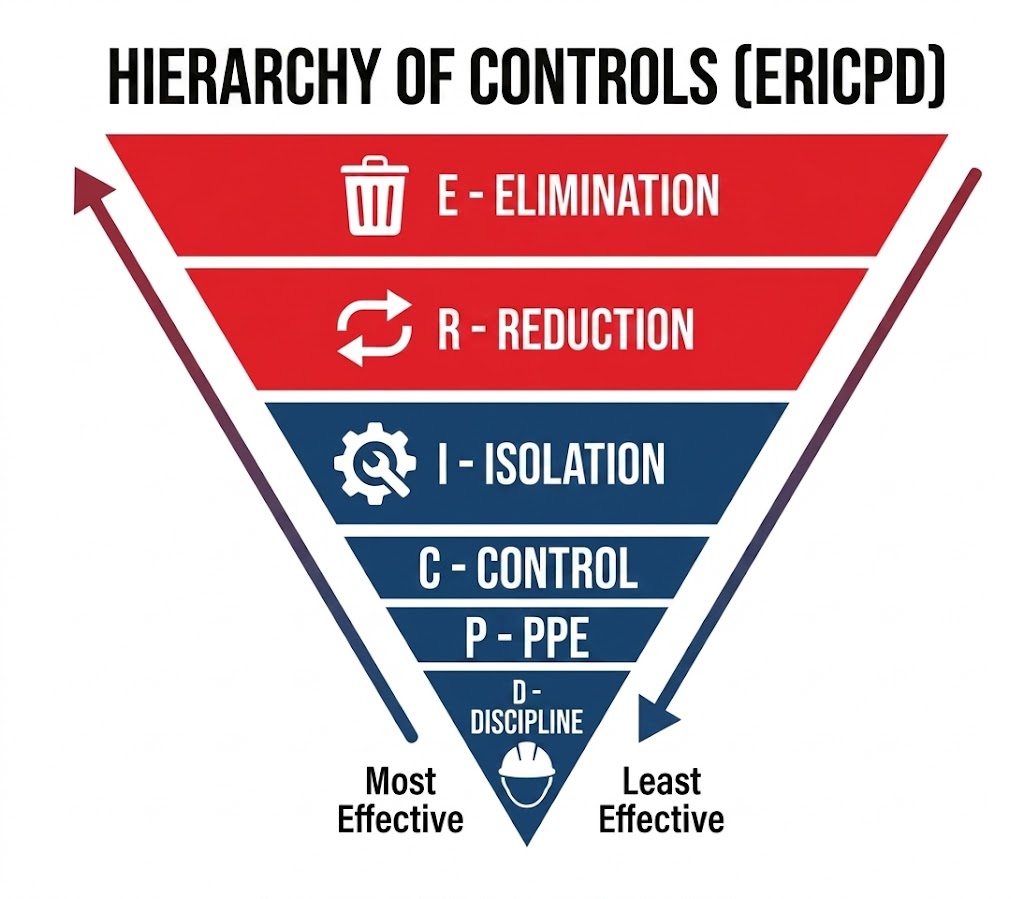
ERICPD hierarchy from your supplied deck. Prefer preventing disturbance through design and planning. Specialist removal is not an operative-level elimination task; PPE does not authorise work on unknown materials.
Use one repeatable routine. First, define what you will disturb: the location, dimensions, depth, layers, route, access and method. Include temporary fixings and preparatory work. A narrow job description can hide a wider disturbance.
Second, check the right information: survey and register extracts, drawings, restrictions and relevant task authorisation. Read exclusions and assumptions. Ask how the information covers the job, rather than accepting a report simply because it is on the site tablet.
Third, receive a clear briefing. It should name known or presumed ACMs, areas not to disturb, the agreed method and what change requires a stop. Confirm the reporting contact and emergency arrangements, including how a lone or remote worker can summon help.
Fourth, compare the brief with the actual workface from a safe position. Do the location and visible condition match? Is there unexpected debris? Do not disturb a material to investigate.
Fifth, keep a change trigger. A rerouted cable, deeper excavation, different board, hidden layer or damaged material means the original decision may no longer apply. Hold the affected work and seek a revised competent decision.
Not every task needs a stopA properly planned, authorised task that avoids disturbance and remains within its assessed scope can proceed. Uncertainty about a relevant material or deviation needs resolution before the affected work continues.
Use the hierarchy before relying on a mask
First consider an assessed design or route that avoids disturbance. Protect known materials and separate people from the affected area. Suitable information, competent planning, access control and the authorised method support the task. RPE and PPE belong within a properly assessed asbestos-work arrangement, with the required competence and equipment; they cannot compensate for an unknown material or missing survey.
OPTIONAL WORKFACE PRACTICE
Five checks, one workface
Use these prompts alongside the five pre-start checks in the lesson.
What exactly will touch the fabric?
Include the fixing, access step, route, depth and layers. A task name such as “install cable” is too broad.
Where does the evidence stop?
Read inaccessible areas and exclusions. Stop at the boundary until competent information resolves it.
What will make us pause?
Agree the unexpected material, damage or method change that triggers a hold, and who receives the report.
Optional practice; it does not change your assessment or completion requirements.
Learning check
An approved non-intrusive task remains within its brief, with known ACMs protected and no change. What is proportionate?
Proceed within the authorised scope and keep watching for change
Ignore the agreed controls because no drilling is planned
Remove the intact ACM first in every case
Explanation
Suitable intact ACMs can be managed in place. Follow the authorised no-disturbance method and stop if conditions change.
Sources: Your supplied construction operatives PowerPoint (59 slides), SHARE Knowledge Hub: risk management and compliance, SHARE Knowledge Hub: asbestos management and safety
LESSON 10 / Check before tools start
Asbestos does not cancel the other hazards
Keep the whole task safe.
An asbestos check is part of a safe task, not a substitute for the rest of the plan. Old cement roof sheets may also be fragile. Do not step onto them to inspect a label or reach a sample. Safe access and fall protection need their own competent plan, even where the asbestos arrangements are understood.
Opening older services can also involve electricity, gas, hot pipework, stored energy or confined spaces. Excavation introduces underground services, plant movement and collapse risks. Keep safe isolation and the relevant task controls in place when work pauses. Do not create a new emergency while responding to a possible asbestos find.
Pressure points
“We only need one fixing”, “the unit is empty” and “we have hired the lift already” do not resolve a survey gap. Work can often be redesigned to avoid an ACM, but that alternative needs assessment too. Moving a route into a different void without checking it transfers the uncertainty.
In a private home, do not assume that the absence of a premises register removes an employer’s asbestos responsibilities. The duty to manage premises has a particular scope, but trades still need to identify and control risks before disturbing materials. Tell your employer or supervisor when suitable information is missing.
Before a breakFinish the module checks, save your place and take a short break. Return ready to think about what may be below a slab.
OPTIONAL WORKFACE PRACTICE
Look at the whole workface
The illustration shows planning features, not confirmed asbestos. Open the checkpoints to connect the controls.
Existing Hub workplace illustration. The scene prompts questions; appearance cannot establish whether material contains asbestos.Access position
Check the task’s access arrangement as well as asbestos information. Avoid creating a fall risk while trying to inspect a hidden space.
People and route
Protect others and keep the workface controlled while the plan is resolved. A controlled route must still serve the actual activity.
Hidden services and fabric
Before fixing or opening, consider the other hazards affected by the route, including services. Resolve them through the task assessment.
Optional practice; it does not change your assessment or completion requirements.
Learning check
A roof looks like asbestos cement. Someone proposes climbing up to read a marking. What is the response?
Climb carefully between the bolts
Avoid access; resolve asbestos and fragile-roof risks through competent planning
Climb if wearing respiratory protection
Explanation
A roof can present both asbestos and fall-through risks. Neither appearance nor RPE provides safe access.
Sources: Your supplied construction operatives PowerPoint (59 slides), SHARE Knowledge Hub: asbestos management and safety, HSE: locations and taking the right action
LESSON 11 / Hidden below your boots
The old building may now be in the ground
A building register is not a ground investigation.
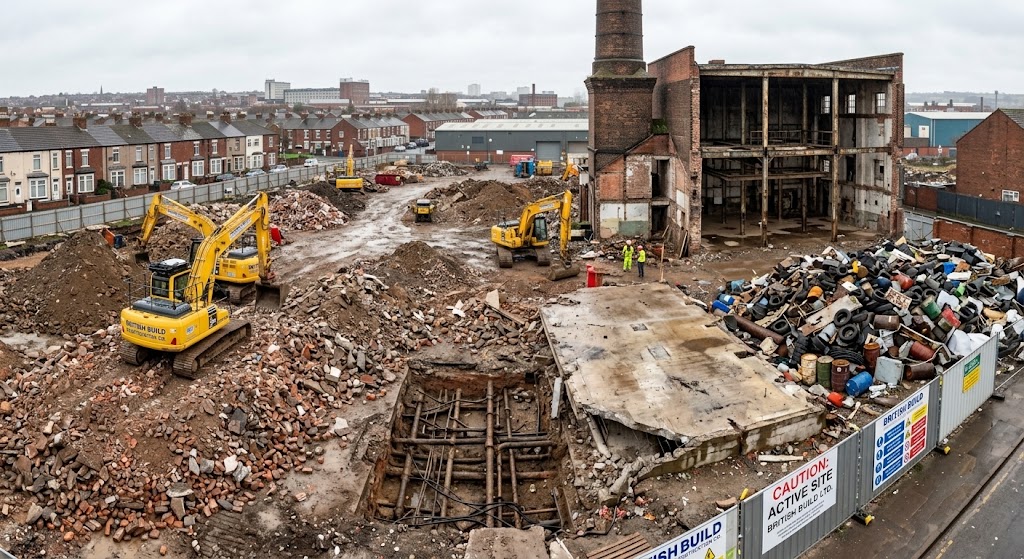
The supplied redevelopment scene prompts questions about former structures, fill, services and plant routes; it is not evidence about this particular site.
Redevelopment can expose demolition rubble, made ground, old service trenches, slabs, foundations and buried plant. Past removal or demolition may have left asbestos-containing fragments or residues mixed with other material. A current building survey may say nothing about that ground.
Think about previous land use: former boiler houses, industrial plant, old drainage, infilled structures or fly-tipping can all be relevant. Site history, ground information and a competent plan need to address the proposed excavation or processing. An awareness course cannot characterise the land or decide remediation methods.
What changes when a bucket enters the ground?
The bucket can expose and break material. A breaker can pulverise it. Loading transfers it to a stockpile or wagon. Screens and crushers can distribute it more widely. Tracks, wheels, footwear and tools can carry suspect contamination onto routes used by other workers.
Before work, know the hold points and report route for unexpected materials. If they appear, stop the affected activity, make the plant safe without further disturbance and alert the supervisor. Keep people and plant from entering or spreading the material. Do not grade it smooth, bury it again, hand-sort it or load it out as ordinary spoil.
Check the boundary of the evidence“The building was surveyed” does not mean “the ground and every buried service were assessed”.
OPTIONAL WORKFACE PRACTICE
Does a building record cover the ground?
Choose a response, read the explanation, then try another if needed.
The old unit has been demolished. A building survey is in the file; excavation will enter made ground. What is the gap?
The ground and the proposed excavation may need separate suitable information and assessment.
The building survey automatically clears all soil below it.
There is no gap if no large board is visible.
Check the reasoning
Correct. Do not assume that building coverage establishes the status of ground, buried debris or the new excavation.
Optional practice; it does not change your assessment or completion requirements.
Learning check
A building survey is complete, but the planned trench and made ground were outside scope. Is the excavation covered?
Yes, because both are at the same address
No — obtain appropriate ground and service information for the task
Yes, if no asbestos is visible from the surface
Explanation
Survey scope matters below ground too. Building information cannot automatically clear ground, buried structures or demolition fill.
Sources: Your supplied construction operatives PowerPoint (59 slides), SHARE Knowledge Hub: asbestos management and safety, SHARE Knowledge Hub: risk management and compliance
LESSON 12 / Hidden below your boots
Four real-photo decisions
Recognise a stop trigger; do not diagnose from a photograph.
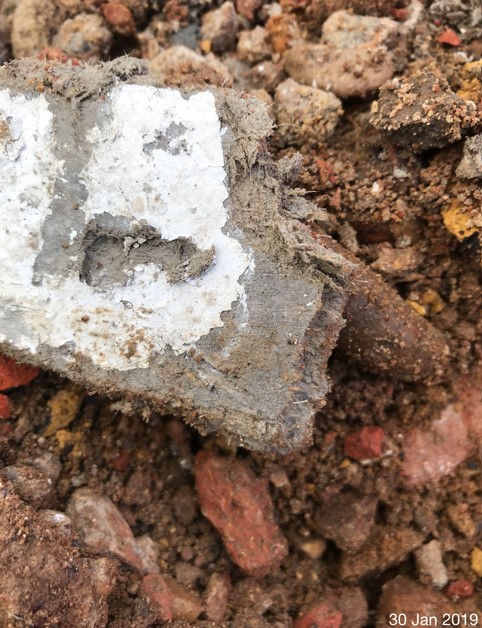
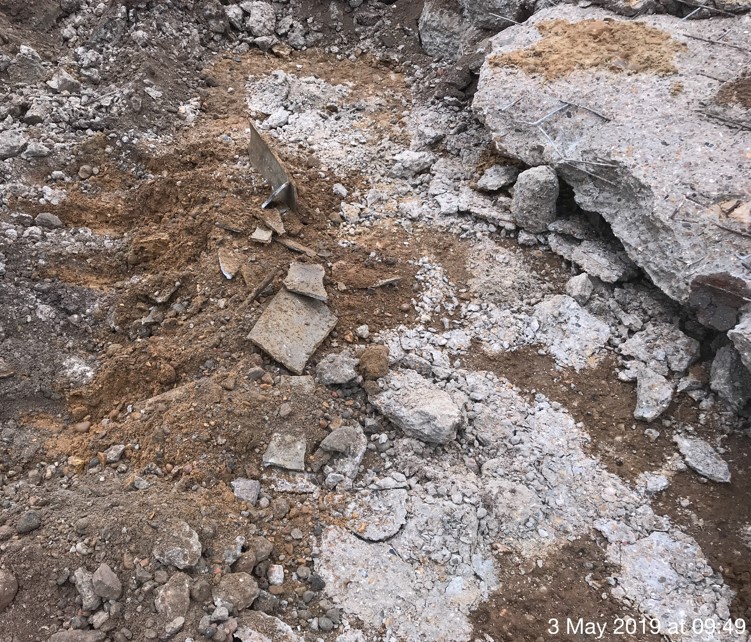
These four photographs come from your supplied PowerPoint. The material descriptions are the source deck’s labels, not new analytical confirmation. Use them to learn the situations that require a stop and a competent response. Similar-looking material on your site must be assessed through the site process.
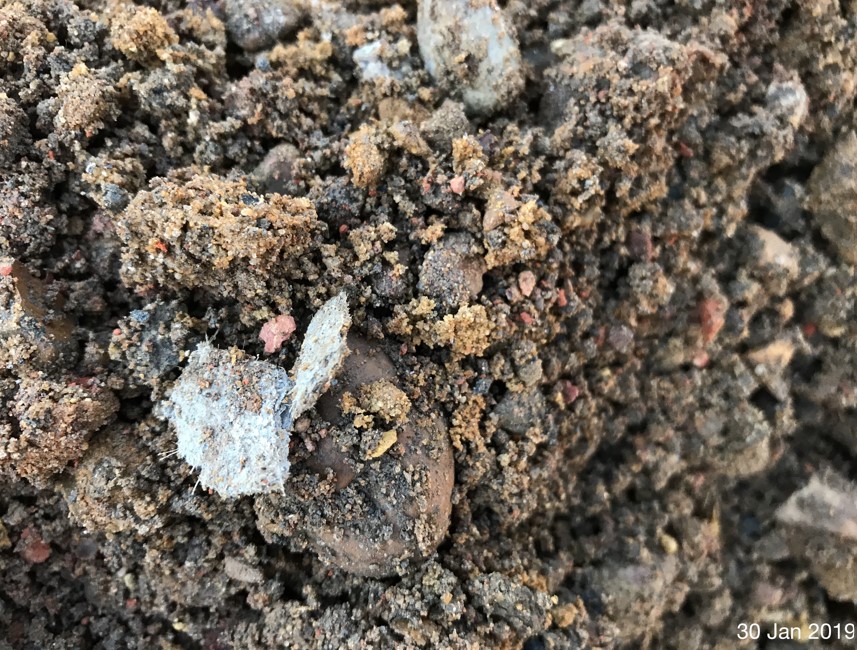
Open every photograph. Each shows a different trap: a damaged board that could be mistaken for rubble; a cement-like flue embedded in concrete; fragments that may be spread during slab breakout; and a very small fragment that someone might propose picking up by hand.
What all four have in common
The correct first action does not depend on naming the mineral or making a visual product diagnosis. It depends on recognising that suspect material may be disturbed by the proposed action. Keep the affected task stopped, prevent contact and report the exact find.
Do not touch, snap, scrape or bring a fragment to the site office to prove the point. If a photo can be taken from an already safe position without approaching the material or delaying the response, it can help the report. A photograph does not replace competent identification or risk assessment.
ActivityReveal all four case notes. Be ready to explain why “small”, “solid”, “outside” and “already broken” do not authorise handling or processing.
Source deck: damaged AIB fragment (slide 30)
Damaged board in rubble
Tempting mistake: It looks like ordinary rubble; perhaps we can shovel it out.
Decision: Stop. Do not pick, break or shovel the suspect material. Keep others away and obtain competent assessment.
Degraded insulation products can release fibres readily. Visual appearance does not confirm identity.
Source deck: cement flue in concrete (slide 31)
A flue within concrete
Tempting mistake: The concrete is solid, so breaking it cannot disturb the pipe.
Decision: Hold breaking or processing. Leave the material undisturbed and report it.
Breaking the surrounding concrete can also break an embedded ACM. A bonded matrix is not permission to demolish.
Tempting mistake: Load the broken material and clear the workface.
Decision: Stop affected breaking, grading and loading. Prevent plant and people spreading suspect material.
Spoil movement can transfer the problem to stockpiles, routes and vehicles.
Source deck: small AIB fragment (slide 33)
A very small fragment
Tempting mistake: It is too small to matter; pick it up with gloves.
Decision: Do not hand-pick. Stop and report the find and its location.
Size is not a safety test. One visible piece can be a clue to more material mixed through the ground.
OPTIONAL WORKFACE PRACTICE
Describe the photo without diagnosing it
Use observations to make a report that a competent responder can act on.
What can I actually describe?
Location, visible fragments or layers, the activity and any disturbance. Keep source-photo labels separate from claims about your own site.
What remains unknown?
Material identity, extent and exposure are not established by a photograph. State the uncertainty plainly.
What action follows?
Stop affected disturbance, protect others and report through the actual site arrangements. Do not collect a sample for the report.
Optional practice; it does not change your assessment or completion requirements.
Learning check
A tiny board fragment is found in spoil. What is the strongest response?
Pick it out because the quantity is small
Stop and report; do not hand-pick suspect debris
Crush it so nobody trips over it
Explanation
Small fragments can signal a wider problem. Hand-picking disturbs material and does not prove the remaining spoil is clear.
Sources: Your supplied construction operatives PowerPoint (59 slides), SHARE Knowledge Hub: asbestos dust
LESSON 13 / Hidden below your boots
Mixed debris defeats a quick visual clearance
One visible piece may be a clue to a wider problem.
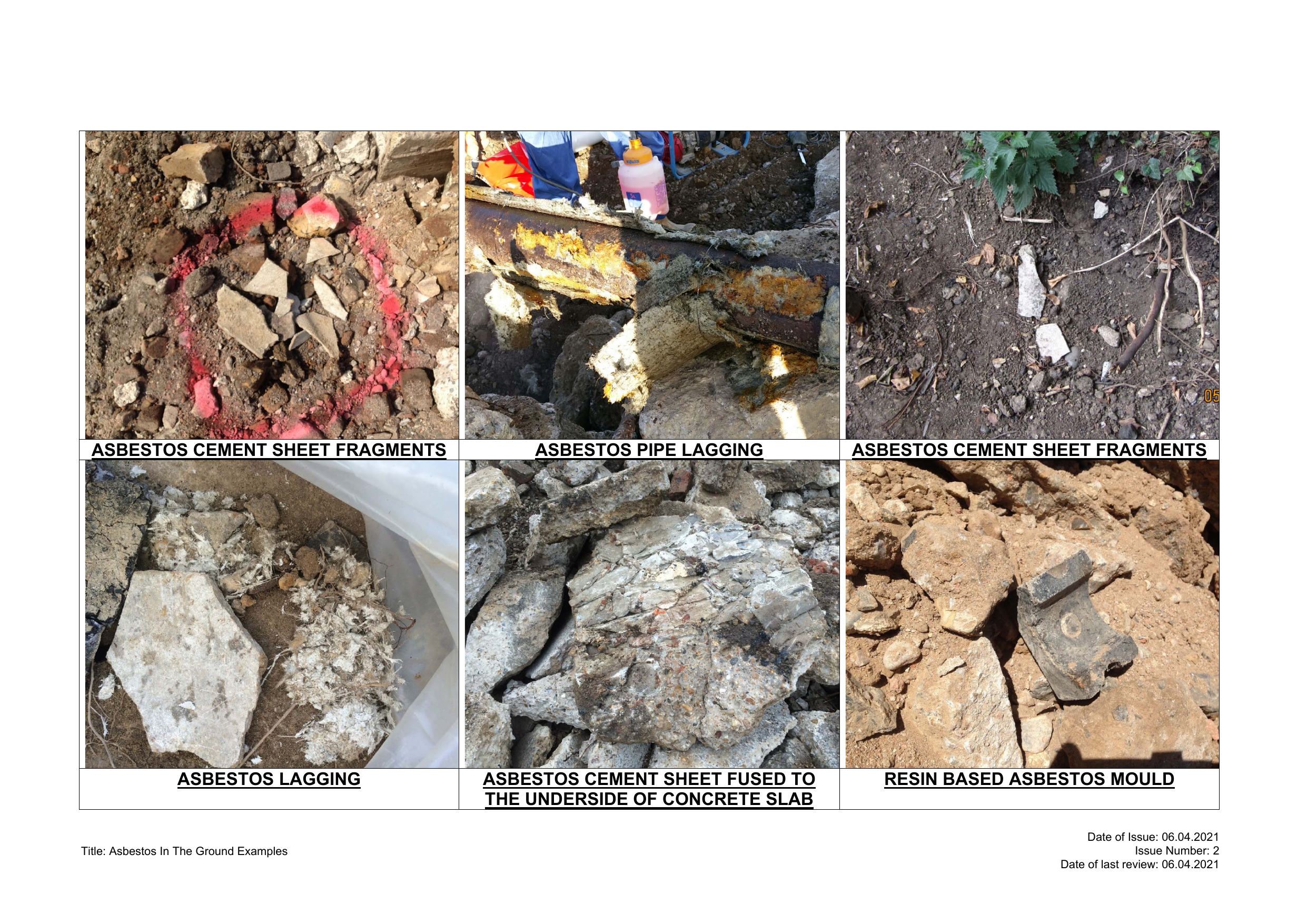
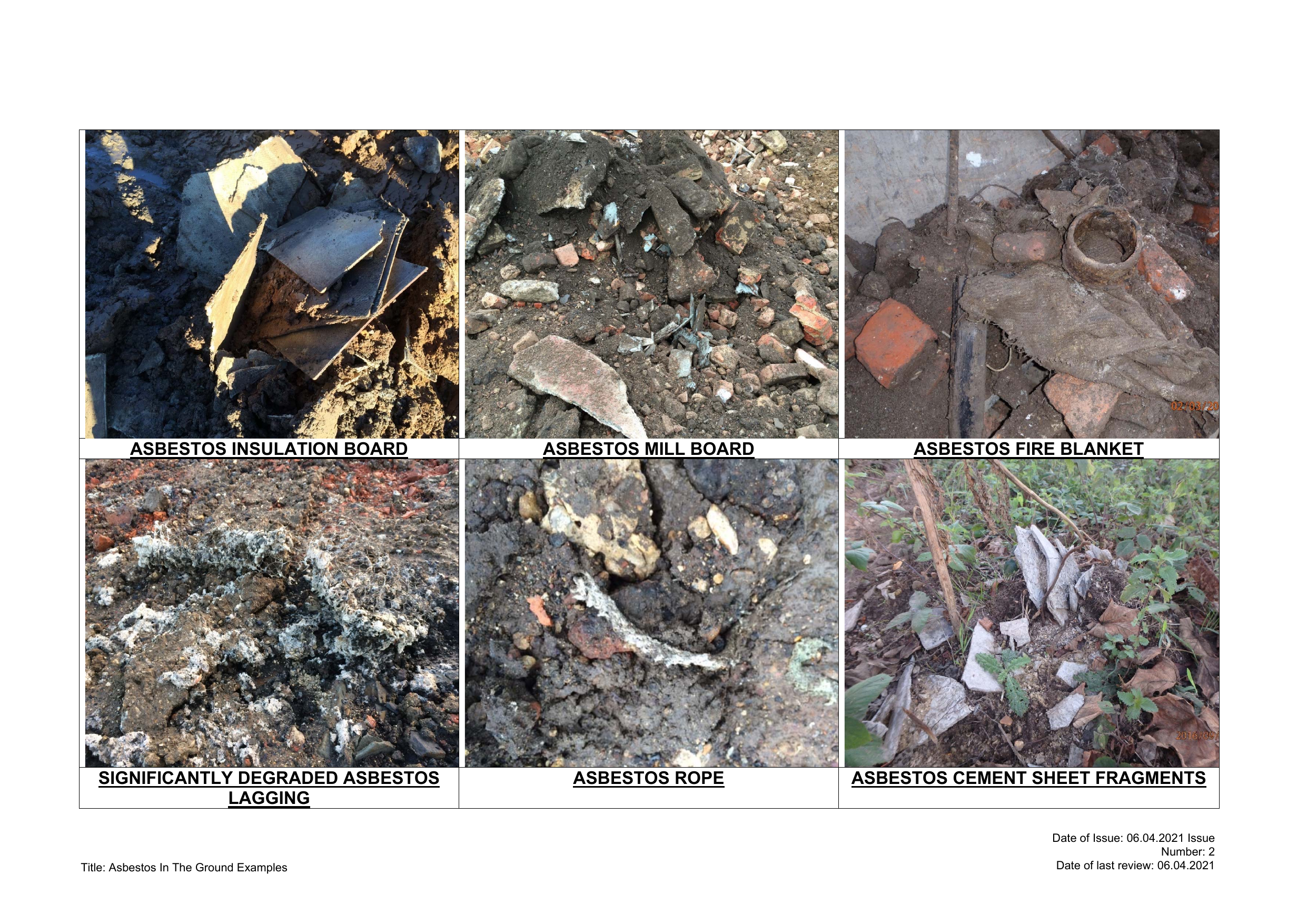
Ground-example sheet embedded in the supplied deck, slide 35. Labels are source examples; the collage includes both bonded and more readily releasing materials.
The source deck’s ground-example sheets show cement fragments, insulation board, lagging, millboard, rope and other products in mixed rubble or soil. Some pieces look solid; others are degraded and fibrous. Neither category should be sorted or assessed by an awareness-trained operative.
A visible fragment does not describe the full distribution of contamination. Other pieces may be beneath the surface, smaller, covered or already broken down. A quick walkover, a photograph or removing the obvious bits cannot demonstrate that a stockpile, trench or haul route is safe for the next activity.
Separate recognition from classification
It is useful to notice a suspicious board, pipe or residue and relate it to site history. It is not useful to declare “cement, therefore low risk” and continue. Competent assessment must consider material identity or presumption, condition, distribution and the proposed work. Ground remediation and processing require specialist planning beyond this course.
Keep the find and affected movements traceable. Tell the supervisor where it was exposed, where spoil has already been placed and what routes plant used. Do not follow a wagon into traffic or enter the suspect area to reconstruct events. Give what you know, mark uncertainty and let the responsible team coordinate the response.
The key distinctionRecognition starts the response. It does not close the investigation.
OPTIONAL WORKFACE PRACTICE
Useful evidence or false clearance?
Classify these statements about a mixed stockpile.
Choose between: Information for competent assessment / False clearance.
Where the load came from and where it was moved.
Information for competent assessment. The movement history helps assess extent and affected routes.
Someone picked out every piece they could see.
False clearance. Visible picking does not establish what remains or its distribution.
It is wet, so it must now be safe to screen.
False clearance. Dampness is not identification, clearance or authority to process the material.
What disturbance occurred and which plant/areas may be affected.
Information for competent assessment. Facts about disturbance and spread support the competent response.
Optional practice; it does not change your assessment or completion requirements.
Learning check
Someone has removed all visible fragments from a stockpile. Can it now be treated as clean?
Yes, if it looks clear
No — visual picking does not establish the remaining material is safe
Yes, if it is damp
Explanation
Visible fragments may be only part of the problem. Competent assessment must determine the stockpile’s status and next steps.
Sources: Your supplied construction operatives PowerPoint (59 slides), SHARE Knowledge Hub: asbestos dust
LESSON 14 / Hidden below your boots
The bucket, the stockpile and the haul road
Prevent spread before the footprint grows.
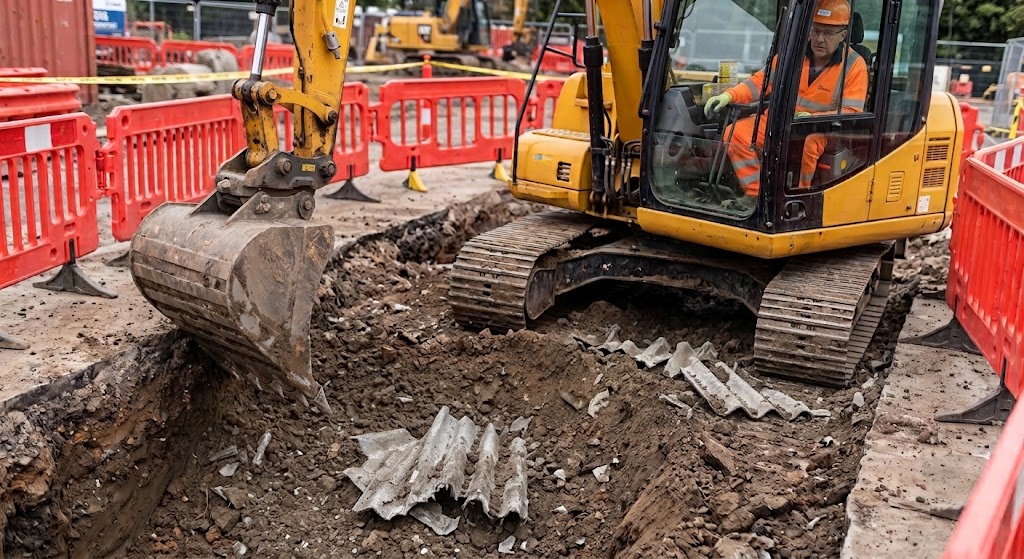
Illustration from the supplied deck. Treat exposed fragments as a reason to pause; this image is not a verified example of a safe working method.
An excavator exposes grey sheet fragments while removing made ground. Spoil has already been placed beside a haul road. Another operative suggests picking out the pieces while the next wagon is loaded. This is a change to the task: the material and extent are unresolved.
Control the interfaces
Stop the affected excavation and processing. Make plant safe using site arrangements without tracking through the suspect material or creating another hazard. Warn the supervisor or banksman so affected loading, stockpiling and vehicle movements can be held. Keep people away from the find and the potentially affected route.
Do not move the stockpile to a quieter corner, tip the bucket elsewhere, compact the area or send material off site to solve a programme problem. Each can spread the issue. Do not approach moving machinery or step into the excavation to investigate.
The supervisor needs facts: where the material emerged, which stockpile received spoil, what plant or loads may have been involved and what was stopped. Competent advice determines the affected area, recovery, plant status, material management and restart conditions. Dust suppression or a mask does not replace this decision.
ActivityResolve the three stages of the bucket scenario. A safe decision protects the excavation, the haul road and the people who may enter later.
1 / The first bucket
Sheet-like pieces appear. The bucket is near the stockpile; the next wagon is ready.
Discuss: Hold disturbance and affected movement before the footprint grows. Do not relocate, process or hand-sort the material.
2 / The haul road
A driver says the pieces are only in the excavation, so the haul road is unaffected. You saw spoil placed beside it.
Discuss: Give the movement history you know. The competent response determines affected areas; appearance does not clear the road.
3 / The next shift
A specialist is coming tomorrow. The stockpile is damp. Someone proposes screening the other end.
Discuss: Water, a cab and a booking do not establish a safe process. The hold remains until the task is properly resolved.
OPTIONAL WORKFACE PRACTICE
Stop the spread, not just the dig
Choose a response, read the explanation, then try another if needed.
Suspect fragments appear while a bucket is loading a stockpile. What needs the report to include?
Only the single fragment’s colour.
The affected digging, loading, stockpile and movements that could spread the material.
A new location to tip the spoil so work can continue.
Check the reasoning
Correct. Report the connected handling and movements, and hold the affected activity pending competent direction.
Optional practice; it does not change your assessment or completion requirements.
Learning check
A wagon is waiting beside suspect spoil. What should happen before loading continues?
Load quickly to clear the area
Hold affected movements and obtain competent direction
Let the driver decide by looking at the fragments
Explanation
Loading can spread suspect material off location. The affected movements need to be held and assessed through the site response.
Sources: Your supplied construction operatives PowerPoint (59 slides), SHARE Knowledge Hub: asbestos dust
LESSON 15 / Hidden below your boots
The groundworks briefing that helps you act
Agree the response before the find.
Supplied slide 36 examples include degraded insulation products and cement fragments. Appearance alone cannot classify the material or the work.
A good groundworks briefing explains the available site history and investigations, their limits, the excavation or processing scope and the unexpected-find procedure. It identifies the person to contact, the hold points and how plant operators, banksmen and other trades will communicate.
Ask what happens to spoil: where it is placed, whether it will be processed, who accepts a load and how a suspect find affects those decisions. Check the arrangements for boundaries, nearby workers and public access. Do not invent a universal exclusion distance; the competent assessment and site response must account for the actual circumstances.
Use the pause to improve the system
If a find occurs, record why it was unexpected. Was the ground outside the survey? Was a former structure omitted? Did a drawing fail to reach the workface? Did the route or depth change after the brief? The aim is to close the missing barrier before more people repeat the same task.
Restart needs a clear, task-specific release: the competent assessment has resolved the material and affected area; any necessary specialist recovery and verification are complete; the method and controls cover the next step; and the affected teams are briefed. “The specialist is booked for tomorrow” does not meet those conditions.
Break promptThink of the last groundworks job you saw. Who could have stopped the next load, and how would they have known that a find had occurred?
OPTIONAL WORKFACE PRACTICE
Test the briefing against a change
Open each change and identify what the next shift needs.
The excavation becomes deeper
Check whether the information and assessed method cover the new depth and layers. Stop the changed part if they do not.
The pile is moved to a new route
Do not improvise relocation of suspect material. Use competent direction and communicate the affected area and restrictions.
A new operator takes over
Pass on the actual task limits, hold points, reporting route and release status. “The other shift knows” is not a briefing.
Optional practice; it does not change your assessment or completion requirements.
Learning check
The asbestos specialist has been booked. Can processing restart while the crew waits?
Yes, because action has been arranged
No — booking attendance is not assessment, recovery or release
Yes, on the far side of the same unassessed stockpile
Explanation
Work remains held until the actual task-specific assessment, required controls and release are in place.
Sources: Your supplied construction operatives PowerPoint (59 slides), SHARE Knowledge Hub: risk management and compliance
LESSON 16 / Stop, protect and report
A calm response to unexpected material
Stop. Prevent access. Avoid disturbance. Report.
You notice suspect material before it has been disturbed. Stop the affected task immediately. Avoid further contact and make the tools or plant safe without disturbing the material. Warn others so they do not continue the same activity or walk into the area.
Prevent access using the site arrangements from a safe position. Do not enter a suspect area to put a barrier in the ideal place. Report to the person in charge as soon as possible, identifying the location, task, material uncertainty and what has been stopped. Follow the site procedure for competent assessment.
What not to add
Do not snap a sample, scrape a surface, lift a panel, collect debris, dry sweep, use compressed air or an ordinary vacuum. Do not ask an unprotected colleague to “just have a look”. These actions can turn a discovery into a release.
Sampling and analysis, or a competent decision to presume asbestos and apply the appropriate arrangements, are managed through the responsible person. They are not a new task for the person who found the material.
ActivityPut the response cards in a sensible order. In a real event, warning, restricting access and reporting may overlap; do not delay an urgent warning while completing a checklist.
OPTIONAL WORKFACE PRACTICE
What the sequence does not mean
The required response activity below rehearses priorities. Open these important limits.
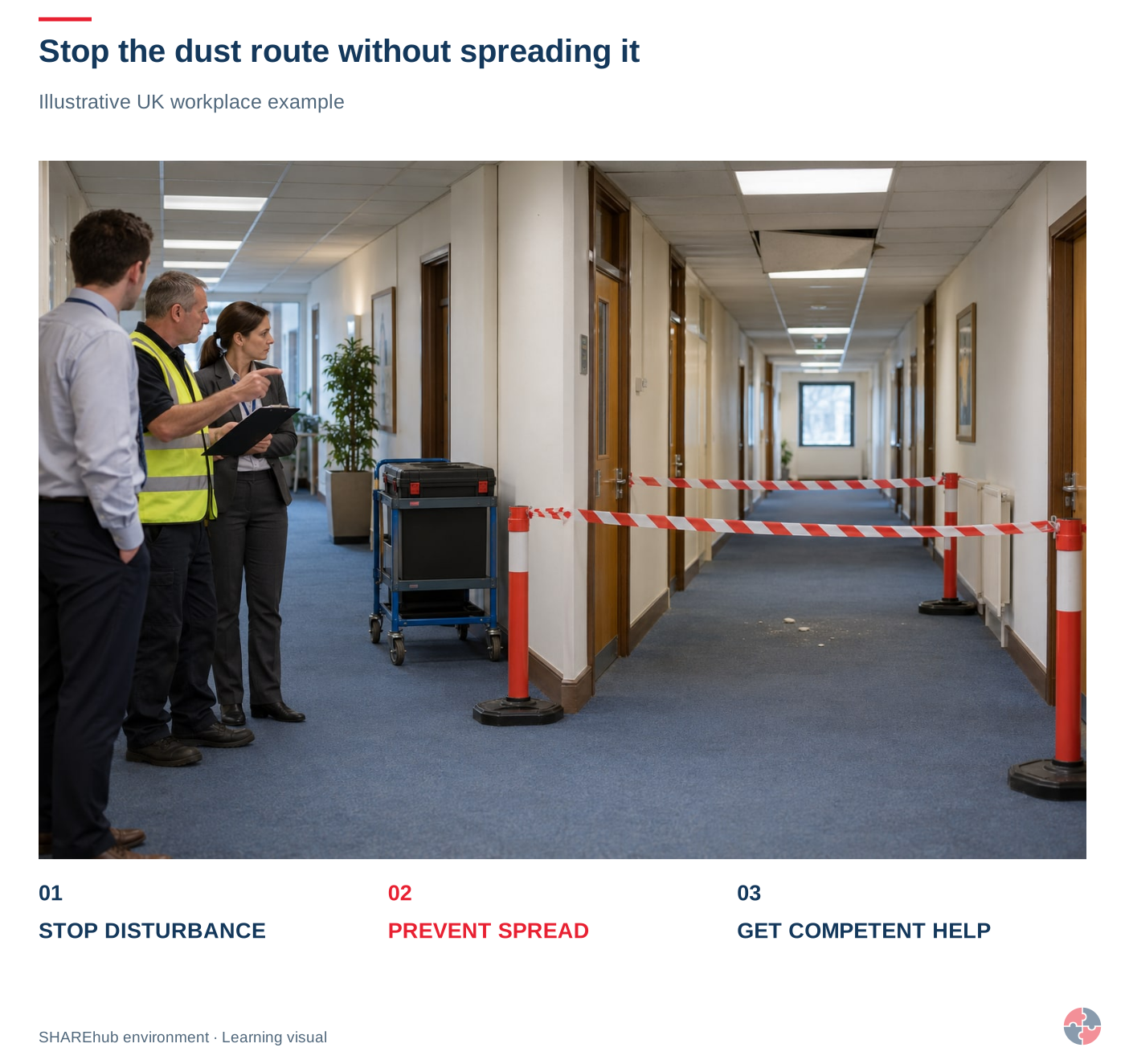
Existing Hub dust-route illustration; it supports the priorities, not a do-it-yourself clean-up method.Do I wait to warn people?
No. Stop further disturbance and warn/protect people promptly. Urgent actions may overlap; do not wait for a numbered exercise step.
Do I collect evidence first?
No. Do not handle suspect material or enter an affected area just to improve a report or photograph.
Does a barrier finish the response?
No. Keep the hold, report and follow the competent response and site emergency arrangements.
Optional practice; it does not change your assessment or completion requirements.
Learning check
You find suspect debris in a corridor. Which action could make the incident worse?
Warn the supervisor from a safe position
Keep others away
Sweep it aside to reopen the route
Explanation
Sweeping can spread contamination. Keep the route controlled and obtain competent advice.
Sources: Your supplied construction operatives PowerPoint (59 slides), SHARE Knowledge Hub: asbestos dust, HSE: discovery or accidental disturbance (EM1)
LESSON 17 / Stop, protect and report
If dust has already been released
Use the emergency plan; prevent further spread.
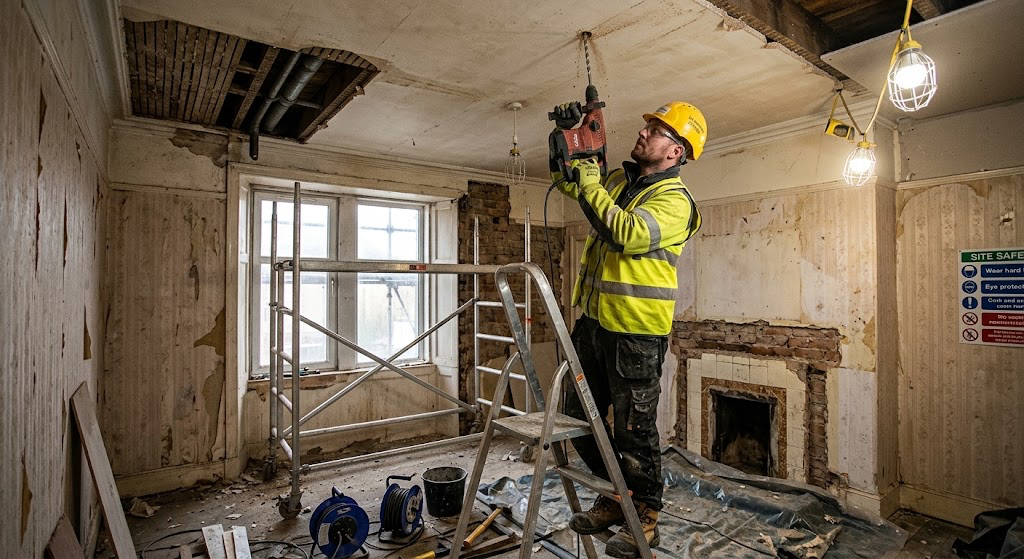
Pause this task: the supplied illustration shows drilling in older fabric. It is a discussion prompt about missing checks, not an endorsed method or PPE example.
A drill, saw or breaker stops being a normal task when unexpected suspect material releases dust. Stop the activity, warn people who may be affected and raise the site emergency response immediately. Keep unnecessary people out. Do not finish the cut, fetch an ordinary vacuum or re-enter for tools.
People, clothing and movement
Follow the site emergency arrangements for leaving the affected area and preventing spread. Tell the responder immediately if dust or debris may be on clothing, footwear, skin or hair. Do not brush or shake clothing, walk through clean areas, enter a vehicle or take potentially contaminated workwear home. Seek competent assistance promptly.
Where someone is heavily contaminated, avoid moving contamination around and summon help from a safe position; the site emergency arrangements must provide competent assistance and suitable decontamination. Do not interpret “stay put” as an instruction to remain in an immediately dangerous situation. Alert the responder to fire, structural, electrical or other urgent hazards.
This course does not teach asbestos clean-up or a decontamination method. The employer’s plan and competent response must address people, equipment, access and recovery. HSE EM1 is provided as the reference for those arrangements. An improvised dust mask or wiping routine does not authorise a return to the task.
First messageSuspected asbestos disturbance. Work stopped. People may be affected. Access needs controlling. We need the site emergency response.
OPTIONAL WORKFACE PRACTICE
Avoid taking contamination into clean areas
Choose the appropriate response route.
Choose between: Use the site emergency/competent response / Do not improvise this action.
Report dust or debris on clothing and follow the emergency arrangements.
Use the site emergency/competent response. Tell responders about potentially affected people and avoid spreading contamination.
Brush workwear off before entering the van.
Do not improvise this action. Brushing or shaking can spread fibres; do not improvise decontamination.
Take suspect workwear home for washing.
Do not improvise this action. Do not take potentially contaminated workwear into clean areas or home.
Warn people and prevent further affected work from a safe position.
Use the site emergency/competent response. Protect others without entering the affected area to investigate or clean it.
Optional practice; it does not change your assessment or completion requirements.
Learning check
Dust may be on a worker’s overalls after a suspect disturbance. Which is appropriate?
Shake them outside, then drive home
Report the contamination and use the site emergency/decontamination arrangements before spreading it
Use compressed air to clean them
Explanation
Avoid spreading contamination and get competent assistance through the emergency arrangements. Do not brush, shake or take suspect workwear home.
Sources: Your supplied construction operatives PowerPoint (59 slides), SHARE Knowledge Hub: asbestos dust, HSE: discovery or accidental disturbance (EM1)
LESSON 18 / Stop, protect and report
Give a report someone can act on
Facts first. Uncertainty clearly marked.
A useful report identifies the exact place and the work taking place. Use a room, asset, grid or drawing reference where known. State when the material appeared, what was being done, whether dust or damage was observed and which activities and movements were stopped.
Identify potentially affected people and areas through the authorised incident route. Explain where tools, plant, spoil or vehicles may already have moved. Only give what you know. “Grey board-like fragment; identity unconfirmed” is better than “definitely harmless cement” or an invented fibre concentration.
Protect people and records
A photograph from an existing safe position can support the report; do not approach, touch or collect material to improve it. Preserve relevant job packs, survey limitations, briefings and a factual timeline. Use the organisation’s approved system for personal details. This training activity uses a fictional event and does not collect a real worker’s medical information.
The responsible person, with competent advice, determines incident classification, exposure assessment and any regulator reporting. Not every suspicion is automatically a reportable RIDDOR event. Operatives should report internally without waiting to decide the legal threshold.
ActivityChoose the statements that belong in the initial report. Separate observed facts from an unsupported diagnosis, guessed identity or a promise that work is safe.
OPTIONAL WORKFACE PRACTICE
Which first message helps the responder?
Choose a response, read the explanation, then try another if needed.
Existing Hub diagram: factual reporting helps connect the event to task and register review.
Choose the useful first report for a fictional exercise.
“Definitely harmless cement. We carried on.”
“Work stopped at the north riser after fragments appeared during opening; identity unknown; access held; supervisor informed.”
“Everyone was exposed to a low dose.”
Check the reasoning
Correct. The message gives location, activity, uncertainty and actions without inventing identity or dose.
Optional practice; it does not change your assessment or completion requirements.
Learning check
Which is the strongest initial description?
“Definitely AIB; exposure level low” without analysis
“Board-like fragments exposed in trench T2 at 10:20; identity unknown; excavation and loading stopped”
“All fine now because the dust has settled”
Explanation
Give location, time, task, observations, uncertainty and actions. Do not guess identity, dose or clearance.
Sources: Your supplied construction operatives PowerPoint (59 slides), SHARE Knowledge Hub: asbestos dust, SHARE Knowledge Hub: asbestosis, HSE: exposure, health concerns and other questions
LESSON 19 / Stop, protect and report
Who owns the next decision?
Your stop starts a coordinated response.
The operative checks and follows the agreed task, stops when information or conditions do not match, avoids disturbance and reports promptly. This remains valuable even if the operative cannot name the material. Nobody needs to wait for proof before reporting a reasonable suspicion.
The employer and supervisor plan and brief the work, maintain the hold, coordinate other trades and obtain competent advice. The dutyholder manages premises asbestos information and communication within the scope of that duty. In shared premises, information may need to come from more than one party.
Competent asbestos specialists undertake the identification, sampling, assessment, controlled work or verification that their roles and authorisations cover. A surveyor, removal contractor and analyst are not interchangeable job labels. The competent work-category decision determines what arrangements are required for the actual material, condition and method.
Keep responsibility visible
Ask who has taken your report and who is controlling access. Do not assume that a sent message has stopped the next team. The supervisor should coordinate the boundaries, other contractors and occupants. An appointment with a contractor does not remove the employer’s or premises parties’ own responsibilities.
Pressure response“I’m holding this task because our information does not cover the material. Please get the competent decision and brief the revised method before we restart.”
OPTIONAL WORKFACE PRACTICE
Match the decision to the right route
This does not replace your organisation’s named responsibilities.
Existing Hub responsibility diagram. The actual organisation must name its decision owners.
Choose between: Operative reports/holds within their role / Competent responsible decision.
Stop your affected task and tell the supervisor about an unexpected layer.
Operative reports/holds within their role. Use the stop/report arrangements; do not wait for a material diagnosis.
Determine the asbestos work category and required controls.
Competent responsible decision. That requires appropriate competence and information for the actual work.
Confirm the released area and method before directing restart.
Competent responsible decision. The responsible route must be supported by the required competent process and evidence.
Tell the incoming team the current restriction in the agreed handover.
Operative reports/holds within their role. Communicate the actual hold or authorised release, not an unsupported assurance.
Optional practice; it does not change your assessment or completion requirements.
Learning check
A colleague says the removal contractor’s arrival transfers all site responsibilities to them. Is that sufficient?
Yes, the specialist owns everything
No — the host and employer still need to coordinate their responsibilities and interfaces
Yes, if the contractor is wearing overalls
Explanation
Specialists have defined tasks; employers, supervisors and premises parties still need to coordinate access, information and follow-on work.
Sources: Your supplied construction operatives PowerPoint (59 slides), SHARE Knowledge Hub: risk management and compliance
LESSON 20 / Stop, protect and report
Restart is a decision with evidence
Dust settling is not clearance.
Restart the affected task only after the competent process has resolved the material and risk, the required actions are complete and the responsible person has authorised the next activity. The evidence must cover the area and task you will actually undertake.
Depending on the circumstances, the route may involve confirmation that the suspect material is not asbestos, or a competent presumption and asbestos work plan; revised design to avoid disturbance; specialist recovery; and appropriate verification or clearance before reoccupation or follow-on work. Do not demand the same certificate for every situation; ask what evidence is required for this one.
What the operative needs to hear
Which location is released? What material remains? What method is allowed? What is still restricted? Who has authorised this work and what change means stop again? The updated register, drawings, permit or briefing must tell the same story.
A visible clean floor, stopped alarm, verbal “looks fine”, photograph, water spray or elapsed time cannot substitute for the competent release. Do not resume under an old permit if the material, method, route or controls have changed.
Handover mattersTell the next shift and other affected trades about residual materials and restrictions. A good response is incomplete if tomorrow’s worker repeats the same disturbance.
OPTIONAL WORKFACE PRACTICE
Evidence for restart or reassurance alone?
Classify what the next team has been told.
Photorealistic illustrative UK workplace scene. Review checks: MANAGE: Read HSE's duty-to-manage guide. LEARN: Use the introduction and published examples. APPLY: Follow the full page's work and incident routes.
Choose between: Evidence to verify through the responsible route / Reassurance alone.
The task and area released, with remaining restrictions and an authorised revised method.
Evidence to verify through the responsible route. Verify that the release covers this task, area and method, and brief affected people.
The dust has settled and the floor looks tidy.
Reassurance alone. Appearance and time passing are not clearance or a task release.
Required competent recovery and verification are complete for the release.
Evidence to verify through the responsible route. Confirm the actual evidence and its limits with the responsible person.
Someone said a specialist visited earlier.
Reassurance alone. A visit does not tell the team what was done, verified or released.
Optional practice; it does not change your assessment or completion requirements.
Learning check
The dust has settled and the floor looks clean after an incident. What is needed before the task restarts?
A quick visual check by any operative
The competent assessment, required recovery/verification and task-specific authorised briefing
An extra disposable mask
Explanation
Appearance and elapsed time do not establish clearance. Restart follows the competent process and updated task controls.
Sources: Your supplied construction operatives PowerPoint (59 slides), SHARE Knowledge Hub: asbestos dust, SHARE Knowledge Hub: risk management and compliance
LESSON 21 / Stop, protect and report
After the event: support and learning
Record accurately without making medical promises.
After a possible exposure, follow the employer’s incident process so the facts and affected people can be considered with competent advice. Useful facts include date, duration, work, material information if known, people nearby, observed dust and the immediate response. Do not invent an exposure level or circulate personal health details in an open group chat.
Workers with concerns can contact their GP or occupational health and explain the possible exposure, including the work history and any confirmed material information. Individual risk and medical decisions belong with qualified professionals. HSE does not recommend routine chest X-rays solely because of an inadvertent exposure; an X-ray cannot tell whether fibres were inhaled. Follow clinical advice about your own circumstances.
Look behind the last tool used
Was the survey scoped to the job? Was a caveat ignored? Did the route change? Was the register usable at the workface? Were other trades briefed? Did the emergency plan address clothing, lone workers and plant? Record actions with an owner and check that the barriers have been repaired before work repeats.
Make it easy for people to report early. An operative who pauses over an unfamiliar fragment may prevent a larger incident. Learning should improve the planning and response, rather than relying on that person to recognise every product perfectly.
Ready for the final moduleYou have practised prevention, discovery, disturbance, reporting and restart. Next, combine them under real programme pressure.
OPTIONAL WORKFACE PRACTICE
Support without making a diagnosis
Open the three parts of a useful response to a worried colleague.
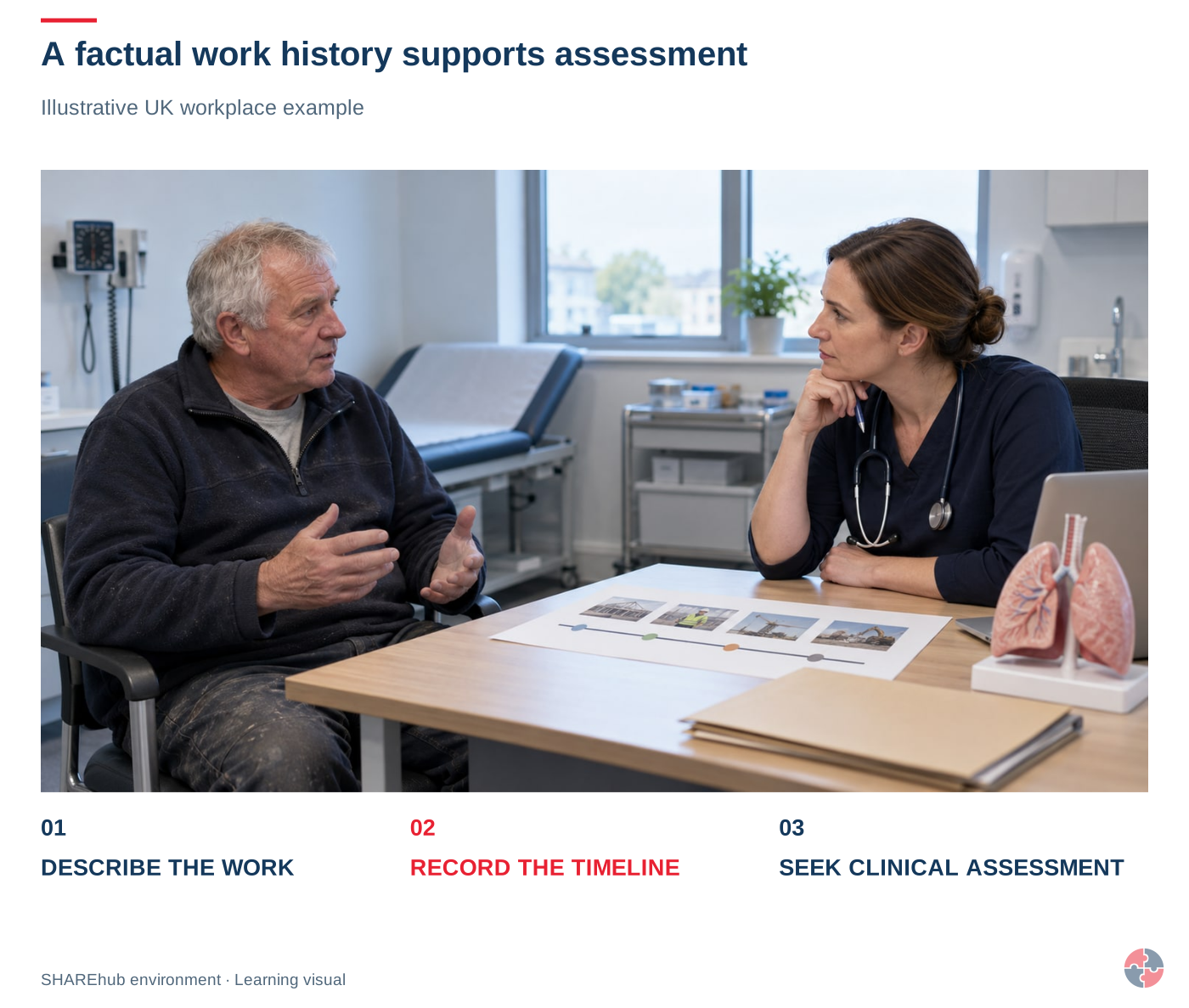
Existing Hub illustration: factual work history can support qualified assessment; the course does not diagnose disease.Listen and record facts
Use the approved route for the activity, date, location, people potentially affected and actions. Handle personal information appropriately.
Use qualified advice
Signpost individual health concerns to GP or occupational health as appropriate. Do not diagnose from a photograph or promise there is no risk.
Learn from the control gap
Review why the task reached the disturbance point and how the information, briefing or hold process can improve. Avoid blame and guessed exposure claims.
Optional practice; it does not change your assessment or completion requirements.
Learning check
A worker asks whether a suspected exposure will cause illness. What is the appropriate response?
Promise there will be no harm
Record facts, support the incident process and direct individual health concerns to a GP or occupational health
Diagnose asbestosis from the event description
Explanation
Keep the response factual and supportive. Colleagues cannot predict or diagnose individual disease from a reported event.
Sources: Your supplied construction operatives PowerPoint (59 slides), SHARE Knowledge Hub: asbestosis, HSE: exposure, health concerns and other questions
LESSON 22 / Bring it together
Your job: industrial unit refurbishment
Three linked decisions. One consistent standard.
Scenario illustration from the supplied deck. The industrial unit, task pack and dialogue in this exercise are fictional training examples.
You are working on a pre-2000 industrial unit. The job includes internal strip-out, a new service route, slab breaking and drainage diversion. A management survey is in the site office. It excludes concealed service boxing, slab edges and the outside trench.
The programme is tight. An electrician wants to open the boxing. In the yard, a groundworker sees cement-like pipe fragments after the first bucket. A wagon is waiting and the supervisor wants to know what can happen next.
Read the work, the information and the change together
The building’s age prompts a check, but the actual decision turns on the survey exclusions and the tasks proposed. Internal intrusion needs suitable information for the route. The building report does not clear the ground. The new find affects spoil and plant movement as well as the fragment itself.
Your response should be specific: hold the affected activities, prevent further disturbance and spread, report the known facts and missing information, then use competent assessment to define the next steps. A mask, smaller tool or change of operator cannot close the gap.
ActivityMake all three decisions. Read the consequence of each choice. You must resolve each safely to complete this lesson.
1 / The service boxing
A management survey excludes the riser lining. The electrician wants to open it to see what is behind.
Discuss: An excluded area remains uncertain. Opening it for a look is intrusive work, not a substitute for a competent survey.
2 / The trench find
Cement-like fragments emerge beside the slab. A wagon is waiting to take the spoil.
Discuss: The stop must cover the activity and relevant spoil/plant interfaces. Do not process, sort or export uncertainty.
3 / The restart meeting
The material has been assessed. The next task will use a different route. What must the crew receive?
Discuss: Assessment must lead to an authorised plan for the actual next task. Check what is released and what remains restricted.
OPTIONAL WORKFACE PRACTICE
Pause the change in the refurbishment
Choose a response, read the explanation, then try another if needed.
The permit covers surface work, but the client now asks for a hole through an unassessed panel. What controls the next decision?
The original permit title.
The programme deadline.
The changed task and the missing evidence for that panel and method.
Check the reasoning
Correct. Hold the changed intrusive work and resolve its information and method through the responsible route.
Optional practice; it does not change your assessment or completion requirements.
Learning check
Which statement best supports the hold?
“All old buildings are too dangerous for any work”
“The survey excludes our intrusive route and ground; a suspect find has changed the task and needs competent assessment”
“Nobody should report until a laboratory proves asbestos”
Explanation
State the specific gap and change. This supports a proportionate, actionable hold without waiting for proof or stopping unrelated assessed work automatically.
Sources: Your supplied construction operatives PowerPoint (59 slides), SHARE Knowledge Hub: asbestos management and safety, SHARE Knowledge Hub: asbestos dust, SHARE Knowledge Hub: risk management and compliance
LESSON 23 / Bring it together
Take it back to your next site
Make a useful brief, not a slogan.
Before your next intrusive task, ask the supervisor to show the exact workface information, its limitations, the agreed method and the stop trigger. Know who receives an urgent report and what emergency arrangements apply if dust or contamination is already present.
A one-minute briefing you can use
“Our task is [activity and location]. The relevant information is [survey/register reference]. It covers [route, layers and method], and excludes [limits]. We must avoid [known or presumed materials]. Stop for [unexpected material, condition or change]. Report to [named contact and route]. Do not sample or clean suspect debris. Restart needs [responsible person and task-specific release].”
Use your organisation’s approved documents for real work. The course pocket card is a memory aid and should sit alongside the job pack, not replace it. Do not put health information or sensitive incident details into a personal training note.
Your action plan
Choose one normal task that could open a hidden layer. Decide one check you will make before it starts and one weakness you will raise if the evidence is missing. Your action plan is held only in this browser or the Moodle attempt where supported; it is not sent to a supervisor.
ResourceOpen the printable site pocket card from the Resources menu. It includes a pre-work check, response prompts and space to write the site reporting contact.
OPTIONAL WORKFACE PRACTICE
Build a briefing someone can use
Open each prompt, then use the required action plan below for your own next task.
Photorealistic illustrative UK workplace scene. Review checks: LOCATE: Identify the exact area and work depth. CHECK: Confirm survey scope and limitations. HOLD: Resolve unknown materials before disturbance.Show me the boundary
Point to the exact task, area, layers and information limits. Include any remaining material or inaccessible area.
Tell me the stop trigger
Name the unexpected material, damage or change that means stop, and the reporting contact and route.
Tell the next person
Hand over the real hold or release, restrictions and revised method. Do not replace this with a course score or a vague assurance.
Optional practice; it does not change your assessment or completion requirements.
Learning check
What is the purpose of the course pocket card?
It replaces the site survey and RAMS
It supports memory while the actual work follows site information and authorisation
It authorises small asbestos tasks
Explanation
A memory aid supports a site briefing. It cannot supply the task-specific evidence or competence.
Sources: Your supplied construction operatives PowerPoint (59 slides), SHARE Knowledge Hub: asbestos management and safety, SHARE Knowledge Hub: risk management and compliance
LESSON 24 / Bring it together
Ready for the assessment
Show what you would do on site.
The final assessment contains 25 questions. It checks recognition, survey scope, practical groundworks decisions, disturbance response, reporting, competence boundaries and restart. The pass requirement is at least 80% overall, with every critical safety question correct.
Critical questions cover actions that could directly create exposure or spread: proceeding into an excluded area, sampling, handling or processing suspect material, unsafe response to contaminated clothing and restarting without competent release. A high total score cannot compensate for an unsafe answer in those areas.
How to use the assessment
Finish the learning checks and activities first. You can revisit any lesson from the course map. Select the single best response for each scenario. Submit when all questions have an answer. If you do not meet the pass requirements, review the explanation and lesson link for each missed question, then start a fresh attempt.
A completed course produces a learning completion record. When launched in Moodle as a SCORM activity, the player reports its score, completion state and saved progress to the LMS and makes save failures visible. Standalone practice saves on this browser only; it does not create a Moodle grade.
Final reminderAwareness means recognise, check, avoid disturbance, stop and report. It does not qualify you to sample, clean, remove or otherwise work on asbestos.
OPTIONAL WORKFACE PRACTICE
Three reminders before your assessment
Use these prompts to check your reasoning; the final questions and pass conditions are unchanged.
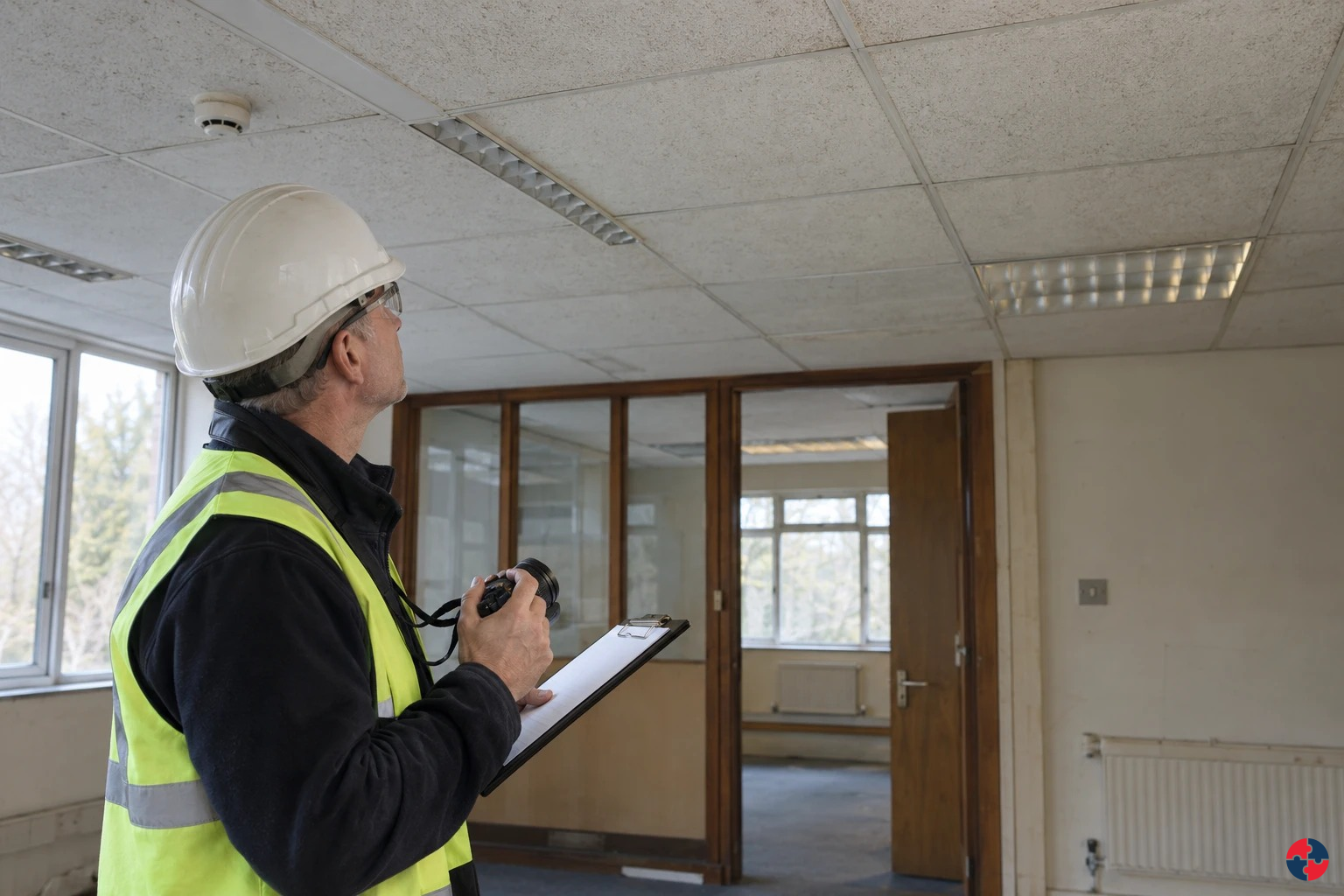
Photorealistic illustrative UK workplace scene. Review checks: BEFORE WORK: Check materials, condition and survey limits. PLAN THE RESPONSE: Use the correct competence and work category. KEEP INFORMATION LIVE: Pass changes into the register and work briefing.A confident visual guess is not evidence
Read what the situation actually establishes. Do not infer material identity, exposure or clearance from appearance.
A high score does not override a critical answer
The existing final assessment still requires at least 80% and every critical safety answer correct.
A course record is not permission for asbestos work
Awareness helps you recognise, check, stop and report. It does not confer the task training or competence for asbestos work.
Optional practice; it does not change your assessment or completion requirements.
Learning check
A learner scores 88% but misses a critical question about sampling. What should happen?
Award completion because the overall score is high
Require review and a new attempt meeting both pass conditions
Allow one small sampling task as practice
Explanation
Both conditions must be met: at least 80% and all critical safety answers correct.
Sources: Your supplied construction operatives PowerPoint (59 slides), HSE: information, instruction and training
Asbestos decision trees
Optional learning aids with decision notes and official source links. These support awareness, not specialist competence or permission to start work. Work classification and hand-back remain subject to competent assessment and the actual site authorisation.
Asbestos: can this intrusive work start?
Task-matched survey evidence, avoiding disturbance, competent planning and explicit hold points, with decision notes and official source links.
Immediate protection, competent incident management, parallel reporting assessment and evidence for safe hand-back, with decision notes and official source links.