Full public teaching and readers are free without an account. A free learner account is required for saved LMS progress and recorded assessment. Completion and any course-completion certificate depend on the configured LMS conditions. Open the course overview.
Lesson 1
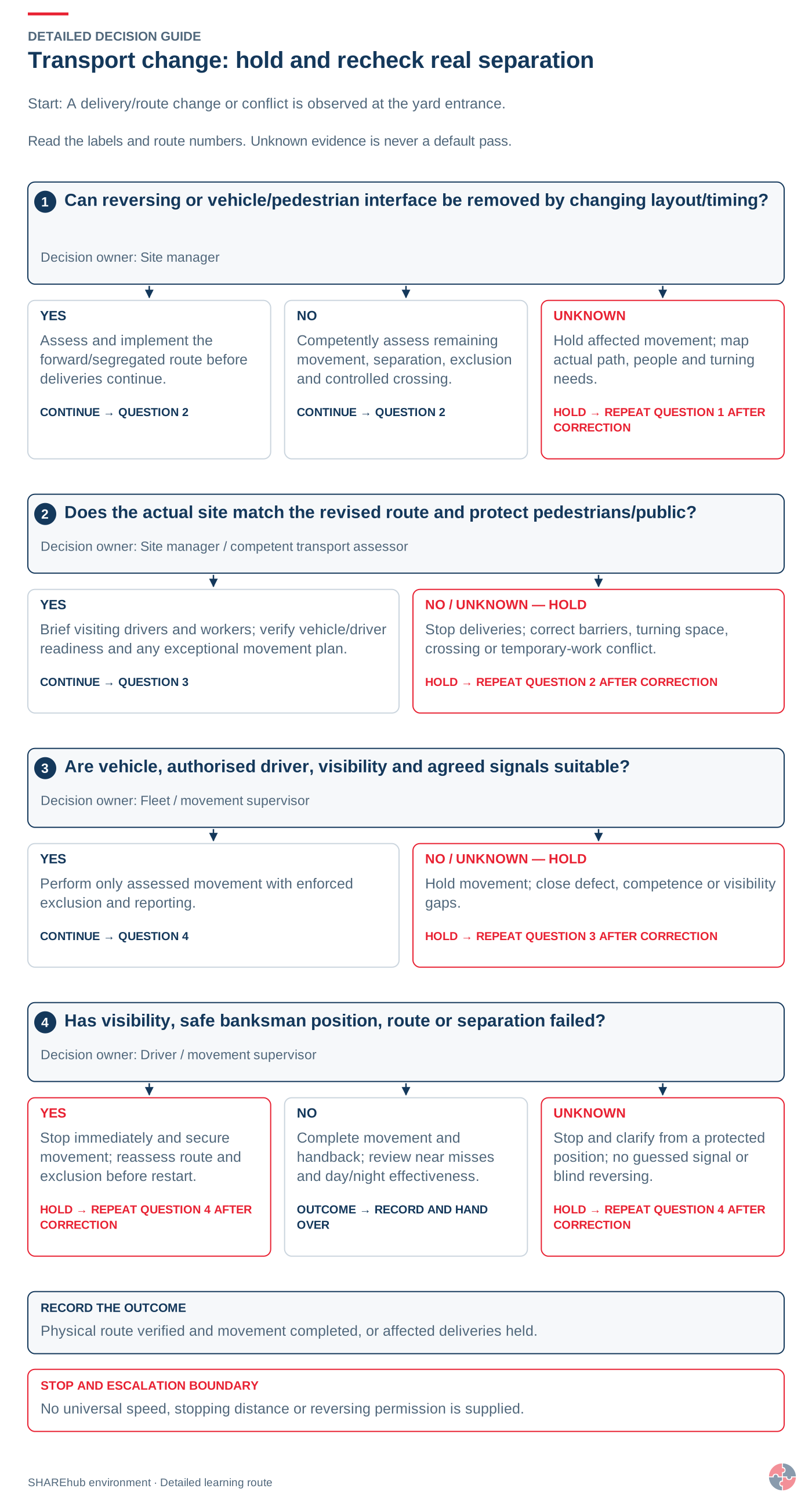
Trace the complete person-and-load journey
Assess the whole route, including the approaches and the destination, before accepting an isolated crossing control.
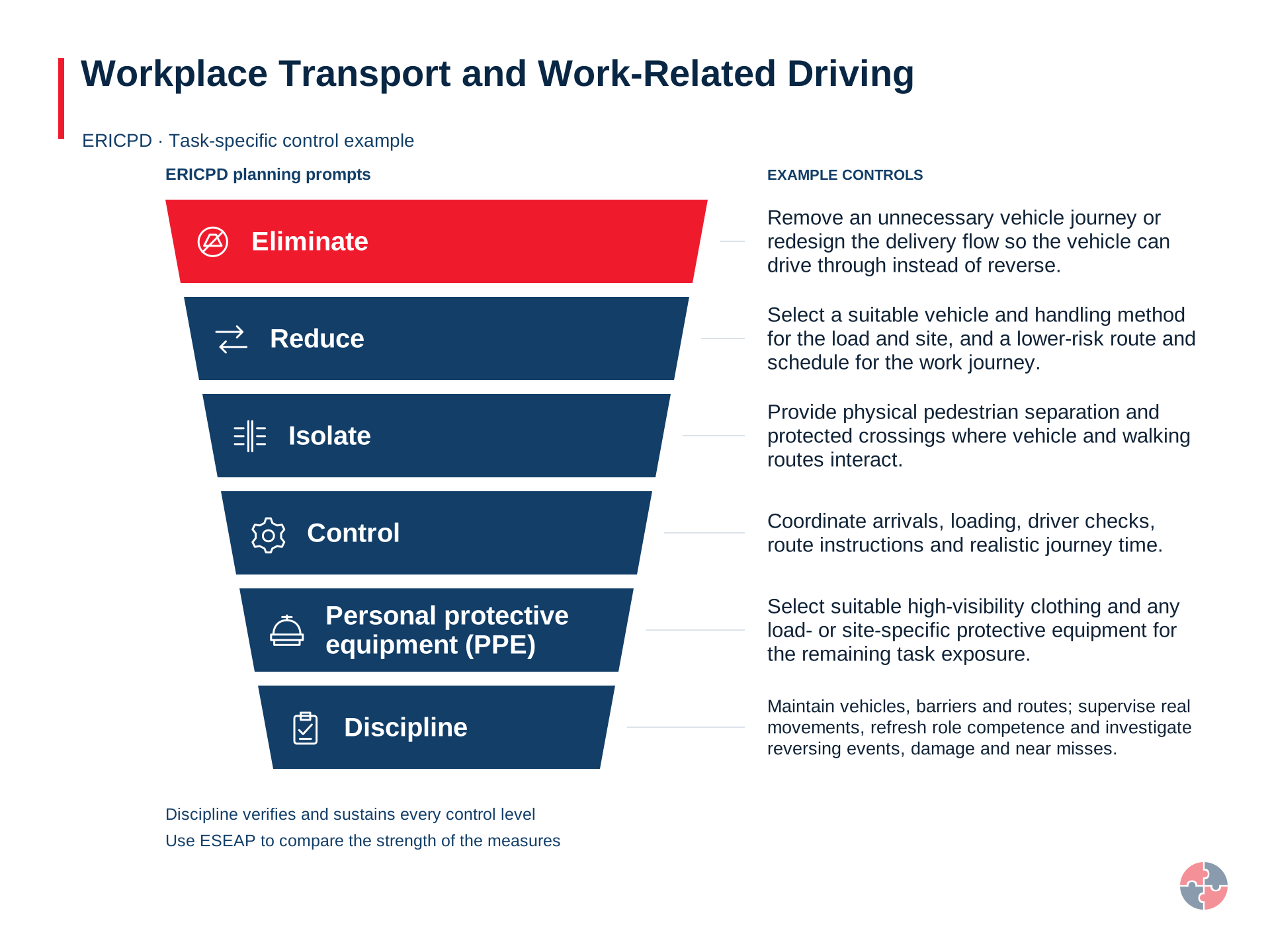
Teaching graphic from the linked SHAREhub source section.
Trace the complete person-and-load journey
A factory arrival is a sequence of connected tasks: a visitor leaves a vehicle, a driver reports to reception and a long component passes through the same entrance. Mapping each journey exposes conflicts that a photograph of the crossing alone cannot show. Include the approach, waiting place, turning movement and final pedestrian destination. Ask what changes when the gate is closed or the usual bay is occupied.
Different people have different views. A person walking from parking may see a clear zebra pattern while a delivery driver sees only the side of a parked van. The driver’s view changes with vehicle height, load, turning angle, weather and lighting. Painted priority does not remove an obstruction or guarantee a useful view. Test the arrangement from both approaches without placing an observer in a live conflict.
Prefer an arrangement that removes the crossing conflict or physically separates movements where practicable. If a crossing remains, its location, sightlines, approach control and user needs must work together. A visitor should not need to squeeze between queued vehicles to find somebody who can explain the route. An accessible pedestrian entrance must connect to a usable onward path.
In the exercise, draw the two journeys and mark where one person depends on the other seeing them. Select the strongest change, identify the person controlling any temporary restriction and state what observation would demonstrate improvement during a representative busy period. This is an awareness review, not authority to design a live traffic scheme. A route is ready when the actual journeys are controlled, not when every box on a generic plan has a colour.
How should transport risk be assessed?
Assessment should map people, vehicles, routes, movements, loading, reversing, visibility and work pressure.
A transport assessment should start with a movement map. Where do vehicles enter, reverse, park, load, tip, refuel, charge, turn, couple, uncouple and exit? Where do pedestrians walk, wait, cross, work, queue or visit welfare? Where do temporary works, waste skips, deliveries or contractors change the route?
The assessment should then challenge each interface. Can pedestrians and vehicles be separated? Can reversing be eliminated? Can route direction be simplified? Are visiting drivers briefed? Are banksmen competent and protected? Are schedules realistic enough to prevent rushing?
Risk area
Assessment question
Control focus
Pedestrian routes
Can people walk without entering vehicle routes?
Segregation, barriers and crossings.
Reversing
Can reversing be eliminated or controlled?
One-way routes, turning areas, aids and banksman rules.
Loading/unloading
Who controls the vehicle, load, people and exclusion zone?
Loading plan and communication.
Blind spots
What can the driver not see?
Vehicle selection, aids, exclusion and pedestrian control.
Temporary change
How do works, skips or congestion alter routes?
Change briefing and temporary traffic plan.
Road journeys
Are time, weather, rest and welfare realistic?
Safe journey planning.
How should a busy warehouse yard be controlled?
A strong yard plan separates people and vehicles, controls reversing and manages visiting drivers before they enter the risk area.
A warehouse has vans, articulated lorries, pedestrian staff, agency workers, forklift trucks, visitors and waste collections. Near misses occur when visiting drivers walk across the yard to reception and forklifts reverse near a loading bay. A weak response is to add more warning signs. A stronger response redesigns pedestrian access, creates a driver waiting point, sets a one-way vehicle system, marks loading exclusion zones, controls reversing, briefs visiting drivers, improves lighting, reviews delivery scheduling and checks compliance during peak periods.
The lesson is that transport safety is mainly design and management. Behaviour matters, but only after the site has made the safe route obvious and practical.
Drivers walking through yard. Weak control: Tell them to watch for vehicles; Better control: Create protected pedestrian route and waiting point.
Forklift reversing. Weak control: Rely on reversing alarm; Better control: Redesign route and use exclusion controls.
Loading bay interface. Weak control: Paint lines only; Better control: Physical controls, bay rules and communication.
Fictional loading sequence: prevent early departure
A visiting driver parks as directed and uses the segregated waiting area. The agreed loading controller verifies suitable vehicle/trailer parking brakes and stability, the loading exclusion and the assessed site method that prevents premature departure. Driver and loader confirm the hold is active before work. If that hold, stability or separation is uncertain, loading stops. Only the agreed controller gives positive departure release after people and equipment are clear, the load is safe and all checks are complete. A briefing or painted bay line alone cannot prevent a runaway or drive-away; select the method for the actual vehicles and site.
Applied case
A queue hides the normal visitor route while a delivery occupies the crossing approach.
Decision and explanation
Trace the visitor and loaded-vehicle journeys through their actual shared conflict points.
Correct decision: Trace the visitor and loaded-vehicle journeys through their actual shared conflict points. Assess the whole route, including the approaches and the destination, before accepting an isolated crossing control.
Lesson 2
Match the road to the oversize component
Consider the carried component, vehicle behaviour and route profile as one movement system.
Related SHAREhub topic guide. Apply its prompts to the specific case below.
Match the road to the oversize component
The vehicle’s wheel track is only part of an oversize movement. A wing or long structure can project beyond the carrier, sweep across an adjacent route during a turn and change the vehicle’s stability. The relevant envelope includes the load, supporting equipment, restraints and clearance throughout the manoeuvre. A lane wide enough for an empty vehicle may be unsuitable for its carried component.
Traffic calming also needs to suit the operation. A hump can alter the load’s movement and ground clearance, particularly with a long overhang or a specialist transporter. The course does not prescribe a universal speed, hump dimension or component clearance. The movement planner needs actual vehicle and load information, route conditions and the appropriate competent assessment.
An apparently gentle movement can still trap someone between a projecting structure and a fixed object. Keep people outside the assessed movement envelope; do not ask a pedestrian to judge how close they can stand. A guide or observer needs a safe position and agreed communication, with the movement stopped if the view or communication is lost.
For the fictional route, mark the widest swept area and identify where a queued vehicle, gate or crossing could remove the required space. Decide whether the move can remain on its authorised route or needs to be held for reassessment. A successful previous journey is useful experience, but it does not prove that today’s differently supported load can use the same road. Route acceptance is linked to the specified movement, not to the transporter’s name alone.
Where do workplace transport controls fail?
They fail when layout, scheduling and vehicle condition are weak and organisations rely on people to avoid conflict at the last moment.
Transport incidents often happen in familiar places. People get used to crossing yards, walking behind reversing vehicles, standing near loads, rushing deliveries or accepting poor lighting. The risk becomes normal because nothing serious has happened yet.
A strong transport system designs out conflict, keeps vehicles fit, briefs visitors, controls temporary change and gives drivers permission to stop unsafe movements.
Signage-only control. How it develops: Signs warn but do not separate people; What good looks like: Physical segregation and clear routes.
Reversing normalised. How it develops: Vehicles reverse routinely in busy areas; What good looks like: One-way flow or controlled reversing.
Visiting drivers unmanaged. How it develops: Drivers wander or load themselves; What good looks like: Briefing, waiting area and site rules.
Banksman over-relied on. How it develops: Banksman compensates for poor design; What good looks like: Redesign route and protect banksman.
Defects tolerated. How it develops: Vehicles with safety defects keep working; What good looks like: Defect quarantine and repair.
Road risk forgotten. How it develops: Schedules create fatigue and rushing; What good looks like: Safe journey planning.
What evidence shows workplace transport is controlled?
Evidence should show safe site design, vehicle control, driver competence, journey planning and active monitoring.
Good evidence includes transport risk assessment, site traffic plan, pedestrian route design, vehicle checks, maintenance, driver authorisation, visitor briefing, delivery rules, loading controls, inspection records, incident trends, near-miss learning and assurance actions.
Photographs, route maps and workface observations are especially useful because they show whether the traffic plan exists in the yard, not just on paper.
Traffic plan. What it should show: Routes, crossings, one-way systems and segregation are defined; Assurance question: Does the physical site match the plan?.
Vehicle checks. What it should show: Daily checks, maintenance and defects are controlled; Assurance question: Are unsafe vehicles removed?.
Driver competence. What it should show: Operators and drivers are authorised and supervised; Assurance question: Is behaviour observed?.
Visitor/delivery controls. What it should show: Visiting drivers know rules and waiting areas; Assurance question: Are contractors included?.
Loading/unloading plan. What it should show: People, loads and vehicles are controlled; Assurance question: Is the exclusion zone enforced?.
Journey controls. What it should show: Road journeys consider fatigue, weather and schedule; Assurance question: Can drivers delay unsafe journeys?.
A different wing support increases the overhang on a route containing a speed hump.
Decision and explanation
The current load envelope, support and route interaction have changed.
Correct decision: The current load envelope, support and route interaction have changed. Consider the carried component, vehicle behaviour and route profile as one movement system.
Lesson 3
Keep the accessible pedestrian route usable
Treat obstruction of a protected route as a change requiring a safe alternative before people arrive.
Related SHAREhub topic guide. Apply its prompts to the specific case below.
Keep the accessible pedestrian route usable
A separate pedestrian gate is useful only if the route beyond it remains continuous, accessible and directed to the correct destination. An obstruction can turn a nominally protected journey into an invitation to use a delivery opening. Think about luggage, mobility aids, unfamiliar visitors and people who cannot easily step over a kerb or move quickly out of the way.
The immediate control is to stop people being directed into an uncontrolled alternative. Coordinate affected vehicle movements and provide a safe waiting or assisted route through authorised site arrangements. Do not wave somebody into a vehicle lane merely because the queue appears stationary; another driver may move without knowing the pedestrian is there.
Resolve the reason the route failed. Storage management, gate maintenance, signage and responsibility for checking the route all affect whether the obstruction returns. Instructions should explain a usable journey rather than simply prohibit the shortcut. Consider how reception learns that the pedestrian gate is unavailable before another visitor is sent to it.
In the exercise, compare a layout change with a reminder to wear brighter clothing. The layout should remove dependence on an unfamiliar visitor negotiating vehicle movements. Communication supports that physical arrangement. Verify the route with the intended users and under ordinary arrival conditions, while keeping the review itself safe.
Record the temporary restriction, who owns it and what confirms that the intended route is back in service. Removing a pallet may resolve one obstruction, while a damaged gate or unsuitable surface remains. Reopening needs the complete route checked, not a photograph of the one object that was moved.
How should workplace design and welfare be managed?
Design the layout and facilities for the people and work first, then provide, maintain, inspect, correct and review them as conditions change. The facilities owner checks routes, lighting, air and welfare in the real shift pattern, records defects and closes or diverts an unsafe area until repaired.
The strongest control is to design good conditions into the workplace before people start work. Once a workplace is operating, the management system has to keep facilities suitable through cleaning, maintenance, inspection, defect reporting, worker feedback and review after change.
Temporary work often fails because the welfare plan is created for the first day but not for the real project. As trades increase, weather changes, demolition exposes dust, or a site becomes more remote, the original toilets, washing, drying, lighting, routes and rest areas may no longer be enough.
Fictional refurbishment shift: 22 workers plus up to 4 visiting workers/drivers; afternoon overlap included. The site manager checks suitable provision against the actual users, not an invented toilet ratio.
Accessible route
The facilities lead and user representative walk protected route R-2 to the agreed accessible toilets, handwash and clean rest room before opening. Actual travel is recorded as about two minutes in this example; suitability and access still require the site assessment.
Clean/dirty boundary
Dusty PPE is removed/stored through the agreed hygiene arrangement. Eating is in the clean area; clean drinking water is reachable without crossing an active unloading bay.
Owner and checks
Facilities lead owns cleaning/restocking, with shift-start and use-driven checks; the supervisor reports failures immediately. Weekly review is an additional formal review.
Failure contingency
If the accessible facility or safe route fails, affected work is held until a suitable authorised alternative is verified and communicated. A vehicle is suitable for a break only where hygiene, space, temperature, contamination and work context support that assessment.
Applied case
A visitor using a mobility aid reaches a locked pedestrian gate and is offered the delivery lane instead.
Decision and explanation
Hold the conflicting movement and arrange an assessed accessible alternative through site control.
Correct decision: Hold the conflicting movement and arrange an assessed accessible alternative through site control. Treat obstruction of a protected route as a change requiring a safe alternative before people arrive.
Lesson 4
Brief a movement that can actually be stopped
Give visiting drivers a route, safe waiting arrangement and reliable stop communication before reversing begins.
Related SHAREhub topic guide. Apply its prompts to the specific case below.
Brief a movement that can actually be stopped
A visiting driver cannot follow a site arrangement they have not understood. Explain where to report, where to wait, the permitted route and how the receiving team will control access. Confirm understanding with a description of the intended movement rather than treating an induction signature as proof. Language, unfamiliar equipment and changes to the usual bay can all affect the conversation.
Avoid reversing where reasonably practicable through a suitable layout and operating arrangement. Where it remains necessary, plan the movement and prevent people entering the danger area. A guide does not make an open pedestrian route safe by standing somewhere nearby. Any guiding role requires suitable competence, a safe position and agreed signals with the driver.
The driver must know what happens if the guide disappears from view, a person enters the route or the receiving bay is not ready. The safe response is to stop the movement and restore the agreed control, rather than continue slowly and hope the missing information resolves itself. Keep the driver’s own pedestrian journey protected when they leave the cab.
Practise the briefing using a map and three interruptions: the bay changes, the radio fails and a visitor enters the approach. State the hold point for each. Then ask what physical arrangement would prevent the conflict from arising at all. A briefing coordinates a suitable system; it cannot compensate for a fundamentally unsuitable route or an uncontrolled public opening.
Who controls transport risk during live work?
Transport safety depends on clear ownership from gate control through to senior investment decisions.
A driver can make good decisions only if the site, vehicle, schedule and communication support those decisions. A supervisor can stop a movement, but managers must remove recurring design and scheduling weaknesses. The fleet lead and the employer’s health and safety adviser should test whether vehicle standards, grey fleet controls and site layouts match the actual risk.
This role split is important for fatal-risk topics because the immediate event may look like driver error while the underlying causes sit in route design, vehicle specification, fatigue, loading pressure or poor contractor control.
Role
What to check
Evidence
Driver/operator
Vehicle condition, route, visibility, fatigue, phone use and load security.
Daily check, defect report and journey decision.
Supervisor
Segregation, reversing, loading, visiting drivers and temporary change.
Yard walkdown and stop-work record.
Manager
Traffic plan, staffing, scheduling, maintenance and contractor controls.
Transport risk assessment and action tracker.
Fleet lead / employer’s health and safety adviser
Vehicle suitability, grey fleet, competence, incident trends and assurance.
Fleet records, licences, insurance and audit findings.
Senior leader
High-potential events, investment needs and repeat weak signals.
Dashboard review and resource decisions.
When should transport or driving activity stop?
Stop when people and vehicles cannot be safely separated, vehicle condition is unsafe, visibility is inadequate or driving conditions make the journey unsafe.
Transport risk changes quickly. A blocked route, failed reversing aid, visiting driver without briefing, poor lighting, damaged surface, unstable load or pedestrian route obstruction can turn a routine operation into a serious risk.
Supervisors should be clear that production pressure does not override traffic controls. If the safe route is blocked, the work should pause until a safe route is restored.
A driver knows the delivery address but has not been told that the normal bay is closed.
Decision and explanation
Confirm the current bay, protected route, exclusion and stop communication with the receiving controller.
Correct decision: Confirm the current bay, protected route, exclusion and stop communication with the receiving controller. Give visiting drivers a route, safe waiting arrangement and reliable stop communication before reversing begins.
Lesson 5
Plan the shift-change exception before dispatch
Coordinate an oversize move with the real pedestrian peak and keep temporary arrangements under control.
Related SHAREhub topic guide. Apply its prompts to the specific case below.
Plan the shift-change exception before dispatch
A traffic plan that works in a quiet yard can fail when a shift ends. People leave several doors at once, parked vehicles move and an oversize dispatch may occupy more than one lane. Treat that combination as a planned interface. The movement controller needs current information about both the dispatch and the pedestrian demand, including contractors and visitors.
Timing can remove a conflict, but a diary entry alone does not reserve a route. Confirm that the agreed window still exists and that people know where to wait. If production delay moves the dispatch into a different period, review the conditions rather than quietly reusing the earlier approval. The load’s urgency does not reduce the possible severity of a collision.
A temporary crossing closure needs a usable alternative and a way to maintain the boundary. Avoid sending people to an unprotected gate or trapping them between barriers and a moving load. The authorised arrangement should identify who holds access, who receives the load and how the movement will be stopped if any part of the protection is lost.
For practice, place the dispatch schedule beside the shift and visitor information. Identify the first conflict and propose the least complex way to avoid it. Explain why adding another observer might be weaker than moving the dispatch to a genuinely clear, controlled window. Verify the arrangement as implemented, and remove temporary controls only after the whole load and its support equipment have cleared. A plan is a live operating decision, not a permanent permission attached to a delivery date.
How should transport and driving risks be assured?
Assurance should test real vehicle movements, route conditions, driver decisions and management of change.
First-line checks include vehicle condition, route walkdowns and driver briefings. Manager assurance samples peak periods, temporary route changes, visitor control and delivery interface. Senior leaders should review high-potential near misses, reversing events, collisions, defects and fatigue signals.
A useful assurance exercise is to follow a delivery from gate to departure and record every pedestrian/vehicle interface.
Frontline. What to check: Routes, vehicles, loads, visibility and people; What good looks like: Unsafe movement stops immediately.
Supervisor. What to check: Briefings, reversing, loading and visitor controls; What good looks like: Rules are followed in busy periods.
Manager. What to check: Traffic plan, maintenance, competence and trends; What good looks like: Actions address recurring weak signals.
Fleet/technical. What to check: Vehicle condition, specification and roadworthiness; What good looks like: Vehicles fit task and environment.
Leadership. What to check: High-potential events and investment needs; What good looks like: Layout and resources improve over time.
A late transporter reaches the crossing just as both shifts change over.
Decision and explanation
Hold and re-coordinate the dispatch with the actual pedestrian flow and controlled route.
Correct decision: Hold and re-coordinate the dispatch with the actual pedestrian flow and controlled route. Coordinate an oversize move with the real pedestrian peak and keep temporary arrangements under control.
Lesson 6
Reopen the route with evidence and a named owner
Carry restrictions across handovers until the actual route and movement conditions have been verified.
Related SHAREhub topic guide. Apply its prompts to the specific case below.
Reopen the route with evidence and a named owner
Reporting a blocked sightline and reopening the crossing are separate actions. A repair request records that somebody needs to act; it does not demonstrate that the control is restored. Keep the restriction understandable to the next controller, including the location, affected movements, temporary protection, outstanding evidence and person authorised to change the status.
Verification should address the original failure and any consequence of the change. Moving the van may restore one approach while the new parking location hides a different gate. Repositioning a barrier can improve separation but reduce the accessible route. Look at the completed arrangement from the driver and pedestrian positions and under conditions that represent ordinary use.
Records support this review when they identify the current route, load or change. A generic annual inspection or an old traffic drawing cannot settle a new oversize movement. Equally, do not invent a failed measurement because the model shows a warning clue. Distinguish what is visible, what the fictional evidence states and what still needs competent confirmation.
In the handover exercise, the incoming supervisor asks whether the next dispatch can start. Give an answer that includes the precise hold or release condition. If verification has not been completed, the instruction remains a restriction with a responsible owner; it is not converted into an approval because the shift has changed.
Finally, ask what prevents recurrence. Assign routine observation of parking, queue growth and crossing availability, and a route for reporting changes before they create another conflict. This learning course develops that evidence question. It does not replace the site’s competent traffic assessment or authorise a particular vehicle movement.
How should transport and driving risks be assured?
Assurance should test real vehicle movements, route conditions, driver decisions and management of change.
First-line checks include vehicle condition, route walkdowns and driver briefings. Manager assurance samples peak periods, temporary route changes, visitor control and delivery interface. Senior leaders should review high-potential near misses, reversing events, collisions, defects and fatigue signals.
A useful assurance exercise is to follow a delivery from gate to departure and record every pedestrian/vehicle interface.
Frontline. What to check: Routes, vehicles, loads, visibility and people; What good looks like: Unsafe movement stops immediately.
Supervisor. What to check: Briefings, reversing, loading and visitor controls; What good looks like: Rules are followed in busy periods.
Manager. What to check: Traffic plan, maintenance, competence and trends; What good looks like: Actions address recurring weak signals.
Fleet/technical. What to check: Vehicle condition, specification and roadworthiness; What good looks like: Vehicles fit task and environment.
Leadership. What to check: High-potential events and investment needs; What good looks like: Layout and resources improve over time.
The van has moved, but nobody has checked the crossing after the barriers were rearranged.
Decision and explanation
A current check of the complete changed arrangement by the responsible controller, with the result handed over.
Correct decision: A current check of the complete changed arrangement by the responsible controller, with the result handed over. Carry restrictions across handovers until the actual route and movement conditions have been verified.
Lesson 7
Obstructed zebra crossing sightline
Hold conflicting movements when the crossing cannot be seen or protected.
Teaching graphic from the linked SHAREhub source section.
Understand the activity and how harm develops
Look along the approach from both sides of the crossing. The parked van hides a person before the driver reaches the markings. A visitor unfamiliar with the site may assume that the zebra pattern guarantees vehicles will stop.
In this factory the crossing connects parking to reception while deliveries continue through the gate. Consider vehicle height, loaded stopping behaviour, darkness and low sun. A driver seeing the stripes is not the same as seeing the pedestrian approaching them.
Remove the obstructing parking arrangement and protect the sightline through layout and enforcement. Review crossing position, lighting and route separation together. Observe the busiest arrival period after the change, rather than accepting an empty-road photograph as proof.
Recognise the evidence boundary
Question
Case evidence
What is observed?
A delivery van blocks the view between the marked crossing and the gate approach.
How can harm occur?
A pedestrian can emerge directly into a vehicle’s stopping path.
What information is needed?
Check visibility from the actual driver and pedestrian approaches.
Protect, manage and verify
Purpose
Practical application
Immediate protection
Protect clear approaches and provide suitable lighting.
Accountable work arrangement
Clear crossing sightlines. Protect the pedestrian approach. Coordinate peak-time vehicle movements. Check the real loaded driver view.
Release verification
Confirm obstructions cannot return without being noticed and corrected.
Apply this at work
Hold conflicting movements when the crossing cannot be seen or protected.
How should transport risk be assessed?
Assessment should map people, vehicles, routes, movements, loading, reversing, visibility and work pressure.
A transport assessment should start with a movement map. Where do vehicles enter, reverse, park, load, tip, refuel, charge, turn, couple, uncouple and exit? Where do pedestrians walk, wait, cross, work, queue or visit welfare? Where do temporary works, waste skips, deliveries or contractors change the route?
The assessment should then challenge each interface. Can pedestrians and vehicles be separated? Can reversing be eliminated? Can route direction be simplified? Are visiting drivers briefed? Are banksmen competent and protected? Are schedules realistic enough to prevent rushing?
Risk area
Assessment question
Control focus
Pedestrian routes
Can people walk without entering vehicle routes?
Segregation, barriers and crossings.
Reversing
Can reversing be eliminated or controlled?
One-way routes, turning areas, aids and banksman rules.
Loading/unloading
Who controls the vehicle, load, people and exclusion zone?
Loading plan and communication.
Blind spots
What can the driver not see?
Vehicle selection, aids, exclusion and pedestrian control.
Temporary change
How do works, skips or congestion alter routes?
Change briefing and temporary traffic plan.
Road journeys
Are time, weather, rest and welfare realistic?
Safe journey planning.
How should a busy warehouse yard be controlled?
A strong yard plan separates people and vehicles, controls reversing and manages visiting drivers before they enter the risk area.
A warehouse has vans, articulated lorries, pedestrian staff, agency workers, forklift trucks, visitors and waste collections. Near misses occur when visiting drivers walk across the yard to reception and forklifts reverse near a loading bay. A weak response is to add more warning signs. A stronger response redesigns pedestrian access, creates a driver waiting point, sets a one-way vehicle system, marks loading exclusion zones, controls reversing, briefs visiting drivers, improves lighting, reviews delivery scheduling and checks compliance during peak periods.
The lesson is that transport safety is mainly design and management. Behaviour matters, but only after the site has made the safe route obvious and practical.
Drivers walking through yard. Weak control: Tell them to watch for vehicles; Better control: Create protected pedestrian route and waiting point.
Forklift reversing. Weak control: Rely on reversing alarm; Better control: Redesign route and use exclusion controls.
Loading bay interface. Weak control: Paint lines only; Better control: Physical controls, bay rules and communication.
Fictional loading sequence: prevent early departure
A visiting driver parks as directed and uses the segregated waiting area. The agreed loading controller verifies suitable vehicle/trailer parking brakes and stability, the loading exclusion and the assessed site method that prevents premature departure. Driver and loader confirm the hold is active before work. If that hold, stability or separation is uncertain, loading stops. Only the agreed controller gives positive departure release after people and equipment are clear, the load is safe and all checks are complete. A briefing or painted bay line alone cannot prevent a runaway or drive-away; select the method for the actual vehicles and site.
Applied case
The van will remain for only ten minutes.
Decision and explanation
Hold traffic and arrange removal of the obstruction.
This restores the control before people cross. A wave cannot reach a driver who cannot see the person. Visible markings do not reveal a hidden pedestrian.
Lesson 8
Speed humps and vehicle stability
Stop the movement if stability or clearance across the hump is uncertain.
Teaching graphic from the linked SHAREhub source section.
Understand the activity and how harm develops
The hump is intended to discourage excessive speed, but its shape interacts with wheelbase, ground clearance and load restraint. A measure suitable for a car is not automatically suitable for a component transporter or a forklift carrying a raised centre of gravity.
Inspect the complete route, including the approach and landing after the hump. Abrupt braking, steering around the hump or a wheel leaving the surface can create new conflicts. Repeated shocks also matter when assessing whole-body vibration and driver comfort.
Have the transport assessment select compatible speed-control measures and vehicle routes. Verify the loaded configuration against supplier information and route design. Never improvise a bypass through the pedestrian strip or treat a test with an empty vehicle as full validation.
Recognise the evidence boundary
Question
Case evidence
What is observed?
A loaded transporter approaches a speed hump with a long component overhang.
How can harm occur?
The load may shift, ground, or destabilise the carrier; repeated jolts can harm the driver.
What information is needed?
Compare hump geometry with the actual loaded vehicle configuration.
Protect, manage and verify
Purpose
Practical application
Immediate protection
Provide a designed, maintained surface and clear approach.
Confirm drivers use the approved path without evasive detours.
Apply this at work
Stop the movement if stability or clearance across the hump is uncertain.
How should transport risk be assessed?
Assessment should map people, vehicles, routes, movements, loading, reversing, visibility and work pressure.
A transport assessment should start with a movement map. Where do vehicles enter, reverse, park, load, tip, refuel, charge, turn, couple, uncouple and exit? Where do pedestrians walk, wait, cross, work, queue or visit welfare? Where do temporary works, waste skips, deliveries or contractors change the route?
The assessment should then challenge each interface. Can pedestrians and vehicles be separated? Can reversing be eliminated? Can route direction be simplified? Are visiting drivers briefed? Are banksmen competent and protected? Are schedules realistic enough to prevent rushing?
Risk area
Assessment question
Control focus
Pedestrian routes
Can people walk without entering vehicle routes?
Segregation, barriers and crossings.
Reversing
Can reversing be eliminated or controlled?
One-way routes, turning areas, aids and banksman rules.
Loading/unloading
Who controls the vehicle, load, people and exclusion zone?
Loading plan and communication.
Blind spots
What can the driver not see?
Vehicle selection, aids, exclusion and pedestrian control.
Temporary change
How do works, skips or congestion alter routes?
Change briefing and temporary traffic plan.
Road journeys
Are time, weather, rest and welfare realistic?
Safe journey planning.
How should a busy warehouse yard be controlled?
A strong yard plan separates people and vehicles, controls reversing and manages visiting drivers before they enter the risk area.
A warehouse has vans, articulated lorries, pedestrian staff, agency workers, forklift trucks, visitors and waste collections. Near misses occur when visiting drivers walk across the yard to reception and forklifts reverse near a loading bay. A weak response is to add more warning signs. A stronger response redesigns pedestrian access, creates a driver waiting point, sets a one-way vehicle system, marks loading exclusion zones, controls reversing, briefs visiting drivers, improves lighting, reviews delivery scheduling and checks compliance during peak periods.
The lesson is that transport safety is mainly design and management. Behaviour matters, but only after the site has made the safe route obvious and practical.
Drivers walking through yard. Weak control: Tell them to watch for vehicles; Better control: Create protected pedestrian route and waiting point.
Forklift reversing. Weak control: Rely on reversing alarm; Better control: Redesign route and use exclusion controls.
Loading bay interface. Weak control: Paint lines only; Better control: Physical controls, bay rules and communication.
Fictional loading sequence: prevent early departure
A visiting driver parks as directed and uses the segregated waiting area. The agreed loading controller verifies suitable vehicle/trailer parking brakes and stability, the loading exclusion and the assessed site method that prevents premature departure. Driver and loader confirm the hold is active before work. If that hold, stability or separation is uncertain, loading stops. Only the agreed controller gives positive departure release after people and equipment are clear, the load is safe and all checks are complete. A briefing or painted bay line alone cannot prevent a runaway or drive-away; select the method for the actual vehicles and site.
Applied case
The loaded carrier grounded on its previous crossing.
Decision and explanation
Hold it and review the route with competent transport staff.
Speed matters but cannot guarantee physical clearance. That transfers the risk directly to pedestrians. The previous contact is evidence that compatibility is unresolved.
Lesson 9
Pedestrian gate and accessible route
Do not direct a person into vehicle space because the protected route is blocked.
Related SHAREhub topic guide. Apply its prompts to the specific case below.
Understand the activity and how harm develops
Trace the journey from the parking bay to reception, rather than examining the gate alone. The separate pedestrian opening has little value when bins, a parked car or a locked latch force people through the vehicle entrance.
People may use wheelchairs, walking aids or carry bags; visitors may not understand the site layout. The route needs usable width, gradients, surfaces, lighting and gate operation for its intended users. Accessibility cannot depend on someone stepping into traffic to ask for help.
Restore the protected route and review the reason it became blocked. Keep the access arrangement understandable in low light and during deliveries. Include people with relevant access needs in checking the real journey and its emergency alternative.
Recognise the evidence boundary
Question
Case evidence
What is observed?
The pedestrian gate is obstructed and a visitor is approaching the delivery opening.
How can harm occur?
A person may enter vehicle space or be unable to reach reception safely.
What information is needed?
Walk the full arrival route with the intended access needs in mind.
Protect, manage and verify
Purpose
Practical application
Immediate protection
Provide maintained surfaces, lighting and usable gate controls.
Accountable work arrangement
Restore continuous protected access. Keep the pedestrian gate usable. Check individual access needs. Prevent storage blocking the route.
Release verification
Confirm the route stays open during deliveries and shift changes.
Apply this at work
Do not direct a person into vehicle space because the protected route is blocked.
How should workplace design and welfare be managed?
Design the layout and facilities for the people and work first, then provide, maintain, inspect, correct and review them as conditions change. The facilities owner checks routes, lighting, air and welfare in the real shift pattern, records defects and closes or diverts an unsafe area until repaired.
The strongest control is to design good conditions into the workplace before people start work. Once a workplace is operating, the management system has to keep facilities suitable through cleaning, maintenance, inspection, defect reporting, worker feedback and review after change.
Temporary work often fails because the welfare plan is created for the first day but not for the real project. As trades increase, weather changes, demolition exposes dust, or a site becomes more remote, the original toilets, washing, drying, lighting, routes and rest areas may no longer be enough.
Fictional refurbishment shift: 22 workers plus up to 4 visiting workers/drivers; afternoon overlap included. The site manager checks suitable provision against the actual users, not an invented toilet ratio.
Accessible route
The facilities lead and user representative walk protected route R-2 to the agreed accessible toilets, handwash and clean rest room before opening. Actual travel is recorded as about two minutes in this example; suitability and access still require the site assessment.
Clean/dirty boundary
Dusty PPE is removed/stored through the agreed hygiene arrangement. Eating is in the clean area; clean drinking water is reachable without crossing an active unloading bay.
Owner and checks
Facilities lead owns cleaning/restocking, with shift-start and use-driven checks; the supervisor reports failures immediately. Weekly review is an additional formal review.
Failure contingency
If the accessible facility or safe route fails, affected work is held until a suitable authorised alternative is verified and communicated. A vehicle is suitable for a break only where hygiene, space, temperature, contamination and work context support that assessment.
Applied case
A visitor cannot use the pedestrian gate.
Decision and explanation
Hold conflicting traffic and restore a suitable protected route.
A gesture does not create pedestrian separation. The whole journey must be made usable. Waiting may be an immediate hold but does not resolve access.
Lesson 10
Delivery driver briefing and reversing
Stop reversing when a person enters the area or communication is lost.
Teaching graphic from the linked SHAREhub source section.
Understand the activity and how harm develops
The driver knows the vehicle but may not know this factory’s routes or shift-change patterns. A booking email alone does not establish the current bay, safe waiting place, pedestrian restrictions or the person controlling the handover.
First examine whether the delivery can use a drive-through arrangement. Where reversing remains necessary, the area must be controlled and nonessential people excluded. Cameras and alarms support the operation but do not replace separation or a clear stopping arrangement.
Agree responsibility between the carrier and receiving team before movement. Where a trained signaller is part of the assessed system, their position and communications must remain safe and effective. Loss of contact or an unexpected person requires a stop, not an improvised signal.
Recognise the evidence boundary
Question
Case evidence
What is observed?
An unfamiliar driver starts reversing while the receiving bay and pedestrian route remain open.
How can harm occur?
People can be struck or crushed where the driver cannot see them.
What information is needed?
Ask the driver to explain the route, waiting point and stop signal.
Protect, manage and verify
Purpose
Practical application
Immediate protection
Separate the manoeuvring area from pedestrian routes.
Accountable work arrangement
Avoid reversing where practicable. Exclude pedestrians from manoeuvres. Brief the visiting driver. Stop when communication is lost.
Release verification
Observe that movement stops if contact or separation is lost.
Apply this at work
Stop reversing when a person enters the area or communication is lost.
How should transport risk be assessed?
Assessment should map people, vehicles, routes, movements, loading, reversing, visibility and work pressure.
A transport assessment should start with a movement map. Where do vehicles enter, reverse, park, load, tip, refuel, charge, turn, couple, uncouple and exit? Where do pedestrians walk, wait, cross, work, queue or visit welfare? Where do temporary works, waste skips, deliveries or contractors change the route?
The assessment should then challenge each interface. Can pedestrians and vehicles be separated? Can reversing be eliminated? Can route direction be simplified? Are visiting drivers briefed? Are banksmen competent and protected? Are schedules realistic enough to prevent rushing?
Risk area
Assessment question
Control focus
Pedestrian routes
Can people walk without entering vehicle routes?
Segregation, barriers and crossings.
Reversing
Can reversing be eliminated or controlled?
One-way routes, turning areas, aids and banksman rules.
Loading/unloading
Who controls the vehicle, load, people and exclusion zone?
Loading plan and communication.
Blind spots
What can the driver not see?
Vehicle selection, aids, exclusion and pedestrian control.
Temporary change
How do works, skips or congestion alter routes?
Change briefing and temporary traffic plan.
Road journeys
Are time, weather, rest and welfare realistic?
Safe journey planning.
How should a busy warehouse yard be controlled?
A strong yard plan separates people and vehicles, controls reversing and manages visiting drivers before they enter the risk area.
A warehouse has vans, articulated lorries, pedestrian staff, agency workers, forklift trucks, visitors and waste collections. Near misses occur when visiting drivers walk across the yard to reception and forklifts reverse near a loading bay. A weak response is to add more warning signs. A stronger response redesigns pedestrian access, creates a driver waiting point, sets a one-way vehicle system, marks loading exclusion zones, controls reversing, briefs visiting drivers, improves lighting, reviews delivery scheduling and checks compliance during peak periods.
The lesson is that transport safety is mainly design and management. Behaviour matters, but only after the site has made the safe route obvious and practical.
Drivers walking through yard. Weak control: Tell them to watch for vehicles; Better control: Create protected pedestrian route and waiting point.
Forklift reversing. Weak control: Rely on reversing alarm; Better control: Redesign route and use exclusion controls.
Loading bay interface. Weak control: Paint lines only; Better control: Physical controls, bay rules and communication.
Fictional loading sequence: prevent early departure
A visiting driver parks as directed and uses the segregated waiting area. The agreed loading controller verifies suitable vehicle/trailer parking brakes and stability, the loading exclusion and the assessed site method that prevents premature departure. Driver and loader confirm the hold is active before work. If that hold, stability or separation is uncertain, loading stops. Only the agreed controller gives positive departure release after people and equipment are clear, the load is safe and all checks are complete. A briefing or painted bay line alone cannot prevent a runaway or drive-away; select the method for the actual vehicles and site.
Applied case
The driver cannot see the designated signaller.
Decision and explanation
Stop and re-establish the agreed safe arrangement.
Continuing without contact defeats the movement control. The controller and safe positions still need to be established. A camera does not authorise movement into an uncontrolled area.
Lesson 11
Oversize wing transporter and swept path
Stop when any part of the loaded movement cannot remain within its controlled clearance.
Teaching graphic from the linked SHAREhub source section.
Understand the activity and how harm develops
The wing tip and tail swing trace different paths from the wheels. Steering changes, articulation and road camber can bring the load into apparently separate pedestrian space. A painted lane wide enough for the carrier may still be too narrow for its component.
Plan the actual loaded configuration through gates, bends and changes of level. Check ground support, overhead clearance, temporary works and other moving vehicles. The assessment needs the journey’s tightest locations and a controlled stop arrangement, not just the wide dispatch apron.
Use the agreed route release, exclusion and communication system. Competent escorts may support it where assessed, but people must not walk in crush gaps to judge clearance. Stop for unexpected obstructions or changed conditions and obtain a revised plan.
Recognise the evidence boundary
Question
Case evidence
What is observed?
A long wing transporter turns beside a crossing and the component sweeps beyond the vehicle lane.
How can harm occur?
The overhang can strike people, barriers or buildings even when the wheels remain on route.
What information is needed?
Compare the actual load envelope with the approved swept-path plan.
Protect, manage and verify
Purpose
Practical application
Immediate protection
Provide adequate clearance, stable surfaces and controlled crossing barriers.
Accountable work arrangement
Plan the complete loaded envelope. Verify ground and overhead clearance. Hold conflicting pedestrian movements. Stop for unplanned obstructions.
Release verification
Confirm crossings are held and the movement controller is clear.
Apply this at work
Stop when any part of the loaded movement cannot remain within its controlled clearance.
How should transport risk be assessed?
Assessment should map people, vehicles, routes, movements, loading, reversing, visibility and work pressure.
A transport assessment should start with a movement map. Where do vehicles enter, reverse, park, load, tip, refuel, charge, turn, couple, uncouple and exit? Where do pedestrians walk, wait, cross, work, queue or visit welfare? Where do temporary works, waste skips, deliveries or contractors change the route?
The assessment should then challenge each interface. Can pedestrians and vehicles be separated? Can reversing be eliminated? Can route direction be simplified? Are visiting drivers briefed? Are banksmen competent and protected? Are schedules realistic enough to prevent rushing?
Risk area
Assessment question
Control focus
Pedestrian routes
Can people walk without entering vehicle routes?
Segregation, barriers and crossings.
Reversing
Can reversing be eliminated or controlled?
One-way routes, turning areas, aids and banksman rules.
Loading/unloading
Who controls the vehicle, load, people and exclusion zone?
Loading plan and communication.
Blind spots
What can the driver not see?
Vehicle selection, aids, exclusion and pedestrian control.
Temporary change
How do works, skips or congestion alter routes?
Change briefing and temporary traffic plan.
Road journeys
Are time, weather, rest and welfare realistic?
Safe journey planning.
How should a busy warehouse yard be controlled?
A strong yard plan separates people and vehicles, controls reversing and manages visiting drivers before they enter the risk area.
A warehouse has vans, articulated lorries, pedestrian staff, agency workers, forklift trucks, visitors and waste collections. Near misses occur when visiting drivers walk across the yard to reception and forklifts reverse near a loading bay. A weak response is to add more warning signs. A stronger response redesigns pedestrian access, creates a driver waiting point, sets a one-way vehicle system, marks loading exclusion zones, controls reversing, briefs visiting drivers, improves lighting, reviews delivery scheduling and checks compliance during peak periods.
The lesson is that transport safety is mainly design and management. Behaviour matters, but only after the site has made the safe route obvious and practical.
Drivers walking through yard. Weak control: Tell them to watch for vehicles; Better control: Create protected pedestrian route and waiting point.
Forklift reversing. Weak control: Rely on reversing alarm; Better control: Redesign route and use exclusion controls.
Loading bay interface. Weak control: Paint lines only; Better control: Physical controls, bay rules and communication.
Fictional loading sequence: prevent early departure
A visiting driver parks as directed and uses the segregated waiting area. The agreed loading controller verifies suitable vehicle/trailer parking brakes and stability, the loading exclusion and the assessed site method that prevents premature departure. Driver and loader confirm the hold is active before work. If that hold, stability or separation is uncertain, loading stops. Only the agreed controller gives positive departure release after people and equipment are clear, the load is safe and all checks are complete. A briefing or painted bay line alone cannot prevent a runaway or drive-away; select the method for the actual vehicles and site.
Applied case
The wheels fit the bend but the wing tip approaches a walkway.
Decision and explanation
Stop and re-establish the approved full-load clearance.
People must not share the moving load’s danger space. Wheel position does not establish tip clearance. The component envelope governs the conflict.
Lesson 12
Crossing protection during shift change
Hold the vehicle whenever the crossing or pedestrian diversion is uncontrolled.
Teaching graphic from the linked SHAREhub source section.
Understand the activity and how harm develops
People leaving work may follow familiar routes, walk in groups or have reduced visibility around parked vehicles. The dispatch team may be focused on meeting a transfer slot. These two ordinary activities create a foreseeable conflict at the crossing.
Prefer scheduling or routing that avoids the overlap. Where movements must be controlled, provide clear holding arrangements and an accessible alternative or waiting place. Closing a crossing without considering the whole pedestrian journey can drive people through an unprotected gap elsewhere.
Coordinate reception, transport and supervisors so the hold begins before the vehicle reaches the conflict point. Review delays and crowding rather than asking people to obey an impractical arrangement. Emergency access and evacuation routes must remain available under the traffic plan.
Recognise the evidence boundary
Question
Case evidence
What is observed?
The shift-change pedestrian flow crosses the route of a scheduled oversize dispatch.
How can harm occur?
A dense or distracted group can enter the transporter’s path or become trapped at a blocked crossing.
What information is needed?
Observe the real shift-change flow and waiting space.
Protect, manage and verify
Purpose
Practical application
Immediate protection
Provide effective crossing control and a protected waiting area.
Accountable work arrangement
Avoid peak-flow transport conflicts. Provide usable protected waiting space. Coordinate crossing holds. Review real pedestrian behaviour.
Release verification
Confirm the pedestrian route reopens safely after the move.
Apply this at work
Hold the vehicle whenever the crossing or pedestrian diversion is uncontrolled.
How should transport risk be assessed?
Assessment should map people, vehicles, routes, movements, loading, reversing, visibility and work pressure.
A transport assessment should start with a movement map. Where do vehicles enter, reverse, park, load, tip, refuel, charge, turn, couple, uncouple and exit? Where do pedestrians walk, wait, cross, work, queue or visit welfare? Where do temporary works, waste skips, deliveries or contractors change the route?
The assessment should then challenge each interface. Can pedestrians and vehicles be separated? Can reversing be eliminated? Can route direction be simplified? Are visiting drivers briefed? Are banksmen competent and protected? Are schedules realistic enough to prevent rushing?
Risk area
Assessment question
Control focus
Pedestrian routes
Can people walk without entering vehicle routes?
Segregation, barriers and crossings.
Reversing
Can reversing be eliminated or controlled?
One-way routes, turning areas, aids and banksman rules.
Loading/unloading
Who controls the vehicle, load, people and exclusion zone?
Loading plan and communication.
Blind spots
What can the driver not see?
Vehicle selection, aids, exclusion and pedestrian control.
Temporary change
How do works, skips or congestion alter routes?
Change briefing and temporary traffic plan.
Road journeys
Are time, weather, rest and welfare realistic?
Safe journey planning.
How should a busy warehouse yard be controlled?
A strong yard plan separates people and vehicles, controls reversing and manages visiting drivers before they enter the risk area.
A warehouse has vans, articulated lorries, pedestrian staff, agency workers, forklift trucks, visitors and waste collections. Near misses occur when visiting drivers walk across the yard to reception and forklifts reverse near a loading bay. A weak response is to add more warning signs. A stronger response redesigns pedestrian access, creates a driver waiting point, sets a one-way vehicle system, marks loading exclusion zones, controls reversing, briefs visiting drivers, improves lighting, reviews delivery scheduling and checks compliance during peak periods.
The lesson is that transport safety is mainly design and management. Behaviour matters, but only after the site has made the safe route obvious and practical.
Drivers walking through yard. Weak control: Tell them to watch for vehicles; Better control: Create protected pedestrian route and waiting point.
Forklift reversing. Weak control: Rely on reversing alarm; Better control: Redesign route and use exclusion controls.
Loading bay interface. Weak control: Paint lines only; Better control: Physical controls, bay rules and communication.
Fictional loading sequence: prevent early departure
A visiting driver parks as directed and uses the segregated waiting area. The agreed loading controller verifies suitable vehicle/trailer parking brakes and stability, the loading exclusion and the assessed site method that prevents premature departure. Driver and loader confirm the hold is active before work. If that hold, stability or separation is uncertain, loading stops. Only the agreed controller gives positive departure release after people and equipment are clear, the load is safe and all checks are complete. A briefing or painted bay line alone cannot prevent a runaway or drive-away; select the method for the actual vehicles and site.
Applied case
People bypass the barrier because the waiting area is blocked.
Decision and explanation
Stop the vehicle and restore a usable protected pedestrian arrangement.
A person is not a physical vehicle restraint. The bypass indicates the control is not working in practice. Information alone does not create usable space.
Lesson 13
Coordinate a delayed wing dispatch through a changing site
Separate immediate protection, movement planning and evidence-based reopening in a combined traffic case.
Teaching graphic from the linked SHAREhub source section.
Coordinate a delayed wing dispatch through a changing site
In this additional fictional course case, a wing transporter reaches the factory gate after its planned dispatch window. A maintenance van occupies a crossing sightline. The pedestrian gate has been closed after a hinge fault, and reception is directing visitors toward the vehicle opening. Shift change is about to increase pedestrian demand. None of these added case facts should be read as a new measurement or finding in the native model.
Begin by identifying who could enter each conflict: arriving visitors, staff leaving the factory, the driver who may leave the cab and people receiving the component. Hold the affected movement through the site controller while a protected arrangement is established. Do not send a person into the swept path to act as an improvised barrier. A sign asking people to be careful does not make the inaccessible route usable.
Next, obtain the actual movement information. Confirm the current component supports, overhang, restraints, transporter and intended route. The planned road contains a traffic-calming feature, so the change cannot be resolved by choosing an arbitrary lower speed from this course. The relevant competent assessment must cover the load and route together. Check that the receiving location and communication are ready; an empty departure route is insufficient if the load cannot be accepted safely at the other end.
Create separate control decisions. One concerns the visitor journey and accessible alternative. Another concerns the oversize route and its movement envelope. A third concerns the time window and pedestrian peak. They can share a controller while retaining different evidence and owners. Record what would make each decision ready and what interruption would stop it. The delivery deadline is information for planning, not evidence that the protection works.
Before release, verify the physical arrangements as implemented: sightlines, access boundaries, waiting positions and the current receiving instruction. Test the stop communication without starting an unsafe movement. After the component and support equipment clear the route, check that barriers and temporary parking have not created another obstruction. Hand over the remaining pedestrian-gate fault explicitly rather than treating completion of dispatch as closure of every issue.
Use the portable exercise to write a concise hold/release board with three rows: pedestrian access, oversize movement and site reopening. Each row needs a current status, responsible role and observable evidence. This is a learning record only; do not use the exercise to authorise a real dispatch or submit an operating form.
How should transport risk be assessed?
Assessment should map people, vehicles, routes, movements, loading, reversing, visibility and work pressure.
A transport assessment should start with a movement map. Where do vehicles enter, reverse, park, load, tip, refuel, charge, turn, couple, uncouple and exit? Where do pedestrians walk, wait, cross, work, queue or visit welfare? Where do temporary works, waste skips, deliveries or contractors change the route?
The assessment should then challenge each interface. Can pedestrians and vehicles be separated? Can reversing be eliminated? Can route direction be simplified? Are visiting drivers briefed? Are banksmen competent and protected? Are schedules realistic enough to prevent rushing?
Risk area
Assessment question
Control focus
Pedestrian routes
Can people walk without entering vehicle routes?
Segregation, barriers and crossings.
Reversing
Can reversing be eliminated or controlled?
One-way routes, turning areas, aids and banksman rules.
Loading/unloading
Who controls the vehicle, load, people and exclusion zone?
Loading plan and communication.
Blind spots
What can the driver not see?
Vehicle selection, aids, exclusion and pedestrian control.
Temporary change
How do works, skips or congestion alter routes?
Change briefing and temporary traffic plan.
Road journeys
Are time, weather, rest and welfare realistic?
Safe journey planning.
How should a busy warehouse yard be controlled?
A strong yard plan separates people and vehicles, controls reversing and manages visiting drivers before they enter the risk area.
A warehouse has vans, articulated lorries, pedestrian staff, agency workers, forklift trucks, visitors and waste collections. Near misses occur when visiting drivers walk across the yard to reception and forklifts reverse near a loading bay. A weak response is to add more warning signs. A stronger response redesigns pedestrian access, creates a driver waiting point, sets a one-way vehicle system, marks loading exclusion zones, controls reversing, briefs visiting drivers, improves lighting, reviews delivery scheduling and checks compliance during peak periods.
The lesson is that transport safety is mainly design and management. Behaviour matters, but only after the site has made the safe route obvious and practical.
Drivers walking through yard. Weak control: Tell them to watch for vehicles; Better control: Create protected pedestrian route and waiting point.
Forklift reversing. Weak control: Rely on reversing alarm; Better control: Redesign route and use exclusion controls.
Loading bay interface. Weak control: Paint lines only; Better control: Physical controls, bay rules and communication.
Fictional loading sequence: prevent early departure
A visiting driver parks as directed and uses the segregated waiting area. The agreed loading controller verifies suitable vehicle/trailer parking brakes and stability, the loading exclusion and the assessed site method that prevents premature departure. Driver and loader confirm the hold is active before work. If that hold, stability or separation is uncertain, loading stops. Only the agreed controller gives positive departure release after people and equipment are clear, the load is safe and all checks are complete. A briefing or painted bay line alone cannot prevent a runaway or drive-away; select the method for the actual vehicles and site.
How should workplace design and welfare be assured?
Observe work as done, inspect a critical physical control, ask the user to explain a stop point, and trace one defect through correction and verification. Escalate repeated weak signals to the accountable manager rather than counting completed forms.
Assurance should include walk-throughs at different times, including shifts, poor weather, peak delivery periods and project phase changes. It should sample both direct employees and people who are easy to miss, such as cleaners, contractors, agency workers and drivers.
A strong assurance review asks whether welfare, layout and environment allow people to do the right thing easily. If the safe route is inconvenient, the toilet is too far away, or the rest area is dirty, the system will drift.
Inspect the workplace at shift start, peak occupancy and after a construction phase change. Ask a cleaner and visiting driver whether they can reach washing and toilets safely, test the route and lighting, and verify that ventilation and temperature problems are acted on. The manager reviews repeated closures and funds a lasting design fix.
Assurance sample
What good looks like
Escalate if
Welfare walk-through
Facilities are clean, stocked, accessible and adequate.
Facilities are locked, dirty, distant or overloaded. (HSE)
Route and surface inspection
Routes are clear, lit, maintained and segregated where needed.
Defects repeat or temporary routes are uncontrolled. (HSE)
Worker conversation
People know where facilities are and feel able to report defects.
People avoid facilities or do not report concerns. (HSE)
Project/seasonal review
Facilities change with work phase, weather and workforce size.
Welfare remains static while the work changes. (HSE)
Contractor/driver sampling
Visitors have clear welfare access and safe routes.
Drivers wait without access or walk through vehicle areas. (HSE)
Leadership review
Welfare defects and environment concerns are treated as risk issues.
A delayed wing dispatch coincides with a blocked crossing view, unavailable pedestrian gate and shift change.
Decision and explanation
Hold the conflict, coordinate distinct pedestrian/load/time-window decisions and release only on current verification.
Correct decision: Hold the conflict, coordinate distinct pedestrian/load/time-window decisions and release only on current verification. Separate immediate protection, movement planning and evidence-based reopening in a combined traffic case.
Lesson 14
Take a verified action into the workplace
Connect one actual task to an owner, evidence and a clear release or escalation decision.
Teaching graphic from the linked SHAREhub source section.
Turn awareness into a practical question
Awareness in an original fictional aerospace manufacturing and airport-interface site. GB occupational guidance has separate NI routes; environmental duties depend on the UK nation and permit. This course does not confer engineering, aircraft maintenance, product-release, lifting, rescue, driving or airside authorisation.
Choose one relevant operation from the course. Describe the person or environment at risk, the mechanism of harm and the exact condition that needs controlling. Separate an observation from a conclusion. A display, signature, badge or clean appearance answers only a limited question.
Use the included practice resources to prepare a fictional task brief, risk review or verification question. Decide which competent role owns the decision and which evidence must be available before work restarts or work is released. Keep worker protection, public exclusion, task acceptance and environmental decisions distinct where required.
At work, use your actual approved arrangements. Report uncertainty and preserve the relevant hold, restriction or safe state while it is resolved. Confirm that the action addressed the original harm route and check whether another shift, load, cleaning task or maintenance change could reintroduce it.
Course completion records awareness learning. It does not establish practical competence, certify an organisation or authorise specialist, clinical, maintenance, chemical or emergency work.
How should transport risk be assessed?
Assessment should map people, vehicles, routes, movements, loading, reversing, visibility and work pressure.
A transport assessment should start with a movement map. Where do vehicles enter, reverse, park, load, tip, refuel, charge, turn, couple, uncouple and exit? Where do pedestrians walk, wait, cross, work, queue or visit welfare? Where do temporary works, waste skips, deliveries or contractors change the route?
The assessment should then challenge each interface. Can pedestrians and vehicles be separated? Can reversing be eliminated? Can route direction be simplified? Are visiting drivers briefed? Are banksmen competent and protected? Are schedules realistic enough to prevent rushing?
Risk area
Assessment question
Control focus
Pedestrian routes
Can people walk without entering vehicle routes?
Segregation, barriers and crossings.
Reversing
Can reversing be eliminated or controlled?
One-way routes, turning areas, aids and banksman rules.
Loading/unloading
Who controls the vehicle, load, people and exclusion zone?
Loading plan and communication.
Blind spots
What can the driver not see?
Vehicle selection, aids, exclusion and pedestrian control.
Temporary change
How do works, skips or congestion alter routes?
Change briefing and temporary traffic plan.
Road journeys
Are time, weather, rest and welfare realistic?
Safe journey planning.
How should a busy warehouse yard be controlled?
A strong yard plan separates people and vehicles, controls reversing and manages visiting drivers before they enter the risk area.
A warehouse has vans, articulated lorries, pedestrian staff, agency workers, forklift trucks, visitors and waste collections. Near misses occur when visiting drivers walk across the yard to reception and forklifts reverse near a loading bay. A weak response is to add more warning signs. A stronger response redesigns pedestrian access, creates a driver waiting point, sets a one-way vehicle system, marks loading exclusion zones, controls reversing, briefs visiting drivers, improves lighting, reviews delivery scheduling and checks compliance during peak periods.
The lesson is that transport safety is mainly design and management. Behaviour matters, but only after the site has made the safe route obvious and practical.
Drivers walking through yard. Weak control: Tell them to watch for vehicles; Better control: Create protected pedestrian route and waiting point.
Forklift reversing. Weak control: Rely on reversing alarm; Better control: Redesign route and use exclusion controls.
Loading bay interface. Weak control: Paint lines only; Better control: Physical controls, bay rules and communication.
Fictional loading sequence: prevent early departure
A visiting driver parks as directed and uses the segregated waiting area. The agreed loading controller verifies suitable vehicle/trailer parking brakes and stability, the loading exclusion and the assessed site method that prevents premature departure. Driver and loader confirm the hold is active before work. If that hold, stability or separation is uncertain, loading stops. Only the agreed controller gives positive departure release after people and equipment are clear, the load is safe and all checks are complete. A briefing or painted bay line alone cannot prevent a runaway or drive-away; select the method for the actual vehicles and site.
How should workplace design and welfare be assured?
Observe work as done, inspect a critical physical control, ask the user to explain a stop point, and trace one defect through correction and verification. Escalate repeated weak signals to the accountable manager rather than counting completed forms.
Assurance should include walk-throughs at different times, including shifts, poor weather, peak delivery periods and project phase changes. It should sample both direct employees and people who are easy to miss, such as cleaners, contractors, agency workers and drivers.
A strong assurance review asks whether welfare, layout and environment allow people to do the right thing easily. If the safe route is inconvenient, the toilet is too far away, or the rest area is dirty, the system will drift.
Inspect the workplace at shift start, peak occupancy and after a construction phase change. Ask a cleaner and visiting driver whether they can reach washing and toilets safely, test the route and lighting, and verify that ventilation and temperature problems are acted on. The manager reviews repeated closures and funds a lasting design fix.
Assurance sample
What good looks like
Escalate if
Welfare walk-through
Facilities are clean, stocked, accessible and adequate.
Facilities are locked, dirty, distant or overloaded. (HSE)
Route and surface inspection
Routes are clear, lit, maintained and segregated where needed.
Defects repeat or temporary routes are uncontrolled. (HSE)
Worker conversation
People know where facilities are and feel able to report defects.
People avoid facilities or do not report concerns. (HSE)
Project/seasonal review
Facilities change with work phase, weather and workforce size.
Welfare remains static while the work changes. (HSE)
Contractor/driver sampling
Visitors have clear welfare access and safe routes.
Drivers wait without access or walk through vehicle areas. (HSE)
Leadership review
Welfare defects and environment concerns are treated as risk issues.