Full public teaching and readers are free without an account. A free learner account is required for saved LMS progress and recorded assessment. Completion and any course-completion certificate depend on the configured LMS conditions. Open the course overview.
Lesson 1
Keep respiratory protection within the whole spray-control system
Do not remove protection or infer clearance from appearance while the assessed exposure conditions remain unresolved.
Locate the lungs, branching airways and diaphragm below them. The cutaway reveals structures normally hidden by the chest wall.
Trace the source-to-breathing-zone route in this lesson. Which change would prevent the contaminant reaching the person?
educational illustration · healthy anatomy; enlarged details and teaching colours.
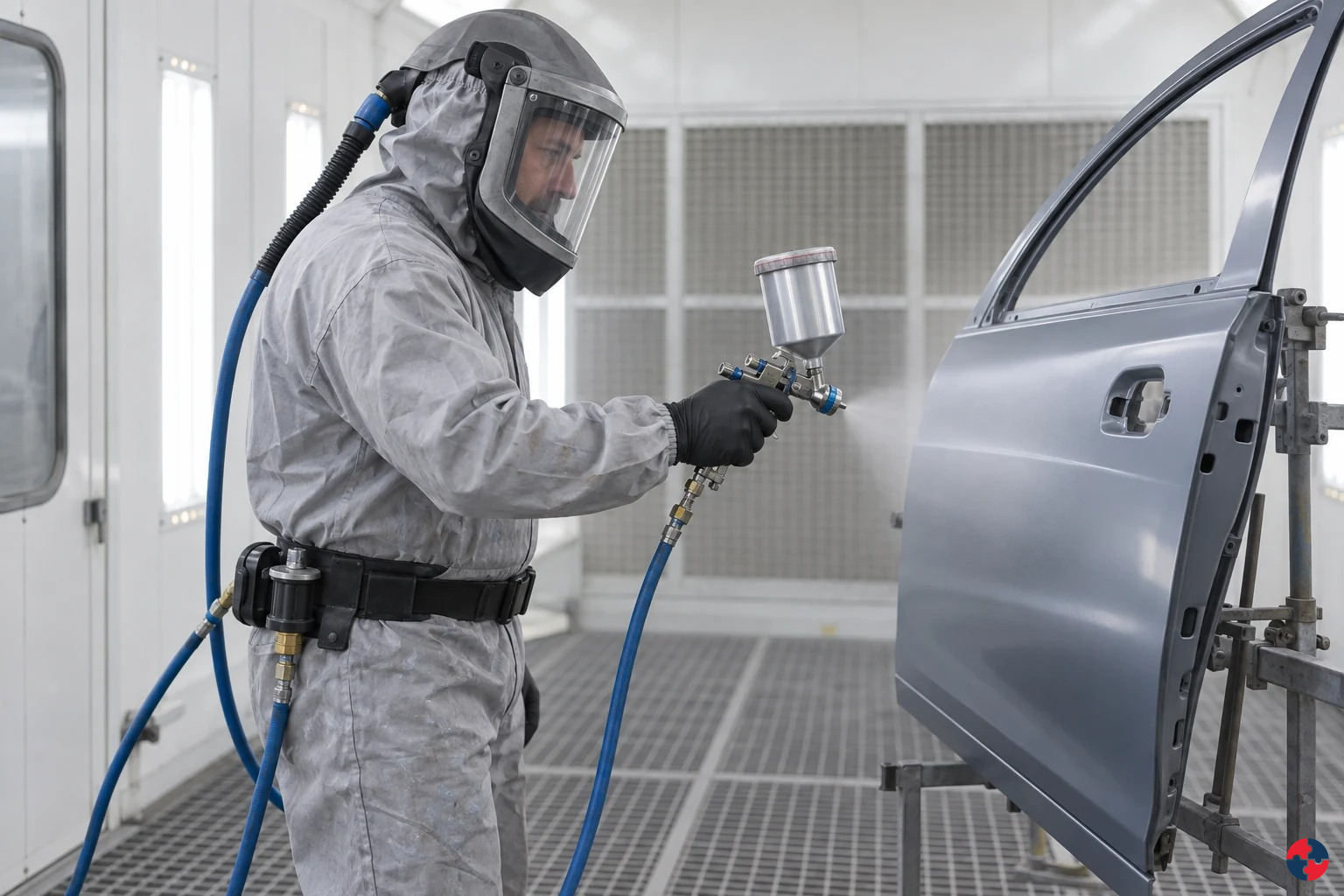
Photorealistic illustrative UK workplace scene. Review checks: Setting: A painter prepares a vehicle panel for two-pack isocyanate paint in an enclosed spray booth; a neighbouring worker may enter during booth clearance. Act: Before spraying, consider an isocyanate-free coating or non-spray method if the specification permits; otherwise verify booth extraction, air-fed respiratory protection and the task COSHH assessment. Hold / review: Stop if booth flow or supplied air fails, the product is unknown, a bystander enters, the visor is lifted in mist or symptoms are reported.
Keep respiratory protection within the whole spray-control system
Spraying can create fine airborne material that is not reliably judged by whether a room looks clear. With isocyanate-containing coatings, the actual product and task assessment must establish the required prevention, enclosure, ventilation and respiratory protection arrangements. The native model’s visor-lifting clue is an exposure decision, not a numerical measurement.
Use the specified protective system and the actual booth or room’s established clearance arrangements. A universal waiting time from another installation is not an acceptable substitute. The point at which spraying stops and the point at which unprotected entry is permitted are different states. Protection must remain appropriate during the period defined by the assessed method.
Selection, supply, maintenance and use of respiratory protective equipment require the suitable competent arrangements for the system. This awareness course does not select a respirator, certify breathing-air quality or teach a change of equipment. Symptoms and health-surveillance concerns need the appropriate professional route; absence of symptoms cannot establish that control is effective.
For practice, compare three clues: spraying has stopped, mist is no longer obvious and the established clearance condition has been met. Only the relevant evidence can resolve the corresponding entry/protection decision. Identify the hold and reporting action if the basis is missing or the enclosure fails. Keep the task restricted until the responsible assessment establishes a safe arrangement, rather than treating a learner’s visual judgement as permission to lift protection.
Why is spraying especially high risk?
Spraying breaks liquid product into fine droplets that can travel, remain airborne and be inhaled.
HSE guidance highlights that spraying can produce very high exposure because mist droplets are easily breathed in and because more product is used in a short time. Conventional spraying, HVLP and airless systems all have different overspray and injection hazards, so the equipment choice matters. See HSG276 - Isocyanate paint spraying; INDG388 - Safety in isocyanate paint spraying.
The spray area must be managed as a contaminated atmosphere until it is clear. A worker who lifts an air-fed visor to inspect finish immediately after spraying can inhale mist despite having worn BA during the spraying pass.
Mist leakage — Can expose bystanders outside booth/room. Maintain enclosure and extraction.
Clearance time unknown — Workers may remove BA too soon. Measure and display clearance time.
Visor lifted — High exposure can occur after spraying. Keep BA on until outside clear area.
Spray gun cleaning — Exposure can occur during wash-out. Use controlled cleaning and RPE.
Outdoor spraying — Wind can carry mist. Plan exclusion, wind direction and controls.
Airless injection hazard — High pressure can inject paint into skin. Guard tips, pressure control and training.
Why do clearance times matter?
Clearance time is the period needed for a booth, room or enclosure to remove airborne contaminant after the process stops.
Clearance time is especially important in spray booths and spray rooms because isocyanate paint mist can be invisible. A sprayer may feel the job is finished when the gun stops, but the breathing hazard can remain in the air. HSE guidance is clear that the booth or room takes time to clear and that people need to know that time.
The clearance time should be measured, rounded up sensibly, displayed on the booth or room entrance and communicated to anyone who uses or enters the area. Workers using air-fed BA must keep it on until they have left the spraying area or the area is clear. Clearance time should be retested when filters are near change, after system changes, after airflow concerns and as part of examination/testing arrangements.
HSE bodyshop clearance-time guidance requires a measured and clearly displayed time. Keep air-fed breathing apparatus on while in the spray area until clearance is achieved; do not infer a safe time from when the gun stopped.
Control
What good looks like
Failure to avoid
Measurement
Use a suitable smoke/fog method to fill the empty booth/room and time how long ventilation takes to clear visible mist.
Guessing from manufacturer claims or old habits.
Worst-case timing
Measure under conditions that represent poor-case clearance, such as before filter changes where relevant.
Testing immediately after new filters and assuming it always applies.
Display
Post the clearance time clearly at the booth or room entrance.
Clearance time hidden in a folder.
Training
Sprayers, inspectors, cleaners and supervisors know they must wait or keep BA on.
People entering to inspect finish while mist remains.
Re-test triggers
Retest after filter changes, airflow changes, booth modifications or poor monitoring results.
Continuing after visible mist, leakage or pressure concerns.
Interlocks/sensors
Use interlocks or warning systems where appropriate to prevent early entry or visor removal.
Relying only on memory in busy bodyshop conditions.
Applied case
Spraying has stopped, but the installation’s clearance condition has not been met.
Decision and explanation
The actual assessed spray-control and clearance arrangement, not visual appearance alone.
Correct decision: The actual assessed spray-control and clearance arrangement, not visual appearance alone. Do not remove protection or infer clearance from appearance while the assessed exposure conditions remain unresolved.
Lesson 2
Check where extracted contaminants go
Verify capture, interlocks and safe discharge rather than moving exposure from the sprayer to another person.
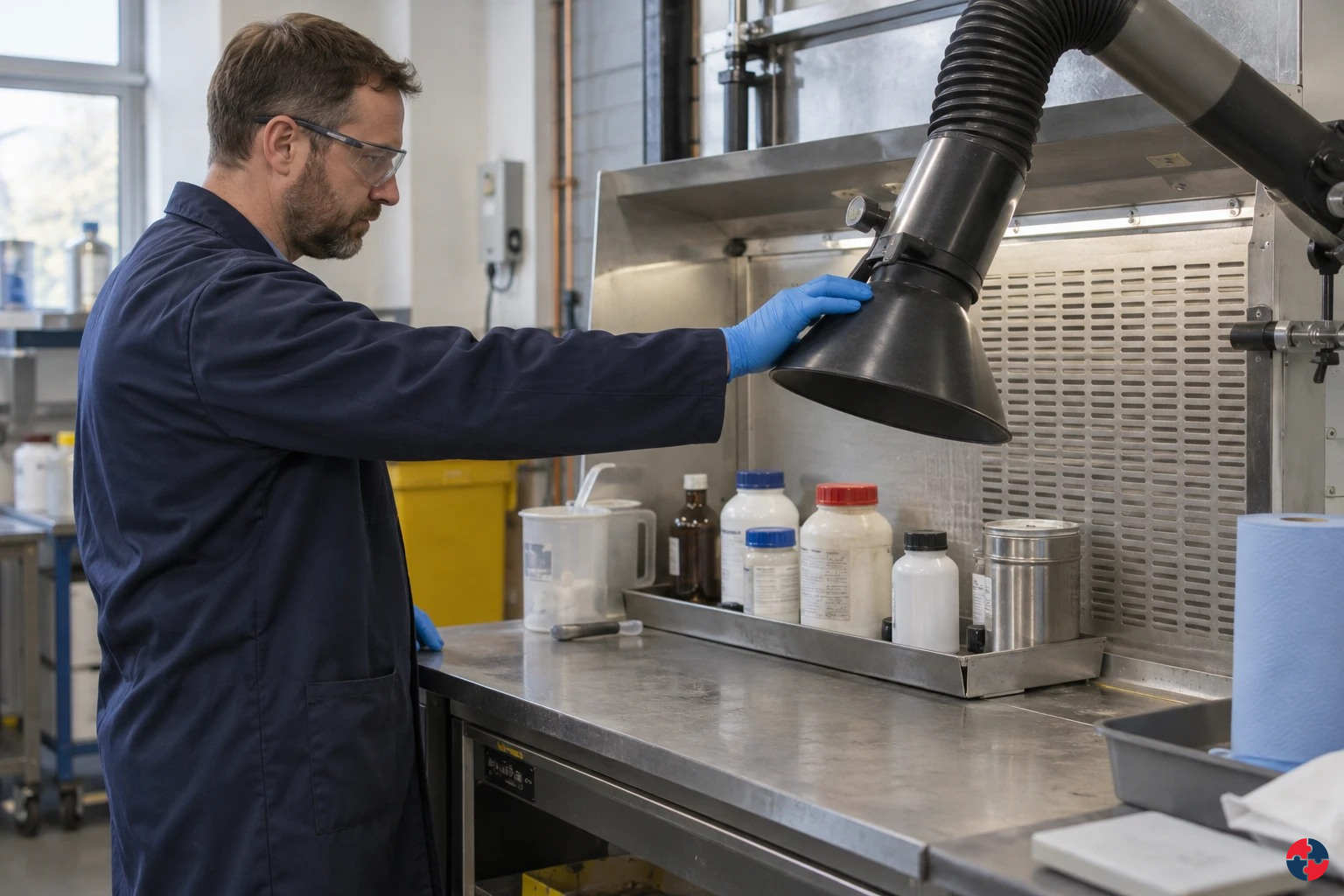
Photorealistic illustrative UK workplace scene. Review checks: Assessing: the site team identifies dust, fume, mist and vapour tasks and links each LEV asset to a COSHH assessment and health risk. Specifying: LEV purchases require task description, contaminant type, worker position, capture requirement and commissioning evidence. Implementing: Operators use hoods, on-tool extraction, booths and gauges correctly, with stop-work triggers for failed capture.
Check where extracted contaminants go
Extraction is a system, not just a moving fan. Capture or enclosure control must suit the process, and the discharged contaminant must not create an uncontrolled exposure for somebody outside the workroom. An outlet beside a door, access route or air inlet needs consideration within the actual competent design and assessment.
An extraction fault or bypassed interlock can remove a dependency of the spray process. Keep the affected task held through the operating arrangements until the required control or a competent authorised alternative is established. An open external door is not automatically a suitable substitute and may alter airflow or expose adjacent people.
Use the current commissioning basis, operating indicators, user information and relevant checks. A report from an earlier configuration cannot automatically accept a new coating, changed outlet or altered room. No safe discharge distance or airflow threshold can be inferred from this course. Those decisions belong to the specific process and installation assessment.
For practice, follow the contaminant from generation through capture to discharge. Name the people who might be affected at each point, including contractors passing outside. Assign evidence to each claim and identify what a fan-running light cannot prove. After a change or repair, verify the current system in representative use and preserve any restriction until the responsible handback is complete. The aim is control of the whole pathway, not merely removing visible mist from the sprayer’s immediate view.
What is the LEV system journey from source to assurance?
The easiest way to understand LEV is to follow the contaminant and then follow the evidence.
The contaminant journey starts at the task. A sanding disc, spray gun, welding arc or powder transfer creates dust, fume, mist, vapour or gas. The hood or enclosure must capture or contain that contaminant before it reaches the breathing zone. Ductwork must then carry it without leakage or settling. The air cleaner or filter must remove what it is designed to remove. The fan must maintain the required airflow. The discharge must release air safely, and the monitoring, maintenance and examination arrangements must prove the control is still working.
For learners, this journey is a useful mental model because it prevents the common mistake of treating LEV as a single item. If any stage in the journey is weak, the system can still look present while exposure control has failed.
1. Contaminant source
Identify exactly where dust, fume, mist, vapour or gas is generated and how it moves.
2. Hood or enclosure
Capture or contain the contaminant before it enters the worker's breathing zone.
3. Duct and air cleaner
Move contaminated air through ductwork and remove particles, mist or vapour where required.
4. Fan and discharge
Maintain the required airflow and release cleaned or extracted air to a safe location.
5. Monitoring
Use gauges, indicators, visual checks, exposure data and health surveillance to detect weak control.
6. Maintenance and TExT
Keep performance reliable through checks, repair, statutory thorough examination and closed defects.
Journey stage
Key question
Evidence expected
Contaminant source
What is generated and how hazardous is it?
COSHH assessment, safety data sheet (SDS), WEL review and process observation.
Hood
Is the contaminant captured before it crosses the breathing zone?
Commissioning evidence, smoke/dust-lamp checks and user observation.
Duct
Is airflow carrying contaminant without leakage, damage or settlement?
Duct inspection, pressure readings and maintenance records.
Filter or air cleaner
Is the cleaner suitable and not overloaded?
Filter change record, differential pressure and waste controls.
Fan
Can the fan overcome system resistance and maintain duty?
Fan inspection, belt/bearing checks and measured performance.
Discharge
Could extracted air re-enter or expose others?
Discharge location review and environmental/DSEAR assessment where relevant.
Monitoring and assurance
Do routine checks, TExT, exposure results and health surveillance tell the same story?
Dashboard, TExT close-out, monitoring interpretation and management review.
Which changes invalidate an air-control assumption?
Changing substance, source, production rate, hood position, tools, room layout, simultaneous hoods, doors, filters or discharge can require reassessment and recommissioning.
A new fan or filter can change system balance; more extraction from one branch can weaken another. Weather, open doors and make-up air can change cross-draughts. A new coating or workpiece can change emission and health hazard. Designers and hygienists should review significant changes before operators are told the original TExT remains sufficient. Record the changed design, tests, user instructions and any new exposure evidence.
A fault is bypassed and extracted coating material discharges beside an outdoor route.
Decision and explanation
The complete capture/interlock/discharge system and all people exposed by it.
Correct decision: The complete capture/interlock/discharge system and all people exposed by it. Verify capture, interlocks and safe discharge rather than moving exposure from the sprayer to another person.
Lesson 3
Plan hot-component handling after curing
Keep residual heat, handling supports and access protection in the release decision after the oven cycle ends.
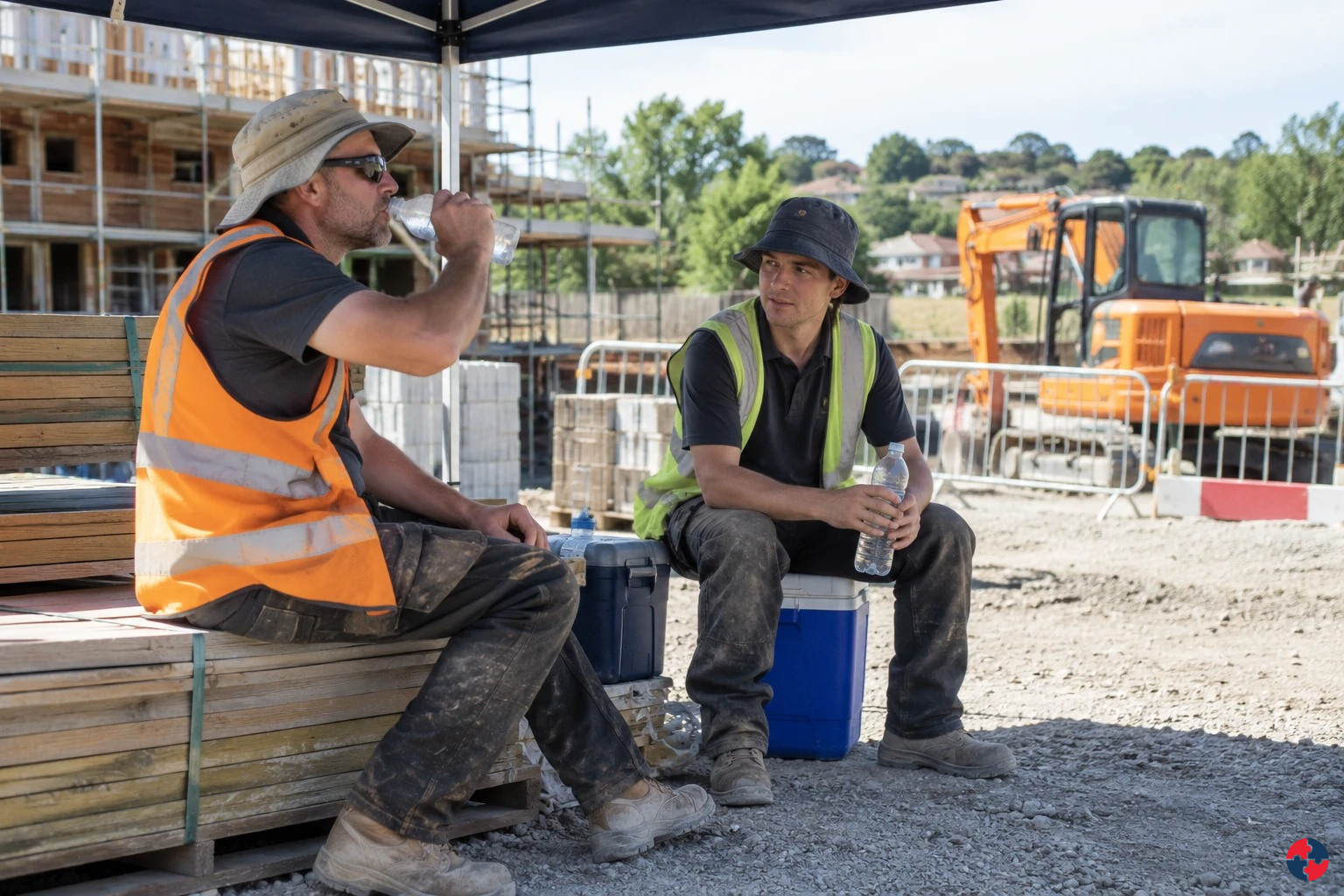
Photorealistic illustrative UK workplace scene. Review checks: Hot task: Assess radiant load, humidity, work rate and the cooling limits of required PPE. Cold task: Move work to temperate space where feasible, or isolate refrigeration and verify the environment. Stock removal alone is not enough. Recovery and change: Provide suitable recovery and escape; stop and reassess when conditions or essential controls change.
Plan hot-component handling after curing
End of cycle does not mean end of thermal risk. The oven, carrier, tooling and component may retain heat and create burn or handling hazards during unloading. The actual material and equipment information must establish the suitable method and release conditions. A cool external handle does not prove that the supported component is safe to touch.
Plan how the load moves from oven to the next support, including the people who guide, transport and receive it. Suitable tools, equipment and specified protection support the assessed method. Do not improvise a lifting point, carry a hot item manually because it is small or place it in an unprotected pedestrian area to cool.
Intervention inside the oven is a separate task. Stopping a heating cycle does not establish isolation, safe atmosphere, safe temperature or protection against movement. Maintenance and any potential confined-space entry need their own competent assessment and control. This course supplies no universal cooling time or safe contact temperature.
In the exercise, separate process completion, hot-load handling and maintenance access on a fictional status board. Identify the evidence for each. Verify the actual receiving position and protection from accidental contact while the component remains hot. Hand over any residual restriction to the next team, rather than treating a production label as evidence that all hazards have ended. The learner recognises the boundary and seeks the authorised information; they do not certify a cured product or approve entry.
What controls should be considered before relying on behaviour?
Thermal risk is best managed by changing the environment, source, task and recovery before relying on personal coping.
Telling workers to drink more or wear a coat is not enough if the job design creates excessive heat or cold exposure. Controls should remove or reduce the thermal load wherever practicable.
Personal adaptation still matters, but only within a system that gives people real choices: access to water, shade, warm areas, dry clothing, recovery time, suitable PPE and the authority to stop.
For heat, remove the hot operation where possible, then insulate or shield radiant surfaces and verify ventilation at the work position. For cold, move a task out of the freezer when practicable, or use heated, enclosed workstations and insulated access doors without compromising escape. Changing the shift pattern or asking people to drink water supports these source controls but cannot replace them.
Protective clothing must be assessed alongside the task: a suit may worsen heat load, while wet gloves can sharply reduce cold protection. The supervisor checks the real work rate, recovery space and worker feedback, then holds the task if a physical control fails or symptoms appear. The worked five-level and ERICPD example sets out feasibility, owners, evidence and stop points for a hot plant room and chilled loading area.
How can maintenance itself be made safe?
Plan intervention hazards before removing guards or opening plant. Control energy, movement, height, substances, contractors and nearby operations for the whole job.
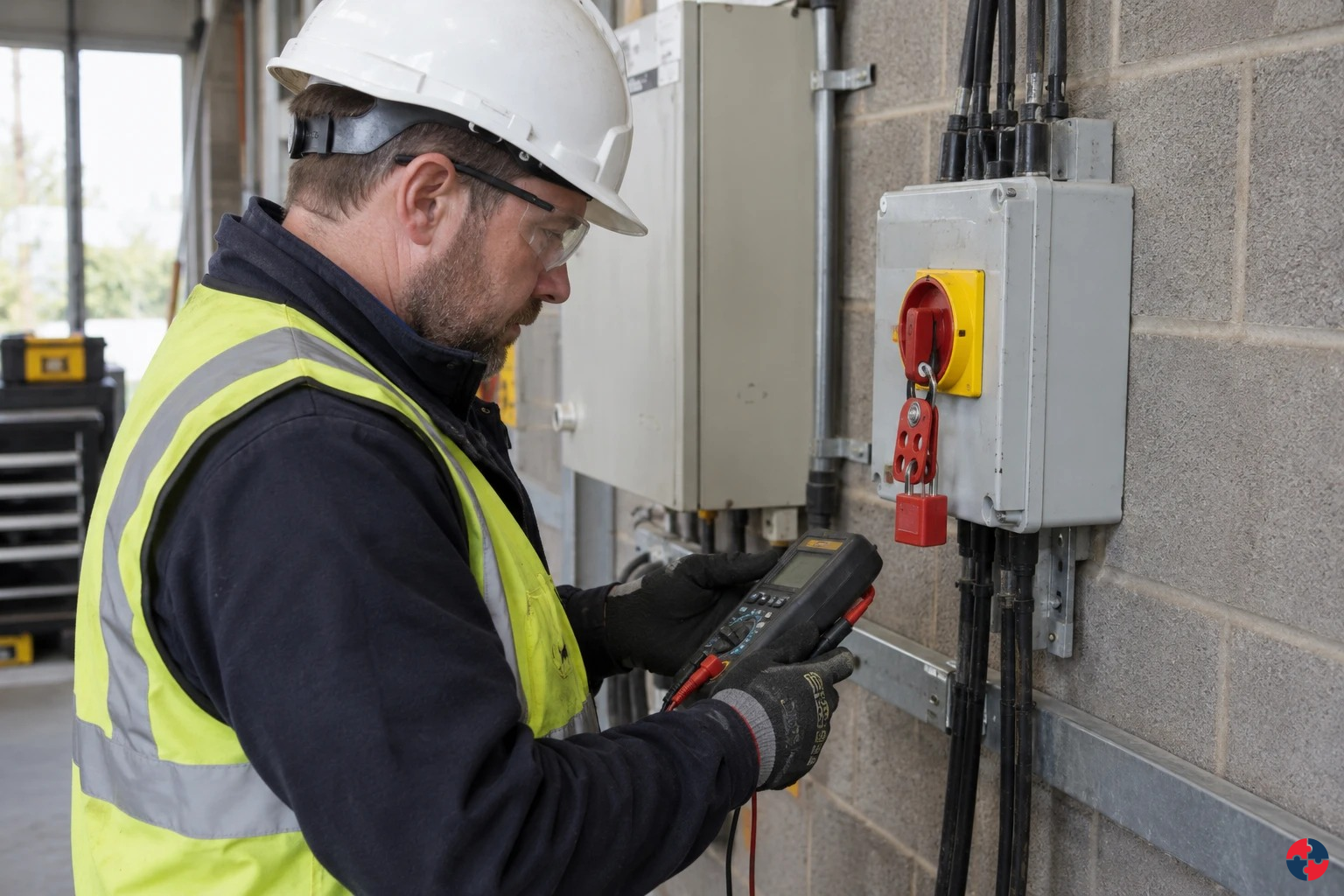
Identify every energy source, bring equipment to the required state, securely isolate, prevent reconnection and release or restrain stored energy. A stop command or open guard is not secure isolation. Use planned exceptional powered fault-finding only with competent specialists and designed protection. Coordinate group work and shift changes. HSE maintenance of work equipment and HSE L22 Safe use of work equipment.
At handback, account for people and tools, restore guards and devices, verify the affected functions and authorise a controlled restart. A permit is a coordination tool where the risk system requires it; it does not substitute for physical controls. Contractors need equipment identity, instructions, hazard information and a defined interface.
Applied case
The cycle is complete, but the carrier and component remain hot.
Decision and explanation
Process completion alone does not release hot handling or maintenance access.
Correct decision: Process completion alone does not release hot handling or maintenance access. Keep residual heat, handling supports and access protection in the release decision after the oven cycle ends.
Lesson 4
Control solvent and fire boundaries together
Keep substance containment, ignition control and premises protection aligned with the actual task and fire arrangements.
Photorealistic illustrative UK workplace scene. Review checks: Setting: At fictional the process operator, a road tanker brings an identified flammable product to a bulk tank after a supplier has changed the additive package. Act: The transport planner confirms classification, documents, vehicle and load details with the carrier. Hold / review: Do not connect if additive compatibility, classification, receiving capacity, hose suitability or a critical protection test is uncertain.
Control solvent and fire boundaries together
Open solvent containers near a curing area can create both exposure and fire concerns. The actual substances, quantities, temperatures, ventilation and possible ignition sources determine the assessment. Do not treat every smell as a measured explosive atmosphere, or assume that an invisible vapour is harmless. Keep conclusions tied to evidence.
Apply the assessed storage, dispensing and waste arrangements, including prevention of avoidable releases and control of ignition sources. The dangerous-substances review must be appropriate to the process and location. This course does not classify hazardous zones, prescribe universal separation distances or select electrical equipment for them.
Fire separation and escape also need to remain effective. A fire door held open for convenient component movement can defeat a premises control independently of whether the solvent container is closed. Resolve the movement method through the responsible arrangement rather than normalising the obstruction. Fire duties vary across UK jurisdictions; use the actual premises assessment and local plan.
For practice, put substance control, ignition prevention, compartmentation and escape on separate lines. Identify the observation and evidence required for each before the affected work continues. Consider temporary maintenance, packaging and charging equipment introduced to the area, because those changes can alter the basis. Verify the completed arrangement after the work, including waste removal and restoration of boundaries. One completed action must not hide another unresolved fire-control dependency.
Which barriers control major accident scenarios involving dangerous substances?
Major accident barriers should be defined for each credible event and checked through performance standards and evidence.
A dangerous substance scenario should be written as a chain: initiating event, release or loss of control, escalation mechanism, people or environment affected, prevention barriers, detection barriers, control barriers, mitigation barriers and emergency response. This prevents a page or assessment becoming a list of generic controls.
For example, a road tanker delivery of petrol may rely on product verification, safe routeing, receiving tank ullage, overfill prevention, earthing and bonding, hose inspection, competent driver and site operator, isolation, emergency stop, spill containment, ignition control, firewater arrangements and site emergency response. If any of those barriers are missing, untested or poorly understood, the risk picture changes.
Barrier assurance asks whether each critical control has an owner, a performance standard, an inspection or test routine, a defect escalation route and a review trigger.
Compatibility matrix, tank allocation, line labelling and independent verification.
pH/temperature checks, abnormal odour, pressure rise or process alarm.
Stop transfer, isolate, evacuate if needed and obtain specialist response.
Runaway reaction
Validated recipe, feed control, cooling capacity, inhibitor control and MOC.
Temperature/pressure alarms, trips and operator response.
Relief system, quench, emergency shutdown, evacuation and emergency plan.
Transport package failure
Approved packaging, load restraint, segregation and carrier controls.
Pre-use checks, driver inspection and incident reporting.
Spill kit, emergency services information, exclusion zone and environmental protection.
Static ignition during transfer
Earthing/bonding, conductive equipment, controlled flow rates and DSEAR zoning.
Bonding confirmation, gas testing where relevant and supervision.
Fire response, isolation, emergency shutdown and evacuation.
What should fire door checks look for?
Fire doors are passive fire protection whose performance depends on correct installation, closure and maintenance. Closers and automatic hold-open releases are active elements; daily use and alteration can still defeat the barrier.
Check the complete door set in context: leaf, frame, hinges, closer, seals, glazing, latch, gaps, hold-open release and any damage or wedges. The exact acceptable detail comes from the door specification and competent inspection, not a universal gap rule. A door that passes a paper register but is routinely propped open will not form the expected barrier in a fire.
A fire door check should look beyond whether a door exists. The practical question is whether it will close into the frame, resist smoke and flame as intended, and remain available when needed. A beautiful door that is wedged open, badly fitted or missing seals is not a reliable control.
Inspection depth should match risk. A simple user check may identify obvious damage, obstruction or wedging. Periodic competent inspection may be needed for door set condition, gaps, seals, glazing, signage, hinges, closers and hold-open devices.
Fire door check prompts
Check
Why it matters
Escalation trigger
CheckDoor closes fully
Why it mattersGaps allow smoke spread.
Escalation triggerDoor fails to close fully, or a required latch does not engage.
CheckSeals and strips
Why it mattersSmoke and heat resistance may be reduced.
Escalation triggerMissing, damaged or painted-over seals.
CheckGlazing and panels
Why it mattersDamaged glass or panels defeat the door set.
Escalation triggerCracks, loose beads or non-rated replacement.
CheckNo wedging
Why it mattersOpen doors cannot protect routes.
Escalation triggerRepeated wedging or unsuitable hold-open arrangements.
CheckFrame and gaps
Why it mattersExcess gaps can compromise performance.
Escalation triggerVisible distortion, impact damage or poor fit.
Official context: official guidance; Scottish existing non-residential fire guidance; Approved Document B. Practical premises guidance supports principles within its stated nation and premises type; worked controls are illustrative and need competent site assessment. Separate NI law does not inherit England, Scotland or GB guidance.
Applied case
The solvent lid is replaced, but a fire door remains wedged open for transport.
Decision and explanation
The separate fire-separation and movement arrangement.
Correct decision: The separate fire-separation and movement arrangement. Keep substance containment, ignition control and premises protection aligned with the actual task and fire arrangements.
Lesson 5
Classify the entry task before anyone crosses the boundary
Avoid entry where practicable and require the actual competent assessment and emergency arrangements when entry is necessary.
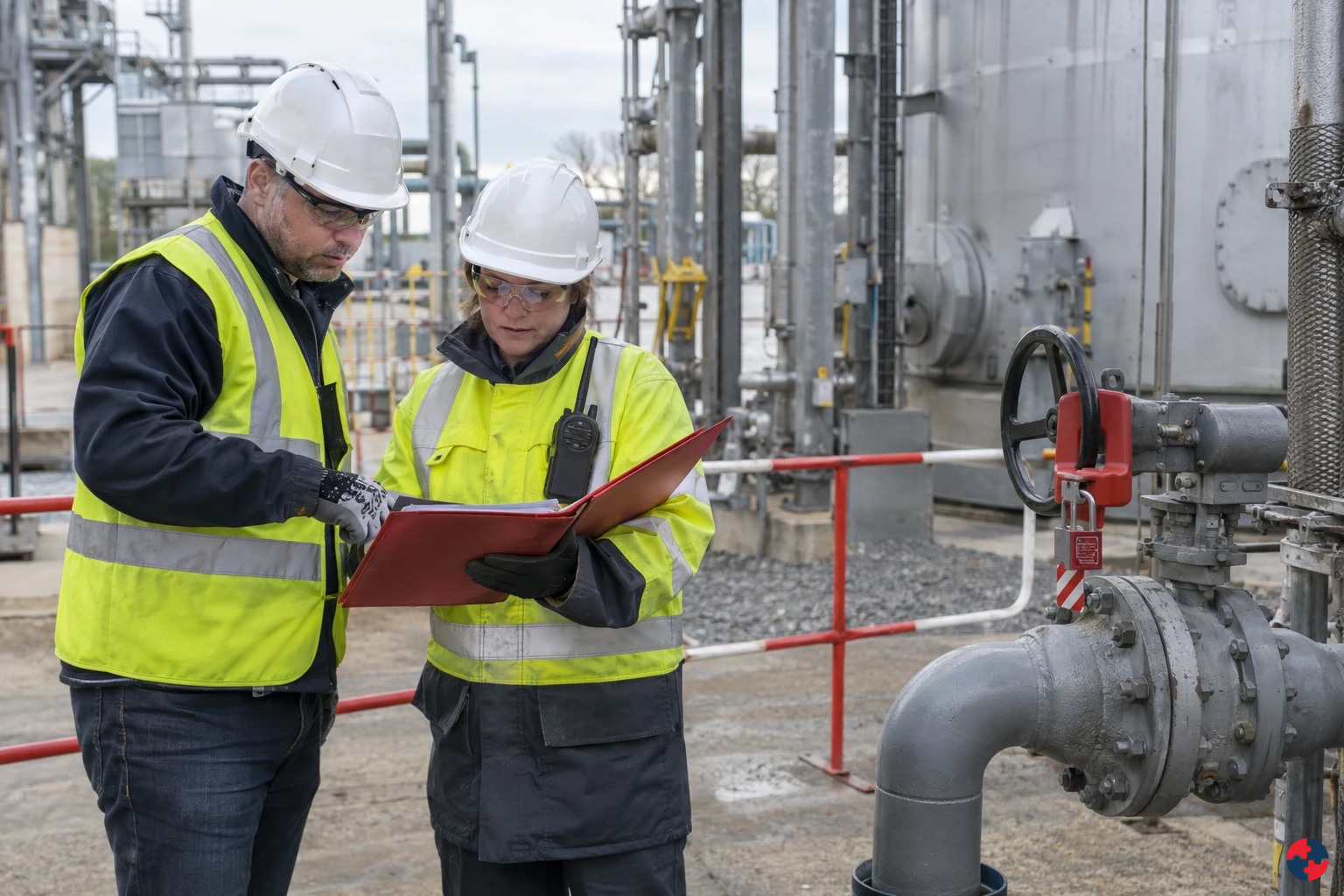
Photorealistic illustrative UK workplace scene. Review checks: Define: Agree the inspection outcome and consider a remote camera from outside. Decide: Do not enter merely because a permit form is available. If entry remains: Use a competent space-specific assessment, safe system and rescue plan.
Classify the entry task before anyone crosses the boundary
An oven or duct is not classified only by its name or size. A confined-space assessment considers enclosure and reasonably foreseeable specified risks from the space, contents and work. A large space can qualify, while a particular entry may have hazards that still require control even if the statutory confined-space definition is not met. Do not make the classification from a picture alone.
First consider whether the task can be done without entry. If entry is necessary, competent planning must establish isolation, atmosphere, access, communication, equipment, people and emergency arrangements appropriate to the task. A permit coordinates an established safe system; it does not create missing technical controls.
Never enter to investigate an alarm, unusual smell or a person in difficulty without the required trained and equipped response. An open door or a stopped fan does not establish safe conditions. The site needs a workable planned emergency arrangement; simply writing call emergency services is not the entire rescue plan.
For practice, review a fictional contractor proposal to clean an oven. List the information needed to classify and plan the work, then identify which assumptions would prevent release. Keep your answer as an evidence request and hold decision, not instructions to test an atmosphere or perform a rescue. Verify that the actual contractor, scope and plant state match the agreed arrangement, and maintain the boundary if the task changes.
How can entry be avoided?
First test a safe no-entry method; design out the need to place a person in the hazardous space wherever reasonably practicable.
For a blocked drainage chamber, use a remote camera and jetting access from outside if the method can safely clear the blockage. A fixed sampling port, clean-in-place system or external gauge can avoid repeated inspection entry. Verify the no-entry equipment itself does not create pressure, chemical or public-exposure hazards. The HSE L101 ACOP sets the GB avoid-entry principle; NI regulations provide the NI route. If entry remains necessary, record why alternatives are not reasonably practicable and move to a task-specific safe system.
How must rescue be prepared?
Plan, equip, staff and rehearse a rescue suited to the exact space and foreseeable casualty condition before entry.
The HSE L101 ACOP says emergency arrangements must be suitable for foreseeable risks. Identify who alerts, who remains outside, retrieval route, lifting equipment, breathing apparatus if indicated, first aid and emergency-service access. The standby person should not enter spontaneously. Test the drill with the same access geometry and an incapacitated-person scenario. If a key rescuer, equipment item or communications link is unavailable, entry does not start; if it fails during entry, withdraw and activate the planned response from safety.
Applied case
A contractor proposes stepping into a stopped oven to inspect residue.
Decision and explanation
Avoid-entry consideration and the competent task-specific assessment/control and response arrangements.
Correct decision: Avoid-entry consideration and the competent task-specific assessment/control and response arrangements. Avoid entry where practicable and require the actual competent assessment and emergency arrangements when entry is necessary.
Lesson 6
Respond to damaged charging equipment within competence
Keep people and escape routes protected while the actual battery/system response is established.
Photorealistic illustrative UK workplace scene. Review checks: Setting: the site team excavates near a buried electrical service at a live client site. Act: Compare drawings with field scan and mark a controlled route; select a non-intrusive alternative where feasible. Hold / review: A conflicting drawing, ambiguous locator signal or exposed unknown service stops the job.
Respond to damaged charging equipment within competence
A damaged traction battery connected to a charger presents a condition that needs the site’s appropriate defect and emergency response. The hazards depend on the battery chemistry, condition, equipment and environment. The model does not justify assuming one chemistry or prescribing the same handling or firefighting method for every battery.
Do not continue charging simply because the vehicle is urgently needed. Protect people and prevent unauthorised use through the assessed arrangements, using competent assistance where intervention is needed. Do not move, disconnect or open a damaged battery as an improvised learner action. Any signs of an incident must be handled through the actual emergency plan and trained response.
The charging location also matters. Packaging, escape routes, ventilation and nearby work can change the exposure and consequences. A charger being electrically powered does not establish compatibility, condition or safe surroundings. Review the complete charging arrangement and manufacturer information rather than only the plug.
For practice, separate the battery defect, equipment readiness and area/escape concerns. State the immediate protection and the responsible role who will establish the safe recovery method. Verify the competent return-to-use decision and current area arrangement before a replacement vehicle or battery is introduced. This course develops recognition and reporting; it does not train electrical repair, battery recovery or incident firefighting. Keep the restriction explicit through handover so urgency cannot silently restart the affected system.
How can charging equipment create electrical and fire risk?
Charging equipment can create risk when chargers, batteries, leads, sockets or ventilation are unsuitable, damaged, overloaded or poorly managed.
Charging is now part of ordinary work: phones, tablets, radios, laptops, tools, cleaning equipment, e-bikes, forklifts and electric vehicles may all be charged on site. The risk is not the word 'battery' alone; it is the combination of electrical load, heat, damaged cells, incompatible chargers, poor ventilation, extension leads, blocked exits and lack of user rules.
Employers should control where charging happens, what chargers can be used, how damaged chargers are reported, whether batteries are removed from service after impact, how overnight charging is managed and whether charging areas affect fire escape routes.
Charging risk examples - Charging risk examples
Charging issue
Why it matters
Control
Incompatible charger
Battery may overheat or fail.
Use manufacturer-approved chargers.
Damaged cable or plug
Shock, arcing or fire.
Remove from use and replace.
Covered charger
Heat cannot dissipate.
Keep chargers ventilated.
Charging near exits
Fire or smoke can block escape.
Designated charging area.
Overloaded extension lead
Overheating and fire.
Adequate socket provision.
Damaged battery
Thermal runaway or chemical release.
Quarantine and specialist advice.
How can the hierarchy of controls reduce risks while preparing for a gas release from process equipment?
Use the stronger source and work-design controls first; response or individual support does not replace prevention.
In some emergencies, evacuation alone may not be enough. A process may need to be shut down, power isolated, gas closed, fuel transfer stopped, ventilation changed, drainage isolated, spill contained, pressure relieved or a machine made safe.
These actions should be designed in advance and clearly marked. People should not be expected to work out which valve, switch or isolator matters while alarms are sounding.
Use the hierarchy to prevent the release and limit exposure before relying on emergency actions. Any real event follows the site emergency plan; people do not work through this teaching diagram before responding.
How can the ERICPD hierarchy of controls reduce risks while preparing for a gas release from process equipment?
ERICPD is a planning crossmap. Its prompts do not add a sixth rung or rank Isolate above engineering. Discipline verifies and sustains every control level.
Control level
Control for this activity
Owner and verification
Stop / restart decision
Eliminate
Remove unnecessary hazardous gas inventory or the releasing process through a validated process redesign.
Task owner verifies that the proposed change removes the named hazardous step, including foreseeable cleaning, maintenance and work transferred elsewhere.
If the hazardous step remains, keep it within the task assessment and select the stronger feasible remaining controls.
Reduce, including substitution
Evaluate a less hazardous material or process condition through engineering and change review, including new reaction and fire risks.
Competent task/process owner validates suitability, compatibility and new hazards against the actual operating requirements before the alternative is adopted.
Reject an alternative if its performance is unproved or its new hazards are unresolved.
Isolate
Provide suitable remote process isolation and separation from occupied areas so the response does not require people to approach a release.
Supervisor checks the actual boundary, affected people and connected work; verify separation or isolation before allowing access.
Hold or stop for real gas alarm, unavailable credited protection, unsafe response route or failed communication.
Control: physical safeguards
Verify containment, gas detection, alarms and designed shutdown or depressurisation functions against the credible scenario and safe-state requirements.
Hold or stop for real gas alarm, unavailable credited protection, unsafe response route or failed communication.
Control: work method and response
Agree control-room actions, alarm meaning, communication, evacuation and responder access; practise the scenario and treat loss of essential protection as a plant operating decision.
Supervisor confirms the work limits, competent cover, communication and stop/restart authority with the people doing this activity.
Hold work when the agreed limits, competent cover or effective communication cannot be maintained.
PPE
Select personal detection and task-specific protection for authorised roles. An ordinary respirator or personal gas detector does not authorise entry into a dangerous atmosphere.
Release only after operations and technical owners verify the safe plant state and restored response capability. Retain verification and unresolved restrictions at handover.
Keep the task on hold until required reinstatement evidence and unresolved defects are accepted by the responsible owner.
How can the ISO 45001 hierarchy of controls reduce risks while preparing for a gas release from process equipment?
The hierarchy of controls in ISO 45001:2018 comes under Clause 8.1.2 (Eliminating hazards and reducing OH&S risks), which is located within Clause 8 ("Operation").
Task owner verifies that the proposed change removes the named hazardous step, including foreseeable cleaning, maintenance and work transferred elsewhere.
If the hazardous step remains, keep it within the task assessment and select the stronger feasible remaining controls.
Substitution
Evaluate a less hazardous material or process condition through engineering and change review, including new reaction and fire risks.
Competent task/process owner validates suitability, compatibility and new hazards against the actual operating requirements before the alternative is adopted.
Reject an alternative if its performance is unproved or its new hazards are unresolved.
Engineering controls
Provide suitable remote process isolation and separation from occupied areas so the response does not require people to approach a release.
Supervisor checks the actual boundary, affected people and connected work; verify separation or isolation before allowing access.
Hold or stop for real gas alarm, unavailable credited protection, unsafe response route or failed communication.
Engineering controls
Verify containment, gas detection, alarms and designed shutdown or depressurisation functions against the credible scenario and safe-state requirements.
Hold or stop for real gas alarm, unavailable credited protection, unsafe response route or failed communication.
Administrative controls
Agree control-room actions, alarm meaning, communication, evacuation and responder access; practise the scenario and treat loss of essential protection as a plant operating decision.
Supervisor confirms the work limits, competent cover, communication and stop/restart authority with the people doing this activity.
Hold work when the agreed limits, competent cover or effective communication cannot be maintained.
PPE
Select personal detection and task-specific protection for authorised roles. An ordinary respirator or personal gas detector does not authorise entry into a dangerous atmosphere.
Release only after operations and technical owners verify the safe plant state and restored response capability. Retain verification and unresolved restrictions at handover.
Keep the task on hold until required reinstatement evidence and unresolved defects are accepted by the responsible owner.
Worked control decision: one scenario through the hierarchy
Illustrative warehouse scenario: a flammable-liquid drum is decanted near occupied work areas. The site must adapt every option to its own fire, substance and process assessment.
Level
Barrier and location
Pre-use and continuing check
Failure and residual risk
Stop decision
Eliminate
Avoid decanting by buying sealed, ready-to-use units delivered to the point of use.
Purchasing and operations confirm the task has actually been removed; review orders and floor observations monthly.
A substitute transfer step may reappear; residual risk remains from stored units.
Do not restart ad hoc decanting without a new assessment.
Reduce / substitute
If decanting remains, trial a less flammable product or smaller quantities at the receiving station.
Process owner checks the safety data and trial before use, then reviews incidents and purchasing changes.
A replacement may create toxicity or compatibility hazards; residual exposure remains.
Hold use if the replacement has not been assessed.
Isolate
Move authorised decanting to a designated, separated and bunded bay away from ignition and escape routes.
Facilities checks bay layout, drainage and separation before first use and during routine inspections.
A blocked route or breached bund defeats separation; vapour and spill risk remains.
Stop decanting if the bay or escape route is compromised.
Control — physical
Fit suitable closed-transfer equipment, ventilation, spill capture and an accessible emergency shutoff in that bay.
Competent maintainer commissions and function-tests controls, then logs scheduled checks and defects.
Loss of ventilation or shutoff leaves release and ignition risk.
Stop transfer on a critical control fault; isolate and call the trained response lead.
Control — method
Use a posted transfer and emergency card at the bay with alarm, isolation, evacuation and fire-service call triggers.
Shift lead walks the steps with workers before use and checks competence and cover at shift changes.
Wrong valve choice or delayed alarm can escalate a release.
Stop transfer if roles, instructions or emergency communication are unavailable.
PPE
Provide assessed splash and respiratory protection only for the defined, authorised task or response role.
Supervisor checks selection, fit, condition and trained use before entry and at periodic review.
PPE can fail or be inadequate for a large release; residual risk is not made safe by clothing.
No entry to an uncontrolled vapour or fire scene; withdraw and call emergency services.
Discipline / assurance
Drill a credible spill with failed shutoff and blocked access, then retest the corrected barrier.
Manager records decision times, defects, owners and closure evidence after each exercise.
A passed drill can miss a later equipment or staffing change.
Suspend the affected activity if critical findings remain open.
Applied case
A damaged battery remains connected beside packaging and an escape route.
Decision and explanation
Protect people through the site arrangements and obtain competent battery/system response without improvised handling.
Correct decision: Protect people through the site arrangements and obtain competent battery/system response without improvised handling. Keep people and escape routes protected while the actual battery/system response is established.
Lesson 7
Two-pack coating and isocyanate mist
Stop spraying for extraction or breathing-air failure, and follow the approved safe exit response.
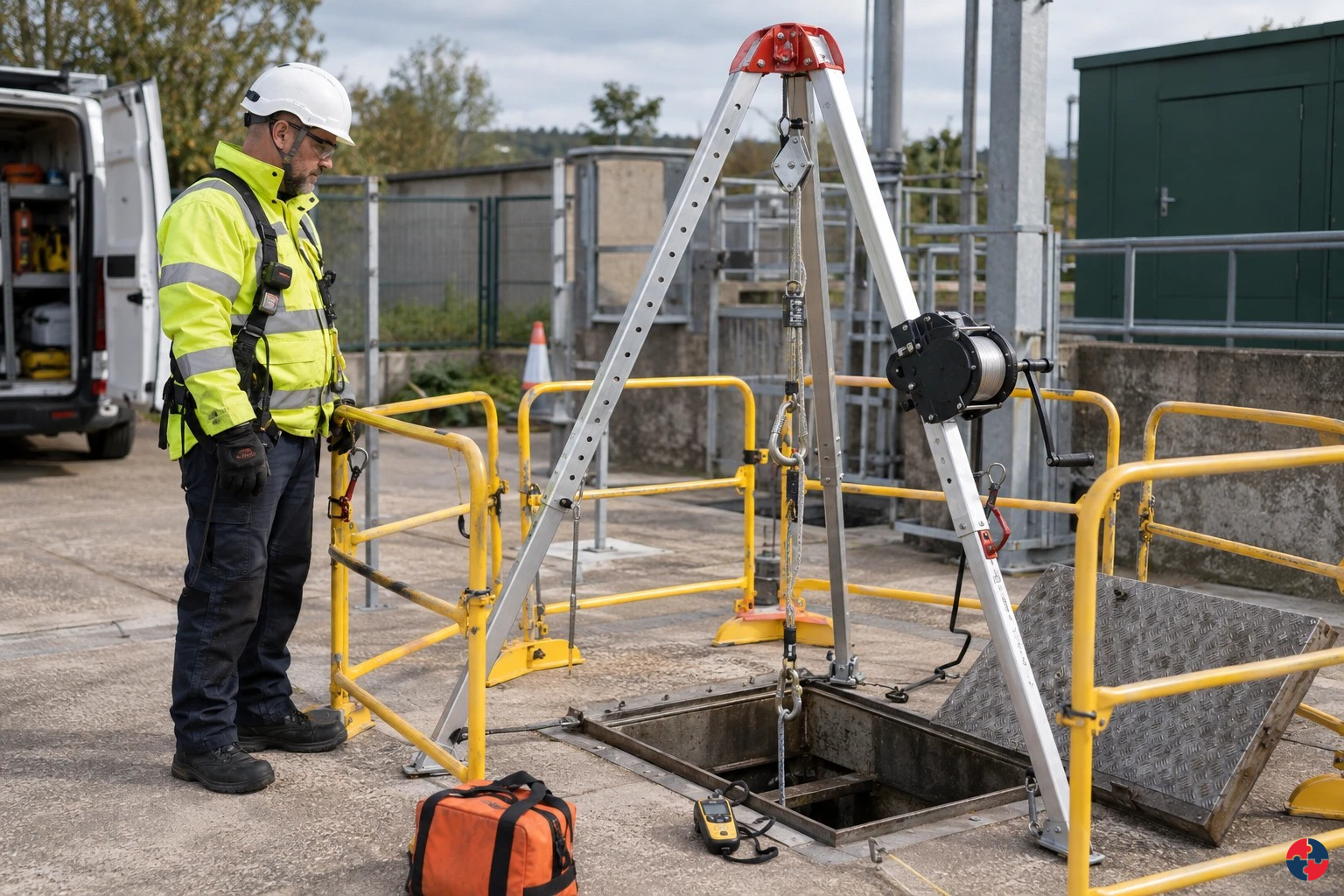
Photorealistic illustrative UK workplace scene. Review checks: Setting: A painter prepares a vehicle panel for two-pack isocyanate paint in an enclosed spray booth; a neighbouring worker may enter during booth clearance. Act: Before spraying, consider an isocyanate-free coating or non-spray method if the specification permits; otherwise verify booth extraction, air-fed respiratory protection and the task COSHH assessment. Hold / review: Stop if booth flow or supplied air fails, the product is unknown, a bystander enters, the visor is lifted in mist or symptoms are reported.
Understand the activity and how harm develops
Check the coating’s actual composition: two-pack describes a system, not a single chemical. Where isocyanates are present, fine mist may be invisible. Lack of smell or visible cloud does not show that the air is clear.
The aircraft component changes airflow and access within a large enclosure. Use a competent assessment of containment, extraction, suitable air-fed respiratory protection and breathing-air quality. HSE spray-booth principles inform this scene, but car-booth dimensions or clearance times cannot simply be copied into a hangar.
Keep respiratory protection in use for the assessed exposure period and follow the safe exit method. Display and observe the measured clearance time for the actual arrangement. Control mixing, cleaning and maintenance exposures too, and use the required exposure monitoring and health-surveillance arrangements.
Recognise the evidence boundary
Question
Case evidence
What is observed?
A sprayer lifts their visor while fine two-pack coating mist remains inside the enclosure.
How can harm occur?
Inhalation can cause occupational asthma; skin contact can also cause dermatitis or sensitisation.
What information is needed?
Confirm the actual coating hazards and current COSHH assessment.
Protect, manage and verify
Purpose
Practical application
Immediate protection
Provide validated enclosure, extraction and suitable supplied breathing air.
Accountable work arrangement
Verify actual coating hazards. Maintain enclosure and extraction. Use assessed air-fed protection. Observe measured clearance and safe exit.
Release verification
Observe that visors stay down and access remains controlled during clearance.
Apply this at work
Stop spraying for extraction or breathing-air failure, and follow the approved safe exit response.
Why is spraying especially high risk?
Spraying breaks liquid product into fine droplets that can travel, remain airborne and be inhaled.
HSE guidance highlights that spraying can produce very high exposure because mist droplets are easily breathed in and because more product is used in a short time. Conventional spraying, HVLP and airless systems all have different overspray and injection hazards, so the equipment choice matters. See HSG276 - Isocyanate paint spraying; INDG388 - Safety in isocyanate paint spraying.
The spray area must be managed as a contaminated atmosphere until it is clear. A worker who lifts an air-fed visor to inspect finish immediately after spraying can inhale mist despite having worn BA during the spraying pass.
Mist leakage — Can expose bystanders outside booth/room. Maintain enclosure and extraction.
Clearance time unknown — Workers may remove BA too soon. Measure and display clearance time.
Visor lifted — High exposure can occur after spraying. Keep BA on until outside clear area.
Spray gun cleaning — Exposure can occur during wash-out. Use controlled cleaning and RPE.
Outdoor spraying — Wind can carry mist. Plan exclusion, wind direction and controls.
Airless injection hazard — High pressure can inject paint into skin. Guard tips, pressure control and training.
Applied case
The mist is no longer visible after spraying.
Decision and explanation
The assessed entry conditions, including the measured clearance requirement.
Visibility alone cannot establish that fine mist has cleared. A guessed time does not represent this enclosure and airflow. Uncontrolled door opening can spread contamination and expose the sprayer.
Lesson 8
Large curing ovens and hot components
Hold access or handling until the approved temperature and atmosphere conditions are established.
Photorealistic illustrative UK workplace scene. Review checks: Hot task: Assess radiant load, humidity, work rate and the cooling limits of required PPE. Cold task: Move work to temperate space where feasible, or isolate refrigeration and verify the environment. Stock removal alone is not enough. Recovery and change: Provide suitable recovery and escape; stop and reassess when conditions or essential controls change.
Understand the activity and how harm develops
Large components and support fixtures can retain heat unevenly. A display measuring oven air does not necessarily show the temperature of a thick part or concealed metal support. A worker can encounter a hot surface after the surrounding air feels cooler.
The approved curing cycle must match the coating or resin, ventilation and equipment. Abnormal temperature, smell, smoke or interrupted extraction requires the established response. Do not change a cycle to recover a delayed schedule without authorised technical review.
Use suitable handling aids, identified cooling areas and verified release conditions. Assess heat load on workers and access around the oven. Entry for cleaning or maintenance is a separate task requiring energy control and assessment of confined-space hazards; routine unloading does not authorise it.
Recognise the evidence boundary
Question
Case evidence
What is observed?
A freshly cured component is being removed while the oven and carrier remain hot.
How can harm occur?
Workers can suffer burns, heat strain or exposure to process fumes.
What information is needed?
Match the curing instruction to the actual material and component.
Protect, manage and verify
Purpose
Practical application
Immediate protection
Provide insulated surfaces, interlocked access and suitable handling aids.
Accountable work arrangement
Follow the approved curing process. Use suitable hot-part handling. Verify relevant cooling conditions. Separate routine unloading from maintenance entry.
Release verification
Confirm the hot-part status remains clear through transfer and storage.
Apply this at work
Hold access or handling until the approved temperature and atmosphere conditions are established.
How should thermal risk be assessed?
Assessment should consider environment, task, clothing/PPE, work rate, duration, worker feedback, symptoms, vulnerable groups and evidence.
The assessment starts with the work, not the weather. Ask what the person is doing, how hard they are working, what clothing or PPE they must wear, how long exposure lasts, what recovery is available and what happens if they become impaired.
For complex heat stress, HSE notes that measurement may need occupational health or competent support and may involve techniques such as wet-bulb globe temperature (WBGT), metabolic-rate estimation, clothing insulation values, heart-rate measurement or physiological monitoring where other controls cannot be implemented.
Step
Practical question
Evidence
Define environment
Indoor, outdoor, process heat, cold store, vehicle cab or mixed?
Location/task map.
Identify thermal drivers
Temperature, radiant heat, air movement, humidity, PPE and work rate?
Observation and measurement.
Map people exposed
Who works there, for how long, and who may be more susceptible?
Roster and consultation.
Review task demand
Manual handling, pace, static work, shift length and recovery?
Task assessment.
Select controls
Engineering, scheduling, breaks, hydration, clothing/PPE and supervision.
Control plan.
Set stop triggers
Symptoms, failed ventilation, PPE intolerance, cold injury signs or weather change.
Briefing and supervisor card.
Verify
Worker feedback, observations, incidents, absence and monitoring reviewed.
Dashboard/action log.
Neither the GB indoor guidance of normally 16°C, or 13°C for rigorous work, nor the similar Northern Ireland guidance is an outdoor work limit or a universal stop-work threshold. There is no legal maximum temperature. Any local work/rest or entry criteria must come from the actual task assessment, PPE and competent advice, then be checked against worker response. HSE law summary; HSENI temperature guidance.
Applied case
The oven air has cooled but a heavy fixture may remain hot.
Decision and explanation
Verify the relevant handling condition using the approved method.
Skin is not a temperature instrument. Elapsed cycle time does not prove safe handling. Air temperature alone may not represent the fixture.
Lesson 9
Extraction fans, interlocks and safe exhaust
Stop the emitting process when required extraction is unavailable or discharge creates danger.
Photorealistic illustrative UK workplace scene. Review checks: Assessing: the site team identifies dust, fume, mist and vapour tasks and links each LEV asset to a COSHH assessment and health risk. Specifying: LEV purchases require task description, contaminant type, worker position, capture requirement and commissioning evidence. Implementing: Operators use hoods, on-tool extraction, booths and gauges correctly, with stop-work triggers for failed capture.
Understand the activity and how harm develops
Trace the full path from booth capture to the outdoor terminal. Filters may control particles but do not necessarily remove solvent vapour. A fan that exhausts outside can still expose a person at a doorway or draw contaminants back through an air intake.
The large hangar needs performance evidence for its actual coating, component geometry and operating modes. Interlocks should prevent the hazardous process continuing without required extraction. A bypass used to finish a batch removes a safeguard exactly when it is needed.
Competent design, commissioning and maintenance establish capture and discharge criteria. Review new neighbouring equipment, occupied routes and weather effects through the site assessment. Environmental permissions and worker exposure are separate obligations; meeting one does not automatically satisfy the other.
Recognise the evidence boundary
Question
Case evidence
What is observed?
A coating extraction fault is bypassed and the exhaust is close to an outdoor access route.
How can harm occur?
Contaminants can remain indoors or expose people and building intakes outside.
What information is needed?
Check the complete capture-to-discharge arrangement against its design.
Protect, manage and verify
Purpose
Practical application
Immediate protection
Provide validated capture, appropriate treatment and safe exhaust location.
Accountable work arrangement
Verify source-to-exhaust performance. Maintain extraction interlocks. Prevent discharge exposure and re-entry. Review changes to process and surroundings.
Release verification
Confirm discharge cannot contaminate occupied areas or air intakes.
Apply this at work
Stop the emitting process when required extraction is unavailable or discharge creates danger.
What parts make up an LEV system?
A complete LEV system is an airflow chain; weakness in one part weakens the whole control.
The visible hood is only the beginning. The system includes ducts, bends, dampers, air cleaners, filters, fans, stacks, make-up air and monitoring devices. It may also include the machine guard, spray booth structure, interlocks, pressure indicators, filter alarms, airflow gauges and operating method.
A professional review follows the air path from contaminant source to safe discharge. It asks whether enough air reaches the hood, whether the duct carries contaminant without settling, whether the filter or collector is suitable, whether the fan can overcome system resistance, and whether discharge could expose other people or re-enter the building.
Component
Purpose
Common failure
Hood or enclosure
Captures or contains contaminant.
Too far away, wrong shape, damaged, obstructed or poorly used.
Ductwork
Carries contaminated air away.
Leaks, blockages, crushed flexible duct or poor bends.
Air cleaner/filter
Removes particles, mist or vapour where needed.
Blocked filters, wrong media or poor disposal of waste.
Fan/air mover
Creates airflow through the system.
Wrong rotation, worn fan, belt slip or insufficient duty.
Discharge
Releases air safely.
Discharge near doors, windows, intakes or occupied areas.
Make-up air
Replaces extracted air.
Room becomes starved, draughty or process airflow is disrupted.
Indicator/instrument
Shows whether performance is within expected range.
Gauge absent, ignored, uncalibrated or not understood.
Applied case
The exhaust fan fault prevents spraying during a deadline.
Decision and explanation
Hold spraying and restore verified extraction performance.
Uncontrolled ventilation can spread contamination. Production must remain within its protective conditions. That does not protect others or control the discharge.
Lesson 10
Solvent vapours, ignition and fire separation
Stop work for an uncontrolled flammable release or failed critical fire protection.
Photorealistic illustrative UK workplace scene. Review checks: Setting: At fictional the process operator, a road tanker brings an identified flammable product to a bulk tank after a supplier has changed the additive package. Act: The transport planner confirms classification, documents, vehicle and load details with the carrier. Hold / review: Do not connect if additive compatibility, classification, receiving capacity, hose suitability or a critical protection test is uncertain.
Understand the activity and how harm develops
Solvent vapour can form around dispensing, cleaning and spills. Its behaviour depends on the actual product, temperature and ventilation. A small container is not automatically low risk when the release is beside a hot process or unsuitable electrical equipment.
Apply the dangerous-substances assessment to storage, use, cleaning and waste. It determines suitable equipment and ignition controls where explosive atmospheres may occur. A generic zone drawn in a teaching model does not establish a real hazardous-area boundary.
Keep working quantities controlled, containers closed and incompatible activities separated. Preserve fire doors and compartmentation, and coordinate hot work through the site system. Emergency arrangements must address evacuation and information for responders; staff should not improvise firefighting beyond their training and the plan.
Recognise the evidence boundary
Question
Case evidence
What is observed?
Open solvent containers sit near a curing area and a fire door is held open.
How can harm occur?
Vapour may ignite and fire or smoke can spread between work areas.
What information is needed?
Check the actual substances and activities against the DSEAR assessment.
Protect, manage and verify
Purpose
Practical application
Immediate protection
Provide suitable containment, ventilation and fire separation.
Accountable work arrangement
Control flammable working quantities. Prevent assessed ignition sources. Maintain ventilation and fire separation. Keep escape and response arrangements usable.
Release verification
Verify spill and fire arrangements are known and escape remains available.
Apply this at work
Stop work for an uncontrolled flammable release or failed critical fire protection.
How do process conditions change dangerous substance risk?
Process conditions can turn a manageable substance into a major accident hazard by changing energy, release behaviour, reaction rate or containment demand.
Temperature, pressure, flow, agitation, catalysts, contamination, concentration and residence time can change how a substance behaves. A solvent below its flashpoint may present a different ignition risk from the same solvent sprayed as a mist. A stable process may become unstable if cooling is lost, feed rate is wrong, a catalyst is contaminated or an inhibitor is missing. A pressure system may be safe during normal flow but unsafe if a valve closes and pressure relief has not been designed for the credible case.
For process safety, the important question is not only what the substance is, but what conditions must stay inside the safe operating envelope. That envelope should define safe limits, alarms, trips, operator actions, shutdown conditions, relief assumptions, emergency isolation and the consequences of leaving the envelope.
Operators should know which limits are safety-critical and what they must do when those limits are approached. Engineers should be able to show the design basis. Managers should know whether inspection, maintenance and change control protect those assumptions.
Process condition questions - Process condition questions
Question
Why it matters
Evidence to check
What are the safe operating limits?
Limits define when operation is safe, abnormal or unacceptable.
Operating procedures, control system data, alarm set points and trip logic.
What happens if cooling, flow or agitation is lost?
Loss of control can create runaway reaction, overpressure or off-spec hazardous material.
HAZOP records, relief calculations, emergency procedures and drills.
Can the substance flash, boil, decompose or polymerise?
Physical or chemical change can create pressure, vapour, heat or blockage.
SDS, process safety data, laboratory data and specialist review.
Is relief sized for the credible scenario?
A relief device sized for one case may not protect against another.
Relief design basis, inspection records and change history.
Can operators see the real state of the plant?
Poor indication, alarm flooding or mistrusted instruments can delay response.
Control room design, alarm rationalisation and operator feedback.
Applied case
A fire door is wedged for moving a paint trolley.
Decision and explanation
Use an approved transfer arrangement and restore the door’s function.
Movement must not defeat the fire-separation strategy. The protection is absent during the transfer period. Ventilation does not replace a fire-resisting barrier.
Lesson 11
Oven or duct entry and confined-space assessment
No entry or improvised rescue without the assessed safe system and emergency capability.
Photorealistic illustrative UK workplace scene. Review checks: Define: Agree the inspection outcome and consider a remote camera from outside. Decide: Do not enter merely because a permit form is available. If entry remains: Use a competent space-specific assessment, safe system and rescue plan.
Understand the activity and how harm develops
Consider both the enclosure and the reasonably foreseeable specified risks from its contents, condition and proposed work. A large oven can still present confined-space hazards. Conversely, not every small enclosure automatically meets the legal definition; competent assessment must decide.
First determine whether inspection or cleaning can be completed from outside. If entry is unavoidable, establish the safe system, isolation, atmosphere assessment and monitoring needed for this task. One gas reading or an open door does not prove continuing safety.
Plan effective emergency arrangements before entry, with suitable trained people and equipment. Changes such as solvent cleaning, hot work or loss of ventilation can invalidate the assessment. A collapsed person is not permission for an unplanned rescue; additional entrants can become casualties.
Recognise the evidence boundary
Question
Case evidence
What is observed?
A contractor plans to enter a curing oven or extraction duct without a task-specific assessment.
How can harm occur?
Heat, harmful atmosphere, oxygen deficiency or other specified hazards may incapacitate an entrant.
What information is needed?
Confirm the assessment covers the enclosure and proposed work.
Protect, manage and verify
Purpose
Practical application
Immediate protection
Provide suitable isolation, ventilation and controlled access.
Accountable work arrangement
Avoid entry wherever practicable. Assess the actual space and task. Maintain isolation and atmosphere controls. Provide suitable rescue before entry.
Release verification
Verify rescue capability is in place before entry begins.
Apply this at work
No entry or improvised rescue without the assessed safe system and emergency capability.
How can entry be avoided?
First test a safe no-entry method; design out the need to place a person in the hazardous space wherever reasonably practicable.
For a blocked drainage chamber, use a remote camera and jetting access from outside if the method can safely clear the blockage. A fixed sampling port, clean-in-place system or external gauge can avoid repeated inspection entry. Verify the no-entry equipment itself does not create pressure, chemical or public-exposure hazards. The HSE L101 ACOP sets the GB avoid-entry principle; NI regulations provide the NI route. If entry remains necessary, record why alternatives are not reasonably practicable and move to a task-specific safe system.
Applied case
A contractor says the oven is safe because its door is open.
Decision and explanation
Complete the task-specific assessment and avoid entry if possible.
A snapshot may not represent changing conditions or all hazards. Human senses cannot establish a safe atmosphere. Ventilation and residual hazards still require evidence.
Lesson 12
Vehicle charging and battery damage
Do not charge a damaged battery; withdraw and raise the alarm if it becomes hot, vents or smokes.
Photorealistic illustrative UK workplace scene. Review checks: Setting: the site team excavates near a buried electrical service at a live client site. Act: Compare drawings with field scan and mark a controlled route; select a non-intrusive alternative where feasible. Hold / review: A conflicting drawing, ambiguous locator signal or exposed unknown service stops the job.
Understand the activity and how harm develops
A lead-acid battery and a lithium-ion pack do not share all the same hazards or response arrangements. Charging may involve gas, electrolyte, high fault current or thermal runaway depending on the system. An apparently quiet pack can still contain substantial energy.
Use the equipment manufacturer’s charging and damage instructions, with suitable electrical protection, ventilation and physical separation. A compatible connector alone does not prove the charger is correct. Protect the area from vehicle impact and keep combustible storage and escape routes clear.
Stop using damaged equipment and activate the site’s assessed isolation or emergency arrangement. Do not open a pack, improvise charging, move a smoking battery by hand or assume all batteries require the same extinguishing action. Warn others and obtain competent emergency assistance when danger develops.
Recognise the evidence boundary
Question
Case evidence
What is observed?
A damaged traction battery is connected to a charger near stored packaging and an escape route.
How can harm occur?
Electrical faults, corrosive electrolyte or battery fire can injure people and block escape.
What information is needed?
Confirm battery identity, charger compatibility and condition.
Protect, manage and verify
Purpose
Practical application
Immediate protection
Provide protected charging space and chemistry-specific engineering controls.
Accountable work arrangement
Identify battery and charger compatibility. Keep charging areas protected and clear. Remove damaged equipment from service. Use the assessed emergency response.
Release verification
Verify people know the warning signs and emergency escalation route.
Apply this at work
Do not charge a damaged battery; withdraw and raise the alarm if it becomes hot, vents or smokes.
How should an electrical hazard be traced?
Trace the energy source, the route to contact or ignition, the person or material exposed, and the protection that could fail. A risk score without that chain can conceal a live part, fault current or nearby service.
Best-practice guide · six simple steps
Best-practice guide: Electrical hazards and risks
Start with the key actions, then explore value, a workplace example, harm, stronger controls and further help. Choose a step or use Previous and Next; the guide does not advance automatically.
Keep one card or the full set for social sharing, team briefings and learning. Each PDF contains one card per page. Read the full topic for explanations, questions and source links.
Read all six steps as text
1. How should an electrical hazard be traced?
Trace the energy source, the route to contact or ignition, the person or material exposed, and the protection that could fail.
Avoid / redesign: Use a suitable non-electrical method or a service that avoids bringing exposed electrical power into the work area.
Control the task: Keep cables, connections and users away from water, traffic and unauthorised access; isolate defective equipment against reuse.
Verify before release: If the hazardous step remains, keep it within the task assessment and select the stronger feasible remaining controls.
Trace the energy source, the route to contact or ignition, the person or material exposed, and the protection that could fail. A risk score without that chain can conceal a live part, fault current or nearby service. Electrical hazards arise when energy can reach a person, ignite material or disable a system; risk depends on the exposure route and the conditions of work.
Apply it: Which part of this plan would you check at the workface before authorising the task?
2. Turn electrical hazards and risks knowledge into a decision
Use the evidence to improve the actual work arrangement.
Change at source: Use a suitable non-electrical method or a service that avoids bringing exposed electrical power into the work area.
Make it observable: If the hazardous step remains, keep it within the task assessment and select the stronger feasible remaining controls.
Keep useful evidence: Service-owner advice, scan record, permit, revised drawing and close-out of any near miss.
Electrical hazards arise when energy can reach a person, ignite material or disable a system; risk depends on the exposure route and the conditions of work. Shock, arc burns, fire and secondary falls can follow damaged equipment, exposed conductors, poor isolation or a service strike. Service-owner advice, scan record, permit, revised drawing and close-out of any near miss.
Apply it: What evidence would show that the change improves this task, rather than only completing a record?
Fictional example: a practical application of the existing topic lesson.
Setting: the site team excavates near a buried electrical service at a live client site.
Act: Compare drawings with field scan and mark a controlled route; select a non-intrusive alternative where feasible.
Hold / review: A conflicting drawing, ambiguous locator signal or exposed unknown service stops the job.
Use the agreed locate and dig method while keeping plant and bystanders out of the exposure zone. Confirm protection and update the as-found route before covering or leaving the site.
Apply it: At which point would you hold this example, and what evidence would allow it to proceed?
Connect the task, the route to the person and the control that can fail.
Electric shock: Current passes through the body after contact with live or faulty parts.
Electrical burn: Current heats tissue or arc energy burns exposed skin.
Arc flash: Fault energy travels through air and releases heat/light/pressure.
Electric shock: Current passes through the body after contact with live or faulty parts. Electrical burn: Current heats tissue or arc energy burns exposed skin. Arc flash: Fault energy travels through air and releases heat/light/pressure.
Apply it: Who could be exposed, including other trades, cleaners, maintainers and people nearby?
5. Choose controls for electrical hazards and risks
Start with the stronger practicable options and verify their effect.
Elimination: Use a suitable non-electrical method or a service that avoids bringing exposed electrical power into the work area.
Substitution: Choose suitable cordless or reduced-voltage equipment where it reduces the assessed shock risk, while checking battery, fire and task limitations.
Engineering controls: Keep cables, connections and users away from water, traffic and unauthorised access; isolate defective equipment against reuse.
Engineering controls: Provide suitable equipment, supply protection, enclosures and cable routing for the actual environment; an RCD is an additional measure, not proof of safety.
Administrative controls: Competent people confirm supply suitability and inspection/test needs; users check damage and stop before adjusting or clearing a tool.
Elimination: Use a suitable non-electrical method or a service that avoids bringing exposed electrical power into the work area. Substitution: Choose suitable cordless or reduced-voltage equipment where it reduces the assessed shock risk, while checking battery, fire and task limitations. Engineering controls: Keep cables, connections and users away from water, traffic and unauthorised access; isolate defective equipment against reuse. Engineering controls: Provide suitable equipment, supply protection, enclosures and cable routing for the actual environment; an RCD is an additional measure, not proof of safety. Administrative controls: Competent people confirm supply suitability and inspection/test needs; users check damage and stop before adjusting or clearing a tool. Read the full control table for qualifications, ownership and verification. Use the actual task and applicable jurisdiction; existing technical approval remains unchanged.
Apply it: Which stronger option can be used here, and who will verify it before accepting the remaining risk?
6. Use the full electrical hazards and risks lesson
Follow the official sources below and retain the task-specific evidence.
Official guidance: HSE electrical safety introduction
Official guidance: HSE - Electricity at work: safe working practices HSG85
Task decision: Service-owner advice, scan record, permit, revised drawing and close-out of any near miss.
Use the full topic for the decision points, practical examples, detailed control tables and source scope. HSE guidance applies to Great Britain; use HSENI for the Northern Ireland route and the source’s stated jurisdiction. A simplified guide does not change the page’s technical-review or approval status.
Apply it: Which official source and full-topic section will you use to resolve the next decision?
Simplified learning guide. Use the full topic, current official guidance and the actual work arrangements. Workplace scenarios labelled fictional are illustrative examples.
For a buried cable, the source is the network supply, the exposure route is a tool strike and arc, and the people at risk include the excavator and bystanders. Drawings alone do not locate the cable; competent detection and a controlled dig method must answer where work can start.
Applied case
A pack is swollen but still powers the vehicle.
Decision and explanation
Remove it from service through the approved damaged-battery arrangement.
Unqualified opening exposes stored energy and hazardous contents. Working output does not establish safety. Charging can worsen an existing fault.
Lesson 13
Maintain coating and curing boundaries during a maintenance interruption
Coordinate exposure, heat, fire, entry and charging restrictions without assuming a single repair releases them all.
Photorealistic illustrative UK workplace scene. Review checks: Setting: A painter prepares a vehicle panel for two-pack isocyanate paint in an enclosed spray booth; a neighbouring worker may enter during booth clearance. Act: Before spraying, consider an isocyanate-free coating or non-spray method if the specification permits; otherwise verify booth extraction, air-fed respiratory protection and the task COSHH assessment. Hold / review: Stop if booth flow or supplied air fails, the product is unknown, a bystander enters, the visor is lifted in mist or symptoms are reported.
Maintain coating and curing boundaries during a maintenance interruption
In this additional fictional case, a coating job is interrupted by an extraction fault. The room looks clear, but its established clearance condition is not confirmed. The fault interlock has been bypassed. Outside, the discharge route is close to a contractor access path. A curing cycle has ended, leaving hot components and carriers. Open solvent containers and a wedged fire door support hurried work, while a damaged traction battery remains on charge beside stored packaging.
Protect the affected people and maintain the restrictions through the responsible site arrangements. The appearance of clear air does not determine when protection may be removed or unprotected entry permitted. The running fan does not prove the complete capture and discharge system is suitable. The fault and bypass need competent correction and the actual operating basis, rather than a guessed waiting time or open-door substitute.
Keep thermal handling separate from maintenance access. End of cycle does not establish that a component can be touched or that an oven is safe to enter. A contractor’s proposed entry requires avoid-entry consideration and the task-specific assessment, plant state and planned response. Do not give the learner an atmosphere-testing, entry or rescue instruction.
The fire review needs several lines of evidence. Substance containment, ignition control, fire separation and usable escape must work together. Closing a solvent container cannot repair a wedged fire door. The damaged battery needs its chemistry- and system-appropriate competent response; do not improvise movement or firefighting from a generic battery label. Protect the escape route and coordinate the incident information through the actual plan.
For recovery, identify the relevant owners and release conditions for spraying, hot handling, maintenance entry, premises protection and charging equipment. Retain satisfactory evidence within its scope and record the exact uncertainty that remains. A signed maintenance report for the fan is not automatically acceptance of the coating process, oven entry or battery.
Use a fictional boundary map and readiness board. Explain what stops, who controls access and what evidence makes each activity ready. Verify the configuration as implemented after the interruption, including contractors, temporary storage and adjacent routes. This learning exercise does not authorise spray work, technical entry, maintenance or product release; it rehearses recognition, coordination and honest handover of an incomplete safe state.
What records prove isocyanate asthma risk is managed?
Records should show assessment, control, monitoring, health surveillance and action.
Records should prove that controls were selected, implemented, checked and improved. The table helps distinguish useful evidence from records that exist only because someone expected a document.
Product register/SDS — Identifies isocyanate products. Is it current after procurement changes?
COSHH assessment — Links task to controls and surveillance. Does it cover cleaning and bystanders?
Booth/LEV maintenance — Shows extraction remains effective. Are defects closed?
RPE records — Shows BA, air quality and checks. Are users trained and supervised?
Biological monitoring — Checks real exposure control. Are results acted on?
Health surveillance — Detects early symptoms. Are referrals followed up confidentially?
What evidence shows confined spaces are controlled?
Evidence should show that confined spaces are identified, entry is avoided where possible, safe systems are used and rescue arrangements are workable.
The most useful evidence is field evidence. A confined-space register helps, but it must be backed by risk assessments, permits, isolation records, gas-test records, equipment checks, training records, rescue drills and supervisor observations. The question is whether the arrangements would protect people during real entry, not whether paperwork exists.
Audits should sample both planned and unplanned work. Maintenance, cleaning, breakdowns and contractor work often create confined-space risk outside routine operations. Evidence should also show that learning from drills, false alarms, permit defects or near misses is used to improve the system.
Confined-space assurance evidence
Evidence
What it proves
What to watch for
Confined-space register
Known spaces are identified and owned.
Missing temporary or non-routine spaces.
No-entry review
Entry avoidance was considered.
Assumption that entry is normal.
Risk assessment
Task hazards and controls are identified.
Generic assessment not matched to the space.
Permit and isolation records
Controls were verified before entry.
Office-issued permits with no field check.
Gas-test records
Atmosphere was tested using suitable equipment.
No calibration, bump-test or user competence evidence.
Rescue drill evidence
Rescue plan is practical.
Plan says call emergency services only.
When must fire emergency controls be updated after change?
Emergency controls should change when the premises, people, routes, fire load or work activity changes.
A change may look operational rather than fire-related: new stock, temporary event, shift change, new contractor, route closure, refurbishment, new machinery, altered alarm zone, new tenant or a person needing evacuation support.
Managers should ask whether the change affects warning, escape, assistance, fire spread, ignition, fuel load, fire service access or emergency shutdown. If it does, the FRA and emergency plan need review.
Change triggers for emergency controls
Change
Fire control affected
Action
ChangeRefurbishment
Fire control affectedRoutes, alarms, doors, penetrations and fire load.
ActionTemporary fire plan and daily review.
ChangeNew shift
Fire control affectedTraining, warden cover and alarm response.
ActionUpdate rota cover and drill evidence.
ChangeNew flammable substance
Fire control affectedIgnition, storage, DSEAR and firefighting media.
ActionReview SDS, storage and emergency response.
ChangeNew tenant
Fire control affectedShared routes and responsible-person coordination.
A coating interruption combines uncertain clearance, bypassed extraction, hot unloading, proposed oven entry and damaged charging equipment.
Decision and explanation
Separate competent checks and release evidence for exposure, heat, entry, fire and charging boundaries.
Correct decision: Separate competent checks and release evidence for exposure, heat, entry, fire and charging boundaries. Coordinate exposure, heat, fire, entry and charging restrictions without assuming a single repair releases them all.
Lesson 14
Take a verified action into the workplace
Connect one actual task to an owner, evidence and a clear release or escalation decision.
Photorealistic illustrative UK workplace scene. Review checks: Setting: A painter prepares a vehicle panel for two-pack isocyanate paint in an enclosed spray booth; a neighbouring worker may enter during booth clearance. Act: Before spraying, consider an isocyanate-free coating or non-spray method if the specification permits; otherwise verify booth extraction, air-fed respiratory protection and the task COSHH assessment. Hold / review: Stop if booth flow or supplied air fails, the product is unknown, a bystander enters, the visor is lifted in mist or symptoms are reported.
Turn awareness into a practical question
Awareness in an original fictional aerospace manufacturing and airport-interface site. GB occupational guidance has separate NI routes; environmental duties depend on the UK nation and permit. This course does not confer engineering, aircraft maintenance, product-release, lifting, rescue, driving or airside authorisation.
Choose one relevant operation from the course. Describe the person or environment at risk, the mechanism of harm and the exact condition that needs controlling. Separate an observation from a conclusion. A display, signature, badge or clean appearance answers only a limited question.
Use the included practice resources to prepare a fictional task brief, risk review or verification question. Decide which competent role owns the decision and which evidence must be available before work restarts or work is released. Keep worker protection, public exclusion, task acceptance and environmental decisions distinct where required.
At work, use your actual approved arrangements. Report uncertainty and preserve the relevant hold, restriction or safe state while it is resolved. Confirm that the action addressed the original harm route and check whether another shift, load, cleaning task or maintenance change could reintroduce it.
Course completion records awareness learning. It does not establish practical competence, certify an organisation or authorise specialist, clinical, maintenance, chemical or emergency work.
What records prove isocyanate asthma risk is managed?
Records should show assessment, control, monitoring, health surveillance and action.
Records should prove that controls were selected, implemented, checked and improved. The table helps distinguish useful evidence from records that exist only because someone expected a document.
Product register/SDS — Identifies isocyanate products. Is it current after procurement changes?
COSHH assessment — Links task to controls and surveillance. Does it cover cleaning and bystanders?
Booth/LEV maintenance — Shows extraction remains effective. Are defects closed?
RPE records — Shows BA, air quality and checks. Are users trained and supervised?
Biological monitoring — Checks real exposure control. Are results acted on?
Health surveillance — Detects early symptoms. Are referrals followed up confidentially?
What evidence shows confined spaces are controlled?
Evidence should show that confined spaces are identified, entry is avoided where possible, safe systems are used and rescue arrangements are workable.
The most useful evidence is field evidence. A confined-space register helps, but it must be backed by risk assessments, permits, isolation records, gas-test records, equipment checks, training records, rescue drills and supervisor observations. The question is whether the arrangements would protect people during real entry, not whether paperwork exists.
Audits should sample both planned and unplanned work. Maintenance, cleaning, breakdowns and contractor work often create confined-space risk outside routine operations. Evidence should also show that learning from drills, false alarms, permit defects or near misses is used to improve the system.
Confined-space assurance evidence
Evidence
What it proves
What to watch for
Confined-space register
Known spaces are identified and owned.
Missing temporary or non-routine spaces.
No-entry review
Entry avoidance was considered.
Assumption that entry is normal.
Risk assessment
Task hazards and controls are identified.
Generic assessment not matched to the space.
Permit and isolation records
Controls were verified before entry.
Office-issued permits with no field check.
Gas-test records
Atmosphere was tested using suitable equipment.
No calibration, bump-test or user competence evidence.
Rescue drill evidence
Rescue plan is practical.
Plan says call emergency services only.
When must fire emergency controls be updated after change?
Emergency controls should change when the premises, people, routes, fire load or work activity changes.
A change may look operational rather than fire-related: new stock, temporary event, shift change, new contractor, route closure, refurbishment, new machinery, altered alarm zone, new tenant or a person needing evacuation support.
Managers should ask whether the change affects warning, escape, assistance, fire spread, ignition, fuel load, fire service access or emergency shutdown. If it does, the FRA and emergency plan need review.
Change triggers for emergency controls
Change
Fire control affected
Action
ChangeRefurbishment
Fire control affectedRoutes, alarms, doors, penetrations and fire load.
ActionTemporary fire plan and daily review.
ChangeNew shift
Fire control affectedTraining, warden cover and alarm response.
ActionUpdate rota cover and drill evidence.
ChangeNew flammable substance
Fire control affectedIgnition, storage, DSEAR and firefighting media.
ActionReview SDS, storage and emergency response.
ChangeNew tenant
Fire control affectedShared routes and responsible-person coordination.

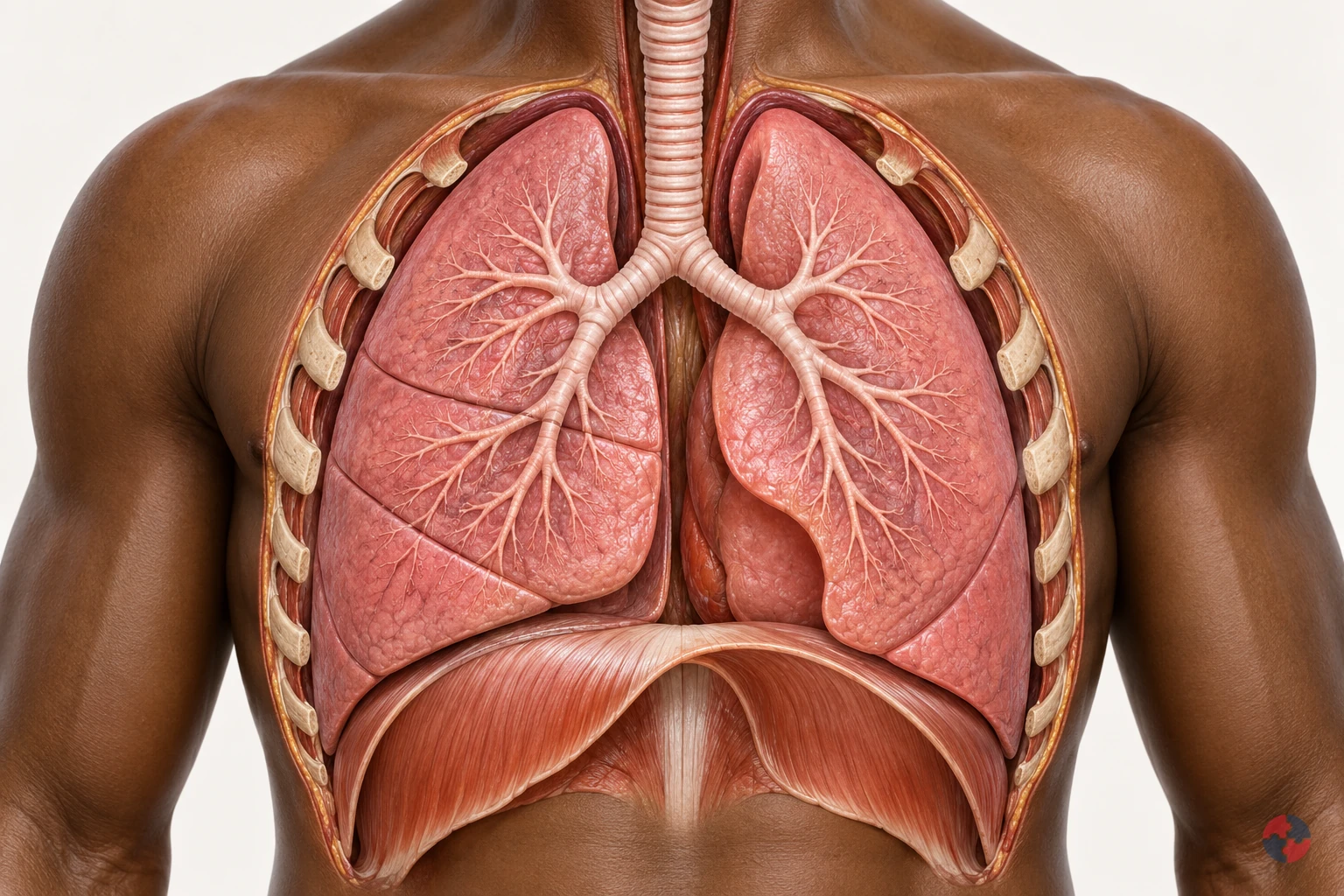 View full detail ↗