Full public teaching and readers are free without an account. A free learner account is required for saved LMS progress and recorded assessment. Completion and any course-completion certificate depend on the configured LMS conditions. Open the course overview.
Lesson 1
Stop loose factory waste becoming a foreign object
Control lightweight material from its point of generation through secure storage and collection.
Photorealistic illustrative UK workplace scene. Review checks: Setting: A diesel hose leaks during delivery near a surface-water drain. Act: Check bund, hose, overfill protection, drain cover, spill kit and the local permit or oil-storage rule. Hold / review: No untrained entry or further delivery while containment, drainage or reporting decisions are uncertain.
Stop loose factory waste becoming a foreign object
A piece of wrapping or composite offcut can leave the factory’s work area and become a hazard elsewhere. Near an aerodrome, windblown material can affect aircraft or airside operations as well as ordinary pedestrians and vehicles. Follow the material from generation to container, collection and the boundary; do not assume the fence is an effective containment system.
Use suitable covered or otherwise secured storage and a collection arrangement that remains effective for the actual material and conditions. Overflow, an open lid or a collection delay may change the control. Prevent avoidable escape rather than relying only on someone finding litter after it has travelled. The relevant site and aerodrome teams need a usable reporting interface.
Do not enter an airport movement area to retrieve an item without the required local authority and controls. A well-intentioned cleanup can create a greater aircraft/vehicle conflict. Report the location and observed condition through the agreed arrangements while protecting people within your role. Aircraft foreign-object response and product/assembly accountability may involve different evidence.
For practice, map the waste route during an ordinary shift and a delayed collection. Identify where lightweight material can escape and who owns the correction. Verify storage after loading and collection, not only while an empty container is closed. Distinguish the visible clue from a claim that an aircraft has actually been affected; the fictional model does not establish an occurrence or a measured wind limit.
How does the source-pathway-receptor model help environmental risk assessment?
The source-pathway-receptor model helps assess whether a pollutant can realistically travel from a work activity to something that could be harmed.
This is one of the most useful thinking tools for environmental risk. A source without a pathway may be well contained. A pathway without a receptor may have lower consequence. But when a source, pathway and receptor line up, the risk becomes credible and needs control.
For example, a diesel tank in a bunded store may be relatively well controlled if the bund is sound, the delivery area is supervised, drains are protected and inspections are completed. The same tank beside an unlabelled surface-water drain, with damaged containment and untrained delivery drivers, creates a very different risk profile. See GOV.UK pollution prevention for businesses.
Yard drain, cracked concrete, soil, groundwater or surface-water drain.
River, stream, groundwater, soil, wildlife or neighbouring land.
Concrete washout and cement slurry
Runoff, gullies, surface-water drains or unprotected ground.
Watercourse, aquatic life, soil quality and drainage infrastructure.
Dust from construction or bulk handling
Air movement, rainwater runoff, vehicle tracking or open doors.
Neighbours, nearby premises, drains, vegetation and local air quality.
Waste containers
Leaks, windblown litter, pests, firewater runoff or unauthorised removal.
Land, water, community, waste chain and regulator confidence.
Noise from plant
Airborne sound, vibration through structures or out-of-hours operation.
Local residents, sensitive premises, wildlife or site neighbours.
How should contractor coordination and communication work?
Coordination should make sure contractors, hosts and other work groups understand who is doing what, where, when and under which controls.
Contractor incidents often occur at interfaces: a delivery enters a pedestrian area, a cleaning contractor works below maintenance work, a hot-work contractor is unaware of flammable storage, an excavation team finds an unknown service, or two contractors rely on each other for isolations. Coordination should make these overlaps visible before the work starts.
Communication must be practical and repeated. Pre-start meetings, daily coordination meetings, shift handovers, permit boards, exclusion zone briefings and supervisor walkdowns all have a role. The method should fit the risk and the pace of change.
Coordination controls
Interface
Control
Evidence
Simultaneous operations
Plan work sequence and separation.
Daily coordination record.
Shared access routes
Manage vehicles, pedestrians and deliveries.
Traffic plan and route briefing.
Energy isolation
Define who isolates, verifies and hands back.
Isolation certificate and permit.
Hot work and fire risk
Control combustibles, ignition and fire watch.
Hot-work permit and post-work check.
Occupied premises
Protect workers, public, visitors and service users.
Communication plan and barriers.
Shift handover
Transfer status, hazards, permits and changes.
Handover log.
Applied case
Light wrapping escapes a full container beside the airport fence during delayed collection.
Decision and explanation
Secure the source/storage and use the agreed boundary reporting arrangement without unauthorised airside entry.
Correct decision: Secure the source/storage and use the agreed boundary reporting arrangement without unauthorised airside entry. Control lightweight material from its point of generation through secure storage and collection.
Lesson 2
Know the drainage pathway before a spill occurs
Connect source control, receptors and the actual response capability without directing untrained intervention.
Photorealistic illustrative UK workplace scene. Review checks: Setting: A diesel hose leaks during delivery near a surface-water drain. Act: Check bund, hose, overfill protection, drain cover, spill kit and the local permit or oil-storage rule. Hold / review: No untrained entry or further delivery while containment, drainage or reporting decisions are uncertain.
Know the drainage pathway before a spill occurs
A drain is a route to another place, not a disposal option. A resin or solvent spill can travel from a work area toward water, land or other connected systems. The responsible assessment needs the actual drainage arrangement and receptors. Do not infer that every marked drain is foul water or that an apparently clean liquid is safe to discharge.
Plan spill prevention and response around the substances, quantities, layout and people. Suitable containment and drain controls can interrupt a pathway, but deployment or isolation may expose responders and requires the assessed competent method. This course does not instruct a learner to enter a contaminated area, operate an unknown valve or improvise a dam.
During a spill, protect people and use the site’s emergency/reporting arrangements with clear substance and location information. Keep unauthorised transfer or cleanup prevented while the competent response assesses the condition. Do not wash material into a drain to make the floor look clean. Notifications and regulator requirements depend on the actual event and jurisdiction.
For practice, trace a fictional spill on the site plan and identify the missing drainage evidence. State who holds that information and how responders obtain it during the shift. Verify the installed control, maintenance and exercise results through the appropriate programme. A plan in a folder is not proof that the correct drain can be identified and the response delivered under the current conditions.
How can water contamination occur at work?
Water contamination occurs when polluting liquids, solids or contaminated runoff enter surface water, groundwater, foul drains, sewers, soakaways or unprotected ground.
The most common practical failure is misunderstanding drainage. Surface-water drains may discharge directly to a watercourse. Foul drains may go to sewage treatment. Some old or complex sites have misconnections, hidden drains, interceptors, soakaways or legacy pipework that workers do not understand.
Water pollution prevention should include up-to-date drainage plans, drain marking, suitable storage, bunding, controlled washing areas, interceptor maintenance, spill kits, drain covers, shut-off valves or penstocks where needed, and clear instructions for deliveries, refuelling and washdown. See GOV.UK pollution prevention for businesses.
Water pollution routes and controls - Water pollution routes and controls
Pollution route
Typical failure
Control
Surface-water drains
Oil, silt, cement washout or chemicals enter a drain after a spill or washdown.
Label drains, protect gullies, use shut-off valves and brief workers.
Foul sewer
Trade effluent or chemicals are discharged without consent or unsuitable treatment.
Check consent requirements and control discharge quality.
Ground and groundwater
Leaks from tanks, drums or pipework soak through unsealed ground.
Use bunded storage, sealed surfaces and inspection routines.
Firewater runoff
Contaminated firefighting water escapes during a fire.
Plan containment, isolation and emergency response.
Vehicle and plant washing
Detergent, silt, oil or metals leave wash areas.
Use designated wash bays, separators and authorised disposal routes.
How can the hierarchy of controls reduce risks while preparing for a gas release from process equipment?
Use the stronger source and work-design controls first; response or individual support does not replace prevention.
In some emergencies, evacuation alone may not be enough. A process may need to be shut down, power isolated, gas closed, fuel transfer stopped, ventilation changed, drainage isolated, spill contained, pressure relieved or a machine made safe.
These actions should be designed in advance and clearly marked. People should not be expected to work out which valve, switch or isolator matters while alarms are sounding.
Use the hierarchy to prevent the release and limit exposure before relying on emergency actions. Any real event follows the site emergency plan; people do not work through this teaching diagram before responding.
How can the ERICPD hierarchy of controls reduce risks while preparing for a gas release from process equipment?
ERICPD is a planning crossmap. Its prompts do not add a sixth rung or rank Isolate above engineering. Discipline verifies and sustains every control level.
Control level
Control for this activity
Owner and verification
Stop / restart decision
Eliminate
Remove unnecessary hazardous gas inventory or the releasing process through a validated process redesign.
Task owner verifies that the proposed change removes the named hazardous step, including foreseeable cleaning, maintenance and work transferred elsewhere.
If the hazardous step remains, keep it within the task assessment and select the stronger feasible remaining controls.
Reduce, including substitution
Evaluate a less hazardous material or process condition through engineering and change review, including new reaction and fire risks.
Competent task/process owner validates suitability, compatibility and new hazards against the actual operating requirements before the alternative is adopted.
Reject an alternative if its performance is unproved or its new hazards are unresolved.
Isolate
Provide suitable remote process isolation and separation from occupied areas so the response does not require people to approach a release.
Supervisor checks the actual boundary, affected people and connected work; verify separation or isolation before allowing access.
Hold or stop for real gas alarm, unavailable credited protection, unsafe response route or failed communication.
Control: physical safeguards
Verify containment, gas detection, alarms and designed shutdown or depressurisation functions against the credible scenario and safe-state requirements.
Hold or stop for real gas alarm, unavailable credited protection, unsafe response route or failed communication.
Control: work method and response
Agree control-room actions, alarm meaning, communication, evacuation and responder access; practise the scenario and treat loss of essential protection as a plant operating decision.
Supervisor confirms the work limits, competent cover, communication and stop/restart authority with the people doing this activity.
Hold work when the agreed limits, competent cover or effective communication cannot be maintained.
PPE
Select personal detection and task-specific protection for authorised roles. An ordinary respirator or personal gas detector does not authorise entry into a dangerous atmosphere.
Release only after operations and technical owners verify the safe plant state and restored response capability. Retain verification and unresolved restrictions at handover.
Keep the task on hold until required reinstatement evidence and unresolved defects are accepted by the responsible owner.
How can the ISO 45001 hierarchy of controls reduce risks while preparing for a gas release from process equipment?
The hierarchy of controls in ISO 45001:2018 comes under Clause 8.1.2 (Eliminating hazards and reducing OH&S risks), which is located within Clause 8 ("Operation").
Task owner verifies that the proposed change removes the named hazardous step, including foreseeable cleaning, maintenance and work transferred elsewhere.
If the hazardous step remains, keep it within the task assessment and select the stronger feasible remaining controls.
Substitution
Evaluate a less hazardous material or process condition through engineering and change review, including new reaction and fire risks.
Competent task/process owner validates suitability, compatibility and new hazards against the actual operating requirements before the alternative is adopted.
Reject an alternative if its performance is unproved or its new hazards are unresolved.
Engineering controls
Provide suitable remote process isolation and separation from occupied areas so the response does not require people to approach a release.
Supervisor checks the actual boundary, affected people and connected work; verify separation or isolation before allowing access.
Hold or stop for real gas alarm, unavailable credited protection, unsafe response route or failed communication.
Engineering controls
Verify containment, gas detection, alarms and designed shutdown or depressurisation functions against the credible scenario and safe-state requirements.
Hold or stop for real gas alarm, unavailable credited protection, unsafe response route or failed communication.
Administrative controls
Agree control-room actions, alarm meaning, communication, evacuation and responder access; practise the scenario and treat loss of essential protection as a plant operating decision.
Supervisor confirms the work limits, competent cover, communication and stop/restart authority with the people doing this activity.
Hold work when the agreed limits, competent cover or effective communication cannot be maintained.
PPE
Select personal detection and task-specific protection for authorised roles. An ordinary respirator or personal gas detector does not authorise entry into a dangerous atmosphere.
Release only after operations and technical owners verify the safe plant state and restored response capability. Retain verification and unresolved restrictions at handover.
Keep the task on hold until required reinstatement evidence and unresolved defects are accepted by the responsible owner.
Worked control decision: one scenario through the hierarchy
Illustrative warehouse scenario: a flammable-liquid drum is decanted near occupied work areas. The site must adapt every option to its own fire, substance and process assessment.
Level
Barrier and location
Pre-use and continuing check
Failure and residual risk
Stop decision
Eliminate
Avoid decanting by buying sealed, ready-to-use units delivered to the point of use.
Purchasing and operations confirm the task has actually been removed; review orders and floor observations monthly.
A substitute transfer step may reappear; residual risk remains from stored units.
Do not restart ad hoc decanting without a new assessment.
Reduce / substitute
If decanting remains, trial a less flammable product or smaller quantities at the receiving station.
Process owner checks the safety data and trial before use, then reviews incidents and purchasing changes.
A replacement may create toxicity or compatibility hazards; residual exposure remains.
Hold use if the replacement has not been assessed.
Isolate
Move authorised decanting to a designated, separated and bunded bay away from ignition and escape routes.
Facilities checks bay layout, drainage and separation before first use and during routine inspections.
A blocked route or breached bund defeats separation; vapour and spill risk remains.
Stop decanting if the bay or escape route is compromised.
Control — physical
Fit suitable closed-transfer equipment, ventilation, spill capture and an accessible emergency shutoff in that bay.
Competent maintainer commissions and function-tests controls, then logs scheduled checks and defects.
Loss of ventilation or shutoff leaves release and ignition risk.
Stop transfer on a critical control fault; isolate and call the trained response lead.
Control — method
Use a posted transfer and emergency card at the bay with alarm, isolation, evacuation and fire-service call triggers.
Shift lead walks the steps with workers before use and checks competence and cover at shift changes.
Wrong valve choice or delayed alarm can escalate a release.
Stop transfer if roles, instructions or emergency communication are unavailable.
PPE
Provide assessed splash and respiratory protection only for the defined, authorised task or response role.
Supervisor checks selection, fit, condition and trained use before entry and at periodic review.
PPE can fail or be inadequate for a large release; residual risk is not made safe by clothing.
No entry to an uncontrolled vapour or fire scene; withdraw and call emergency services.
Discipline / assurance
Drill a credible spill with failed shutoff and blocked access, then retest the corrected barrier.
Manager records decision times, defects, owners and closure evidence after each exercise.
A passed drill can miss a later equipment or staffing change.
Suspend the affected activity if critical findings remain open.
Applied case
A leak approaches a drain whose destination is uncertain.
Decision and explanation
Protect people, use the assessed response and establish the actual pathway through the responsible information/competent team.
Correct decision: Protect people, use the assessed response and establish the actual pathway through the responsible information/competent team. Connect source control, receptors and the actual response capability without directing untrained intervention.
Lesson 3
Make waste collection a controlled handover
Verify contents, container and movement interfaces before the carrier begins the task.
Photorealistic illustrative UK workplace scene. Review checks: Chemical register: Compatibility class, SDS section 10, storage, owner and approved use. Transfer verification: Right product, tank, hose, valve lineup and ullage confirmed. Storage segregation: Acids, alkalis, oxidisers, flammables and wastes separated.
Make waste collection a controlled handover
Waste collection joins different organisations and operating systems. The carrier needs reliable information about the contents and the task, while the factory controls access, nearby people and the container area. A booking confirms an intention to collect; it does not demonstrate that the material, lifting arrangement or site route is ready.
Keep unknown, incompatible or incorrectly presented material within the appropriate restriction until the responsible assessment establishes the route. Waste classification, documentation and authorised-carrier/receiving arrangements depend on the applicable UK nation and operation. Do not invent a classification or acceptance from a container’s appearance. Product traceability and chemical identity may inform the decision but do not replace it.
The physical collection also needs coordination. Consider who can enter the lifting/movement area, how the container is secured and what remains after it leaves. A driver arriving early or a replacement container with different features may change the arrangement. The people on site need a reliable stop and reporting route when the expected conditions are absent.
For practice, separate the documentary acceptance, container condition and movement-control evidence on a fictional handover sheet. Identify the owner for each and explain how a collection is held without leaving people exposed or waste unsecured. Verify the area after collection, including closure of containers, removal of loose material and restoration of access protection. This exercise does not submit a real waste transfer or permit record.
Why are waste streams and drains high-risk mixing routes?
Waste streams and drains are high-risk because chemicals can meet out of sight after leaving the original task area.
A drain, sump, interceptor, IBC, drum or waste tank can become the mixing vessel. Workers may think each individual disposal was small, but incompatible discharges can accumulate or react in a confined space, generating heat, pressure, gas or pollution.
Waste compatibility needs a positive approval process. Unknown waste should not be bulked because it looks similar or because the container is available. Waste labels should include contents, hazards, source, date, incompatible materials and owner.
Drain maps and isolation points are important for process sites, laboratories, workshops and construction sites. If responders do not know where a drain goes, they cannot confidently control a spill or incompatible discharge.
Waste and drain controls
Control
Purpose
Evidence
Waste-stream approval
Prevents incompatible waste from being bulked.
Waste acceptance or approval record.
No unknown bulking rule
Prevents reaction from unidentified material.
Quarantine and characterisation procedure.
Drain map
Shows where spills and discharges may travel.
Current site drainage plan.
Drain protection
Stops incompatible or polluting material entering drainage.
Drain covers, valves and spill drills.
Waste labels
Communicate contents and hazards.
Label inspection and waste register.
Compatibility testing
Confirms bulking is safe where required.
Test record and acceptance criteria.
What information must be exchanged before work starts?
The client and contractor must exchange enough information for both parties to understand site hazards, task hazards, interfaces and emergency arrangements.
Information exchange should be two-way. The host should provide existing hazards such as asbestos, fragile roofs, buried services, traffic routes, process hazards, isolation requirements, fire arrangements, welfare, restricted areas and emergency rules. The contractor should provide task hazards, equipment, substances, sequencing, people, supervision and any new risks introduced by the work.
A common failure is assuming the contractor will work out the site risks or that the client can approve a method without understanding the work. The pre-start meeting is where assumptions should be exposed. It should be close enough to the work to be practical, but early enough to change the plan.
Information exchange
Information
Client provides
Contractor provides
Scope and boundaries
Where, when and what is permitted.
Task sequence and work limits.
Existing hazards
Asbestos, services, traffic, process, fire and access hazards.
Questions and controls needed for those hazards.
Introduced hazards
Site constraints and affected operations.
Tools, substances, plant, energy and work methods.
Emergency arrangements
Alarms, evacuation, first aid, rescue and contacts.
Task-specific emergency and rescue arrangements.
Coordination needs
Other work, permits, restrictions and occupancy.
Interface risks and required isolations.
Evidence
Site rules, drawings, registers and permits.
RAMS, certificates and inspection records.
Applied case
The carrier is booked, but contents and the lifting area have not been confirmed.
Decision and explanation
Separate verified waste acceptance, container and controlled movement arrangements.
Correct decision: Separate verified waste acceptance, container and controlled movement arrangements. Verify contents, container and movement interfaces before the carrier begins the task.
Lesson 4
Treat the airport gate as a permission boundary
Confirm the current receiving and local access arrangements before a factory movement enters an aerodrome system.
Photorealistic illustrative UK workplace scene. Review checks: Risk-based approval: Approves contractors by work type and risk level. Procurement controls: Tender packs state health, safety, welfare and supervision expectations. Pre-start planning: Client and contractor exchange site and task hazards.
Treat the airport gate as a permission boundary
A factory traffic route does not simply continue unchanged through an airport gate. The receiving aerodrome has its own current rules, permissions, communications and operating conditions. Confirm who accepts the movement, where it waits and what authority the people and vehicle require. A familiar destination or previous visit does not automatically establish today’s permission.
The relevant aviation framework depends on the aerodrome and activity. CAP168 addresses UK National licensed aerodromes; it should not be presented as the sole rule for every airport. CAP642 provides airside safety-management guidance, and CAP790 addresses airside driving-permit schemes. Local requirements and applicable regulations must be established by the responsible operator and competent functions.
Keep manufacturing/product release, safe physical transport and airport access separate. A completed tool check does not grant airside entry. An airside permit does not certify a component’s conformity. A safe waiting place on the factory side must remain available when acceptance is delayed, so the driver is not pressured into crossing an uncertain boundary.
For practice, prepare the questions a dispatch controller needs answered before approaching the gate. Include receiving contact, current route, permissions, communication and changes to aircraft activity. Do not invent local radio instructions or universal separation distances. The learner practises recognition and handover; this course issues no airside driving permit, aircraft maintenance authorisation or permission to enter a movement area.
How should contractor coordination and communication work?
Coordination should make sure contractors, hosts and other work groups understand who is doing what, where, when and under which controls.
Contractor incidents often occur at interfaces: a delivery enters a pedestrian area, a cleaning contractor works below maintenance work, a hot-work contractor is unaware of flammable storage, an excavation team finds an unknown service, or two contractors rely on each other for isolations. Coordination should make these overlaps visible before the work starts.
Communication must be practical and repeated. Pre-start meetings, daily coordination meetings, shift handovers, permit boards, exclusion zone briefings and supervisor walkdowns all have a role. The method should fit the risk and the pace of change.
Coordination controls
Interface
Control
Evidence
Simultaneous operations
Plan work sequence and separation.
Daily coordination record.
Shared access routes
Manage vehicles, pedestrians and deliveries.
Traffic plan and route briefing.
Energy isolation
Define who isolates, verifies and hands back.
Isolation certificate and permit.
Hot work and fire risk
Control combustibles, ignition and fire watch.
Hot-work permit and post-work check.
Occupied premises
Protect workers, public, visitors and service users.
Communication plan and barriers.
Shift handover
Transfer status, hazards, permits and changes.
Handover log.
Who controls transport risk during live work?
Transport safety depends on clear ownership from gate control through to senior investment decisions.
A driver can make good decisions only if the site, vehicle, schedule and communication support those decisions. A supervisor can stop a movement, but managers must remove recurring design and scheduling weaknesses. The fleet lead and the employer’s health and safety adviser should test whether vehicle standards, grey fleet controls and site layouts match the actual risk.
This role split is important for fatal-risk topics because the immediate event may look like driver error while the underlying causes sit in route design, vehicle specification, fatigue, loading pressure or poor contractor control.
Role
What to check
Evidence
Driver/operator
Vehicle condition, route, visibility, fatigue, phone use and load security.
Daily check, defect report and journey decision.
Supervisor
Segregation, reversing, loading, visiting drivers and temporary change.
Yard walkdown and stop-work record.
Manager
Traffic plan, staffing, scheduling, maintenance and contractor controls.
Transport risk assessment and action tracker.
Fleet lead / employer’s health and safety adviser
Vehicle suitability, grey fleet, competence, incident trends and assurance.
Fleet records, licences, insurance and audit findings.
Senior leader
High-potential events, investment needs and repeat weak signals.
Dashboard review and resource decisions.
When should transport or driving activity stop?
Stop when people and vehicles cannot be safely separated, vehicle condition is unsafe, visibility is inadequate or driving conditions make the journey unsafe.
Transport risk changes quickly. A blocked route, failed reversing aid, visiting driver without briefing, poor lighting, damaged surface, unstable load or pedestrian route obstruction can turn a routine operation into a serious risk.
Supervisors should be clear that production pressure does not override traffic controls. If the safe route is blocked, the work should pause until a safe route is restored.
A familiar driver arrives with a factory pass but no confirmed receiving contact.
Decision and explanation
Current aerodrome acceptance and the applicable local person/vehicle permissions and instructions.
Correct decision: Current aerodrome acceptance and the applicable local person/vehicle permissions and instructions. Confirm the current receiving and local access arrangements before a factory movement enters an aerodrome system.
Lesson 5
Recognise aircraft movement and propulsion hazards
Keep factory movements within the aerodrome’s assessed operating arrangement rather than guessing a safe distance.
Photorealistic illustrative UK workplace scene. Review checks: Setting: the process operator practises a tank overfill leading to a vapour release and possible explosion. Act: Confirm containment, detection, alarm, isolation, command succession and alternative shelter or evacuation routes. Hold / review: Failed detector, blocked route, unknown wind direction or absent command lead triggers a safe hold and escalation.
Recognise aircraft movement and propulsion hazards
Aircraft movement, propellers, rotors, engines and jet blast can affect people, vehicles, equipment and loose material. A factory transfer near those activities needs the aerodrome’s current coordination and restrictions. Do not infer safety from an aircraft appearing stationary or from a brief period with no visible movement.
The applicable operating instructions depend on aircraft type, activity, location and the responsible operator’s arrangements. This awareness course gives no universal engine exclusion distance or authority to approach an aircraft. Noise, airflow and attention demands may also affect communication; a factory hand signal is not automatically an accepted airside instruction.
If the intended transfer conflicts with aircraft activity or the receiving information is missing, hold at the agreed safe location and use the current reporting/coordination route. Do not cross to ask someone on the apron or chase loose material into the operating area. The responsible aerodrome functions determine how the movement can safely proceed.
For practice, compare the factory dispatch plan with a fictional notice of changed aircraft activity. Identify the assumption that no longer holds and the person who must confirm acceptance. Keep product/FOD checks and physical load security in place while waiting; a delayed airport permission does not remove those requirements. Verify the current instruction before release and record restrictions clearly for a replacement driver or incoming shift.
What off-site interfaces must be planned?
Off-site interfaces include emergency services, the relevant external-plan lead, neighbours, the public, environmental responders, media and mutual aid partners. For upper-tier COMAH, the external-plan lead differs between Great Britain and Northern Ireland.
Major accidents do not respect the fence line. Smoke, vapour, blast, fragments, contaminated water, road closures, public fear and media attention can all leave the site boundary quickly. Emergency plans should define who contacts whom, what information is given, how updates are issued and who speaks publicly.
For upper-tier COMAH sites in Great Britain, the local authority prepares the external emergency plan, using information from the operator. See GB COMAH regulation 13. In Northern Ireland, the Executive (HSENI) arranges the external emergency plan and consults designated authorities under NI COMAH regulation 13. The operator must supply scenario, consequence, warning and response information to the appropriate lead. Do not assign the GB local-authority lead to an NI site.
External interface map - External interface map
Interface
Why it matters
Evidence
Emergency services
Need early accurate information and site hazards.
Rendezvous point and joint exercises.
External-plan lead: GB local authority; NI Executive (HSENI)
Prepares or arranges the upper-tier external plan under the applicable COMAH rules.
Operator information submission, consultation and plan review.
Regulator
Notification, investigation and enforcement interface.
COMAH and incident communication record.
Neighbouring sites
Domino and shared emergency impacts.
Mutual aid and warning arrangements.
Public
Warning, advice and reassurance.
Public information and message templates.
Environment agency/interface
Runoff, pollution and environmental monitoring.
Containment and notification plan.
How should transport and driving risks be assured?
Assurance should test real vehicle movements, route conditions, driver decisions and management of change.
First-line checks include vehicle condition, route walkdowns and driver briefings. Manager assurance samples peak periods, temporary route changes, visitor control and delivery interface. Senior leaders should review high-potential near misses, reversing events, collisions, defects and fatigue signals.
A useful assurance exercise is to follow a delivery from gate to departure and record every pedestrian/vehicle interface.
Frontline. What to check: Routes, vehicles, loads, visibility and people; What good looks like: Unsafe movement stops immediately.
Supervisor. What to check: Briefings, reversing, loading and visitor controls; What good looks like: Rules are followed in busy periods.
Manager. What to check: Traffic plan, maintenance, competence and trends; What good looks like: Actions address recurring weak signals.
Fleet/technical. What to check: Vehicle condition, specification and roadworthiness; What good looks like: Vehicles fit task and environment.
Leadership. What to check: High-potential events and investment needs; What good looks like: Layout and resources improve over time.
An aircraft activity change affects the transfer route after the factory load is ready.
Decision and explanation
Hold at the agreed safe place and obtain current aerodrome coordination before crossing.
Correct decision: Hold at the agreed safe place and obtain current aerodrome coordination before crossing. Keep factory movements within the aerodrome’s assessed operating arrangement rather than guessing a safe distance.
Lesson 6
Manage wildlife, lighting and emergency interfaces with the airport
Control factory attractants and communicate relevant changes through the responsible aerodrome arrangements.
Photorealistic illustrative UK workplace scene. Review checks: Setting: A diesel hose leaks during delivery near a surface-water drain. Act: Check bund, hose, overfill protection, drain cover, spill kit and the local permit or oil-storage rule. Hold / review: No untrained entry or further delivery while containment, drainage or reporting decisions are uncertain.
Manage wildlife, lighting and emergency interfaces with the airport
Factory activities can affect an airport without crossing its fence. Food waste may attract birds, loose material can travel and new lighting can create glare or confusion. Consider the source, pathway and affected operations. A change that seems minor to the factory may need coordination with the aerodrome’s responsible functions before implementation.
Secure waste and manage the site conditions that create attractants through the assessed arrangements. Wildlife risk management belongs to the aerodrome’s competent programme and relevant partners. This course does not teach dispersal, lasers, shooting or any other wildlife-control technique. Reporting and prevention at the factory source are the learner’s appropriate focus within their role.
Lighting changes need review of direction, glare and the receiving environment through the competent process. A luminaire meeting an internal factory need does not establish that its effect on the airport is acceptable. Keep the decision linked to the actual change and receiving assessment, without inventing a general lighting limit.
Emergency liaison should be established before an incident. Identify how the factory and aerodrome share relevant information about smoke, spills, access restrictions or other conditions, and who controls each response. Practise a fictional notification with location, observed facts and current protection, avoiding unsupported claims about aircraft effects. Verification should check that the contact and information route work on the current shift and that lessons are converted into controlled changes, not simply filed as an exercise record.
How does the source-pathway-receptor model help environmental risk assessment?
The source-pathway-receptor model helps assess whether a pollutant can realistically travel from a work activity to something that could be harmed.
This is one of the most useful thinking tools for environmental risk. A source without a pathway may be well contained. A pathway without a receptor may have lower consequence. But when a source, pathway and receptor line up, the risk becomes credible and needs control.
For example, a diesel tank in a bunded store may be relatively well controlled if the bund is sound, the delivery area is supervised, drains are protected and inspections are completed. The same tank beside an unlabelled surface-water drain, with damaged containment and untrained delivery drivers, creates a very different risk profile. See GOV.UK pollution prevention for businesses.
Yard drain, cracked concrete, soil, groundwater or surface-water drain.
River, stream, groundwater, soil, wildlife or neighbouring land.
Concrete washout and cement slurry
Runoff, gullies, surface-water drains or unprotected ground.
Watercourse, aquatic life, soil quality and drainage infrastructure.
Dust from construction or bulk handling
Air movement, rainwater runoff, vehicle tracking or open doors.
Neighbours, nearby premises, drains, vegetation and local air quality.
Waste containers
Leaks, windblown litter, pests, firewater runoff or unauthorised removal.
Land, water, community, waste chain and regulator confidence.
Noise from plant
Airborne sound, vibration through structures or out-of-hours operation.
Local residents, sensitive premises, wildlife or site neighbours.
How should drills test communication?
Drills should test whether information is accurate, timely, understood and still available when systems fail.
Many emergency failures are communication failures: people do not know the meaning of an alarm, radio channels are overloaded, the emergency services receive poor site information, muster information is late, or senior managers make decisions using incomplete facts.
A drill should deliberately test message flow: who calls 999, who contacts the control room, who updates assembly points, who briefs emergency services, who communicates with neighbouring businesses and who records decisions.
Coverage, channels, battery and message discipline.
Radio check and dead-zone map.
Emergency contact list
Correct numbers and deputies.
Contact test log.
Command log
Decisions, timings, assumptions and handover notes.
Completed exercise log.
Muster reporting
Accuracy and speed of accountability.
Muster report and missing-person drill.
External communication
Emergency services, neighbours, local authority and regulators where relevant.
Handover checklist and call script.
Applied case
A new floodlight and unsecured food-waste area are proposed beside the airport boundary.
Decision and explanation
Control the attractant and coordinate the actual lighting/wildlife interface with competent aerodrome functions.
Correct decision: Control the attractant and coordinate the actual lighting/wildlife interface with competent aerodrome functions. Control factory attractants and communicate relevant changes through the responsible aerodrome arrangements.
Lesson 7
Loose waste becomes windblown FOD
Contain the source and report escaped FOD; do not enter a controlled airport area without authority.
Photorealistic illustrative UK workplace scene. Review checks: Setting: A diesel hose leaks during delivery near a surface-water drain. Act: Check bund, hose, overfill protection, drain cover, spill kit and the local permit or oil-storage rule. Hold / review: No untrained entry or further delivery while containment, drainage or reporting decisions are uncertain.
Understand the activity and how harm develops
The source is the open container, the pathway is wind and the possible receptor is an aircraft or occupied route. A fence stops unauthorised entry but may not stop a light strip of wrapping from passing over or through it.
Control debris at the point where it is produced, transferred and stored. Container lids and restraints must suit the waste, weather and collection method. Do not wait for a boundary patrol to find material that could have been contained beside the production task.
Inspect during windy conditions and after collections, when lids and loose residues are often overlooked. If debris reaches a controlled airport area, report it through the agreed liaison route. Do not cross the boundary or enter aircraft movement space to retrieve it without authorisation.
Recognise the evidence boundary
Question
Case evidence
What is observed?
Lightweight wrapping and composite offcuts escape an open waste container near the airport fence.
How can harm occur?
Debris can strike people, obstruct drains or damage aircraft if it reaches the movement area.
What information is needed?
Check lids, contents and surrounding ground in representative wind.
Protect, manage and verify
Purpose
Practical application
Immediate protection
Provide secure covered containers and effective transfer containment.
Accountable work arrangement
Contain waste at its source. Secure lids and loose packaging. Inspect after wind and collections. Report escaped FOD through airport liaison.
Release verification
Confirm staff know how to report debris beyond the boundary.
Apply this at work
Contain the source and report escaped FOD; do not enter a controlled airport area without authority.
How does the source-pathway-receptor model help environmental risk assessment?
The source-pathway-receptor model helps assess whether a pollutant can realistically travel from a work activity to something that could be harmed.
This is one of the most useful thinking tools for environmental risk. A source without a pathway may be well contained. A pathway without a receptor may have lower consequence. But when a source, pathway and receptor line up, the risk becomes credible and needs control.
For example, a diesel tank in a bunded store may be relatively well controlled if the bund is sound, the delivery area is supervised, drains are protected and inspections are completed. The same tank beside an unlabelled surface-water drain, with damaged containment and untrained delivery drivers, creates a very different risk profile. See GOV.UK pollution prevention for businesses.
Yard drain, cracked concrete, soil, groundwater or surface-water drain.
River, stream, groundwater, soil, wildlife or neighbouring land.
Concrete washout and cement slurry
Runoff, gullies, surface-water drains or unprotected ground.
Watercourse, aquatic life, soil quality and drainage infrastructure.
Dust from construction or bulk handling
Air movement, rainwater runoff, vehicle tracking or open doors.
Neighbours, nearby premises, drains, vegetation and local air quality.
Waste containers
Leaks, windblown litter, pests, firewater runoff or unauthorised removal.
Land, water, community, waste chain and regulator confidence.
Noise from plant
Airborne sound, vibration through structures or out-of-hours operation.
Local residents, sensitive premises, wildlife or site neighbours.
Applied case
Wrapping blows through the airport fence.
Decision and explanation
Stop further escape and report it through the agreed airport contact.
Containment and authorised recovery protect both sides of the boundary. An airport hazard may need prompt coordinated action. That creates an unauthorised aircraft-area incursion.
Lesson 8
Spill drains, isolation and water protection
Do not wash a spill into drains; withdraw from danger and activate the pollution response.
Photorealistic illustrative UK workplace scene. Review checks: Setting: A diesel hose leaks during delivery near a surface-water drain. Act: Check bund, hose, overfill protection, drain cover, spill kit and the local permit or oil-storage rule. Hold / review: No untrained entry or further delivery while containment, drainage or reporting decisions are uncertain.
Understand the activity and how harm develops
A surface-water drain commonly leads toward the environment rather than a treatment process. A foul connection also does not authorise chemical disposal: permissions and substance-specific arrangements matter. The route may be hidden, so an accurate drainage plan is essential evidence.
Secondary containment, suitable storage and controlled transfer prevent the release reaching drainage. An oil separator cannot be assumed to remove dissolved solvents, resin chemicals or every contaminant. Firewater and rainfall can exceed or bypass arrangements designed for a smaller routine spill.
Use the assessed pollution response with trained people and suitable equipment, without exposing them to vapour, traffic or reactive material. Notify the relevant authority when required and preserve information for responders. Environment Agency guidance cited here applies to England; other UK nations have their own regulators.
Recognise the evidence boundary
Question
Case evidence
What is observed?
A resin or solvent leak is moving toward a surface-water drain.
How can harm occur?
Pollution can leave the site rapidly and harm water, soil, wildlife or neighbouring operations.
What information is needed?
Trace the drain to its verified destination on the current plan.
Protect, manage and verify
Purpose
Practical application
Immediate protection
Provide compatible containment and designed drain-isolation arrangements.
Accountable work arrangement
Verify where every drain leads. Prevent releases reaching drainage. Maintain designed containment and isolation. Use trained pollution-response arrangements.
Release verification
Confirm escalation, waste recovery and discharge permissions are understood.
Apply this at work
Do not wash a spill into drains; withdraw from danger and activate the pollution response.
How does the source-pathway-receptor model help environmental risk assessment?
The source-pathway-receptor model helps assess whether a pollutant can realistically travel from a work activity to something that could be harmed.
This is one of the most useful thinking tools for environmental risk. A source without a pathway may be well contained. A pathway without a receptor may have lower consequence. But when a source, pathway and receptor line up, the risk becomes credible and needs control.
For example, a diesel tank in a bunded store may be relatively well controlled if the bund is sound, the delivery area is supervised, drains are protected and inspections are completed. The same tank beside an unlabelled surface-water drain, with damaged containment and untrained delivery drivers, creates a very different risk profile. See GOV.UK pollution prevention for businesses.
Yard drain, cracked concrete, soil, groundwater or surface-water drain.
River, stream, groundwater, soil, wildlife or neighbouring land.
Concrete washout and cement slurry
Runoff, gullies, surface-water drains or unprotected ground.
Watercourse, aquatic life, soil quality and drainage infrastructure.
Dust from construction or bulk handling
Air movement, rainwater runoff, vehicle tracking or open doors.
Neighbours, nearby premises, drains, vegetation and local air quality.
Waste containers
Leaks, windblown litter, pests, firewater runoff or unauthorised removal.
Land, water, community, waste chain and regulator confidence.
Noise from plant
Airborne sound, vibration through structures or out-of-hours operation.
Local residents, sensitive premises, wildlife or site neighbours.
Applied case
The leak is near a drain labelled interceptor.
Decision and explanation
Nothing about this chemical’s removal without verified design and route information.
A cover does not establish containment. That can accelerate pollution beyond the site. An interceptor label is not proof of solvent or resin treatment.
Lesson 9
Waste collection handover and container security
Hold collection when contents, authorisation, container integrity or exclusion is unresolved.
Photorealistic illustrative UK workplace scene. Review checks: Setting: A diesel hose leaks during delivery near a surface-water drain. Act: Check bund, hose, overfill protection, drain cover, spill kit and the local permit or oil-storage rule. Hold / review: No untrained entry or further delivery while containment, drainage or reporting decisions are uncertain.
Understand the activity and how harm develops
The container should be suitable for its contents and collection equipment, secure against leakage and accessible without people entering a lifting or vehicle danger area. Overfilling, damaged lifting points or loose lids can defeat an otherwise routine collection.
Confirm the waste description, appropriate carrier and authorised receiving route for the relevant jurisdiction and waste type. Hazardous-waste requirements may differ from ordinary transfer documentation. A carrier’s arrival does not remove the producer’s responsibility to check the arrangement.
Agree the exclusion, collection sequence and departure release between the site and driver. Keep incompatible waste separate and check for material left behind after the lift. Records should describe what actually left the site, not copy an old description that no longer matches production.
Recognise the evidence boundary
Question
Case evidence
What is observed?
A waste carrier starts collection before the container contents and lifting area are confirmed.
How can harm occur?
People can be struck during collection, waste can escape, and unsuitable transfer can lose legal traceability.
What information is needed?
Check container condition, contents and correct collection equipment.
Protect, manage and verify
Purpose
Practical application
Immediate protection
Provide secure containers and a controlled loading area.
Accountable work arrangement
Describe the actual waste accurately. Verify carrier and receiving route. Control lifting and vehicle movements. Complete the physical and documented handover.
Release verification
Reconcile documentation and inspect the area after collection.
Apply this at work
Hold collection when contents, authorisation, container integrity or exclusion is unresolved.
How does the source-pathway-receptor model help environmental risk assessment?
The source-pathway-receptor model helps assess whether a pollutant can realistically travel from a work activity to something that could be harmed.
This is one of the most useful thinking tools for environmental risk. A source without a pathway may be well contained. A pathway without a receptor may have lower consequence. But when a source, pathway and receptor line up, the risk becomes credible and needs control.
For example, a diesel tank in a bunded store may be relatively well controlled if the bund is sound, the delivery area is supervised, drains are protected and inspections are completed. The same tank beside an unlabelled surface-water drain, with damaged containment and untrained delivery drivers, creates a very different risk profile. See GOV.UK pollution prevention for businesses.
Yard drain, cracked concrete, soil, groundwater or surface-water drain.
River, stream, groundwater, soil, wildlife or neighbouring land.
Concrete washout and cement slurry
Runoff, gullies, surface-water drains or unprotected ground.
Watercourse, aquatic life, soil quality and drainage infrastructure.
Dust from construction or bulk handling
Air movement, rainwater runoff, vehicle tracking or open doors.
Neighbours, nearby premises, drains, vegetation and local air quality.
Waste containers
Leaks, windblown litter, pests, firewater runoff or unauthorised removal.
Land, water, community, waste chain and regulator confidence.
Noise from plant
Airborne sound, vibration through structures or out-of-hours operation.
Local residents, sensitive premises, wildlife or site neighbours.
Applied case
The paperwork says general waste but the container contains solvent residues.
Decision and explanation
Hold collection and resolve classification and the authorised route.
Concealing contents increases risk and defeats traceability. The description must match the real contents. The onward chain still lacks accurate information.
Lesson 10
Controlled airside handover and airport rules
Do not cross the airport boundary without confirmed authority and the agreed operating arrangement.
Teaching graphic from the linked SHAREhub source section.
Understand the activity and how harm develops
The factory driver may be competent for internal transport yet not authorised for the airport area. The vehicle, route, escort and communications must meet the applicable aerodrome arrangements. A company badge or road-driving licence does not establish airside permission.
Agree the transfer point and responsibility with the airport operator and receiving organisation. Current airside-driving requirements and local rules determine training, permits and operating conditions. Weather, visibility or an incident may change access even when the usual route is familiar.
Hold at the designated point until the receiving authority confirms the movement. If instructions are unclear or communication fails, stop in the agreed safe position and seek clarification. Do not infer permission from an open gate or another vehicle passing through it.
Recognise the evidence boundary
Question
Case evidence
What is observed?
A factory transporter approaches the airport gate without confirmed airside permission or receiving contact.
How can harm occur?
An unauthorised incursion can conflict with aircraft, airport vehicles or controlled operations.
What information is needed?
Check the driver, vehicle and escort permissions for this movement.
Protect, manage and verify
Purpose
Practical application
Immediate protection
Provide a controlled gate and defined safe holding location.
Accountable work arrangement
Keep factory-only traffic outside airside. Verify driver and vehicle authority. Confirm receiving contact and route. Hold when instructions are unclear.
Release verification
Verify the handover is recorded and the boundary remains controlled.
Apply this at work
Do not cross the airport boundary without confirmed authority and the agreed operating arrangement.
How should transport risk be assessed?
Assessment should map people, vehicles, routes, movements, loading, reversing, visibility and work pressure.
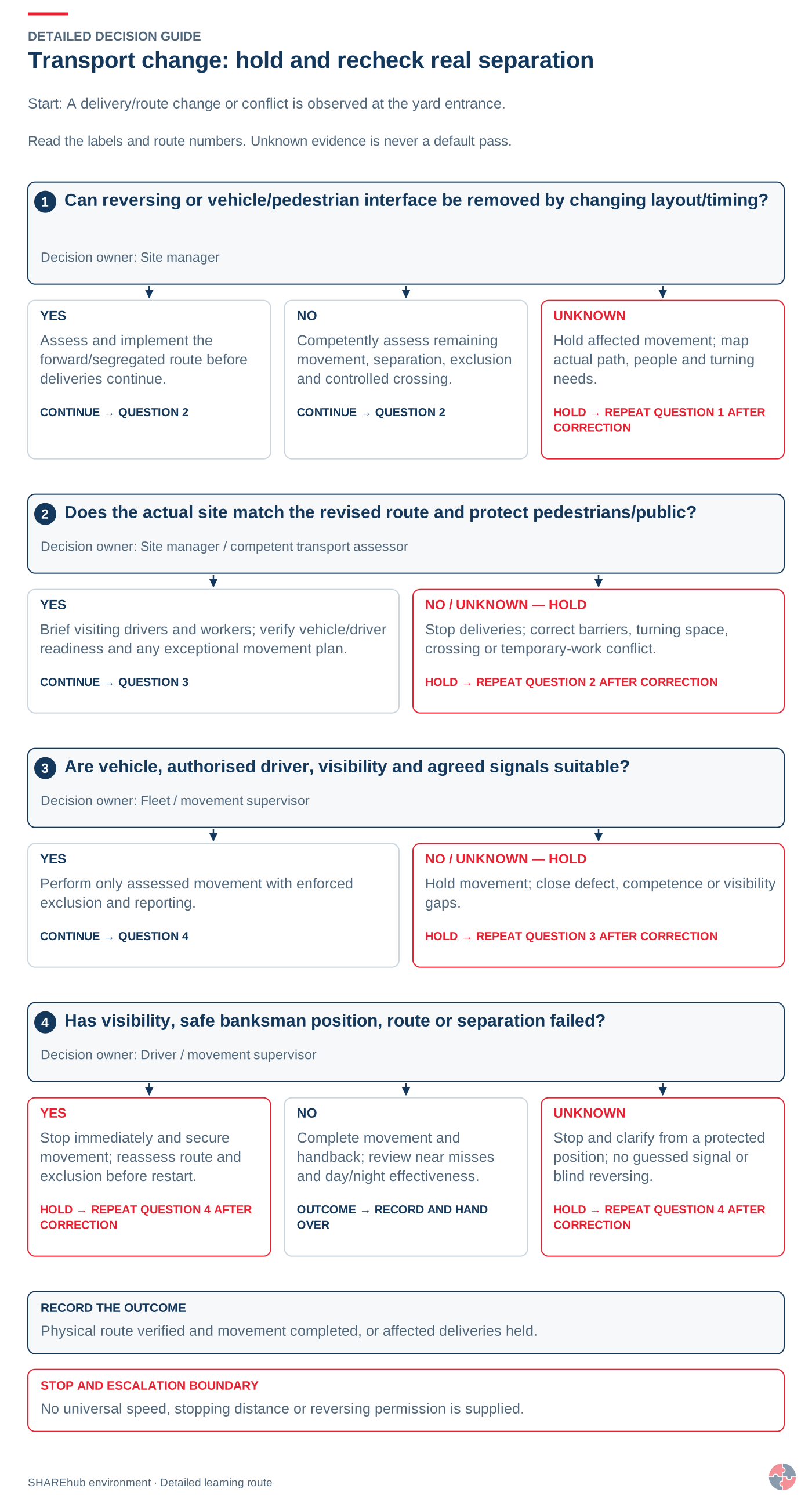
A transport assessment should start with a movement map. Where do vehicles enter, reverse, park, load, tip, refuel, charge, turn, couple, uncouple and exit? Where do pedestrians walk, wait, cross, work, queue or visit welfare? Where do temporary works, waste skips, deliveries or contractors change the route?
The assessment should then challenge each interface. Can pedestrians and vehicles be separated? Can reversing be eliminated? Can route direction be simplified? Are visiting drivers briefed? Are banksmen competent and protected? Are schedules realistic enough to prevent rushing?
Risk area
Assessment question
Control focus
Pedestrian routes
Can people walk without entering vehicle routes?
Segregation, barriers and crossings.
Reversing
Can reversing be eliminated or controlled?
One-way routes, turning areas, aids and banksman rules.
Loading/unloading
Who controls the vehicle, load, people and exclusion zone?
Loading plan and communication.
Blind spots
What can the driver not see?
Vehicle selection, aids, exclusion and pedestrian control.
Temporary change
How do works, skips or congestion alter routes?
Change briefing and temporary traffic plan.
Road journeys
Are time, weather, rest and welfare realistic?
Safe journey planning.
How should a busy warehouse yard be controlled?
A strong yard plan separates people and vehicles, controls reversing and manages visiting drivers before they enter the risk area.
A warehouse has vans, articulated lorries, pedestrian staff, agency workers, forklift trucks, visitors and waste collections. Near misses occur when visiting drivers walk across the yard to reception and forklifts reverse near a loading bay. A weak response is to add more warning signs. A stronger response redesigns pedestrian access, creates a driver waiting point, sets a one-way vehicle system, marks loading exclusion zones, controls reversing, briefs visiting drivers, improves lighting, reviews delivery scheduling and checks compliance during peak periods.
The lesson is that transport safety is mainly design and management. Behaviour matters, but only after the site has made the safe route obvious and practical.
Drivers walking through yard. Weak control: Tell them to watch for vehicles; Better control: Create protected pedestrian route and waiting point.
Forklift reversing. Weak control: Rely on reversing alarm; Better control: Redesign route and use exclusion controls.
Loading bay interface. Weak control: Paint lines only; Better control: Physical controls, bay rules and communication.
Fictional loading sequence: prevent early departure
A visiting driver parks as directed and uses the segregated waiting area. The agreed loading controller verifies suitable vehicle/trailer parking brakes and stability, the loading exclusion and the assessed site method that prevents premature departure. Driver and loader confirm the hold is active before work. If that hold, stability or separation is uncertain, loading stops. Only the agreed controller gives positive departure release after people and equipment are clear, the load is safe and all checks are complete. A briefing or painted bay line alone cannot prevent a runaway or drive-away; select the method for the actual vehicles and site.
Applied case
The gate is open and the delivery slot is about to expire.
Decision and explanation
Wait at the agreed point until airside authority is confirmed.
An open gate is not permission. Another vehicle’s authority does not transfer to this load. Factory access and airside operating permission are different.
Lesson 11
Jet blast, propellers and aircraft movement
Stop and obtain airport direction when aircraft activity compromises the authorised route.
Teaching graphic from the linked SHAREhub source section.
Understand the activity and how harm develops
A propeller can be difficult to see when turning, and engine intake or exhaust hazards are not contained by painted vehicle lanes. Blast can move loose objects and destabilise people or equipment. Apparent engine quietness is not reliable clearance to approach.
The aircraft type, operating state and aerodrome procedures determine exclusion and movement arrangements. This model provides no universal separation distance or permission to enter an aircraft stand. Factory staff must remain within the authorised route and receiving arrangements.
Coordinate with the airport authority and stop if the route conflicts with aircraft activity or instructions are unclear. Maintain awareness of noise affecting communications and use the specified protection without losing essential signals. Recovering a dropped item never justifies stepping into an aircraft danger area.
Recognise the evidence boundary
Question
Case evidence
What is observed?
A factory transfer route is close to aircraft movement and propulsion hazards.
How can harm occur?
Jet blast, engine intake, propellers or moving aircraft can cause fatal injury and throw debris.
What information is needed?
Confirm the authorised route and current aircraft activity.
Protect, manage and verify
Purpose
Practical application
Immediate protection
Provide appropriate access control and protected holding positions.
Accountable work arrangement
Remain within authorised routes. Confirm aircraft operating conditions. Respect controlled hazard areas. Use agreed airport communications.
Release verification
Verify no person or loose equipment enters the controlled hazard area.
Apply this at work
Stop and obtain airport direction when aircraft activity compromises the authorised route.
How should transport risk be assessed?
Assessment should map people, vehicles, routes, movements, loading, reversing, visibility and work pressure.
A transport assessment should start with a movement map. Where do vehicles enter, reverse, park, load, tip, refuel, charge, turn, couple, uncouple and exit? Where do pedestrians walk, wait, cross, work, queue or visit welfare? Where do temporary works, waste skips, deliveries or contractors change the route?
The assessment should then challenge each interface. Can pedestrians and vehicles be separated? Can reversing be eliminated? Can route direction be simplified? Are visiting drivers briefed? Are banksmen competent and protected? Are schedules realistic enough to prevent rushing?
Risk area
Assessment question
Control focus
Pedestrian routes
Can people walk without entering vehicle routes?
Segregation, barriers and crossings.
Reversing
Can reversing be eliminated or controlled?
One-way routes, turning areas, aids and banksman rules.
Loading/unloading
Who controls the vehicle, load, people and exclusion zone?
Loading plan and communication.
Blind spots
What can the driver not see?
Vehicle selection, aids, exclusion and pedestrian control.
Temporary change
How do works, skips or congestion alter routes?
Change briefing and temporary traffic plan.
Road journeys
Are time, weather, rest and welfare realistic?
Safe journey planning.
How should a busy warehouse yard be controlled?
A strong yard plan separates people and vehicles, controls reversing and manages visiting drivers before they enter the risk area.
A warehouse has vans, articulated lorries, pedestrian staff, agency workers, forklift trucks, visitors and waste collections. Near misses occur when visiting drivers walk across the yard to reception and forklifts reverse near a loading bay. A weak response is to add more warning signs. A stronger response redesigns pedestrian access, creates a driver waiting point, sets a one-way vehicle system, marks loading exclusion zones, controls reversing, briefs visiting drivers, improves lighting, reviews delivery scheduling and checks compliance during peak periods.
The lesson is that transport safety is mainly design and management. Behaviour matters, but only after the site has made the safe route obvious and practical.
Drivers walking through yard. Weak control: Tell them to watch for vehicles; Better control: Create protected pedestrian route and waiting point.
Forklift reversing. Weak control: Rely on reversing alarm; Better control: Redesign route and use exclusion controls.
Loading bay interface. Weak control: Paint lines only; Better control: Physical controls, bay rules and communication.
Fictional loading sequence: prevent early departure
A visiting driver parks as directed and uses the segregated waiting area. The agreed loading controller verifies suitable vehicle/trailer parking brakes and stability, the loading exclusion and the assessed site method that prevents premature departure. Driver and loader confirm the hold is active before work. If that hold, stability or separation is uncertain, loading stops. Only the agreed controller gives positive departure release after people and equipment are clear, the load is safe and all checks are complete. A briefing or painted bay line alone cannot prevent a runaway or drive-away; select the method for the actual vehicles and site.
Applied case
A dropped cover lies near an aircraft with uncertain engine status.
Decision and explanation
Remain outside the area and report it for authorised recovery.
Hearing cannot establish propulsion status or safe clearance. Short exposure can still be fatal. The aircraft hazard must be controlled before retrieval.
Lesson 12
Wildlife attraction, lighting and emergency liaison
Report boundary conditions that may affect aircraft safety; do not improvise wildlife or airside action.
Photorealistic illustrative UK workplace scene. Review checks: Setting: A diesel hose leaks during delivery near a surface-water drain. Act: Check bund, hose, overfill protection, drain cover, spill kit and the local permit or oil-storage rule. Hold / review: No untrained entry or further delivery while containment, drainage or reporting decisions are uncertain.
Understand the activity and how harm develops
Waste, standing water and changes in land use can make the boundary attractive to wildlife. A lighting change intended to improve factory security can affect visibility or confuse nearby operations. These are interface hazards requiring discussion with the aerodrome, not unilateral assumptions.
Keep waste contained and maintain drainage, then refer habitat, lighting and development concerns through airport liaison. Wildlife action must be lawful and competent; staff should not improvise lasers, scaring devices or removal. The airport’s wildlife plan and relevant permissions determine the response.
Agree emergency contacts, access points and how factory incidents affecting the airport will be communicated. Test the arrangements with relevant parties and keep changes current. A plan that names an inaccessible gate or an unattended telephone may fail when responders need it.
Recognise the evidence boundary
Question
Case evidence
What is observed?
Food waste attracts birds beside the boundary while a new floodlight points toward the airport.
How can harm occur?
Wildlife, distracting light or poorly coordinated emergency access can affect aircraft and people.
What information is needed?
Inspect attractants and changes near the boundary.
Protect, manage and verify
Purpose
Practical application
Immediate protection
Provide secure waste storage, maintained drainage and suitable light control.
Accountable work arrangement
Remove avoidable wildlife attractants. Review boundary lighting and changes. Coordinate with the aerodrome. Test emergency contacts and access.
Release verification
Test emergency contacts, access and cross-boundary information sharing.
Apply this at work
Report boundary conditions that may affect aircraft safety; do not improvise wildlife or airside action.
How does the source-pathway-receptor model help environmental risk assessment?
The source-pathway-receptor model helps assess whether a pollutant can realistically travel from a work activity to something that could be harmed.
This is one of the most useful thinking tools for environmental risk. A source without a pathway may be well contained. A pathway without a receptor may have lower consequence. But when a source, pathway and receptor line up, the risk becomes credible and needs control.
For example, a diesel tank in a bunded store may be relatively well controlled if the bund is sound, the delivery area is supervised, drains are protected and inspections are completed. The same tank beside an unlabelled surface-water drain, with damaged containment and untrained delivery drivers, creates a very different risk profile. See GOV.UK pollution prevention for businesses.
Yard drain, cracked concrete, soil, groundwater or surface-water drain.
River, stream, groundwater, soil, wildlife or neighbouring land.
Concrete washout and cement slurry
Runoff, gullies, surface-water drains or unprotected ground.
Watercourse, aquatic life, soil quality and drainage infrastructure.
Dust from construction or bulk handling
Air movement, rainwater runoff, vehicle tracking or open doors.
Neighbours, nearby premises, drains, vegetation and local air quality.
Waste containers
Leaks, windblown litter, pests, firewater runoff or unauthorised removal.
Land, water, community, waste chain and regulator confidence.
Noise from plant
Airborne sound, vibration through structures or out-of-hours operation.
Local residents, sensitive premises, wildlife or site neighbours.
Applied case
Birds gather at an open food-waste bin near the fence.
Decision and explanation
Secure the waste and report the pattern through airport liaison.
The boundary does not prevent wildlife reaching aircraft operations. This removes an attractant while supporting coordinated assessment. It may create another aviation hazard and require legal controls.
Lesson 13
Prevent a factory disruption crossing the airport boundary
Coordinate source control, emergency information and receiving authority through a combined interface case.
Photorealistic illustrative UK workplace scene. Review checks: Setting: A diesel hose leaks during delivery near a surface-water drain. Act: Check bund, hose, overfill protection, drain cover, spill kit and the local permit or oil-storage rule. Hold / review: No untrained entry or further delivery while containment, drainage or reporting decisions are uncertain.
Prevent a factory disruption crossing the airport boundary
In this additional fictional case, a delayed waste collection leaves lightweight wrapping in an unsecured container near the airport fence. A resin leak is moving toward an uncertain surface-water route. The carrier arrives early and proposes lifting before contents and access are confirmed. At the same time, a component transporter approaches the airport gate without current receiving contact. Aircraft activity has changed, food waste is attracting birds and a temporary floodlight points toward the boundary.
Protect people and preserve the affected boundaries through the site’s arrangements. Do not enter airside to retrieve escaped material, cross the gate to find the receiver or send an untrained person into a spill. Communicate observed facts and location through the competent response routes. An apparent absence of aircraft movement does not establish a safe operating window.
Separate the source-pathway decisions. Secure or otherwise control the loose waste through the assessed method and review the collection delay. Establish the drain destination and spill response capability through the responsible information; do not flush the substance away. Waste contents, container condition and collection movement each need their own acceptance evidence. A carrier booking cannot resolve unknown material or an uncontrolled lifting area.
Keep the component’s gates distinct. Manufacturing/product release, safe physical transport and airport acceptance retain different owners and records. A completed product or tool check does not grant airside permission. The current aerodrome instructions must address the changed aircraft activity and the people/vehicle involved. Maintain a safe waiting arrangement while that decision is resolved.
Factory source controls also support the wider airport interface. Secure food waste and report relevant wildlife concerns through the responsible programme. The new light needs the applicable competent change review and receiving coordination; it is not accepted merely because the factory yard is brighter. This course provides no wildlife-control technique, radio procedure or aircraft separation distance.
Prepare a fictional liaison message and readiness board. Include exact locations, observed conditions, current protection, uncertainties and responsible contacts, without claiming a pollution event or aircraft occurrence that has not been established. Test how information reaches both organisations on the actual shift, and verify each restriction before it changes. The exercise teaches a connected, evidence-based interface response while preserving the limits of factory, environmental and aviation authority.
How does the source-pathway-receptor model help environmental risk assessment?
The source-pathway-receptor model helps assess whether a pollutant can realistically travel from a work activity to something that could be harmed.
This is one of the most useful thinking tools for environmental risk. A source without a pathway may be well contained. A pathway without a receptor may have lower consequence. But when a source, pathway and receptor line up, the risk becomes credible and needs control.
For example, a diesel tank in a bunded store may be relatively well controlled if the bund is sound, the delivery area is supervised, drains are protected and inspections are completed. The same tank beside an unlabelled surface-water drain, with damaged containment and untrained delivery drivers, creates a very different risk profile. See GOV.UK pollution prevention for businesses.
Yard drain, cracked concrete, soil, groundwater or surface-water drain.
River, stream, groundwater, soil, wildlife or neighbouring land.
Concrete washout and cement slurry
Runoff, gullies, surface-water drains or unprotected ground.
Watercourse, aquatic life, soil quality and drainage infrastructure.
Dust from construction or bulk handling
Air movement, rainwater runoff, vehicle tracking or open doors.
Neighbours, nearby premises, drains, vegetation and local air quality.
Waste containers
Leaks, windblown litter, pests, firewater runoff or unauthorised removal.
Land, water, community, waste chain and regulator confidence.
Noise from plant
Airborne sound, vibration through structures or out-of-hours operation.
Local residents, sensitive premises, wildlife or site neighbours.
What off-site interfaces must be planned?
Off-site interfaces include emergency services, the relevant external-plan lead, neighbours, the public, environmental responders, media and mutual aid partners. For upper-tier COMAH, the external-plan lead differs between Great Britain and Northern Ireland.
Major accidents do not respect the fence line. Smoke, vapour, blast, fragments, contaminated water, road closures, public fear and media attention can all leave the site boundary quickly. Emergency plans should define who contacts whom, what information is given, how updates are issued and who speaks publicly.
For upper-tier COMAH sites in Great Britain, the local authority prepares the external emergency plan, using information from the operator. See GB COMAH regulation 13. In Northern Ireland, the Executive (HSENI) arranges the external emergency plan and consults designated authorities under NI COMAH regulation 13. The operator must supply scenario, consequence, warning and response information to the appropriate lead. Do not assign the GB local-authority lead to an NI site.
External interface map - External interface map
Interface
Why it matters
Evidence
Emergency services
Need early accurate information and site hazards.
Rendezvous point and joint exercises.
External-plan lead: GB local authority; NI Executive (HSENI)
Prepares or arranges the upper-tier external plan under the applicable COMAH rules.
Operator information submission, consultation and plan review.
Regulator
Notification, investigation and enforcement interface.
COMAH and incident communication record.
Neighbouring sites
Domino and shared emergency impacts.
Mutual aid and warning arrangements.
Public
Warning, advice and reassurance.
Public information and message templates.
Environment agency/interface
Runoff, pollution and environmental monitoring.
Containment and notification plan.
How should contractor work be handed back and reviewed?
Handback and review confirm that work is complete, hazards are controlled, systems are safe to return and learning is captured.
Many contractor failures happen at the end of the job: guards are not replaced, isolations are removed incorrectly, temporary openings remain, alarms are left impaired, waste is left behind, drawings are not updated or latent defects are introduced. Handback should be formal where the work affects plant, services, structure, fire protection or process safety.
Post-job review should ask whether the contractor performed safely, whether the scope was realistic, whether client information was accurate, whether monitoring was adequate and whether the contractor remains approved. Lessons should feed into procurement, planning and future RAMS review.
Handback and review controls
Stage
Question
Evidence
Work completion
Is the work complete and area safe?
Completion check and photographs.
Reinstatement
Are guards, covers, isolations, fire systems and barriers restored?
Permit close-out and acceptance.
Defects
Are outstanding defects risk assessed and owned?
Defects log and temporary controls.
Documentation
Are drawings, certificates and records updated?
O&M information and certificates.
Performance
Did the contractor meet safety expectations?
Scorecard and review minutes.
Learning
What should change next time?
Lessons learned and approved-list update.
Applied case
A waste/spill disruption coincides with uncertain airport acceptance, changed aircraft activity and new boundary attractants/lighting.
Decision and explanation
Control factory sources, protect people and coordinate distinct environmental, collection and aerodrome decisions through their responsible owners.
Correct decision: Control factory sources, protect people and coordinate distinct environmental, collection and aerodrome decisions through their responsible owners. Coordinate source control, emergency information and receiving authority through a combined interface case.
Lesson 14
Take a verified action into the workplace
Connect one actual task to an owner, evidence and a clear release or escalation decision.
Photorealistic illustrative UK workplace scene. Review checks: Setting: A diesel hose leaks during delivery near a surface-water drain. Act: Check bund, hose, overfill protection, drain cover, spill kit and the local permit or oil-storage rule. Hold / review: No untrained entry or further delivery while containment, drainage or reporting decisions are uncertain.
Turn awareness into a practical question
Awareness in an original fictional aerospace manufacturing and airport-interface site. GB occupational guidance has separate NI routes; environmental duties depend on the UK nation and permit. This course does not confer engineering, aircraft maintenance, product-release, lifting, rescue, driving or airside authorisation.
Choose one relevant operation from the course. Describe the person or environment at risk, the mechanism of harm and the exact condition that needs controlling. Separate an observation from a conclusion. A display, signature, badge or clean appearance answers only a limited question.
Use the included practice resources to prepare a fictional task brief, risk review or verification question. Decide which competent role owns the decision and which evidence must be available before work restarts or work is released. Keep worker protection, public exclusion, task acceptance and environmental decisions distinct where required.
At work, use your actual approved arrangements. Report uncertainty and preserve the relevant hold, restriction or safe state while it is resolved. Confirm that the action addressed the original harm route and check whether another shift, load, cleaning task or maintenance change could reintroduce it.
Course completion records awareness learning. It does not establish practical competence, certify an organisation or authorise specialist, clinical, maintenance, chemical or emergency work.
How does the source-pathway-receptor model help environmental risk assessment?
The source-pathway-receptor model helps assess whether a pollutant can realistically travel from a work activity to something that could be harmed.
This is one of the most useful thinking tools for environmental risk. A source without a pathway may be well contained. A pathway without a receptor may have lower consequence. But when a source, pathway and receptor line up, the risk becomes credible and needs control.
For example, a diesel tank in a bunded store may be relatively well controlled if the bund is sound, the delivery area is supervised, drains are protected and inspections are completed. The same tank beside an unlabelled surface-water drain, with damaged containment and untrained delivery drivers, creates a very different risk profile. See GOV.UK pollution prevention for businesses.
Yard drain, cracked concrete, soil, groundwater or surface-water drain.
River, stream, groundwater, soil, wildlife or neighbouring land.
Concrete washout and cement slurry
Runoff, gullies, surface-water drains or unprotected ground.
Watercourse, aquatic life, soil quality and drainage infrastructure.
Dust from construction or bulk handling
Air movement, rainwater runoff, vehicle tracking or open doors.
Neighbours, nearby premises, drains, vegetation and local air quality.
Waste containers
Leaks, windblown litter, pests, firewater runoff or unauthorised removal.
Land, water, community, waste chain and regulator confidence.
Noise from plant
Airborne sound, vibration through structures or out-of-hours operation.
Local residents, sensitive premises, wildlife or site neighbours.
What off-site interfaces must be planned?
Off-site interfaces include emergency services, the relevant external-plan lead, neighbours, the public, environmental responders, media and mutual aid partners. For upper-tier COMAH, the external-plan lead differs between Great Britain and Northern Ireland.
Major accidents do not respect the fence line. Smoke, vapour, blast, fragments, contaminated water, road closures, public fear and media attention can all leave the site boundary quickly. Emergency plans should define who contacts whom, what information is given, how updates are issued and who speaks publicly.
For upper-tier COMAH sites in Great Britain, the local authority prepares the external emergency plan, using information from the operator. See GB COMAH regulation 13. In Northern Ireland, the Executive (HSENI) arranges the external emergency plan and consults designated authorities under NI COMAH regulation 13. The operator must supply scenario, consequence, warning and response information to the appropriate lead. Do not assign the GB local-authority lead to an NI site.
External interface map - External interface map
Interface
Why it matters
Evidence
Emergency services
Need early accurate information and site hazards.
Rendezvous point and joint exercises.
External-plan lead: GB local authority; NI Executive (HSENI)
Prepares or arranges the upper-tier external plan under the applicable COMAH rules.
Operator information submission, consultation and plan review.
Regulator
Notification, investigation and enforcement interface.
COMAH and incident communication record.
Neighbouring sites
Domino and shared emergency impacts.
Mutual aid and warning arrangements.
Public
Warning, advice and reassurance.
Public information and message templates.
Environment agency/interface
Runoff, pollution and environmental monitoring.
Containment and notification plan.
How should contractor work be handed back and reviewed?
Handback and review confirm that work is complete, hazards are controlled, systems are safe to return and learning is captured.
Many contractor failures happen at the end of the job: guards are not replaced, isolations are removed incorrectly, temporary openings remain, alarms are left impaired, waste is left behind, drawings are not updated or latent defects are introduced. Handback should be formal where the work affects plant, services, structure, fire protection or process safety.
Post-job review should ask whether the contractor performed safely, whether the scope was realistic, whether client information was accurate, whether monitoring was adequate and whether the contractor remains approved. Lessons should feed into procurement, planning and future RAMS review.
Handback and review controls
Stage
Question
Evidence
Work completion
Is the work complete and area safe?
Completion check and photographs.
Reinstatement
Are guards, covers, isolations, fire systems and barriers restored?
Permit close-out and acceptance.
Defects
Are outstanding defects risk assessed and owned?
Defects log and temporary controls.
Documentation
Are drawings, certificates and records updated?
O&M information and certificates.
Performance
Did the contractor meet safety expectations?
Scorecard and review minutes.
Learning
What should change next time?
Lessons learned and approved-list update.
Applied case
The shift action log says “training completed, issue closed”. It records no condition check, work status or task owner.
Decision and explanation
The accountable person verifies the task-specific control and records the justified decision.
Learning supports the decision; evidence that the relevant control works is needed before the responsible person closes the action.